
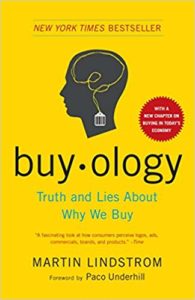
Martin Lindstrom begins “Buy*ology” with the idea that something is inherently not right — or rotten — in the field of advertising.
Traditional research methods of marketing aren’t working.
Why?
 Because they’re outdated and based on facts that are not actual facts.
In fact, Buy*ology is centered on the fact that neuromarketing is the marriage of marketing and science.
Lindstrom’s ideas cover how your brain subconsciously reacts to product placement, advertising, and the marketing of products became a threshold for how consumers see and intake the message and information of advertising in society.
So, What Is Buyology?
Buyology is the subconscious processing of thoughts, feelings, and desires that ultimately drives purchasing decisions. Put more simply, it’s the science of relating emotions to buying.
Early in the book, Lindstrom makes it clear that he believes in the power of neuromarketing. The more we know about why we fall prey to the tricks of advertising, the better we can prepare and defend ourselves against those tactics.
The Science Behind Buyology
Over the course of about three years, Lindstrom studied the power of unconscious advertising. Looking not at what we report that we like, but what our brains respond most favorably to, instead.
Using SST, which tracks brain waves, and fMRI, which tracks the activation of the brain (by seeing what’s working the most, which requires the most “fuel”), Lindstrom was able to study what our brains were most excited about, what they craved, what they wanted more than what we said we wanted.
One thing to know going in: the study behind this book was never published in a peer-reviewed journal, so outside scientists couldn’t check it. Dan Ariely and Gregory Berns reviewed the published neuromarketing research in 2010. They found growing evidence that brain scans can pick up things people don’t report, and thought the best use was testing product ideas before launch (Ariely and Berns, 2010).
Take, for example, cigarettes
Despite national and international bans on overt advertising, cigarettes have not died out. In fact, 10 million cigarettes are sold a minute around the globe.
Even though there are warnings depicting the gruesome side effects of smoking printed right on the packaging, the habit hasn’t gone away. Smoking rates have fallen since 1990, but in 2015 one in four men worldwide still smoked every day (Reitsma et al., 2017).
In fact, advertising bans have forced cigarette companies to come up with new and interesting ways in which to market to consumers, developing a system in which subliminal messaging creates connotations that smoking is still an okay thing to do.
Lindstrom’s own fMRI scans suggested that the cigarette warning labels didn’t deter smoking, and even lit up parts of the brain linked to craving.
Published research points the other way. A meta-analysis of 37 experiments with 33,613 participants found picture warnings beat text-only warnings on 12 of 17 measures (Noar et al., 2016). In a four-week trial with 2,149 smokers, 40% of those whose packs carried picture warnings tried to quit, against 34% of those with text-only warnings (Brewer et al., 2016).
The smoking study shows “how branding and marketing messages work on the human brain – how our truest selves react to stimuli at a level far deeper than conscious thought.”
Our Unconscious Minds
Unknown to many, our unconscious minds are a lot better at interpreting our behavior (and consequently, what we decide to buy). Much more than our conscious minds. So why, according to Lindstrom, do 8 in every 10 new U.S. products fail?
Key Point from Page 35: Neuromarketing isn’t about implanting ideas into people’s brains – it’s about discovering what’s already inside our brains. From there, consumers can be more aware of what’s being marketed to them, and make more informed decisions.
Currently, in advertising, there’s no originality — it’s too risky.
Think of car commercials – the same shiny car zips around the same tight turn, then spins up dust in the desert. You’re familiar with the commercial – you just don’t remember which automaker it comes from.
That, Lindstrom says, is the point — rather than creating something new, companies copy each other, creating visual branding of the overall product (a car) rather than the specific brand they’re trying to sell (like an Audi).
Product Placement
Lindstrom says 75% of scripted primetime shows feature product placement, placements advertisers have paid the big bucks for.
The issue, then, is the level of effectiveness of the product placement. Unless the item in question is integral to the plot of the show, we easily forget that it even existed.
Cristel Russell tested this with TV placements in 2002, and the answer was messier. How closely a brand tied into the plot mattered, and so did whether it was shown or mentioned out loud. Placements that fit the show made people like the brand more. Placements that felt out of place were remembered better but liked less (Russell, 2002).
An example of product placement done right is the Friends episode that centers around a Pottery Barn coffee table – the table was integral to the plot of the episode, and so we were all able to pick it out.
Pottery Barn says it donated the table and didn’t pay for the placement. Either way, it got years of free attention from reruns.
Unconscious Minds and Why We Buy
We want to be like the others — be popular, be perceived as attractive or funny — to be accepted. The concept of imitation is a huge deciding factor in why we buy the things we do.
Lindstrom thinks the future of advertising lies in mirror neurons, brain cells that fire both when we act and when we watch someone else act. That link to buying is his theory, and neuroscientists still argue over what mirror neurons do in humans (Hickok, 2009). We want to simulate what we see – we want to be like the person in the ad who is popular and well liked.
Subliminal Advertising
Subliminal advertising works chillingly well, Lindstrom argues.
The lab evidence is narrower than that. James Vicary’s famous claim that flashing messages in a cinema sold more Coke and popcorn was a hoax. In two experiments, flashing the brand name Lipton Ice too fast to see did nudge people toward choosing it, but only people who were already thirsty (Karremans, Stroebe and Claus, 2006).
Additionally, logos are next to worthless – we forget millions of logos, but we will remember ads that don’t predominately display the logo and instead create a scene and a feeling that evokes wanting.
The most successful ads create a situation in which we aren’t even conscious of the fact it was an advertisement in the first place.
Images associated with the act of “fitting in” or “being cool” are more powerful than the logos. They invoke colors, sounds, and other physical actions. Also, Lindstrom says, they trigger our mirror neurons, which want to imitate and mirror what we see and perceive.
So, we understand that we’re playing a giant game of monkey see monkey do. But why do we purchase the same thing over and over again?
What’s happening in our subconscious that makes us turn the air down before we go to sleep, or put our shoes on in the morning the same way every time (left, right, tie the laces, or whichever pattern you do)?
Creatures of Habit
Rituals, which are not entirely rational actions, and superstitions help us form emotional connections with brands and products.
There’s lab support for the ritual part. Kathleen Vohs and colleagues had people go through a short ritual before eating chocolate, and they rated it as more flavorful and more valuable than people who just ate it. Doing the ritual yourself worked better than watching someone else do it (Vohs et al., 2013).
Lindstrom details in chapter 5 how we wear the same jersey every time our favorite sports team is playing, or use the same face cream as our mothers did before us, and theirs before them. The superstition was formed in which an emotional connection was made in order to mirror the people we love, or the thing we love, or action that released happy chemicals into our brains.
And so over and over again, we do the ritual to release that chemical into our brains – which creates a loyalty to a brand.
Like religions, successful companies and successful brands have created a clear and very powerful sense of mission. They have tied longstanding rituals and superstitions to their products, in order to create a sense of wanting, needing, or chemical-releasing pleasure.
So Why Did I Buy the More Expensive Water?
As we grow, we develop bookmarks in our brain, which later affect how we pick one product over another. The release of the chemicals in our brains establishes connections, or somatic markers, that act as instant shortcuts, built from a lifetime of associations.
Lindstrom’s term is somatic markers, which he borrows from neuroscientist Antonio Damasio. The idea is that emotional signals from past experiences steer the choices we make later (Bechara and Damasio, 2005). It’s an influential theory, and other researchers have challenged parts of it (Dunn, Dalgleish and Lawrence, 2006).
Advertising sells to our senses, creating a link between the association from our brains to the product itself.
Lindstrom notes a fine line, however – too much stimulation creates oversaturation, which will lead to no memory retention of the product.
He notes that sounds and smells are more potent when it comes to recalling brands – and the evocation of the theme, that triggers those bookmarks, leads to more sales.
Sound can change what people buy without them noticing. In a UK supermarket, French wine outsold German wine 40 bottles to 12 on days with French music playing. On German music days, German wine outsold French 22 to 8. Only 6 of 44 shoppers surveyed said the music had affected their choice (North, Hargreaves and McKendrick, 1997).
Sensory branding, then, creates a correlation between being happy, and purchasing – which will lead us to purchase the more “eco friendly” option, even if it’s the exact same product, just in different packaging.
Two published brain-scan studies back up the “same product” point. When people knew which cup held Coke, the brand changed both their stated preference and their brain response (McClure et al., 2004). When 20 volunteers tasted the same wine labeled $90 and $10, they liked it more at $90, and a brain area linked to pleasure was more active too (Plassmann et al., 2008).
What We Like vs. What We Say We Like
Lindstrom takes chapter 9 to detail how what people claim to like and how they really feel are often polar opposites.
There is a peer-reviewed version of this idea. Berns and Moore scanned teenagers while they listened to songs by unknown artists, then tracked the songs’ sales for three years. The teens’ own ratings didn’t predict sales, but activity in a reward area of the brain did (Berns and Moore, 2012).
Lindstrom argues that we may say we don’t like the warnings on cigarette packages, but our brains crave the cigarettes more anyway. It seems exclusivity has become more engaging and brain-triggering than warnings against harm.
Think about Gmail
You could have said you loved Outlook (or, at the time, Hotmail) and that you were never going to leave. But when Gmail first launched, it launched as an invite-only platform.
That sense of exclusivity, of belonging to something that other people couldn’t have, overloaded the place in our brain that wanted it so bad. So while you might have said you liked Hotmail better, your subconscious brain wanted that piece of exclusivity that Gmail offered.
Sex in Advertising Doesn’t Sell (as well as we’ve been led to believe)
An interesting correlation that Lindstrom presents in chapter 10 is sex in advertising. The suggestion of sex is prevalent. However, data has shown that sex doesn’t sell anything. By all accounts, sexually suggestive marketing material actually blinds people to the product they’re trying to sell.
This is the part of the book with the best published support. Across 53 experiments with 8,489 people, sexual ads didn’t improve brand memory or buying intentions, and the brands in them were rated less favorably (Lull and Bushman, 2015). A second meta-analysis found people remembered sexy ads better but didn’t remember the brand any better (Wirtz, Sparks and Zimbres, 2018).
The converse of that is the implication of sexiness. Think of Brooke Shields in her Calvins, “nothing gets between me and my Calvins”, and you see the picture. Lindstrom credits our mirror neurons, which he says made us want to be just like her.
The Truth About Why We Buy
Throughout the book, Martin Lindstrom argues that humans are, by nature, poor reporters of their own actions. Visceral, visual pleasure ranks higher in terms of advertising tactics than anything else.
Marketers and advertisers have become better at targeting subconscious wishes and desires – and the truth about why we buy is due to the fact that they’re getting better and better about triggering the subconscious bookmarks in our minds that relate pleasurable experiences with their products.
Overall, Lindstrom paints a picture of advertising in a unique way in Buy*ology. The truth behind what motivates our purchasing decisions lies purely in the advertising company’s ability to relate their product to a need, a want, a desire.
Lindstrom’s data and use of neuromarketing suggest that by creating those connotations, why we buy what we buy really isn’t up to us – it’s up to advertisers.
Sources
- Ariely, D., & Berns, G. S. (2010). Neuromarketing: the hope and hype of neuroimaging in business. Nature Reviews Neuroscience, 11(4), 284–292. doi.org/10.1038/nrn2795
- Bechara, A., & Damasio, A. R. (2005). The somatic marker hypothesis: A neural theory of economic decision. Games and Economic Behavior, 52(2), 336–372. doi.org/10.1016/j.geb.2004.06.010
- Berns, G. S., & Moore, S. E. (2012). A neural predictor of cultural popularity. Journal of Consumer Psychology, 22(1), 154–160. doi.org/10.1016/j.jcps.2011.05.001
- Brewer, N. T., Hall, M. G., Noar, S. M., et al. (2016). Effect of pictorial cigarette pack warnings on changes in smoking behavior: A randomized clinical trial. JAMA Internal Medicine, 176(7), 905. doi.org/10.1001/jamainternmed.2016.2621
- Dunn, B. D., Dalgleish, T., & Lawrence, A. D. (2006). The somatic marker hypothesis: A critical evaluation. Neuroscience and Biobehavioral Reviews, 30(2), 239–271. doi.org/10.1016/j.neubiorev.2005.07.001
- Hickok, G. (2009). Eight problems for the mirror neuron theory of action understanding in monkeys and humans. Journal of Cognitive Neuroscience, 21(7), 1229–1243. doi.org/10.1162/jocn.2009.21189
- Karremans, J. C., Stroebe, W., & Claus, J. (2006). Beyond Vicary’s fantasies: The impact of subliminal priming and brand choice. Journal of Experimental Social Psychology, 42(6), 792–798. doi.org/10.1016/j.jesp.2005.12.002
- Lull, R. B., & Bushman, B. J. (2015). Do sex and violence sell? A meta-analytic review of the effects of sexual and violent media and ad content on memory, attitudes, and buying intentions. Psychological Bulletin, 141(5), 1022–1048. doi.org/10.1037/bul0000018
- McClure, S. M., Li, J., Tomlin, D., Cypert, K. S., Montague, L. M., & Montague, P. R. (2004). Neural correlates of behavioral preference for culturally familiar drinks. Neuron, 44(2), 379–387. doi.org/10.1016/j.neuron.2004.09.019
- Noar, S. M., Hall, M. G., Francis, D. B., Ribisl, K. M., Pepper, J. K., & Brewer, N. T. (2016). Pictorial cigarette pack warnings: A meta-analysis of experimental studies. Tobacco Control, 25(3), 341–354. doi.org/10.1136/tobaccocontrol-2014-051978
- North, A. C., Hargreaves, D. J., & McKendrick, J. (1997). In-store music affects product choice. Nature, 390, 132. doi.org/10.1038/36484
- Plassmann, H., O’Doherty, J., Shiv, B., & Rangel, A. (2008). Marketing actions can modulate neural representations of experienced pleasantness. PNAS, 105(3), 1050–1054. doi.org/10.1073/pnas.0706929105
- Reitsma, M. B., Fullman, N., Ng, M., et al. (2017). Smoking prevalence and attributable disease burden in 195 countries and territories, 1990–2015: A systematic analysis from the Global Burden of Disease Study 2015. The Lancet, 389(10082), 1885–1906. doi.org/10.1016/S0140-6736(17)30819-X
- Russell, C. A. (2002). Investigating the effectiveness of product placements in television shows: The role of modality and plot connection congruence on brand memory and attitude. Journal of Consumer Research, 29(3), 306–318. doi.org/10.1086/344432
- Vohs, K. D., Wang, Y., Gino, F., & Norton, M. I. (2013). Rituals enhance consumption. Psychological Science, 24(9), 1714–1721. doi.org/10.1177/0956797613478949
- Wirtz, J. G., Sparks, J. V., & Zimbres, T. M. (2018). The effect of exposure to sexual appeals in advertisements on memory, attitude, and purchase intention: A meta-analytic review. International Journal of Advertising, 37(2), 168–198. doi.org/10.1080/02650487.2017.1334996