
“Words that Work” by Dr. Frank Luntz can be read by just about anyone, from those who identify themselves as an everyday reader, through CEOs or politicians, marketing professionals or educators.
This book digs into the way we use words, and it should resonate with any person from any background.
But it’s especially useful for copywriters, marketers, and entrepreneurs.
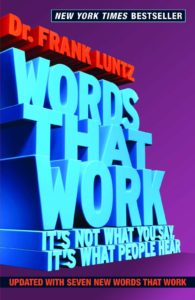
In the introduction, Luntz remarks that “the best products and the best marketing campaigns involve ideas, not just packaging.”
Throughout the text, Luntz iterates over and over again it’s not what you say, it’s what people hear.
It’s more important to speak how readers will interpret it, rather than speaking in such a way that makes you happy.
As Luntz suggested, you should remove yourself from your own perceptions and thoughts for a moment —attempting to step into the shoes of the person to whom you are speaking. Is your message going to be interpreted the same from their point of view as yours?
Amos Tversky and Daniel Kahneman showed how far this goes. When a plan for a disease outbreak was described as saving 200 of 600 people, 72% of people chose it. When the same plan was described as 400 of the 600 dying, 22% chose it (Tversky and Kahneman, 1981).
Lesson 1: Words Matter
Barack Obama, who arguably had some of the least political experience in the field, took a sweeping victory at the polls. The book came out before that election, so this part is my reading rather than a claim from the book. I don’t think “change”, or any of the other words bandied about during the historic 2008 presidential election, had the most impact.
What so many Americans were searching for was hope — dreams and aspirations, and a willingness to do better and to be better.
America had optimism and wanted to believe again in the political system.
The words that inspired hope were, I think, a big part of what drew new voters to the polls. Words that gave hope, that gave purpose, were what made a difference. And words can make a difference in anything, whether that’s your everyday speech or a politician’s.
Survey researchers have measured this for decades. Tom Smith found that questions about spending on “welfare” got much more negative and less generous answers than the same questions about spending on the “poor”. People heard waste and bureaucracy in the first word and not in the second (Smith, 1987).
7 Important Words
- Consequences: What will personalize, what will dramatize the result of your actions?
- Impact: How can you utilize this word to make your listeners feel as if there will be a measurable difference?
- Diplomacy: See below
- Dialogue: These two words – diplomacy and dialogue – work together in tandem to establish a state of being. Are you bringing a sense of peace to the listener’s mind? Use them to ease tension, to establish a sense of normalcy or goodwill.
- Reliability: There are many people who believe that the reliability of something is more important than any other factor – look at how car companies like Toyota or Chevy have branded themselves with longevity and reliability.
- Mission: Your listener wants to know the how, what and why. As Luntz details in the “Words Matter” fore-section, you should explain what you do, why you do it and above all, why you care – and why should the listener care.
- Commitment: What kind of personal mission are you going to undertake? Use commitment in the terms of “personal commitment” and explain what your particular cause or effort is, and how you promise to see it through.
While the previous seven words are integral components of any type of speech you are compiling, there are words that must be used with great caution and in a relatable, sensible manner.
However — if you can wield them in such a way as to not be overbearing, then you can revel in their power.
Powerful Words to Be Careful With
- Authentic & Genuine: Americans tend to seek out people who exemplify these traits, and that is not limited to political players – indeed, even corporations are being held to a higher standard of authenticity.
- Corporate Social Responsibility: Corporate authenticity and a deeper commitment to the community as a whole is now demanded, and should be carried out in such a way that it’s more than a standalone effort, but rather an integral piece of the company culture and strategy. Include words like proactive, track record, cleaner, safer, healthier and sustainable.
The discipline that your words portray matters. The importance of being able to grab and maintain the attention of the listener is paramount when it comes to clarity and what is understood versus what you said.
Lesson 2: Ten Rules For Effective Language
No matter what you’re doing (Luntz describes in Chapters 10-12 words that anyone could use, not just politicians and CEOs), the way you say it matters. How you speak to other people matters.
No matter how well-spoken you believe yourself to be, there are always places to improve.
Ten Rules for Successful Communication
- Simplicity – use easy to comprehend words
- Brevity – get to your point, quickly
- Credibility – be credible in every word or statement you make
- Consistency – iterate the same message, over and over
- Novelty – explain or detail what is new (breed excitement)
- Sound – the texture of your words, how you sound saying them, matters
- Aspirational – be and speak in an aspirational manner (Luntz leans on the old line that people forget what you say but not how you made them feel, which is usually credited to Carl W. Buehner. In his words, “Messages need to say what people want to hear.”)
- Imagery – visualization and imagination are incredibly powerful, use them frequently
- Question – question everything, ask questions and provide the solution
- Context – give background to why you’re here and why people should bother to listen to you – give relevance to the situation
The consistency rule works on anything you repeat, true or false. People rated how true a set of trivia statements were three times, two weeks apart. The statements that were repeated got rated as more likely to be true each time, and the new ones didn’t move (Hasher, Goldstein and Toppino, 1977). So make sure what you repeat is true.
Novelty has a long research history too. Hedwig von Restorff found in 1933 that the one item in a list that differs from the rest is the one people remember best (von Restorff, 1933).
Sound changes whether people believe you. Readers judged “What sobriety conceals, alcohol reveals” more accurate than “What sobriety conceals, alcohol unmasks”. The authors’ explanation is that rhyme makes a line easier to process, and people mistake that ease for truth (McGlone and Tofighbakhsh, 2000).
Imagery can change behavior as well as opinion. Homeowners who were asked to imagine themselves using cable TV were more likely to sign up when someone asked them to weeks later (Gregory, Cialdini and Carpenter, 1982).
Questions make people think harder about what you say. With readers who didn’t care much about the topic, rhetorical questions made strong arguments more persuasive and weak arguments less persuasive. With readers who already cared, the questions got in the way (Petty, Cacioppo and Heesacker, 1981). Only ask if your answer holds up.
Context comes first for a reason. John Bransford and Marcia Johnson gave people a vague passage to read. People told the topic beforehand understood and remembered it better, and people told the same topic afterward got no benefit (Bransford and Johnson, 1972).
Remember: “It’s not what you say, it’s what people hear . . . and see.”
Some “Don’ts” in Communication
Rules 2 to 6 below are George Orwell’s, from his 1946 essay “Politics and the English Language”. His sixth rule is worth keeping too: “Break any of these rules sooner than say anything outright barbarous.”
- Don’t assume that people know what you do, or are even aware of you
- Never use a metaphor, simile or other figure of speech which you are used to seeing in print.
- Never use a long word where a short one will do.
- If it is possible to cut a word out, always cut it out.
- Never use the passive where you can use the active.
- Never use a foreign phrase, a scientific word or a jargon word if you can think of an everyday English equivalent.
Long words don’t make you sound smarter either. Daniel Oppenheimer found that people rated the writers of needlessly complex essays as less intelligent than the writers of plain versions, whatever the quality of the original essay (Oppenheimer, 2006).
Lesson 3: Become Successful at Communicating
In “Words That Work” Dr. Luntz gives many examples of words that can elevate your idea – that can give meaning or focus to your speech or text.
Utilize some of these important words to be successful:
- Inspire, Imagine
- Healthier, Cleaner, Safer
- Comprehensive / Long-term
- Accountability
- Solutions
- Hassle-Free, No Worries
- You’re in control / You Decide
- Efficient & Efficiency
- Important R’s:
- Reliable
- Results
- Respect
- Renew
- Revitalize
- Rejuvenate
- Restore
- Rekindle
- Reinvent
- Simple
- Consequences
- Bold Action / Getting it Done
- Peace of Mind
- Independent Certification
- Mission, Commitment
- Cutting Edge
- Common Sense
- Convenience
- Exceeding Expectations
“You decide” has evidence behind it. A meta-analysis of 42 studies found that telling people they’re free to say no made them more likely to say yes in most settings. The effect was weaker when people didn’t have to decide on the spot (Carpenter, 2013).
To bring it all home, remember: It’s not what you say, it’s what people hear.
Are would-be buyers hearing your message, your hope, your aspirations for something better?
Or are they hearing a speech full of jargon, full of nonsense, full of promises they know you have no intentions of keeping?
Are you shouting German at someone who only speaks French, or are you meeting in the middle?
You need to find the common ground that you share.
Sources
- Bransford, J. D., & Johnson, M. K. (1972). Contextual prerequisites for understanding: Some investigations of comprehension and recall. Journal of Verbal Learning and Verbal Behavior, 11(6), 717–726. doi.org/10.1016/S0022-5371(72)80006-9
- Carpenter, C. J. (2013). A meta-analysis of the effectiveness of the “but you are free” compliance-gaining technique. Communication Studies, 64(1), 6–17. doi.org/10.1080/10510974.2012.727941
- Gregory, W. L., Cialdini, R. B., & Carpenter, K. M. (1982). Self-relevant scenarios as mediators of likelihood estimates and compliance: Does imagining make it so? Journal of Personality and Social Psychology, 43(1), 89–99. doi.org/10.1037/0022-3514.43.1.89
- Hasher, L., Goldstein, D., & Toppino, T. (1977). Frequency and the conference of referential validity. Journal of Verbal Learning and Verbal Behavior, 16(1), 107–112. doi.org/10.1016/S0022-5371(77)80012-1
- McGlone, M. S., & Tofighbakhsh, J. (2000). Birds of a feather flock conjointly (?): Rhyme as reason in aphorisms. Psychological Science, 11(5), 424–428. doi.org/10.1111/1467-9280.00282
- Oppenheimer, D. M. (2006). Consequences of erudite vernacular utilized irrespective of necessity: Problems with using long words needlessly. Applied Cognitive Psychology, 20(2), 139–156. doi.org/10.1002/acp.1178
- Petty, R. E., Cacioppo, J. T., & Heesacker, M. (1981). Effects of rhetorical questions on persuasion: A cognitive response analysis. Journal of Personality and Social Psychology, 40(3), 432–440. doi.org/10.1037/0022-3514.40.3.432
- Smith, T. W. (1987). That which we call welfare by any other name would smell sweeter: An analysis of the impact of question wording on response patterns. Public Opinion Quarterly, 51(1), 75–83. doi.org/10.1086/269015
- Tversky, A., & Kahneman, D. (1981). The framing of decisions and the psychology of choice. Science, 211(4481), 453–458. doi.org/10.1126/science.7455683
- von Restorff, H. (1933). Über die Wirkung von Bereichsbildungen im Spurenfeld. Psychologische Forschung, 18(1), 299–342. doi.org/10.1007/BF02409636