Your email list is a broadcast channel. Right? You send a weekly newsletter, maybe a promotion, and wonder why open rates are tanking.
That’s lazy. It’s predictable. And it’s a massive opportunity for you to dominate.
While your competitors are stuck in 2020, you and I are going to build an intelligent, autonomous system that runs 24/7. A system that turns subscribers into high-value customers. Since 2016, I’ve deployed machine learning in businesses to create these kinds of unfair advantages. This isn’t about minor tweaks; it’s about fundamental email marketing automation strategies that build a moat around your business.
This isn’t about sending more email. It’s about sending the right email to the right person at the exact moment they need it. Automatically.
This article gives you the playbook. Eight distinct, powerful strategies. For each one, I’m providing the what, the why, and how to implement it. This is the operational detail missing from most high-level advice. To truly outmaneuver your rivals, a deeper dive into these 10 essential B2B marketing automation strategies provides critical context.
Our goal isn’t just to improve your email marketing. It’s to build a scalable, automated engine that creates a tangible competitive advantage. Let’s get to work.
1. Behavioral Trigger-Based Email Sequences
Stop sending emails on your schedule. Your customers don’t care about your Tuesday newsletter. They care about what’s relevant to them right now.
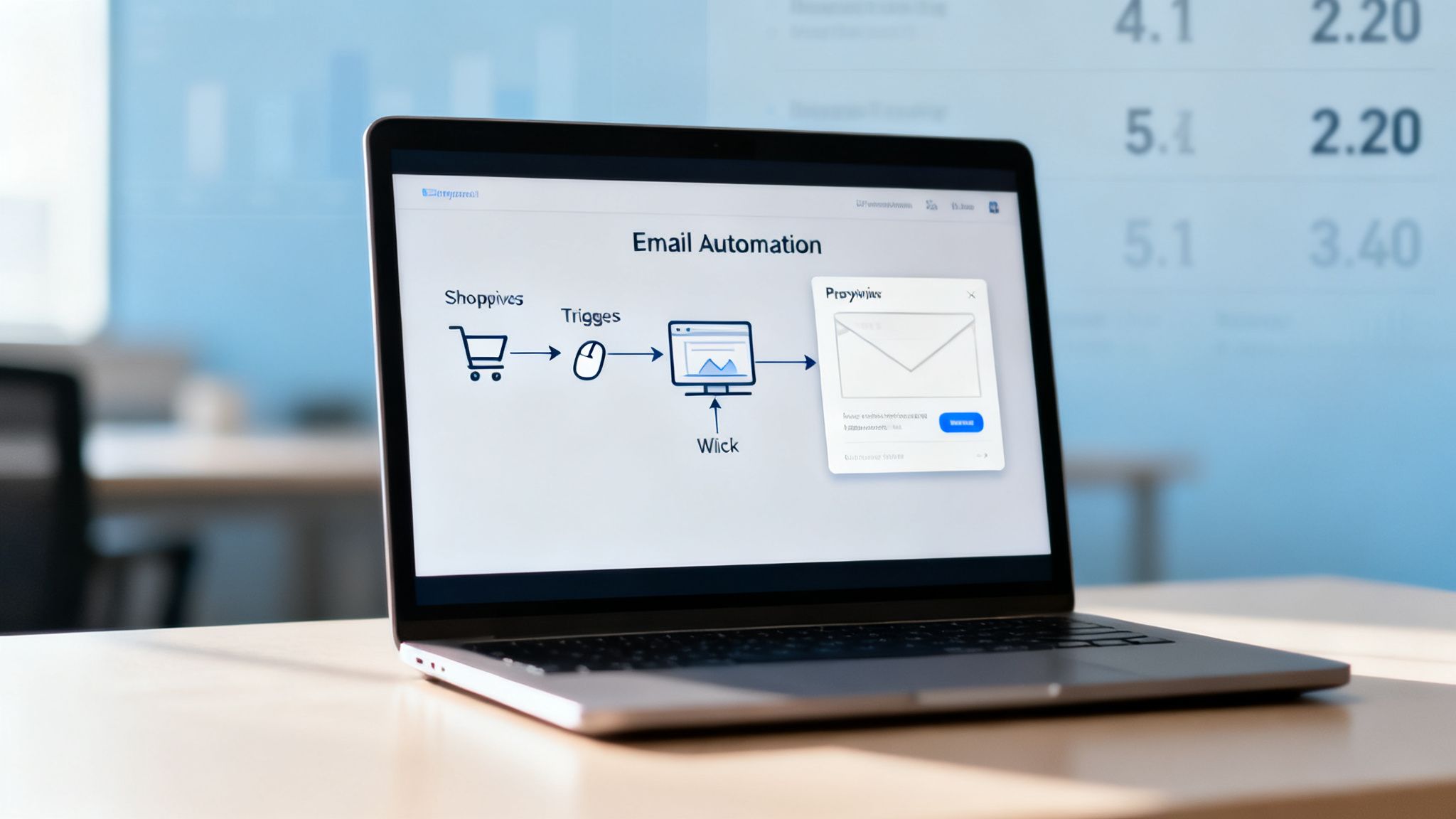
Behavioral trigger-based sequences are your most powerful weapon here. Instead of a generic blast, you’re reacting instantly to a specific user action. This is one of the most profitable email marketing automation strategies you can deploy.
Someone visits a product page three times in a day? They get an email about it. They abandon a cart? The sequence kicks in. You’re not guessing. You’re responding to their demonstrated interest, giving you a massive edge.
Why It Works
Relevance drives revenue. Simple as that. Behavioral triggers ensure your message arrives at the peak of your customer’s interest. It’s the difference between a cold call and a warm lead.
While your competitors send generic “weekly updates,” you’re having a 1-to-1 conversation based on action. A well-timed abandoned cart email alone can boost sales by 10-15%.
How to Implement It
- Map Key Actions: Identify high-value user behaviors. Go beyond cart abandonment. Think repeat views on a pricing page, video completions, or category browsing.
- Define the Trigger: In your automation tool, set up a trigger for that behavior. Example: “Trigger when a user views URL containing ‘/pricing’ more than twice in 24 hours.”
- Craft the Content: Create a short, helpful email sequence. Acknowledge their action. For a pricing page visit, send a case study or a feature comparison guide.
- Set Time Delays: Don’t be creepy. A 1-2 hour delay feels helpful. A 1-minute delay feels invasive. Test it.
- Use AI for Personalization: Dynamically populate product recommendations in these emails based on the specific items a user viewed. Incredibly personal and effective.
2. Predictive Send Time Optimization
Your perfect email is useless if it lands in a buried inbox. Sending your entire list an email at 10 AM on Tuesday is a one-size-fits-all approach. It’s obsolete.
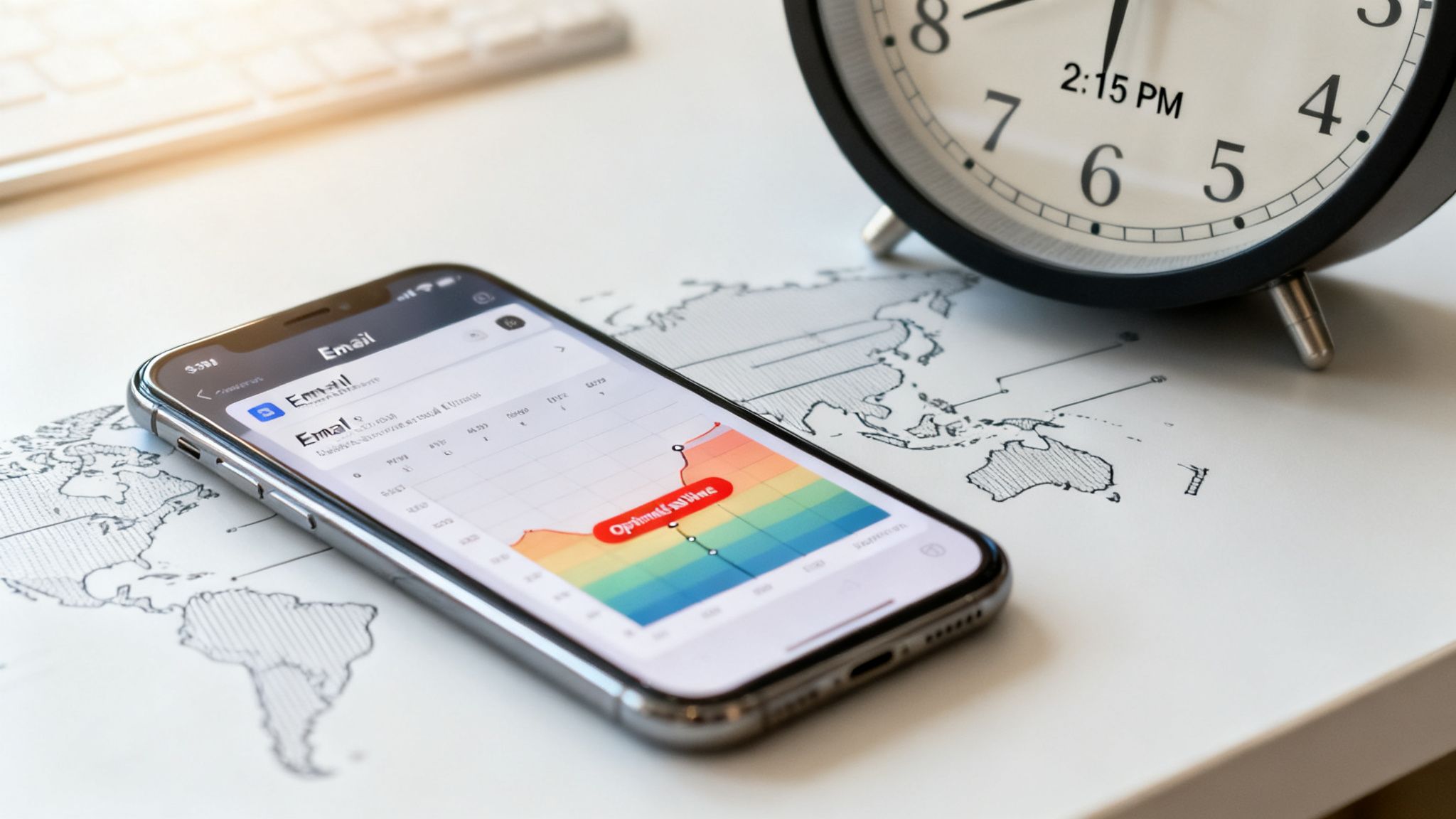
Predictive send time optimization uses AI to fix this. It treats each subscriber as an individual, delivering your message at the precise moment they are most likely to open it.
The algorithm analyzes each person’s historical engagement patterns to determine the optimal delivery window. Instead of one send time, your emails go out staggered over 24 hours, hitting the top of each inbox. It’s one of the easiest email marketing automation strategies for an immediate lift.
Why It Works
Attention is the only currency that matters in the inbox. Aligning your send time with individual habits dramatically increases the probability of your email being seen.
This isn’t a marginal gain. It can boost open rates by several percentage points, which translates directly to more clicks and more revenue. While your competitors debate the “best” day to send, you’re operating on a personalized schedule.
How to Implement It
- Gather Sufficient Data: AI needs data. You’ll need a history of engagement for your subscribers. If your list is new, focus on building this data first. Don’t use this on a cold list.
- Activate the Feature: In your email platform (like Klaviyo or HubSpot), enable “Send Time Optimization” or “Predictive Sending.” The tool handles the analysis.
- Start with a Segment: Don’t roll it out to your entire list at once. Test it on a large, engaged segment. Monitor performance for 4-6 weeks to establish a new baseline.
- Analyze the Results: Compare the optimized campaign against a control group sent at a fixed time. Look for a statistically significant lift. The model gets smarter over time.
- Integrate with Other Automations: This is where you get a compounding effect. An abandoned cart email sent when a user is most likely to be on their phone is far more effective. For more, explore various AI marketing automation tools that facilitate this.
3. Dynamic Content Personalization & AI-Generated Copy
Generic email is dead. Sending the same message to everyone is like yelling into a crowded room hoping someone listens. The game is 1-to-1 communication at scale.
Dynamic content and AI-generated copy are essential email marketing automation strategies for this. You’re not just inserting a first name. You’re building entire emails customized in real-time for each user.
This approach uses customer data and AI to swap out content blocks, images, and offers based on who is opening the email. A VIP customer sees a loyalty offer. A new subscriber sees a welcome discount. You and I can leverage AI to write the copy for these variations, achieving personalization without manual effort.
Why It Works
Hyper-personalization drives conversions. Period. When an email reflects a customer’s purchase history or browsing behavior, it feels like a helpful service. Not marketing.
This is how Amazon and Netflix dominate. They make you feel understood. Using AI to craft this copy gives you this level of personalization with unprecedented speed. A serious competitive advantage.
How to Implement It
- Segment Your Audience: Go beyond demographics. Create segments based on purchase history, lifetime value (LTV), browsing behavior, and engagement.
- Define Dynamic Content Blocks: Identify sections of your email that can be customized. A hero banner, product recommendations, or a testimonial block.
- Use AI to Generate Copy Variations: Feed your brand voice and segment data into a tool like ChatGPT or Claude. Prompt it to create copy for each segment. Example: “Write a 2-sentence CTA for our new shoe collection, tailored for a high-LTV customer who previously bought running gear.”
- Set Up Conditional Logic: In your email platform, use conditional rules to display the correct content. The rule looks like: “IF subscriber is in ‘VIP Customer’ segment, THEN show ‘VIP Offer’ block.”
- Test and Refine: Always A/B test your AI-generated copy against a control. Use the performance data to refine your prompts and improve the AI’s output over time.
4. Lead Scoring & Progressive Nurture Automation
Not all leads are created equal. Yet most marketing automation treats them the same. Blasting your list with a generic nurture sequence is a waste of resources.
A lead scoring system is one of the most vital email marketing automation strategies. It’s a workflow that assigns points to leads based on their engagement: email opens, content downloads, pricing page visits.
As a lead’s score increases, the automation intelligently shifts the messaging from educational to sales-focused. This creates a perfectly timed handoff to your sales team.
Why It Works
This strategy separates the window shoppers from the ready-to-buy prospects. It ensures your sales team spends their time only on qualified, engaged leads, which shortens the sales cycle and boosts close rates.
Instead of guessing, you’re using a lead’s own behavior to tell you exactly when to escalate the conversation. It creates a seamless bridge between marketing and sales.
How to Implement It
- Identify Key Signals: Define 5-7 high-intent actions. This could be downloading a case study, attending a webinar, or visiting your pricing page multiple times.
- Assign Point Values: Assign points to each action. A pricing page visit might be worth 10 points; an email open is worth 1. Base this on historical data, not just assumptions. To help, learn the critical questions for lead nurturing.
- Set Score Thresholds: In your automation tool, define the scores that trigger a status change. 0-20 points is a cold lead. 21-50 is a Marketing Qualified Lead (MQL). 51+ is a Sales Qualified Lead (SQL), which alerts sales.
- Create Nurture Paths: Build distinct email sequences for each threshold. An MQL gets a relevant case study. An SQL gets an email prompting them to book a demo.
- Implement Negative Scoring: Just as important. Deduct points for disengagement. An unsubscribe or a long period of inactivity should lower a lead’s score, keeping your pipeline clean.
5. Segmentation & Audience Intelligence Automation
Sending the same email to your entire list is a guaranteed way to land in spam. The “batch and blast” era is over. The real power is treating different customers differently.
This is where Segmentation & Audience Intelligence Automation becomes non-negotiable. This isn’t about manually creating static lists. It’s about using data to build dynamic, self-updating audiences that get the right message. Every time.
Your customer data is a goldmine. This strategy unifies that data to automatically group users based on behavior, purchase history, and predictive analytics like churn risk. A “high-value VIP” segment gets exclusive offers, while a “potential churn” segment gets a re-engagement campaign. All without you lifting a finger.
Why It Works
Precision targeting multiplies your ROI. By sending highly relevant content to pre-defined segments, you build a stronger customer relationship. People pay attention when you understand their needs.
This level of personalization makes your brand feel like a trusted advisor, leading to higher engagement and increased customer lifetime value. It’s how you dominate an inbox filled with generic noise.
How to Implement It
- Unify Your Data: Integrate your key data sources (Shopify, CRM, website analytics) into a central platform like Klaviyo or a CDP. Create a single source of truth for customer data.
- Define Core Segments: Start with high-impact, behavior-based segments. Think “VIPs” (high LTV), “Recent Buyers,” “Window Shoppers,” and “At-Risk.” You can learn more about these powerful segmentation methods to create your own funnel tactics.
- Build Dynamic Lists: Use your email tool’s “smart list” feature. Set the rules for each segment. A VIP list might automatically add anyone whose total spend crosses $500.
- Create Segment-Specific Automations: Don’t just segment; act on it. Build unique welcome series, re-engagement flows, and promotional campaigns tailored to each audience.
- Use AI for Predictive Analytics: Leverage AI tools within platforms like Klaviyo to create predictive segments. Automatically identify customers likely to purchase again, have a high predicted LTV, or are at risk of churning.
6. Win-Back & Re-engagement Automation Campaigns
Acquiring a new customer costs 5 to 25 times more than keeping one. So why are you letting your customers slip away without a fight? A huge chunk of your email list is likely inactive.
Automated win-back campaigns are a crucial part of your email marketing automation strategies. This isn’t a desperate, one-off “We miss you!” email. It’s a systematic process to identify lapsed customers and re-ignite their interest before they’re gone for good.
You’re using automation to spot the early signs of disengagement. Then, you intervene with a series of personalized, value-driven messages designed to remind them why they chose you in the first place.
Why It Works
Reactivating a customer is pure profit. These campaigns directly boost your customer lifetime value (CLV) and reduce churn. While competitors are on an expensive acquisition treadmill, you’re turning a leaky bucket into a fortified reservoir of revenue.
It works because you’re leveraging past relationships and data. That’s far more powerful than starting from scratch.
How to Implement It
- Define “Inactive”: Decide what inactivity means for your business. For e-commerce, it might be 90 days without a purchase. For a SaaS tool, it could be 30 days without logging in. This is your trigger.
- Segment Your Lapsed Users: Don’t treat all inactive users the same. A high-value customer who spent thousands deserves a different sequence than a one-time buyer.
- Build the Automation: Create a workflow that triggers when a user enters your “inactive” segment. A 3-4 email sequence over a few weeks works well. Start with a gentle reminder, followed by a special offer, and end with a final “goodbye” email.
- Lead with Value, Not Discounts: Your first email shouldn’t be a coupon. Ask for feedback. Remind them of your brand’s value or showcase what’s new. Make it about them, not you.
- Use AI to Predict Churn: The next level. Use AI models to predict which customers are at risk of churning before they hit your inactive threshold. This allows you to launch a preventative campaign, which is even more effective.
7. Customer Journey Mapping & Multi-Channel Automation Orchestration
Your email list isn’t just an email list. It’s people interacting with your brand on SMS, social media, and your website. Treating email as an isolated silo creates a disjointed customer experience.
Stop thinking in channels. Start thinking in journeys.
This strategy involves mapping the entire customer lifecycle and orchestrating automated messages across all channels. A customer who sees a Facebook ad, gets a follow-up email, and then receives an SMS alert about their order experiences one seamless, intelligent conversation.
Why It Works
Consistency creates trust. Trust drives lifetime value. When your messaging is coordinated, you prevent channel conflict, like sending a 20% off email to someone who just bought at full price.
This moves beyond simple email marketing automation strategies and into true customer experience orchestration. While your competition argues about open rates, you’re building an integrated ecosystem that locks customers in.
How to Implement It
- Visually Map the Journey: Grab a whiteboard. Map out the key stages a customer goes through: Awareness, Consideration, Purchase, Retention, Advocacy. Identify key touchpoints.
- Define Channel Roles: Assign a primary role to each channel. Email is for storytelling. SMS is for urgent alerts. Push notifications are for timely reminders.
- Choose an Orchestration Platform: This requires a tool built for it. Look at platforms like HubSpot, Iterable, or Braze that have visual journey builders.
- Implement Unified Tracking: Use consistent UTM parameters and event tracking across all channels to get a single view of a customer’s behavior. This data fuels the automation.
- Start Small and Scale: Don’t try to orchestrate everything at once. Start by integrating email and SMS for your welcome series and cart abandonment. Then layer in other channels.
8. Email Testing Automation & Multivariate Experimentation
Stop guessing what works. Start knowing. Relying on gut feelings to optimize your emails leaves money on the table. You need a system that continuously learns and improves on its own.
This is where you move from basic A/B testing to a fully automated optimization engine. Instead of manually setting up a test, you build workflows that do it all for you.
The system automatically tests variables, determines a statistically significant winner based on your goals, and rolls out the winning version to the rest of your audience. You’re building a self-optimizing email program.
Why It Works
Continuous, automated optimization compounds your gains. A 2% lift in open rates from one test seems small, but when your system is running tests every week, those small wins add up to a huge competitive advantage.
While others are debating subject lines in a meeting, your system is already deploying the one proven to get more opens. It removes human bias and guesswork.
How to Implement It
- Start with High-Impact Variables: Focus on what matters: the subject line, the call-to-action (CTA) button copy, and send time.
- Use Your Platform’s Automation: Tools like HubSpot or Klaviyo have built-in A/B testing features that automate winner selection. Configure the test to send variations to a small percentage of your list (e.g., 20%), wait for a set period, and automatically send the winning version to the remaining 80%.
- Level Up with Multiple Variables: Once you’re comfortable, explore more advanced methods. To optimize campaigns, understanding how to conduct multivariate testing provides deeper insights than simple A/B tests by showing how different elements interact.
- Create a Testing Repository: Document everything. Track the hypothesis, variables, results, and insights. This prevents re-running old tests and builds a library of what works for your audience.
- Use AI for Hypothesis Generation: Stuck on what to test? Use a prompt like: “Given an email with the subject line ‘[Your Subject],’ generate 5 alternative subject lines to A/B test. Focus on urgency, curiosity, and benefit.”
9. Account-Based Marketing (ABM) Email Automation
Broadcasting to thousands of lukewarm leads is a waste of resources. What if you could treat your 100 most valuable potential customers like VIPs? That’s Account-Based Marketing (ABM) email automation.
This strategy flips the traditional funnel. Instead of casting a wide net for individual leads, you focus on specific, high-value accounts.
You’re not just emailing a single contact; you’re orchestrating a conversation with multiple stakeholders within that organization. By using firmographic data and intent signals, you can coordinate messaging that speaks directly to the unique needs and roles of each person, dramatically increasing your chances of closing a complex B2B deal.
Why It Works
Relevance and coordination win big deals. While competitors send generic content to one contact, you’re building consensus across an entire buying committee.
This approach positions you as a strategic partner, not just another vendor. For high-ticket B2B sales, this can slash sales cycles and significantly increase deal size.
How to Implement It
- Define Your Ideal Customer Profile (ICP): Don’t skip this. Use data to identify the firmographic (industry, company size) and technographic (what software they use) traits of your best customers.
- Build Your Target Account List: Start small. Identify 50-100 companies that perfectly match your ICP. Tools like 6sense or Terminus can find accounts actively researching solutions like yours.
- Map Key Personas: Within each account, who matters? The Economic Buyer, the Champion, the Technical User. You’ll need different messaging for each.
- Create Persona-Based Content Tracks: Develop email sequences tailored to each persona’s pain points. A CFO gets an ROI-focused email. An IT Director gets a message about security.
- Automate and Coordinate: In a tool like Salesforce Account Engagement, set up workflows that trigger these persona-based sequences. Crucially, coordinate the timing so you’re not bombarding the account.
10. Lifecycle Email Automation & Smart Nurture Workflows
Are you sending the same message to a new lead and a loyal customer? You’re leaving money on the table. Your customers are on a journey, and your emails must reflect where they are.
Lifecycle email automation is about creating a cohesive narrative that guides users from awareness to advocacy.
This strategy moves beyond single triggers to a holistic view of the customer relationship. It uses customer stage data—new subscriber, first-time buyer, VIP—to trigger workflows designed to move them to the next stage. Slack’s onboarding sequence does this perfectly, turning new users into power users.
Why It Works
This is one of the email marketing automation strategies that creates long-term value. By aligning your messaging with the customer’s current stage, you increase relevance and reduce churn.
A new subscriber needs education, not a hard sell. A repeat customer might appreciate early access. This approach builds relationships, increases lifetime value (LTV), and turns customers into brand evangelists.
How to Implement It
- Define Your Lifecycle Stages: Map out the key milestones. Common stages: Subscriber, Lead, MQL, First-Time Customer, Repeat Customer, and Advocate/VIP.
- Set Progression Triggers: What action moves someone to the next stage? A “First-Time Customer” becomes a “Repeat Customer” after their second purchase. Define these triggers clearly.
- Map Content to Each Stage: Create a content plan for each stage. Onboarding emails for new customers. Re-engagement campaigns for at-risk users. Exclusive offers for VIPs.
- Build Stage-Specific Workflows: In your automation tool, build a separate workflow for each stage. When a user enters a stage, they are added to that workflow and removed from the previous one.
- Monitor Progression Rates: Track how effectively you’re moving customers between stages. Identify bottlenecks and optimize the content in that stage to improve flow.
Email Marketing Automation Strategies — 10-Point Comparison
| Automation Type | Implementation Complexity | Resource Requirements | Expected Outcomes | Ideal Use Cases | Key Advantages |
|---|---|---|---|---|---|
| Behavioral Trigger-Based Email Sequences | High — requires real-time tracking and conditional workflows | Tracking infra, analytics integration, developer & optimization time | Higher engagement and conversions; clear action-tied ROI | E‑commerce cart recovery, SaaS onboarding, behavior-driven follow-ups | Real-time relevance, scalable automation, action-specific messaging |
| Predictive Send Time Optimization | Medium — ML modelling + scheduling integration | Substantial historical open/engagement data, ML tooling, compute | Improved open rates (typical uplift), reduced unsubscribes | High-volume or global audiences, time-sensitive campaigns | Personalized send timing, timezone/device aware, automated scheduling |
| Dynamic Content Personalization & AI-Generated Copy | High — LLM integration and dynamic templates | Clean CRM data, AI models, content QA and review workflows | Higher CTRs and conversions; 1:1 personalization at scale | Retail, media, subscription services with product catalogs | Scales personalized copy, consistent brand voice, faster creative output |
| Lead Scoring & Progressive Nurture Automation | Medium–High — scoring models + conditional cadence | CRM integration, scoring rules, sales/marketing alignment | Better lead prioritization, shorter sales cycles, higher conversion rates | B2B SaaS, sales-driven organizations, MQL→SQL processes | Efficient nurturing, sales prioritization, clearer lead quality visibility |
| Segmentation & Audience Intelligence Automation | Medium — data unification and AI segmentation | First‑party data, CDP/CRM, ML clustering tools | More targeted campaigns, reduced email waste, discovery of high-value clusters | Businesses with diverse audiences, lifecycle and RFM-driven strategies | Real-time segments, automated audience discovery, scalable targeting |
| Win-Back & Re-engagement Automation Campaigns | Low–Medium — sequence design and churn detection | Churn models, segmented creative, re-engagement offers | Recover lapsed customers, improved retention ROI, better list hygiene | Subscription services, ecommerce with lapsed buyers | Cost-effective revenue recovery, feedback collection, deliverability gains |
| Customer Journey Mapping & Multi-Channel Orchestration | Very high — cross-channel mapping and orchestration | Multiple platform integrations, unified data layer, orchestration tools | Cohesive multi-touch experiences, optimized channel mix, less fatigue | Enterprise omnichannel programs, cross-channel retention and acquisition | Unified journeys, frequency capping, cross-channel attribution |
| Email Testing Automation & Multivariate Experimentation | Medium — statistical setup and experiment management | Sufficient send volume, testing framework, analyst oversight | Continuous performance gains, evidence-based optimizations | High-volume senders, teams focused on conversion optimization | Removes guesswork, accelerates learnings, iterative uplift compounding |
| Account-Based Marketing (ABM) Email Automation | High — account-level workflows and multi-stakeholder sequencing | Intent/firmographic data, custom content, tight sales coordination | Higher close rates for target accounts, shorter enterprise sales cycles | B2B enterprise and mid-market targeted account plays | Account-level personalization, aligned sales-marketing workflows, improved ROI |
| Lifecycle Email Automation & Smart Nurture Workflows | Medium — stage definitions and progression logic | Lifecycle data, content library, CRM/product integrations | Increased LTV, higher retention, predictable stage progression | Onboarding, renewal, upsell/cross-sell programs across industries | Stage-appropriate messaging, consistent customer experience, predictable growth |
Stop Campaigning. Start Building Systems.
We’ve just walked through ten powerful email marketing automation strategies. But if your takeaway is a list of new campaign ideas, you’ve missed the point.
This isn’t about a slightly better win-back campaign. It’s about a fundamental shift in how you think.
The old way is launching campaigns. It’s manual, episodic, and temporary. The new way is building systems. These are automated, always-on engines that acquire, nurture, and retain customers with minimal human intervention.
Each strategy we covered is a component of a larger machine. Your competitors are still manually batching and blasting emails. You, on the other hand, can build an intelligent system that responds to individual customer behavior in real-time. 24/7. That is a staggering competitive advantage.
From Tactics to an Autonomous Engine
The true power of these email marketing automation strategies emerges when you stop seeing them as isolated tactics and start architecting a cohesive ecosystem.
Imagine this:
- A new lead enters. Lead Scoring immediately qualifies them.
- Lifecycle Automation places them into the correct initial nurture sequence.
- As they interact, Behavioral Triggers fire off, sending hyper-relevant content.
- Dynamic Content ensures every email feels 1-to-1, with AI-generated copy that resonates.
- If engagement wanes, your Win-Back Automation kicks in, pulling them back before they’re lost.
This isn’t a campaign. It’s a self-optimizing system. It learns, adapts, and executes with a precision and scale a human team cannot match. While your competitors plan their next blast, your system is running thousands of personalized micro-campaigns every day.
Your Action Plan: Start Building, Not Brainstorming
The gap between knowing these strategies and profiting from them is execution. Theory is cheap. Don’t get paralyzed.
Your immediate, three-step action plan:
- Pick One Battleground: Don’t implement all ten at once. Choose the one that addresses your biggest bottleneck. Lead conversion? Focus on Lifecycle Nurture. Churn? Start with Win-Back Automation.
- Define a Micro-Pilot: Scope it down. Instead of a full win-back system, start with a single three-email sequence for customers who haven’t purchased in 90 days. Get a win on the board.
- Measure and Iterate: Track the core KPI for that one pilot. Did it move the needle? Great. Expand it. If not, analyze the data and tweak your approach.
This isn’t just about sending better emails. It’s about reclaiming your time to focus on strategy and market positioning. You build the machine once, then let it work for you. That’s how you achieve asymmetric leverage.
Stop being a campaign manager. Start being an architect. Build the systems that will dominate your market long after your competitors have burned out.