You’re bombarded with lists of “game-changing” AI tools. Most are toys. Since 2016, I’ve been in the trenches with machine learning, and since 2019, with the generative models powering today’s platforms. I see what drives revenue and what’s a waste of budget.
Let me show you what I mean.
This isn’t about producing more content. It’s about building a system that lets your team out-think, out-maneuver, and out-execute the competition. While you read this, your rivals are using AI to map markets and scale production. This is no longer optional. It’s about market domination.
In this guide, you and I will cut through the hype. I’ll show you the 12 AI tools for content marketing that actually move the needle. Not just features, but how to weld them into your strategy to drive tangible business results. To truly build a content empire, marketers are increasingly leveraging diverse AI solutions, including specialized AI transcription apps for podcasts to maximize the reach and accessibility of audio content.
Forget the generic lists. Let’s build your engine for growth.
1. Jasper
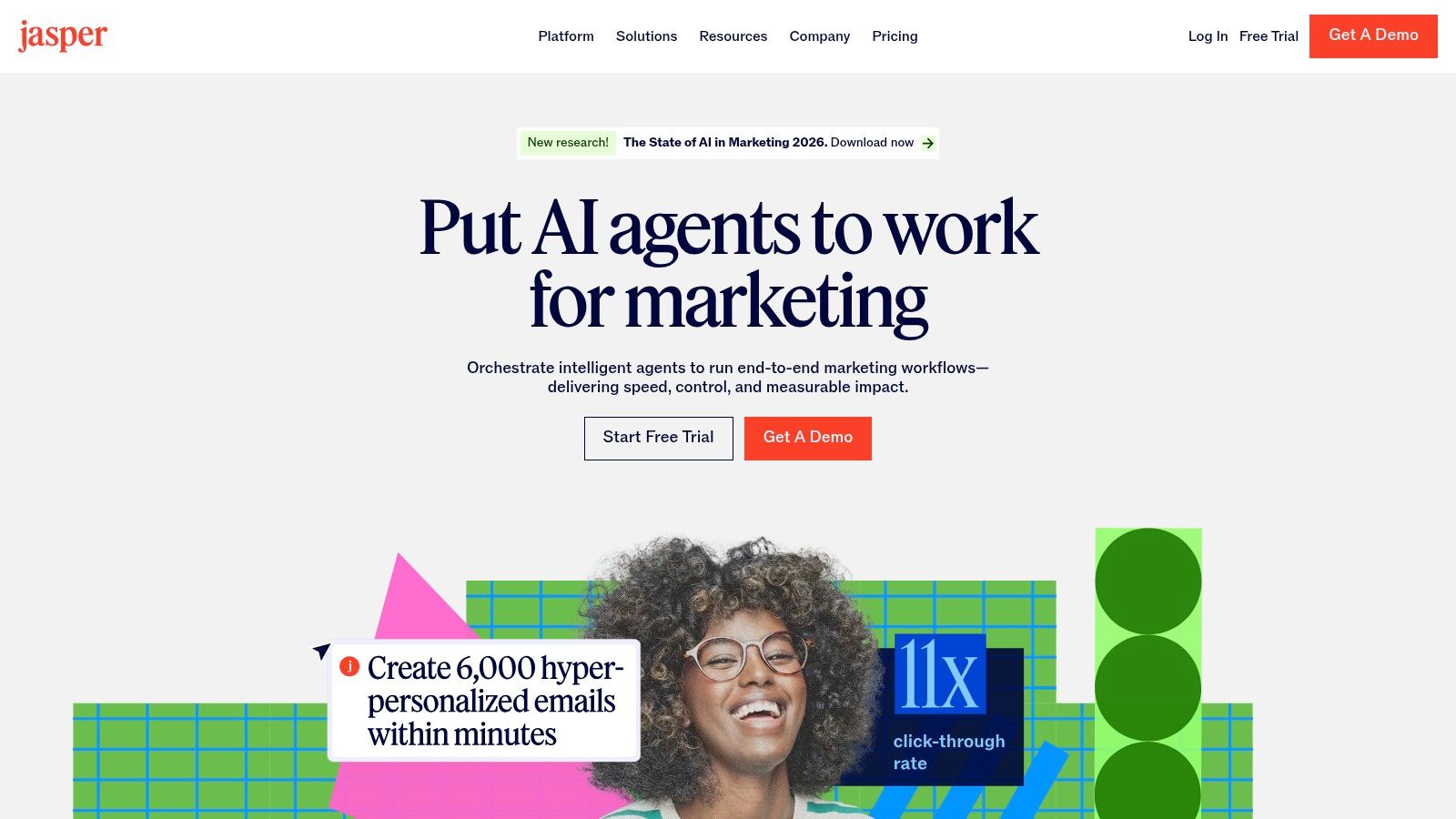
Jasper isn’t just another GPT wrapper. It’s a strategic content platform built for marketing teams. Instead of just generating text, it enables you to orchestrate entire campaigns that are consistently on-brand. A crucial distinction.
Its killer feature is the ability to absorb your specific Brand Voice and Knowledge. You feed it style guides and product catalogs, and the AI generates assets that sound like you, not a generic chatbot. This makes it one of the most powerful ai tools for content marketing when brand integrity is non-negotiable. One client used this to cut their review time for social media copy from 4 hours a week down to 30 minutes.
Key Differentiators & Use Cases
Jasper excels at creating a unified content ecosystem. The Canvas workspace takes you from brief to final blog post, social media updates, and ad copy in one place. Its no-code App Builder lets you create repeatable workflows for tasks like generating SEO meta tags, giving you a competitive edge in operational speed.
When not to use it? If you’re a solo creator just needing basic text, it might be overkill. Jasper’s real power is unlocked in a team setting where brand consistency and workflow governance are critical.
Best For: Marketing teams at startups, agencies, and enterprises who need to scale on-brand content while maintaining strict quality controls. It provides the governance that fast-growing companies require.
| Pros | Cons |
|---|---|
| Purpose-built for brand-consistent marketing | Best features are on the higher-priced Business plan |
| Strong team management and permission controls | Per-seat pricing can become costly for large teams |
| 7-day free trial on Creator and Pro plans | Learning curve to master advanced features |
Pricing: Starts at $39/month (billed annually) for the Creator plan. The Pro and Business plans offer more advanced features like Brand Voice and campaign tools.
Website: https://www.jasper.ai
2. Copy.ai
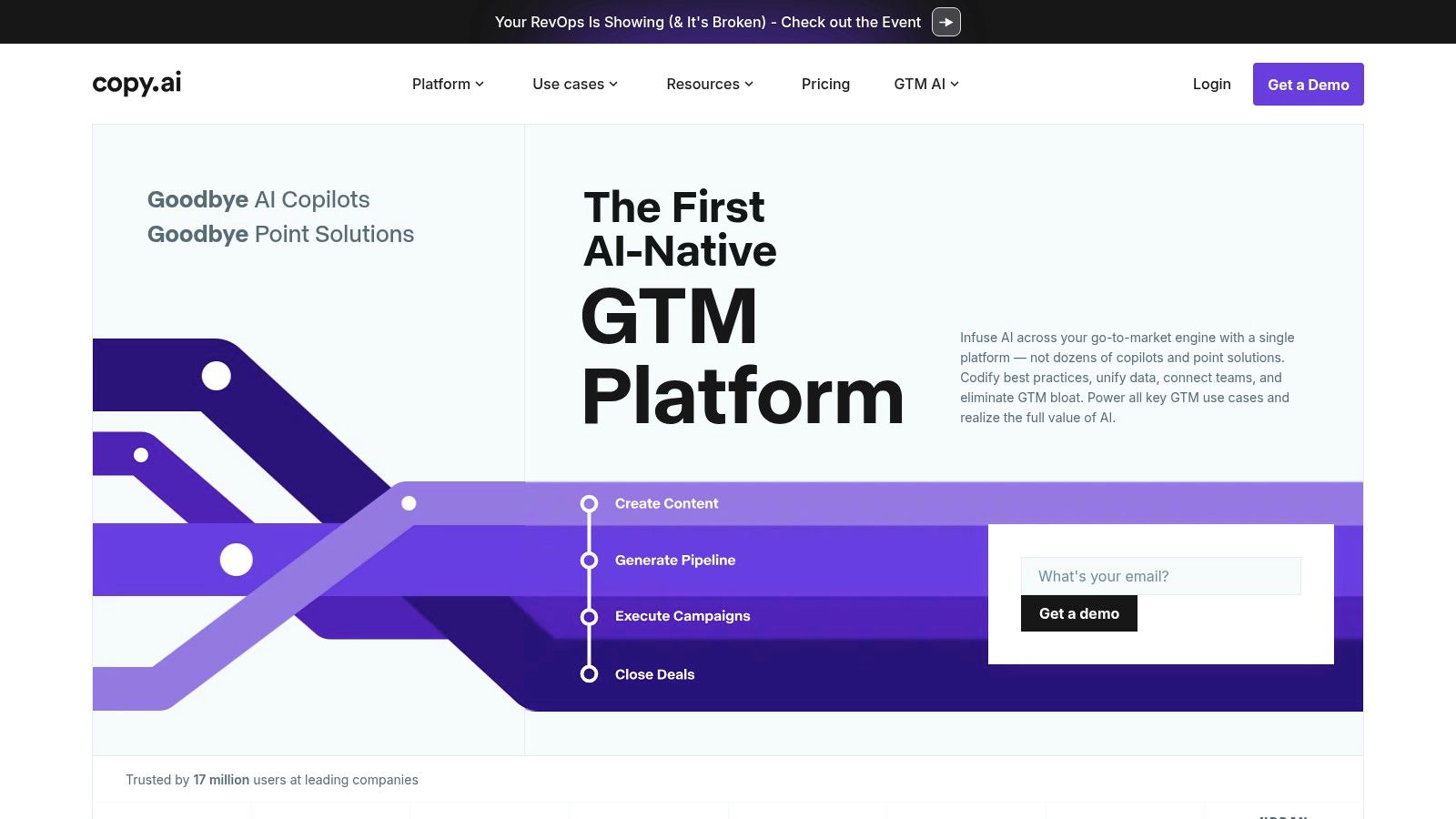
Copy.ai moves beyond text generation into AI-powered process automation. It’s built around deploying autonomous 'Content Agents' to handle multi-step workflows. This fundamentally changes your approach to content velocity, shifting from manual tasks to automated systems.
The core is its Workflow builder. You can train agents on your brand voice and data sources to automate tasks like generating SEO blog drafts from a keyword. This focus on repeatable processes makes it one of the most practical ai tools for content marketing for teams looking to systematize operations and crush competitors on speed.
Key Differentiators & Use Cases
Copy.ai shines in its operational approach. Instead of just being a writer's assistant, it's a central hub for marketing operations. The ability to choose from different LLMs gives you flexibility, a concept I explain in my quick primer on the topic.
Its trade-off is a steeper initial setup. Building a robust agent requires a clear understanding of your process. If your workflows are chaotic, Copy.ai will just automate the chaos. Get your process right first.
Best For: Marketing and sales teams in SMBs and startups that need to automate repetitive, high-volume content tasks. Ideal for building scalable systems for lead generation and SEO content production.
| Pros | Cons |
|---|---|
| Practical workflow automation for operations | Credit-based workflows may need careful monitoring |
| Straightforward and scalable team pricing tiers | Agent setup requires an initial investment of time |
| Multi-model access provides flexibility | Less focused on campaign-level brand governance |
Pricing: Starts at $36/month (billed annually) for the Pro plan with 5 seats. Team and Enterprise plans scale up features and workflow credits.
Website: https://www.copy.ai
3. Writesonic
If your content strategy lives and dies by SEO, Writesonic is a tool you need to examine. It deeply integrates search data directly into the creative process. This isn't just about writing articles; it's about engineering content designed to rank from the moment you hit "generate."
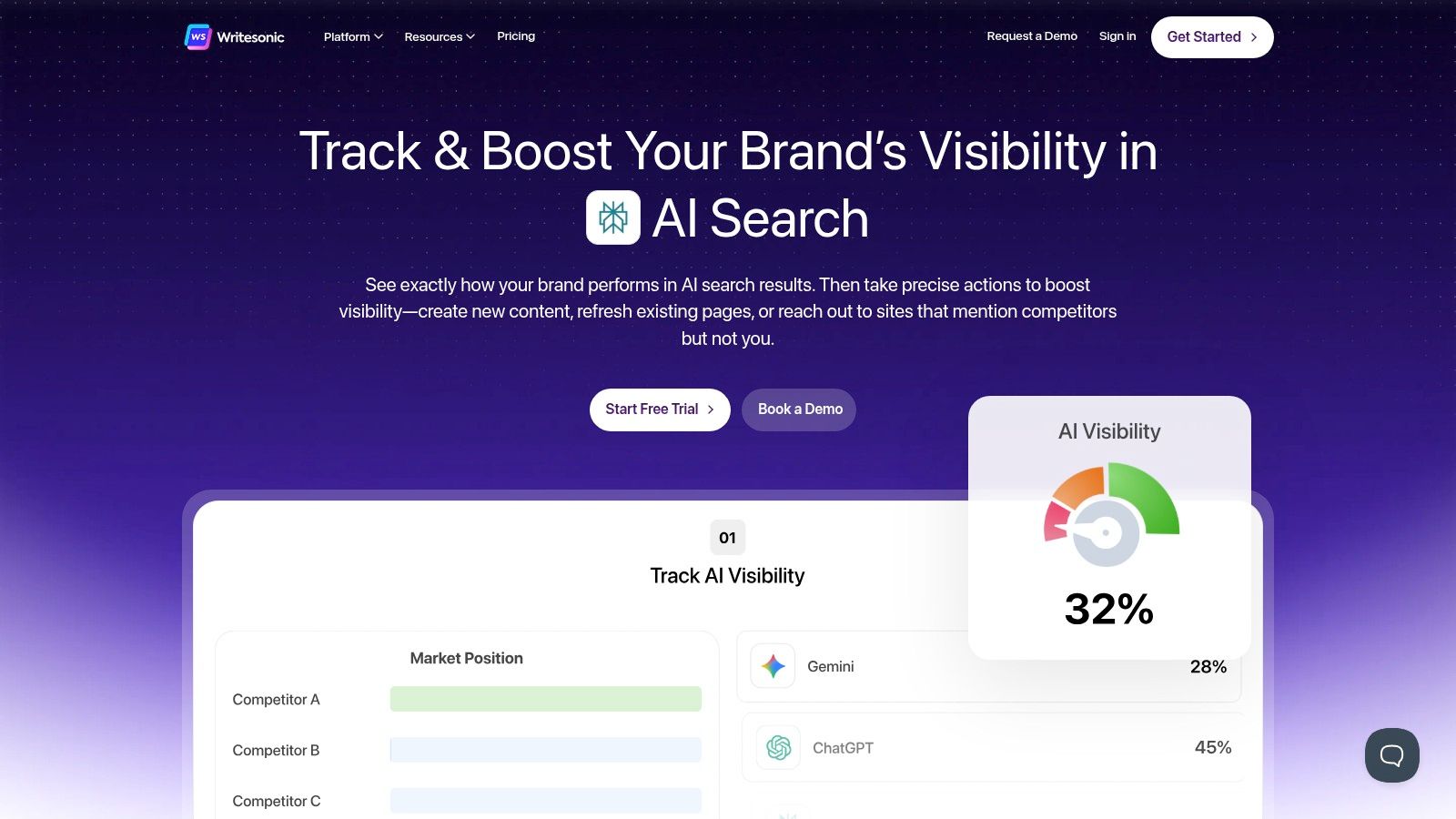
Its standout feature is tracking your brand's visibility across AI search platforms like Perplexity. It combines this forward-looking data with traditional SEO sources, making it one of the most comprehensive ai tools for content marketing for teams obsessed with outranking competitors on every search surface.
Key Differentiators & Use Cases
Writesonic's power comes from its hybrid approach. The AI Article Writer pulls real-time data from Google and Ahrefs to inform its structure and content. You can build entire articles fact-checked and optimized for specific keywords in a single workflow. A marketing agency I work with used this to reduce their time-to-first-draft for a 2,000-word article from 6 hours to just under 1 hour.
The limitation? The sheer number of features can be overwhelming. To get maximum value, you need to commit to learning its specific workflows rather than just using it as a simple text generator.
Best For: SEO-focused content teams and agencies that need to create high-volume, search-optimized content efficiently. Particularly valuable for those looking to improve visibility in emerging AI search environments.
| Pros | Cons |
|---|---|
| Strong combination of SEO data and AI content creation | Advanced features are gated on higher-tier plans |
| Flexible multi-model chat and deep data integrations | Pricing and word/feature limits can be complex |
| GEO tracking offers a unique view of AI search visibility | The interface can feel busy with so many features |
Pricing: Offers a free trial with limited words. Paid plans start at $13/month (billed annually) for the Small Team plan. Business and Enterprise tiers unlock more advanced SEO tools and higher limits.
Website: https://writesonic.com
4. Semrush – Content Toolkit
Semrush breaks down the wall between SEO research and AI content creation. Its Content Toolkit is built directly on its industry-leading SEO data. This ensures every piece of content is engineered to rank from the start.
The platform’s strength is its unified workflow. You move from keyword research to a data-driven content brief, then to an AI-generated draft, all without leaving the Semrush ecosystem. This makes it one of the most efficient ai tools for content marketing for teams whose primary goal is driving organic traffic. The process ensures your content is strategically sound, not just well-written.
Key Differentiators & Use Cases
What sets Semrush apart is its direct integration of live SERP data into the AI generation process. The "SEO-boosted" article feature analyzes top-ranking competitors to inform the AI's structure and tone. This creates a powerful feedback loop where SEO insights directly shape content creation.
The trade-off is cost and complexity. It’s a professional-grade tool with a price tag to match. Don't use it if you're not deeply committed to a data-driven SEO strategy, as you'll be paying for features you won't leverage.
Best For: SEO-focused content teams and agencies already invested in the Semrush ecosystem. It’s ideal for closing the gap between SEO strategy and content execution within a single platform.
| Pros | Cons |
|---|---|
| Tight SEO and content workflow in one stack | Some capabilities gated by 'SEO-boosted' credits |
| Backed by Semrush's robust SEO data | Add-on pricing and multi-user costs can be complex |
| 7-day free trial available for the toolkit | Best for users already familiar with the Semrush UI |
Pricing: The Content Toolkit is available as an add-on to a core Semrush subscription (starting at $129.95/month). The toolkit itself starts at an additional $200/month.
Website: https://www.semrush.com
5. Surfer
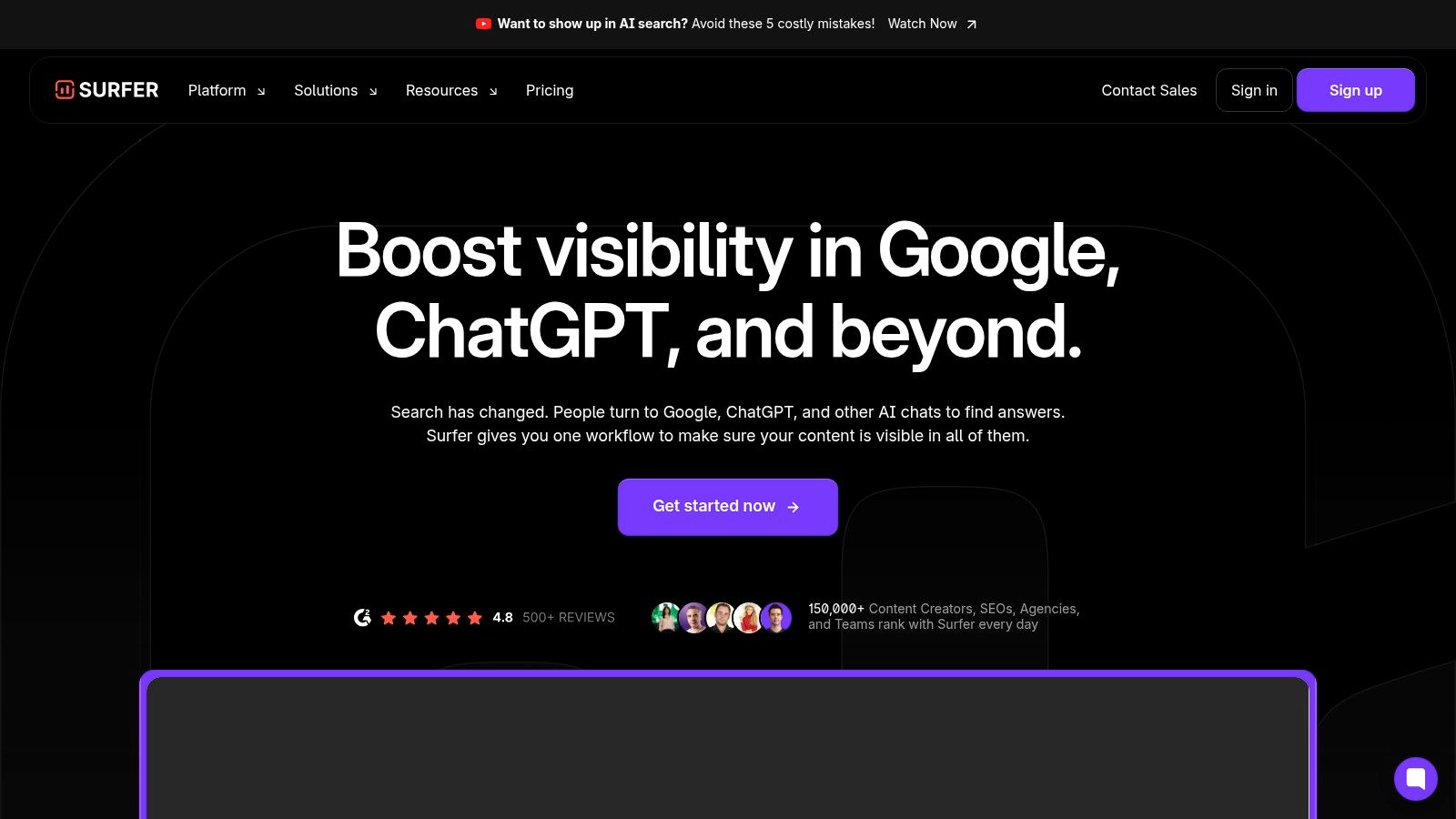
Surfer doesn't just generate content; it ensures the content you create actually ranks. It fuses AI-driven SERP analysis with a powerful content editor to give your writers a clear, data-backed roadmap to hitting the front page. It's an AI-powered SEO strategist guiding your every move.
The platform excels by reverse-engineering top-ranking pages to provide actionable, real-time feedback. It analyzes hundreds of on-page factors to build a dynamic brief, telling you exactly which keywords to use and what topics to cover. For any team serious about organic traffic, it’s one of the most indispensable ai tools for content marketing because it removes the guesswork from SEO.
Key Differentiators & Use Cases
Surfer’s core strength is its Content Editor, which provides a live "Content Score" as you write. While Surfer AI can generate a full article, its real power lies in arming human writers with superior data to beat the competition.
The risk? Chasing the score. A writer who blindly follows every suggestion can produce robotic, keyword-stuffed content. The tool is a guide, not a dictator. Your expert writer's judgment is still the most critical component.
Best For: SEO agencies, content marketing teams, and freelance writers who need a data-driven framework to consistently create high-ranking content. Perfect for scaling content operations without sacrificing quality.
| Pros | Cons |
|---|---|
| Strong optimization guidance for writers | Can have a learning curve to get the best results |
| Emerging AI-search visibility tracking | Entry price is higher than some basic tools |
| Excellent for creating detailed content briefs | Optimization limits on lower-priced plans |
Pricing: Starts at $69/month (billed annually) for the Essential plan. Higher plans unlock more document optimizations, AI credits, and advanced features.
Website: https://surferseo.com
6. HubSpot – Content Hub
HubSpot's Content Hub isn't a standalone tool; it's a content operations engine supercharged with AI. It integrates AI assistants directly into its marketing automation and CRM platform. This creates an end-to-end system where your content creation and customer data live together.
The standout feature is 'Content Remix,' which instantly repurposes a blog post into social media updates, emails, or video scripts. This tight integration makes it one of the most effective ai tools for content marketing for businesses already in the HubSpot ecosystem. You're not just creating content; you're immediately deploying it into revenue-generating campaigns.
Key Differentiators & Use Cases
HubSpot excels at bridging the gap between content and conversion. The AI provides on-page SEO recommendations, and its "Smart Content" features personalize website content based on CRM data. A known lead sees a different call-to-action than a first-time visitor. That’s a real competitive advantage.
Don't buy HubSpot just for its AI. Its value comes from the deep integration with its CRM and marketing automation suite. If you're not using those, you're paying a premium for a fraction of the benefit.
Best For: Marketing and sales teams who need a unified platform for content, automation, and CRM. Ideal for businesses looking to tie every piece of content directly to a marketing or sales outcome.
| Pros | Cons |
|---|---|
| End‑to‑end content + CRM/automation in one platform | Pricing increases quickly with seats and add-ons |
| Scales from starter sites to multi-brand setups | Heavier platform compared to specialized point solutions |
| Robust ecosystem and HubSpot Academy for training | AI features are best utilized within the HubSpot ecosystem |
Pricing: Content Hub plans start at $25/month for the Starter tier, with more advanced AI and governance features available in Professional and Enterprise plans.
Website: https://www.hubspot.com/products/content-hub
7. Grammarly (Pro/Enterprise)
Grammarly is no longer just a spellchecker. Its evolution into a generative AI assistant makes it a mandatory final checkpoint for any serious content team. It’s about enforcing brand consistency and refining tone across every platform your team uses, from Google Docs to your CMS.
The Enterprise plan is where it becomes one of the most essential ai tools for content marketing. You establish a centralized Brand Voice, creating style guides that automatically prompt team members to adhere to specific terminology and tone. This isn't about replacing writers; it's about giving them an AI-powered editor that ensures every piece of content is polished and on-brand.
Key Differentiators & Use Cases
Grammarly’s strength lies in its ubiquity. It integrates seamlessly into the tools your team already uses, making adoption effortless. Its generative features are perfect for on-the-fly rewrites and adjusting the tone of an email with a single click.
It is not a full-scale content generator. Trying to write a 2,000-word blog post with it is inefficient. Use it for its intended purpose: a final layer of polish and consistency enforcement before you hit publish.
Best For: Any marketing team that needs to enforce quality and brand consistency at scale. It's the perfect final-stage tool to polish content created by humans or other AIs before it goes live.
| Pros | Cons |
|---|---|
| Improves quality and consistency across teams | Generative prompt quotas on lower-tier plans |
| Simple rollout via browser extensions and apps | Not a full SEO or strategic content planning suite |
| Strong security and admin controls for teams | Best features are gated behind higher-cost plans |
Pricing: Premium plans start at $12/month per member (billed annually). Business plans with team features start at $15/month per member.
Website: https://www.grammarly.com
8. Frase
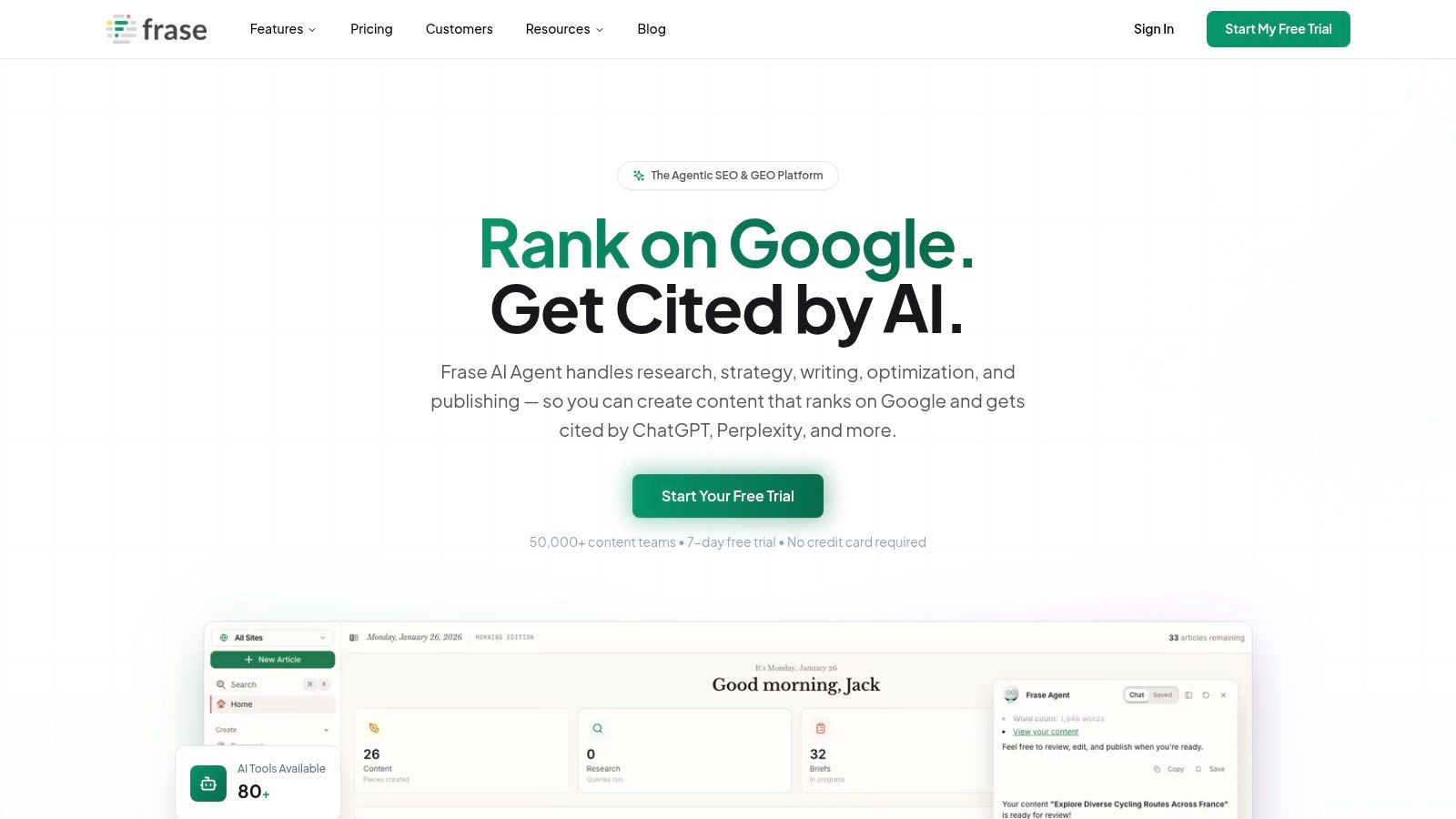
If you're tired of guessing what Google wants, Frase is your answer. It reverse-engineers top-ranking search results to give you a data-driven blueprint for creating content that ranks. I see it as the bridge between raw SEO data and AI-powered content creation.
Frase's core strength is its research-to-draft workflow. It analyzes the top SERP results and automatically generates a detailed content brief with recommended headings and topics. This process takes the ambiguity out of SEO, making it one of the most effective ai tools for content marketing for anyone focused on organic search.
Key Differentiators & Use Cases
Frase excels at both creating new SEO pages and refreshing existing ones. The platform integrates with Google Search Console to identify "decaying" content, giving you a prioritized list of pages to update for quick wins. One of our portfolio companies used this feature to identify 15 "quick win" articles, and updating them led to a 22% increase in organic traffic in 60 days.
The limitation is that its analysis is purely based on existing SERPs. It won't help you create a truly novel, category-defining piece of content. Use it to win existing battles, not to invent new ones.
Best For: SEO specialists and content managers who need a systematic, data-backed approach to creating and optimizing articles. Perfect for turning keyword research into rank-ready drafts with minimal friction.
| Pros | Cons |
|---|---|
| Excellent SERP analysis and brief generation | UI depth and multiple features take time to master |
| Google Search Console integration is a major plus | Project/document caps on lower-tier plans |
| Clear pricing with generous project limits | Best for informational content, less so for creative |
Pricing: Starts at $14.99/month for the Solo plan. The Pro Add-On at $35/month unlocks unlimited AI-generated "Rank-Ready Documents".
Website: https://www.frase.io
9. Clearscope
Clearscope bridges the gap between AI-generated text and content that actually ranks. It focuses on optimizing text for topical authority, ensuring it meets the requirements Google is looking for. It’s less about generating the first draft and more about refining it into an asset that can dominate search results.
Its core strength is its high-quality topic and keyword research. Its content grading system gives you a tangible score, telling you exactly how well your piece covers a subject compared to top competitors. This makes it one of the essential ai tools for content marketing for teams that prioritize ranking for competitive terms over just content volume.
Key Differentiators & Use Cases
Clearscope excels at turning a good AI draft into a great, rankable asset. I use it to analyze AI-generated blog posts, identify semantic gaps, and ensure the content has the required depth. Its AI Drafts are specifically tuned to its own optimization guidelines, giving you a solid, SEO-focused starting point.
When not to use it? For low-competition keywords or short-form social content. Its depth of analysis is overkill. Use it for your most important, high-stakes pillar pages where ranking first means significant revenue.
Best For: In-house SEO teams and content marketing agencies that rely heavily on organic search for growth. It provides the data-driven insights needed to make both human-written and AI-generated content perform better.
| Pros | Cons |
|---|---|
| Clean UX and high-quality recommendations | Higher entry price than some competitors |
| Scales well for teams with flexible add-ons | Draft credits are limited by plan (add-on cost) |
| Unlimited users and projects on paid tiers | More focused on optimization than pure generation |
Pricing: Starts at $199/month for the Essentials plan, which includes 10 content reports and 2 AI drafts. Business and Enterprise plans offer more reports, drafts, and support.
Website: https://www.clearscope.io
10. MarketMuse
MarketMuse isn't about a single blog post; it's about architecting your market dominance. It uses patented topic modeling to give you a site-wide blueprint for building topical authority. It moves you from a tactical, post-by-post mindset to a strategic, library-building one.
Its core strength is its ability to inventory your entire content catalog, identify critical gaps, and show you exactly what to write next to become the definitive source in your niche. This makes it one of the most strategic ai tools for content marketing for teams serious about long-term organic growth and building a defensible content moat.
Key Differentiators & Use Cases
MarketMuse shines when you're managing a large content library. Its Inventory and Heatmaps provide a powerful visual of your site's strengths and weaknesses, helping you prioritize updates. Use its SERP X-Ray to deconstruct why competitors are ranking and what it will take to unseat them.
This is not a tool for beginners or small sites. Its value is realized when you have a significant volume of content to analyze and a team dedicated to executing a long-term content strategy. Using it for a ten-page blog is like using a sledgehammer to crack a nut.
Best For: SEO teams and enterprises with established content catalogs who need a data-driven way to plan, prioritize, and optimize their efforts to build lasting topical authority.
| Pros | Cons |
|---|---|
| Deep strategic view beyond keyword-level tools | Pricing is higher than many lightweight SEO tools |
| Excellent for large content catalogs & planning | Best value is realized with consistent publishing volume |
| Patented topic modeling provides a unique edge | Can be overkill for small sites or solo creators |
Pricing: Starts at $149/month for the Standard plan. Higher tiers offer more content briefs, inventory analysis, and strategic features.
Website: https://www.marketmuse.com
11. Canva – Magic Studio
Canva's Magic Studio transforms it from a design tool into an AI content creation hub. Where other tools separate text from visuals, Canva integrates them seamlessly. You aren't just generating copy; you're creating finished marketing assets in one unified workflow.
The platform's strength is this integration. You can use Magic Write to generate copy for a social post, then instantly apply it to a template and generate a custom background image with its AI. This makes it one of the most efficient ai tools for content marketing for teams that need to produce high volumes of visually-driven content.
Key Differentiators & Use Cases
Canva excels at rapid asset creation. Magic Switch is the killer feature, allowing you to transform a presentation into a blog post or a single graphic into a multi-platform social campaign with a few clicks. For a SaaS client, we built a workflow that turns one webinar into 12 distinct social assets in under 20 minutes, a process that used to take their designer half a day.
Its AI writing is best for short-form copy. Don't rely on it for in-depth, long-form articles. It lacks the SEO focus and strategic depth of dedicated writing platforms.
Best For: Marketing teams and solo entrepreneurs who manage the entire content lifecycle, from copywriting to visual design and multi-channel distribution. A powerhouse for social media graphics, ads, and presentations.
| Pros | Cons |
|---|---|
| All-in-one creative environment for content marketing | Advanced collaboration requires pricier Teams plan |
| Extremely fast for repurposing assets across formats | AI generation quotas vary by plan and can be limited |
| Massive library of templates speeds up creation | AI writing is good for short-form, less so for long-form articles |
Pricing: Offers a robust free plan. Canva Pro starts at $14.99/month per person, unlocking more AI features and brand tools. Canva for Teams pricing is customized.
Website: https://www.canva.com
12. Notion AI
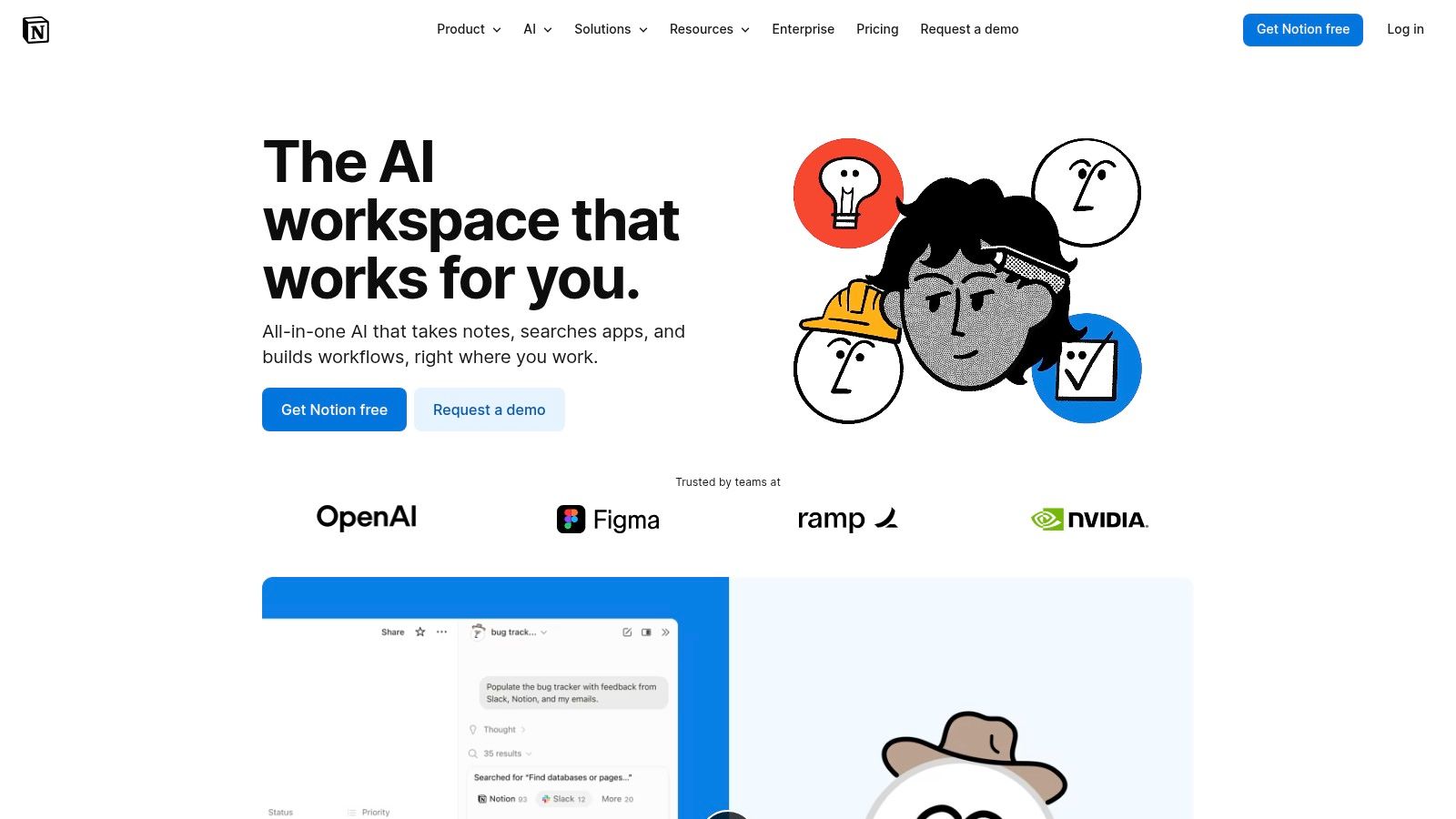
Notion AI transforms your workspace from a static documentation hub into an active content operations engine. It's not just about writing; it's about connecting every stage of the content lifecycle within a single, interconnected system. This is your weapon against the chaos of disconnected Google Docs and spreadsheets.
The power of Notion AI is its ability to operate across your entire knowledge base. You can ask it to summarize meeting notes into actionable content briefs or pull key data from a research database to generate a first draft. This contextual awareness makes it one of the most practical ai tools for content marketing for centralizing operations.
Key Differentiators & Use Cases
Notion AI excels at creating and managing structured content workflows. You can build a content calendar database, use AI to automatically populate summaries or social media captions, and then move items through a Kanban board for review. Its new AI Agent capabilities promise to automate multi-step processes like generating an entire content package from one prompt.
The trade-off? It requires discipline. Without a well-designed workspace, Notion AI can't leverage its full potential. You have to invest time in building the operational structure first.
Best For: Marketing teams and agencies that need to centralize their entire content operation. Ideal for building repeatable, transparent workflows for briefs, calendars, and team collaboration in one platform.
| Pros | Cons |
|---|---|
| Centralizes content operations (briefs, calendars, approval) | Full AI features now reside on higher-tier plans for new users |
| Strong for process documentation and team collaboration | Requires intentional workspace setup to unlock its full value |
| Operates with context across your entire workspace | Can feel less like a pure-play writing tool than competitors |
Pricing: Notion AI is an add-on for $8 per member/month (billed annually) to any paid plan. Core plans start at $8 per member/month for Plus.
Website: https://www.notion.so/product/ai
Top 12 AI Content Marketing Tools Comparison
| Tool | Best for (Core use) | Key features | Target audience | Pricing / Tier notes | Unique selling point |
|---|---|---|---|---|---|
| Jasper | On‑brand marketing copy & campaign orchestration | Canvas workspace; Brand Voice & Knowledge; No‑code App Builder; Enterprise governance | Marketing teams & enterprises scaling content ops | Per‑seat pricing; Business/Enterprise for top features; 7‑day trial | Purpose‑built for brand consistency and templatized workflows |
| Copy.ai | Automated content agents & workflow automation | Content Agent Studio; Workflow Credits; Multi‑model access; Chat workspace | Marketing ops, growth teams automating processes | Credit‑based workflows; clear team tiers | Trainable content agents to automate multi‑step marketing tasks |
| Writesonic | SEO‑centric content creation + visibility tracking | AI Article Writer; GEO visibility tracking; Chatsonic (browsing); SEO integrations | SEO‑focused content teams & agencies | Tiered limits; advanced features on higher plans | Combines SEO data, multi‑model chat and GEO tracking |
| Semrush – Content Toolkit | SEO research + AI drafting in one stack | AI articles & SEO briefs; SERP analysis; WP publishing; Brand Voices | SEO teams and agencies needing research‑driven drafts | 'SEO‑boosted' credits for enhanced drafts; 7‑day trial | Built atop Semrush SEO dataset for research‑backed drafts |
| Surfer | On‑page optimization and SERP guidance | Content Editor; Surfer AI; AI Visibility; internal linking reports | Writers, editors, and SEO specialists | Document/optimization limits by tier; higher tiers add features | Strong on‑page optimization guidance with SERP focus |
| HubSpot – Content Hub | End‑to‑end content + CRM automation | AI remixing; SEO recommendations; personalization; multi‑domain governance | Teams wanting integrated CMS + marketing automation | Pricing scales with seats/add‑ons; Enterprise features costly | Unified content, CRM and automation platform |
| Grammarly (Pro/Enterprise) | Quality, tone, and brand consistency | Rewrite & tone tools; Brand style guides; Generative prompts; Security controls | Teams polishing copy; orgs needing governance | Prompt quotas on lower tiers; Enterprise SSO/controls | Easy rollout for consistent, polished brand copy |
| Frase | Research‑to‑draft SEO workflows & refresh cycles | SERP analysis; outline builder; Rank‑Ready AI docs; GSC integration | SEO/content teams focused on page creation & updates | Generous projects/month; pay‑as‑you‑go AI docs option | Affordable project caps + buyable AI documents |
| Clearscope | Premium content optimization & scoring | Topic research; content scoring; AI drafts; visibility tracking | Agencies & in‑house teams prioritizing quality | Higher entry price; draft credits limited (add‑ons) | Clean UX with high‑quality, actionable recommendations |
| MarketMuse | Topic modeling & content strategy at scale | Tracked Topics; Topic Navigator; briefs; inventory & heatmaps | Large catalogs, enterprise editorial teams | Higher tiers; best ROI with consistent publishing | Deep topic modeling for building topical authority |
| Canva – Magic Studio | Design‑first content creation with AI | Magic Write/Switch; image & video generation; Brand Kit; templates | Social teams, small marketing teams, creators | Team/Business for advanced collaboration; quotas vary | All‑in‑one creative environment pairing visuals and copy |
| Notion AI | Centralized content ops, briefs & SOPs | AI writing/summarization; AI Agent; pages & DB AI; enterprise permissions | Teams centralizing documentation, briefs and workflows | Full AI now on Business/Enterprise for new users | Centralizes content operations with embedded AI assistants |
The Real Competitive Edge Isn't the Tool—It's the System You Build
We've walked through an arsenal of powerful ai tools for content marketing. You've seen the writers, the SEO optimizers, and the all-in-one platforms. It's a lot.
But let me be direct. Buying a subscription won't double your revenue. The tool is just the starting point. I've seen countless companies license the "best" software, only to see it gather dust because they had no plan.
The real, defensible competitive advantage comes from how you orchestrate these tools into a cohesive system. It’s about building a bionic content engine unique to your business. A system your competitors cannot copy.
Moving from Tools to an Integrated Content Engine
Think about it this way. A single tool helps you write a blog post 30% faster. An integrated system identifies a high-value keyword, generates an SEO-optimized brief, produces a first draft, sends it for human refinement, and schedules it, all with minimal friction.
That’s the difference between tactical gains and strategic domination. Your competitors can buy the same Jasper license. They can't copy your unique workflow that leverages your team’s expertise at precisely the right moments.
This is the work that matters. It’s asking questions like:
-
How does our keyword research from Semrush automatically inform the content briefs created in Frase?
-
Can Notion AI connect to our project management system to seamlessly move content from ideation to final review?
-
How do we use the visual assets from Canva’s Magic Studio within content optimized by Clearscope without 15 manual steps?
Building the connective tissue between these platforms is what creates a scalable content operation. It's how you move from simply using AI to truly leveraging it for market growth. This system becomes your moat.
Your Next Steps: From Selection to Systemization
Don't get paralyzed by choice. Identify your single biggest content bottleneck right now. Is it ideation? First-draft speed? SEO optimization?
Pick one tool from this list that directly attacks that single pain point. Start there. Master it. Once you've proven the ROI, move to the next bottleneck.
As you build, remember the landscape is evolving. The traditional SEO playbook is being rewritten by AI search. To truly compete, exploring a list of the 12 Best AEO Tools to Dominate AI Search is non-negotiable. This is about being the answer everywhere.
The ultimate goal isn't just to adopt ai tools for content marketing. It’s to build an intelligent, automated, and human-refined content engine that your competitors can't replicate.