
Using AI in social media is about building a real competitive advantage. Scheduling posts a little faster is the smallest part of it.
That means putting machine intelligence to work to analyze markets, predict trends, and automate revenue-generating activities at a scale your manual-first competitors simply can’t match. This is how you shift your social strategy from a content calendar to a 24/7 market intelligence engine.
Why Your Social Media Is Already Obsolete
Let’s cut to the chase. If you’re not actively using AI in your social media marketing, you’re playing an entirely different game from the people who are, and losing ground every week.
While you manually A/B test headlines, your competitors are launching systems that analyze market sentiment, generate dozens of content variations, and optimize ad campaigns while they sleep. The way social media work gets done is changing right now.
I’ve been working with machine learning models since 2016 and generative AI since 2019. The change I’m seeing now is fast, and it redefines what it takes to be competitive. The gap is widening.
The Real Problem AI Solves
The core issue is human bandwidth, and more tools or data won’t fix it.
You and your team can only process so much information. You can only create so much content. You can only run so many tests. AI makes these tasks faster and, for many of them, removes the human bottleneck entirely.
This means you can now:
- Process intelligence at scale, analyzing thousands of competitor posts, customer comments, and market trends in minutes instead of weeks.
- Create content faster, going from one post idea to 20 data-backed concepts, complete with drafts and visuals.
- Optimize with precision by letting algorithms pick the best audience segments and ad creatives instead of guessing, which raises your ROAS.
The goal is a “bionic” marketing operation, even if it’s just you: human judgment backed by AI agents that handle the repetitive, data-heavy lifting. That frees you for high-level strategy, the work that actually grows the business.
From Reacting to Predicting
Most social media strategies are reactive. You post, wait, analyze, and try to replicate what worked. It’s a constant cycle of looking in the rearview mirror.
I saw this with a B2B SaaS client spending over 20 hours a week on manual social media, only to see engagement completely plateau. They were stuck.
By implementing a simple AI workflow, I built an engine that started predicting what would resonate before they ever hit “publish.” Within 60 days, their engagement shot up by 40%, while their team spent less than five hours per week on execution.
This is the advantage. In this guide, you and I are going to explore exactly how to build this engine. I’ll cut through the noise and design a system that works around the clock to drive revenue while everyone else stays stuck in the old cycle.
Building Your AI-Powered Content Engine
Content is the fuel for your social media. The challenge is creating it with velocity and quality at the same time. One-off posts don’t cut it anymore.
Forget the image of an intern staring at a blank screen. You need a system where AI agents can spit out dozens of data-backed, platform-specific content ideas in minutes. This gives you, or whoever creates your content, far more to work with.
This shift is happening at scale. By 2026, 94% of marketers plan to use AI in their content creation. It’s a direct response to algorithms that reward constant, high-value output.
From Raw Ideas to Polished Drafts
Getting an AI to generate text is the easy part. The real work is generating text that sounds like your brand and aligns with your strategy. This requires a process I call context engineering.
Before I write a single prompt, I’ll give a model like Claude 3 a “brief” that includes:
- Your brand voice, with specific adjectives, tone guidelines, and examples of what not to say.
- A summary of your top-performing posts, covering the topics, formats, and CTAs that worked.
- A detailed audience persona describing who you’re talking to, including their pain points and goals.
With that context locked in, I can use a prompt like: “Acting as a senior social media strategist for a B2B SaaS company, generate 5 LinkedIn post concepts based on our top-performing content about workflow automation. Each concept must address the primary pain point of our CTO persona and include a hook, a key insight, and a question to drive comments.”
The result is a strategic starting point that’s 80% of the way there. You, or your editor, spend time on the final 20% of refinement and strategic oversight. A human stays in charge of what gets published.
I helped a mid-stage SaaS company implement this exact system. They tripled their content output, and their engagement rate climbed by 40% in the first quarter. Why? Because every single piece of content was rooted in data.
The diagram below illustrates this shift from a slow, reactive process to a predictive, AI-driven one.
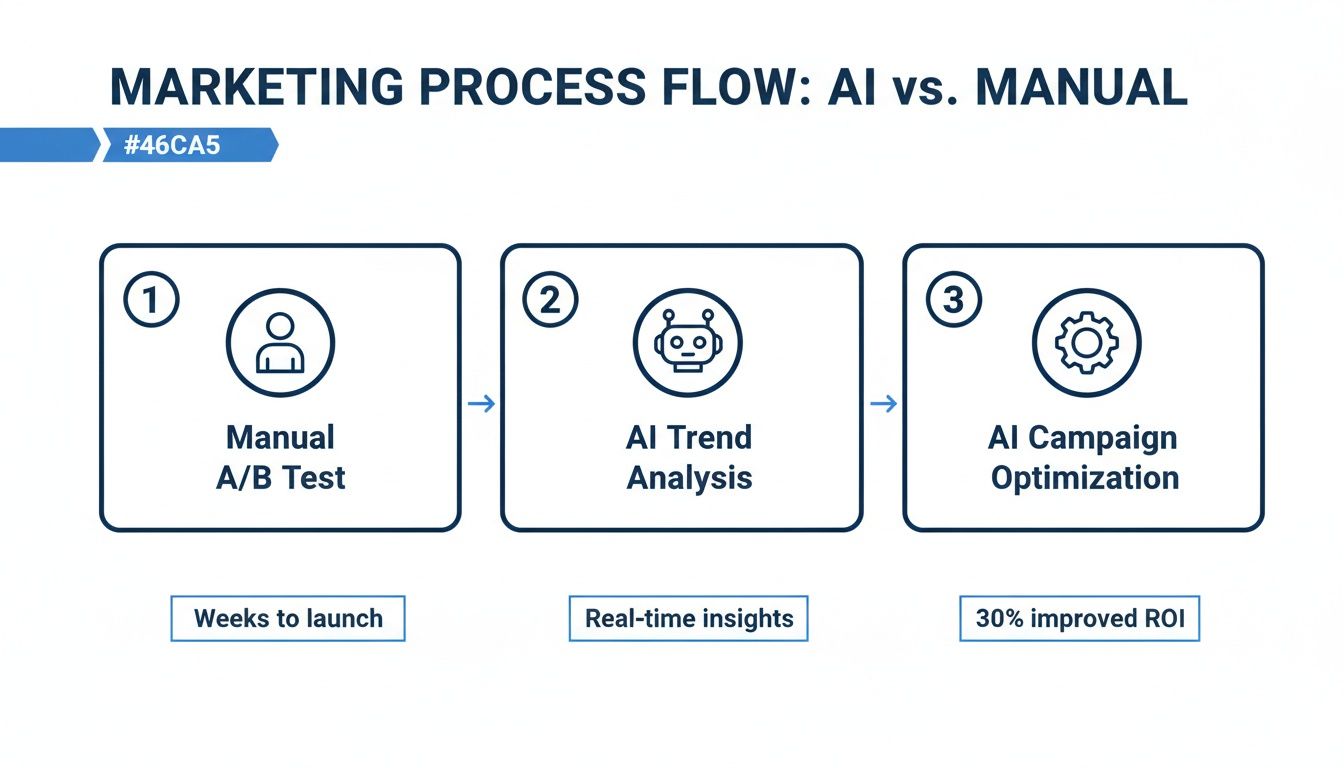
This visual shows the clear advantage: moving from slow, manual A/B testing to rapid, data-informed optimization that slower competitors can’t keep pace with.
The table below breaks down exactly how this “bionic” workflow compares to the old-school, manual approach.
AI Content Engine Framework
| Stage | Traditional Workflow (Manual) | AI-Augmented Workflow (Bionic) | Resulting Advantage |
|---|---|---|---|
| Ideation | Brainstorming sessions, gut feelings, reviewing past successes one by one. | AI analyzes performance data and market trends to generate dozens of topic clusters. | Data-driven ideas with a higher probability of success from the start. |
| Drafting | Writers start from a blank page, often spending hours on a single post. | AI generates multiple drafts based on a detailed brief and brand voice context. | 80% of the initial writing is done in minutes, not hours. |
| Refinement | Manual editing for tone, clarity, and brand alignment. | Human editors focus on high-level strategy, storytelling, and adding unique insights. | Creative talent is used for strategic value, not repetitive tasks. |
| Distribution | Manually adapting content for each social platform (LinkedIn, X, etc.). | AI agents automatically reformat a core idea into platform-specific variants. | Tailored content for every channel without the manual overhead. |
| Analysis | Monthly or quarterly reports analyzing what worked and why. | Real-time AI analysis feeds performance insights back into the ideation stage. | A self-improving loop that gets smarter with every post published. |
Speed is only part of the gain. The bigger part is a system that learns and adapts.
Choosing Your Tools and Automating the Pipeline
A solid AI content engine relies on more than one tool. While models like GPT-4 and Claude 3 are powerful, specialized AI content creation tools can speed up specific parts of the process, such as generating videos or designing carousels.
But the real magic happens when you stitch these tools into an automated workflow. Imagine connecting your social listening tool to an AI model that summarizes daily trends, which then feeds those insights directly into a content generation agent. I cover the nuts and bolts of this in my guide to AI workflow automation tools.
The end goal is a content engine that gets smarter as it produces more. It learns from its own performance, adapts to market feedback, and consistently delivers content that drives real business results.
Building Social Media Intelligence with AI
Your social media channels are a real-time focus group and a competitive battleground. But let’s be direct: most businesses treat this data like a box of old receipts.
This is a big missed opportunity. While your competitors are busy scheduling posts, you can be deploying AI agents to pull actionable, revenue-driving intelligence out of the noise.
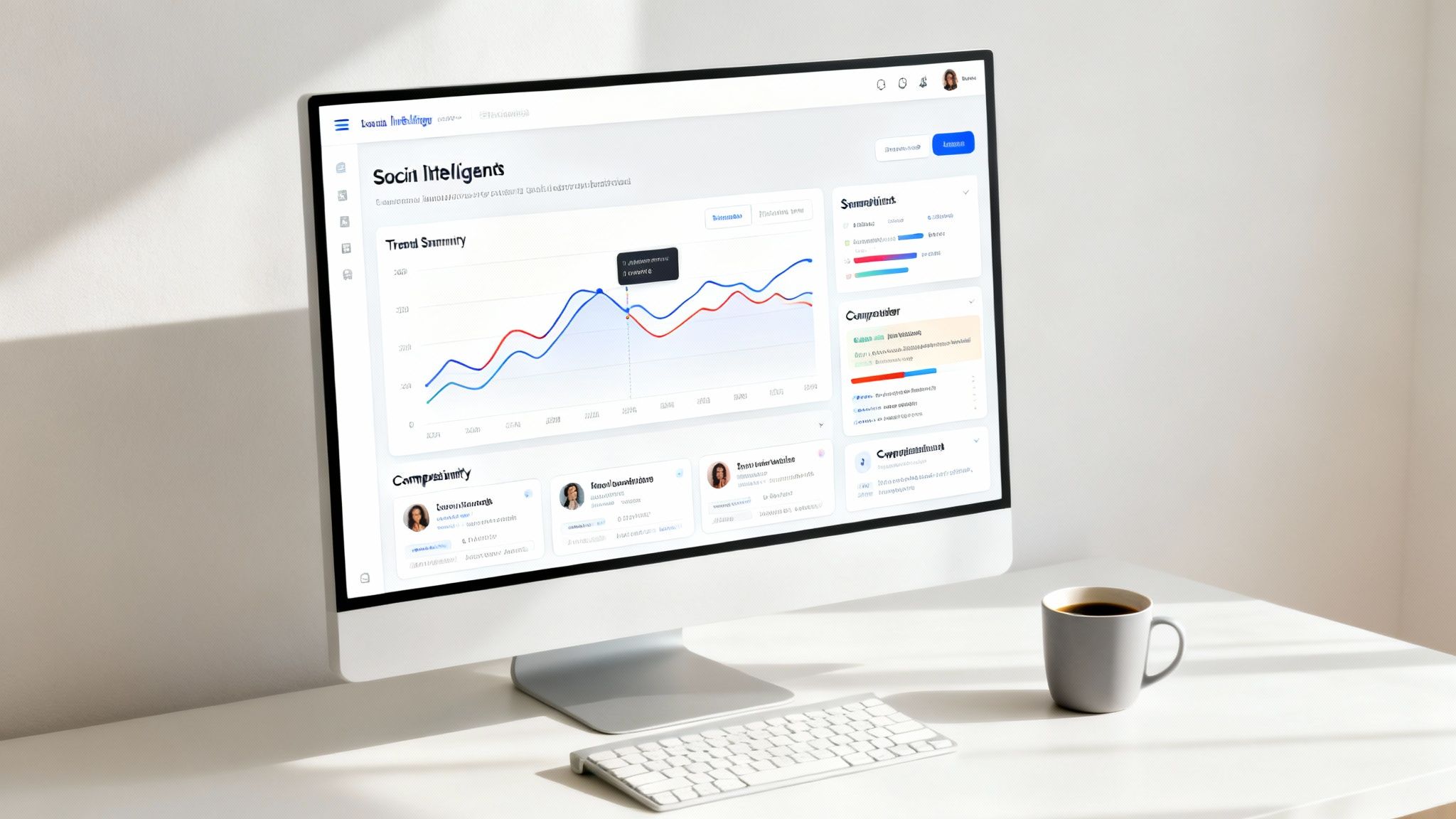
Tracking mentions is the easy part. The real work is building a system that processes thousands of data points (competitor posts, customer complaints, emerging hashtags) and translates them into clear next actions you can take the same day.
Building Your Real-Time Intelligence Dashboard
Stop thinking in terms of manual analysis. Human capacity is the bottleneck. Instead, you and I are going to build an automated intelligence pipeline.
The architecture is straightforward. You connect social listening tools like Brand24 to an LLM like Claude 3. An AI agent can monitor thousands of conversations and deliver a concise summary to your dashboard every morning.
I set this up for an e-commerce client who was constantly blindsided by competitor flash sales. I built an AI agent that:
- Monitored competitor accounts for keywords like “discount,” “sale,” and “limited time.”
- Analyzed the engagement on those announcements to gauge customer interest.
- Summarized the findings into a daily one-paragraph brief sent directly to their Slack.
The result? They went from reacting two days late to launching counter-promotions within three hours, which protected their market share.
From Sentiment Analysis to Predictive Insights
Standard sentiment analysis is table stakes. Knowing if a comment is positive or negative is useful, but it doesn’t give you a strategic edge.
I worked with a DTC brand seeing a spike in negative comments. A basic tool flagged “customer dissatisfaction.” I trained an AI model to go deeper. It found the negative sentiment was about the “unboxing experience” rather than the product, a detail the product team had missed completely.
This insight led directly to a packaging redesign. That change reduced negative social chatter by 60% and drove a surge in user-generated content. You don’t get that from a monthly report.
You can take this further with predictive analytics. By feeding an AI your historical engagement data, it can identify patterns. For more on this, I’ve detailed how to turn this data into a strategic asset in my article on how AI market intelligence turns signals into decisions.
Imagine knowing that next week, short-form videos under 30 seconds focusing on a specific product feature are 85% more likely to outperform carousel posts. That’s a data-driven prediction, and it lets you allocate resources with confidence.
A Case Study in Turning Chatter into Cash
Here’s a practical example. A B2B software company I advised used AI to monitor industry forums and LinkedIn groups.
The AI agent ignored brand mentions. It was trained to identify conversations about specific operational pain points that their software could solve. It flagged a recurring theme around “manual data entry errors.”
Armed with this insight, their marketing team launched a targeted campaign with social posts and ads centered on solving that exact problem. This hyper-relevant campaign generated over $150,000 in new pipeline in its first quarter. Their competitors, still talking about generic “efficiency,” missed the opportunity completely.
That’s the difference. Your competitors listen to what’s said about them. You should be listening for the market gaps they can’t see.
Squeezing Every Drop of Value from Your Ad Spend with AI
Let’s be honest about your ad budget. For too many businesses, social ad spend feels like a slot machine. You feed money in, pull the lever, and hope. This is a surefire way to burn cash.

Running social ads without AI today is like trying to navigate a new city with a paper map while everyone else uses Waze. You might get there, eventually, but you’ll arrive long after your competitor has already closed the deal. It’s time to stop guessing and start engineering predictable returns.
This is where AI for social media marketing creates a big advantage: it turns your ad spend from a volatile expense into a predictable, revenue-generating machine.
Going Way Beyond Basic Platform Targeting
If you’re only relying on the built-in targeting from Meta or LinkedIn, you are leaving money on the table. They’re built for the masses. Your edge comes from building predictive models trained on your own first-party data.
I start by feeding an AI model the attributes of your highest-LTV customers. The model’s job is to chew on this data and build a predictive profile of your next best customer.
The result? Lookalike audiences that are exponentially more accurate. I worked with an e-commerce brand whose ROAS was stuck at 2.5x. By building a custom predictive audience model, I pushed their ROAS to 4x in just 60 days.
Your conversion data is a blueprint for future success. AI is the only tool that can read that blueprint at scale and find customers who are likely to buy instead of merely clicking.
The competition for attention is only getting fiercer. Social media ad spend is projected to hit $277 billion globally in 2025, growing 13.6% year-over-year. As you can see in the latest global overview report, winning means building intelligent systems that can out-think the competition.
Scaling Ad Creative with Generative AI
Getting the audience right is only half the battle. You still have to feed them compelling ad creative. The old method of manually A/B testing two or three variations is too slow.
Generative AI changes that. With a well-engineered prompt, you can generate dozens of ad variations in minutes: copy, headlines, image concepts, and video outlines.
Here’s a practical framework I use:
- Start by nailing the core angle, the single most important pain point this ad must communicate.
- Then feed the AI your detailed customer persona, including their specific vocabulary, motivations, and fears.
- Finally, prompt the model to generate 10 headline variations using different copywriting formulas and 5 body copy variations using different emotional tones.
This process lets you launch campaigns with a huge volume of creative assets from day one. AI-powered ad platforms then rapidly test these combinations, automatically shifting budget to the winners. It’s A-to-Z testing, and it’s always on.
This system transforms creative development from a bottleneck into a high-speed pipeline. You discover what resonates faster and start winning ad auctions while competitors are stuck in a meeting debating which headline to test next week.
Keeping Your Brand Voice Human in an AI World
Let’s be honest. Scaling your social media with AI offers incredible speed, but speed without control is just a faster way to crash. Many businesses get mesmerized by the volume and forget to build guardrails.
This is all about control. How do you make sure every piece of AI-generated content sounds like it came from you? The answer is a solid governance document. It’s the line separating businesses that win with AI from those that create a brand identity crisis.
Create Your Brand Voice & Governance Bible
The single most important asset in your AI stack is a document. I call it the Brand Voice & Governance Bible. Treat it as a technical specification you feed directly into your AI models as core context, and keep fluffy mission-statement language out of it.
This document must be explicit. It should include:
- A tone and style spectrum that defines your voice within a specific range. Are you “authoritative but approachable”? Give concrete examples of phrases that fit and phrases that don’t.
- A lexicon listing your company-specific terms, product names, and acronyms, with rules on how to use them.
- Ethical guardrails. What topics are off-limits? What’s your official stance on sensitive issues? This is your safety net.
Your brand voice is your competitive moat. A well-defined governance document keeps your AI inside the walls of that moat, so your brand stays distinct in a noisy market.
The Human-in-the-Loop Imperative
Let’s get one thing crystal clear: full automation of your social media content is a trap. The most effective AI for social media marketing systems are always built on a human-in-the-loop workflow. The AI generates the first draft (the 80% solution), and a skilled human editor, often you, provides the final sign-off.
This person acts as the strategic filter, checking for nuance, emotional resonance, and alignment with real-time conversations. For one of my B2B SaaS clients, this workflow slashed content creation time by 70%. That final human touch was responsible for the posts that drove the highest engagement, every time.
Knowing When to Turn the AI Off
Knowing when not to use AI is just as critical as knowing when to use it. There are specific situations where automation is a liability and human empathy is your only asset.
Do not use AI for these three things:
- During a brand crisis, every word matters, and the situation demands deep empathy and human judgment that an AI cannot replicate.
- When a customer is angry or frustrated, an automated response is infuriating. You or a trained human must handle those conversations.
- High-value personal outreach, like connecting with a key influencer or a major potential client, require genuine, handcrafted communication.
Building an AI-powered system gives you scale you couldn’t reach by hand. Knowing when to pull the human lever keeps that scale from costing you your brand’s authenticity.
Your First AI-Powered Social Media Playbook
Alright, enough theory. Time to get your hands dirty. Let’s wrap this up into a playbook you can start using the second you finish this guide.
Forget the paralysis of a million different AI tools. Real momentum comes from starting small, banking a few quick wins, and then scaling aggressively. The goal is simple: get your first AI-driven campaign live and profitable.
Your Starter Toolkit
Your tech stack will grow, but you need a solid foundation. The name of the game is capability, not complexity. Here’s a lean toolkit based on what I deploy with my clients.
- If you’re starting free, use Meta’s Llama 3 for text generation. For scheduling, a free account with a tool like Buffer will handle the basics. Scrappy, but it works.
- On a lean budget (under $100/mo), you hit the sweet spot. Your core investment should be a subscription to a top-tier model like Claude 3 Opus or GPT-4. Then, add a specialized tool like Flick for its AI copilot features.
- At the growth stage ($100+/mo), once you have traction, combine your premium model with a fuller platform like FeedHive. Its content recycling and conditional posting features save a lot of manual work.
Go-To Prompt Templates for Immediate Execution
These are structured frameworks built to drive business results. Copy, tweak, and put them to work.
1. For Data-Driven Ideation
Turn your best-performing content into a goldmine of new ideas.
Act as a senior social media strategist. Analyze the attached transcript of our top 5 performing YouTube videos. Identify the 3 core themes that drove the highest audience retention. Now, generate 10 LinkedIn post ideas based on these themes, each with a strong hook, a contrarian viewpoint, and a call-to-action asking for audience input.
2. For High-Converting Ad Copy
When you need copy that sells, precision is key.
Using our Brand Voice Bible [attached], act as a direct response copywriter. Write 5 Facebook ad primary text variations for our new [product/service]. Each variation must use the Problem-Agitate-Solution (PAS) framework and address the primary pain point of our [customer persona]. Incorporate the keyword "[your keyword]" and end with a clear, urgent call to book a demo.
Your 30-Day Implementation Plan
Don’t overthink this. Pick one channel to start. My recommendation is LinkedIn for B2B or Instagram for B2C.
- In week 1, lay the foundation: build your Brand Voice Bible and choose your starter toolkit.
- Week 2 is for ideation and creation. Use the ideation prompt to generate 20 post ideas. Pick the best 10 and get the drafts ready.
- Week 3 is execution. Go live. Schedule and publish 5 of your AI-assisted posts. Watch the engagement signals daily.
- Week 4 is for analysis and scaling. Analyze the results. Find the pattern, double down on that theme, and start prepping to launch your first AI-assisted ad campaign.
This simple playbook is your on-ramp. Once you’ve got these basics down, you might find my guide on how to use AI for marketing helpful.
Remember, the point is to build momentum and prove the ROI. While your competitors are stuck in meetings talking about AI, you’ll already be executing.
Frequently Asked Questions
I’ve covered a lot of ground. These are the questions I hear most often from founders and small marketing teams. No fluff, just straight answers.
Can AI Really Replace My Social Media Manager?
No. That shouldn’t even be the goal. Think of AI as a force multiplier. It automates the 80% of repetitive work that bogs down your team.
This frees up your social media manager to focus on the high-value 20%: strategy, community engagement, and creative direction. The real win is building a “bionic” team where human strategists are amplified by AI agents.
How Much Should I Budget for AI Tools?
You can start for free. Using open-source models like Llama 3 and the free tiers of various tools, you can build a functional workflow with a $0 investment. It’s a scrappy way to prove the concept.
For a small team, a realistic starting budget is $50-$150 per month. This gets you more powerful models like Claude 3 or GPT-4 and a specialized social media tool. A great place to start your research is to explore the best AI tools for digital marketing.
What’s the Biggest Mistake Companies Make?
The single biggest mistake is chasing shiny tools instead of building a solid system. Companies get excited about new AI software, buy it, and then have no real strategy for how it fits into their workflow.
Don’t ask, “What AI tool should we buy?” Instead, ask, “What’s the single biggest bottleneck in our social media process that’s costing us revenue?” Then, find the right AI application to fix that specific problem.
Strategy first, tools second. Always.
This approach guarantees that every dollar you invest in AI is tied to a tangible result.