
Statista’s forecasts put the global AI market between roughly $826 billion and more than $1.2 trillion by 2030, and generative AI is the fastest-growing segment. I treat those numbers as a directional signal only. Forecasts measure different things, and trust, accuracy and approval requirements shrink the demand you can actually capture.
Most founders read an AI market forecast as a permission slip to spend. A large projected market appears, investors get excited, and the business starts hiring or building before anyone can answer the only question that matters: which dollars will become revenue rather than permanent pilot costs?
I've tested enough AI claims inside real companies to distrust a single market-size number. Forecasts help me choose where to look. They don't tell me what to build, which customer will pay, or whether the workflow can survive accuracy, privacy, and approval requirements.
The useful opportunity is narrower and more practical. AI creates opportunities. Agents and workflows make them yours. I use market forecasts to find the openings, then build small systems that capture them and measure what breaks.
Here's the operating rule I'd use this week: treat the forecast as a directional signal, then demand evidence at the level of a customer, workflow, and margin.
Table of Contents
- Why the AI Market Forecast Matters Less Than You Think
- What an AI Market Forecast Actually Measures
- The Headline Numbers From the Major Analysts
- Generative AI as the Fastest-Growing Segment
- The Trust Gap That Quietly Shrinks the Market
- Turning Forecasts Into a Founder and Marketer Playbook
- What to Change on Monday and How to Know It Worked
Why the AI Market Forecast Matters Less Than You Think
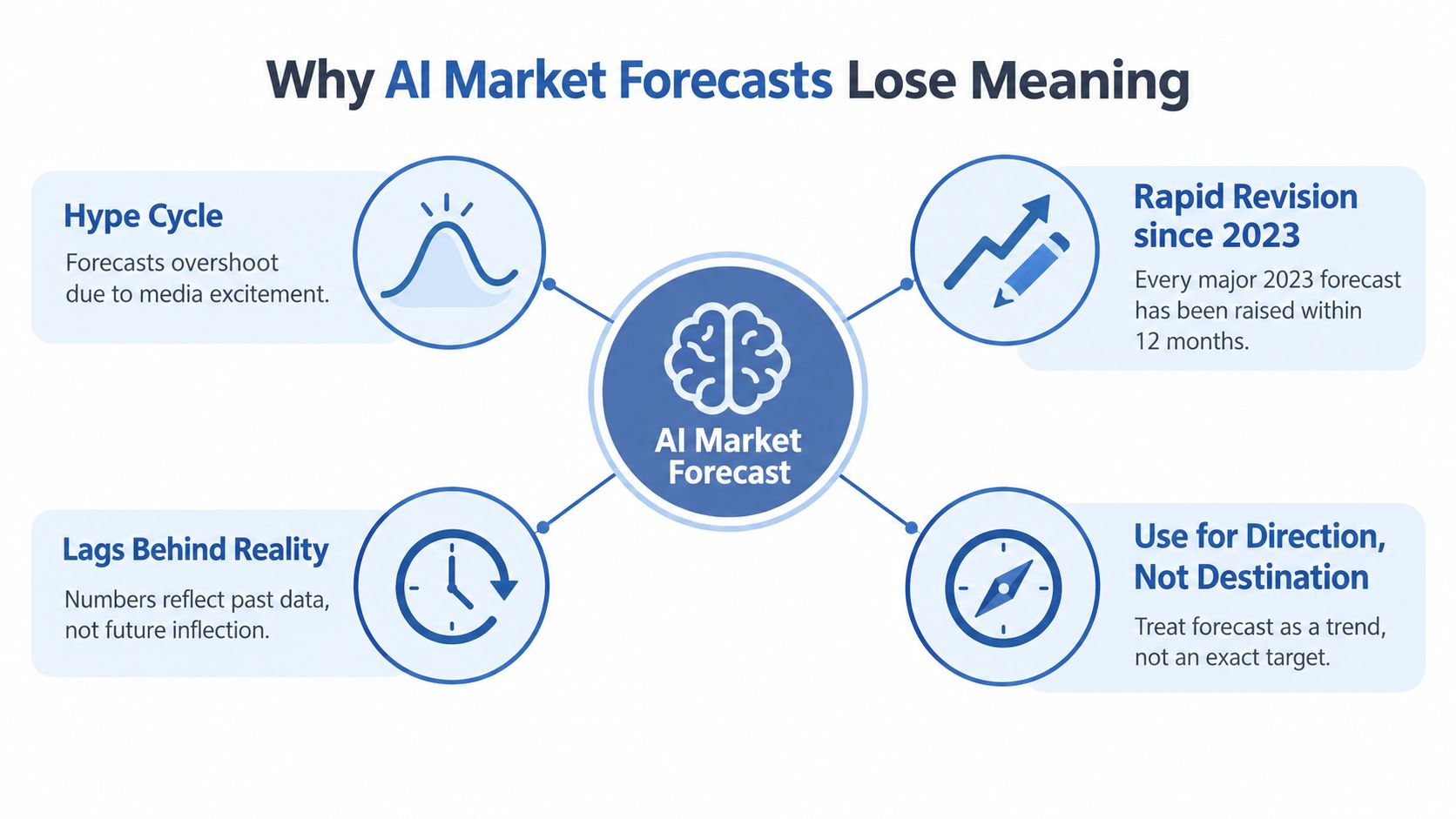
The popular advice is to chase the largest AI category and move quickly. That confuses market spending with revenue a company can capture.
Statista estimates the global AI market at nearly $260 billion in 2025 and projects it above $1.2 trillion by 2030, implying roughly a fourfold increase in five years (Statista's AI market forecast comparison). Another Statista forecast places the market above $184 billion in 2024 and above $826 billion in 2030. The difference is substantial, and it appears before examining the definitions behind each estimate.
That gap changes how founders should use forecasts. One report may count software revenue, another may include services, infrastructure, hardware, or broader economic value. Reports can use the same phrase, “AI market,” while measuring different pools of activity.
My rule: never set a budget from a market-size headline. Set it from a customer problem, a measurable outcome, and a credible path to payment.
I watched a Series B founder raise on the strength of a $1.3 trillion AI market projection. The pitch sounded persuasive until enterprise buyers entered the process. 70% of the company's enterprise deals stalled because procurement required ROI proof that the vendor ecosystem could not yet provide.
That example exposes the issue: projected spending can grow faster than realized ROI. Capital may enter a category before buyers know how to approve purchases. A company can sell into a fast-growing market and still lose money when implementation takes too long, results are difficult to verify, or legal teams block deployment.
I read forecasts through four practical lenses:
- Forecast mechanics: What exactly is measured?
- Headline numbers: Which assumptions changed between reports?
- Segment growth: Where is budget moving fastest?
- The trust gap: How much demand survives accuracy, privacy, and approval constraints?
The useful operating signal is the distance between forecasted AI spend and realized monetization. Founders should use that distance to test one workflow, one buyer, and one measurable return before expanding investment.
What an AI Market Forecast Actually Measures
An AI market forecast is a probabilistic estimate of future revenue or spending across technologies that enable or deliver artificial intelligence. Depending on the publisher, that can include hardware, software, cloud infrastructure, services, implementation, and related commercial activity.
The category boundary comes first. If you don't know the boundary, the number has little decision value.
Four ways analysts build the estimate
| Methodology | Primary data source | Strength | Main weakness |
|---|---|---|---|
| Top-down macroeconomic modeling | Economic indicators and investment assumptions | Gives a broad view of possible market scale | Macro models can lag sudden technical or adoption changes |
| Bottom-up vendor revenue aggregation | Company filings, earnings, and revenue estimates | Ties the forecast to identifiable suppliers | Can miss private-company spending and unreported internal work |
| Adoption-curve diffusion | Survey panels and assumed adoption patterns | Helps model how usage may spread | Assumes buyers adopt in relatively rational patterns |
| Bottom-up use-case TAM stacking | Estimated value across individual applications | Connects spending to specific use cases | Can count the same buyer budget more than once |
The data feeding these models usually comes from earnings transcripts, capital expenditure disclosures, cloud consumption data, government research budgets, and survey panels. A research agent can help you collect those inputs, but it won't remove the judgment required to define the market. I've documented that collection approach in this guide to AI research agents.
A founder doesn't need to reproduce an analyst model. You need to interrogate it before using it.
Ask three questions:
- What methodology produced the number? A vendor aggregation forecast means something different from a use-case value forecast.
- What's the base year? A fast-growing endpoint can look larger or smaller depending on whether the model starts before or after a major adoption shift.
- What does “AI” include? Infrastructure and model access produce a different opportunity from customer-facing applications.
These questions also expose why forecasts get revised. Analysts update assumptions when vendors report new spending, buyers change behavior, or a category gets redefined. The revision is useful evidence, but it's evidence about changing expectations rather than a promise about your revenue.
For your own planning, create a one-page forecast record with the report date, base year, included categories, methodology, and the assumption most likely to fail. That small habit stops a persuasive number from becoming an accidental business plan.
The Headline Numbers From the Major Analysts
Treat the headline forecast as a budget signal, not a business plan. The well-documented forecasts support a range of outcomes. Many roundups also quote IDC, Bloomberg, Goldman Sachs, or McKinsey figures without a traceable source, and repeating those numbers creates false precision.
Statista's comparison shows the spread clearly. One forecast places the global AI market at nearly $260 billion in 2025 and above $1.2 trillion by 2030. Another puts it above $184 billion in 2024 and above $826 billion in 2030 (Statista's comparison of AI market growth forecasts).
| Analyst or source | Target year | Projected value | Implied CAGR |
|---|---|---|---|
| Statista forecast A | 2030 | More than $1.2 trillion | Roughly fourfold growth from 2025 |
| Statista forecast B | 2030 | More than $826 billion | Not reported |
The gap matters more than the larger endpoint. Definition and methodology matter as much as the endpoint, especially when one estimate may include infrastructure, services, software, or downstream applications that another treats separately.
Goldman Sachs forecasts global AI investment to exceed $1 trillion in 2026 (Goldman Sachs on projected AI investment). Investment is not the same as revenue available to a small online business. Data centers, chips, and model infrastructure can absorb substantial capital before a customer sees measurable value.
Stanford HAI estimates the annual value of generative AI tools to U.S. consumers reached $172 billion by early 2026 (Stanford's 2026 AI Index). That estimate confirms meaningful user value, but it does not prove that vendors have captured equivalent revenue or that business buyers will achieve acceptable returns.
For adoption context, compare these market projections with the AI in marketing statistics breakdown. Then ask which buyer has a recurring task, enough urgency to pay, and an outcome you can verify without elaborate procurement.
Use the forecast to choose where to test, not what to promise. That is how founders and marketers turn a large AI market forecast into an operating decision.
Generative AI as the Fastest-Growing Segment
Generative AI receives the most attention because its projected growth is unusually steep and its applications are easy to demonstrate. Content generation, search, customer support, automation, and code assistance all give buyers an immediate place to test the technology.
The verified forecasts vary, but they point in the same direction. One study projects the global generative AI market at $109.37 billion by 2030, with a 35.6% CAGR from 2023 to 2030 (ResearchAndMarkets generative AI forecast). Other reported estimates put the segment at $100.5 billion by 2030 from $10.1 billion in 2023, with a 33.2% CAGR, or $128.64 billion by 2030 from $21.48 billion in 2024, with a 35.51% CAGR. Those figures use different methods, so I treat them as a directional cluster rather than interchangeable measurements.
| Analyst or study | GenAI CAGR | 2030 GenAI size |
|---|---|---|
| ResearchAndMarkets study | 35.6% | $109.37 billion |
| Other reported estimate (2023 base) | 33.2% | $100.5 billion |
| Other reported estimate (2024 base) | 35.51% | $128.64 billion |
The supply chain behind those forecasts is circular. Hyperscalers spend on infrastructure, model companies consume that capacity, businesses test copilots and agents, and adoption creates a reason for more infrastructure spending. Each layer can make the next layer appear larger.
That doesn't mean every layer offers the same opportunity to you. Hardware may capture large absolute revenue, while software layers can offer a more accessible path for a small operator. A focused workflow can create value around research, support, merchandising, content production, or internal reporting without requiring you to build a model.
The margin question is more important than the growth-rate question. If model access becomes cheaper, generic wrappers may lose pricing power. A workflow connected to proprietary customer context, reliable evaluation, and a clear business result has a better chance of retaining value.
I'd use generative AI growth as a signal to inspect buyer behavior. Find the task that already costs time or delays revenue. Then build the smallest workflow that changes one measurable number.
The Trust Gap That Quietly Shrinks the Market
Published forecasts often assume that a buyer can deploy the product once the technology works in a demo. Real buyers add conditions. They ask whether the output is accurate enough, whether sensitive data can enter the system, who reviews an autonomous action, and what happens when the model is wrong.
Capgemini reports that GenAI adoption rose from 6% in 2023 to 30% in 2025, while 71% of organizations cannot fully trust autonomous AI agents and only 46% have governance policies in place (Capgemini's 2025 generative AI research). The same research says only one in five organizations measure GenAI's environmental footprint.
Thomson Reuters found that accuracy concerns became the top barrier to increasing AI investment in 2025, with 91% of respondents saying AI should meet higher accuracy standards than humans. Those figures show why adoption can rise while realized revenue remains uneven.
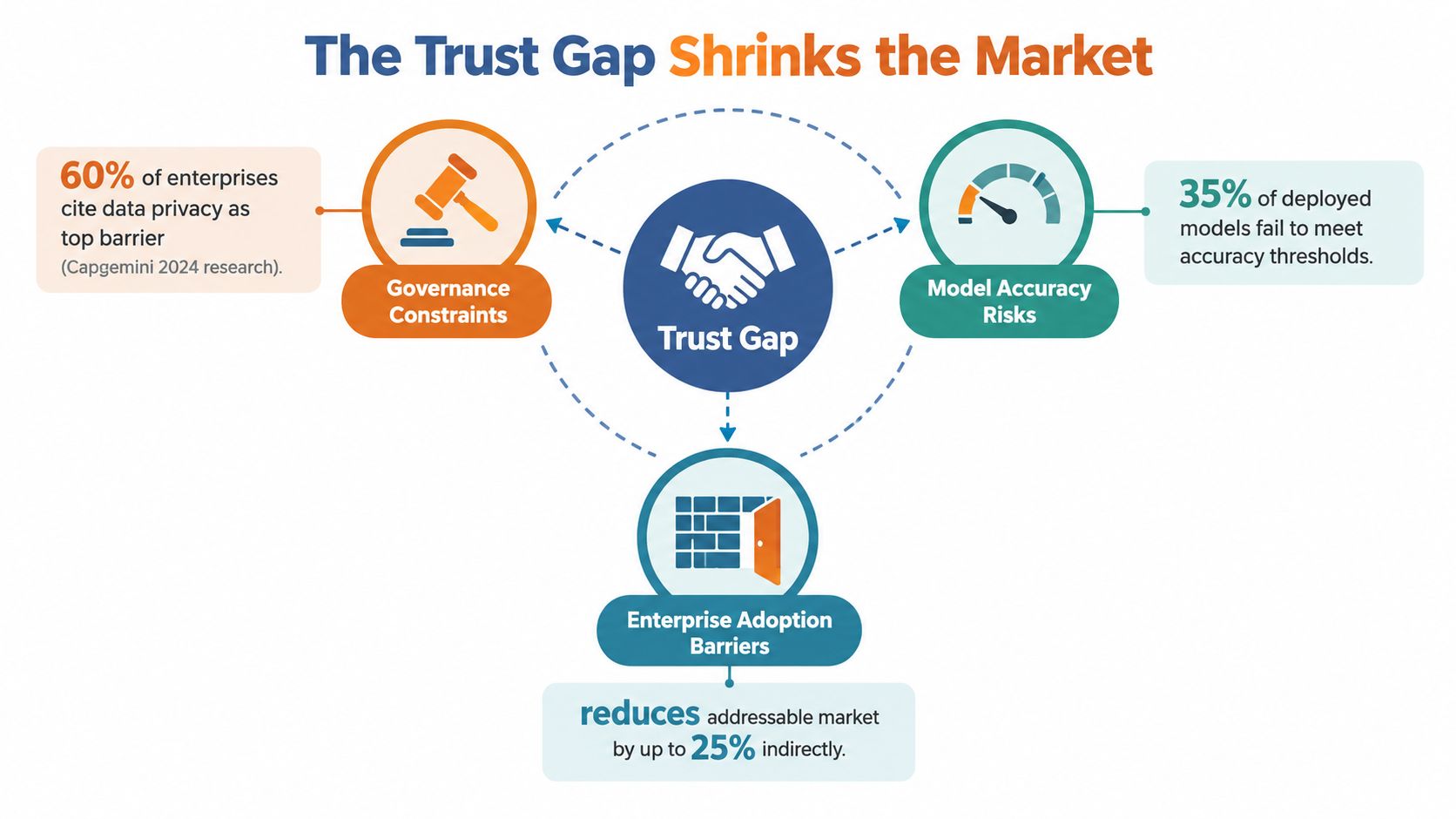
Three drags on addressable demand
Hallucination liability blocks workflows where a wrong answer creates financial, legal, medical, or reputational damage. A customer-support draft may tolerate review. An automatic refund decision may require a very different control system.
Privacy and residency constraints narrow which data can be processed, where it can be stored, and which vendors can access it. A tool that works for public content may fail when it needs private customer records.
The audit trail problem becomes sharper when an agent takes action across several systems. You need to know what it saw, what it decided, which tool it called, and who approved the result.
Don't apply a fixed percentage haircut for trust constraints. I'd model three scenarios instead: unrestricted demand, demand after your known approval constraints, and demand after the buyer's accuracy threshold is applied.
Trust isn't a tax you reluctantly pay after building the product. For a small business, trust can be the product feature that makes the workflow usable.
Start with reviewable workflows. Keep a human approval step where the cost of an error is material. Record inputs and outputs in a simple log. If you can explain how the system reached an answer, you can sell into more situations than a black box that merely sounds impressive.
Turning Forecasts Into a Founder and Marketer Playbook
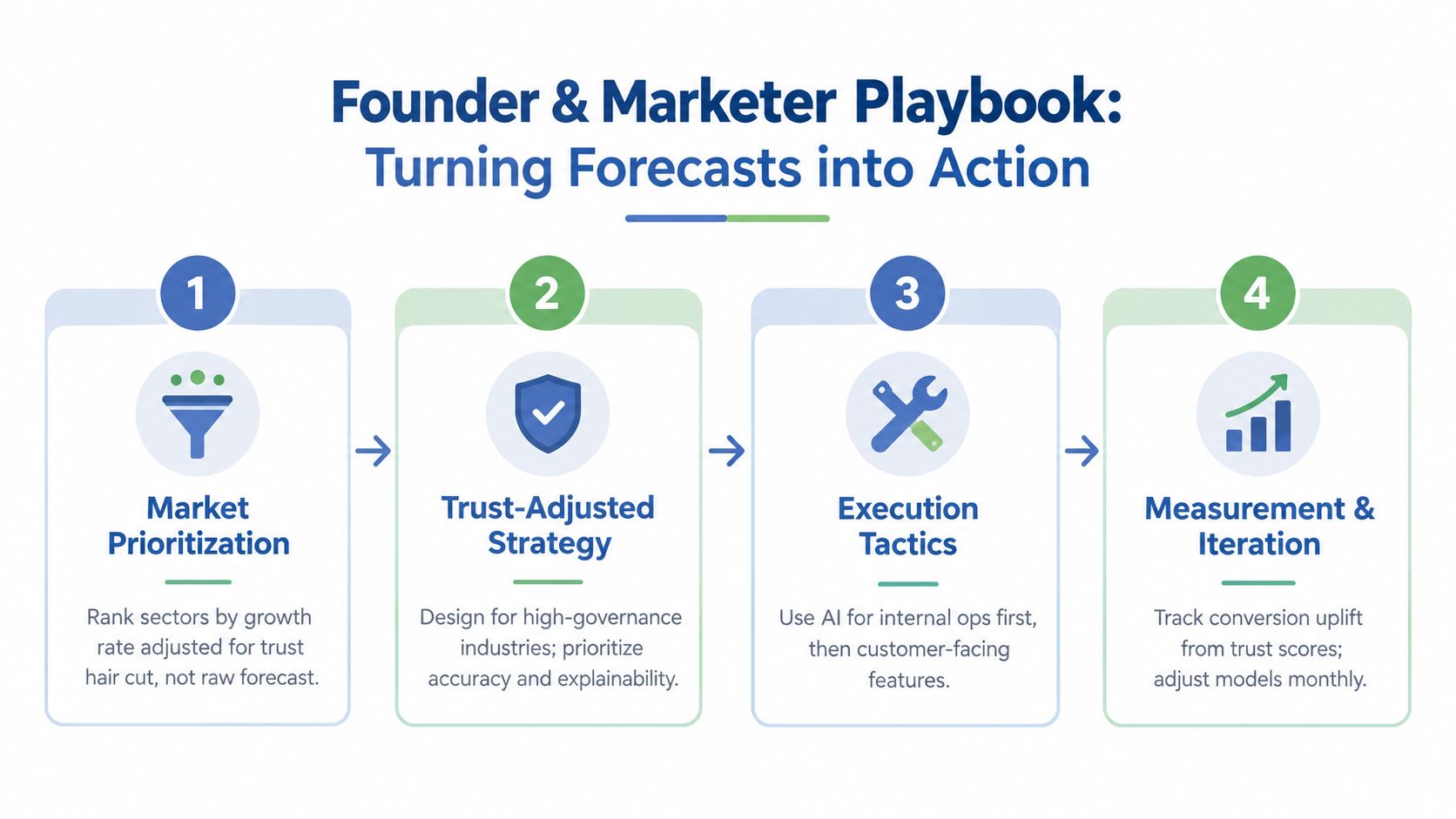
I turn an AI market forecast into four operating moves. Each one ends with a decision you can make without a large team.
1. Rank markets by usable growth
Raw forecast growth comes first, then I subtract practical friction. A category with fast projected expansion but severe data restrictions may be less attractive than a smaller category where the buyer can deploy immediately.
Create a sheet with these columns:
- Buyer: Who pays and who uses the workflow?
- Recurring task: What happens repeatedly?
- Forecast signal: Which market or segment points toward rising spend?
- Trust requirement: What accuracy, privacy, or review condition could block adoption?
- Capture path: What can you deliver this week?
- Proof metric: Which number changes if the workflow works?
Don't rank sectors by excitement. Rank them by growth multiplied by reachable access.
2. Build a revision-monitoring habit
Set a recurring research task in ChatGPT, Claude, or Gemini. Feed it new earnings transcripts, capex disclosures, pricing pages, product announcements, and buyer comments. Ask it to separate confirmed changes from interpretation.
A useful prompt is:
Compare this quarter's AI market forecast with the previous version. Extract changes to the base year, category definition, target year, endpoint, and assumptions. Quote the source text for every material change. Mark each change as higher confidence, lower confidence, or unclear. Finish with one implication for a small online business.
Run the task quarterly. Watch hyperscaler spending commentary, foundation-model pricing changes, and regulatory enforcement actions. I describe a broader AI market research report workflow for turning those inputs into a repeatable briefing.
3. Set capture-based KPIs
Don't claim a share of a trillion-dollar market. Choose the number you can influence.
For a content workflow, track qualified leads per published asset. For a support workflow, track resolved tickets requiring no correction. For an ecommerce workflow, track contribution margin after model and review costs.
Your KPI needs a baseline, a target, and a review date. If you can't state all three, you're measuring activity rather than value.
4. Create a pause rule
Write the pause rule before enthusiasm arrives. If your forecast assumption moves against you, or customer proof fails to improve, stop adding features.
A sensible rule might say: pause the build when buyers won't commit to a measurable test, when review time removes the expected saving, or when the workflow creates more correction work than it removes. Those are qualitative conditions because the right threshold depends on your economics.
The playbook is deliberately small. You don't need a market-intelligence department. A spreadsheet, a scheduled research prompt, source links, and a weekly customer conversation can reveal more than a polished market deck.
What to Change on Monday and How to Know It Worked
On Monday, don't start by reading another forecast. Start by choosing one workflow and writing down the number it must change.
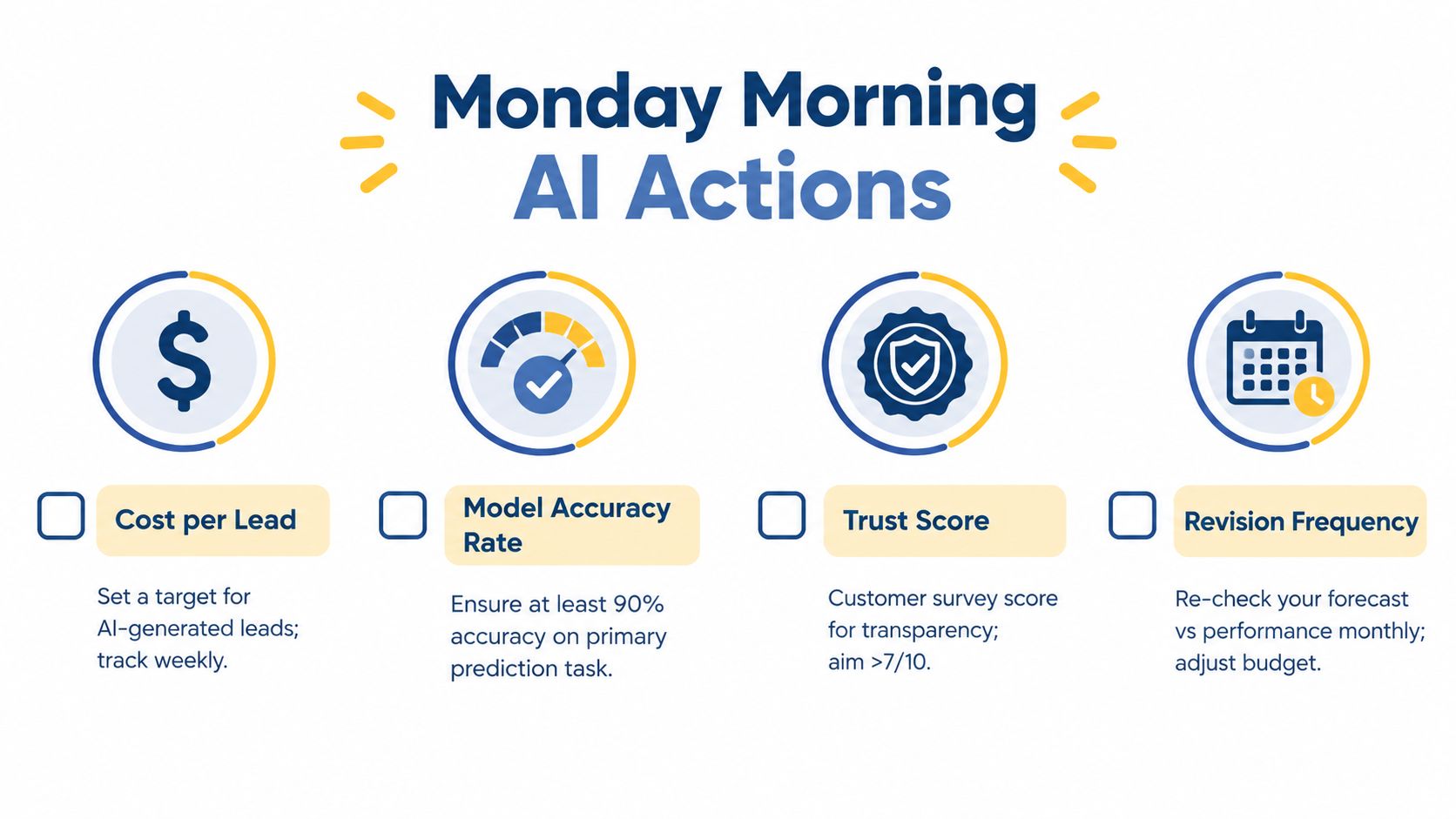
Track four operating signals:
- Forecast-to-spend conversion: Compare the spending direction described in your sources with actual buyer behavior in your category. Pull evidence from customer conversations, pricing changes, and your own pipeline. Review it monthly. If the forecast sounds strong but buyers won't test or pay, pause expansion.
- Generative AI adoption velocity: Ask target buyers which tasks they already use AI for and whether usage is increasing. Record the answers in a simple sheet and review them monthly. If adoption is growing around a task you can serve, build a narrow workflow. If usage remains casual, don't assume a paid market exists.
- Governance incident frequency: Count incorrect outputs, privacy concerns, rejected recommendations, and manual corrections. Review weekly. A rising count means you need better retrieval, narrower permissions, stronger prompts, or a human approval step before adding volume.
- Position relative to segment growth: Compare your own customer and revenue movement with the segment direction you're tracking. Review quarterly. If your category appears to grow while your conversion or retention stays flat, the forecast isn't solving your positioning problem.
The Monday build should be concrete. Open a spreadsheet, create one row for each target workflow, paste the source evidence, and add columns for buyer, task, cost, expected result, trust requirement, and next test.
Then run one controlled test. Use the existing process as the comparison. Measure the number tied to the business outcome, such as qualified leads, contribution margin, support corrections, or hours saved. Don't count prompts created or documents generated as success.
I've seen three failure modes repeatedly. Teams hire ahead of projected market size, build features for hypothetical segments, and ignore trust problems until customers leave. The forecast didn't cause those mistakes. Treating it as strategy did.
The specific number to watch is the one closest to money. A forecast can tell you where attention is moving. Only your workflow test can tell you whether that attention creates revenue.
On Monday, choose one AI workflow, record its baseline, and run a test against a business number that matters. If you want the weekly version of this work, I continue tracking practical AI opportunities, operating systems, and failure points in Bionic Business.
Frequently Asked Questions
How big is the AI market expected to be by 2030?
It depends on the forecast. One Statista estimate puts the global AI market at nearly $260 billion in 2025 and above $1.2 trillion by 2030. Another puts it above $184 billion in 2024 and above $826 billion in 2030. Much of the gap comes from definitions, since some reports count software alone while others add services, infrastructure or hardware.
How fast is the generative AI market growing?
Generative AI is the fastest-growing segment of the AI market. One study projects $109.37 billion by 2030 with a 35.6% CAGR from 2023. Other estimates land at $100.5 billion with a 33.2% CAGR, or $128.64 billion with a 35.51% CAGR. The methods differ, so read them as a directional cluster instead of interchangeable measurements.
Why do AI market forecasts differ so much?
Analysts build them differently, using top-down macroeconomic models, vendor revenue aggregation, adoption-curve diffusion or use-case TAM stacking. They also draw different category boundaries, so one report may count infrastructure and services while another counts software alone. Base years shift the picture too. Before you use a number, check the methodology, the base year and what the report counts as AI.
Is AI investment the same as AI market revenue?
No. Goldman Sachs forecasts global AI investment to exceed $1 trillion in 2026, but a large share of that capital goes into data centers, chips and model infrastructure long before a customer sees measurable value. Investment tells you where money is flowing. It does not tell you how much revenue a small online business can capture.
What holds real AI adoption below the forecasts?
Trust. Capgemini reports that GenAI adoption rose from 6% in 2023 to 30% in 2025, while 71% of organizations cannot fully trust autonomous AI agents. Thomson Reuters found accuracy concerns became the top barrier to more AI investment in 2025. Hallucination liability, privacy and residency limits, and missing audit trails all shrink the demand a vendor can actually reach.
How should a small business use an AI market forecast?
Use it to choose where to test, then demand proof from a real buyer and a measurable workflow. Rank opportunities by growth multiplied by reachable access, set a KPI with a baseline, target and review date, and write a pause rule before enthusiasm arrives. Never set a budget from a market-size headline.