
Most advice on how to do market research is slow, bloated, and outdated the second you finish reading it. It tells you to run a few surveys, skim competitor sites, dump findings into a slide deck, and call that strategy. That's administrative theater dressed up as strategy.
I'm Samuel Woods, and I treat market research as an ongoing, AI-powered market intelligence system that helps you move faster than competitors who are still waiting for quarterly reports, agency decks, or a meeting to decide what they already should've known last week.
The businesses that win build a repeatable way to spot shifts early, validate demand quickly, and turn signal into action before the rest of the market catches up.
Table of Contents
- Your Competitors Are Flying Blind You Should Not Be
- Start with the Decision Not the Data
- Build Your Automated Intelligence Engine
- Get Ground Truth Faster Than Ever
- Map the Battlefield and Choose Your Target
- Translate Insight into Action and Market Share
- The Market Is Talking Are You Listening
Your Competitors Are Flying Blind You Should Not Be
Most founders still approach research like they're writing a college paper. They gather a pile of notes, summarize what everyone already knows, and feel productive because the document looks polished. Meanwhile, the market changes.
That old approach creates a blind spot you can exploit. If your competitor reviews the market occasionally, and you monitor it continuously, you'll see changes in messaging, pricing, positioning, customer complaints, and category shifts before they do. Speed becomes strategy.
The smarter model is simple: build a sensory system instead of a report. It should pull in competitor changes, customer language, category signals, and internal performance data on a steady cadence, then use AI to synthesize what matters.
The old model loses on timing
Traditional research is too episodic for modern markets. By the time a team scopes a project, collects sources, interviews customers, and presents findings, the conclusion is often already stale.
That gap is where fast-moving operators win. They don't wait for certainty. They create faster feedback loops, then refine.
Research that arrives after the decision window closes has no strategic value.
This matters even more in SaaS and fast-moving digital markets, where positioning can shift quickly. If you want a practical lens on competitive positioning mechanics, these SaaS market positioning insights are useful because they force you to look at how competitors frame value as well as what features they list.
What you actually need
Your market research system should answer questions like:
- What changed this week? Competitor homepage copy, pricing pages, product updates, hiring language, and review themes.
- What do customers keep repeating? Pain points, objections, desired outcomes, workarounds, and switching triggers.
- What deserves action now? Messaging tests, feature bets, pricing experiments, and segment prioritization.
If you do this well, you stop reacting late. You start seeing the market with enough clarity to move first.
Start with the Decision Not the Data
It's common for market research to begin with curiosity. Bad move. Curiosity creates sprawling research projects, bloated dashboards, and interviews that feel insightful but change nothing.
Start with the business decision. Always.

The U.S. Small Business Administration notes that many businesses lack a repeatable process for turning research into action, which helps explain why only 18% of small businesses use business data most of the time or always to make decisions in its guidance on market research and competitive analysis. This is the core failure mode: a lack of decision discipline, more than a lack of data.
Pick one business decision
Before you collect anything, write down the exact call you need to make. It should be a decision, rather than a topic or an area of interest.
Good examples:
- Should you enter this segment
- Should you reposition the offer around speed, price, or outcomes
- Should you keep this pricing model
- Should you build this feature now or later
- Should you expand into this market
Weak examples look like this:
- Understand your audience better
- Learn more about competitors
- Get market insights
- See what customers think
Those are inputs. They are not decisions.
Define the cost of being wrong
You and I should care about research only when it reduces expensive mistakes or reveals a faster path to revenue. If the answer won't change what you build, sell, price, or target, don't research it yet.
Ask three questions:
- What decision will this inform? Be precise about the next move.
- What happens if you guess wrong? Lost time, bad positioning, wasted ad spend, or product drift.
- What evidence would change your mind? Customer interviews, pricing feedback, review analysis, win-loss patterns, or competitor messaging changes.
This is also where a decent reporting layer matters. If your findings can't connect back to operating metrics, they'll die in a doc. A practical way to close that gap is to connect research with marketing analytics dashboards so you can compare market signals against performance, not opinions.
A practical rule: if a research task doesn't tie to a decision owner and a business action, cut it.
Build a tighter brief
A solid market research brief should fit on one page. Mine usually includes:
- The exact decision you need to make.
- The deadline for making it.
- The few signals that would materially improve confidence.
- Your constraints on budget, time, access to customers, and internal data.
- The action threshold, meaning what evidence is enough to move.
That last point matters. Founders often wait for perfect clarity. Competitors love when you do that.
Build Your Automated Intelligence Engine
Manual secondary research is too slow. You open tabs, read articles, check review sites, skim competitor pages, maybe save a few screenshots, then promise yourself you'll synthesize it later. You won't. Or you will, once, and then the system dies.
Secondary research should run continuously in the background, not depend on someone having spare time.
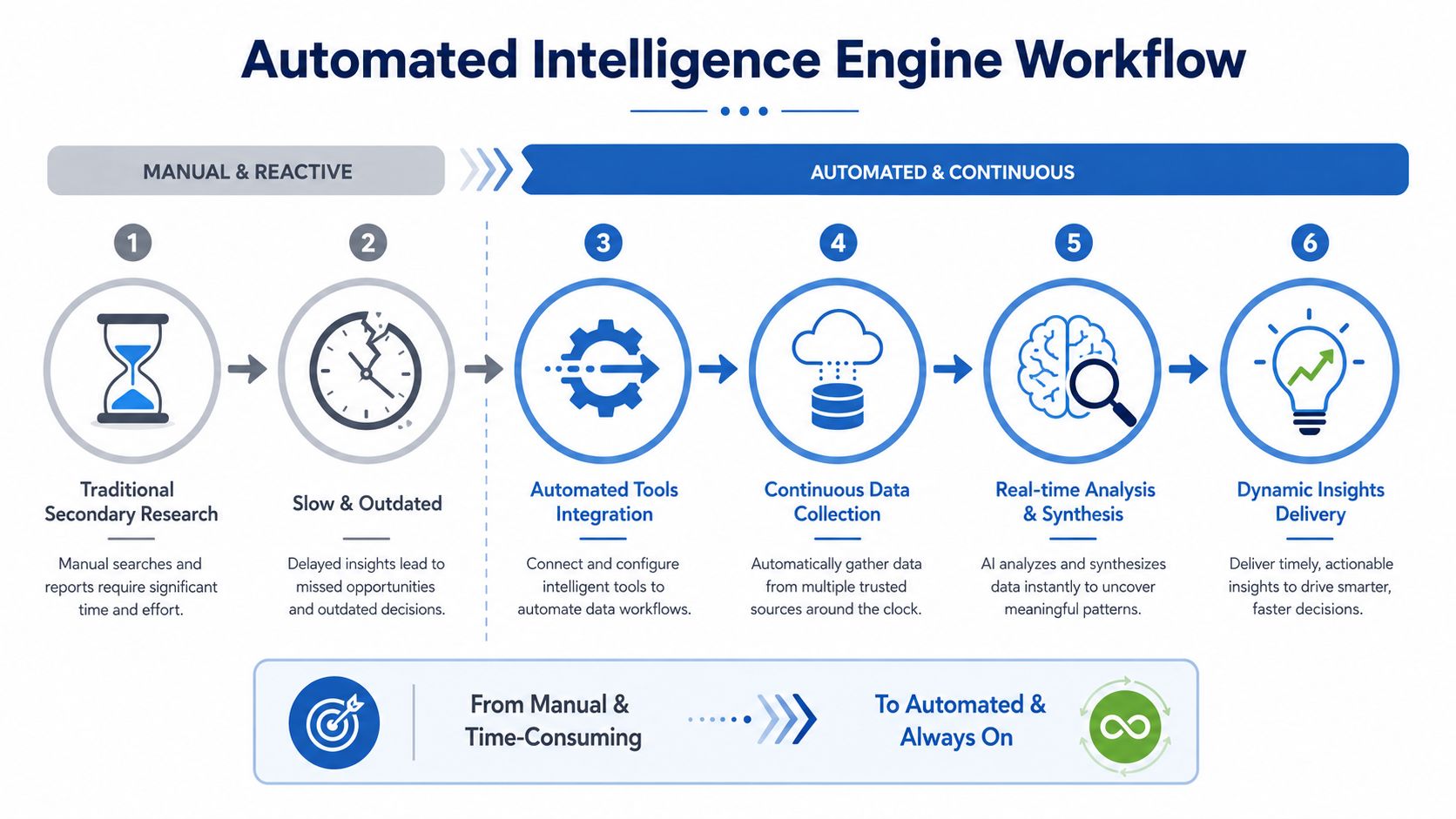
Harvard Business School's discussion of underserved market needs highlights the need for ongoing observation, and it cites McKinsey's finding that 65% of organizations were regularly using generative AI in 2024. What matters is that AI changes how frequently you can update your research, as noted in this overview of finding needs in the market.
Turn secondary research into a live feed
A strong intelligence engine tracks a few categories relentlessly.
- Competitor properties such as homepage copy, product pages, pricing pages, changelogs, help docs, and job listings.
- Customer conversation zones like Reddit threads, LinkedIn comments, review platforms, support communities, and niche forums.
- Category movement in news, funding announcements, partnerships, launches, analyst commentary, and regulatory shifts.
- Your internal signals, including search queries, support tickets, call notes, demo transcripts, CRM loss reasons, and campaign performance.
This is why secondary research matters so much. It uses existing sources, and when you automate collection, you build a current market map without paying to rediscover what's already observable.
Use AI to structure the noise
Businesses rarely lose because data is unavailable. They lose because nobody has time to normalize it.
Here's the AI workflow I prefer:
- Collect updates from competitor pages, news feeds, reviews, and community posts.
- Classify each item by topic such as pricing, onboarding, integrations, complaints, switching triggers, or positioning angle.
- Summarize the change in plain language.
- Compare it against prior snapshots so you can spot movement over time.
- Route the insight to the right owner. Product, sales, growth, or founder.
A lot of this can be handled with AI agents, scheduled prompts, and simple automations. If you want a working example of an AI tool for market research, that type of setup is useful as a reference point for how structured analysis can be generated from messy inputs.
Later, when you need these research streams connected to operational decisions inside the business, I can help you build custom agent workflows for it.
Use the video below as a mental model for where this is going. Less manual gathering. More automated synthesis.
Prompts that produce decision-grade output
Most prompts are too vague. They ask AI to “analyze competitors” and then wonder why the output sounds like intern filler.
Use prompts that force structure. For example:
Review these competitor page snapshots and identify changes in positioning, pricing language, ICP signals, and proof elements. Classify each change as offensive, defensive, or neutral. Then recommend what our team should monitor next.
Or this:
Analyze these review excerpts and cluster repeated complaints by job to be done, failed expectation, switching trigger, and perceived alternative. Output only themes that appear across multiple excerpts.
Or this:
Compare our homepage messaging with these three competitors. Identify where our claim is generic, where their differentiation is clearer, and what buyer anxiety each company is trying to resolve.
Don't ask AI for truth. Use it to compress raw material into something a human can verify and act on fast.
Get Ground Truth Faster Than Ever
Secondary research tells you what's visible. Primary research tells you what buyers mean. You need both.
A basic rule for how to do market research is to split the work into primary and secondary research, then combine them. Primary research collects new firsthand data from surveys, interviews, and focus groups, while secondary research uses existing sources such as public records, government databases, industry reports, and academic publications. The strongest programs use secondary to build the map and primary to confirm where your business fits on it, according to this guidance on research methods for marketing.
Use secondary first and primary second
Founders get this backward all the time. They launch surveys before they understand the category. They interview random people before they've mapped competitors or identified the likely buying triggers.
Do this instead:
- Start with existing evidence by reviewing demand signals, competitor positioning, customer reviews, and internal performance data.
- Find the gaps. What do you still not know about the buyer, the objection, or the offer?
- Run focused primary research, interviewing or surveying only to close those gaps.
That sequence saves time and money because you don't waste primary research on questions secondary research already answered.
Don't ask customers to explain a market you haven't studied yet.
Primary research methods traditional vs AI-powered
You don't need slow research ops to get useful primary insight. You need tighter scoping and better processing.
| Task | Traditional Method (Weeks) | AI-Powered Method (Days) |
|---|---|---|
| Interview guide creation | Weeks | Days |
| Survey draft and revision | Weeks | Days |
| Transcript review and coding | Weeks | Days |
| Open-text response clustering | Weeks | Days |
| Theme extraction across interviews | Weeks | Days |
| Insight summary for leadership | Weeks | Days |
AI compresses the grunt work so you can spend more time on interpretation. The thinking is still yours.
Where AI helps and where it should not lead
Use AI aggressively in three places:
- Let it help with question design by drafting survey questions, tightening interview flows, and removing duplication.
- Let it handle processing: transcribing calls, summarizing interviews, clustering responses, and tagging recurring themes.
- Let it handle synthesis, pulling together dozens of comments into a short list of objections, desired outcomes, and language patterns.
Don't let AI lead when nuance matters most.
- Don't outsource respondent selection. Bad participants produce bad insight.
- Don't trust synthetic certainty. AI can overstate patterns that need human review.
- Don't skip direct exposure. Founders should still hear real buyers in their own words.
For qualitative customer discovery, HubSpot recommends recruiting about 10 participants per buyer persona, prioritizing people who interacted with your company within the last 6 to 12 months, and including recent buyers, competitor buyers, and non-buyers to reduce sample bias in its guide to market research across the buyer's journey. That's practical guidance because it forces contrast instead of letting you hear only from happy customers.
Map the Battlefield and Choose Your Target
Market research is target selection.
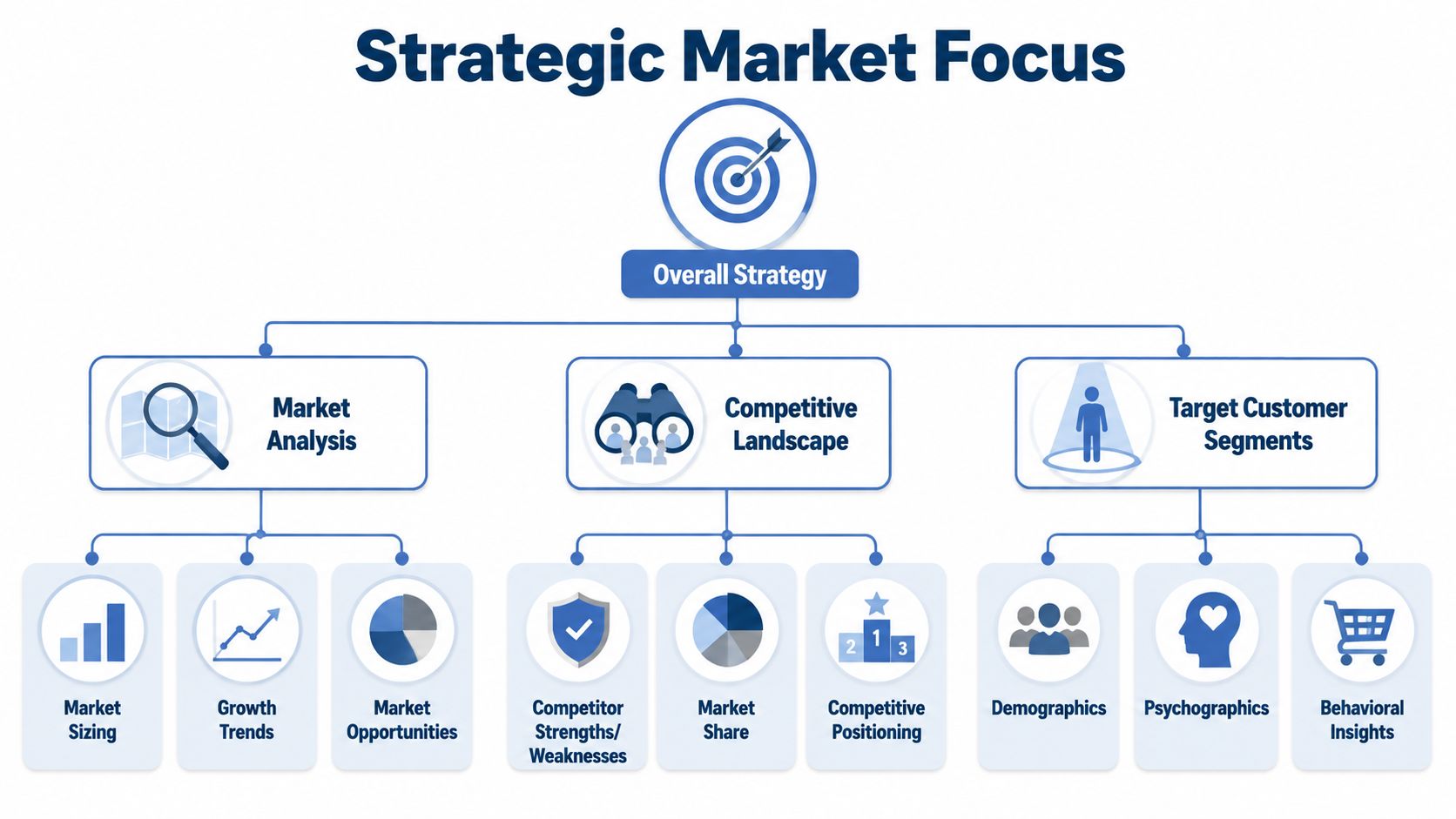
If you try to fight everywhere, you'll burn cash everywhere. If you identify the right slice of the market, plus the competitor weakness inside that slice, your growth strategy gets a lot sharper.
Statista reports that worldwide market research revenue was almost $54 billion in 2023, up by more than $20 billion since 2008, and Coursera reports that 95% of businesses say market research delivers a positive ROI, as summarized in this Statista market research industry overview. Your competitors are investing in research because it works. Your edge comes from running it faster and turning it into sharper choices.
Stop making competitor lists
A competitor list is inventory, and inventory tells you little about how to win.
You need a field map that shows:
- Who owns which claim? Fastest, easiest, cheapest, safest, most advanced, most compliant.
- Where are they weak? Vague messaging, narrow use cases, poor onboarding, bad reviews, weak proof, confusing pricing.
- What are they signaling? New target segment, enterprise push, feature pivot, international expansion, or retention problems.
That map should force a strategic question. Where can you win without copying them?
A useful companion read is this breakdown to discover market analysis insights, especially if you want another perspective on turning market analysis into positioning choices rather than generic research output.
Use market size to narrow the fight
Founders love talking about TAM because it sounds ambitious. Investors tolerate it. Operators should care more about focus.
I use the standard market sizing trio in a blunt way:
- TAM is the broad category ceiling. Good for context, weak for execution.
- SAM is the part of the market your offer serves.
- SOM is the realistic segment you can capture with your current product, channel access, positioning, and budget.
Your real target sits inside SOM, but not every SOM is worth attacking. The best target has three features:
- Visible pain
- Weak incumbent messaging or delivery
- A channel where you can reach buyers efficiently
AI tools become useful for pattern recognition. If you're comparing platforms, workflows, and practical use cases, I've already broken down a stack of AI tools for market research that help with collection, synthesis, and analysis.
A smaller segment with urgent pain beats a bigger segment with fuzzy demand.
Choose the battleground where your offer solves a painful problem and a competitor has left an opening. That's where research turns into market share.
Translate Insight into Action and Market Share
Research only matters when it changes what you do next. If nobody owns the outcome, all you've built is a knowledge archive.
Most people collect sources, interview users, run summaries, and then stop right before the step that creates value.
Run the six-stage operating rhythm
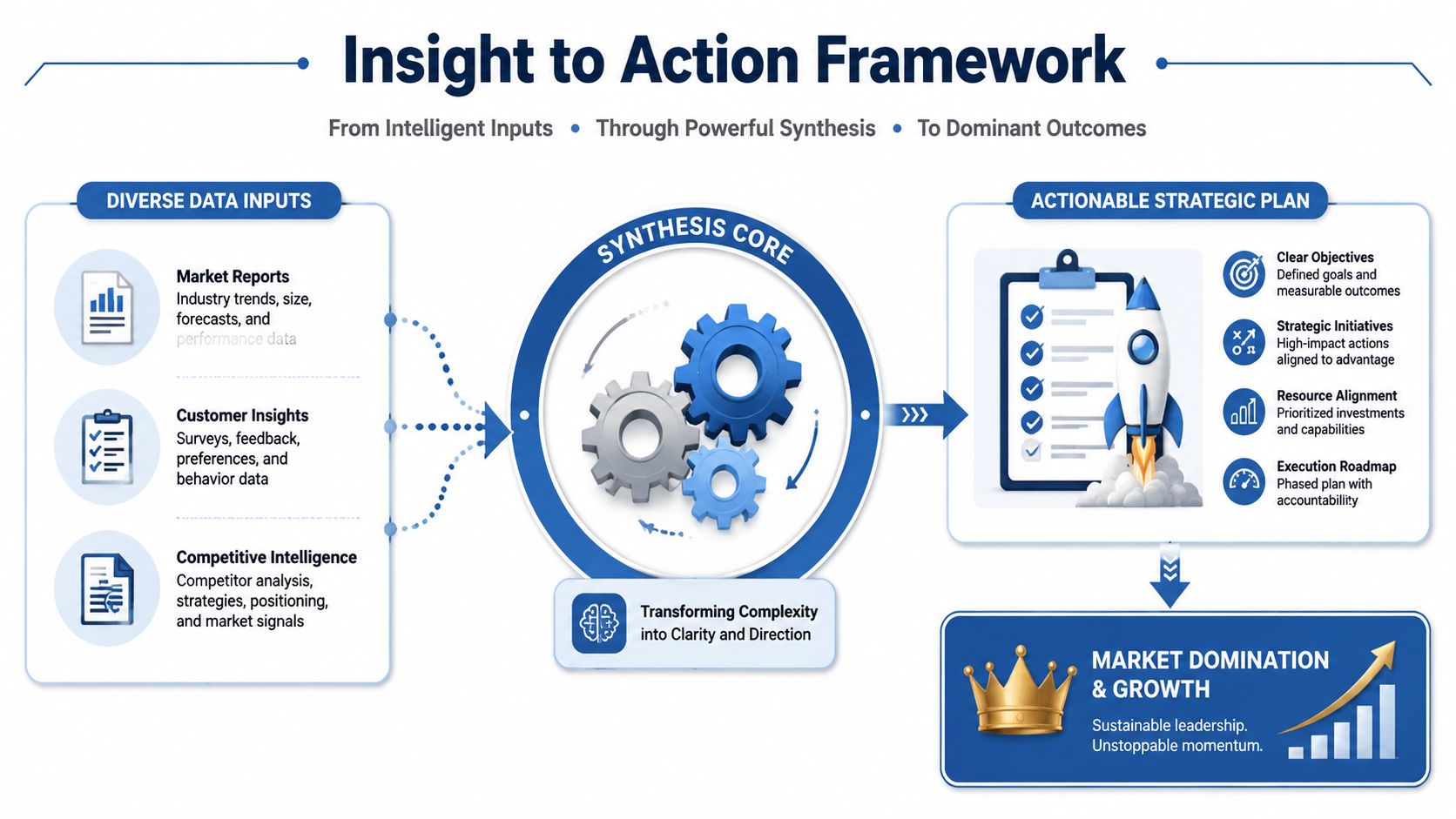
A complete workflow follows six stages: define the question, create the plan, collect data with secondary first and then primary, analyze, interpret, and translate findings into action items with owners and timelines, based on this step-by-step guidance for a market research process for better decisions. I like this model because it forces execution at the end instead of pretending analysis is the finish line.
Use that rhythm as a repeating cycle, not a one-off project.
Turn findings into moves
Once your inputs are collected, AI can help synthesize across them. But you still need to make the hard calls.
I usually convert findings into four action buckets:
- Messaging moves mean rewriting homepage positioning, sales narratives, ad angles, or demo framing based on repeated buyer language and competitor gaps.
- Product moves mean prioritizing features, onboarding fixes, integrations, or workflow simplifications that align with recurring friction.
- Pricing moves mean testing packaging logic, value communication, or pricing page structure when confusion or comparison pressure shows up repeatedly.
- Channel moves mean shifting budget and attention toward the places where target buyers already reveal urgency.
This is also where segmentation gets more useful. Don't build personas out of demographic trivia. Build them from behavior, desired outcome, buying trigger, and objection pattern.
What to ship first
If your research reveals ten interesting ideas, don't launch ten things. Rank actions by strategic impact.
A simple prioritization filter works:
| Action Type | What to Ask |
|---|---|
| Messaging | Will this make the value proposition clearer right now |
| Product | Does this remove friction from activation, retention, or switching |
| Pricing | Will this reduce confusion or better align price to value |
| Channel | Can we reach this segment efficiently with our current resources |
Then assign each action an owner, a timeline, and a success metric. Without that, insight dies in shared docs.
A decision filter: if a finding doesn't change messaging, product, pricing, or channel strategy, it probably isn't important enough yet.
The businesses that lead a category don't have perfect certainty. They have a tighter loop between signal, synthesis, and execution.
The Market Is Talking Are You Listening
Treat market research as a core operating function instead of a task you check off once a quarter.
Build the system, and you stop relying on stale assumptions. You hear buyer language faster, spot competitor movement earlier, and make sharper calls with less wasted motion. If you want to extend this into ongoing voice-of-customer monitoring, these customer sentiment analysis tools are a practical next layer in the stack.
Your competitors can keep guessing. You shouldn't.