
Most advice on the AI agent tech stack is backward. It starts with frameworks, model benchmarks, and demo workflows. That's how teams end up with expensive prototypes that impress in a demo and fail in production.
I'm Samuel Woods. I've been working with ML since 2016 and Generative AI since 2019. I've watched the market repeat the same mistake over and over. Buyers chase agent hype when they should be designing for scalable efficiency. If you care about revenue, margin, and beating slower competitors, your AI agent tech stack has one job. It must turn knowledge, decisions, and actions into a repeatable business advantage.
Table of Contents
- Stop Building AI Toys and Start Building Empires
- First Understand What a Real Agent Is
- The Core AI Agent Tech Stack Components
- Architectural Blueprints That Win
- The Great Debate: Vendor Platforms vs Open Source
- Example Stacks for Marketing and SaaS
- Deployment Costs and Measuring What Matters
Stop Building AI Toys and Start Building Empires
I'm going to challenge the most popular advice first. Stop asking which agent framework is hottest. Start asking which business process you want to own outright.
That shift matters because the upside isn't small. The strongest view I've seen is blunt. Highly capable agentic systems will eventually complete many common business processes with one tenth of the headcount required today, enabling the same output with 90% fewer humans while maintaining or improving quality metrics like customer satisfaction and profitability, according to theCUBE Research analysis on agentic AI platforms. If that trajectory plays out in your category before you move, your competitor doesn't need a better brand. They just need a more efficient machine.
Most companies still build the wrong thing. They launch a branded chatbot, plug it into a help center, then call it transformation. All that creates is a feature.
A practical rule: if your agent can't complete a workflow, make a decision, use tools, and hand back a measurable business outcome, you've built theater.
The right way to think about the AI agent tech stack is as a new operating layer for the company. Sales qualification. Competitive monitoring. Customer retention. Internal knowledge routing. QA triage. Pricing analysis. Treat these as points of advantage rather than “AI use cases.”
Here's the filter I use:
- Choose a process with economic weight. Pick something tied to revenue, churn, fulfillment, or speed.
- Find the decision bottleneck. Where do humans spend time collecting context instead of acting?
- Build the agent around that bottleneck, rather than around the model or the demo.
A toy answers prompts. An empire runs on systems that execute.
First Understand What a Real Agent Is
A lot of confusion disappears when you stop calling every AI interface an agent. A chatbot responds. A real agent operates.
BCG draws the line clearly. AI agents differ significantly from chatbots because they have planning, reasoning, tool use, memory, and self-correction, allowing them to detect errors, fix them autonomously, and learn through multi-step plans with internal checks rather than just responding to static instructions, as described in BCG's overview of AI agents. That difference is everything in business.
The five capabilities that matter
A real agent plans. Instead of only answering “what should I do?”, it breaks a goal into actions.
A real agent reasons. It chooses between options based on context, constraints, and trade-offs.
A real agent uses tools. That means APIs, databases, CRMs, spreadsheets, code interpreters, ticketing systems, and internal platforms.
A real agent keeps memory. It tracks prior context, previous actions, and unresolved states across steps.
A real agent self-corrects. When a tool call fails or a result conflicts with policy, it checks, revises, and retries within bounds.
A chatbot gives you language. An agent gives you execution.
That's why I push for specifics. If your “agent” can't read an account record, look up product usage, compare it against a retention playbook, draft the right intervention, and route it into the system of record, it's still sitting in chatbot territory.
What this means for your business
When you get this right, you stop buying conversational novelty and start building process automation that can adapt. That changes staffing plans, customer response speed, and how fast your team can act on fragmented information.
If you want a deeper foundation for that distinction, my primer on intelligent agents in AI breaks down how these systems move from passive response to active execution.
Use one standard inside your company. If the system cannot plan, act, and recover, don't call it agentic. You'll make cleaner buying decisions and avoid wasting budget on dressed-up chat interfaces.
The Core AI Agent Tech Stack Components
You lose money when you treat the stack like a shopping list. You win by choosing the few layers that improve speed, margin, retention, or expansion revenue, then designing them so you can swap vendors without rewriting the business.
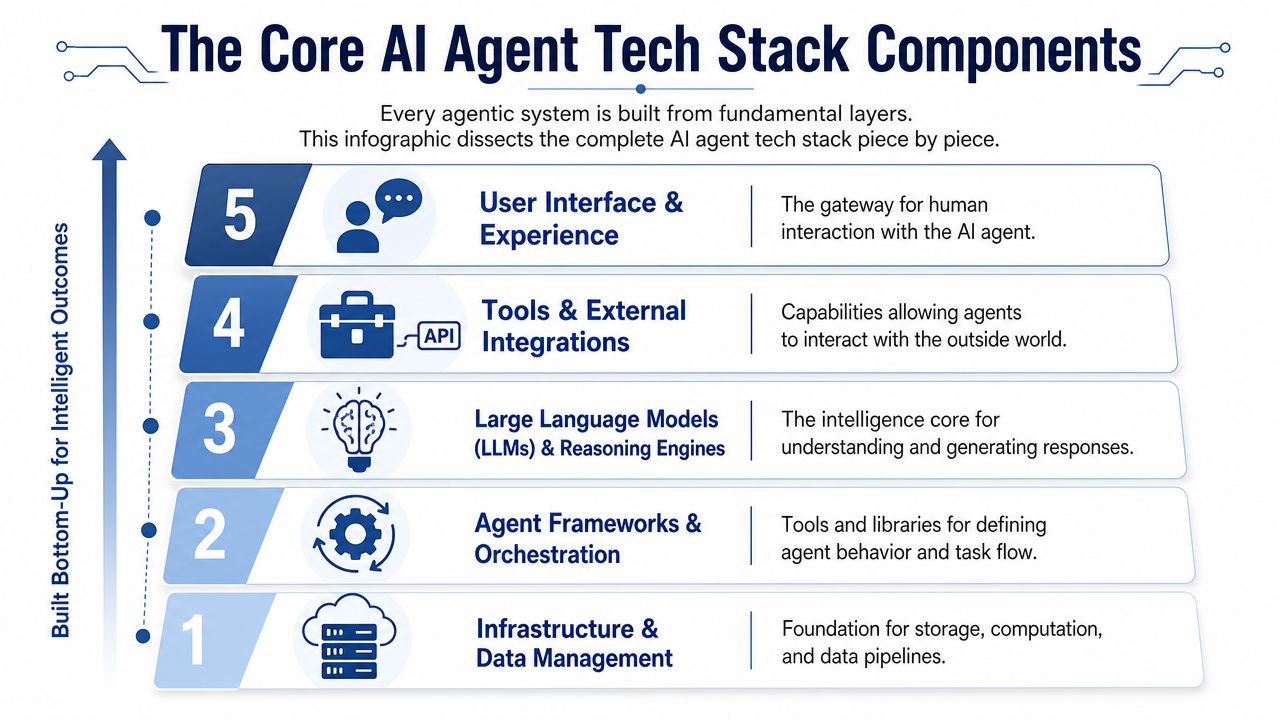
Start with the model layer
Treat models as a capability layer. They won't be your moat.
Pick the model based on the job you need done. Some models handle long documents better. Some are stronger at structured tool use. Some are better for large codebases or knowledge-heavy tasks. Your buying question is simple: which model helps the agent complete the workflow with the highest accuracy, acceptable latency, and economics that still work at scale?
That is why model choice should follow business design. A revenue operations agent that updates CRM records, drafts follow-ups, and triggers workflows needs dependable tool calling and predictable output structure. A research or legal review agent needs better document handling and stronger recall across long inputs. If your team still treats model selection as the strategy, go fix that. The model is one layer in the machine.
A useful companion resource here is understanding AI app development, especially if you're trying to connect business goals to product architecture decisions rather than treating the model like the product.
Orchestration is where strategy turns into daily execution
Orchestration decides whether your agent behaves like a disciplined operator or an expensive intern.
This layer manages planning, tool calls, retries, memory flow, state transitions, and handoffs. It also determines how tightly you control execution. I prefer orchestration frameworks that make workflows explicit, auditable, and replaceable. Hidden prompt spaghetti does not scale. It creates operational risk, slows debugging, and traps you in tribal knowledge.
Analysts at Stack Overflow reported rising workplace adoption of agents and identified LangChain and LangGraph among the most used frameworks in that environment, according to their reporting on agent adoption at work. Treat that as a market signal rather than a mandate. The right choice is the framework your team can govern, test, and evolve without turning every change into a production incident.
Use orchestration to enforce business discipline:
- Use workflow control to sequence tasks, branch decisions, and stop runs before they drift into low-value work
- Use state management to record what happened, what failed, and what the agent should do next
- Use multi-agent coordination to split specialized roles only when it improves throughput or quality
- Use policy enforcement to keep approvals, compliance checks, and budget limits inside the execution path
If you want the missing layer between prompts and reliable execution, study agentic context engineering for production AI systems. Context design determines whether the agent acts with precision or burns tokens producing confident nonsense.
A video helps here if you want a visual walkthrough of how these layers connect.
Memory, tools, observability, and infrastructure determine whether it makes money
The next layers decide whether the agent creates measurable value or collapses under real operating conditions.
Memory and retrieval give the agent the right context at the moment of action. Tool integration connects the agent to the systems that run the business, such as your CRM, ticketing stack, data warehouse, finance system, or internal apps. Observability shows what happened in each run, where failures started, which prompts or tools caused them, and what each successful outcome cost. Infrastructure keeps response times, queues, and workloads stable when usage spikes.
Here's the practical view.
| Layer | What it does | Business impact |
|---|---|---|
| Memory and retrieval | Pulls the right context at the right time | Reduces bad actions caused by incomplete account, product, or customer data |
| Tool integration | Lets the agent act inside the systems you already run | Turns chat output into booked meetings, resolved tickets, retained accounts, or completed workflows |
| Observability | Exposes traces, failure patterns, and cost drivers | Shows where margin is leaking and where quality breaks before customers feel it |
| Infrastructure | Runs workloads reliably with containers, queues, caching, and scalable services | Protects uptime and keeps unit economics under control as volume grows |
One rule matters here. If the agent cannot be monitored, evaluated, and constrained, it does not belong near revenue workflows.
If you can't see what the agent did, why it did it, and what it cost, what you have is a blindfolded experiment.
The strongest AI agent tech stack is the one built around a workflow your competitors cannot match on speed, consistency, or cost.
Architectural Blueprints That Win
Architecture decides whether your AI agent becomes a profit engine or an expensive demo.
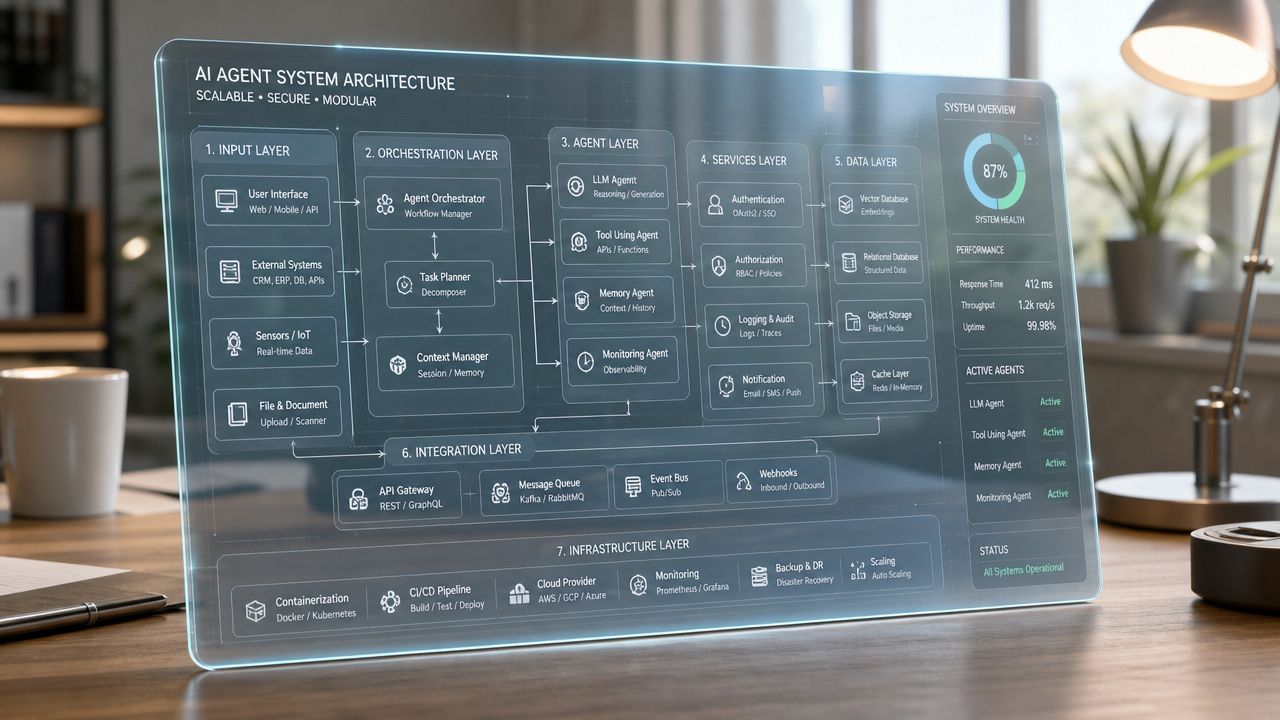
Use a hub and spoke architecture
For most companies, hub and spoke is the right default. Put orchestration at the center and connect models, retrieval, tools, policy, and logging through clean interfaces. That setup gives you one thing that matters more than technical elegance. Control.
The orchestration layer should decide what happens next. It routes tasks, applies business rules, requests context, calls tools, and stops unsafe actions before they touch customers or money. If that logic is scattered across prompts, app code, and vendor workflows, what you have is operational drift.
Keep high-risk workflows deterministic. Billing, approvals, compliance checks, contract changes, refunds, and account permissions belong inside fixed rules and audited services. The agent should handle judgment around those systems, then pass execution into controlled paths.
Design for replacement, not permanence
The best architecture ages well under pressure. Model pricing changes. Vendor terms tighten. Internal security standards change. A stack that cannot absorb those shifts becomes a growth tax.
Build every layer so it can be swapped without rewriting the business process. Your moat comes from workflow design, proprietary context, and execution speed. Hardwiring your future to one model provider or one framework adds nothing to it.
Here is the pattern I recommend:
- A central orchestration service that owns workflow state, permissions, routing, and guardrails.
- A model abstraction layer so you can switch between GPT, Claude, Gemini, or open-weight models without rebuilding the product.
- Separate retrieval and memory services so context management stays reliable instead of bloating prompts.
- Thin API-based connectors into core systems such as CRM, support, billing, and product data.
- Full run tracing and evaluation so operators can see quality, latency, failure points, and cost at every step.
This shift is easier to understand through understanding AI product evolution. Products are becoming coordinated systems of actions and decisions instead of static interfaces with a chatbot attached.
Context design is the other make-or-break factor. If the agent gets the wrong account history, stale product rules, or too much irrelevant information, performance collapses fast. A practical framework for agentic context engineering is worth studying before you scale anything customer-facing.
Build your stack so you can replace a model, a memory layer, or a tool connector in weeks, not quarters.
That is how you keep speed, margin, and strategic freedom at the same time.
The Great Debate: Vendor Platforms vs Open Source
Treat this as a capital allocation decision.
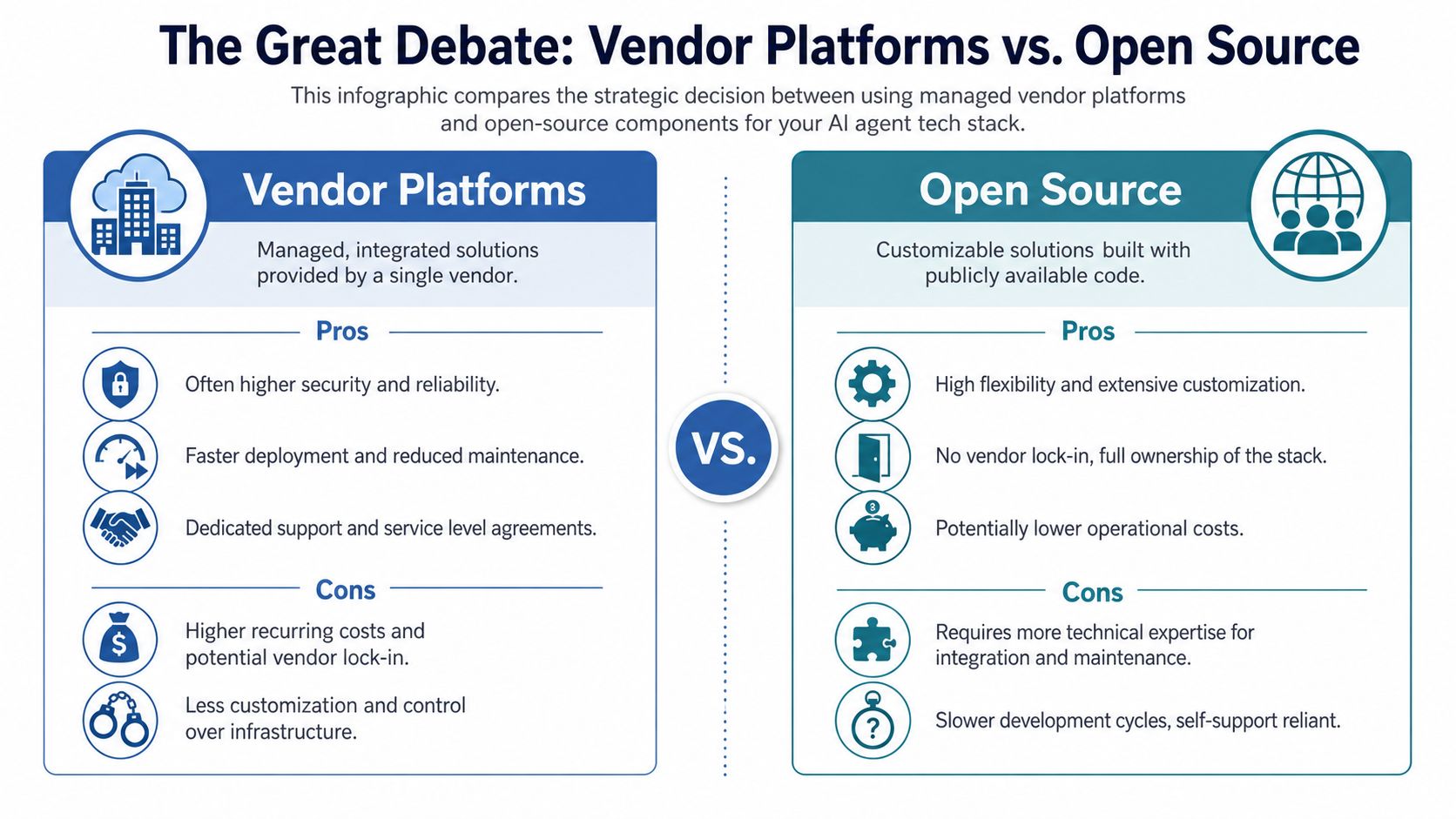
The wrong choice shows up fast in margin, speed, and strategic control. A vendor platform can get an agent into production faster. An open source stack can protect your economics and keep a strategic workflow out of someone else's box. Judge it by one standard. Which option increases revenue sooner without weakening your position later?
When vendor platforms win
Buy the platform if the agent supports execution rather than differentiation.
That usually means support automation, internal knowledge workflows, SDR assistance, and other cases where time-to-value matters more than custom infrastructure. If your team needs results this quarter, do not waste engineering time rebuilding orchestration, hosting, monitoring, and access controls that a vendor already solved.
Vendor platforms are the right call when you need:
- A fast launch, because you can move from pilot to production without months of infrastructure work.
- Lower operating drag, because hosted systems reduce the burden on engineering, security, and DevOps.
- Managed reliability, meaning you get support, updates, uptime controls, and fewer moving parts to babysit.
- Cleaner business focus, so you stay focused on workflow design, adoption, and ROI.
This is often the correct path for commercial teams adopting AI marketing automation tools to improve campaign execution, lead routing, and reporting before they build proprietary agent infrastructure.
When open source wins
Open source is the better bet when the agent touches your moat.
If the system shapes pricing, retention, underwriting, product usage expansion, or market intelligence, own more of the stack. The more your agent influences revenue or strategic decision-making, the less sense it makes to accept rigid workflows, limited visibility, and pricing power in a vendor's hands.
That control matters at the model layer too. Closed models often give you better speed, tooling, and support. Open-weight models give you deployment control, custom tuning options, and more freedom around data handling. You pay for that freedom with stronger infrastructure requirements, more ML operations work, and a larger talent bill. That trade is worth it only when strategic control produces a real business advantage.
Here's the side-by-side view I use:
| Decision factor | Vendor platform | Open source stack |
|---|---|---|
| Speed to market | Strong | Slower |
| Control over infrastructure | Limited | Strong |
| Customization depth | Moderate | High |
| Operational burden | Lower | Higher |
| Vendor lock-in risk | Higher | Lower |
| Talent required | Lower to moderate | Moderate to high |
My recommendation is blunt. Buy speed for non-core workflows. Own the stack for revenue-critical workflows that can become a moat.
A hybrid model usually wins. Use vendor platforms to prove value fast. Move the most impactful workflows into a stack you control once the economics and strategic upside are clear. That is how you keep momentum now and pricing power later.
Example Stacks for Marketing and SaaS
Theory matters less than application. So here it is in concrete terms.
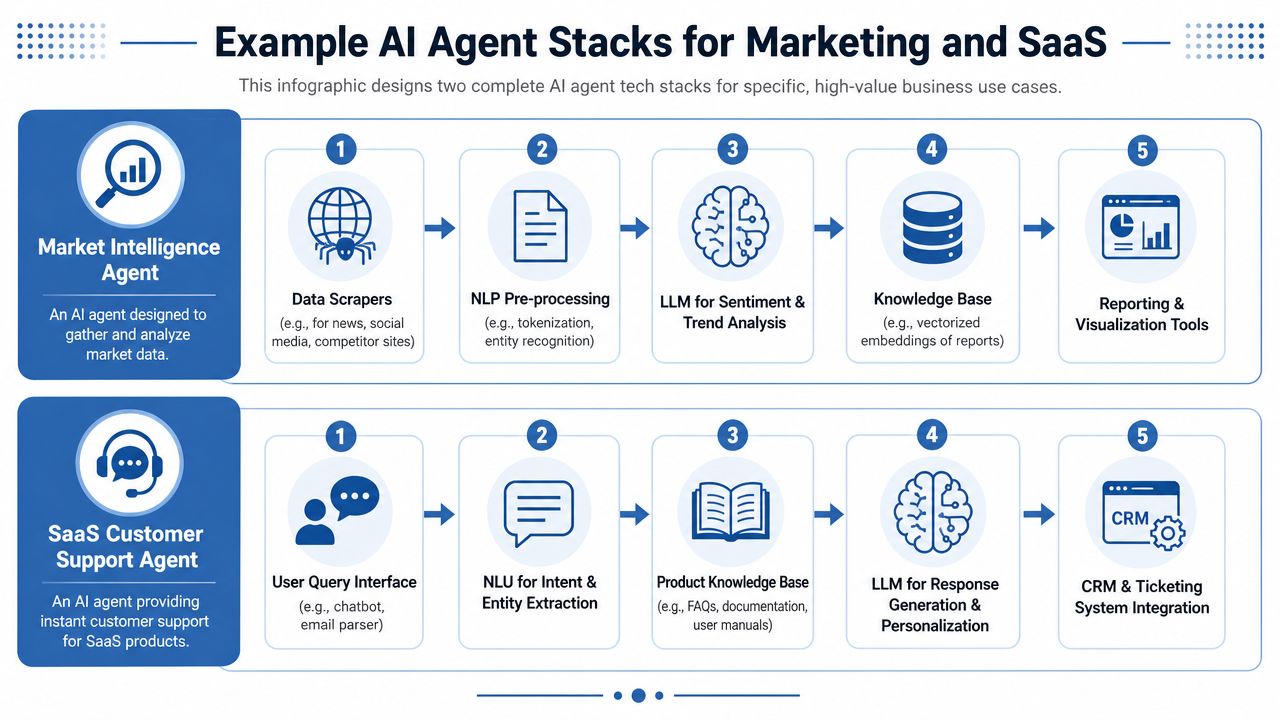
Market intelligence agent for a growth team
A growth team wants to monitor competitors, track messaging shifts, analyze launch patterns, and generate weekly strategic briefs. This is a perfect use case for an agent because the bottleneck is context gathering more than writing.
I'd build it like this:
- For the model layer, Claude Sonnet 4.6 for long-form analysis across competitor pages, transcripts, reports, and campaign documents.
- For orchestration, LangGraph for multi-step workflows that scrape, classify, summarize, compare, and draft.
- For memory and retrieval, a vector store for archived competitor assets, launch notes, ad copy, and strategic memos.
- For tools, web scraping tools, CRM enrichment, Google Docs or Notion export, and Slack delivery.
- For observability, trace logs for source quality, missing data, and output consistency.
The output is a decision asset. New offers entering the market. Messaging changes by competitor. Pricing movement. Category narratives. You act faster because the machine does the grunt work.
If your team is modernizing campaign execution too, my guide to AI marketing automation tools pairs well with this stack.
Proactive support agent for a SaaS company
Now take a SaaS business trying to reduce churn. The signal is spread across product usage, support history, billing status, and account notes. Humans miss patterns because the context lives in too many places.
I'd design that stack differently.
The agent watches product analytics for risk behavior, pulls account context from the CRM, checks the support knowledge base for likely issues, drafts a personalized outreach sequence, and opens a task for a customer success manager when intervention needs a human touch. It should also log every action back into the system of record.
The stack would look like this in practice:
- A tool-friendly model for operational actions and structured outputs.
- A retrieval layer connected to product docs, ticket history, and internal playbooks.
- An orchestration framework that supports conditional logic based on account health signals.
- CRM and email integrations so the agent can act as well as recommend.
- Evaluation rules tied to retention outcomes, escalation quality, and message relevance.
The best business agents give your team better timing, better context, and fewer low-value tasks.
The point of the AI agent tech stack is advantage.
Deployment Costs and Measuring What Matters
Production is where weak agent strategies get exposed.
A polished demo can hide broken data, sloppy process design, and runaway usage costs. Once the agent touches customers, revenue workflows, or retention programs, those problems stop being technical issues and start showing up as margin loss, missed pipeline, and avoidable churn.
Data quality decides whether the agent earns trust
CoreSignal's analysis of the agentic tech stack highlights the core failure point: bad inputs. I agree. Dirty CRM fields, outdated documentation, inconsistent support tags, and fragmented account history will break performance faster than any model choice.
Most owners overfocus on model quality and underinvest in data operations. That is backwards.
If the agent cannot access current pricing rules, product facts, customer history, and approved playbooks in a clean format, it will produce inconsistent work. Your team will stop trusting it. Adoption drops. The project stalls. Competitors with better operating discipline pull ahead.
The moat is a data layer your competitors cannot copy quickly.
Cost control starts before rollout
Cost problems usually come from bad workflow design more than from model pricing. Repeated calls for the same answer, agents allowed to loop too long, and low-value tasks sent to expensive models will gradually erode unit economics.
Fix that early.
Cache repeat requests. Batch work that does not need an instant response. Put hard limits on tool calls and iteration depth. Route simpler tasks to cheaper models and reserve premium inference for decisions that affect revenue, retention, or risk. As noted earlier, these controls can materially reduce waste in production.
Treat token spend like any other operating expense. Set budgets by workflow. Review cost per completed outcome alongside total usage.
Measure business impact, or kill the project
Agent activity is not a success metric. Throughput is not a success metric. A rising count of completed tasks means nothing if the business result stays flat.
Use scorecards tied to financial outcomes:
- For marketing work, measure campaign cycle time, qualified pipeline influenced, win-rate lift, and response speed to market changes.
- For a SaaS business, measure churn reduction, expansion opportunity capture, renewal support speed, and time to resolution for high-risk accounts.
- For operations, measure labor hours removed, exception rate, decision speed, and error reduction in core workflows.
One rule matters here. Every agent should map to a number you already track.
If it does not improve revenue growth, retention, gross margin, or operating speed, it is overhead. If it improves those numbers consistently, it becomes part of your competitive system.