
Most advice on AI agent ROI is backwards. It tells you to hunt for time savings, trim a few process costs, and call it a win.
That's small thinking.
I'm Samuel Woods. I've been working with ML since 2016 and Generative AI since 2019, and I can tell you this plainly. If you evaluate AI agents like a nicer chatbot or a smarter automation tool, you'll underinvest, measure the wrong things, and hand your competitors time to catch up. The critical question is whether an agent helps you move faster, learn faster, sell faster, and scale decisions your competitors still make manually, well beyond saving a team a few hours.
That's where AI agent ROI gets interesting. And dangerous, if you get it wrong.
Table of Contents
- The ROI Illusion: Why Most AI Agents Fail to Deliver
- Redefining ROI: From Cost Savings to Market Capture
- Your Practical ROI Measurement Framework
- Attributing Value: Designing Smart Experiments
- Building Your AI ROI Dashboard
- AI Agent ROI in the Wild: Two Case Studies
- Conclusion: From Measurement to Momentum
The ROI Illusion: Why Most AI Agents Fail to Deliver
The market has a deployment addiction. Founders love saying they've launched AI agents. Everyone likes hearing that innovation is happening. Teams celebrate pilots.
Then finance asks a simple question. What changed in the business?
According to analysis of the AI agent ROI gap, 97% of enterprises deploy AI agents, but only 29% report measurable ROI. That same analysis says 71% of failed deployments involve agents that can't alter processes beyond simple observation. That's the whole problem in one shot. Most companies didn't build operators. They built spectators.
Activity isn't value
If your agent drafts summaries, suggests replies, or surfaces insights, that may feel useful. It often is useful. But useful isn't the same as valuable.
I look for one question first. Did the agent change how work gets done in a way that affects revenue, margin, speed, or retention? If the answer is no, your team may be busy with AI while your business stays exactly where it was.
A lot of owners still hide behind “hours saved.” I don't hate that metric. I hate it when it stands alone.
- Hours saved without workflow change means labor got lighter, but the business model stayed the same.
- Automation without authority means the agent observed work, then handed it back to humans.
- Dashboards without decisions mean you collected intelligence but didn't turn it into advantage.
A practical rule: if your agent can't trigger, route, approve, personalize, escalate, or reshape a real workflow, it probably won't produce meaningful ROI.
Operational integration is the real line
This is why I care more about operational integration than raw automation rates. An agent that lives inside your CRM, support stack, ad platform, knowledge base, or sales workflow can amplify capabilities. An agent that sits on the side and offers suggestions usually creates friction dressed up as progress.
That's also why I keep pushing teams toward agentic workflows. You need agents embedded where decisions happen instead of floating around as novelty interfaces.
Your competitors can copy prompts. They can license the same model. What they can't easily copy is a business where agents are wired into execution and continuously improving how the company runs.
That's the difference between an AI project and a competitive moat.
Redefining ROI: From Cost Savings to Market Capture
Most founders start in the wrong place. They ask, “How many people can this replace?” That question kills strategic thinking.
If your whole AI agent ROI model is based on labor substitution, you're aiming for incremental efficiency while someone else is building speed, responsiveness, and market share. Cost savings matter. They just aren't the whole prize.
According to IBM 2026 enterprise AI deployment findings summarized here, production AI agents deliver a median ROI of 171% over 12 months, and that figure is approximately three times higher than traditional Robotic Process Automation. I read that as a business signal. Agentic systems have become a stronger investment class for efficiency and growth than another automation line item.
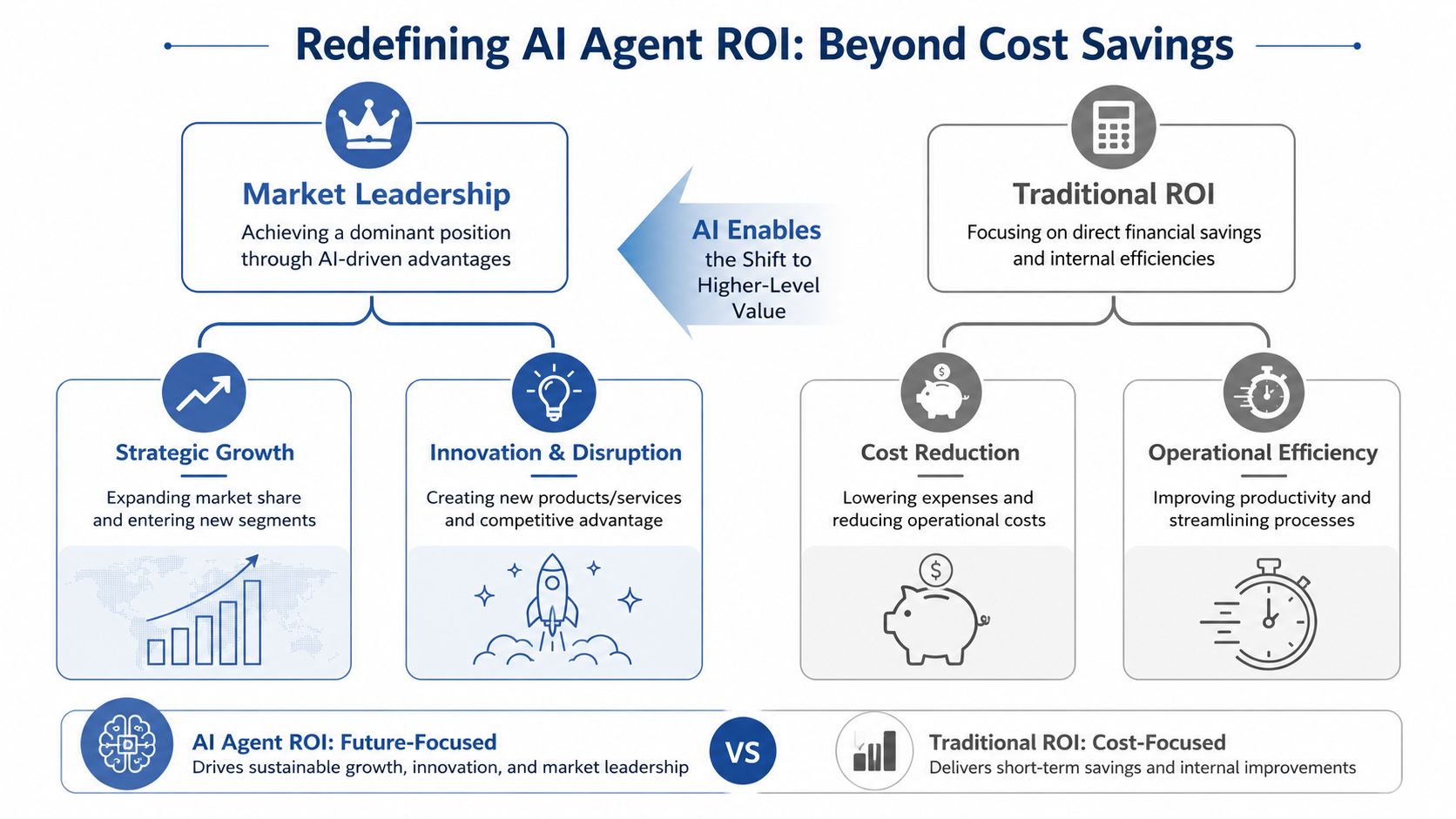
Tactical ROI versus strategic ROI
Traditional automation usually helps you do the same work with less drag. That's fine. It trims waste.
AI agents can do something far more interesting. They can help you change the shape of the business.
Here's how I split it:
| ROI lens | What you measure | What it enables |
|---|---|---|
| Tactical ROI | Lower handling cost, reduced admin load, shorter cycle times | Cleaner operations |
| Strategic ROI | Faster go-to-market, more pipeline coverage, better intelligence, stronger retention | Competitive advantage |
A support agent that resolves repetitive tickets is tactical. A support agent that also identifies churn signals, updates CRM context, and feeds product insight into roadmap discussions starts becoming strategic.
A sales agent that sends follow-ups is tactical. A sales agent that prioritizes accounts, adapts outreach by segment, and helps reps spend time where deals move becomes a market capture engine.
What I tell founders to focus on
You and I should care about three strategic outputs.
Speed
Faster response loops win markets. If your team can qualify leads, launch campaigns, answer objections, and act on customer signals faster than competitors, you take deals they're still discussing internally.
Intelligence
Beyond executing, AI agents collect patterns across conversations, channels, objections, and customer behavior. That means you stop guessing and start operating with sharper commercial awareness.
Capacity without linear hiring
With agents, the economics shift. Agents let you expand coverage and consistency without adding headcount at the same pace. That matters in sales, service, onboarding, retention, and operations.
Don't build your ROI case around replacing tasks alone. Build it around expanding throughput, compressing reaction time, and increasing the number of high-quality decisions your company can make each day.
When cost savings thinking becomes a trap
There are times when cost savings should not be the lead story.
If you're in a crowded SaaS category, ecommerce niche, or professional service market, your problem is usually slower execution than the competitor who follows up first, personalizes better, and sees opportunity sooner, more than expensive staff.
That's why I push founders to evaluate AI agent ROI through a harder lens. Ask what new capability this creates that your competitors can't easily match. If the answer is weak, the implementation is weak.
The companies that win with agents become cheaper to run and harder to outmaneuver.
Your Practical ROI Measurement Framework
You need a disciplined model more than a fancy one.
The formula is simple. According to Blue Prism's AI agent ROI methodology, the core equation is (Total Benefits − Total Costs) / Total Costs × 100%. That same methodology stresses that success depends on defining baseline metrics before deployment, including cost per interaction and handling time. It also notes two ugly failure points: poor data quality is cited by 30% of organizations, and over-engineering systems can inflate costs by 3–15x.
That's enough to tell you where most ROI models go off the rails.
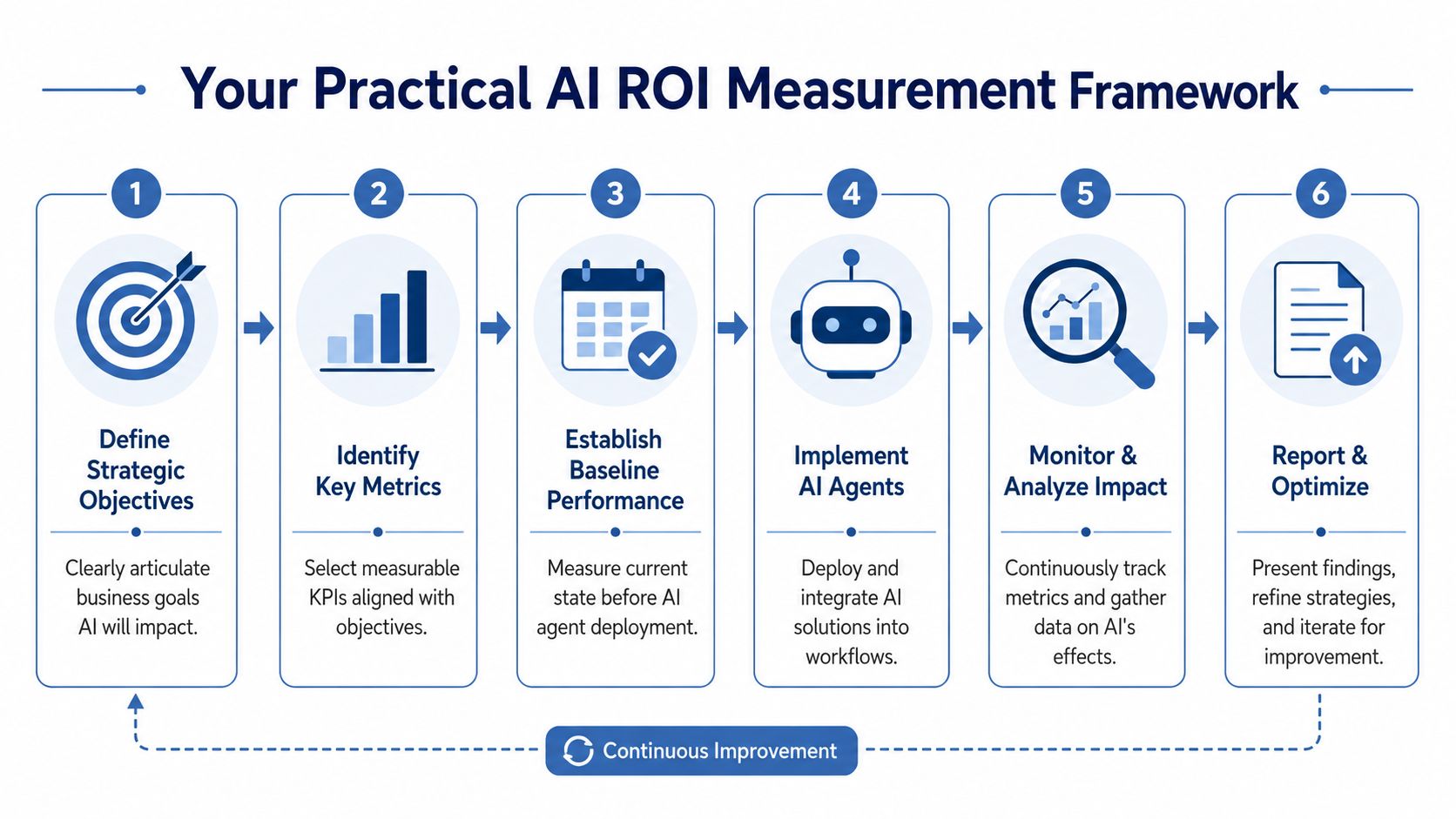
Step one: tie the project to a business outcome
Don't start with “we want an AI agent.” Start with a business constraint.
Maybe your SDR team can't keep up with inbound. Maybe support is slow. Maybe onboarding leaks users before activation. Maybe your marketing team ships too slowly to capitalize on demand.
Write the objective in commercial language.
- Revenue objective like more qualified pipeline or better expansion coverage
- Margin objective like lower cost per resolution or lower process cost
- Speed objective like shorter quote turnaround or faster lead response
- Retention objective like fewer churn-risk accounts going unmanaged
If the project can't be expressed in one of those buckets, I'd pause it.
Step two: establish a baseline before you touch the workflow
This aspect is critical. If you don't know the current state, any ROI claim later is just storytelling.
Use the baseline categories the methodology calls out and adapt them to the function. In support, that might be cost per interaction, handling time, error rate, and escalation rate. In marketing or sales, it may be lead response speed, qualification accuracy, follow-up consistency, or campaign cycle time.
ROI tells you whether an agent paid for itself. To check week by week that it’s doing the job correctly, see how to tell if your AI agent is working.
Here's a practical baseline table:
| Function | Baseline metrics to capture before deployment |
|---|---|
| Customer service | Cost per interaction, handling time, escalation rate, resolution time |
| Sales | Lead response time, meeting booking rate, rep time spent on admin, stage progression speed |
| Marketing | Campaign production cycle, content throughput, qualified lead flow, handoff delays |
| Operations | Error rate, turnaround time, rework volume, human touchpoints per process |
Step three: calculate the full cost honestly
Owners sabotage AI agent ROI when they only count the software bill. That's amateur math.
Your cost model should include implementation, training, integration effort, testing, monitoring, governance, and ongoing optimization. If you skip those, you'll show a fake payback period, then wonder why confidence disappears after launch.
A practical stack might include workflow tools, CRM integrations, analytics, a knowledge layer, model usage, and internal time from ops or revops. If you're using a service partner, include that too. I run 90-day pilots for task-specific agents, for example, and that scoped model fits this kind of cost accounting alongside internal builds and platform-led deployments.
Step four: avoid the two mistakes that wreck economics
I see these constantly.
First, weak data. If your knowledge base is stale, your CRM is a mess, or your process rules live in five people's heads, the agent won't perform reliably.
Second, architecture vanity. Teams jump to multi-agent systems because it sounds advanced. If one focused agent can do the job, use one focused agent. Complexity burns budget fast.
Build the smallest agent system that can produce a business result you can defend in a finance meeting.
Step five: track both hard and soft benefits
Hard benefits are easier. Labor savings, process cost reduction, faster resolution, higher throughput.
Soft benefits matter too, but treat them with discipline. Improved customer experience, better team focus, or stronger consistency should support the business case, not replace it. If soft benefits are the entire story, your ROI case is still weak.
Good AI agent ROI measurement is blunt. Baseline first. Full costs second. Benefits third. No theater.
Attributing Value: Designing Smart Experiments
Once an agent goes live, people get sloppy. Revenue goes up, support gets cleaner, meetings increase, and everyone wants to give the agent credit.
That's not good enough.
If you can't isolate what the agent changed, you're building a belief system instead of an ROI model. Attribution matters because you, any investors, and your team need to know whether the system caused the result or just happened to be present while something else improved.
Start with a clean test question
A strong experiment begins with one operational question. Not five.
For a marketing agent, the question might be whether AI-generated nurture sequencing produces better lead progression than the current human-built workflow. For a sales agent, the question might be whether autonomous lead triage improves rep focus and opportunity movement compared with the old first-in, first-out process.
Keep the test narrow. One workflow. One decision point. One measurable business outcome.
Use control groups when you can
The simplest structure is still the best one.
- For a marketing agent test, split comparable lead cohorts. One gets the current nurture process. The other gets the AI-agent-driven sequence, timing logic, and message adaptation.
- For a sales agent test, route similar inbound leads into two paths. One follows the standard rep qualification process. The other goes through the agent for enrichment, prioritization, and initial follow-up.
- For a support agent test, keep a defined queue on the legacy path and move another queue to the agent-assisted or agent-led path, then compare resolution quality and workflow movement.
Don't contaminate the groups. If humans override one side constantly and not the other, you no longer have a useful comparison.
If the test design is messy, the ROI claim will be messy too.
Match the metric to the decision
A lot of teams measure what's easy instead of what matters. Open rate is easy. Pipeline quality is harder. Guess which one pays the bills.
For marketing agents, I usually prefer downstream commercial signals over vanity metrics. Lead-to-opportunity movement, sales acceptance, follow-up speed, and pipeline contribution tell a much better story than surface-level engagement.
For sales agents, I care about rep time reclaimed, stage progression quality, and whether the system helps reps spend effort on the accounts most likely to close. If the agent increases activity but sends reps after bad-fit leads, you automated waste instead of improving sales.
When A/B testing isn't practical
Some agent systems touch too many workflows to run a neat split test. That's common in operations, support routing, onboarding, and cross-functional orchestration.
In those cases, use simpler attribution logic:
| Attribution approach | Best use case | What to watch |
|---|---|---|
| Before and after comparison | Stable process with clear baseline | Seasonality and demand swings |
| Matched cohort comparison | Similar account segments or customer groups | Hidden differences between groups |
| Stage-level attribution | Complex funnels with multiple human and AI touches | Over-crediting one touchpoint |
If you're doing multi-channel growth work, teams often need a stronger attribution structure. My guide on multi-touch attribution models is useful when an agent influences multiple steps rather than one neat conversion event.
Keep humans in the loop long enough to learn
Full autonomy sounds impressive. It also makes bad attribution easier, because nobody knows where the system helped and where it hurt.
I prefer phased authority. Let the agent recommend, then act within a bounded workflow, then own more as evidence builds. That gives you cleaner observation and safer economics.
The point of smart experiments is operational confidence, more than academic rigor. You need enough evidence to know what to scale, what to redesign, and what to kill.
Building Your AI ROI Dashboard
If your ROI lives in a quarterly slide deck, you're already late. You need a dashboard that operators actively use.
I don't mean a vanity dashboard packed with colorful charts and meaningless activity. I mean a command surface that tells you whether your agents are improving the economics of the business this week.

According to 2026 AI ROI benchmarks summarized by Pickaxe, a good first-year ROI for an AI agent falls between 100% and 200%, above 200% is considered excellent, and above 50% is generally considered worthwhile because benefits can compound in year two. Those are useful thresholds. They stop teams from celebrating weak economics and help you decide when a pilot deserves expansion.
What belongs on the dashboard
For most SMBs and startup teams, I'd organize the dashboard into four layers.
Financial layer
Show total cost, realized benefits, payback progress, and current ROI status. If finance can't read it quickly, the dashboard is too clever.
Workflow layer
Track where the agent is changing process performance. In marketing that might be qualified lead flow and campaign cycle time. In support it may be cost per resolution and containment trends. In sales it could be rep time recovered and follow-up coverage.
Commercial layer
This is where the strategic nature of AI agent ROI emerges. Show AI-sourced pipeline influence, conversion movement, activation progress, retention signals, or expansion identification.
Reliability layer
If the agent output quality drops, your ROI model breaks. Include exception rates, human override frequency, and workflow completion health.
A simple dashboard structure for growth teams
| Dashboard block | Example metrics |
|---|---|
| Efficiency | Cost per resolution, campaign production speed, admin time reduced |
| Revenue influence | AI-assisted pipeline, lead progression, expansion identification |
| Adoption | Workflow usage, handoff acceptance, human override patterns |
| Quality control | Error flags, escalation quality, approval accuracy |
You don't need twenty charts. You need the five that reveal whether the system is producing strong results.
A simple filter: if a metric doesn't help you decide to scale, fix, or stop the agent, it probably doesn't belong on the dashboard.
Don't isolate AI metrics from business metrics
This is the mistake I see in almost every dashboard review. Teams create an “AI section” full of agent stats and never connect it to the actual business.
Your dashboard should sit inside the same performance conversation as pipeline, retention, CAC efficiency, onboarding performance, or service cost. Treat AI as part of operating the company better rather than as a separate sport.
If you want a stronger model for structuring this visually, my breakdown of marketing analytics dashboards is a useful reference. The principle is the same. Tie activity to business movement instead of stopping at tool usage.
A dashboard should make one thing obvious. Whether the agent is becoming an asset or a distraction.
AI Agent ROI in the Wild: Two Case Studies
A lot of AI ROI talk is still too small. Most owners fixate on labor savings and miss the bigger prize. The bigger prize is a company that covers more opportunities, responds faster, and learns at a speed competitors can't match.
I care about two case patterns because they create that kind of advantage. One expands revenue capacity. The other increases customer value over time. Analysts at Ajentik found that sales and marketing agents averaged 280% ROI within 12 months, and a broader review of 200 B2B companies showed a median 12.8x ROI from agent deployment. Those returns make sense when you apply agents to repeatable commercial decisions instead of isolated tasks.
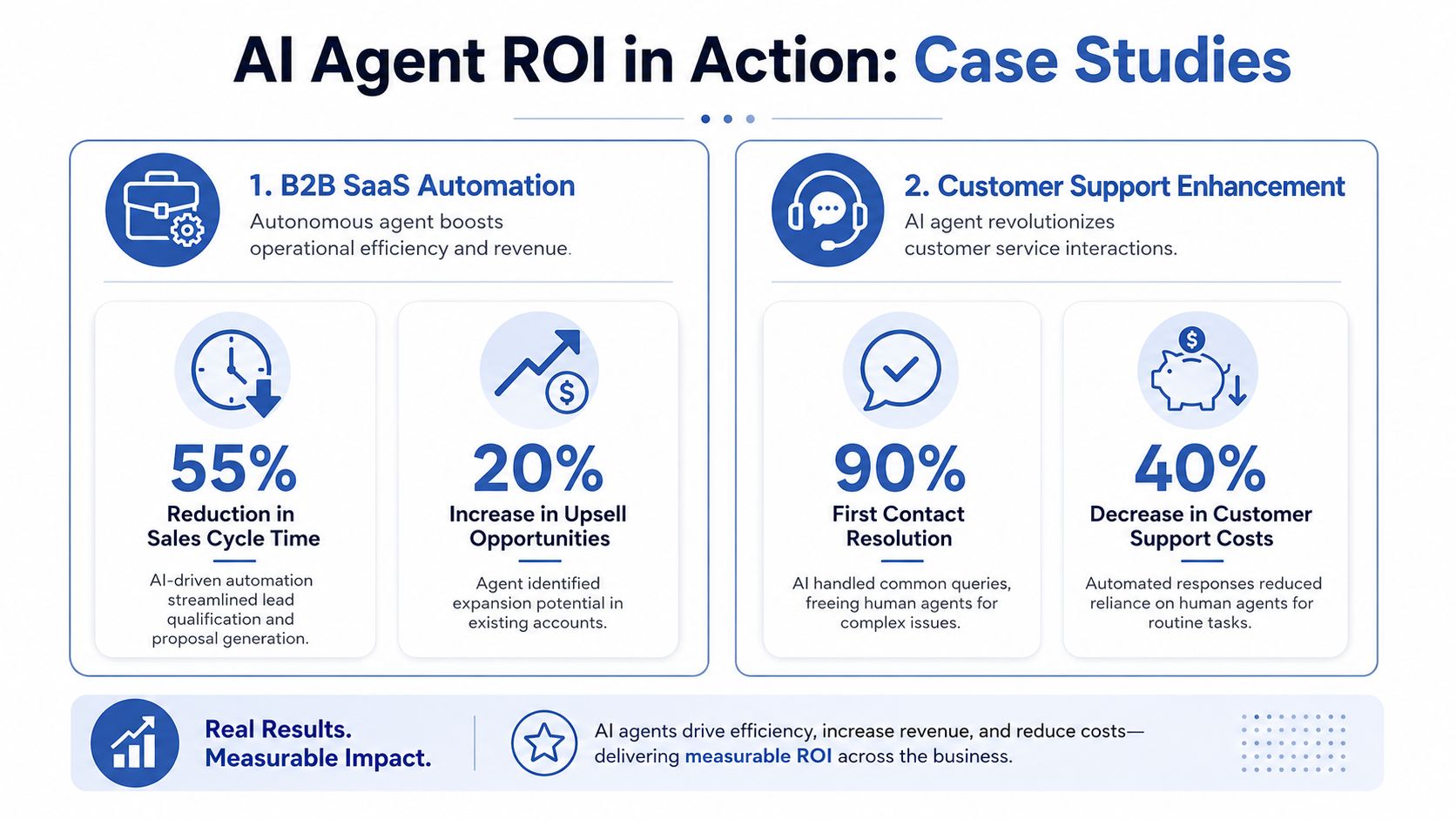
Case study one: B2B SaaS pipeline acceleration
B2B SaaS companies rarely have a pure lead problem. They have a speed and coverage problem.
A strong agent sits inside the revenue workflow. It pulls from inbound forms, CRM history, email sequences, and routing rules. Then it enriches leads, flags urgency, sends relevant follow-up, pushes high-intent accounts to reps quickly, and keeps lower-intent prospects engaged until timing improves.
That changes the economics of selling.
Your reps spend less time sorting, chasing, and updating records. They spend more time in live conversations with accounts that matter. Pipeline gets cleaner. Response times drop. Coverage expands without matching headcount growth. That is how an AI agent stops being a productivity tool and starts acting like a revenue engine.
Organic acquisition follows the same logic. Teams evaluating AI SEO agents are chasing more than content output. They want broader search coverage, faster iteration, and better signals about what demand is forming before competitors react.
Case study two: retention and lifecycle compounding
The second pattern is even more defensible because it compounds.
In ecommerce, subscriptions, and other customer-rich businesses, an agent can connect lifecycle messaging, purchase behavior, support activity, and segmentation rules into one operating loop. It can react to churn signals faster than a human team, personalize offers with more consistency, and keep improving who receives what message and when.
That produces more than campaign efficiency. You get better retention timing, stronger upsell identification, and more repeat purchases from the same customer base. Over time, the company gets smarter about monetizing demand it already paid to acquire. Competitors can copy your tools. They cannot easily copy your data feedback loop once it is working at scale.
What both examples have in common
The winners make three decisions right away.
- They choose workflows tied to revenue, retention, or strategic speed
- They connect agents to core systems instead of running side experiments
- They judge performance by business results rather than agent activity
Use that filter ruthlessly. If an agent does not improve a high-value decision and create an edge you can measure, what you have is a demo.
Conclusion: From Measurement to Momentum
AI agent ROI is a control system for growth, something you keep running rather than a finance exercise you complete once and file away.
If you measure it correctly, you'll know which workflows deserve more investment, which agents need redesign, and which experiments should be killed before they drain time and credibility. That discipline matters because AI compounds. Small workflow wins stack into faster execution, better intelligence, and stronger commercial coverage.
I'd treat ROI tracking as your offensive feedback loop.
The companies that win with AI agents will be the ones that can prove, repeatedly, that an agent changes operating economics in their favor. Better pipeline coverage. Faster decisions. More consistent execution. More capacity without matching headcount growth.
That's what turns AI from a software expense into an economic engine.
And once you build that engine, competitors need more than the same tools. They have to catch up to a faster business.