
Most attribution advice is too polite. I'm not.
If you're still using a simplistic reporting view to decide where marketing budget goes, you're measuring whichever platform was lucky enough to sit closest to the sale and calling it performance. That's how businesses starve the channels that create demand, overfund the channels that harvest it, and then wonder why growth stalls.
I've worked with ML systems since 2016 and generative AI since 2019. My view is straightforward. Rule-based multi-touch attribution models are a necessary phase, and you should plan to move past them. They help you stop making obviously bad decisions. But if you want a real edge, you need to move toward algorithmic attribution built on unified data, disciplined experimentation, and AI-driven analysis. That's where attribution stops being reporting theater and starts becoming a weapon.
Your Marketing Attribution Is Lying to You
If you're running your business on last-click attribution, your dashboard is telling a comforting lie.
It tells you the final ad, email, or branded search term “won” the sale. It hides the fact that the buyer may have discovered you elsewhere, compared you against competitors through a different channel, and only returned later when your brand finally felt credible. That reporting model misses nuance, and worse, it pushes you to cut the very programs that make future revenue possible.
The popular advice says last-click is “good enough” for many businesses. I disagree. It's only good enough if you don't mind funding the wrong channels.
The problem is simple. Most customer journeys aren't single-event journeys. Roivenue reports that 70% of conversion journeys involve 2 or more touchpoints, which is exactly why multi-touch attribution became necessary in the first place, as summarized in Twilio's introduction to the topic: Twilio's overview of multi-touch attribution.
What bad attribution actually does to your business
When you over-credit the final touch, three things happen.
- You overinvest in closers. Branded search, retargeting, and bottom-funnel email look stronger than they really are.
- You underinvest in creators of demand. Content, paid social, creator partnerships, upper-funnel video, and marketplace discovery get punished.
- Your competitors gain ground. They keep funding the touches that shape preference while you keep rewarding whatever happened last.
A practical rule: if a channel mostly appears at the end of the journey, don't assume it created the demand.
This gets even messier for brands that sell across their own site, marketplaces, and retail channels. If that's your world, a practical companion read is this D2C brand guide to Amazon attribution, because the reporting gaps between ad platforms and downstream sales are where a lot of margin gets lost.
Why you should care as the owner
Attribution is a capital allocation issue first, and a marketing issue second.
If your attribution is wrong, your budget plan is wrong. Your CAC assumptions drift. Your growth forecasts weaken. And your team starts arguing over channel credit instead of building a system that compounds demand.
That's why I treat attribution as a decision system rather than a reporting feature.
The Standard Playbook of Attribution Models
Before you can beat the standard models, you need to know how they think.
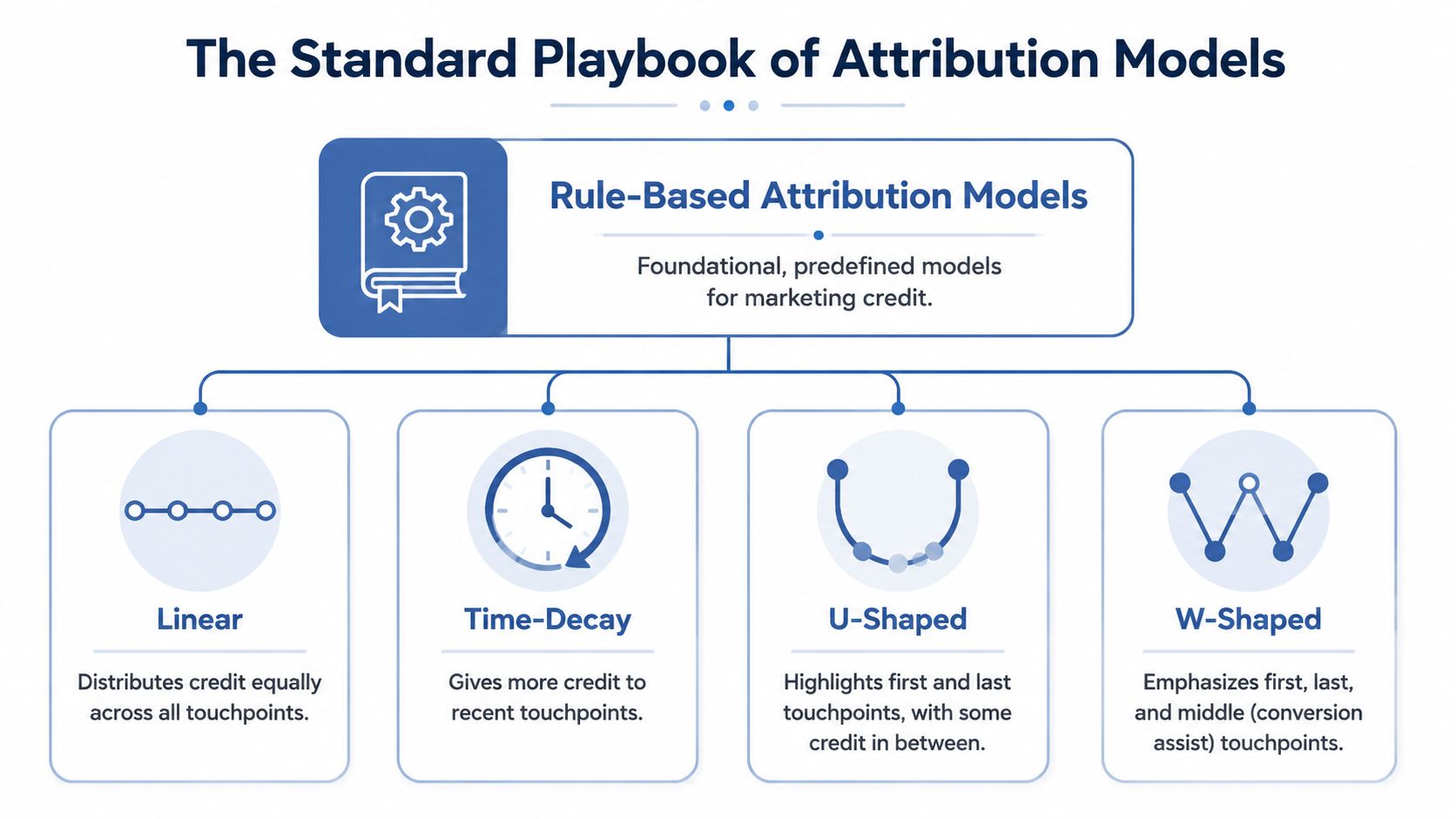
Multi-touch attribution models emerged because single-touch models assign all credit to one interaction even when the buyer moved through several steps first. Salesforce lays out the common rule-based formats clearly: linear attribution gives equal credit across touchpoints, time-decay gives more credit to touches closer to conversion, and position-based or U-shaped gives 40% to the first touch, 40% to the last touch, and 20% split across the middle touches in the journey, as described in Salesforce's guide to multi-touch attribution.
Linear attribution
Linear is the easiest upgrade from last-click. Every touch gets equal credit.
That sounds fair. It usually isn't. A random blog visit and a high-intent demo request rarely deserve the same influence in a buying decision.
Time-decay attribution
Time-decay assumes the touches closest to conversion matter more.
That can be useful when your sales cycle is relatively short and late-stage interactions carry more decision weight. The catch is obvious. It can downplay the channels that introduced the buyer and built trust earlier.
U-shaped attribution
U-shaped models are popular because they reflect a truth many teams feel instinctively. The first touch matters, and the last touch matters.
The weighting is predefined, not discovered from your own data. That's the trade-off. You get a cleaner structure, but you also force reality into a formula.
W-shaped and full-path thinking
A lot of marketers stop at linear, time-decay, and U-shaped. That's too shallow for serious operators.
Adobe's fuller view adds a full-path model with four milestone stages weighted at 22.5% each. That approach reflects a more mature business view because it recognizes that important events happen between awareness and close. If you're trying to understand commerce journeys in newer channels, this breakdown on TikTok Shop attribution models is useful because platform-native commerce rarely fits clean first-click or last-click logic.
Rule-based models are useful because they force discipline. They're limited because they force assumptions.
My judgment on the standard playbook
Use rule-based models to graduate from nonsense, not to declare victory.
They're table stakes. They formalize how credit gets distributed across a journey. That's valuable. But they still rely on weights that humans picked in advance, not on what your actual customer paths reveal.
A Side-by-Side Comparison of Attribution Models
Most comparison charts are too soft. They tell you every model has pros and cons, then leave you with no recommendation.
I'd rather be blunt. Every attribution model creates a strategic blind spot. No model is perfect. Your job is to choose the model whose blind spot does the least damage to your business while you build toward something smarter.
Here's the cheat sheet I'd use to make the call.
Attribution model cheat sheet
| Model | Core Logic | Best For | Biggest Blind Spot |
|---|---|---|---|
| Last-click | Gives all credit to the final interaction before conversion | Very early-stage teams that only need a rough signal and have weak tracking | Treats closers as creators of demand |
| First-click | Gives all credit to the initial interaction | Teams trying to understand awareness entry points | Ignores everything that moved the buyer toward purchase |
| Linear | Splits credit evenly across all tracked touchpoints | Companies moving off single-touch and needing a simple shared baseline | Assumes all touches matter equally |
| Time-decay | Gives more weight to interactions closer to conversion | Shorter cycles or businesses where late-stage evaluation is decisive | Understates early education and brand formation |
| U-shaped | Heavily weights first and last touch, with less credit in the middle | Businesses that care about both acquisition and conversion endpoints | Starves the middle of the funnel where nurturing often happens |
| W-shaped | Weights first touch, lead milestone, and conversion milestone more heavily | Businesses with defined funnel stages and meaningful lead progression | Depends on clean milestone definitions and still uses fixed logic |
| Full-path | Credits key lifecycle stages across a longer journey | B2B and complex journeys with multiple meaningful milestones | Becomes harder to maintain when data is fragmented |
| Data-driven | Uses statistical methods or machine learning to assign credit dynamically | Mature teams with enough conversion volume and unified data | Fails when data quality, identity resolution, or volume are weak |
What matters more than the label
The model name is less important than the business question.
If you want to know which channels introduce buyers, first-touch tells you something useful. If you want to know which channels help close, time-decay or last-click will bias toward that answer. If you want a more balanced operating view, linear or position-based models are a better starting point.
That's why I don't ask, “Which model is best?” in the abstract. I ask, “Which wrong assumption can you afford this quarter?”
A few hard recommendations
- Don't stay on last-click. It's too distorted for any business that runs multiple channels.
- Don't idolize linear. Equal weighting is cleaner than last-click, but it can still flatten reality.
- Use position-based models when your funnel has real stages. If your business has identifiable conversion milestones, that structure gives operators something more useful than generic channel totals.
- Move to algorithmic attribution when your data can support it, because that's where the true edge starts.
If you run referral-heavy acquisition or partner-led growth, you also need to think beyond paid media reporting. This resource on how to track referral marketing attribution is worth reviewing because referrals often get undercounted when teams only look at standard ad-platform views.
The best model is the one that helps you reallocate money correctly, not the one that sounds smartest in a slide deck.
My operating lens
I treat rule-based models like training wheels: useful, necessary for some businesses, and something to grow out of.
If your competitors are still debating whether email “owns” the conversion and you're mapping how channels work together across the full path, you're already making better budget calls than they are. That gap compounds.
How to Choose the Right Model for Your Business
The right model depends less on analytics theory and more on how your company sells.
A founder with a short ecommerce purchase path doesn't need the same attribution setup as a B2B founder dealing with multiple stakeholders, CRM stages, and a sales-assisted close. If you choose the wrong model, you get fuzzy reporting and, worse, you optimize against the wrong behavior.

Start with journey shape, not software
For straightforward journeys, simple models can work as a management tool. For complex journeys, they break fast.
Improvado makes the critical point here. For B2B and long, multi-stage purchase journeys, common rule-based models are often too simplistic. Their guidance is directionally right. Custom or position-based models fit more complex journeys better, while full-path attribution can assign credit to distinct milestones like first touch, lead creation, and opportunity creation, which is especially important when marketing influences pipeline before revenue shows up in the ledger. Their discussion is here: Improvado on multi-touch attribution for complex journeys.
My decision framework
Use these questions.
How long is your sales cycle?
If buyers convert quickly, you can operate with a simpler model for a while. If the cycle spans multiple stages, departments, or meetings, simple endpoint models will mislead you.Do you have milestone events that matter?
Lead created. Opportunity created. Demo booked. Proposal sent. Closed won. If these events exist and are trustworthy, use them.Is your revenue motion self-serve, sales-led, or mixed?
Self-serve brands can get away with lighter structure. Sales-led businesses need attribution that maps to actual pipeline stages as well as sessions and clicks.What decision are you trying to make?
Budget allocation, channel mix, sales and marketing alignment, or stage conversion improvement. Different decisions need different views.
Clear recommendations
- For early-stage ecommerce, start with linear or a simple position-based model if your tracking is messy and your team needs a shared baseline.
- For B2B demand gen, use a milestone-aware model. If your CRM stages matter, your attribution should reflect them.
- For hybrid motions, if you have both self-serve and sales-assisted paths, segment the analysis. One model for all journeys is usually lazy thinking.
If your model can't show how marketing influences pipeline stages, it won't help you manage growth.
I also recommend tying attribution review to margin and efficiency decisions as well as marketing reporting. If you're trying to improve spend quality, this guide on how to improve marketing ROI pairs well with attribution work because the whole point is better capital allocation.
When not to overcomplicate it
Don't build a custom attribution framework just to look advanced.
If your data is inconsistent, your CRM stages are dirty, or your team still can't agree on what counts as a qualified lead, complexity will make the confusion worse. In that case, choose a simple model, enforce process discipline, and earn the right to get more advanced.
Implementing Your First Multi-Touch System
Most attribution projects fail before the model even matters.
They fail because links aren't tagged consistently, CRM fields are incomplete, conversion events are poorly defined, and no one has unified the data. If the foundation is weak, the model is just decorative math.
Phase one gets boring on purpose
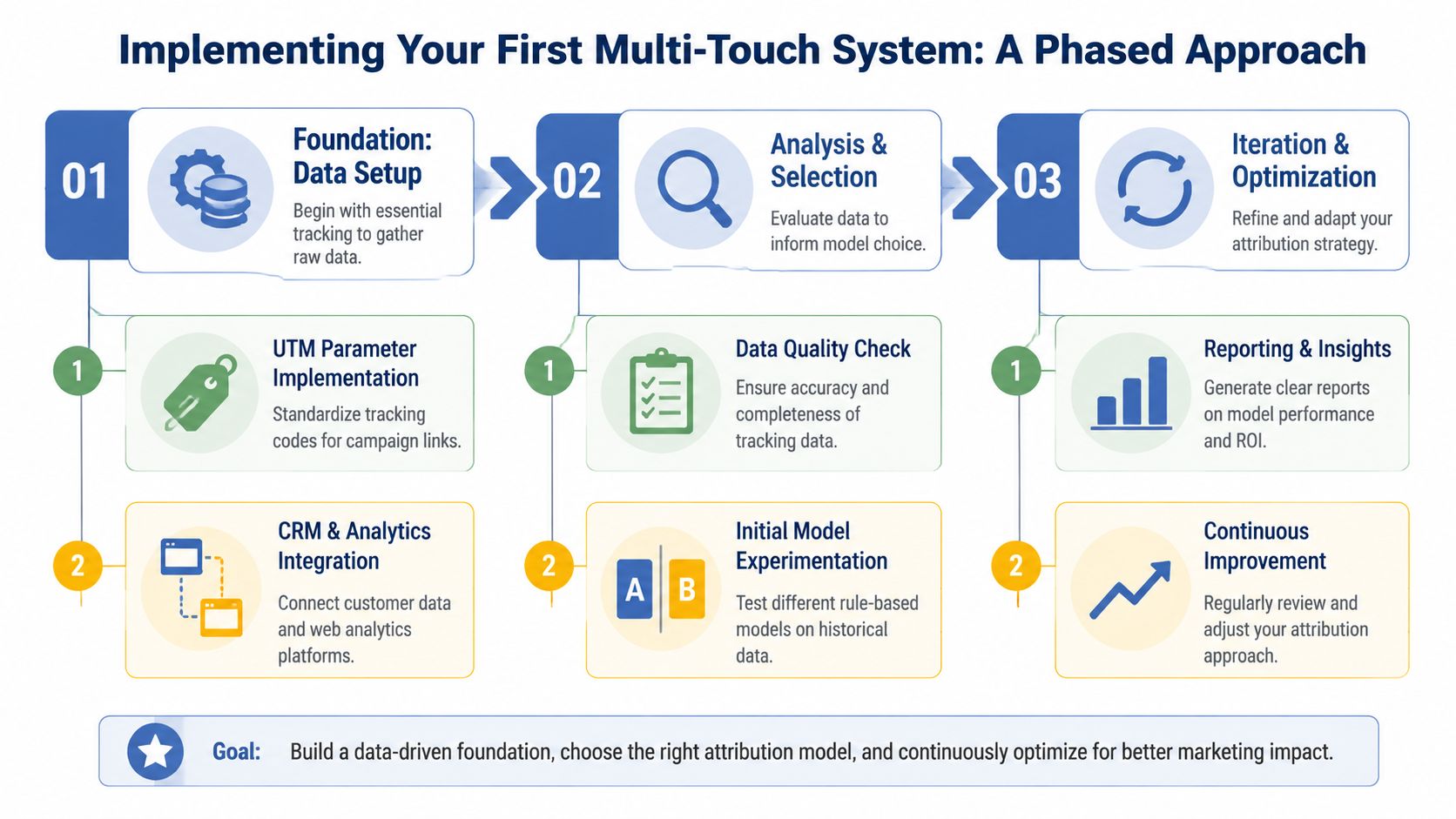
Start with disciplined tracking. That means UTMs, campaign naming standards, CRM source fields, and clear conversion definitions.
Twilio frames the implementation pattern well. Teams typically collect touchpoint data, centralize it in a warehouse or platform, and then apply an attribution model to visualize contribution. That sequence matters. Don't skip the centralization step and expect clarity later.
The practical stack
You don't need a data team on day one. You do need a system.
- Web analytics, such as GA4 or Adobe Analytics
- A CRM, such as HubSpot, Salesforce, or another system with usable lifecycle stages
- Ad data from Google Ads, Meta, LinkedIn, TikTok, email platform exports
- A storage layer, whether a warehouse, attribution platform, or a clean reporting layer that can unify records
- BI and reporting in Looker Studio, Power BI, Tableau, or your platform's native dashboards
A rollout I'd actually recommend
Standardize inputs first
Clean UTM conventions. Shared channel naming. One owner for taxonomy. If three people name the same campaign three different ways, your reporting is already compromised.Map touchpoints to identities
Use first-party identifiers where you can. At minimum, connect anonymous web activity to known leads once a user converts into CRM.Define milestone events
Track purchase and form submit, and also track the operational moments your business cares about.Start with one rule-based model
Pick one simple model and use it consistently long enough to expose data gaps. Treat it as your diagnostic phase rather than the final state.Build reporting people will use
You need budget and channel summaries. Whoever runs campaigns needs journey and stage views. Whoever sells needs source-to-opportunity context.
If you're evaluating stack options, I'd also review this breakdown of marketing intelligence tools because attribution only works when your reporting layer can combine data from channels, analytics, and CRM without constant manual patchwork.
Bad data doesn't become insight because you put it in a dashboard.
What to expect operationally
Your first version won't be elegant. That's fine.
The goal is to produce a trustworthy enough view that helps you stop making obviously wrong budget calls. Once the data is flowing and you trust the definitions, then you earn the right to move into algorithmic attribution.
The Real Edge: Algorithmic Attribution
This is the part that separates serious operators from teams still playing reporting dress-up.
Rule-based multi-touch attribution models are useful, but they're still static. They apply predefined weights. Humans decide the formula first, then the system pushes reality through it. Algorithmic attribution flips that. It uses machine learning or statistical inference to infer contribution from observed conversion paths.
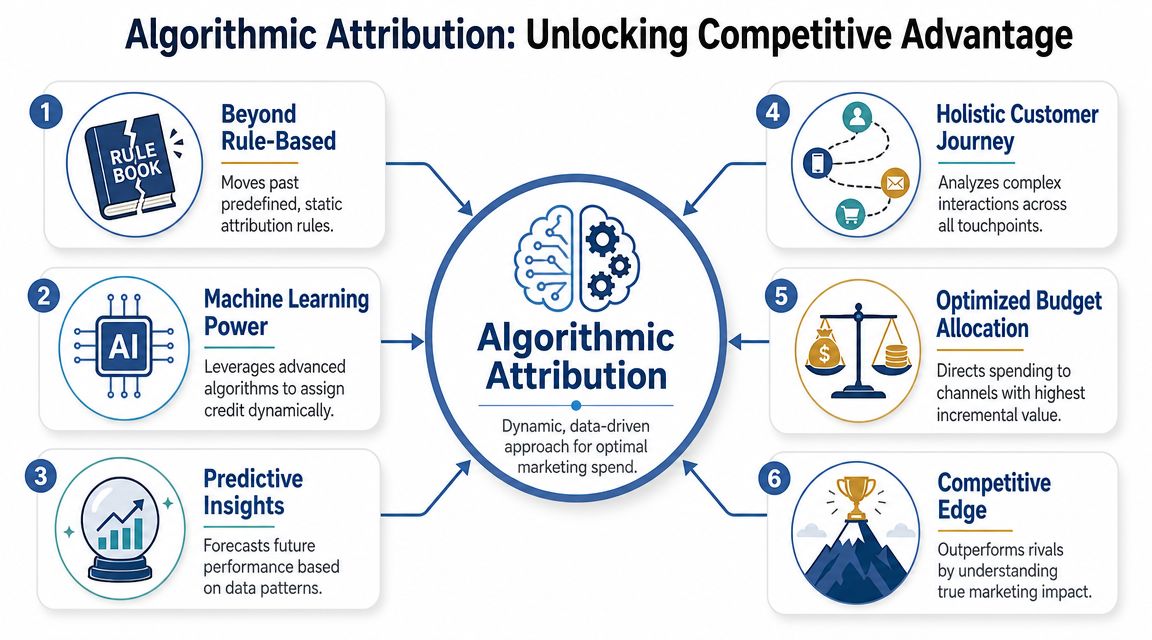
I like this shift because it matches how modern businesses operate. Your customer journey is dynamic. Your attribution logic should be dynamic too.
What algorithmic attribution changes
Instead of saying, “first and last touch deserve preset weight,” the system analyzes historical paths and estimates which touches appear to contribute more meaningfully across the observed data. Funnel notes this move from fixed-rule logic to data-driven systems, and that's a key milestone in attribution maturity.
That matters because the best-performing channels often don't win on visibility alone. They win in sequence. A touch that looks weak in isolation can be powerful when it appears before a high-intent event.
Here's a useful explainer if you want a quick visual primer before going deeper.
When you're ready for it
Not every company should jump into data-driven attribution immediately.
Dataslayer gives a practical benchmark that I think is useful because it forces operational honesty. If a business has fewer than 100 conversions per month, last-click is recommended. 100 to 300 conversions per month can support position-based attribution as a safer default. 300 to 600 conversions per month is enough to begin considering data-driven attribution in GA4, where algorithmic models are more likely to outperform simpler rule-based approaches, according to Dataslayer's benchmark for attribution model readiness.
My blunt advice on readiness
Use this framework.
- With low volume and messy data, don't force AI into it. Clean your instrumentation first.
- With moderate volume and clear funnel stages, use a strong position-based model while you strengthen the data layer.
- With sufficient volume and unified records, start testing algorithmic attribution now.
The advantage is making better budget decisions before your competitors see the pattern. “Using AI” is only the means.
Why this becomes a competitive weapon
Once attribution becomes algorithmic, you stop relying purely on human intuition about channel value. You can identify paths that consistently create revenue, beyond the channels that tend to appear near the finish line.
That changes budget allocation, creative strategy, and how sales and marketing line up. It helps you spot channels your competitors will keep underfunding because their dashboards still over-credit the obvious closer.
I've seen this mindset shift transform how teams operate. They stop asking which platform “deserves” credit and start asking which sequence of touches creates profitable movement through the funnel. That's a much stronger question.
Validating Your Model and Avoiding Common Pitfalls
Launching an attribution model is easy. Trusting it blindly is reckless.
Even the best model is still a representation of reality, not reality itself. If you treat it like sacred truth, your team will start defending the model instead of improving decisions.
What I trust and what I don't
I trust attribution most when it aligns with business outcomes and survives challenge.
If the model says a channel matters, I want to see whether budget shifts, controlled tests, holdouts, or stage movement support that conclusion. If the model can't survive scrutiny, I don't let it drive major allocation decisions.
The common ways teams ruin attribution
- They use it as political ammunition. Paid media blames brand. Brand blames lifecycle. Sales dismisses marketing influence. Everyone fights over credit instead of discussing contribution.
- They ignore offline reality. Calls, events, partner influence, sales touches, and founder-led selling often matter. If they're missing, the model will skew.
- They confuse correlation with causation. A touchpoint showing up often before conversion doesn't automatically mean it drove the conversion.
- They stop updating definitions. Funnel stages change, go-to-market changes, and reporting logic stays frozen.
How I'd validate a model in practice
Run a simple discipline loop.
Check data integrity
Look for source gaps, mis-tagged campaigns, duplicate conversions, and broken identity stitching.Compare outputs against operational reality
Ask whoever handles sales whether the journey patterns look believable. Ask whoever handles finance whether channel efficiency trends line up with actual spend and pipeline movement.Use tests where possible
Holdout tests, geo splits, creative pauses, or controlled budget changes help expose whether the attributed influence matches real lift.Review model drift
A model that made sense six months ago may be wrong now if your funnel, product, or market changed.
If you want a stronger operating framework for this part, I'd pair your attribution work with a broader system for how to measure marketing effectiveness so you don't confuse one reporting methodology with the whole truth.
Attribution should guide decisions. It should never end the argument.
My final take
Use rule-based models to build discipline. Move to algorithmic attribution when your volume and data quality justify it. Validate everything against actual business outcomes.
That's the path I'd recommend to any owner who wants marketing tech to drive profit instead of presentations.
If you want help designing a practical attribution and AI measurement system for your business, you can learn more about working with me.