
Let’s cut the hype. You’re swimming in data but drowning in confusion. You have more dashboards than you know what to do with, but less actual clarity than ever. Your marketing intelligence tools were supposed to be a secret weapon. For most businesses, they’re just expensive pieces of software gathering digital dust.
Adding another tool to your stack won’t fix this. What you need is a central nervous system for your marketing, a system designed for one thing: turning market signals into action.
I’ve been working with ML since 2016 and Generative AI since 2019. I’ve seen firsthand how the right intelligence stack can become an engine for growth, and how the wrong one just bleeds cash.
Why Your Current Marketing Stack Is Bleeding Money
Your tools don’t talk to each other. Those disconnects create blind spots. In those gaps, your competitors are snatching deals, grabbing market share, and controlling the conversation. All while you’re stuck trying to figure out which dashboard to believe. This problem is actively costing you revenue.
I once watched a promising B2B SaaS company get completely outmaneuvered. They had all the “right” tools: a CRM, an analytics platform, social listening software. The problem? All that data was fragmented, locked away in different departmental silos. Their reaction time was glacial.
While they were busy pulling last quarter’s reports, a smaller competitor used their intelligence stack to spot an emerging customer pain point. They launched a targeted micro-campaign, tweaked their messaging on the fly, and scooped up a market segment that should have been a sure thing for the incumbent. Opportunities missed. Revenue lost.
Moving from Fragmented Tools to a Bionic System
This is where I reframe the problem. Stop thinking about individual marketing intelligence tools. Start architecting what I call a “bionic” marketing system. It’s where my expertise in AI and your strategic goals get fused into a single, cohesive unit.
The goal is brutally simple: process market signals and act on them faster than anyone else. That’s how you win.
The point of this system is a feedback loop where market insights automatically inform strategy, strategy drives action, and the results feed right back into the system to make it smarter. Think of it as your company’s AI-powered intuition. This is the only sustainable path to building a real competitive moat and to learn how to improve your marketing ROI in a way that actually moves the needle.
The real advantage comes from having the fastest, most accurate path from raw data to decisive action, whatever the size of your data.
The market for these tools is exploding. The marketing technology (MarTech) sector, which powers these intelligence platforms, is projected to swell from $551.96 billion in 2025 to over $2.3 trillion by 2033.
Yet, here’s the kicker: a shockingly small 6% of marketers have fully implemented AI. The other 94% are left with fractured data and no clear path forward. That gap is your opportunity to get ahead. You can read more on these marketing technology market trends to see the full picture.
The Six Layers of a Modern Intelligence Stack
One tool can’t carry the whole job. Yet that’s how many businesses build their tool stack: a jumble of disconnected point solutions bought to solve yesterday’s problems. This approach guarantees you’ll always be reacting, never leading.
So, let’s build a proper stack. A modern intelligence stack is a layered framework where each component feeds the next, far from a random shopping list of software. When I think about marketing intelligence tools, I organize them into six distinct layers of capability.
The diagram below shows exactly why a fragmented approach fails. Disconnected tools create data silos, which directly leads to slow reactions and missed growth.
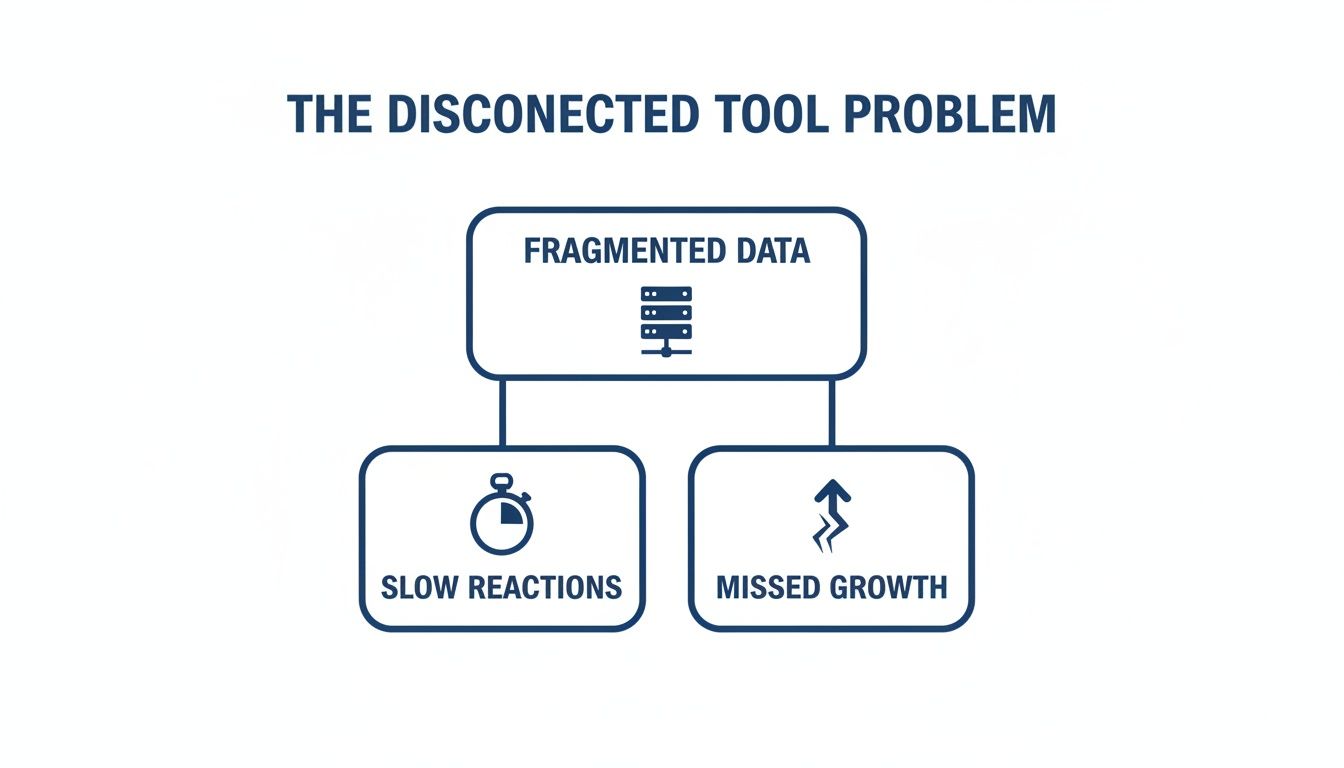
This visual gets to the heart of the matter: your intelligence is only as fast as its weakest link. Disconnected systems create permanent bottlenecks that cripple your ability to move.
To build a truly effective system, you need to think in layers. Each one provides a different kind of visibility. When stacked together, they give you a complete picture of your market. Here’s a quick overview.
| Intelligence Layer | Primary Business Function | Example Tool |
|---|---|---|
| Market Research | Understanding macro trends and seeing what’s on the horizon. | Google Trends |
| Competitive Intel | Tracking what your direct rivals are doing, right now. | Crayon |
| Audience Intel | Knowing who your customers really are and where they live online. | SparkToro |
| Customer Journey | Mapping every single touchpoint from stranger to customer. | HubSpot |
| Content/Creative | Analyzing what content and creative actually drives results. | BuzzSumo |
| Sales & Attribution | Connecting marketing efforts directly to closed deals and revenue. | Salesforce |
When these layers work in concert, you move from guessing to knowing, and from reacting to anticipating. Now let's break down what each layer does and why it matters.
1. Market Research and Trend Spotting
This is your 'eye in the sky.' It covers your whole market, well beyond your own corner of it. These tools analyze macro trends, search behavior, and industry shifts so you can see what’s coming long before it arrives.
Think of it as the difference between staring at a paper map and having a live satellite feed. One shows you where things are; the other shows you where they're moving.
2. Competitive Intelligence
If market research is the satellite feed, competitive intelligence is your spy on the ground. Its job is singular: tell you exactly what your rivals are doing, planning, and saying.
This layer tracks everything: their messaging changes, pricing updates, new feature launches, and ad campaigns. This intelligence lets you intercept their strategy or exploit a sudden weakness. It’s about being proactive. Always.
3. Social and Audience Intelligence
Let's be clear: you don't have a 'target market.' You have living, breathing groups of people with specific beliefs, pains, and online hangouts. This layer tells you who they really are, what they actually talk about, and where they spend their time.
Your customers are already telling you exactly how to sell to them. The question is whether you have the systems in place to listen at scale.
Tools like SparkToro let you move beyond vague personas. They show you the specific podcasts your audience listens to, the YouTube channels they binge-watch, and the social accounts they follow. This is how you discover high-return marketing channels your competitors have completely missed.
4. Customer Journey Analytics
This layer is your detective, mapping every single touchpoint a person has with your brand. From their first anonymous website visit to their tenth purchase. It connects the dots between your marketing actions and their behavior.
Without this, you’re just guessing. With a platform like HubSpot, you can actually see how a specific blog post influenced a demo request three weeks later. This is the basis for understanding attribution and optimizing the entire path to conversion.
5. Content and Creative Intelligence
Every piece of content you publish is an asset designed to do a job. This intelligence layer analyzes what topics are resonating in your market, which content formats are driving the most engagement, and what creative angles are actually converting.
Tools like BuzzSumo show you what content gets shared and linked to, revealing the gaps you can fill. This intelligence is the fuel for your content engine. You can see how this data fuels AI marketing agents that automate content briefing and creation.
6. Sales Enablement and Attribution
This is where marketing intelligence translates directly into closed deals. This final layer equips your sales team with the competitive insights and content they need to win. It also tracks which marketing efforts actually influenced revenue. When building your stack, a key decision involves choosing the right SaaS Business Intelligence Tools to power this layer.
This layer closes the loop, proving marketing’s contribution to the bottom line. The aim is to tie every marketing dollar to a real revenue outcome instead of vanity metrics. This is how you know where the next dollar should go.
How AI Agents Create Your Bionic Marketing System
The six layers I just covered are powerful on their own. But having these marketing intelligence tools is only the start. The advantage comes from chaining them together into an automated, intelligent system that acts on your behalf.
This is where you move from static tools to dynamic, bionic systems.

Since 2019, I've been building what I call "neural networks" for market intelligence using LLMs and AI agents. Forget the hype. This is about creating practical, automated workflows that give you a real head start. It's about scaling strategic output without scaling your headcount.
From Manual Analysis to Automated Action
Right now, you or your team likely spend hours manually pulling reports, trying to connect the dots in a spreadsheet, and then debating what it all means. This process is slow, expensive, and riddled with human bias. An AI agent system removes this bottleneck.
Imagine an autonomous agent that does this 24/7:
- Monitors industry news and your competitors' social feeds via an API.
- Summarizes key strategic shifts using a model like Claude 3 Opus for its reasoning capabilities.
- Compares those shifts against your current product messaging and active campaigns.
- Flags high-priority opportunities or threats and pushes a concise brief directly to your Slack channel.
You can build this workflow today. The real advantage is the speed of the insight-to-action loop. While your competitor is waiting for their Monday morning meeting to discuss last week's news, you have already published a counter-narrative. That’s how you win.
An AI agent goes past handing you data: it performs the cognitive labor of synthesis and prioritization, freeing you to focus on high-level strategy and execution.
In the near future, marketing intelligence tools will increasingly function as stacked, modular layers that transform raw buyer data into revenue. The key is using AI agents to connect these layers and automate the workflows that turn disparate data points into cohesive, revenue-driving action.
A Practical Example of an Intelligence Agent
Let's make this concrete. You and I could build an agent to automate competitive battlecards for whoever handles your sales. The battlecard stays current instead of going stale. You can build on this concept by exploring how to apply AI agents for sales enablement more broadly.
The workflow would look something like this:
- It starts when Crayon (your Competitive Intel layer) detects a price change on a competitor's website.
- In step 1, the agent pulls the new pricing data and grabs the last three customer reviews mentioning "price" from G2.
- In step 2, it feeds this context to a fine-tuned LLM with a prompt to analyze the strategic implication and generate three counter-talking points.
- In step 3, the agent automatically updates the relevant battlecard in your sales enablement tool (like Highspot) and pings whoever owns sales in Teams.
This entire process happens in under 60 seconds. No meetings, no emails, no manual work. Whoever sells for you has real-time intelligence before they even knew they needed it. That is the power of a bionic system.
Building Your Intelligence Stack
Theory is just talk. Now for the part where you build. I’ll move from the 'what' to the 'how' with two distinct, actionable playbooks for building out your marketing intelligence stack.
Forget the one-size-fits-all approach. A cash-strapped startup has very different needs than a multi-client agency. Trying to force the same tools on both is a recipe for wasted money and missed opportunities.

Below is the right stack for each business model. The goal is to acquire the exact capabilities you need to win, and nothing extra.
The Startup and SMB Playbook
If you're running a startup, your reality is dictated by two things: speed and capital efficiency. You can't afford a bloated, enterprise-level intelligence stack. You need lean, high-impact tools that deliver immediate value and help you find product-market fit faster than your funded competitors.
Your priorities are survival and traction. That means your intelligence stack has to be ruthless in its focus.
- Audience intelligence is non-negotiable. Your first job is to deeply understand a small, passionate group of early adopters. A tool like SparkToro is essential. It tells you exactly where your audience hangs out online so you don't waste a single dollar on the wrong channels.
- Focus on one or two key competitors. You don't need to track the entire market. Use a simple, cost-effective tool like Visualping to monitor your top two rivals' websites for pricing and messaging changes. Think of it as your early warning system.
- Unify your customer data immediately. Start with a platform like HubSpot Starter. It combines your CRM with basic marketing analytics, giving you a single view of the customer journey from day one. Don't let your data get fragmented.
Build a good enough system that lets you learn and iterate faster than anyone else. Perfect can wait.
As a startup, your competitive advantage is agility. A lean intelligence stack amplifies that advantage by turning market signals into immediate action.
The Agency Playbook
Running an agency? Your challenges are totally different. You're juggling multiple clients, each with their own brand, competitors, and goals. Your playbook needs to be built for scalability, client management, and proving ROI at every turn.
Beyond insight, your intelligence stack is a tool for client retention and winning new business. Your priorities are efficiency and proof.
- Centralize competitive intelligence. Managing competitive intel across a dozen clients is a nightmare. A platform like Crayon is built for this. It lets you create separate intelligence workspaces for each client, automating the tracking and delivering curated insights your team can use to look like geniuses.
- Automate reporting and data aggregation. You and your team can't spend half your time pulling data into spreadsheets. This is where a tool like Improvado earns its place. It automates data collection from all your clients' ad platforms and analytics tools into a single destination, freeing up your team for actual strategy.
- Invest in scalable content and SEO intelligence. Agencies live and die by generating results through content. Mastering large scale web scraping for AI and SEO fuels modern BI. You'll also want tools like BuzzSumo or Ahrefs to find content opportunities and track keyword performance across your entire client portfolio.
The right agency stack allows you to deliver sophisticated insights that would be too expensive or complex for clients to build themselves. This is how you move from being a vendor to an indispensable strategic partner.
To make this crystal clear, let's look at how these two playbooks stack up side-by-side. Each path is designed to maximize what matters most for that business model: agility for the startup, and scalable service delivery for the agency.
Startup vs. Agency Intelligence Stack Comparison
| Focus Area | Startup/SMB Playbook (Lean & Agile) | Agency Playbook (Scale & Reporting) |
|---|---|---|
| Core Priority | Find Product-Market Fit & Iterate Fast | Deliver Client Results & Prove ROI |
| Market Research | SparkToro: Find where early adopters live online. Focus on a narrow, passionate audience. | AlsoAsked / AnswerThePublic: Uncover content gaps and questions across multiple client industries. |
| Competitive Intel | Visualping: Track 1-2 direct competitors for pricing/messaging changes. Simple and cheap. | Crayon: Centralize intel for all clients. Automated tracking and shareable battlecards. |
| Customer Data | HubSpot Starter: Unify CRM and marketing data from day one. Single source of truth. | Segment / Customer.io: Build sophisticated data pipelines to manage multiple client data sources cleanly. |
| Attribution | Native Platform Analytics: Rely on Google Analytics and ad platform data. Good enough for now. | Improvado / Supermetrics: Aggregate data from all client channels into a unified reporting dashboard. |
| Content/Creative | Manual Research: Monitor key subreddits and forums to find authentic customer language. | BuzzSumo / Ahrefs: Identify high-potential content topics and track keyword rankings across the portfolio. |
| AI Integration | LLM Chat Interfaces (ChatGPT/Claude): For quick copy generation, brainstorming, and data summarization. | Custom AI Agents / Workflows: Build scalable, repeatable processes for client reporting and analysis. |
Choosing the right path means building the stack that aligns with your mission, whatever the “best” tools lists say. Whether you’re a nimble startup chasing traction or a growing agency proving value, the right intelligence foundation is your key to getting ahead.
Common Mistakes That Neutralize Your Advantage
Buying a suite of powerful marketing intelligence tools feels like progress. It feels like you’re arming yourself for battle. But I’ve seen companies spend a fortune on the best software only to get zero competitive lift from it.
Why? Because buying tools is an expense. The advantage comes from the system you build around those tools.
Most initiatives fail before they even begin because of a few predictable, fatal mistakes. You and I are going to make sure you sidestep them.
The Data Hoarder Problem
The first and most common failure is becoming a data hoarder. This is the team that’s obsessed with collecting everything. Every click, every impression, every social mention gets funneled into a massive data lake, but there’s no clear plan for what to do with any of it.
Data without a decision-making framework is just noise. Worse, it’s a liability that costs money to store and time to manage. I worked with a mid-size ecommerce brand that had terabytes of customer data but couldn’t answer a simple question: “Which marketing channel brings us our most profitable customers over a 90-day period?”
Collecting data you don’t use is like buying ingredients for a five-star meal and letting them rot in the fridge. Beyond the waste, it keeps you from cooking anything useful.
The fix is simple but requires discipline: start with the business question, not the data. Before you track a single new metric, define the specific decision it will influence. If you can’t articulate how the data will change your behavior, don’t collect it.
Shiny Object Syndrome
The second pitfall is chasing shiny new AI tools for the hype instead of a solid business case. Every week there’s a new “AI-powered” platform that promises to reinvent your marketing. Most of them are just thin wrappers around a generic language model.
A startup founder I advised was convinced he needed an expensive AI platform to analyze market trends. When I pressed him on the specific outcome he needed, it turned out all he really wanted was a better way to brainstorm blog topics. I helped him set up a simple, automated workflow using free tools that did the job in 10 minutes a week.
Don’t buy an AI tool. Buy a solution to a revenue problem. If a tool doesn’t directly help you acquire more customers, increase their value, or steal market share from a competitor, you don’t need it. Your job is to grow the business, not to beta-test some VC-backed startup’s new feature.
The Silo Trap
Finally, the most insidious mistake: the silo trap. This happens when different teams (marketing, sales, product) all buy their own “best-in-class” intelligence tools that don’t talk to each other. Marketing has their analytics, sales has their CRM intel, and product has its user feedback data.
The result? Everyone has a different version of the truth.
I saw this cripple a B2B SaaS company where the marketing team was celebrating a surge in “marketing qualified leads” (MQLs). At the same time, the sales team was furious because their close rates had plummeted.
Marketing’s intelligence tool couldn’t see that the new leads were low-quality. Sales’ intelligence tool couldn’t see where the junk leads were coming from. They were flying blind in separate planes, heading for a crash. The solution is a single source of truth. Your intelligence stack must be integrated.
Your First Step Toward a Working Intelligence System
Alright, let’s wrap this up. Consider this a direct challenge from me to you. The window to build a genuine, AI-driven intelligence advantage is closing much faster than you think. Your competitors are reading articles just like this one. The ones who act are the ones who will win.
The difference between the market leaders and everyone else over the next 24 months will come down to one thing: who builds the most effective bionic marketing system first. It’s that simple.
So, I’m challenging you to take one specific, high-impact action in the next 48 hours. Not next week. Now. You’re going to conduct a ‘gap audit’ of your current stack.
The 48-Hour Gap Audit
It is a simple exercise, and you don’t need new software. You just need to be brutally honest with yourself. Pull up the six layers of the intelligence stack I showed you earlier. Now, map your current marketing intelligence tools (or lack thereof) against each one.
Use this simple checklist as your guide:
- On market research, do you have a real-time view of market trends, or are you just plugging terms into Google Trends and guessing?
- On competitive intel, can you see your rivals’ moves as they happen, or are you constantly reacting to last month’s news?
- On audience intel, do you know the specific podcasts your best customers listen to, or are you still relying on vague, outdated personas?
- On the customer journey, can you map a customer’s entire path from their first touch to the final sale, or are your analytics a fragmented mess?
- On content and creative, do you know which specific content angles are driving revenue, or are you just chasing likes and shares?
- On attribution, yes or no: can you confidently connect your marketing spend directly to closed deals?
Paralysis costs more than buying the wrong tool. Acting on an 80% perfect plan today is infinitely better than waiting for a 100% perfect plan that never comes.
Here’s the bottom line: you don’t need a massive budget or a team of data scientists to start. You just need a clear framework (which you now have) and the will to act.
This audit is your first real step. It will shine a harsh light on your biggest blind spots. And that’s exactly where you begin building your system for measurable, relentless growth.
A Few Lingering Questions
I’ve covered a lot of ground, but a few questions always pop up. Let’s tackle them head-on.
Market Intelligence vs. Competitive Intelligence
People use these terms interchangeably. That’s a rookie mistake. Getting the distinction right helps you focus your resources.
Think of it this way: market intelligence is your 30,000-foot satellite view. It shows you the whole market: shifting customer trends, new technologies, and untapped markets. It’s about seeing the whole weather system before the storm hits.
Competitive intelligence, on the other hand, is your spy on the ground. It’s a laser focus on what your direct rivals are doing right now: their new pricing, a change in their ad copy, their latest feature launch. One tells you where you should be playing, the other tells you how to win on that field.
How Much Should I Budget for an Intelligence Stack?
Think in a percentage of your marketing budget rather than a fixed dollar figure. Start small and scale only when you can prove it’s working.
My advice is always the same: don’t try to boil the ocean. Start with just one or two tools that solve your most painful, immediate problem. For most early-stage companies, that usually means either getting a deep read on your audience with a tool like SparkToro or keeping a close eye on your top competitor using something like Visualping.
On day one, invest in the single capability that gives you the biggest, most immediate advantage. An enterprise-level stack can wait. Start small, prove the value, and earn the right to spend more.
Once you can trace a specific win back to an insight from that first tool, you’ve built your business case to expand.
Can I Just Build This System with Free Tools?
Let’s be direct. Can you get started with free tools? Absolutely. They’re great for learning.
But can you build a system that gives you a sustainable, market-beating edge with only free tools? No. Not if you’re serious about winning.
Free tools will always hit a wall. They limit your data depth, lack any real automation, and can’t deliver the real-time insights you need to move faster than everyone else. They give you a taste of what’s possible, but they’ll never give you the depth to pull clearly ahead.
The moment you need to scale your analysis or automate a workflow, you have to invest. Paid tools are the difference between being a hobbyist and being a professional operator.