
If you want to improve your marketing ROI, you first have to figure out where your budget is bleeding out. It’s a process of digging into your attribution models, challenging the vanity metrics, and getting brutally honest about what’s actually driving revenue.
This is about surgically cutting the channels that burn cash. Then you can set a clear baseline for what comes next.
Your Marketing ROI Is Quietly Bleeding Out

Does your marketing budget feel like a black box? You pour money in, campaigns run, and revenue somehow comes out the other side. But you can’t draw a straight line from ad spend to profit. This is a fatal frustration for any business serious about growth.
You and I are going to move past the generic advice. We’ll perform a surgical review of your entire marketing funnel to find the silent killers draining your ROI. This is about finding where value is leaking out before you even think about a new tool or strategy.
Identifying the Leaks
The first culprits are almost always broken attribution models. These are the systems that give all the credit to the last click—a brand search—while ignoring the five blog posts and two social ads that created the demand. Your Google Analytics might say Brand Search has an incredible ROI, but it’s just catching the ball at the one-yard line.
Another major leak is our addiction to vanity metrics. High impression counts and thousands of social media likes feel great to report, but they often have zero correlation with actual sales. A campaign with a 0.5% conversion rate is a failure, even if it boasts a 10% CTR. We have to stop celebrating activity that doesn’t produce revenue.
“The core problem is mistaking motion for progress. Many marketing teams are incredibly busy running campaigns that do nothing for the bottom line. The first step to a higher ROI is developing the discipline to measure what matters, not what’s easy.”
Finally, don’t forget hidden operational costs. The hours your team spends manually pulling reports, tweaking bids, or A/B testing ad copy are a direct drain on your budget. These manual tasks create an invisible drag on efficiency that keeps your team from strategic work. This inefficiency is a direct competitive disadvantage.
To stop your marketing ROI from quietly bleeding out, it’s essential to implement effective content monetization strategies that directly translate your efforts into revenue.
This table breaks down the common symptoms of a leaky ROI funnel and points to the AI-powered fixes we’ll be diving into. A quick diagnostic cheat sheet.
Diagnosing Your ROI Leaks: Symptoms and AI-Powered Fixes
| Symptom | Common Cause | AI-Powered Solution |
|---|---|---|
| High CTR, Low Conversions | Poor message-to-market fit; misleading ad copy; broken user experience. | AI-driven creative analysis & predictive performance modeling. |
| Over-reliance on “Brand Search” | Broken attribution model ignoring top-of-funnel touchpoints. | AI-powered multi-touch attribution (MTA) & marketing mix modeling (MMM). |
| Rising Customer Acquisition Cost (CAC) | Inefficient targeting; ad fatigue; manual bid management. | Algorithmic audience segmentation & automated bid optimization. |
| Inconsistent Campaign Performance | Lack of a systematic testing framework; manual optimization is slow. | AI-powered experimentation engines for rapid CRO & creative testing. |
| Low Customer Lifetime Value (LTV) | Acquiring the wrong customer segments; poor post-purchase experience. | Predictive LTV modeling to focus ad spend on high-value segments. |
| Team Burnout & Slow Execution | Manual reporting; repetitive creative tasks; slow data analysis. | Generative AI for content creation & workflow automation for reporting. |
With these common leaks in mind, we can start to build a solid foundation based on what’s actually happening in your business, not what you think is happening.
Establishing Your Ground Truth
Before we use AI to patch these leaks, you have to establish your ground truth. This means asking your data the right questions to understand what’s truly driving results. Forget the complex dashboards for a moment.
- What is our true Customer Acquisition Cost (CAC) per channel? I mean true CAC. Include ad spend, creative costs, agency fees, and your team’s time. Be honest.
- What is the Customer Lifetime Value (LTV) for customers from each channel? A channel might bring in cheap leads, but if they churn in a month, the long-term ROI is negative.
- Which content or creative assets consistently show up in converting customer journeys? Look beyond that last click. What blog post did they read three weeks before they finally bought?
Answering these questions creates your baseline. A “high-performing” paid search channel often has a much lower true ROI once you factor in the low LTV of the customers it attracts. Getting this foundation right is non-negotiable.
This process isn’t about blame; it’s about clarity. Once you have a clear picture of your performance, you can stop guessing. You can make decisions that measurably grow your profit, leaving competitors in the dark while you scale.
Using AI for Ruthless Data Interrogation

Most businesses are sitting on a goldmine of data they can’t use. Your CRM, ad platforms, and analytics tools are all telling a story, but it’s written in a language most teams can’t decipher quickly enough.
This is where AI changes the game. It’s not about some futuristic algorithm. This is about using tools you can access right now—like Claude or ChatGPT’s data analysis features—as your own on-demand data scientist. We’re going to turn your raw data into a competitive weapon.
Your New Data Scientist Speaks English
Forget wrestling with complex dashboards or waiting weeks for an analyst to pull a report. The real power of modern AI is that it understands plain English. You can upload a simple CSV of your campaign data and start asking it questions like you would a colleague.
This is the single biggest shift in business intelligence I’ve seen in my career.
Your competitors are still fumbling in spreadsheets, trying to manually connect dots. You can get straight answers in minutes. That speed is how you dominate a market.
To do this, you just need two things: clean data and a clear question. Let’s say you want to figure out which ad creatives are really driving sales, not just vanity clicks.
- Export Your Data: Pull a detailed report from your ad platform (Meta, Google, etc.) for the last 90 days. Include columns for Campaign Name, Ad Set Name, Ad Creative, Spend, Impressions, Clicks, and Conversions.
- Clean It Up: Make sure the column headers are simple. Ditch any merged cells or unnecessary rows. Simplicity is key.
- Upload and Ask: Drag this CSV into a tool like ChatGPT-4’s data analysis feature or Claude 3. Then, start grilling it for insights.
The Prompts That Uncover Profit
Generic prompts get you generic answers. If you want insights that will actually improve your marketing ROI, you have to be specific and frame your questions around profitability.
Here are some of the exact prompts I use with my clients to find hidden opportunities.
Prompt 1: Find the Winners
"Analyze the attached ad performance data. Identify the top 3 ad creatives based on Return on Ad Spend (ROAS). For each one, describe the common themes in their names that might indicate why they are successful. Show me a table with their Spend, Conversions, and calculated ROAS."
This doesn’t just ask for the “best” ads. It forces the AI to hunt for patterns (common themes) and present the key financial metric (ROAS). You might realize your top performers are all user-generated videos, not the polished studio ads you spent a fortune on.
Prompt 2: Cut the Losers
"Based on this campaign data, identify the bottom 10% of campaigns by spend that have the lowest conversion rates. Calculate the total amount spent on these underperforming campaigns. What would be the impact on our overall CPA if we reallocated this budget to the top 10% performing campaigns?"
This prompt is about ruthless efficiency. It tells you exactly where you’re torching money and models the financial upside of fixing the leak. I’ve used this exact prompt to help clients find and cut over $100,000 in wasted ad spend in a single quarter.
Your job isn’t just to find what’s working. It’s to find what’s not working and have the discipline to kill it. AI gives you the data to make those calls without emotion.
Moving from Raw Data to Market Intelligence
Asking the right questions turns your raw numbers into actionable intelligence. But you can go a step further by blending data sources. Combine your ad data with customer data from your CRM or Shopify.
You could upload a CSV with customer purchase history and another with ad interaction data, then ask:
"Analyze this combined customer and ad data. Segment customers into quartiles based on their Lifetime Value (LTV). Now, identify which ad campaigns are most effective at acquiring customers in the top LTV quartile. What are the common characteristics of these campaigns?"
This is how you stop wasting money on low-value customers. You use AI to pinpoint the exact campaigns that bring in your most profitable segment, letting you focus your budget with surgical precision. This is the foundation of a real AI market intelligence system that fuels sustainable growth.
The only limitation here is your data quality. The old rule of GIGO—Garbage In, Garbage Out—still applies. But if you have clean data, there is no faster way to extract value and start making smarter, more profitable decisions today.
Building an AI Automation Engine to Dominate Your Market

Insights are only half the battle. Execution is the other half, and it’s where most marketing teams fall apart. While your competitors are stuck manually tweaking campaigns, you’re going to build an automated system that outmaneuvers them 24/7.
This isn’t just about efficiency. It’s about operating at a speed and intelligence that human-only teams simply can’t match. We’re building an engine that compounds your advantage with every data point it processes.
Deploying Your AI Watchdogs
First, stop relying on manual report checks. It’s a losing game. Instead, deploy AI agents—think of them as autonomous digital employees—to monitor your most critical marketing metrics in real-time. These agents don’t get tired and never miss a crucial fluctuation.
Your key metrics are the vital signs of your marketing health. I always start my clients with these three non-negotiables:
- Customer Acquisition Cost (CAC): What it costs you to acquire a single paying customer.
- Return on Ad Spend (ROAS): The direct revenue you generate for every dollar of ad spend.
- LTV to CAC Ratio: The ultimate measure of profitable, sustainable growth.
Manually checking these is slow and reactive. An AI agent, however, can watch them second-by-second across all your platforms—Google Ads, Meta, your CRM—and spot anomalies the instant they happen.
The goal is to move from reactive analysis to proactive control. Your competitors are looking in the rearview mirror at last week’s data; you’ll be adjusting your strategy based on what’s happening right now.
From Simple Alerts to Intelligent Actions
A simple alert is just noise. An intelligent action creates leverage. Most monitoring tools just ping you when a metric crosses a threshold. That’s not good enough.
We’re going to build automations that not only flag anomalies but also suggest a specific, data-backed course of action.
Imagine your Facebook ad CPA for a key campaign spikes by 30% overnight. Instead of a generic “CPA is high” notification, your AI agent sends a message directly to your team’s Slack channel that says this:
“CPA for Campaign ‘Q3-LeadGen’ increased from $50 to $65 in the last 12 hours. The primary cause appears to be ad set ‘Lookalike-US-1%’, which has seen a 50% drop in conversion rate. Recommendation: Pause this ad set and reallocate its budget to ‘Interest-Targeting-B2B’, which is performing 20% below its target CPA.”
See the difference? One is a problem; the other is a solution.
This shift toward automated insights is critical. Manual analysis is too slow and leads to wasted ad spend on silently failing campaigns. My clients find that AI agents scanning cross-channel data to flag these performance leaks can deliver efficiency gains of 15-25%.
Building Predictive Budget Allocation Models
Once your monitoring agents are in place, the next stage of market dominance is building predictive models. You can use your historical data to train a simple model that forecasts performance and adjusts budgets automatically.
For example, you can feed an AI model your campaign data from the past year, including seasonality, spend, and ROAS. Then, you task an AI agent with a simple directive: “Adjust daily budgets across all active campaigns to maximize total ROAS, without exceeding the overall monthly budget of $50,000.”
The agent will begin making small, incremental adjustments based on real-time performance. It shifts budget away from a campaign the moment its performance dips and pours it into another that’s catching fire. It’s making thousands of micro-decisions a day a human couldn’t manage. You can explore some of my recommended AI workflow automation tools to find the right fit.
This is not a “set it and forget it” system. You still need human oversight to set the strategy. But by automating the tactical execution, you free up your team to focus on what humans do best: strategy, creativity, and finding the next growth opportunity.
Your AI-Powered Personalization Engine
Generic marketing is dead. The real path to high-ROI marketing is one-to-one communication, delivered at scale. This is where most businesses trip up, but where we’re going to build a serious advantage.
We’ll focus on your most valuable asset: your owned channels. Your email list. While competitors are in a bidding war for expensive ad clicks, you’ll be building a direct, predictable revenue machine that is 100% yours.
It’s More Than Just a [First Name] Token
Hyper-personalization is not just plugging a first name into a subject line. That was impressive in 2015.
True personalization means every single email—subject, body copy, product recommendations, even the call-to-action—is dynamically generated for each user based on their unique history with your brand.
Imagine an email to a customer who browsed three specific products yesterday. The subject line references the one they spent the most time on. The body copy highlights a benefit you know they care about. This isn’t a fantasy; it’s what you can do right now by plugging Large Language Models into your marketing workflows.
Your competitors are sending one email to 10,000 people. You’re going to send 10,000 unique, one-to-one emails automatically. This is an almost insurmountable competitive advantage.
Smart brands get this. They’re allocating 15-20% of their 2026 digital marketing budgets to email because they see the ROI. Weaving LLMs into user-triggered email flows can juice open rates by 30% and click-throughs by 20%, feeding directly into a healthier conversion funnel. You can dig into more of these budget allocation insights on almcorp.com.
Building Your AI Email Agent
Let’s get practical. You can build a simple AI agent that hooks into your customer data platform and your email service provider. Its entire job is to craft personalized email sequences on the fly.
Here’s a simplified look at how this AI agent “thinks” and acts:
- Trigger Event: A user abandons their cart with a specific product.
- Data Ingestion: The agent instantly pulls that user’s file: past purchases, items viewed, and the product they just left behind.
- Contextual Prompting: It sends a detailed prompt to an LLM like Claude 3, packing in all that user data.
- Content Generation: The LLM gets to work, generating a completely unique email based on that user’s context.
- Deployment: The agent pushes this fresh content into a template in your email platform (like Klaviyo or Mailchimp) and sends it.
This whole process happens in seconds, for thousands of customers at once.
The Prompt Is Your Secret Weapon
The magic is in the prompt you feed the LLM. A lazy prompt gets a lazy email. But a sharp, context-rich prompt creates a conversion machine.
Here’s an example of a powerful prompt for an abandoned cart scenario.
"You are an expert ecommerce email copywriter for a brand selling high-end, sustainable activewear. A customer named [Customer Name] just abandoned their cart containing the [Product Name] priced at [Product Price].
Their purchase history includes [List of Previous Purchases]. They have an LTV of [Customer LTV].
Write a 75-word abandoned cart email. The subject line should be casual and create curiosity, mentioning the [Product Name]. The body should connect the product to their past interest in [Related Past Purchase Category] and highlight its [Key Feature 1], which is sustainability. The tone should be helpful, not pushy. End with a clear call to action to complete their purchase."
This level of detail ensures the AI isn’t guessing. It’s using customer data to craft a message that feels personal and deeply relevant, dramatically increasing the odds of recovering that sale.
Once you build a library of these prompts for different scenarios—welcome series, win-back campaigns—you’ve created an automated system that works around the clock to maximize the lifetime value of every single customer.
Your 90-Day Roadmap to Higher Marketing ROI
All the theory in the world doesn’t mean a thing without action. Consider this your tangible plan to put everything we’ve covered into practice and see a real lift in your numbers.
Let’s cut right to execution. A roadmap isn’t a list of nice-to-haves; it’s a commitment to a sequence of actions designed for maximum impact. Stick to this, and you’ll transform your marketing operations in a single quarter.
Days 1-30: Foundational Audit And AI Setup
The first month is all about establishing your ground truth. You can’t improve what you don’t accurately measure.
Your first priority is to conduct a ruthless ROI audit. Pull all your channel data from the last six months. Use the AI data analysis prompts we covered earlier to pinpoint your biggest financial leaks and uncover hidden profit centers.
At the same time, get your core AI toolset in place. This doesn’t have to be complicated. Start by giving your team access to a powerful LLM like Claude 3 or ChatGPT-4 for data analysis and content generation. The goal is simple: get your team asking the AI questions instead of a data analyst.
This initial phase is the most critical. Rushing this is like building a skyscraper on sand. Get your data clean and your baseline metrics right, or you’ll be making flawed decisions for the next 90 days.
By day 30, you should have a “hit list”—a clear, data-backed document outlining the top three underperforming campaigns to cut and the top three high-performing campaigns to scale.
Days 31-60: Launching Your First AI Experiments
With your foundation set, month two is for controlled experimentation. We shift from analysis to action, deploying your first AI-driven automations and testing hyper-personalization on a small scale.
Your primary goal is to get your first AI monitoring agent live. Start simple. Set up an automation that watches the CPA of your most important paid ad campaign and sends a Slack alert if it deviates by more than 15%. This moves you from reactive to proactive management.
Simultaneously, run your first hyper-personalized email test. Choose a small, engaged segment of your email list (no more than 10%) and create an AI-powered sequence for an abandoned cart or welcome series. A/B test it against your current generic version. The only metric that matters here is conversion rate.
The visualization below shows the journey from old-school mass messaging to the hyper-personalization we’re aiming for.
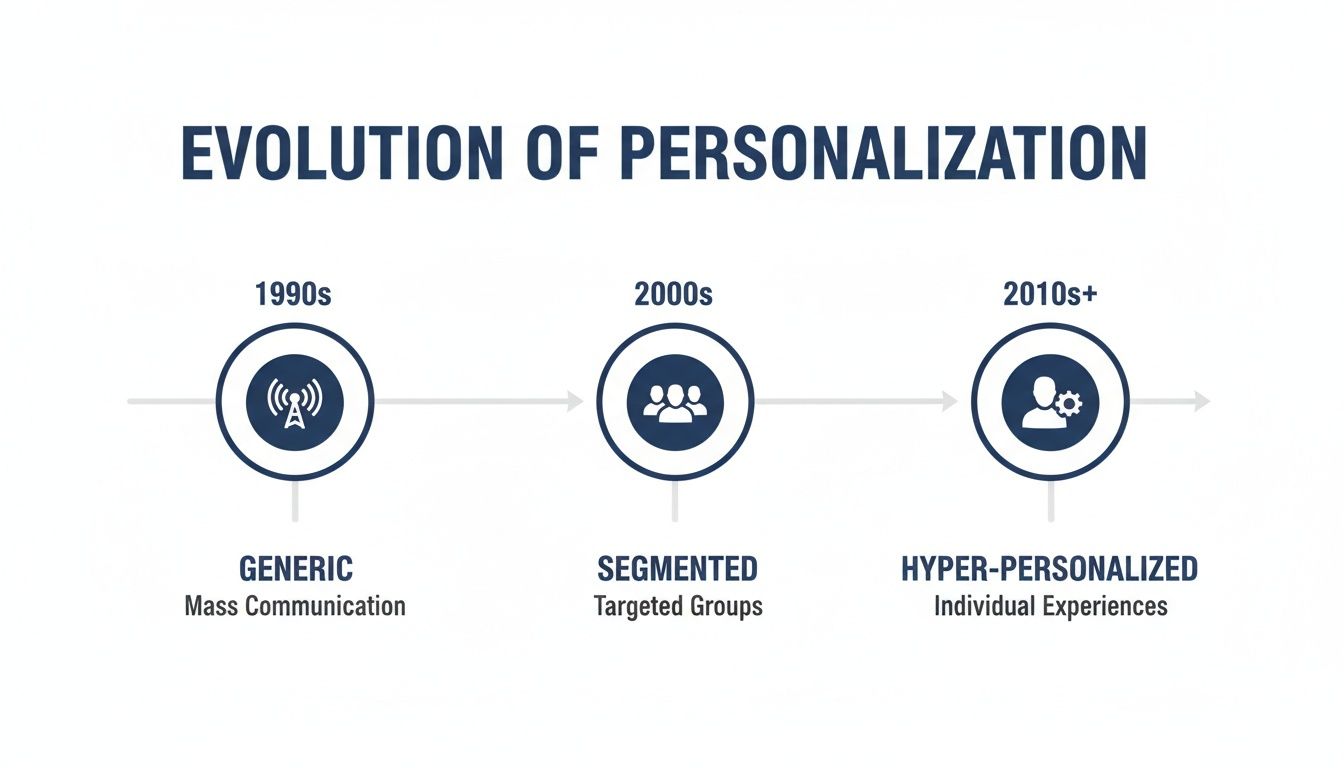
This shift is the core of modern, high-ROI marketing. It’s about making every interaction feel like a one-on-one conversation, which is finally possible at scale.
By day 60, you must have hard data from these experiments. Did the AI monitor catch an issue your team would have missed? Did the personalized email sequence outperform the control? We need definitive answers.
Days 61-90: Scaling Winners And AI-Informed Budgeting
Month three is all about scaling what works. We take the winning experiments from month two and roll them out across multiple channels. The goal is to make AI-informed decision-making the default for your entire marketing team.
Take your successful personalized email sequence and apply the learnings to other segments. Expand your AI monitoring to cover all major campaigns and key metrics like ROAS and LTV:CAC. As you move forward, you’ll naturally start to improve your marketing ROI with better leads because you now have the data to identify which channels deliver them.
This is also when you’ll make your first fully AI-informed budget allocation decisions. Use your AI data analyst to model the potential impact of shifting 20% of your budget from your weakest channel to your strongest. Present this data-backed recommendation to leadership.
By the end of this 90-day sprint, you will have moved from guessing to knowing. You will have cut waste, automated monitoring, and proven the financial upside of hyper-personalization. You won’t just have a higher marketing ROI; you’ll have a smarter, faster, and more competitive marketing engine.
This plan gives you a clear path from analysis to scaled execution. Here’s a table summarizing your first 90 days.
Your 90-Day AI-Powered ROI Improvement Plan
| Phase | Key Actions | Primary Goal | Success Metric |
|---|---|---|---|
| Days 1-30 | Conduct ROI audit with AI. Set up core AI tools. Identify top/bottom 3 campaigns. | Establish a data-backed baseline for all marketing activities. | Completion of a documented “hit list” of campaigns to cut and scale. |
| Days 31-60 | Launch first AI monitor for CPA. Run hyper-personalized email A/B test on a small segment. | Validate the impact of AI automation and personalization in a controlled environment. | Definitive A/B test results (conversion lift) and at least one valuable alert from the AI monitor. |
| Days 61-90 | Scale winning email personalization. Expand AI monitoring to all key campaigns. Reallocate 20% of budget based on AI analysis. | Integrate AI-driven insights into core marketing operations and budget decisions. | Successful rollout of scaled personalization. Budget reallocation approved based on AI-generated models. |
Treat this roadmap as your guide, not a rigid script. The goal is to build momentum and prove value quickly. By focusing on these high-impact steps, you’ll create a feedback loop where each success builds the case for deeper AI integration into your marketing strategy.
Common Questions on AI and Marketing ROI
You’re right to be skeptical. The AI space is noisy and it’s easy to get lost in the hype. Here are straight answers to the questions I get most often from founders and marketing leaders who want to use AI to actually improve their ROI.
What Is a Realistic Marketing ROI to Aim For with AI?
Don’t let anyone sell you on a 10x return overnight. That’s pure fantasy.
A realistic, yet aggressive, goal for the first 90 days is a 15-25% improvement in your primary metric, whether cutting your CPA or boosting ROAS. Those initial gains almost always come from using AI analysis to eliminate the obvious waste we talked about earlier.
The bigger, systemic gains that lead to 2x or 3x ROI improvements happen in months four through twelve. This is when your automated systems mature and your personalization efforts begin to compound. Start with a crystal-clear baseline and focus on those incremental, data-backed wins first.
How Much Technical Skill Is Needed for AI Data Analysis?
Far less than you’d think. You do not need to be a programmer or a data scientist. If you can write a clear email to a colleague explaining what you need, you can write an effective prompt for an AI.
The real skill isn’t coding; it’s what I call “context engineering.” It’s your ability to feed the AI the right information and give it clear instructions to get the insight you need. It’s about structuring your question and providing clean data, like a simple CSV export.
Can AI Replace the Creative Side of Marketing?
No. Full stop. It enhances it, but it doesn’t replace it.
AI is a powerful tool for ideation, cranking out variations, and optimizing at scale, but it lacks genuine human insight and strategic vision. Your competitors who try to replace their creatives with AI will fail. Period.
Use AI to generate 50 different ad headlines to test in an hour. But rely on your team’s hard-won expertise to determine the core message and strategic direction that underpins it all.
The winning teams I work with operate a “bionic” model where human creativity guides AI’s powerful execution. AI handles the scale; humans handle the strategy and the soul of the brand.
What Is the Most Important Metric for Tracking AI’s Impact on ROI?
While it depends on your business model, I constantly steer my clients toward one metric above all others: the Customer Lifetime Value to Customer Acquisition Cost ratio (LTV:CAC).
Honestly, it’s the ultimate measure of sustainable, profitable growth. Everything else is a vanity metric in disguise.
AI can dramatically impact both sides of this equation. It lowers CAC through smarter ad targeting and creative optimization. It increases LTV through the hyper-personalized retention marketing we discussed. Your north star metric for true ROI improvement has to be a healthy LTV:CAC ratio—ideally 3:1 or higher.