
Everyone’s talking about AI. Most of it is noise. I’ve been in the trenches with machine learning since 2016 and generative AI since 2019, and I can tell you this: AI is a tool, and it only pays off when you know how to use it.
Forget vague promises of ‘transformation.’ You and I are here to talk about tangible business results: revenue, competitive advantage, and a moat your rivals can’t easily cross. This is a playbook.
I’m going to break down the specific AI agent use cases that are separating the winners from the spectators. These are the automations my clients are using right now to scale operations and capture market share.
Before getting into them, you need to understand what an agent actually is. For a solid foundation on these autonomous systems, this guide on What Is an AI Agent for Advertising is a good starting point. Now, let’s build.
1. Customer Support & Chatbot Automation
Your customers ask the same ten questions 90% of the time. Every one of those interactions costs you money and pulls your team away from high-value problem-solving. It’s a competitive disadvantage.
While you’re manually answering “Where is my order?”, your competitors are using that same time to proactively identify at-risk accounts and save them.

This is one of the most mature AI agent use cases. Connect an agent to your knowledge base and past support tickets. It can automate first-response and resolution for most inbound queries. Instantly.
The business impact is that you and your people get time back for retention, upselling, and solving the complex problems that cause customer churn. That’s where the money is.
Start small. Identify your top five most frequent questions. Build an agent that confidently answers those and has a frictionless handoff to a human for everything else. Monitor First Contact Resolution (FCR) and Customer Satisfaction (CSAT). A high automation rate with low CSAT means you’re just annoying customers faster.
2. Lead Scoring & Sales Qualification
Whoever does your selling is wasting half their day. They’re calling leads who aren’t ready, nurturing contacts with no budget, and sending follow-ups into the void. That inefficiency puts a direct cap on your revenue.
Every hour spent on a dead-end lead is an hour not spent closing a deal that was actually ready to buy. Your competition is pulling ahead.
AI agents act as tireless analysts for your pipeline. Connect an agent to your CRM and marketing platform. It analyzes behavioral signals (website visits) and firmographic data (company size) to predict purchase intent with real accuracy.
The business impact is a system that tells you exactly who to talk to, right now, and what to say, while it automates the nurturing for everyone else. That shortens your sales cycle.
First, define a “qualified lead” for your business. Build a scoring model based on historical data from your best customers. Then, task the agent to score new leads and route the hot ones directly to sales. For a deeper look, learn more about AI agents for sales. This is how you win deals while others are still making lists.
3. Content Generation & Copywriting at Scale
Your content calendar is a relentless beast. Blog posts, social updates, and email campaigns demand constant attention. Falling behind means losing visibility and pipeline. This bottleneck forces a choice between quality and quantity, and that compromise costs you market share.
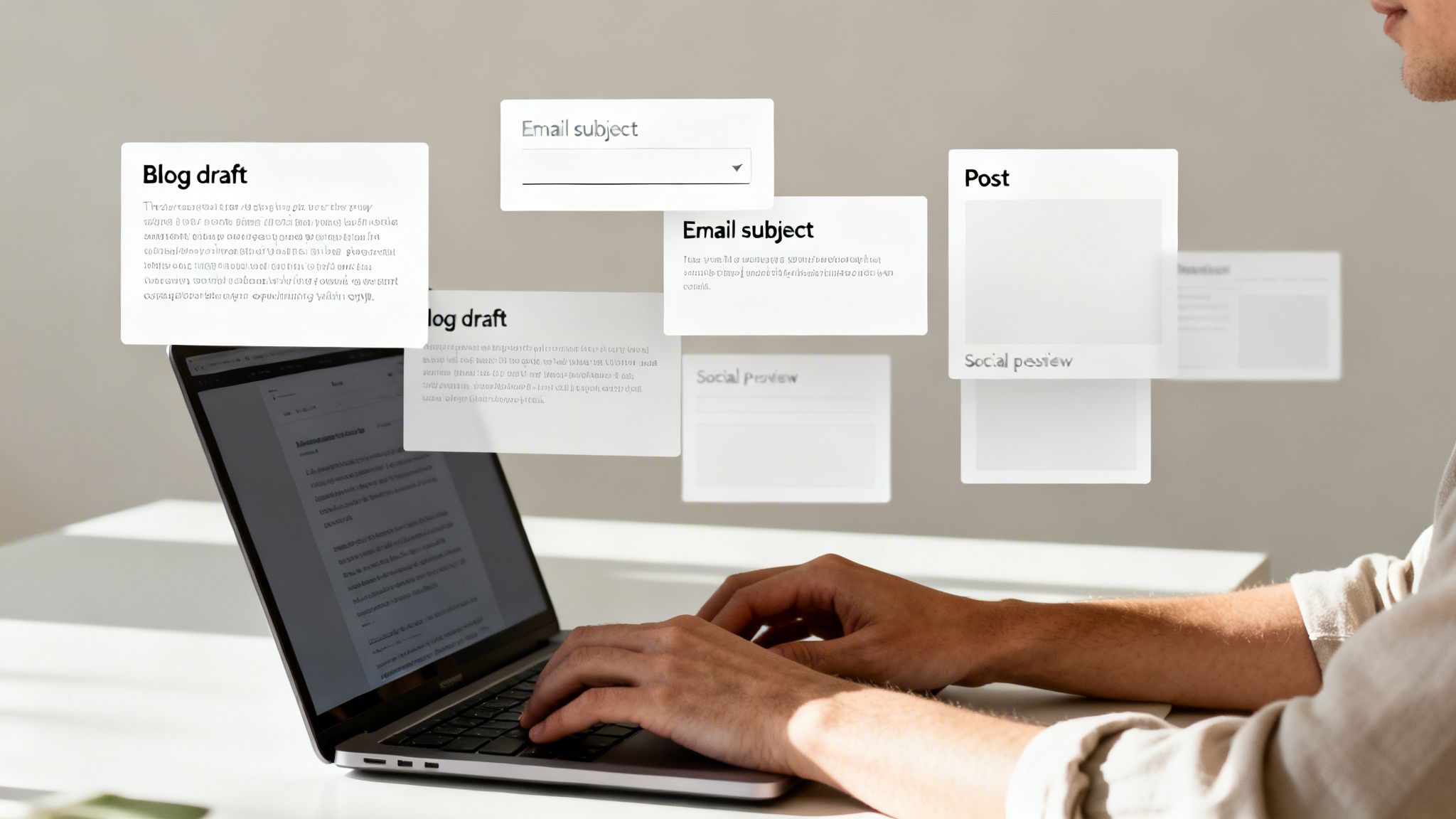
This is one of the most powerful AI agent use cases for any marketing team. Train an agent on your brand voice and top-performing content. It can produce drafts at a scale humanly impossible. Understanding effective AI agent content creation can dramatically accelerate your output.
The business impact comes from turning your writers (including you) into editors and strategists who guide AI output instead of starting from a blank page. That multiplies their impact and gives you a bigger voice in your market.
To start, feed the agent detailed brand voice guidelines and examples of your best-performing content. Always have a human writer review and refine the output. The goal is to augment, not abdicate. You can explore more AI tools for content creation to round out your marketing stack.
4. Email Marketing Personalization & Optimization
Your generic email blasts are getting ignored. You’re guessing at the best time to send and the right subject line. Every send is a gamble that burns list equity and leaves money on the table.
Meanwhile, your competitors are sending messages that feel one-to-one, arriving at the exact moment a customer is ready to act.
AI agents act as optimization machines for your email marketing. They analyze individual user behavior (open times, click patterns, purchase history) to dynamically adjust everything. This is a high-return AI agent use case for any business with an email list.
The business impact is a system that treats every subscriber as an individual, which does more than lift open rates. It maximizes lifetime value and makes your emails something people look forward to instead of inbox clutter. More revenue. Period.
Start with send-time optimization in your email service provider. Low effort, high impact. Next, let the AI test subject line variations for different audience segments. Monitor conversion value per recipient and treat open rates as secondary. If engagement drops, the AI needs new data or your offers are missing the mark.
5. Social Media Content Strategy & Publishing
Whoever runs your social media is spending hours manually scheduling posts and digging for trending topics. That’s manual labor, and it leaves no time for strategy. While you’re stuck in the scheduling grind, your competition is analyzing engagement patterns in real-time to double down on what works.
AI agents can take over the tactical execution. Connect an agent to your content library and analytics to automate post creation, scheduling, and performance analysis. This is one of the most practical AI agent use cases for freeing up creative capacity.
The business impact is that the tedious work disappears while the strategist (often you) stays. That leaves time for building community and creating high-impact brand campaigns that your competitors can’t automate.
Define clear, platform-specific tone guidelines. An AI agent needs to know the difference between a LinkedIn post and a TikTok caption. Use the agent to generate drafts and schedule posts based on its analysis of peak engagement times. Monitor engagement rate and click-through rate ahead of follower count.
6. Campaign Performance Prediction & Optimization
You’re about to spend thousands on a new ad campaign. It’s a risk. You’ve based your decisions on past performance, but you’re still launching with a massive blind spot. What if you could know which creative and audience will perform best before you spend a single dollar?
It’s a real capability, and one of the most profitable AI agent use cases in modern marketing. Agents analyze your historical campaign data against current market trends to act as a pre-flight check for your marketing spend.
The business impact is lower risk on your ad spend and learning up front. Instead of spending the first week figuring out what works, you start with an AI-informed hypothesis that is already 80% of the way there. That’s a real competitive advantage.
To get this right, you need clean historical campaign data. At least 3-6 months’ worth. Use the agent’s recommendations for audience segments and ad copy as a strong starting point, but always test against a control group. Track the predicted ROI against the actual ROI and feed those results back into the system. The agent gets smarter with every campaign.
7. Landing Page Optimization & CRO Automation
Your best ad campaigns can fail if they point to a landing page that doesn’t convert. You’re burning cash. Manually A/B testing every headline and call-to-action is a slow, expensive grind. Your team is guessing, and every wrong guess costs you customers.
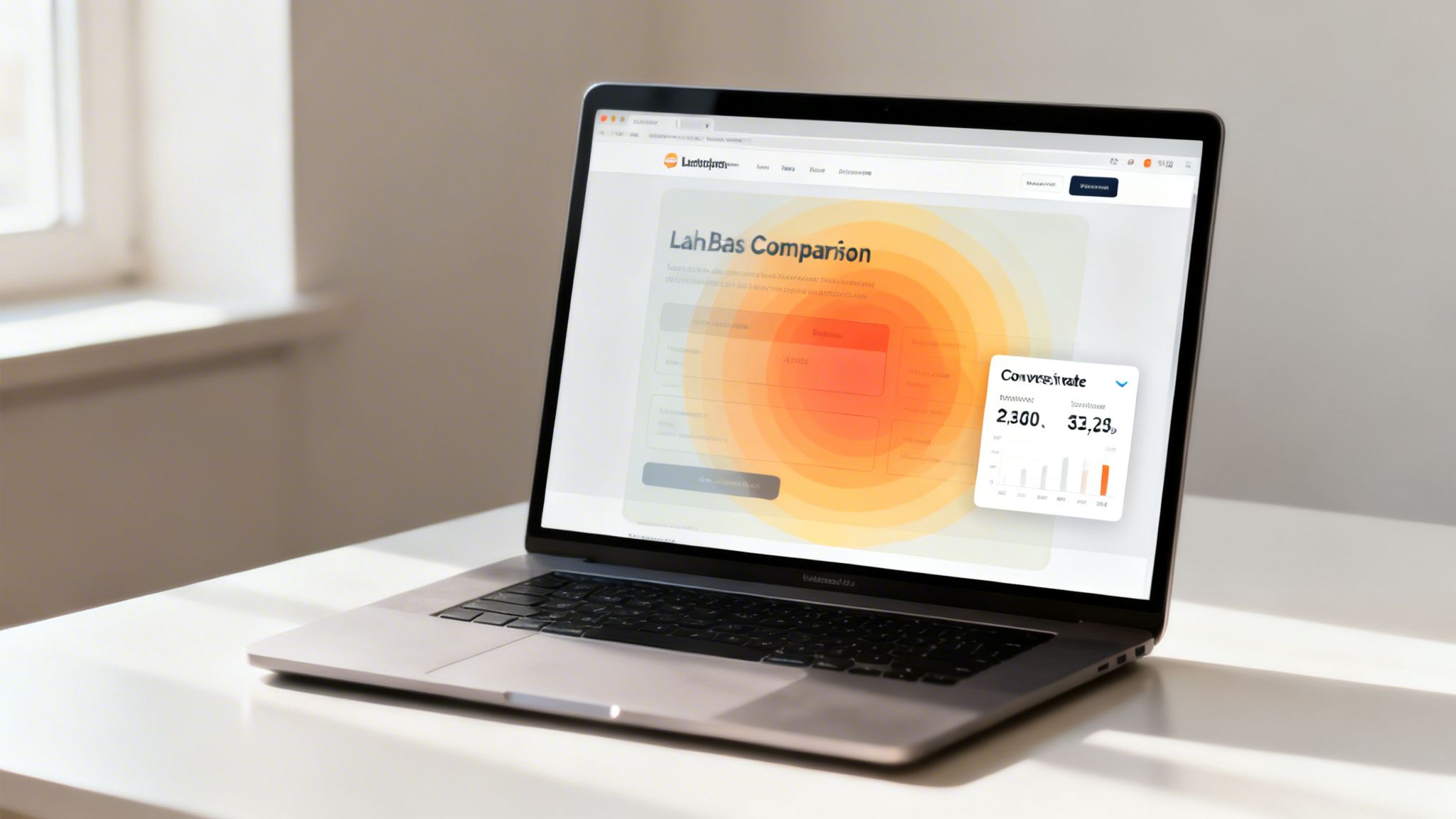
AI agents turn this guesswork into a science. They can run thousands of multivariate tests simultaneously, analyzing user behavior to find winning combinations faster than any person could. This is one of the highest-return AI agent use cases for any business that relies on web traffic.
The business impact is a self-improving engine that keeps lifting conversion rates, which is worth far more than one better headline. It turns your marketing spend into a direct profit driver instead of an expense.
To get started, point an agent at your highest-traffic, highest-intent landing page. Let it focus on a single element first, like the main headline. As you gain confidence, expand to multivariate tests. The only metric that matters here is the conversion rate for your page’s primary goal.
8. Market Intelligence & Competitive Analysis
Your competitors are moving faster than your planning cycle. By the time you’ve analyzed their last move, they’ve already launched three new features. Flying blind is a death sentence in a crowded market. You’re reacting to last month’s news.
AI agents are your perpetual reconnaissance team. They continuously monitor competitor websites, product updates, and social chatter. This creates a live feed of competitive intelligence, turning raw data into actionable alerts. A powerful AI agent use case for maintaining a strategic edge.
The business impact is a shorter cycle from market signal to strategic response. You know when a competitor changes their homepage headline the day it happens instead of a month later. Speed is the advantage here.
Start by configuring an agent to track your top three competitors. Set up alerts for pricing page modifications, new job postings, and specific keywords on their blog. Feed these insights directly into a dedicated Slack channel you check daily. This is how you get the intel to win deals today.
9. Customer Data Analysis & Segmentation
Your customer database is a gold mine, but you’re only scratching the surface with manual filters. You segment by “last purchase date.” Your competitors are building predictive models to identify who is about to churn or has the highest lifetime value potential. You are falling behind.
AI agents connect directly to your customer data platforms and run continuous analysis. They identify dynamic segments based on complex behavioral signals and predictive traits. This is one of the most powerful AI agent use cases for achieving true personalization at scale.
The business impact is smarter, predictive segments (more segments alone won’t help) that allow you to personalize marketing, product, and retention efforts before your competitors know what’s happening. Anticipate needs. Win the customer.
To begin, connect an agent to a clean customer dataset. Task it with identifying behavioral segments, like “frequent browsers, infrequent buyers.” Validate these segments against real business outcomes. Your primary KPI is the conversion lift or retention improvement within these AI-defined segments compared to everyone else.
10. SEO Content Strategy & Keyword Research Automation
You spend weeks buried in spreadsheets trying to find the perfect keyword. It’s a slow, manual process based more on gut feel than hard data. This leaves you vulnerable to competitors who are creating better-targeted content, faster.
This is a perfect scenario for agent-driven automation. AI agents connect to real-time search data, analyze top-ranking content, and identify high-value keyword clusters you’re missing. They generate complete content briefs that go beyond lists of terms. A strategic AI agent use case for capturing market share.
The business impact is a scalable content engine that systematically identifies and captures valuable search traffic. It turns your blog from a hopeful experiment into a predictable customer acquisition channel.
Task an agent with a broad topic. Have it analyze the top-ranking articles for a target keyword and generate a “content gap” report. Use this output to create your first AI-assisted content brief. Focus on creating content around keyword clusters to build topical authority. That’s how you own a niche on Google.
11. Dynamic Pricing & Revenue Optimization
Leaving money on the table is the fastest way to lose. Most businesses set their pricing based on a cost-plus model and then leave it static for years. You are underpriced during peak demand and overpriced during lulls. Sacrificing revenue and turning away customers.
AI agents can execute dynamic pricing strategies that no manual process can match. Connect an agent to your inventory levels, competitor pricing, and market demand data. It adjusts prices on the fly to maximize revenue. This is one of the most direct bottom-line AI agent use cases you can deploy.
The business impact comes from using data to find the optimal price point for every product, for every customer segment, at any given moment, instead of fluctuating prices at random. This maximizes total revenue and profit margin.
Start by creating an agent that tests different prices for specific customer segments. Give it a clear goal: “Adjust the price for first-time visitors by +/- 10% to find the price that maximizes total revenue from that segment this week.” Monitor conversion rates and average order value. This is a powerful lever, but use it carefully; always balance immediate gains against long-term customer trust.
12. Workflow Automation & Process Intelligence
Your team is drowning in busywork. Manual data entry, copying information between apps, and following rigid, multi-step processes. It drains your capacity for high-value work and breeds costly human error.
AI agents act as the connective tissue between your tools, automating workflows without expensive, custom-coded integrations. This is one of the most practical AI agent use cases for immediate operational gains. Tools like Zapier and Make allow agents to execute complex logic across your entire software stack.
The business impact is an operational system that runs itself, which is worth more than the time saved. Cut process cycle times from days to minutes and free your team to focus on strategic growth. This is how you scale.
Map your most painful, high-frequency manual process. Start with a simple two-step automation, like creating a project task from a new CRM lead. For a deeper dive, check out my guide to AI workflow automation tools. Build confidence, then tackle more complex workflows.
AI Agent Use Cases: 12-Point Comparison
| Solution | Implementation complexity | Resource requirements | Expected outcomes | Ideal use cases | Key advantages |
|---|---|---|---|---|---|
| Customer Support & Chatbot Automation | Medium: integration + training required | Knowledge base, historical tickets, multi-channel integrations; Low–Medium cost | Faster responses, lower support cost, 24/7 coverage, higher CSAT | High-volume support, first-line triage, multi-channel customer service | Reduces response time, scales support, frees human agents |
| Lead Scoring & Sales Qualification | Medium: CRM integration and model training | Historical CRM and engagement data; Medium cost | Higher sales efficiency, faster contact, improved conversion focus | B2B sales, ABM, high lead volumes | Prioritizes hot leads, automates routing, reduces manual grading |
| Content Generation & Copywriting at Scale | Low: quick to deploy but needs oversight | Brand guidelines, prompt/design inputs; Low–Medium cost per user | Faster content production, many variations, consistent output | Blog/email/social campaigns, content teams needing scale | Speeds creation, scales output, maintains consistency when guided |
| Email Marketing Personalization & Optimization | Low–Medium: depends on data and compliance | Email history, list segmentation, compliance setup; Low cost | Higher opens/CTR, improved deliverability, reduced unsubscribes | Lifecycle/email-heavy campaigns, e‑commerce | Personalized sends at scale, send-time and subject optimization |
| Social Media Content Strategy & Publishing | Low: scheduling and recommendations simple; strategic tuning needed | Platform access, content assets, analytics; Low–Medium cost | Consistent posting cadence, better engagement, trend discovery | Multi-platform social programs, content calendars | Automates scheduling, surfaces trends, scales social output |
| Campaign Performance Prediction & Optimization | Medium–High: forecasting needs integrations and models | Historical campaign/ad data, ad platform access; Medium–High cost | Reduced wasted spend, better budget allocation, higher ROI | Paid media planning, campaign budgeting, performance teams | Pre-launch forecasts, budget and audience recommendations |
| Landing Page Optimization & CRO Automation | Medium: testing framework and traffic required | Sufficient traffic, analytics and testing tools; Medium cost | Improved conversion rates without extra traffic, faster test results | High-traffic landing pages, signup and checkout funnels | Automated multivariate testing, heatmap insights, continuous CRO |
| Market Intelligence & Competitive Analysis | Medium: data collection and alerting setup | Monitoring feeds, news/social sources; Medium cost | Early competitor alerts, saved research time, informed strategy | Product strategy, pricing decisions, competitive monitoring | Continuous competitor monitoring, trend detection, market signals |
| Customer Data Analysis & Segmentation | Medium–High: data cleaning and modeling needed | Clean customer DB, CDP/analytics, integration effort; Medium–High cost | Precise targeting, churn prediction, improved LTV | Retention programs, personalized marketing, CRM-driven teams | Identifies high-value segments, enables predictive targeting |
| SEO Content Strategy & Keyword Research Automation | Low–Medium: tool setup and review needed | SEO tools, keyword data, content resources; Low–Medium cost | Prioritized keyword opportunities, faster briefs, long-term traffic gains | Organic growth, content planning, SEO teams | Rapid keyword discovery, content briefs, on-page optimization guidance |
| Dynamic Pricing & Revenue Optimization | High: real-time systems and complex modeling | Inventory/sales data, competitor feeds, advanced infra; High cost | Increased revenue and margins, reactive pricing, fewer stock issues | E‑commerce, travel/hospitality, inventory-sensitive businesses | Real-time price adjustments, elasticity analysis, revenue uplift |
| Workflow Automation & Process Intelligence | Low–Medium: process mapping then automation | Process documentation, integration tools (RPA/no-code); Low–Medium cost | Eliminates repetitive work, fewer errors, faster cycle times | Marketing ops, data syncs, repetitive multi-tool processes | Saves time, reduces errors, harmonizes cross-platform workflows |
Your Next Move: From Plan to Profit
That’s a dozen AI agent use cases. You’ve seen the mechanics. You know what’s possible. But knowing the playbook doesn’t win the game. Execution does.
Right now, your competitors are reading the same articles. The advantage goes to the one who moves first, learns fastest, and builds a system of execution.
Start with a Single, High-Impact Pilot
The temptation is to boil the ocean. To launch a dozen AI initiatives at once. This is a recipe for failure. You’ll spread your resources too thin and end up with a collection of half-working toys instead of a working growth system.
The path to profit is simpler.
Pick one problem. Look at the list above. Where is the most friction in your business right now? The cost of customer queries? The bottleneck of qualifying leads? Pick that one problem.
Focus all your initial effort on solving it with a dedicated AI agent. Your goal is to solve a real business problem and prove the value. A successful pilot creates the momentum and budget you need to scale.
The Bionic Company Framework
What you’re building is a ‘bionic’ system. This is a core concept in how I build. It means creating a business where intelligent agents amplify human talent instead of replacing it. Your agents handle the repetitive, data-heavy tasks.
This frees up you and your best people (marketers, salespeople, strategists) to focus on what matters: building relationships, creating breakthrough campaigns, and making critical judgment calls. That’s the model that wins. Your competitors are still operating at human speed. You’ll be operating at bionic speed.
Each of the AI agent use cases in this guide is a brick. Your job is to lay them one by one. Start with the first brick today. Pick your pilot, define your success metric, and get to work.