
Most online businesses already use Robert Cialdini’s principles. The countdown timer that starts again when you reload the page. “Join 5,000+ founders” under a form with 300 subscribers behind it. The testimonial from “Sarah K., Texas”. Each of those comes from Influence, and each is the version the book warns you about.
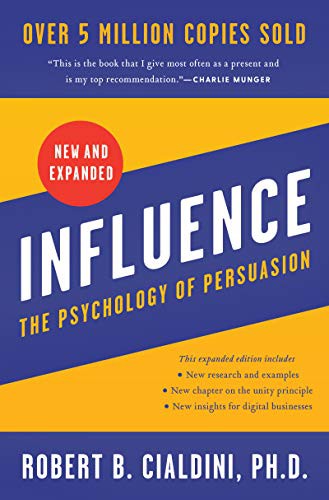
Influence came out in 1984, and it’s still the clearest explanation of why people say yes without thinking it through. Cialdini’s argument is that we run on mental shortcuts because we have to, and anyone who knows the shortcuts can set them off. The useful question for your business is which ones you can use honestly.
This summary covers all seven principles in the current edition: the original six, plus unity, which Cialdini added in 2021. For each one you get the idea, the research behind it, what hasn’t held up since, one way to use it in your own marketing, and Cialdini’s advice for spotting it when someone uses it on you.
Contents
- The seven principles at a glance
- Why the principles work: we decide on autopilot
- 1. Reciprocation: people repay what they’re given
- 2. Liking: we say yes to people we like
- 3. Social proof: when we’re unsure, we copy people like us
- 4. Authority: we defer to signs of expertise
- 5. Scarcity: we want what’s running out
- 6. Commitment and consistency: we stick with what we’ve said
- 7. Unity: we favour people we count as one of us
- The last chapter: shortcuts matter more as life speeds up
- Checking AI-written copy against the seven principles
- What to change this week
- Sources
The seven principles at a glance
| # | Principle | The shortcut | One honest use |
|---|---|---|---|
| 1 | Reciprocation | We repay what we’re given | Give something useful before you ask for anything |
| 2 | Liking | We say yes to people we like | Show the reader what you genuinely have in common |
| 3 | Social proof | When unsure, we copy people like us | Use testimonials from customers whose situation matches the reader’s |
| 4 | Authority | We defer to signs of expertise | Show the one credential that bears on this decision |
| 5 | Scarcity | We want what’s running out | State only limits that are real, and say why they exist |
| 6 | Commitment and consistency | We act in line with what we’ve already said | Ask for a small first step the reader chooses |
| 7 | Unity | We favour people we count as one of us | Name the group you and the reader both belong to |
The 1984 edition has six principles, with commitment and consistency second. The 2021 New and Expanded edition moves it to sixth and adds unity, which Cialdini first wrote about in Pre-Suasion (my Pre-Suasion summary covers that book’s 30 principles). I’ve followed the 2021 order. If you came here for “the 6 principles of influence”, they’re numbers 1 to 6.
Why the principles work: we decide on autopilot
Cialdini opens with a mother turkey. Turkey hens look after chicks that make a “cheep-cheep” sound and ignore or attack chicks that don’t. In an experiment he describes, a hen mothered a stuffed polecat, the turkey’s natural enemy, as long as it played a recording of that sound. One feature set off the whole behaviour.
People do the same, more often than we’d like to admit. The best-known human example in the book is Ellen Langer’s photocopier study. Asking to cut in line to copy five pages worked 60% of the time with no reason, and 93% of the time with “because I have to make copies”, a reason that says nothing. For 20 pages the empty reason did nothing (24% either way), and only a real reason, “because I’m in a rush”, lifted it, to 42% (Langer, Blank and Chanowitz, 1978).
So the word “because” worked as a cue when little was at stake. When more was at stake, people listened to what came after it. A later replication didn’t reproduce Langer’s result at all (Folkes, 1985). Buying from you is a bigger ask than five pages of copying, so give a real reason.
The first chapter also sets out the contrast principle: we judge the second of two things against the first. A clothing salesperson sells the suit before the sweater, because the sweater’s price looks small after the suit’s. An estate agent shows you a run-down, overpriced house before the one they want you to buy.
Contrast is the easiest of the shortcuts to use honestly. If your top package is a real offer that some customers buy, put it first on your pricing page. Compare your price with the reader’s real alternative, such as hiring a freelancer or losing a weekend to doing it themselves, rather than with an invented “total value”.
Cialdini’s point is that the shortcuts usually work. They’re how anyone gets through a day with too many decisions in it. The damage comes when someone fakes the cue. Keep that in mind through every principle below, because the faked version is the one most small business sites use.
1. Reciprocation: people repay what they’re given
We feel obliged to return favours, gifts and concessions, including ones we never asked for. Cialdini argues that every human society runs on some version of this rule, because it lets people give first without losing out.
The rule works even between strangers. A sociologist, Phillip Kunz, sent Christmas cards to people he’d never met, and cards came back from people who had no idea who he was (Kunz and Woolcott, 1976). Dennis Regan tested it in a lab. People who got an unexpected Coke from a fellow participant later bought more of his raffle tickets, and the favour worked through a sense of obligation more than through liking him (Regan, 1971).
The gift doesn’t have to be wanted. That’s why, as the book describes, Hare Krishna members handed travellers a flower at the airport before asking for a donation. Plenty of people threw the flower away and gave money anyway.
The second half of the chapter covers concessions, which Cialdini calls rejection then retreat. If I ask for something big, you refuse, and I retreat to something smaller, you feel pressure to concede too. In Cialdini’s 1975 study, students on a campus were asked to chaperone a group of young offenders on a day trip to the zoo. Asked directly, 17% agreed. Asked first to counsel young offenders for two hours a week for two years, and then, once they’d refused, asked about the zoo trip, 50% agreed (Cialdini et al., 1975). Another team repeated the study in a different country 45 years later and got similar results (Genschow et al., 2021).
What the famous studies leave out is how much the effect shrinks across many studies. A meta-analysis of 35 years of door-in-the-face research found it reliably gets people to say yes. Its effect on whether they then actually do the thing was too small to be statistically significant. It also worked best for good causes and volunteering, and less well when the request was for money (Feeley, Anker and Aloe, 2012). For a business asking for a purchase, that’s the weak case.
For a small business, reciprocation is the honest engine behind content and lead magnets. My test for a lead magnet: would the reader be glad they had it if they never bought anything from you? A checklist that only makes sense after you buy the course is an ad. A checklist that fixes something today is a gift. The same goes for concessions on a sales call. If a prospect turns down your full package, offering a smaller version is a real concession only if the full package was a real offer.
Cialdini’s defence: accept favours in good faith, but if one turns out to be a sales device, redefine it as one. You owe a favour back for a favour. You don’t owe a purchase back for a trick.
2. Liking: we say yes to people we like
We prefer to say yes to people we know and like, and people who sell for a living have found many ways to make us like them. Cialdini’s main example is the Tupperware party, where you’re buying from your friend, the host, as much as from the company. Another is Joe Girard, whom Guinness listed as the world’s greatest car salesman. Every month he sent every customer he’d ever had a card that said “I like you”.
The book sets out what makes us like someone. Physical attractiveness is the first, through a halo effect: we assume good-looking people are also kind, honest and clever.
Similarity is the second, and it takes very little. People lent a dime more often to a stranger who was dressed like them (Emswiller, Deaux and Willits, 1971). Students who believed they shared a birthday or a first name with the person asking were more likely to agree to a request. The catch: it only worked when the shared detail felt uncommon (Burger et al., 2004).
Compliments are the third. In one study, people liked a person who praised them best of all, even though that person needed a favour from them (Drachman, deCarufel and Insko, 1978).
The rest are contact and cooperation, and association. We come to like people we see often, and much more so when we work with them toward a shared goal. We also like people and products linked to things we already like, which is why brands pay for celebrities and sports sponsorships. Martin Lindstrom makes a related argument about advertising in Buyology: we want to be like the people we see in ads.
Of all these, similarity is the one a small business can use honestly, and the Burger study tells you how. “I’m an entrepreneur too” is shared by everyone who reads your page, so it does nothing. Your about page should say who you are in terms your reader shares and few others do: the kind of business you run, its size, the specific mistake you both made. And testimonials work best from customers whose situation matches the reader’s.
Cialdini’s defence is to skip trying to spot every liking tactic. Notice instead when you like someone more than you’d expect after a short time, and then separate the person from the deal.
3. Social proof: when we’re unsure, we copy people like us
We decide what’s right partly by looking at what other people do. Canned laughter makes audiences laugh more, even audiences who say they hate it. Bartenders put a few notes in the tip jar before the night starts.
Crowds pull harder the bigger they are. In a study the book uses, Stanley Milgram had people stand on a busy city street and look up at a building. One person looking up got 42% of passers-by to look up too. Fifteen people got 86% (Milgram, Bickman and Berkowitz, 1969).
The principle is strongest under two conditions: uncertainty and similarity. When a situation is unclear, we look to others, and we copy people who seem like us more than people who don’t. In a classic experiment, students filling in a questionnaire in a room that slowly filled with smoke were less likely to report it when two other people in the room ignored it than when they were alone (Latané and Darley, 1968).
This is also where the book is out of date. Its best-known example of the danger is the 1964 murder of Kitty Genovese in New York, reported at the time as 38 neighbours watching and doing nothing. Researchers who went back to the archive found no evidence that there were 38 witnesses, that the witnesses saw the murder, or that they did nothing (Manning, Levine and Collins, 2007). The bystander effect itself holds up in experiments like the smoke study. The story everyone tells about it doesn’t.
Cialdini’s later work shows how specific social proof can get. Hotel guests told that most guests reused their towels reused more than guests given the usual environmental message, and saying that most guests in that same room did so worked best (Goldstein, Cialdini and Griskevicius, 2008). Treat the “same room” detail with care, though. Two German hotels repeated the study with 928 guests, and the social-proof messages did no better than the standard one (Bohner and Schlüter, 2014). The principle is solid. The extra lift from very precise wording isn’t guaranteed.
He also warns about a mistake marketers make constantly: describing a problem as common. “Many people are doing this bad thing” carries a second message, which is “many people are doing this” (Cialdini, 2003). A page that says “most small businesses never follow up with their leads” tells your reader that not following up is normal.
Drew Whitman covers the same effect as the bandwagon effect in Cashvertising: show how many people already choose your product, and tie it to a group your customer already identifies with.
For your own pages, use the most specific proof you can stand behind. A named customer, the kind of business they run, what changed and how long it took will do more than “trusted by thousands”. If your numbers are small, show the customers instead of the count. Never write a testimonial for someone, and never round a number up.
Cialdini’s defence: watch for faked evidence, like canned laughter or staged “real customer” ads, and remember that what similar people do shouldn’t be the only basis for your decision.
4. Authority: we defer to signs of expertise
This chapter is built on Stanley Milgram’s obedience experiments. Volunteers were told to give a man in the next room an electric shock for each wrong answer, stronger each time. The man was an actor and the shocks were fake, but the volunteers didn’t know that. Twenty-six of the 40 went all the way to the highest switch on the machine because the researcher running the study told them to continue (Milgram, 1963). Jerry Burger repeated the experiment in 2006, up to the point where the man first protests, and found obedience rates only slightly lower than Milgram’s (Burger, 2009).
The book’s workplace example is a hospital study. A man claiming to be a doctor phoned nurses and told them to give a patient an unfamiliar drug at twice the maximum dose printed on the label. Twenty-one of 22 nurses were stopped on their way to give it (Hofling et al., 1966). Read that one with a caveat. When Steven Rank and Cardell Jacobson repeated it with a drug the nurses knew and let them talk to colleagues first, the result didn’t replicate (Rank and Jacobson, 1977).
Cialdini’s sharper point is that we respond to the symbols of authority as much as to the real thing. He names three: titles, clothes and trappings such as expensive cars. Leonard Bickman had experimenters stop people in the street with odd requests, like picking up a paper bag or giving a dime to a stranger. People complied more when the experimenter was dressed as a guard than when he wore ordinary clothes or a milkman’s uniform (Bickman, 1974).
The honest version of authority has two parts, expertise and trustworthiness, and the book gives a tactic for the second. Mention a weakness or a drawback early, then make your strongest point. The classic ad example is Avis, which built a campaign on admitting it was only number two in car rental: “We try harder.”
For a solo operator, the credential that counts is usually the work: results, the thing you built, the clients you’ve done it for. State the one that bears on this decision, once, and back it with something the reader can check. “As seen on” logos for a one-line mention in a listicle are the trappings without the substance. For trustworthiness, say plainly who your product isn’t for.
Cialdini’s defence is two questions. Is this person really an expert on this subject? And how honest can I expect them to be with me here?
5. Scarcity: we want what’s running out
“Only a few left” and “offer ends Friday” work because we value things more when they’re harder to get. Cialdini gives two reasons. Scarce things usually are better, so scarcity works as a shortcut for quality. And losing the freedom to choose makes us want the thing more, which psychologists call reactance.
The book leans on Stephen Worchel’s cookie study. People rated the same cookies as more desirable from a jar of two than from a jar of ten. They rated them higher still when the jar had just dropped from ten to two, and higher again when the drop was caused by demand from other people rather than an accident (Worchel, Lee and Adewole, 1975).
That’s the useful detail: scarcity is strongest when it’s new and when other people caused it. “Only 3 left” says less than “We sold 40 this week and 3 are left.”
This chapter is also where the book is wrong. As an example of reactance, Cialdini cites the “Romeo and Juliet effect”: couples whose parents interfered more reported falling more in love (Driscoll, Davis and Lipetz, 1972). A 2014 replication followed 396 people using the original measures and found no such effect. People who reported more interference from family and friends reported poorer relationships (Sinclair, Hood and Wright, 2014). Reactance is real. This example of it hasn’t held up.
Online, scarcity is the easiest principle to fake. A 2019 study crawled about 53,000 product pages on about 11,000 shopping sites and found 1,818 dark patterns, including countdown timers and low-stock messages, with 183 sites using deceptive ones. It also found 22 third-party providers offering dark patterns as a ready-made service (Mathur et al., 2019).
Use only limits that exist, and say why they exist. A cohort capped at 20 because you review every assignment yourself is a real limit with a reason. A deadline that resets when the reader comes back is a lie, and it only takes one reader to notice.
Cialdini’s defence: when you feel the rush, stop and ask why you want the thing. If you want it to use, its scarcity won’t make it work any better.
6. Commitment and consistency: we stick with what we’ve said
Once we’ve taken a stand, we feel pressure to act in line with it. People who had just placed a $2 bet at a racetrack rated their horse’s chances higher than people about to place one: a median of 4.81 on a seven-point scale, against 3.48 (Knox and Inkster, 1968). Nothing about the horse had changed.
The chapter’s best-known study is the foot in the door. Only 17% of homeowners agreed to put a large “Drive Carefully” sign in their front garden. Among homeowners who had agreed a couple of weeks earlier to a small request, 76% said yes (Freedman and Fraser, 1966).
Cialdini says commitments hold best when they’re active, public, take effort and feel freely chosen. On effort: students who went through a harsher initiation to join a discussion group rated its deliberately dull discussion more highly than those whose initiation was mild (Aronson and Mills, 1959).
The foot in the door is less reliable than the book suggests, though. A review of the research found it fails, or even reduces compliance, under some conditions, and set out which conditions make it work (Burger, 1999).
The chapter also covers the low-ball, a car-dealer tactic: get a yes, then change the terms. Cialdini showed it in the lab. Students who agreed to take part in a study before learning it started at 7 a.m. were more likely to go through with it than students told the time up front (Cialdini et al., 1978). Don’t use this one. Changing the price after a customer says yes is how you get refunds and chargebacks.
The honest version for your funnel is a small, active first step the reader chooses. Ask new subscribers to reply to your welcome email with the one thing they want help with. Let buyers pick their own goal in onboarding rather than handing them a pre-ticked box. A goal someone wrote down themselves is one they’ll want to stay consistent with.
Cialdini’s defence: when you feel trapped by something you agreed to earlier, ask yourself, “Knowing what I know now, would I make the same choice again?”
7. Unity: we favour people we count as one of us
Unity is the principle Cialdini added in 2021, after introducing it in Pre-Suasion. Liking is the feeling that someone is like you. Unity is the feeling that they’re one of you: family, the same place, the same tribe.
He describes two routes to it. The first is being together: kinship, a shared hometown or region, a shared identity. The second is acting together. People who walked in step or sang together cooperated more afterwards in a group money game, even when it cost them personally (Wiltermuth and Heath, 2009). Working on something together counts too. Asking customers for advice made them feel closer to an organisation and more likely to buy from it, while asking what they expected from it pushed them away (Liu and Gal, 2011). I cover the Pre-Suasion version, with more examples, in principles 18 and 19 of my Pre-Suasion summary.
For a solo operator, unity is the honest basis of a community or a newsletter with a point of view. Name the group you and the reader both belong to, such as “people who run a business with no staff”, and keep the promise the name makes. To get the acting-together part, ask readers for advice on something you’re building, then show them what you did with it.
The last chapter: shortcuts matter more as life speeds up
Cialdini’s closing argument is that the more information we face and the less time we have, the more we decide on single cues. That makes the shortcuts more useful. It also makes faking them more damaging, because every fake cue teaches people to distrust a signal that’s usually right. So he argues for pushing back hard on anyone who counterfeits the evidence, such as fake testimonials and fake shortages, while leaving honest use of the principles alone.
That’s the book’s real instruction to marketers, and it’s a sharper rule than “use the six principles”. The same idea runs through Pre-Suasion, where the question becomes what state the reader is in before your message arrives. I wrote up how that plays out across a funnel in Pre-Suasion for marketers.
Checking AI-written copy against the seven principles
Ask any AI model to “write a persuasive sales page” and you’ll get every principle in its cheapest form: “join thousands of satisfied customers”, “limited spots available”, a testimonial from someone who doesn’t exist. It has read thousands of pages like that, and it copies them. That’s the counterfeit Cialdini’s last chapter warns about, and it’s now free to produce.
I’d use the model the other way round: as a checker, after you’ve written the page, with your real facts as the only evidence it’s allowed to use. Here’s the prompt:
You are checking a sales page against the seven principles in Robert Cialdini's Influence: reciprocation, liking, social proof, authority, scarcity, commitment and consistency, and unity.

Below the page is a list of facts about my business: real customer and subscriber numbers, testimonials I have permission to use, my actual credentials, any real limits on supply or time, and who the product is for.

For each principle:
1. Quote every line of the page that uses it.
2. Mark each line SUPPORTED if a fact in my list backs it up, or UNSUPPORTED if nothing does.
3. For each UNSUPPORTED line, write a replacement that uses only my facts, or say "cut it".
4. Name one place the page could use the principle honestly and doesn't.

Do not invent numbers, testimonials, credentials or deadlines. If my facts list doesn't cover something, say so instead of guessing.

PAGE:
[paste the page]

FACTS:
[paste your facts]
Run it on your opt-in page first. It’s short, and it’s the page most likely to carry a stock “join thousands” line.
Keep a note of what you cut. Every unsupported line you remove is a rule the model should follow on the next draft, so you don’t fix the same thing twice. I explained how I turn edits like these into standing rules in a Bionic Business issue, Make AI Sound Like You.
What to change this week
Pick the page that asks for the most: your sales page, or your opt-in page if you don’t sell directly yet. Go through it principle by principle and take out anything you can’t back up, such as a subscriber count you’ve rounded up, a deadline that resets or a testimonial you paraphrased.
Then add one true thing for the principle the page uses least. For most small business pages that’s specific social proof: one named customer, the kind of business they run, and what changed for them. If the page has a deadline, keep it only if it’s real, and add one line saying why it exists.
Sources
The book: Cialdini, R. B. (2021). Influence, New and Expanded: The Psychology of Persuasion. Harper Business. First published 1984.
- Aronson, E., & Mills, J. (1959). The effect of severity of initiation on liking for a group. Journal of Abnormal and Social Psychology, 59(2), 177–181. doi.org/10.1037/h0047195
- Bickman, L. (1974). The social power of a uniform. Journal of Applied Social Psychology, 4(1), 47–61. doi.org/10.1111/j.1559-1816.1974.tb02599.x
- Bohner, G., & Schlüter, L. E. (2014). A room with a viewpoint revisited: Descriptive norms and hotel guests’ towel reuse behavior. PLoS ONE, 9(8), e104086. doi.org/10.1371/journal.pone.0104086
- Burger, J. M. (1999). The foot-in-the-door compliance procedure: A multiple-process analysis and review. Personality and Social Psychology Review, 3(4), 303–325. doi.org/10.1207/s15327957pspr0304_2
- Burger, J. M. (2009). Replicating Milgram: Would people still obey today? American Psychologist, 64(1), 1–11. doi.org/10.1037/a0010932
- Burger, J. M., Messian, N., Patel, S., del Prado, A., & Anderson, C. (2004). What a coincidence! The effects of incidental similarity on compliance. Personality and Social Psychology Bulletin, 30(1), 35–43. doi.org/10.1177/0146167203258838
- Cialdini, R. B. (2003). Crafting normative messages to protect the environment. Current Directions in Psychological Science, 12(4), 105–109. doi.org/10.1111/1467-8721.01242
- Cialdini, R. B., Cacioppo, J. T., Bassett, R., & Miller, J. A. (1978). Low-ball procedure for producing compliance: Commitment then cost. Journal of Personality and Social Psychology, 36(5), 463–476. doi.org/10.1037/0022-3514.36.5.463
- Cialdini, R. B., Vincent, J. E., Lewis, S. K., Catalan, J., Wheeler, D., & Darby, B. L. (1975). Reciprocal concessions procedure for inducing compliance: The door-in-the-face technique. Journal of Personality and Social Psychology, 31(2), 206–215. doi.org/10.1037/h0076284
- Drachman, D., deCarufel, A., & Insko, C. A. (1978). The extra credit effect in interpersonal attraction. Journal of Experimental Social Psychology, 14(5), 458–465. doi.org/10.1016/0022-1031(78)90042-2
- Driscoll, R., Davis, K. E., & Lipetz, M. E. (1972). Parental interference and romantic love: The Romeo and Juliet effect. Journal of Personality and Social Psychology, 24(1), 1–10. doi.org/10.1037/h0033373
- Emswiller, T., Deaux, K., & Willits, J. E. (1971). Similarity, sex, and requests for small favors. Journal of Applied Social Psychology, 1(3), 284–291. doi.org/10.1111/j.1559-1816.1971.tb00367.x
- Feeley, T. H., Anker, A. E., & Aloe, A. M. (2012). The door-in-the-face persuasive message strategy: A meta-analysis of the first 35 years. Communication Monographs, 79(3), 316–343. doi.org/10.1080/03637751.2012.697631
- Folkes, V. S. (1985). Mindlessness or mindfulness: A partial replication and extension of Langer, Blank, and Chanowitz. Journal of Personality and Social Psychology, 48(3), 600–604. doi.org/10.1037/0022-3514.48.3.600
- Freedman, J. L., & Fraser, S. C. (1966). Compliance without pressure: The foot-in-the-door technique. Journal of Personality and Social Psychology, 4(2), 195–202. doi.org/10.1037/h0023552
- Genschow, O., Westfal, M., Crusius, J., Bartosch, L., Feikes, K. I., Pallasch, N., & Wozniak, M. (2021). Does social psychology persist over half a century? A direct replication of Cialdini et al.’s (1975) classic door-in-the-face technique. Journal of Personality and Social Psychology, 120(2), e1–e7. doi.org/10.1037/pspa0000261
- Goldstein, N. J., Cialdini, R. B., & Griskevicius, V. (2008). A room with a viewpoint: Using social norms to motivate environmental conservation in hotels. Journal of Consumer Research, 35(3), 472–482. doi.org/10.1086/586910
- Hofling, C. K., Brotzman, E., Dalrymple, S., Graves, N., & Pierce, C. M. (1966). An experimental study in nurse-physician relationships. Journal of Nervous and Mental Disease, 143(2), 171–180. doi.org/10.1097/00005053-196608000-00008
- Knox, R. E., & Inkster, J. A. (1968). Postdecision dissonance at post time. Journal of Personality and Social Psychology, 8(4), 319–323. doi.org/10.1037/h0025528
- Kunz, P. R., & Woolcott, M. (1976). Season’s greetings: From my status to yours. Social Science Research, 5(3), 269–278. doi.org/10.1016/0049-089X(76)90003-X
- Langer, E. J., Blank, A., & Chanowitz, B. (1978). The mindlessness of ostensibly thoughtful action: The role of “placebic” information in interpersonal interaction. Journal of Personality and Social Psychology, 36(6), 635–642. doi.org/10.1037/0022-3514.36.6.635
- Latané, B., & Darley, J. M. (1968). Group inhibition of bystander intervention in emergencies. Journal of Personality and Social Psychology, 10(3), 215–221. doi.org/10.1037/h0026570
- Liu, W., & Gal, D. (2011). Bringing us together or driving us apart: The effect of soliciting consumer input on consumers’ propensity to transact with an organization. Journal of Consumer Research, 38(2), 242–259. doi.org/10.1086/658884
- Manning, R., Levine, M., & Collins, A. (2007). The Kitty Genovese murder and the social psychology of helping: The parable of the 38 witnesses. American Psychologist, 62(6), 555–562. doi.org/10.1037/0003-066X.62.6.555
- Mathur, A., Acar, G., Friedman, M. J., Lucherini, E., Mayer, J., Chetty, M., & Narayanan, A. (2019). Dark patterns at scale: Findings from a crawl of 11K shopping websites. Proceedings of the ACM on Human-Computer Interaction, 3(CSCW), 1–32. doi.org/10.1145/3359183
- Milgram, S. (1963). Behavioral study of obedience. Journal of Abnormal and Social Psychology, 67(4), 371–378. doi.org/10.1037/h0040525
- Milgram, S., Bickman, L., & Berkowitz, L. (1969). Note on the drawing power of crowds of different size. Journal of Personality and Social Psychology, 13(2), 79–82. doi.org/10.1037/h0028070
- Rank, S. G., & Jacobson, C. K. (1977). Hospital nurses’ compliance with medication overdose orders: A failure to replicate. Journal of Health and Social Behavior, 18(2), 188–193. doi.org/10.2307/2955382
- Regan, D. T. (1971). Effects of a favor and liking on compliance. Journal of Experimental Social Psychology, 7(6), 627–639. doi.org/10.1016/0022-1031(71)90025-4
- Sinclair, H. C., Hood, K. B., & Wright, B. L. (2014). Revisiting the Romeo and Juliet effect (Driscoll, Davis, & Lipetz, 1972): Reexamining the links between social network opinions and romantic relationship outcomes. Social Psychology, 45(3), 170–178. doi.org/10.1027/1864-9335/a000181
- Wiltermuth, S. S., & Heath, C. (2009). Synchrony and cooperation. Psychological Science, 20(1), 1–5. doi.org/10.1111/j.1467-9280.2008.02253.x
- Worchel, S., Lee, J., & Adewole, A. (1975). Effects of supply and demand on ratings of object value. Journal of Personality and Social Psychology, 32(5), 906–914. doi.org/10.1037/0022-3514.32.5.906