
Your sales team is drowning. They’re spending 80% of their day on manual, soul-crushing tasks—researching leads, sending cold emails, and chasing down prospects who will never buy. It’s a massive waste of talent and a huge drag on revenue.
While they’re grinding it out, your competitors are deploying a new kind of sales force. One that never sleeps, never gets tired, and can engage thousands of prospects with perfect personalization, 24/7. This isn’t a future trend. It’s happening right now.
This is your guide to building that advantage for yourself. I’ve been building with generative AI since 2019, long before it was a buzzword. I don’t care about the hype. I care about what works to drive revenue and dominate a market. You and I are going to cut through the noise and get straight to what matters.
Your Competitors Are Already Deploying AI Sales Agents
Forget the theory. Let’s talk about market domination. This shift isn’t coming; it’s here.
While your team is stuck manually dialing and researching leads one by one, your competitors are unleashing autonomous AI sales agents that never clock out. They engage thousands of potential customers around the clock with perfectly personalized, data-driven messages. This isn’t science fiction. It’s the new reality of sales.

The New Competitive Edge
Let’s be crystal clear. This isn’t about replacing your star closers. It’s about building a ‘bionic’ sales force. Imagine your best people getting a steady stream of perfectly qualified, pre-warmed leads dropped right onto their calendars.
That’s what this tech makes possible. It automates the grueling top-of-funnel work that burns out even the most dedicated Sales Development Reps (SDRs). This creates a powerful competitive advantage, letting you move faster and smarter than everyone else. This is how AI market intelligence is your unfair advantage.
This isn’t a future trend; it’s a present-day land grab for market share. The companies that master AI sales agents first will define the competitive landscape for the next decade.
This guide is designed to cut through the noise. You and I will get into the nitty-gritty of how these agents work, what it takes to deploy them, and how you can use them to own your market. Understand the battlefield before it’s too late. Let’s go.
How AI Sales Agents Actually Generate Revenue
Let’s get under the hood. An AI sales agent isn’t just another chatbot on your website. It’s an autonomous system built to run the complex sales workflows you’d normally assign to a human.
Think of it as a digital Sales Development Representative (SDR) with infinite capacity and a perfect memory. At its core, it’s a powerful mix: a Large Language Model (LLM) for conversation, an orchestration engine to decide the next best action, and deep integrations into your CRM, email, and ad platforms.
This is where it translates into revenue.
The Autonomous Sales Workflow in Action
It starts the moment a new lead enters your system. Instead of sitting in a queue, the AI sales agent jumps into action immediately.
-
Ingestion and Enrichment: The agent pulls a lead from a form fill or ad campaign. It then autonomously scours the web—LinkedIn, company websites, data tools—to build a complete profile of the prospect. Instantly.
-
Hyper-Personalized Outreach: Armed with fresh context, the agent drafts a hyper-personalized email. It might reference a recent blog post, a funding announcement, or a shared connection, creating an opening that feels genuine. Not generic spam.
-
Intelligent Follow-Up Cadence: The agent manages an entire follow-up sequence across multiple channels. It smartly adapts its messaging based on how the prospect engages. Or doesn’t.
This frees up your human team from the top-of-funnel work that burns them out. Instead of chasing cold leads, they focus on closing deals with prospects who are ready to talk. This approach works hand-in-hand with other powerful AI marketing automation tools.
From Engagement to Booked Meetings
Handling outreach is just the start. The real power is in managing the entire conversation autonomously.
They handle common objections—like “Not interested right now”—with smart responses drawn from your team’s proven playbooks. They answer product questions and nurture a lead over weeks or months. Once a prospect is ready, the agent seamlessly books a meeting on a human rep’s calendar.
The handoff is flawless. Your salesperson walks into a call with a fully qualified, engaged prospect and a complete interaction history. That’s how you build an unstoppable sales engine. A great example is how an AI phone answering service can capture opportunities 24/7, boosting leads and cutting costs.
Imagine your sales team never sleeps, handles thousands of leads simultaneously, and boosts conversions by 70%. That’s the reality for companies adopting AI sales agents. This isn’t an incremental improvement; it’s a fundamental shift in capacity.
Let’s compare the daily output of a human SDR versus an AI sales agent.
Human SDR vs AI Sales Agent Capabilities
A single human SDR can only accomplish so much in a day. Juggling research, writing, calling, and data entry naturally caps their output. An AI agent operates without those limitations.
| Capability | Human SDR (Daily Max) | AI Sales Agent (Daily Capacity) |
|---|---|---|
| Lead Research | 30-50 leads | Thousands of leads enriched in minutes |
| Personalized Emails | 40-60 emails | 10,000+ unique, personalized emails |
| Follow-ups | 50-80 touches (email/social) | Tens of thousands, perfectly timed |
| Phone Calls | 40-50 dials | N/A (or integrates with AI voice agents) |
| Objection Handling | Variable, depends on skill | Consistent, based on best-practice playbook |
| CRM Updates | Manual, prone to error | 100% automated and accurate |
| Meeting Booking | 1-3 meetings per day | Scales with lead flow, no upper limit |
| Operating Hours | 8 hours/day, 5 days/week | 24/7/365, never sleeps |
The table makes it clear. This isn’t about replacing humans. It’s about augmenting them with a level of scale and consistency that’s impossible to achieve manually. A human SDR tops out at around 40 calls and 40 emails per day. An AI agent engages thousands without coffee breaks, letting you scale outreach without scaling headcount.
The Architecture of a High-Performing AI Sales Agent
Building an effective AI sales agent isn’t plug-and-play. You can’t just flip a switch and expect revenue. It requires a thoughtful tech stack where each component works in concert to crush your competitors.
Getting this architecture right is the difference between an agent that generates millions in pipeline and one that just annoys your prospects. Let’s pull back the curtain on the components that make up a system I’d actually deploy.
The Three Core Pillars of an Agent Stack
Every high-performing agent has three critical layers. Think of it like a human salesperson: a brain for thinking, a process for deciding what to do, and tools to get the job done.
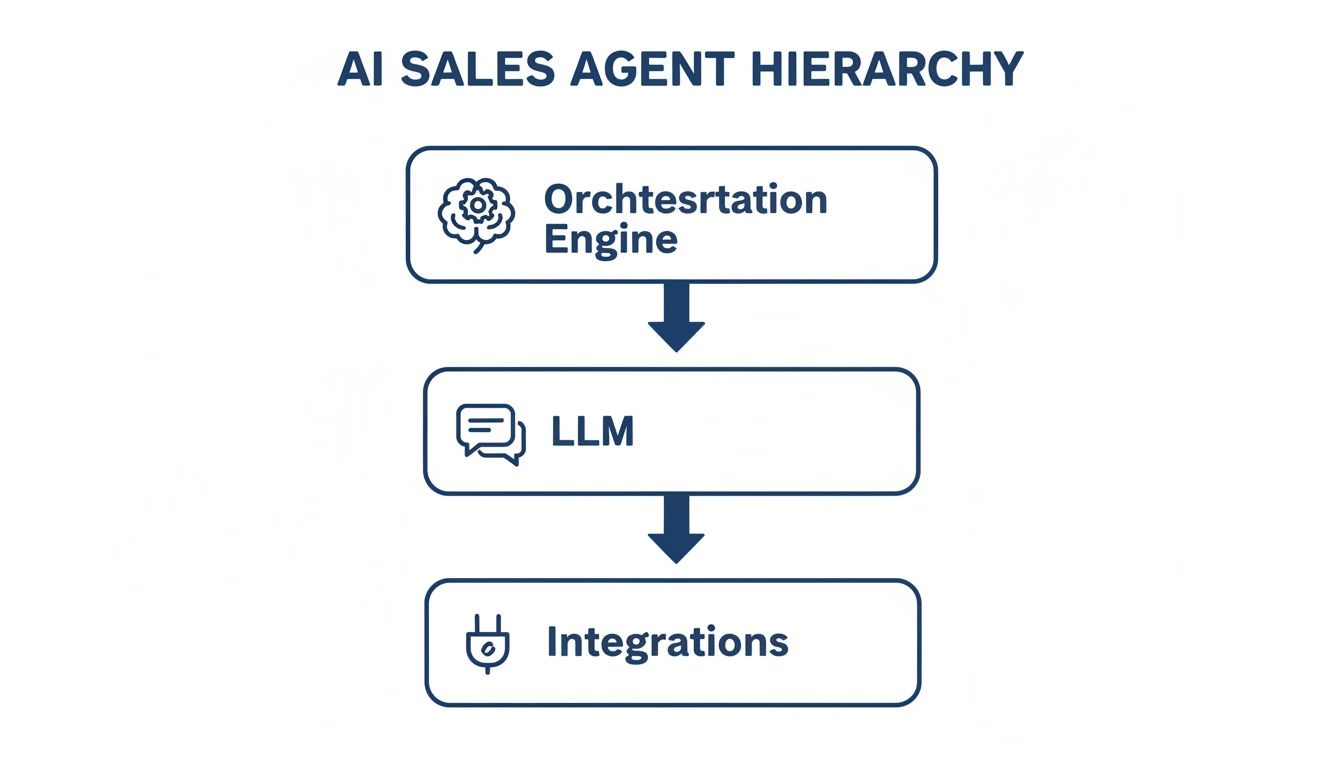
This structure ensures the agent’s actions are both intelligent and grounded in the realities of your sales process. Let’s break down each layer.
-
The Reasoning Engine (The ‘Brain’): This is the cognitive core, usually a powerful Large Language Model (LLM) like GPT-4 or Claude 3. This is where the “thinking” happens—drafting emails, understanding replies, and deciding what to say next. A more powerful model means more nuanced, human-like interactions. Cheaper models save a few bucks but will cost you in lost opportunities.
-
The Orchestration Layer (The ‘Playbook’): If the LLM is the brain, the orchestration layer is the central nervous system. It’s a framework—like LangChain or LlamaIndex—that manages the agent’s tasks, memory, and decision-making. It tells the agent what to do next. This layer turns a language model into a true, autonomous agent that can follow a strategy.
-
The Tool Belt (The ‘Hands and Feet’): Your agent needs a “tool belt” of APIs to connect with the world. This is how it does things. This includes connections to your CRM (Salesforce, HubSpot), email platform (Gmail, Outlook), and data services (Clay, Clearbit). Without these tools, the agent is a brain in a jar. It can think, but it can’t act.
Understanding how these parts fit together is crucial. For a deeper dive into the ‘brain’ component, I’ve written about the strategic use of reasoning AI models in your business.
Build vs. Buy: The Critical Decision
Now the big question: build this from scratch or use a pre-built platform? There’s no single right answer.
A custom build gives you maximum control and a proprietary edge. A platform gets you into the market faster. The right path depends entirely on your company’s stage, technical depth, and strategic goals.
A custom solution offers unparalleled control. It’s the path for well-funded companies aiming for market domination. The downside is significant upfront investment in time and money. When you build, you own the competitive advantage.
A pre-built platform gets you 80% of the way there in days. It’s a faster, less resource-intensive route. The trade-off is less flexibility. For most businesses, it’s a fantastic starting point. Don’t let perfect be the enemy of profitable.
Theory is great. Results are better. Let’s talk numbers, because when you’re making a strategic investment, that’s the only language that counts. Hype doesn’t pay the bills. Pipeline does.
I’ve personally watched companies deploy AI sales agents and completely overhaul their unit economics. I’m not talking about small bumps. I’m talking about fundamental shifts in how they find customers and dominate their markets.
The real cost is sticking with an outdated, human-only top-of-funnel model while your competitors are busy building scalable, automated sales machines.
Slashing Costs and Boosting Efficiency
Let’s start with the most immediate impact: cost reduction. I’ve worked with companies that have slashed their cost-per-qualified-lead by over 60% in just 90 days.
Think about what that means. Better leads for less than half the price. This frees up capital to pour back into things that accelerate growth.
One SaaS startup I advised used an AI agent to handle all inbound demo requests. The agent engaged leads the second they came in, asked qualifying questions, and booked meetings on reps’ calendars.
The results were immediate.
- A 25% jump in qualified meetings booked.
- 15 hours per week of admin work handed back to each sales rep.
- Lead response times dropped from hours to under 60 seconds.
This is the kind of operational leverage that creates an unfair advantage. Your team stops being reactive and starts closing.
Driving Pure Revenue Growth
Cutting costs is one thing. Top-line growth is the real prize. This is where AI sales agents become a true revenue engine.
Take an e-commerce brand that set up an agent to re-engage abandoned carts. In its first month, that single agent recovered an extra $30,000 in revenue. No new hires, no extra ad spend—just pure profit from leads that were already dead.
The payback period for this technology is measured in months, not years. The data is clear: the initial investment is quickly dwarfed by the financial returns.
The market data backs this up. The AI agents market is projected to leap from USD 7.84 billion in 2025 to USD 52.62 billion by 2030. Users are reporting up to 70% higher lead conversions, 40-60% lower costs, and a 317% annual ROI with a payback period of just over five months. You can dig into more of these remarkable market statistics to see the trend.
Tracking the Right ROI Metrics
You have to measure what matters. Forget vanity metrics. When you and I talk ROI, we focus on numbers that tie directly to business growth.
Track these key metrics when you roll out an AI sales agent:
- Customer Acquisition Cost (CAC): This is the ultimate measure of sales efficiency. Your goal is a dramatic drop as agents handle top-of-funnel work more cost-effectively than a fully-loaded SDR.
- Lead-to-Meeting Conversion Rate: With instant, personalized engagement, this rate should climb. A lot. Agents don’t let good leads go cold.
- Sales Cycle Length: By handing off perfectly qualified leads, agents shorten the time it takes your human reps to close.
- Pipeline Velocity: This measures how quickly deals move through your funnel. Faster qualification means a healthier, faster-moving pipeline.
When you track these numbers, the business case becomes undeniable. It’s no longer a question of if you should adopt this tech, but how fast you can deploy it to leave your competition in the dust.
Your Step-by-Step Implementation Roadmap
Alright, you see the potential. You get the architecture. Now, let’s get this thing off the whiteboard and generating revenue.
This is where most companies stumble. They try to boil the ocean and drown in planning cycles. We’re going to be smarter. We’ll use a phased battle plan that delivers value quickly and scales with intelligence.

This isn’t a big bang launch. It’s a series of controlled, deliberate steps. Each one is designed to prove ROI, minimize risk, and build momentum.
Phase 1: Identify Your Biggest Bottleneck
First, we pick a single, high-value target. Where is the most painful friction in your top-of-funnel process? Don’t guess. Look at your data.
Are slow lead response times killing conversions? Is your team burning their day on manual research? Is your appointment setting rate just embarrassing?
Pinpoint the one area where an autonomous agent could deliver the biggest financial impact, fast.
- Lead Qualification: Handling inbound inquiries 24/7.
- Initial Outreach: Automating the first personalized touchpoint.
- Appointment Setting: Managing the back-and-forth to get meetings booked.
Pick one. This laser focus is the secret to a quick win and building the business case for a wider rollout.
Phase 2: Choose Your Stack
With a clear target, it’s time to choose your weapons. As we covered, you can buy a platform or build a custom solution. For your first mission, I almost always recommend starting with a platform.
Tools like Gem-E, Clay, or Artisan are built to get you running fast. They’ve already handled the complex integrations. A custom build offers more control, but it’s a much heavier lift. Save that for when you’ve proven the model.
The goal here is speed to value. Choose a stack that lets you launch a pilot in weeks, not quarters.
Phase 3: Run a Controlled Pilot Program
Now, we deploy. But not to your entire database. That would be reckless. Carve out a small segment of leads for your pilot.
Run the AI sales agent in parallel with your human team. Give them both the same kind of leads and measure everything. Open rates, reply rates, meetings booked, cost-per-qualified-lead. This head-to-head bake-off will give you undeniable data.
This is the most critical phase. You’re not just testing the tech; you’re building a data-backed argument for why this agent deserves to scale in your organization.
This pilot is also where you master context engineering. You feed the agent the right data—your ideal customer profile, best-performing email templates, and brand voice guidelines. This ensures it sounds like a genuine extension of your team, not a robot.
Phase 4: Refine and Scale
Once your pilot is done, you’ll have a clear picture of what’s working. Analyze the agent’s performance against your human baseline. Where did it crush it? Where did it stumble?
This is your feedback loop. Use these insights to refine the prompts, update the knowledge base, and tweak the agent’s logic. When the agent is consistently outperforming your baseline, you’ve earned the right to scale.
Start by gradually increasing the agent’s lead volume. Move from one segment to an entire territory. Once it dominates that, expand it across your entire top-of-funnel process. This is how you transform your sales engine with control.
Avoiding Pitfalls with Governance and Guardrails
Letting an autonomous system loose is where the real work begins. An AI sales agent is a powerful tool, and it demands respect. Speed without control is a recipe for disaster.
A poorly configured agent can damage your brand in hours. Imagine it firing off thousands of off-brand or aggressive messages to your prospects. That’s why we need to talk about governance and guardrails before you unleash it.
This isn’t about moving slower. It’s about building the discipline to move fast without breaking things.
Establishing Your Control Framework
Your first move is a clear control framework. This doesn’t need to be a hundred-page document. It just needs to answer a few critical questions.
Start with these:
- Who has the authority to launch, pause, or modify agents? Define a small, accountable team.
- What is the escalation path when an agent makes a mistake? When an agent flags a conversation, who gets the alert?
- How will you ensure compliance with data privacy regulations like GDPR and CCPA? Your agent handles personal data. It must be compliant from the ground up.
Answering these questions creates the scaffolding for a safe deployment. Without it, you’re flying blind.
Human-in-the-Loop: The Ultimate Safety Net
One of the most effective guardrails is a human-in-the-loop (HITL) review process. This doesn’t mean manually approving every email—that defeats the purpose of automation.
Instead, you set up smart rules. For example, any conversation with a prospect from a Fortune 500 company might require human approval before the first message goes out. Or, if an agent detects negative sentiment, it automatically flags the conversation for a human rep to take over.
This hybrid approach gives you the scale of automation with the judgment of an experienced salesperson. It’s your safety net against costly mistakes.
The goal isn’t to restrict AI; it’s to unleash its power while maintaining control. Your governance framework is the set of rules that lets your agents operate with aggressive autonomy inside a safe sandbox.
This isn’t a hypothetical concern. AI agents are taking center stage in sales. 87% of organizations use some form of AI in their sales process. The top-performing sales teams are 1.7 times more likely to use them. As more companies deploy these agents, the ones who do it with discipline will win.
Frequently Asked Questions About AI Sales Agents
Let’s cut right to it. Whenever I talk with founders and sales leaders about deploying AI sales agents, the same handful of practical questions pop up. Let’s tackle them head-on.
How Much Does It Cost to Implement an AI Sales Agent?
Cost varies. Let’s break it down into two paths.
Using a pre-built SaaS platform is the quickest route. You could be looking at a few hundred to several thousand dollars a month, depending on scale. This is the best way to prove the concept without a massive upfront investment.
A custom build is a different animal. This requires engineering talent and a significant upfront cost—think $10k to $50k+ to get started. The trade-off? Lower long-term operational costs and a system built perfectly for you. Weigh that initial spend against the fully-loaded cost of a human SDR.
Will AI Sales Agents Replace My Human Sales Team?
No. This is the biggest misconception out there.
AI agents replace repetitive, soul-crushing tasks. They handle the top-of-funnel grind: first outreach, initial qualification, and relentless follow-up, at a scale no human team can match.
This frees up your human reps to become strategic closers. They focus exclusively on building relationships, navigating complex deals, and doing the high-value work machines can’t touch.
How Do I Ensure an Agent Matches My Brand Voice?
This is the critical piece of the puzzle, a discipline I call context engineering. An AI agent is only as good as the information you feed it. You must provide it with a comprehensive knowledge base.
This is a requirement for success. You need to include:
- Your official brand and messaging guidelines.
- Examples of successful, high-performing email templates your team already uses.
- Detailed customer personas and their exact pain points.
The more high-quality, specific context you provide, the closer the agent’s output will align with your brand voice. Do not skip this step.