You’ve poured money into AI agents, hoping for a growth engine. Instead, you’re stuck with digital interns who need constant supervision, costing you real time and money. This isn’t the competitive edge you were promised.
I’m going to show you how agentic context engineering turns your simple AI tools into a team that builds and executes its own growth playbook. No theory, just results.
Your AI Agents Are Burning Cash
You were sold a story about AI agents taking your business to the next level. What you got are tools that feel like it’s their first day on the job… every single day.
They forget what you told them five minutes ago. They make the same rookie mistakes over and over, treating every task like a cold start.
What you have is a digital treadmill, and you’re the one powering it. Every prompt needs hand-holding, every output needs your review. It’s a bottleneck.

While you’re busy babysitting your AI, your competitors are shipping products and closing deals. That makes it a business problem, and an expensive one.
The Real Cost of ‘Dumb’ AI
The AI model is rarely the problem. I can promise you that. The problem is how you’re communicating with it.
Standard prompting and even basic Retrieval-Augmented Generation (RAG) create a static, one-and-done relationship. You give a command, it gives a response. The learning stops there.
This one-off interaction leads to critical business failures:
- Your brand voice drifts. Your AI produces on-brand marketing copy one day and sounds like a different company the next, which kills customer trust.
- You waste ad spend. It generates campaign ideas that ignore last month’s failed experiments and repeats the same costly errors. For one client, this was a $50k/month mistake.
- Your strategy stalls. The system never builds on its successes, so you reinvent the wheel for every project.
You’re paying for a supercomputer but using it like a cheap calculator. That disconnect between potential and reality is where your competitive advantage goes to die.
It’s time to stop this cycle. You need a system with a memory, one that learns, adapts, and gets better on its own. That’s what agentic context engineering delivers.
No more babysitting. Just results.
Standard AI Vs Agentic Context Engineering
To see the shift clearly, put the two approaches side-by-side. The table below shows the move from static, one-off AI inputs to the dynamic, self-improving systems you and I can build.
| Attribute | Standard AI (RAG and Prompting) | Agentic Context Engineering (ACE) |
|---|---|---|
| Learning | Static; forgets between sessions. | Dynamic; learns and improves over time. |
| Context | Limited to the current prompt. | Builds a rich, persistent context library. |
| Strategy | Executes one-off tasks in isolation. | Develops and refines strategies based on past outcomes. |
| Adaptation | Relies on you to update prompts. | Adapts its own approach based on new data. |
| Efficiency | High manual effort for each task. | Becomes more autonomous and efficient with use. |
| Outcome | Delivers isolated outputs. | Builds a compounding knowledge asset for the business. |
Standard AI is a tool you have to wield perfectly every time. Agentic context engineering creates a partner that gets smarter and more valuable the more you work with it. One creates work, the other creates wealth.
How Agentic Context Engineering Actually Works
Here it is without the jargon. You don't need a computer science degree for this. Agentic context engineering (ACE) gives your AI agents a brain that remembers, learns, and gets better on its own.
A standard prompt is like handing a junior employee a one-off task. They do it, then forget everything they learned. RAG is like giving them access to a static company wiki. They can look things up, but they can't improve it.
ACE gives your agent a dynamic, living playbook that it writes, critiques, and refines by itself. This is how you and I stop managing disconnected tasks and start commanding a self-improving intelligence.
The Three Core Business Functions
Think of agentic context engineering as a tiny, autonomous team inside your AI. This team has three roles that work in a continuous loop. These functions are what make the system intelligent.
- The Generator is your strategist. It creates new tactics, drafts copy, or outlines a campaign based on the current playbook. Its job is to generate value.
- The Reflector is your in-house analyst. After the Generator acts, the Reflector looks at what happened. Did the email campaign actually work? It provides honest feedback on what worked, what bombed, and why.
- The Curator is your editor-in-chief. It takes the lessons from the Reflector and updates the playbook. It cuts failing strategies, doubles down on winning tactics, and keeps the core knowledge base potent.
This "generate, reflect, curate" loop is the engine of self-improvement. It turns every action into a lesson, compounding your AI's effectiveness. To get this right, you need well-built AI Agent Input Pipelines that feed your agents high-quality, relevant information.
From Theory to Results
I've built systems like this, and the gains are concrete. For example, a financial analysis agent can spot trends over long histories, speeding up decisions by 30-50%.
A CRM bot I configured for a B2B SaaS company remembered tiny client details from calls months prior. This hyper-personalized outreach drove a 22% lift in qualified meetings. That's real revenue.
This loop is how your marketing AI stops making the same mistake twice. It's how your sales bot remembers a client's pain point from three months ago. It's the mechanism for creating a true learning asset instead of a fancy chatbot.
The real power is that the AI curates its own high-signal context. It learns a certain headline style doubles click-through rates and makes it a core part of its playbook. This is how you pull ahead: by building systems that learn and adapt faster than your competitors.
Solving The Context Rot Problem In Your AI
The biggest threat to your AI agent is a quiet poison I call context rot, and it's the number one killer of AI ROI.
Context rot is a two-headed monster. You either drown your agent in irrelevant information, or you starve it of the details it needs, forcing it to guess. The result is the same: dismal performance on the complex tasks that actually move the needle.
Ask your agent to run a multi-week marketing campaign, and you’ll watch it crumble. This is why.
Why Your Agent Keeps Getting Lost
Standard AI systems are built for static inputs. The moment a task requires remembering what happened three steps ago, the system's working memory gets clogged with noise.
This is a design failure at the root, far more serious than a minor bug. How can you trust an AI to manage a long-term project when it can't maintain a clean understanding of its immediate goals?
Every time your AI has to re-learn your brand voice or ignores past performance data, you're paying for its amnesia in wasted time, money, and opportunity. This is the hidden tax on unsophisticated AI.
And no, a bigger context window won't solve it. Cramming more data into the prompt just makes the context rot worse. The real fix is giving the agent the ability to manage its own context.
Benchmarking The Reality Of Context Failure
The data tells a brutal story. A recent benchmark called Context-Bench revealed how even top-tier models choke on the long-horizon tasks essential for any serious business function. On jobs requiring file chaining and multi-step retrieval, Claude Sonnet 4.5 peaked at just 74% accuracy. You can see the full breakdown in the Context-Bench findings from Letta.com.
That 26% failure rate is where your marketing campaigns go to die. It's why an AI-generated campaign might brilliantly analyze one competitor but completely forget your own A/B test data from last month.
This performance gap is where agentic context engineering creates its advantage. Instead of pushing a firehose of information at the agent, you give it the tools to pull, filter, and curate information for itself.
Turning Noise Into Signal
Agentic context engineering attacks this problem head-on. It treats context as a dynamic, living workspace. Your agent receives data and actively manages it.
Here’s what that looks like for a real business:
- With just-in-time retrieval, an agent building a landing page doesn't need your entire product catalog. It learns to fetch only the specs, testimonials, and pricing for that product, keeping its working memory sharp.
- With dynamic playbook curation, the agent actively updates a central playbook as it runs email campaigns, pruning ineffective subject lines and promoting high-converting calls-to-action for future use.
While your competitors are trying to write the "perfect" prompt, your system is busy building a self-improving brain. You can learn more about this distinction in my guide to context engineering vs prompt engineering.
By solving for context rot, you're turning a high-potential tool into a high-performance, reliable asset that executes complex strategies without getting lost.
Building Your AI Team With A Multi-Agent Architecture
Trying to solve a complex business problem with a single AI agent is like asking a solo founder to be the CEO, CMO, and lead engineer. It’s a path to burnout and mediocre results.
The real power comes alive when you stop thinking about a single agent and start building a multi-agent architecture. This is the blueprint for assembling your 'bionic' team of specialists.
The Specialist Team Structure
Imagine a lead agent acting as the project manager. Its job is to understand the goal and delegate tasks to specialized sub-agents instead of trying to do all the work itself. This division of labor is how you conquer complex business challenges.
Here’s what that team might look like:
- A market researcher agent, hooked into search APIs, exists only to gather fresh market intelligence and competitor data.
- A data analyst agent digs into your internal data (CRM, ad platforms) to identify what's working and what isn't.
- A copywriter agent takes the curated insights and generates on-brand content, from ad copy to email sequences.
This structure prevents the 'context rot' I just described by ensuring each agent only deals with the information it absolutely needs.
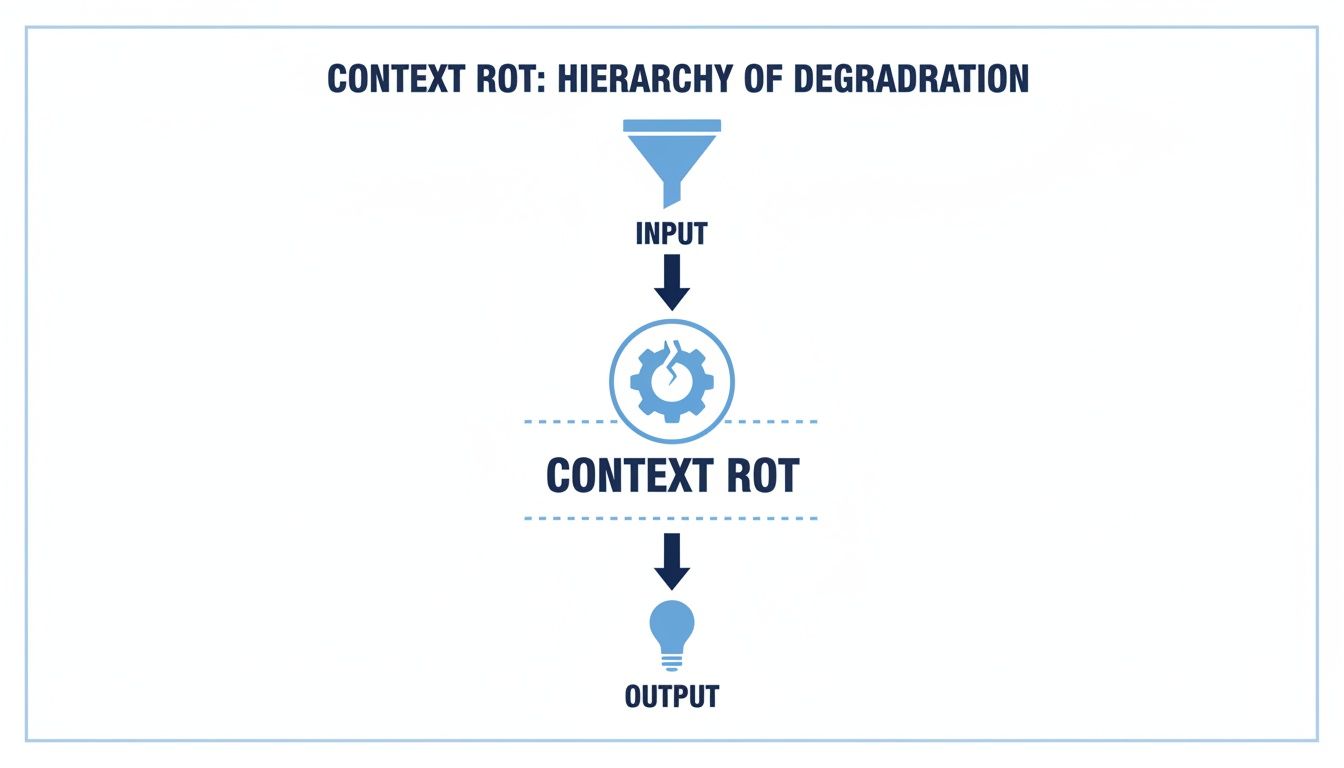
This visual nails how unfiltered input leads to broken processes and weak output, a problem multi-agent systems solve by design.
Slashing Context Overload For Massive Gains
The point of this structure is efficiency. A multi-agent architecture can slash context size by 80-90% for each agent. This allows the system to tackle massive tasks that would paralyze a single, overloaded agent.
For a client in the fintech space, I built a multi-agent system for compliance checks. The lead agent delegated document analysis to three specialist agents. This modular loop reduced processing time from 4 hours to 15 minutes per case. A 16x improvement.
Speed on the same tasks is the smaller gain. The bigger one is taking on challenges that were previously impossible, with a system that can out-think and out-execute your competition at scale.
Real-World Business Applications
The applications are immediate. An e-commerce team can automate social media ideation. One agent pulls trends, a second curates viral hooks aligned with the brand, and a third generates the final posts. This can scale creative output 5-7x without brand drift.
The key is modularity and clear roles. This is how founders I work with are achieving a 35% faster go-to-market: they build specialized AI teams that execute with precision. You can see how various agentic solutions structure AI teams for specific needs.
Your Practical Implementation Framework
Theory is cheap. Results matter. This is my step-by-step framework for putting agentic context engineering to work in your business, starting now.
The aim is an asset that generates revenue, not a science fair project. Time to turn concepts into cash flow.

The goal is a predictable, repeatable system that gives your AI the clarity it needs to drive growth. Here is how it works.
Phase 1: Define Your Initial Playbook
Before you touch any code, you must define the "seed" of your AI's intelligence. This initial playbook is the foundation. Most businesses skip this, and it's why their AI initiatives fail.
Don't overcomplicate this. Your initial playbook is a concise document capturing your core operating intelligence. Start here:
- Start with core strategy. What's the one big goal? Lead generation? Market expansion? Be brutally specific.
- Then brand voice. How do you sound? Pull examples of good and bad copy. Define your tone.
- Then market intelligence. Who are your top 3 competitors and their biggest weaknesses? Who is your ideal customer profile (ICP)? What keeps them up at night?
This initial playbook is your Day 1 context. A weak foundation here guarantees a weak AI, no matter how powerful the model.
Phase 2: Design The ACE Loop
Now, build the engine: the Generate, Reflect, and Curate loop. You can orchestrate this with a single powerful model like Claude or Gemini, or use a multi-agent framework. The principle is the same.
- Set up the Generator, the agent that creates. Its core prompt references the playbook for guidance: "Acting as a world-class growth marketer, review the attached Playbook and generate five campaign ideas to target our ICP's primary pain point."
- Set up the Reflector, the agent that critiques. Its prompt focuses on evaluation: "Analyze the five campaign ideas against our past performance data. Score each from 1-10 on likely ROI and provide a rationale."
- Set up the Curator, the agent that improves the playbook. Its prompt is about synthesis: "Based on the Reflector's analysis, update the 'Winning Campaign Tactics' section of the Playbook with the top-scoring idea."
This structure turns every action into a learning opportunity. For a deeper look into these models, check out my guide on the strategic use of reasoning AI models in your business.
Phase 3: Implement The Feedback Mechanism
An agentic system without a feedback loop is just a fancy automation. The feedback mechanism is what makes self-improvement possible. It's how the system learns from the real world.
Start with a human-in-the-loop. After the Reflector agent scores the outputs, you give the final approval. Did that AI-generated campaign actually drive a 12% increase in sign-ups? That's critical feedback.
This real-world performance data is gold. You feed it back to the Curator to make smarter updates to the playbook. Over time, as accuracy improves, you can automate more of this validation.
ACE Implementation Checklist
| Phase | Key Action | Success Metric |
|---|---|---|
| 1. Strategy & Foundation | Define a single, high-value business problem to solve. | Clear, measurable KPI for the target problem (e.g., increase lead conversion by 15%). |
| Create the V1 Playbook with core strategy, voice, and market intelligence. | A concise, documented playbook is complete and approved by stakeholders. | |
| Identify key internal data sources (CRM, analytics, past campaigns). | At least 2-3 reliable data sources are connected and accessible. | |
| 2. System Design & Build | Choose your LLM(s) – start with a single powerful model if possible. | Model selected and API access confirmed. |
| Draft initial prompts for Generator, Reflector, and Curator agents. | V1 prompts are written and reviewed for clarity and goal-alignment. | |
| Set up the basic automation to pass outputs between agents. | A successful end-to-end test run of the G-R-C loop is completed. | |
| 3. Feedback & Iteration | Establish a human-in-the-loop validation step. | A clear process for a human to review and approve/reject AI output is in place. |
| Define the process for feeding real-world performance data back to the Curator. | The first set of real performance metrics (e.g., campaign results) is fed back into the system. | |
| Schedule weekly or bi-weekly reviews of system performance and playbook accuracy. | System accuracy improves by a measurable amount (e.g., 5% fewer rejections) within the first month. |
Following these steps provides a structured path from concept to a functioning AI system that contributes directly to your bottom line.
Critical Trade-Off: Single LLM vs. Multi-Agent
When do you use one LLM versus a multi-agent system? It’s a trade-off between simplicity and capability. Don’t over-engineer it.
- A single-LLM setup is best for focused tasks like content ideation. It’s faster to set up and cheaper to run. If your problem is well-defined, start here.
- A multi-agent system is necessary for complex workflows like a full market analysis or product launch. It avoids the context rot that plagues a single model juggling too many things.
My advice? Start lean with a single LLM. Only scale to a multi-agent architecture when the complexity of the task genuinely demands it. This pragmatic approach will save you time, money, and headaches.
This Is How You Win
Straight to the point. While everyone else is tweaking prompts for tiny improvements, you and I are building a self-improving intelligence network. That split is what separates market leaders from followers.
Agentic context engineering is a structural change in how you use AI to drive growth. It’s the engine behind everything from fixing context rot to building entire teams of specialized AI agents.
From Reactive Tool to Proactive Asset
The old way of using AI is purely reactive. You feed it a task, it spits out an answer. The value is temporary, transactional.
With agentic context engineering, you’re building a proactive asset. Your campaigns launch faster because the system already knows what works. Your outreach scales because it remembers every past interaction. Your systems can react to market shifts in real-time, often without you lifting a finger.
This is the strategic equivalent of adopting the internet in 1998 while your competitors are still figuring out their fax machines. The gap this creates is massive and nearly impossible for them to close.
Owning The Learning Loop
Your product still matters, but your biggest competitive moat is now the speed at which your entire business learns. Agentic context engineering bakes this learning loop directly into your operations.
Here’s the bottom line:
- Your competitors are treating AI like a calculator, a useful tool for one-off answers.
- You will be building an AI that acts like a partner, one that accumulates knowledge and gets smarter with every task it performs.
This is more than an operational upgrade. This is how you build a business that leads its market and can create a new one. This is how you leave everyone else wondering how you did it.
Your Questions Answered
I get a lot of questions from founders about agentic context engineering. The ideas are powerful, but the execution can seem intimidating. Here are the most common ones I hear.
Is Agentic Context Engineering Just A More Complicated Version Of RAG?
Not at all, and the difference is critical for your business. RAG is like giving your AI a fixed library. It can look things up, but the library never changes or learns on its own.
Agentic context engineering empowers the AI to be the librarian, author, and editor. The context becomes a living playbook that the AI actively curates based on feedback. That self-improvement loop is the entire game.
Do I Need An AI Research Team To Implement This?
Absolutely not. While the concept originated in research, implementation is now very accessible. You can orchestrate the “Generate, Reflect, Curate” loop using a single powerful LLM like Claude 3.5.
For more complex systems, frameworks like CrewAI help you coordinate multiple specialized agents. You don’t need a PhD. The real barrier is a commitment to thinking strategically about how your business learns.
What Is A Realistic First Project?
Automating content ideation. It’s high-value, the results are easy to measure, and it’s a fantastic way to prove the concept internally. It’s a low-risk, high-reward starting point.
Here’s the plan:
- Seed the playbook by documenting your brand voice, best-performing content themes, and audience pain points.
- Set up the loop so the “Generator” proposes new blog topics based on the playbook and real-time trends.
- Add feedback so the “Reflector” scores these ideas against past engagement metrics. The “Curator” updates the playbook with patterns from winning ideas.
You’ve just built a self-improving content engine. A tangible asset you can spin up in a week, not a quarter.
How Do You Measure The ROI Of This System?
You measure it with hard business metrics that show up in your accounts, not vanity AI stats. You and I care about revenue, speed, and competitive advantage.
The ultimate measure of a successful agentic context engineering system is its direct impact on your bottom line. It either makes you more money, saves you significant time, or creates a durable competitive edge. If it’s not doing one of those, it’s just a science project.
Track these relentlessly:
- A 40% reduction in time from campaign brief to launch.
- A 3x increase in high-quality creative assets produced per week.
- A measurable uplift in conversion rates from AI-driven campaigns.
- A quantifiable reduction in manual effort spent managing AI.
A well-built ACE implementation should directly contribute to revenue, slash operational costs, and increase your speed to market. That’s the only ROI that matters.