
ou’re hitting a wall with AI. You’re spending hours tweaking prompts, trying to get reliable results for marketing, sales, or operations, and it’s a crapshoot. Sometimes it works. A lot of the time, it doesn’t.
This isn’t a failure of your prompting skills. It’s a sign that you’ve outgrown the approach entirely. I’ve been in this game since 2016, long before the hype, and I can tell you the real winners aren’t just writing better prompts. They’re building smarter systems.
The fight isn’t between prompt engineering and context engineering. It’s between one-off tactics that feel productive and strategic systems that actually build a competitive moat.
Why Your Prompts Are Hitting a Wall
You and I both know the feeling. You’ve been trying to perfect prompts for ChatGPT or Claude to get consistent marketing copy or sales emails. But you’re getting diminishing returns. No amount of clever phrasing fixes the core problem: unreliable, inconsistent AI output.
You’re trying to solve a systems problem with a language solution. It’s like shouting louder at someone who doesn’t have the right map.

The critical shift you need to make is from tweaking individual sentences (prompt engineering) to building intelligent information systems (context engineering). This is the leap from one-off tasks to scalable, automated AI systems that actually drive revenue and dominate markets.
The Tactical Tool vs. The Strategic System
Most people are stuck treating AI like a new intern, giving it increasingly specific instructions. That approach caps out fast. It’s the ceiling you’re hitting right now.
The real game is won by building a framework where the AI has everything it needs before you even ask the question. That’s context engineering. One is a conversation; the other is an architecture that makes that conversation consistently intelligent.
The companies that master context engineering will dominate their markets. The ones stuck in “prompt engineering hell” will be wondering why their AI initiatives consistently fail to deliver ROI.
To make this crystal clear, let’s look at what matters for your business. It’s not about which approach is “better.” It’s about which tool you need for the job in front of you.
Quick Comparison: Prompt Engineering vs. Context Engineering
| Dimension | Prompt Engineering (Tactical Tool) | Context Engineering (Strategic System) |
|---|---|---|
| Primary Goal | Get a high-quality output for a single, immediate task. | Build a reliable, repeatable, and scalable AI-powered workflow. |
| Scope | One-off interaction. The conversation has no memory or external access. | An entire information pipeline. Manages memory, data retrieval, and tool use. |
| Typical Use Case | Writing a social media post, brainstorming ideas, summarizing an article. | Powering a customer service bot, an automated market analysis agent, or a personalized content engine. |
| Business Impact | Quick wins and productivity boosts on discrete tasks. | Creates a durable competitive advantage through automation and superior data processing. |
Thinking like a context engineer means you stop asking, "What's the magic phrase?" You start asking, "What information, tools, and memory does the AI need to have to make failure almost impossible?" That question changes everything.
When ChatGPT first launched, everyone suddenly became a "prompt engineer." It was the wild west. For a short while, crafting the perfect set of magic words felt like the most critical skill in business. You were probably spending hours a day just tweaking phrases.
But then, businesses like yours tried to build real, revenue-generating workflows. You tried automating client reports or qualifying sales leads. The limitations of just "prompting harder" became painfully obvious. The inconsistency was a killer.
From One-Off Tricks To Reliable Engines
This forced an industry-wide shift. The conversation had to move from a narrow focus on user instructions—the prompt—to a much broader, strategic view of the entire information environment an AI operates within. This wasn't some academic exercise; it was a necessary evolution driven by the demands of building reliable, enterprise-grade AI applications.
The market demanded this change. Since late 2022, the AI industry has matured at a breakneck pace. By early 2024, context engineering had evolved from a niche concept into a critical discipline for any organization trying to build real business assets with AI.
This is the core difference between a fun tool and a business asset. A tool can fail 40% of the time, and it’s just an annoyance. A core business system cannot.
Why Systems Thinking Wins
Prompt engineering is like giving directions to a tourist on a busy street corner. You get one chance to get it right, with tons of noise and no shared map.
Context engineering, on the other hand, is like building a GPS for your business. It provides the AI with the map (your knowledge base), real-time traffic updates (live data APIs), and a clear destination (the user's goal). The "prompt" is just the final address you type in.
You don't build a competitive advantage by being slightly better at giving one-time directions. You build it by creating a navigation system so robust that it gets you to the right destination, every single time, faster than anyone else.
As we shift from simple prompts to comprehensive AI systems, implementing AI powered knowledge management becomes the foundation. This is how you give your AI the "map" it needs to win.
The reality is that tweaking prompts hits a hard ceiling. You can spend another 10 hours refining a prompt for a 2% improvement. Or, you can spend that time building a simple data retrieval system that improves reliability by 80%. The choice is obvious.
Comparing The Mechanics And Workflow
Alright, let's get into the weeds. The real difference between context and prompt engineering is in the daily workflow, the tools, and the results you can deliver.
One is about mastering language. The other is about designing architecture.
Prompt engineering is about linguistic precision. Your focus is on a single interaction. You're a wordsmith, trying to cram maximum clarity into one shot. It's a stateless, short-term game of trial and error.
Context engineering is a stateful, systems-level approach. The individual prompt is often the least important part of the equation. You're architecting the entire information pipeline that feeds the model.
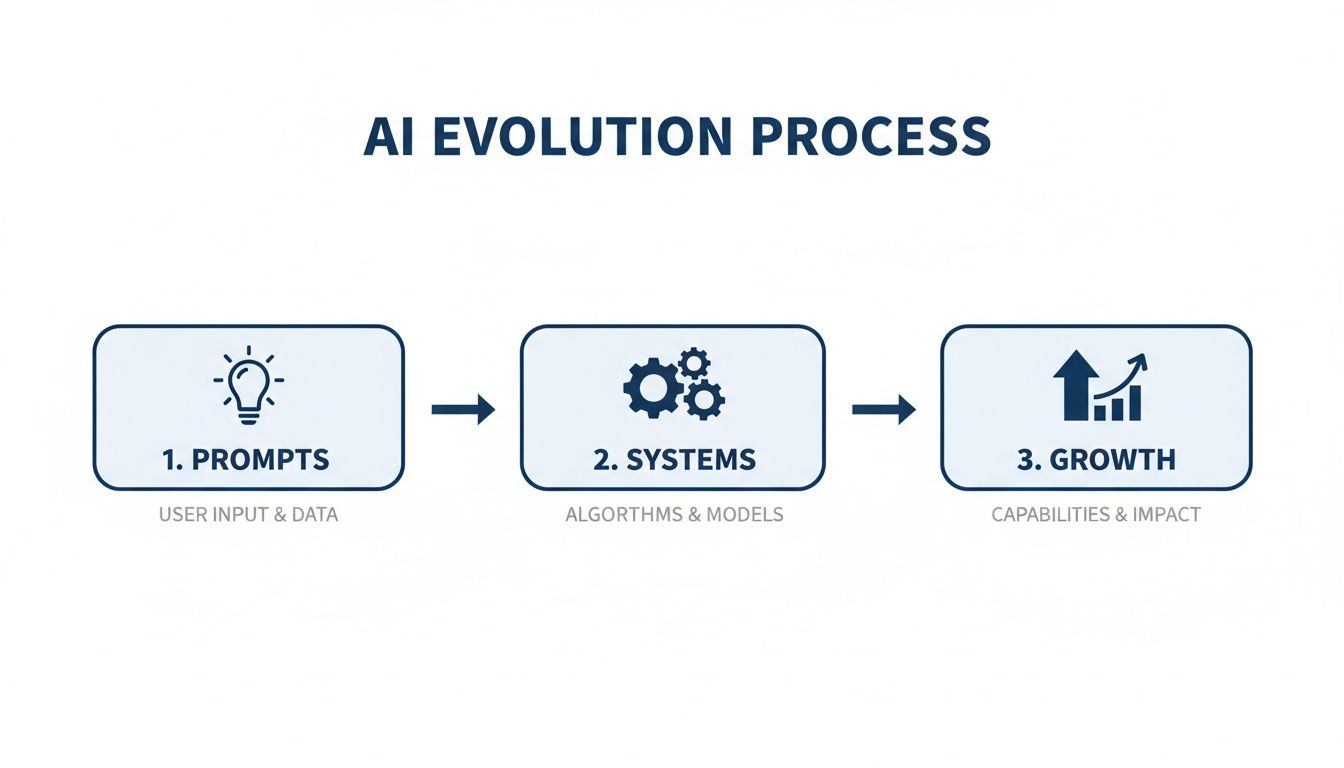
This diagram shows the maturity curve. Moving from simple instructions to building robust systems is the only path to scalable, revenue-generating AI applications.
Technical And Workflow Comparison
This table breaks down the differences that matter. It’s a strategic distinction that determines whether you're building a helpful assistant or a core business asset.
| Attribute | Prompt Engineering | Context Engineering |
|---|---|---|
| Primary Goal | Elicit a specific, high-quality response from a single query. | Build a durable, autonomous system that consistently performs complex tasks. |
| Core Mechanic | Crafting precise, detailed text instructions. | Designing an information pipeline and providing the AI with tools. |
| Scope | Single, isolated interactions (stateless). | Continuous, multi-step processes and conversations (stateful). |
| Typical Tools | Text editor, AI chat interface (e.g., ChatGPT, Claude.ai), spreadsheets for tracking. | Vector databases (Pinecone, ChromaDB), orchestration frameworks (LangChain), APIs. |
| Focus | The words in the prompt. | The system that provides context to the prompt. |
| Business Outcome | A well-written email, a good summary, a creative idea. | An automated lead nurturing sequence, an intelligent customer support agent. |
As you can see, the shift is from being a writer to being a systems architect. One helps you with a task; the other builds the machine that automates the entire task.
The Toolkits Tell The Story
The tools you use reveal the problem you’re solving.
A prompt engineer’s toolkit is simple: a text editor and an LLM interface. It’s an artisan’s craft.
A context engineer’s toolkit looks like a modern data engineer’s.
- Vector Databases: Tools like Pinecone or ChromaDB become your AI’s long-term memory.
- Orchestration Frameworks: LangChain acts as the plumbing, connecting data sources and APIs into a coherent workflow.
- Data APIs: You’re constantly pulling live data from your CRM, analytics platforms, or financial feeds.
You stop trying to explain your company’s Q3 sales data in a prompt. Instead, you build a system that automatically pulls the data and gives it to the AI as needed.
When you’re a prompt engineer, you’re trying to win a single debate with the AI. When you’re a context engineer, you’re building the library so the AI never has to debate in the first place.
Statefulness Changes Everything
This brings us to the most critical mechanical difference: prompt engineering is stateless, while context engineering is stateful. A stateless interaction starts fresh every time. A stateful system remembers and builds on past interactions.
This is why prompt engineering fails at scale. Imagine trying to onboard a new client with a chatbot that forgets everything you told it three messages ago. It’s a non-starter.
Context engineering solves this by managing conversation history and retrieving relevant data. This is the only way to build AI that can handle complex dialogues required for sales or support. If you want to dive deeper, you might be interested in the strategic use of reasoning AI models in your business.
Ultimately, prompt engineering is for one-off tasks. Context engineering is for production systems that drive revenue.
Real-World Use Cases That Drive Revenue
Theory is great, but let’s talk about making money. Let’s make the context engineering vs. prompt engineering debate real.
I’ll walk you through two scenarios: a simple content task and a strategic market intelligence system. One is a task; the other is a weapon.

Use Case 1: The Prompt Engineering Approach
Let’s say you need five social media posts for a new product launch. This is a perfect job for prompt engineering.
You open up your favorite AI and craft a detailed prompt. You include the product name, target audience, and brand voice. After a few tweaks, you get five solid posts. The entire process takes maybe 20 minutes. Fast. Efficient.
But next week? You do it all over again. It’s a manual, repetitive task that doesn’t scale.
Prompt engineering gives you an asset for the day. It’s a quick hit of productivity, but it doesn’t build a durable advantage.
Use Case 2: The Context Engineering System
Now, let’s design an AI-powered market intelligence agent. This is where context engineering becomes a game-changer. This is about building a continuous competitive advantage.
Your goal: automatically monitor your top three competitors and generate a weekly strategic brief.
Here’s how we build it.
- Dynamic Data Retrieval: We connect the system to tools that monitor your competitors’ websites and blogs. Every change is captured.
- API Integration: The agent is hooked into your Google Analytics and CRM APIs to pull your real-time performance data.
- Knowledge Base: We feed a vector database with your past marketing strategies, performance reports, and brand guidelines. This becomes the agent’s memory.
Now, the agent has a complete picture of the market. The “prompt” is the final, simple step. Every Monday at 9 AM, a trigger fires: “Analyze new competitor data, compare it against our performance and history, and generate a strategic brief with three actionable recommendations.”
The output isn’t just a summary. It’s a strategic document:
“Competitor X launched a new feature. Our user engagement in that area dipped 5% since their launch. Based on our successful Q2 campaign, I recommend we counter with a targeted email sequence highlighting our superior feature Y.”
This is how you dominate. While competitors manually check websites, your AI system delivers strategic insights automatically. This system scales, learns, and builds a moat around your business. You can connect these systems with various AI workflow automation tools without a massive engineering team.
One approach saves you 20 minutes. The other gives you a persistent eye on the market your rivals can’t match.
Choosing The Right Approach For The Job
This isn’t an ‘either/or’ fight. The real question is which tool you need right now. Getting this wrong is how you waste months on AI projects that go nowhere.
Think of it this way: prompt engineering is your speed boat. Fast, agile, perfect for one-off creative tasks or exploring a new model. Need 10 ad headlines for an A/B test? That’s a prompt engineering job.
Context engineering is your cargo ship. It’s what you build to reliably transport value across the organization, 24/7. This is for core business processes where failure is not an option—customer-facing applications, complex automations, and scalable systems.
The Inflection Point When Prompts Are Not Enough
There’s a critical moment every company hits. You feel it when you’ve spent three days tweaking a prompt for a client report, only for it to fail on the fourth day because the input data changed slightly.
This is your inflection point. The signal that you’ve pushed a tactical tool past its breaking point.
After hitting a wall with endless prompt iterations, teams discover that real, scalable improvements demand a fundamentally different approach. You can learn more about these enterprise-level findings and see why systems thinking is so crucial. This is the moment your focus has to shift from instructing the AI to truly informing it.
When To Use Prompt Engineering
Stick with prompt engineering for high-speed, low-stakes work.
- Brainstorm and Ideate: Generate creative concepts, outlines, or marketing angles.
- Execute One-Off Tasks: Summarize an article, write a single email, or rephrase a paragraph.
- Test a Model’s Limits: Explore a new LLM without committing to building a system.
Its primary limitation is that it’s stateless. For a deeper dive into the specific applications of various models, you might be interested in why open-source LLMs may be the future of AI marketing.
When To Build A Context System
You graduate to context engineering when reliability becomes non-negotiable.
- Automating Core Workflows: Powering systems for lead qualification, customer support, or market analysis.
- Building Customer-Facing Applications: Creating chatbots or personalized content engines that need to access user data.
- Handling Complex, Multi-Step Reasoning: Any task where the AI has to retrieve data, use a tool, and then make a decision.
In a well-built context engineering system, the prompt becomes the smallest, simplest part of the machine. The context pipeline does all the heavy lifting.
Your competitors are still trying to write the perfect magic sentence. You’ll be building an intelligent machine that makes their approach look like a horse and buggy next to a fighter jet.
Your Questions On Context Engineering Answered
Over the years, I’ve seen hundreds of founders hit the same wall. They get good at writing prompts, see some early wins, and then plateau.
Let’s dive into the common questions I hear when they’re ready to move past simple prompts. These are the real-world problems that surface when you try to turn a fun tool into a core business asset.
What’s The First Step To Move From Prompt To Context Engineering?
The first move has nothing to do with technology. It’s strategic.
Pinpoint a single, high-value, repetitive workflow that’s a magnet for human error. A perfect example is compiling a weekly competitor analysis report.
Instead of writing a better prompt to summarize websites, map out the information supply chain. What sources does a human analyst check? They’d look at competitor websites, your internal analytics, and past reports.
Your first project should be building a simple RAG (Retrieval-Augmented Generation) pipeline for that one task. This immediately changes your mindset from “How do I ask the question better?” to “How do I give the AI all the necessary information?”
Does Context Engineering Require A Dedicated Data Science Team?
Not anymore. Ask me this in 2019, and my answer would have been “yes.” Today, the tooling has matured at a stunning pace.
Platforms like LangChain, LlamaIndex, and managed vector databases like Pinecone have smoothed over massive complexity. A technically-savvy marketer or a generalist developer can now assemble a powerful context pipeline.
You don’t need a machine learning PhD anymore. The crucial skill has shifted to systems thinking—understanding how to connect data sources and APIs to create a coherent information flow.
How Do I Measure The ROI Of This Investment?
This is where the game changes. You stop measuring fuzzy things like “prompt quality” and start tracking cold, hard business outcomes.
Here’s your starting point.
- Error Rate Reduction: What percentage of AI outputs need manual correction? A well-designed context system can slash this by over 80%.
- Time Savings: Calculate the hours saved by automating a manual workflow. If your new market intelligence agent saves your strategy team 10 hours a week, that’s your return.
- Scalability: Can you 10x the volume of a task without a proportional jump in errors or cost? That’s operational leverage.
Ultimately, you have to tie it back to revenue. Did the AI agent help your sales team spot an overlooked market segment that led to a 15% bump in qualified leads? That’s your ROI.
Is Prompt Engineering Becoming Obsolete?
Absolutely not. This is a dangerous misconception. Prompt engineering isn’t being replaced; it’s being integrated into a larger, more powerful framework.
Think of it this way: Context engineering is the architect designing the entire building. Prompt engineering is the interior designer choosing the perfect words for the plaque in the lobby.
The prompt becomes the final instruction that triggers an action within the well-prepared environment you’ve constructed. To truly grasp this, you must first understand what is prompt engineering, as it’s the foundation of interacting with these models.
The skill of clearly articulating a task remains vital. It’s just evolving from being the entire solution to being the final, critical step in a much more intelligent machine.