You're probably seeing the same pattern I see in small businesses and marketing teams every week. Someone opens ChatGPT, asks for ad copy, gets polished nonsense back, and mistakes fluency for usefulness. Then the team spends hours editing AI output that never should've been generated in the first place.
That's an operating problem.
I've worked with machine learning since 2016 and generative AI since 2019. The companies that win with prompt engineering for marketing have tighter context, stricter rules, clearer success criteria, and a feedback loop tied to pipeline, conversion, and revenue. Everyone else is just producing more words.
Table of Contents
- Your AI Is Lying to You
- The Revenue-Driven Prompting Framework
- Prompt Templates for High-Converting Copy
- Uncovering Market Gaps with AI Ideation
- How to Test and Measure Prompt Performance
- From Prompts to Automated Marketing Agents
Your AI Is Lying to You
Your team ships a batch of AI-generated ads on Monday. By Friday, the copy looks polished, approvals moved fast, and performance is flat. The problem showed up before launch. The model produced language that sounded credible, while your process failed to give it the commercial context needed to produce anything that could lift conversion.
I see this with business owners and marketers all the time. They ask for “high-converting Facebook ads” or “a stronger landing page headline,” and the model returns generic copy a competitor could publish the same day. Then the team blames the tool. I blame the operating model. If you give AI no audience definition, no buying stage, no channel constraints, no offer economics, and no success threshold, you get polished guesswork.
Why polished output fools smart teams
Large language models are prediction engines. They fill in the next plausible sentence. They do not understand your CAC target, your sales cycle, or which objection is blocking conversion on a pricing page.
That creates a dangerous illusion inside marketing teams. Copy that reads well gets approved. Campaign summaries that sound sharp survive meetings. Ad concepts that feel strategic make it into production. Revenue does not care how convincing the draft sounded.
I use a simple test. Ask your team why one prompt should beat another before you spend a dollar on traffic. If the answer is “this one feels stronger,” you are still treating AI like a novelty. Serious teams can explain the mechanism. They can point to the segment, the offer, the objection, and the KPI they expect to move.
If you want a useful reminder of how often AI confidence and AI correctness diverge, the Lumi Humanizer report on AI accuracy is worth reading. Different category, same lesson. Confident output is cheap. Reliable output takes controls.
A practical rule: if a prompt can work for any company, it will not create an advantage for yours.
The process mistake behind weak marketing AI
I do not treat prompting like chatting. I treat it like revenue operations.
That means every serious prompt engineering for marketing workflow needs five inputs before anyone hits enter:
- Start with the business objective. Are you trying to increase demo bookings, improve lead quality, cut wasted spend, or speed production without hurting conversion?
- Define the audience precisely. Which segment, buying stage, objections, and language patterns matter?
- Name the operational context. Which channel, offer, campaign window, and brand constraints apply?
- Set the decision criteria. What decision should the output help a human make or execute?
- Write a measurement plan. Which KPI decides whether this prompt stays in the system?
At this stage, many AI projects stall. Teams obsess over wording and skip decision design, measurement, and accountability.
My advice is simple. Stop treating prompts as one-off creative requests. Start treating them as production assets with owners, rules, and expected business outcomes. This framing is important because it turns prompting into an operating discipline tied to conversion rate, pipeline quality, and speed to market.
Once you run AI that way, the conversation changes. You stop asking whether a prompt sounds better. You ask whether it produces assets your team can test, score, and improve against revenue goals.
The Revenue-Driven Prompting Framework
I don't care about clever prompts. I care about prompts that produce usable outputs under pressure, across channels, with enough consistency that a team can scale them.
That's why I use C.R.A.F.T.. Context. Role. Action. Format. Thresholds.
Used properly, it works as a control system for prompt engineering for marketing.
Use C R A F T instead of vague instructions
Start with the framework image. This is the simplest way to explain it to anyone who helps you.
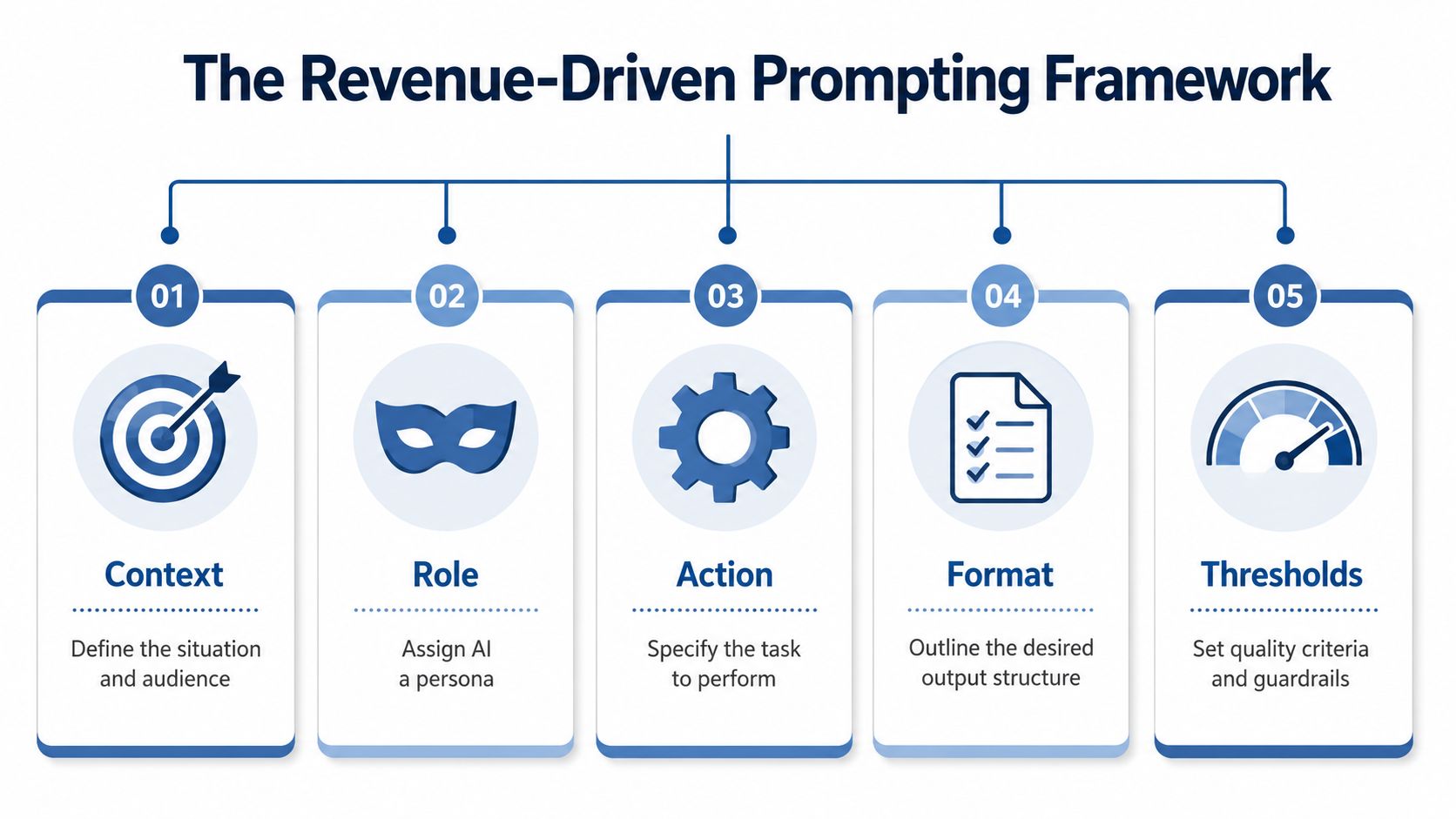
Here's how I define each part.
| Component | What I put in it | Why it matters |
|---|---|---|
| Context | Brand, audience, offer, channel, timing, campaign goal | Stops generic output |
| Role | CRO strategist, lifecycle marketer, paid social operator, analyst | Pushes the model toward the right frame |
| Action | Audit, rewrite, rank, compare, draft, summarize | Removes ambiguity |
| Format | Table, JSON, email sequence, ad matrix, headline list | Makes output usable inside workflows |
| Thresholds | Constraints, exclusions, quality rules, performance triggers | Forces business discipline |
Google Cloud recommends breaking complex tasks into smaller steps, and Skai's TRIM structure adds task, relevant context, intent, and measurable thresholds to make AI outputs actionable for campaign analysis and budget decisions, which is why I'm opinionated about decomposition and constraints in day-to-day prompt design for marketing teams in Google Cloud's prompt engineering overview.
The part often skipped is Thresholds. That's the expensive mistake. Without thresholds, the AI gives you “good sounding.” With thresholds, it starts working inside your economics and operating rules.
A quick example. Don't ask, “Analyze campaign performance.” Ask for a diagnosis across a defined period, require comparison against a prior period, specify the metrics that matter, and tell it to flag exceptions that need action. That's the difference between commentary and operational support.
Later in the workflow, I often share this video because it helps non-technical people understand why prompt structure matters in practice.
Three copy-paste prompt patterns
Use these as starting points. Then customize them to your economics, funnel, and brand standards.
Paid social ad prompt
“Act as a senior paid social copywriter for a [industry] brand. Audience: [specific customer segment]. Offer: [offer]. Channel: Meta ads. Goal: drive [desired action]. Write 5 ad variations. Each must use a different angle based on these pains: [list]. Format output in a table with headline, primary text, CTA, emotional trigger, and likely objection. Exclude generic claims and hype. Keep language aligned to a [brand voice] tone. Flag which variation is most likely to convert cold traffic and why.”
Email sequence prompt
“Act as a lifecycle marketer focused on activation. Create a 3-email welcome sequence for new leads who downloaded [asset]. Audience context: [segment]. Desired next step: [activation event]. Email 1 should reinforce the problem. Email 2 should handle objections. Email 3 should push a direct CTA. Format each email with subject line, preview text, body copy, CTA, and rationale. Keep each email aligned to these positioning rules: [rules].”
Landing page messaging prompt
“Act as a CRO strategist. Review this product description, customer reviews, and competitor messaging. Generate 10 headline options and 10 subheads for a landing page targeting [audience]. Prioritize clarity over cleverness. Reflect these pains: [list]. Emphasize this differentiator: [differentiator]. Format the output by awareness level and estimated objection addressed.”
A prompt becomes valuable when another person on your team can reuse it and get a similarly useful result.
Prompt Templates for High-Converting Copy
Templates are useful. Blind reliance on templates is not.
When you need speed, a prompt template can get you to a solid draft fast. When you need differentiated messaging, sharper positioning, or channel-specific nuance, templates start to flatten your advantage. That's the trade-off.

Where templates save time
Templates shine when the job is structurally predictable.
A welcome sequence is a great example. You know the funnel stage, the intent signal, and the next action you want. Same with first-pass ad variations or LinkedIn post drafts. If your team is trying to scale personal brand output, this guide on how to write LinkedIn content with AI is a useful example of turning repeatable content structure into a practical workflow.
Here are three templates I'd put into your playbook.
Facebook ad copy template
“Act as a direct-response copywriter. Create 6 Facebook ad variations using AIDA for [product/service]. Customer avatar: [avatar details]. Core pain points: [pain points]. Desired action: [CTA]. Include one curiosity-led angle, one proof-led angle, one urgency-led angle, and one objection-handling angle. Keep copy suitable for cold traffic. Output as a table.”
Welcome email sequence template
“Act as an email strategist. Build a 3-part welcome sequence for [brand]. Audience joined via [lead source]. Goal is to move them from awareness to activation. Email 1 should validate the problem and set expectations. Email 2 should teach one useful concept and build trust. Email 3 should create urgency around [offer]. Output with subject line, preview text, email body, CTA, and segmentation notes.”
If you need a practical reference point for sequence structure, I'd also review these email drip campaign templates. They're useful when you want to map prompt outputs to actual lifecycle flows instead of isolated emails.
Landing page headline template
“Act as a CRO-focused messaging strategist. Use the information below to generate 12 landing page headlines and 12 supporting subheads for [offer]. Audience: [audience]. Desired action: [CTA]. Prioritize specificity, pain-solution fit, and clarity. Avoid generic superlatives. Group options by angle: outcome, speed, trust, pain, differentiation.”
Where templates break
Templates fail when your context is weak or your source material is shallow.
If you ask AI to write a landing page without customer language, objections, review data, or competitor framing, you'll get synthetic mediocrity. Cleanly written. Strategically empty.
Use this decision rule:
- Use a template when the task is repetitive, the funnel stage is known, and the message is already validated.
- Build a bespoke C.R.A.F.T. prompt when outcomes are critical, the audience is nuanced, or the output will shape your positioning.
- Don't use AI first when the core issue is offer weakness, unclear ICP definition, or internal disagreement about strategy.
Templates accelerate execution. They don't replace thinking.
The strongest teams I work with feed AI customer interviews, sales call notes, review summaries, CRM patterns, and competitor copy instead of asking it to invent strategy from nothing. Then they use templates to turn insight into assets quickly.
Uncovering Market Gaps with AI Ideation
Your team leaves a planning meeting with 20 content ideas, three campaign angles, and zero confidence that any of them will move pipeline. I've seen that movie too many times. The problem is that nothing in the process ties ideation to buyer friction, conversion behavior, or revenue.
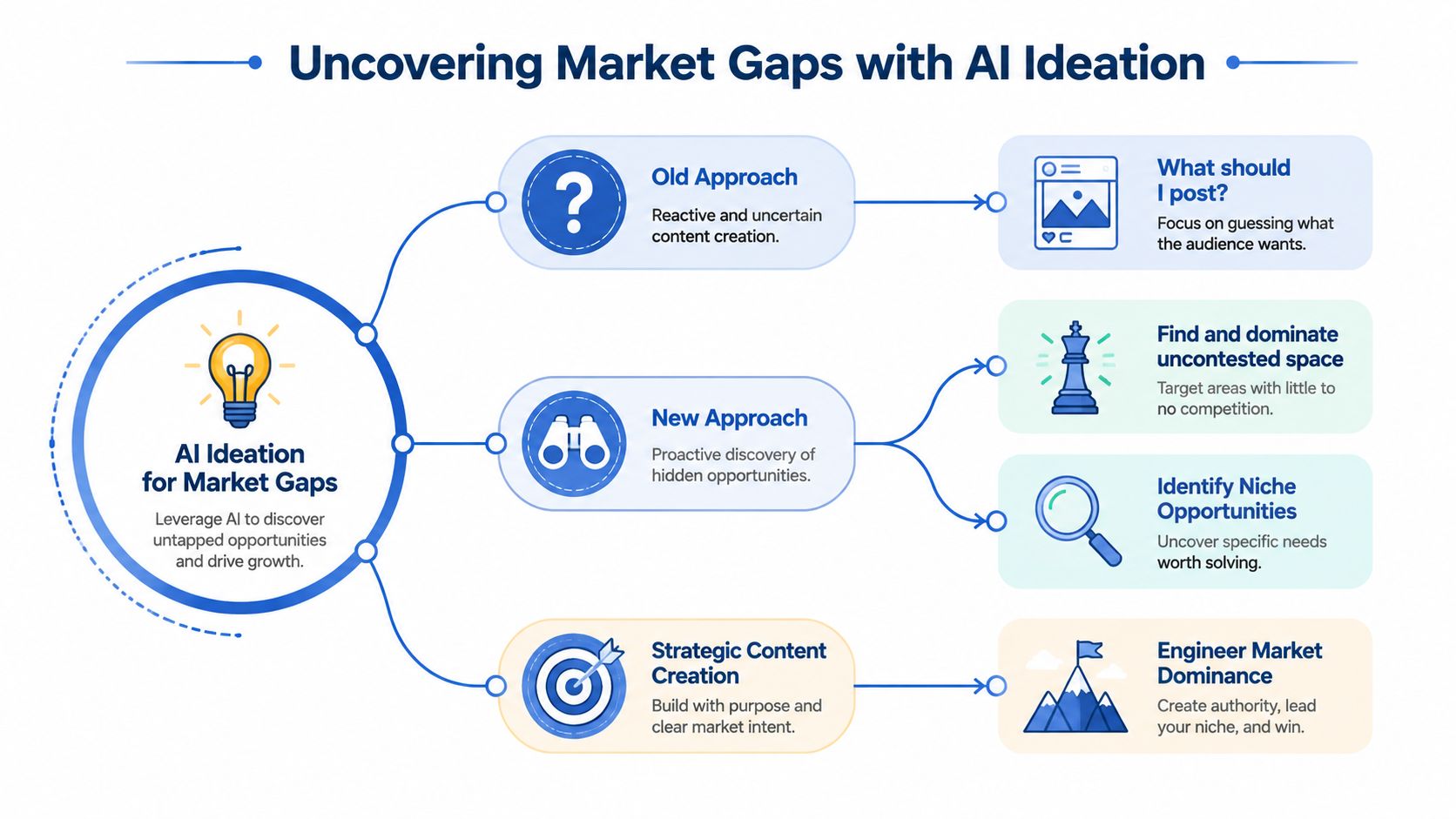
AI can help, but only if you use it like a market analyst, not a copy intern.
Use AI to find gaps buyers will pay attention to
I use AI brainstorming to surface gaps between what the market says and what competitors keep repeating.
That difference is where conversion gains usually sit.
Start with evidence, not opinions. Pull together inputs that show buyer demand, hesitation, and disappointment in plain language:
- Customer reviews from your category and nearby categories
- Reddit threads and forum posts where prospects describe problems in their own words
- Competitor landing pages and ad libraries
- Sales call transcripts if your team has them
- Support tickets if churn, onboarding, or retention affect growth
Then give the model a strict job. Keep it diagnostic. Keep it commercial. Use a prompt like this:
“Analyze the attached customer reviews, competitor messaging, and forum discussions. Identify repeated pains, unmet needs, emotional language patterns, and buying objections. Rank themes by frequency and likely commercial importance. Compare those findings against competitor claims. Then identify messaging gaps where buyer demand appears under-addressed and suggest which gaps are most likely to improve conversion.”
That last clause matters. You are asking for ranked opportunities that can change buyer action, which is more than a list of content ideas.
Turn ideation into an operating system
The strongest marketing teams I work with run this as a repeatable process, month after month.
My recommendation is simple. Create a monthly gap review. Feed in a fresh batch of reviews, call notes, lost-deal reasons, and competitor pages. Run the same prompt structure each time. Compare the outputs against active funnel metrics. That gives you a working system for spotting new angles before the market gets crowded.
This is how prompt work becomes operational. It starts informing positioning, CRO testing, creative briefs, and campaign planning with the same source material.
If you want that process tied more tightly to performance data, this guide on using AI to measure marketing effectiveness is the right next layer.
Rank gaps by revenue potential
A long list of “insights” has no value on its own. I care about whether a gap can improve a metric that already matters to the business.
Use a simple ranking table like this:
| Gap type | What to look for | Why it matters |
|---|---|---|
| Pain mismatch | Buyers repeat a frustration competitors barely mention | Often leads to stronger message-market fit and higher response rates |
| Proof gap | Competitors make claims without concrete support | Creates room for trust-driven positioning and stronger conversion pages |
| Use case neglect | A segment or scenario is barely addressed | Supports vertical campaigns, new landing pages, and tighter targeting |
| Objection blind spot | Buyers hesitate for reasons no one answers well | Improves ads, email sequences, sales enablement, and close rates |
I've learned to ignore novelty. Original ideas do not pay the bills. Angles that reduce friction do.
If a gap cannot plausibly improve click-through rate, conversion rate, lead quality, demo completion, or sales velocity, drop it. It may be interesting. It is not useful.
The only ideation worth keeping is ideation you can test against revenue.
Once AI flags a gap, put it into market fast. Build a headline variant. Rewrite the offer stack. Create a paid ad set around the objection. Add proof where competitors stay vague. Then watch what happens in the numbers. That is how you separate real market gaps from internal excitement.
How to Test and Measure Prompt Performance
At this point, prompt engineering for marketing stops being interesting and starts being valuable.
A prompt is good when it improves a metric that matters, whatever your team thinks of the output. If it doesn't do that, archive it.
Build a prompt scorecard tied to KPIs
A major underserved angle is measurement and governance, not prompt writing itself. Most coverage spends time on prompting techniques and very little on whether prompts improve marketing outcomes versus producing nicer copy. That gap matters because AI adoption is rising fastest in functions like marketing and sales, which makes repeatable measurement more important than prompt novelty, as noted in Coursera's marketing prompt engineering overview.
That matches what I see in the field. Teams have prompt libraries, but no scoring model. They can tell you which prompt sounds sharper. They can't tell you which one produced better lead quality.
I recommend a simple operating rhythm.
Version every prompt.
Prompt A and Prompt B should differ intentionally. Change one meaningful variable at a time, such as audience framing, role assignment, or threshold definition.
Map each prompt to one KPI.
For ads, that might be CTR or CPA. For landing pages, conversion rate. For email subject lines, open rate. For qualification flows, lead quality.
Track context along with the outcome.
Record channel, audience segment, offer, campaign date range, and human edits. Without that, your learnings won't transfer.
Kill weak prompts fast.
Keep a prompt only when it consistently helps produce assets that perform.
If you want a practical model for connecting AI outputs to business metrics, this guide on using AI to measure marketing effectiveness is one useful reference point.
Here's a lean scorecard structure:
| Prompt ID | Use case | Variable tested | KPI | Human edits needed | Keep, revise, or kill |
|---|---|---|---|---|---|
| P-01 | Meta ad copy | Pain-led vs benefit-led framing | CTR or CPA | Low, medium, high | Decision |
| P-02 | Landing page headlines | Outcome-led vs objection-led angle | Conversion rate | Low, medium, high | Decision |
| P-03 | Welcome sequence | Trust-first vs CTA-first structure | Open rate or activation | Low, medium, high | Decision |
Move from single prompts to systems
Once you start measuring prompts, a bigger opportunity appears. You stop thinking in isolated prompt moments and start building chains.
One prompt generates campaign hypotheses from performance data. Another rewrites underperforming ads against a known winning angle. A third drafts test variants in a required format for your ad platform or CMS. At that point, you're building a repeatable decision system.
That's the foundation of a bionic marketing operation. Human judgment stays where it should, in strategy, prioritization, and approval. AI handles the repetitive transformation work that slows your team down.
If you can't measure a prompt against a business outcome, it's still an experiment.
From Prompts to Automated Marketing Agents
Manual prompting has a ceiling. Your team runs out of time, attention, and patience.
The next step is simple. Take the prompts that have already proved useful and wire them into workflows that run without constant human babysitting.
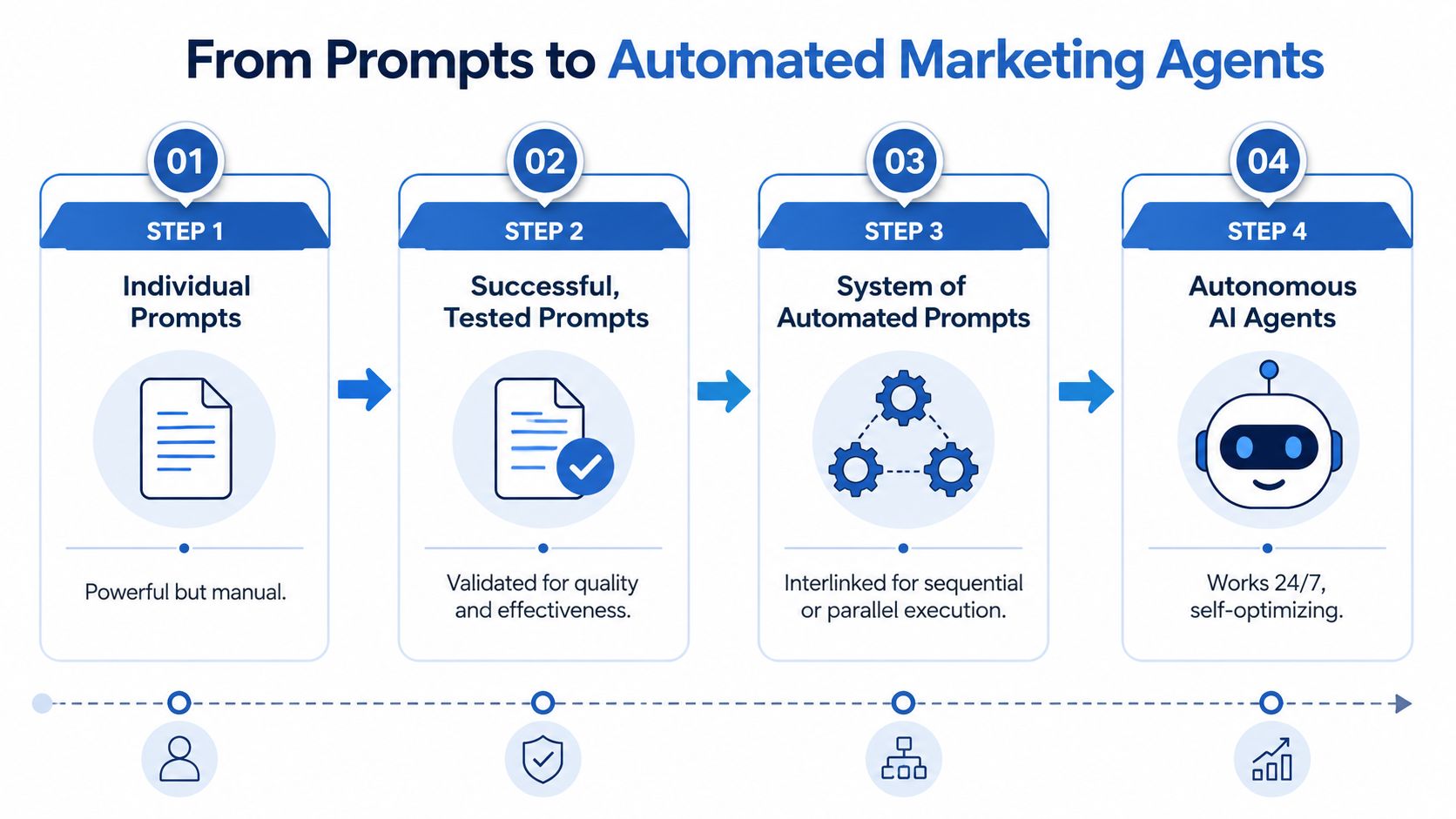
Marketing-native AI can eliminate 90% of prompt engineering overhead by using pre-integrated, normalized data with built-in metric context, and one key pattern behind that shift is the move toward structured, repeatable prompt frameworks such as TRIM, which stands for task, relevant context, intent, and measurable criteria, as described in Skai's guide to prompt engineering for marketers.
Two integration patterns that matter
I see two patterns work again and again.
The assembly line
This is the practical starting point. Use Zapier, Make, n8n, or native workflow tooling to chain together tested prompt steps.
Example:
- A new customer testimonial lands in Airtable or Notion
- Prompt one turns it into social proof snippets
- Prompt two creates three LinkedIn hooks
- Prompt three converts the strongest hook into an email intro
- A human reviews and approves
It's unglamorous and effective.
The supervisor agent
This is more advanced and far more powerful. The agent pulls data from multiple systems, reasons across inputs, and produces a recommendation set.
Example:
- Pull weekly campaign performance from your reporting layer
- Compare current period against prior period
- Flag underperforming campaigns against predefined thresholds
- Generate likely causes
- Draft optimization suggestions by channel and objective
- Route findings to Slack, Notion, or your PM tool
At that point, the advantage is strategic as well as operational.
If you want to explore what this looks like in a dedicated implementation context, this primer on AI agents for marketing covers the operating model in more depth.
Why this becomes a competitive moat
Most competitors will stop at content generation. They'll use AI to produce more posts, more ads, more summaries, more noise.
You should use it to compress the gap between signal, decision, and execution.
That's the payoff of prompt engineering for marketing: faster learning loops, better message-market fit, tighter campaign analysis, and cleaner handoffs between strategy and execution. And eventually, an operating system your competitors can't copy just by opening the same chatbot.
I've been doing this long enough to tell you where the edge sits. It sits in the system wrapped around the model.
Build prompts like assets. Test them like campaigns. Chain them like workflows. Then promote the winners into agents.
That's how AI stops being a novelty in your marketing stack and starts acting as a key advantage.