
Your competitors do not need better prompts. They need better operating systems for growth. If you pick the wrong AI agent framework, you will burn budget on prototypes that never reach production while a faster rival builds agent workflows into sales, service, research, and execution.
Most articles on the best AI agent frameworks miss the point. They rank tools like a developer shopping for features. You should judge them by a harder standard: which one helps your business ship revenue-producing agents faster, control risk, scale as you grow, and create an advantage competitors cannot copy in a quarter.
I'm Samuel Woods. I've worked with ML since 2016 and generative AI since 2019. From that vantage point, the opportunity is clear. AI agents are becoming digital workers that qualify leads, support customers, generate assets, monitor markets, and trigger actions across your systems 24/7.
That changes economics.
Companies that deploy agents well gain speed, coverage, lower operating drag, and better decision cycles. Those gains show up in pipeline, margin, retention, and market share. If you want the practical playbook behind that shift, start with this guide on how to build AI agents for real business use cases.
I'm not scoring these frameworks as a hobby project or a coding exercise. I'm assessing them the way I do in my work as a Fractional Chief AI Officer. Which framework gives you the fastest path to production, the strongest fit for your stack, and the best chance to build a moat around data, workflow, distribution, or execution?
That is the only question that matters.
Table of Contents
- 1. LangGraph (by LangChain)
- 2. Microsoft Agent Framework
- 3. AG2 (AutoGen 2)
- 4. CrewAI
- 5. LlamaIndex Agents
- 6. Hugging Face smolagents
- 7. PydanticAI
- 8. OpenAI Agents SDK
- 9. Google Agent Development Kit (ADK) & Vertex AI Agent Builder/Engine
- 10. Agents for Amazon Bedrock (AgentCore)
- Top 10 AI Agent Frameworks, Feature Comparison
- The Tool Is Not the Strategy
1. LangGraph (by LangChain)
Plenty of companies waste time comparing agent frameworks like developer toys. That misses the core question. Which one gives you the best shot at shipping revenue-producing automation that holds up under scale, compliance pressure, and operational messiness? For most businesses, LangGraph is the best starting point.
I put it first because it handles the part that kills agent projects in practice: control. LangGraph gives you stateful, graph-based orchestration for retries, branching, persistence, human approval, and long-running execution. If your agent touches customer support, sales operations, research workflows, or internal decision systems, that control protects margin and brand reputation.
Cloudraft's review of top AI agent frameworks says LangGraph has reached 43% organizational adoption among enterprise users, with more than 132,000 LLM applications built on its ecosystem. The same analysis notes that Klarna's LangGraph-based support bot served 85 million active users and cut resolution time by 80% (Cloudraft). That is the standard you should care about. Faster service, lower support cost, and more capacity without adding headcount.
Why I put LangGraph first
LangGraph benefits from the wider LangChain ecosystem, which supports more than 1,000 external tools and APIs, according to OSS Insight's AI agent framework collection. That matters because speed to integration affects speed to revenue. A framework that plugs into your stack faster gets pilots into production sooner and shortens the gap between AI ambition and actual business impact.
My recommendation is simple.
Use LangGraph when the agent will touch core workflows, multiple systems, or any process where a failure creates customer pain, compliance risk, or lost revenue.
It is not the easiest framework to learn. Graph-based design is heavier than simple prompt chains, and teams often pair it with LangSmith to get stronger tracing and observability. That added complexity is usually worth it. You are buying operational discipline, not convenience, and operational discipline is what turns an agent from a flashy experiment into an asset competitors struggle to match.
If you are shaping the business logic behind your own deployment, this guide on how to build AI agents for real business use cases will help you structure the system around outcomes rather than code.
You can explore the platform at LangGraph by LangChain.
2. Microsoft Agent Framework
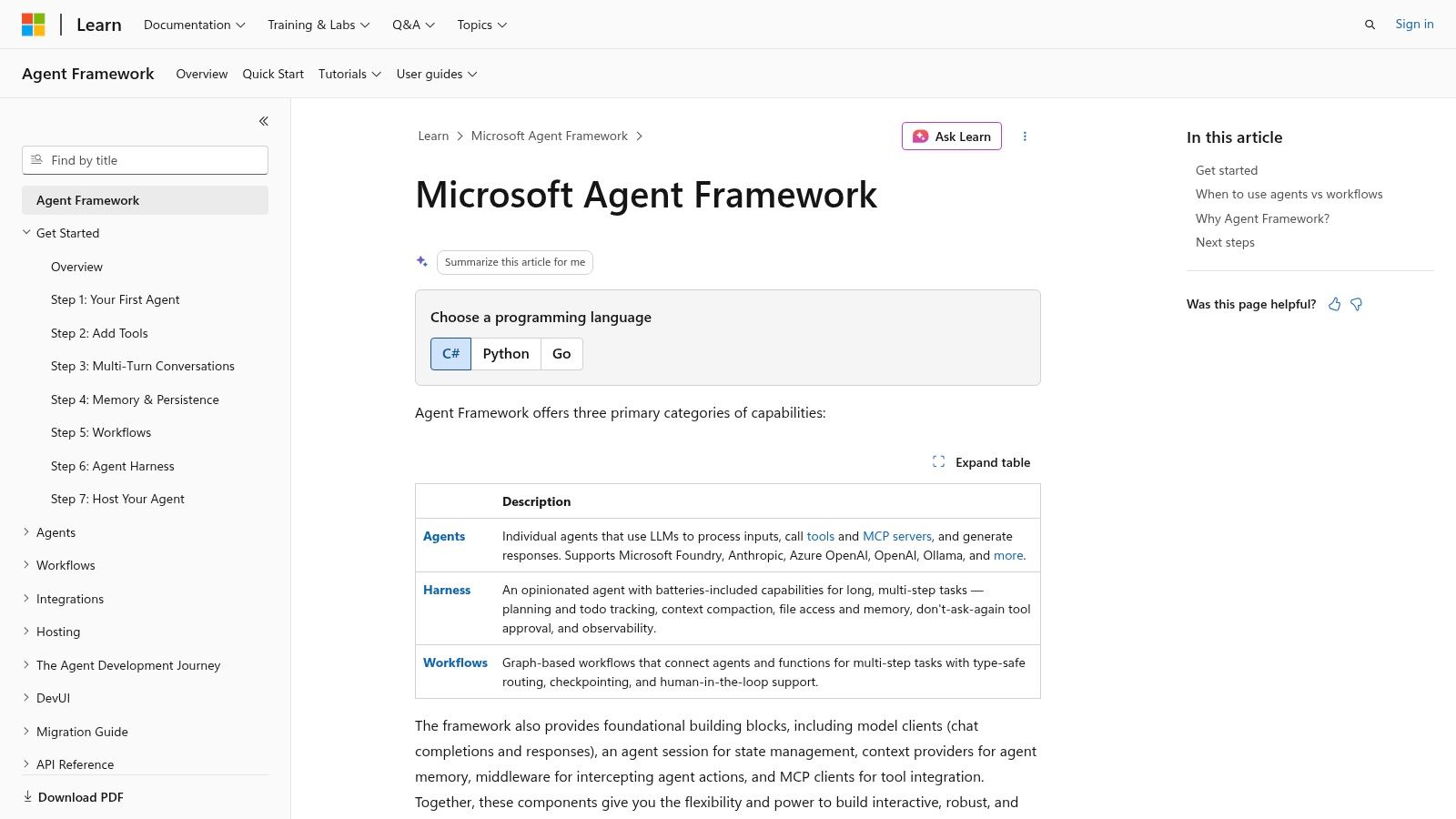
Microsoft Agent Framework is the obvious choice for companies already committed to Azure, Microsoft 365, Teams, Dynamics, and Copilot. Do not waste time forcing a cross-platform strategy if your data, identity, security, and workflow layer already live inside Microsoft. The fastest path to revenue is usually the one that builds on systems your team already trusts and your buyers already use.
That is the value here. Microsoft gives businesses already on its stack a way to turn existing infrastructure into customer-facing speed, lower service cost, and tighter operational control. If your moat depends on proprietary internal knowledge, sales process discipline, or regulated workflow execution, this framework gives you a practical way to put agents on top of assets you already own.
Best fit for Microsoft-heavy businesses
I recommend Microsoft Agent Framework for businesses that want agents in production without switching platforms. It fits best when the business case is clear: sales copilots connected to Dynamics, service agents working inside Teams, operations workflows tied to Microsoft identity and permissions, and compliance-sensitive use cases that need centralized control.
Governance is a business issue as much as a technical one. Large enterprises now expect agent systems to fit existing risk, audit, and policy structures. Microsoft's advantage is simple. It can slot agents into the security, admin, and procurement model many enterprises already have in place. That shortens approvals, speeds deployment, and reduces the odds that a pilot dies in security review.
If you are designing coordinated agent workflows across different parts of the business, this guide to multi-agent systems for small business is a useful reference for thinking through orchestration around business outcomes instead of isolated prompts.
Choose Microsoft Agent Framework when your goal is to turn Microsoft footprint into market advantage, not to chase framework novelty.
There is a tradeoff. Outside the Microsoft stack, the case gets weaker fast. You can still use the framework, but the strategic upside drops once you leave the environment where Microsoft controls identity, tooling, governance, and deployment flow. At that point, you are paying for ecosystem alignment without getting the full benefit.
For Microsoft-centric firms, though, this is one of the strongest bets in the category. It helps you move from scattered AI experiments to an integrated operating layer that sales, support, and operations can use.
You can review it at Microsoft Agent Framework overview.
3. AG2 (AutoGen 2)
AG2 is for teams that want flexible multi-agent conversations without being boxed into a rigid abstraction too early. If you like the old AutoGen mental model of specialized agents handing work back and forth, AG2 keeps that spirit alive.
That still makes it useful for research, content operations, and software-style workflows where one agent acts like a planner, another like an executor, and another like a reviewer. For some businesses, that role-splitting creates faster internal throughput because each agent has a narrower job and less prompt confusion.
Where AG2 still makes sense
I'd use AG2 when the team needs room to experiment with multi-agent design patterns before settling on a more opinionated production architecture. It's good for prototyping agent teamwork, especially when your developers want low-level control over handoffs and conversational flows.
That said, I wouldn't put AG2 at the center of a long-term roadmap without checking maintenance direction carefully. The Microsoft ecosystem has clearly shifted toward its newer consolidated framework, so you need confidence that your chosen path won't become technical debt.
AG2 is strong for learning, experimenting, and iterating on agent collaboration patterns. It's weaker as a default bet if you want a stable long-horizon platform decision.
A lot of small and mid-sized firms get seduced by multi-agent setups too early. That's a mistake. If your system uses fewer than 10 tools, needs less than 50K tokens of context, and runs sequential tasks, stick with a single-agent design, based on Sid Saladi's architecture rule of thumb for agent frameworks. Multi-agent complexity should solve an actual bottleneck, not satisfy curiosity.
If you're thinking about specialized agent teams for leaner organizations, I've written about multi-agent systems for small business.
You can explore the framework at AG2.
4. CrewAI
CrewAI earns attention for one reason. It gets multi-agent workflows into production fast enough for the business to learn before the market moves.
That matters more than elegance. If your goal is to launch a revenue-producing content operation, research pipeline, or internal workflow assistant in weeks instead of quarters, CrewAI is one of the shortest paths. Its role-based model is easy for non-developers to understand. You assign responsibilities like researcher, analyst, writer, or reviewer, connect tools to each role, and get a working system without designing every orchestration detail from scratch.
Chatbot.com's review of AI agent frameworks points to CrewAI's appeal for rapid setup and broad developer adoption. That tracks with what I see in the field. Teams choose CrewAI when they need proof of value fast, not when they want to spend months perfecting control flow.
Best for fast commercial validation
CrewAI fits businesses that already know the workflow and want to automate labor around it. Marketing teams use it to build research and content crews. Sales organizations use it for account research and outbound preparation. Operations teams use it for repeatable internal tasks where a sequence of specialist roles beats one overloaded generalist agent.
The business case is straightforward. Faster deployment means faster feedback on whether the workflow cuts cost, increases output, or creates a better customer experience. That speed can matter more than architectural purity, especially in markets where being first to operationalize AI creates pricing power, share gains, and a data advantage competitors struggle to match.
CrewAI is not the framework I would pick for every high-stakes system. If you are automating regulated decisions, managing long-running workflows with heavy state, or dealing with strict audit requirements, choose a framework built for tighter control and clearer execution guarantees.
Use CrewAI when speed-to-revenue is the priority.
- Use CrewAI for content operations, market research pipelines, sales support workflows, internal copilots, and fast pilot programs tied to measurable business outcomes.
- Avoid CrewAI as your first choice for compliance-heavy processes, failure-sensitive state machines, or systems where deterministic branching and audit trails matter more than launch speed.
If you want examples of where specialized agent teams create business value, review these AI agent use cases for revenue and operations.
You can check the platform at CrewAI.
5. LlamaIndex Agents
LlamaIndex earns its place when your edge comes from proprietary information, not orchestration theater. If your company wins by turning documents, reports, call notes, PDFs, repositories, and structured records into faster decisions, this framework deserves a serious look.
That matters more than many teams admit.
A lot of agent projects stall because the model is fine, but the business context is weak. The agent cannot find the right contract clause, product spec, pricing history, or research memo fast enough to produce work that you and your team can trust. LlamaIndex addresses that bottleneck well. It is built for ingestion, indexing, retrieval, parsing, and connecting agents to the information that drives revenue.
I recommend it for market intelligence systems, proposal and RFP generation, internal research copilots, analytics-backed content workflows, and competitor monitoring. In those cases, better context quality usually produces better output quality, faster cycle times, and stronger commercial performance.
Best for businesses turning proprietary data into revenue
If you are trying to build a moat, start here. Your moat is rarely the agent shell itself. Your moat is the speed and accuracy with which your systems can use proprietary context to answer questions, generate assets, and support decisions competitors cannot match.
LlamaIndex also works well in a hybrid stack. That is one of its strongest business advantages. You can use it as the data and retrieval layer while another framework handles complex orchestration, governance, or stateful workflows. That gives you more control over where you invest engineering time and helps you avoid overbuilding a single framework into jobs it does not handle best.
The limitation is clear. LlamaIndex is not my first pick for complex multi-agent coordination or long-running process control. If your main problem is branching logic, handoffs across many agents, or strict execution oversight, choose an orchestration-first framework and use LlamaIndex as the knowledge layer inside it.
Use LlamaIndex when better access to internal knowledge will improve win rates, response speed, or decision quality.
You can explore it at LlamaIndex.
6. Hugging Face smolagents
Most companies do not need a sprawling agent stack to start winning. They need a fast path from idea to working automation that saves labor, speeds decisions, or creates a new revenue motion. That is where smolagents earns its place.
Hugging Face built smolagents for teams that want lightweight agents with minimal overhead. I recommend it when the business goal is simple: ship targeted automations fast, prove economic value, then decide what deserves heavier orchestration later. That makes it a strong fit for price monitoring, lead enrichment, market research sweeps, support triage, and internal tools that remove repetitive work from high-cost teams.
Best for speed-to-value, not control-heavy scale
smolagents is a smart choice when your moat comes from execution speed. If your competitors are still debating architecture, your team can already be testing agents that gather data, call tools, and complete narrow workflows tied to pipeline growth or operating margin.
That business posture matters. A compact framework lowers the cost of experimentation. It lets a lean team launch five useful automations instead of spending a quarter building one oversized platform no one fully uses.
The tradeoff is obvious. smolagents is not the framework I would choose for long-running, stateful operations with strict approvals, deep audit requirements, or enterprise-wide governance. If your agent program touches regulated workflows or complex cross-functional handoffs, you will need to build more of the control plane yourself.
That makes smolagents focused, and focus is often what creates early market advantage.
- The best use is compact internal tools, revenue-adjacent experiments, open-source model workflows, and task-specific automations.
- A bad use is enterprise-grade orchestration with heavy compliance, persistent multi-step process control, and complex approval chains.
My advice is straightforward. Use smolagents when speed matters more than architecture purity and when each agent has a narrow job with a clear commercial outcome. If a small team can deploy agents that cut research time, clean CRM data faster, or spot pricing changes before competitors do, that creates real advantage. Revenue follows teams that ship.
You can review the docs at Hugging Face smolagents.
7. PydanticAI
PydanticAI is for businesses that are tired of flaky outputs and “close enough” tool calls. If your team already builds production Python services with FastAPI and Pydantic, this framework feels natural because it treats agents more like reliable software components and less like magical assistants.
That matters when agents feed dashboards, update records, classify inbound requests, or trigger operational workflows. Structure wins money when bad output creates rework.
Where structure beats cleverness
I recommend PydanticAI when you need type safety, schema validation, and predictable output contracts. Those things sound boring until an agent starts writing broken payloads into systems that affect customers, finance, or reporting. Then they become business-critical.
There's a larger lesson here. Most content in this category overweights prototyping and underweights the production governance gap. Rasa notes that 70% of enterprise AI initiatives fail due to weak observability, auditability, and deterministic logic controls in its analysis of enterprise framework selection. That doesn't mean every company should choose the same stack. It does mean you should stop mistaking a working demo for production readiness.
If a bad output creates manual cleanup, PydanticAI starts to look a lot more strategic.
The limitation is orchestration depth. For very complex multi-agent graphs, LangGraph still gives you more prebuilt patterns and state machinery. PydanticAI asks your team to compose more of that architecture itself. If your developers are strong and your workflows revolve around structured services, that's a reasonable trade.
You can explore it at PydanticAI overview.
8. OpenAI Agents SDK
If your company has already standardized on OpenAI models, the OpenAI Agents SDK is the simplest path to first-party tooling, tracing, search, file handling, and server-side tool loops. You get a cleaner route into OpenAI-native agent patterns without relying on third-party wrappers for everything.
That can speed execution for teams that care more about shipping than portability. Sometimes that's the right call.
Strong choice if OpenAI is already your standard
I'd use this when the business wants to build quickly around OpenAI's ecosystem and is comfortable accepting some provider dependence in exchange for velocity. Product teams, support automations, and internal knowledge tools can often move faster this way.
The risk is lock-in. If your margins or compliance model later push you toward a multi-provider stack, unwinding that dependence can get painful. You also need to watch migration guidance carefully as OpenAI evolves its platform.
There's a financial angle too. If your agent footprint grows and OpenAI usage expands across teams, it's smart to monitor and reduce OpenAI API spend before cost creep eats the efficiency gains your agents created.
OpenAI Agents SDK is a speed play. It's not the framework I'd pick if provider flexibility is part of your strategic moat.
That said, for organizations moving fast with OpenAI already embedded across the stack, it can be one of the best AI agent frameworks because it removes friction between idea and deployment.
You can start with OpenAI Developers.
9. Google Agent Development Kit (ADK) & Vertex AI Agent Builder/Engine
Google ADK plus Vertex AI Agent Builder or Engine is a market-share play for companies already built on Google Cloud. You use ADK to develop agents with more control in the open, then use Vertex to deploy, govern, and scale them inside the same operating environment. That matters because fragmented AI stacks slow execution, raise security review time, and delay revenue-producing launches.
I recommend this stack for businesses that want agents tied directly to the rest of the Google estate. Gemini, Vertex, data services, identity, and cloud operations fit together cleanly enough to reduce handoff friction between prototype and production. If your growth plan depends on getting AI into customer operations, service workflows, or internal decision systems fast, that operational fit is worth more than framework purity.
Best for GCP-first companies that want execution speed with enterprise control
I'd choose this framework for a business that wants to turn its existing GCP footprint into a defensible AI advantage before competitors do. If staying cloud-agnostic at all costs is the goal, pick something else.
That distinction matters.
A lot of teams treat agent frameworks like developer preferences. You should treat them like distribution and margin decisions. If your analytics, customer data, security controls, and ML operations already run on Google Cloud, ADK and Vertex help you ship against that foundation instead of rebuilding it elsewhere. You cut integration drag, shorten procurement cycles, and give security teams fewer reasons to stall deployment.
The trade-off is clear. Portability takes a hit. If your strategy depends on aggressive multi-cloud optionality for pricing advantage or regulatory posture, Google's stack will feel tighter than an open orchestration layer built for provider switching.
Governance is another reason this stack makes sense for larger organizations. Google is aligned with the enterprise shift toward stronger AI controls, policy management, and reviewability, which helps when legal, compliance, and procurement start shaping the buying decision. That does not create revenue by itself. It does keep high-value AI initiatives from dying in committee.
- Choose Google ADK and Vertex if your business is already committed to GCP, you want a direct path from development to managed deployment, and governance requirements will increase as agents spread across the company.
- Avoid it if cross-cloud portability is part of your moat, or you expect to switch infrastructure strategy often.
My verdict is simple. For GCP-first businesses, this stack helps convert cloud concentration into faster rollout, tighter control, and a better shot at scaling agents into an actual business advantage instead of another pilot.
You can explore it at Google Agent Development Kit.
10. Agents for Amazon Bedrock (AgentCore)
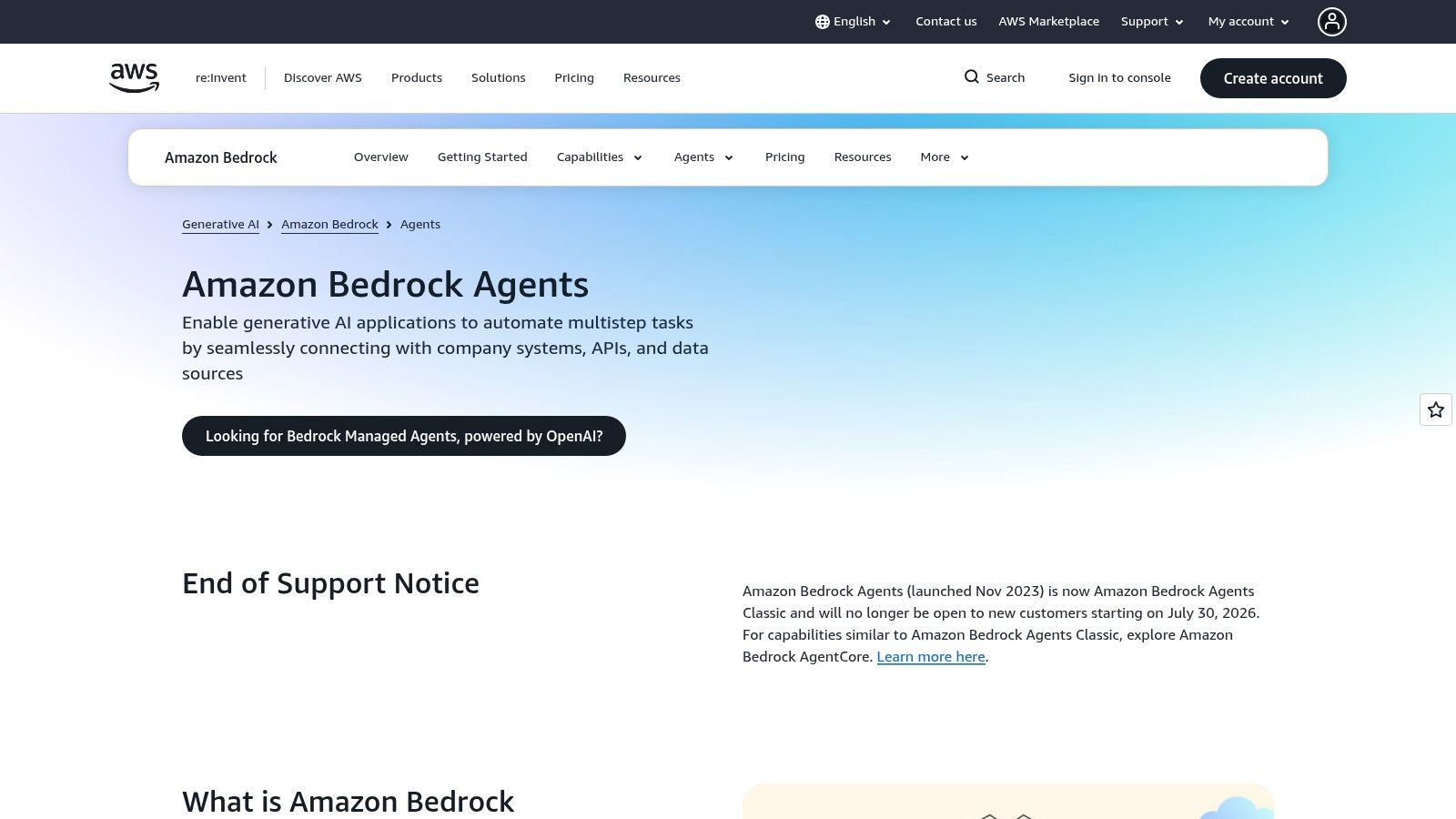
For AWS-first organizations, Amazon Bedrock's agent stack is the practical choice. You get governed tool use, managed deployment patterns, tracing guidance, and model choice across providers inside the AWS environment your team already knows.
That combination matters more than people admit. A framework that fits your existing cloud, identity, data, and security operations usually beats a theoretically better tool that creates a new operational island.
Best for AWS-first governance
I recommend Bedrock agents for businesses that need security posture, procurement familiarity, and strong infrastructure controls as much as they need agent features. It's well-suited to internal operations agents, support automations, and business workflows where governance and cloud alignment matter more than experimental flexibility.
There's also a portfolio advantage. Bedrock supports model choice across Anthropic, Meta, Mistral, and Amazon models, which is useful if you want more optionality than a single-model-vendor approach. That can protect negotiating power and reduce architecture dependence over time.
The trade-off is that AWS complexity doesn't disappear just because you're using managed services. Cost visibility can get messy across multiple services, and portability to other clouds still takes effort.
If your company already trusts AWS for core systems, Bedrock agents can get you to governed deployment faster than forcing an open-source stack into enterprise shape.
This is one of the best AI agent frameworks for businesses that care about controlled deployment and model optionality inside AWS, not for teams seeking the lightest possible developer experience.
You can review it at Agents for Amazon Bedrock.
Top 10 AI Agent Frameworks, Feature Comparison
| Framework / Provider | Core focus / Best for | Key features (brief) | Unique strengths | Trade-offs / Limitations | Ideal audience & pricing |
|---|---|---|---|---|---|
| LangGraph (LangChain) | Graph-based, stateful multi‑actor orchestration | Stateful graphs, checkpoints, Python SDK, persistence, LangSmith tracing | Strong reliability controls and observability; broad provider support | Steeper graph learning curve; some observability tied to paid LangSmith | Production automation teams; open‑source core, LangSmith paid features |
| Microsoft Agent Framework | Enterprise multi‑agent on Azure / M365 integration | Agent‑to‑agent, Azure Functions hooks, governance, migration guides | Enterprise support and deep Azure/M365 integration | Best experience on Azure; cloud/model costs apply | Enterprises on Azure; Azure pricing / paid services |
| AG2 (AutoGen 2) | Role‑specialized multi‑agent conversations and research workflows | Conversable role agents, tool calling, coder/reviewer patterns, OSS examples | Large AutoGen heritage and flexible experimentation | Roadmap/maintenance may shift toward Microsoft offerings | Researchers and content ops experimenting; community OSS |
| CrewAI | "Crews of agents" for marketing/content pipelines | Role/task abstractions, HITL, enterprise governance and marketplace | Fast prototyping with community; enterprise scaling options | OSS edition lacks full enterprise monitoring; enterprise is quote‑based | Marketing/content teams; OSS + paid enterprise plans |
| LlamaIndex Agents | Data‑centric agents for retrieval & document workflows | AgentRunner, rich connectors, LlamaParse, indexing tools | Best‑in‑class indexing/parsing and data connectors | Advanced managed features and scale can be paid | Market research and analytics teams; freemium + paid managed tiers |
| Hugging Face smolagents | Lightweight, code‑first agents for quick tasks | CodeAgent, tool‑agnostic integrations, many built‑in tools | Very fast to prototype; fully open source with clear docs | Not batteries‑included for long‑running stateful ops; observability DIY | Open‑source devs and prototypers; free OSS |
| PydanticAI | Type‑safe Python agents for production reliability | Typed tools, pydantic‑graph, provider‑agnostic, FastAPI friendly | Excellent developer ergonomics and schema validation | Fewer prebuilt complex orchestration patterns than graph frameworks | Python/FastAPI teams building reliable pipelines; OSS |
| OpenAI Agents SDK | First‑party agents tightly integrated with OpenAI features | Python/JS SDKs, tracing, server‑side tool loops, file/web search | Native OpenAI features, easy tracing and analytics | Vendor lock‑in risk; watch deprecations and costs | Teams standardizing on OpenAI; pay‑as‑you‑go OpenAI billing |
| Google ADK & Vertex AI Agent Builder | GCP‑native agent development and managed runtime | Multi‑lang SDKs, managed Vertex runtime, governance, codelabs | Deep Gemini/Vertex integration and GCP deploy patterns | Best for GCP customers; managed compute costs apply | Teams on GCP using Gemini/Vertex; GCP pricing |
| Agents for Amazon Bedrock (AgentCore) | AWS‑managed agents with enterprise governance | Multi‑agent collaboration, tracing, model choice, Bedrock guidance | Strong security/governance and model flexibility on AWS | AWS‑specific; costs span multiple services needing FinOps | AWS enterprises requiring governed deployments; AWS pricing |
The Tool Is Not the Strategy
You now have my vetted list of the best AI agent frameworks. Here's the blunt truth. Most companies will still get poor results even if they pick the right tool. The framework is rarely the cause. They treat framework selection like strategy.
It isn't.
Your framework is the foundation layer. It determines how much control, speed, observability, portability, and governance you get. That matters a lot. But it does not create your moat on its own. Your moat comes from the proprietary context your agents can access, the workflows they can execute, the decisions they can accelerate, and how tightly all of that maps to revenue, retention, margin, and execution speed.
That's why I push founders to think beyond demos. A founder shouldn't ask, “Which framework has the most features?” You should ask, “Which framework helps my company capture opportunities faster than competitors, with acceptable risk and operating cost?” Different answer. Better question.
LangGraph is my top recommendation when reliability and complex orchestration matter most. CrewAI is often the fastest path for role-based agent teams in marketing and content. Microsoft Agent Framework is the obvious choice for Azure-heavy businesses. LlamaIndex is the smart play when your edge comes from proprietary knowledge and retrieval. Bedrock and Vertex make sense when cloud alignment and governance are mandatory. PydanticAI is the quiet winner for teams that need structure and predictable outputs. smolagents is great when a narrow, useful internal agent beats a bloated architecture.
You also need to be honest about timing. Not every company needs multi-agent systems right now. If your workflow is still simple, your tool count is low, and the process is sequential, adding agent complexity too early just creates technical theater. A single reliable agent that saves money or closes more deals beats a fancy multi-agent stack nobody fully controls.
The businesses that win with agents over the next few years will be the ones that wire agents into lead research, outbound personalization, customer service resolution, pricing intelligence, internal knowledge access, reporting, and campaign execution. They'll learn faster, ship faster, and respond faster. Competitors will feel that difference in lost deals and slower growth long before they understand what changed.
That's the essential frame for evaluating the best AI agent frameworks. You're choosing the operating model behind a more bionic business, and the software is only one part of it.
I've spent years helping companies think this way through practical AI strategy, prompt engineering, context engineering, and agent system design. If you want that help inside your business, work with me. The pattern is consistent. The winners don't chase hype. They build systems that turn data into action faster than everyone else in their market.
Pick the framework that matches your business reality. Then build the workflows competitors can't catch.