
You're probably feeling this already. Your team is busy all day, yet competitors still seem to launch faster, respond faster, and learn faster. That gap usually comes down to system design, rarely talent.
I'm Samuel Woods. I've been working with ML since 2016 and Generative AI since 2019, and I can tell you this plainly. Founders who treat AI like a chatbot upgrade are going to lose to founders who treat it like an operating model. For multi agent systems for small business, the win is turning scattered work into repeatable, compounding execution.
The trap is obvious. The market is moving fast, but most companies still build agent projects badly. They start too big, wire too many moving parts together, and create expensive confusion instead of real value. A tighter playbook avoids that, and you can write one without a data science team.
Table of Contents
- Your Real Competitors Aren't Human Anymore
- Finding Your First Win with Agents
- Designing Your First Agent Crew
- The Low-Code Playbook for Building and Integrating
- How Multi-Agent Systems Fail and How to Avoid It
- Your First Move
Your Real Competitors Aren't Human Anymore
Most founders think they're competing against another founder, another agency, or another local player. The real competition is businesses that have built faster decision loops.

That's why I take multi-agent systems seriously. They give a lean business a tireless layer of digital operators that gather information, sort signal from noise, and draft useful outputs while your competitors are still waiting for someone on staff to get to it.
Why this matters right now
The global multi-agent system market is projected to grow from USD 7.2 billion in 2024 to USD 375.4 billion by 2034, which signals a foundational shift, not a passing trend, according to Nevermined's MAS market analysis. I read that as a strategic warning for small businesses. If you adopt early and adopt well, you build an execution advantage that compounds while slower competitors stay stuck in manual workflows.
You and I don't need to romanticize this. A good agent crew behaves like a small team of hyper-efficient junior operators. One gathers competitor updates. One analyzes patterns. One turns the findings into a clean brief you can use today.
A practical rule: if an activity happens every week, touches multiple tools, and ends in a decision, it's a candidate for agents.
AI isn't the advantage anymore
Using AI is no longer impressive. Plenty of companies already use it somewhere. What matters is whether your business can sense, decide, and act faster than the market around you.
Single-prompt tools help with isolated tasks. Multi agent systems for small business help with workflows. That's the difference between asking one intern to “help with research” and hiring three people with narrow roles, clean handoffs, and defined outputs.
If you want a bigger strategic frame for this shift, I'd also look at agent-native company design. The true advantage lies in how your business is structured to make decisions at speed, far more than in one clever prompt.
What this enables against competitors
A lean team using agents can monitor market movement more consistently, respond to leads faster, and package internal knowledge better than a larger team running on ad hoc effort.
Your competitor may still have more headcount. But if your system spots pricing changes, customer objections, and demand signals before they do, you can steal attention and market share without matching their payroll.
That's the core point. Not automation for its own sake. Revenue protection. Better timing. Better decisions. More shots on goal.
Finding Your First Win with Agents
Most SMBs need one workflow that pays for itself long before any grand AI transformation.
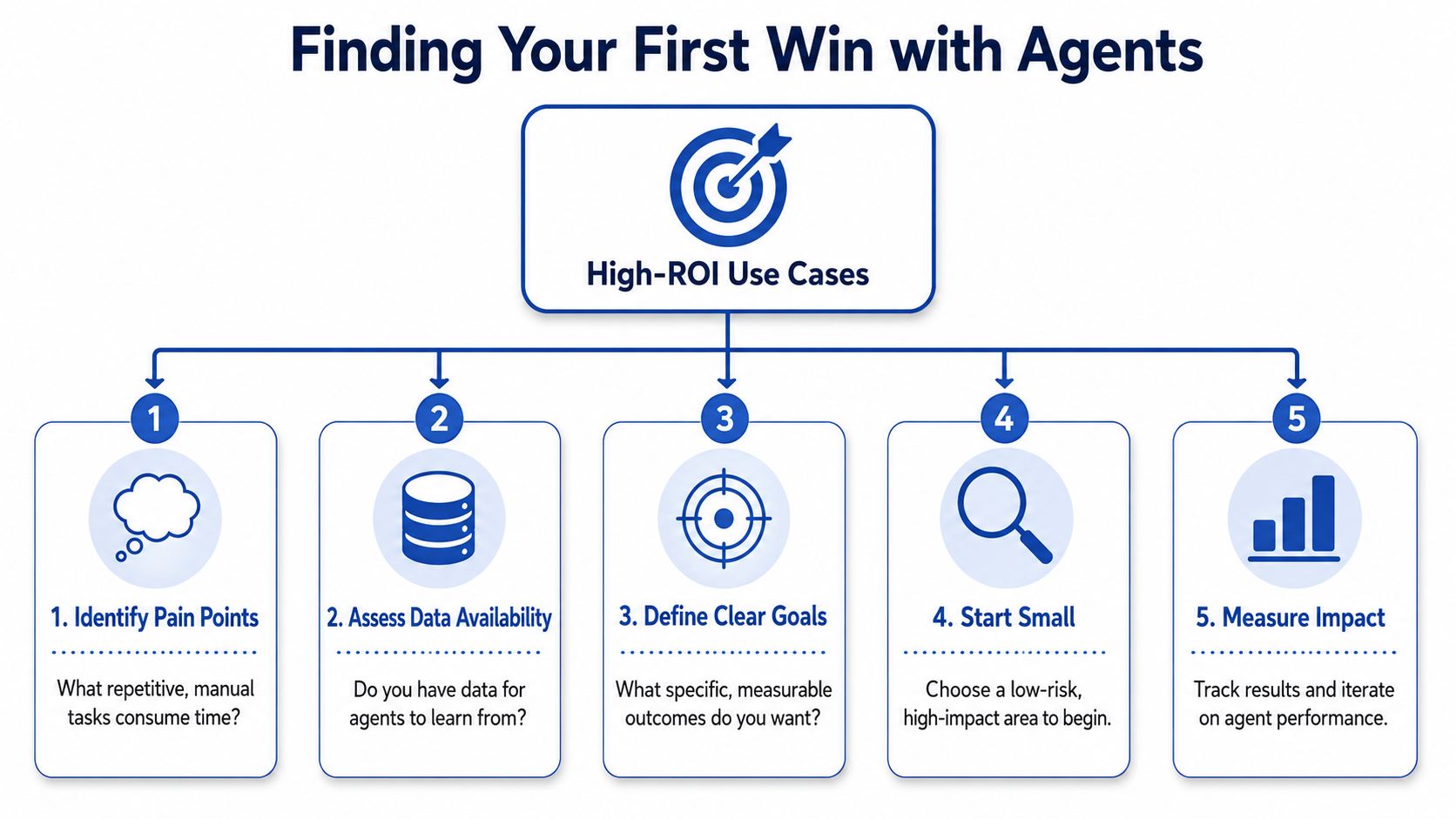
I see founders waste months chasing broad automation when the smarter move is narrower. Start with one painful process that repeats often, drains good people, and has a clear business outcome. That's where your first win lives.
Use pain-point mapping, not brainstorming
Don't start by asking, “Where can we use AI?” That question is too vague and it produces junk ideas.
Ask these instead:
- What task repeats every week? Think reporting, lead qualification, follow-up drafting, competitor monitoring, support triage.
- Where does work get stuck waiting on a person? Bottlenecks are where agents create speed.
- Which workflow affects revenue or cost directly? Prioritize what influences pipeline, retention, or operating expense.
- Do you already have usable inputs? CRM data, emails, call notes, support logs, product docs, spreadsheets.
- Can success be judged quickly? If you can't tell whether the output is useful, don't automate it yet.
This is how I'd approach multi agent systems for small business when the goal is immediate ROI. I'd rank workflows by pain, frequency, and commercial impact. Then I'd ignore everything except the top one.
Three strong first-use cases
The best starter workflows usually look boring. That's a feature, not a flaw.
- Competitive intelligence reporting, where agents gather updates from competitor websites, news, customer reviews, and your own notes, then produce a weekly summary you can act on.
- Lead nurturing support, where one agent reviews CRM activity, another drafts segmented follow-ups, and a final agent checks for tone, offer alignment, and missing context.
- Customer follow-up after service or purchase, where agents collect transaction context, identify likely concerns, and draft personalized post-sale communication for approval.
These use cases need structure. No research lab required.
The right first agent workflow usually sits in plain sight. It's the task you or your team complain about, delay, or perform inconsistently.
Why narrow scope wins
Companies that implement MAS around a specific use case report 25 to 40 percent faster manual processes, 50 to 70 percent quicker decision-making, 15 to 25 percent revenue increases, and positive ROI within 12 to 18 months, based on Ultra Web Labs' small business marketing automation analysis.
Those results come from disciplined focus on one use case.
That's also why I'd recommend reading how to deploy AI agents in a small team. Lean teams win when they reduce moving parts, not when they copy enterprise architecture.
A simple filter for your first pilot
Use this quick decision screen before you build anything:
| Workflow | Good first pilot | Bad first pilot |
|---|---|---|
| Weekly competitor brief | Clear output, easy review | No issue |
| Lead follow-up drafting | Revenue-adjacent, human approval possible | No issue |
| Support triage summaries | Repetitive, measurable | No issue |
| Full customer service automation | Too broad, higher risk | Yes |
| End-to-end finance ops | Sensitive, error costs high | Yes |
The founder mistake is trying to prove AI can run the company. Don't do that. Prove it can remove one bottleneck and improve one business metric. Then expand.
Designing Your First Agent Crew
Your first crew should be small enough to understand in one sitting. If you need a flowchart that looks like a subway map, you've already gone too far.
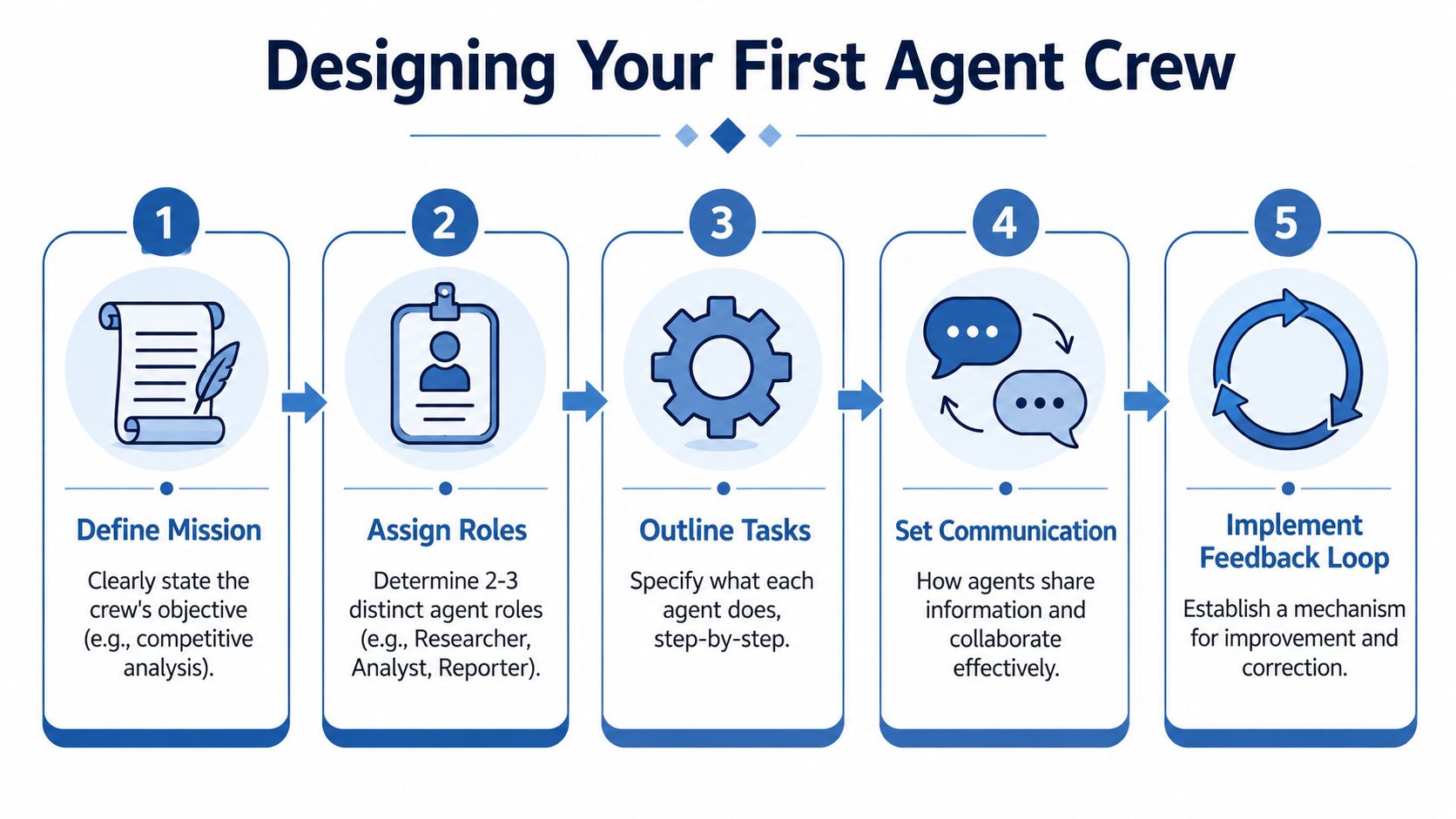
For small businesses, a 2- or 3-agent workflow is the optimal starting point, and a competitive intelligence process is one of the cleanest examples, as outlined in Airtable's guide to multi-agent systems.
The competitive intelligence crew
I like this example because it maps directly to real business value. Better market awareness helps you position offers, adjust messaging, spot threats, and move before slower competitors do.
Here's the crew:
| Agent | Job | Input | Output | Success metric |
|---|---|---|---|---|
| Scout | Collect competitor and market signals | Websites, news, reviews, notes | Structured findings | Relevant items only |
| Analyst | Identify patterns and implications | Scout output | Insights and priorities | Actionable conclusions |
| Briefing agent | Draft founder-ready report | Analyst output | Weekly brief | No editing required |
That final metric matters. If the report still needs heavy rewriting, your system isn't done.
Role separation is where the value comes from
Most founders build one overloaded “do everything” agent. That usually fails because the instructions become messy, context gets bloated, and outputs lose consistency.
Split the work the same way you'd split human labor.
- The scout is good at gathering and bad at strategy.
- The analyst is good at pattern recognition and doesn't need to draft polished communication.
- The briefing agent is good at packaging insight in your voice and format.
That separation reduces confusion and makes debugging easier. If the brief is weak, you can inspect whether the issue started in collection, analysis, or communication.
A useful implementation reference for this is Hyperleap AI advanced settings, especially if you're trying to think through handoffs and workflow logic without overengineering the whole thing.
Keep the handoffs simple
I want each agent to pass only what the next one needs. Not the full internet. Not your entire CRM. Just the relevant payload.
My rule is that every agent should have one job, one input shape, and one output shape.
That discipline keeps your crew usable by a non-technical team.
A short walkthrough helps here:
What not to build first
Don't start with agents that negotiate with each other across a dozen systems. Don't start with a fully autonomous sales engine. And don't let one agent write directly into important systems without review.
A first crew should be easy to inspect with your own eyes. If you can't explain each role in plain English, it's too complex for version one.
The Low-Code Playbook for Building and Integrating
Here's the good news. You can build your first agent system without a team of Python developers. What it takes is a practical stack, a narrow scope, and the discipline to stop adding features.
The most common SMB failure is ambition without boundaries. 65 percent of SMBs fail their first MAS pilot due to scope creep rather than technical failure, according to Teradata's analysis of multi-agent systems.
Your low-code stack
For most founders, I'd build version one with tools you can already learn:
- Airtable, for structured records, prompts, review queues, and lightweight memory.
- Zapier or Make, for orchestration between forms, CRMs, inboxes, spreadsheets, and messaging apps.
- Slack or email approvals, for human review before outputs go live.
- Your CRM, whether HubSpot, Pipedrive, Salesforce, or whatever you already use.
- An LLM layer, the model that powers reasoning, drafting, summarizing, or classification.
That's enough to build useful multi agent systems for small business without creating a maintenance nightmare.
Pick a workflow pattern before you pick tools
The wrong order is tool first, workflow second.
The right order looks like this:
- A trigger fires when a new event happens: new lead, support ticket, weekly schedule, competitor update.
- For collection, the first agent gathers the relevant inputs.
- For processing, the second agent turns raw input into a judgment, recommendation, or summary.
- For packaging, the third agent formats the output for a human or another system.
- For approval, a human checks it, especially in early versions.
- For logging, store input, output, and decision history somewhere you can inspect later.
That's a business system. Not a demo.
Choosing the right model family
What you need here is a business decision rather than a model popularity contest.
I won't quote token pricing or pretend there's a fixed universal answer, because actual costs and performance shift constantly. So use this comparison table qualitatively, then verify current pricing inside the vendors you're considering.
| Model Family | Best For | Cost (Per Million Tokens) | Key Trade-off |
|---|---|---|---|
| GPT-4o class | Strong reasoning, multimodal tasks, complex instructions | Varies by provider and plan | Strong capability, but may cost more than lighter models |
| Claude 3.5 Sonnet class | Drafting, analysis, long-context workflows | Varies by provider and plan | Often feels strong in writing and reasoning, but you still need testing in your workflow |
| Gemini class | Google ecosystem workflows, integrated enterprise environments | Varies by provider and plan | Convenient in some stacks, but onboarding and workflow fit matter more than brand name |
| Smaller fast models | Classification, routing, simple extraction | Usually lower than frontier models | Lower cost and speed can be great, but quality drops on nuanced tasks |
I'd usually test a stronger model in the analyst role and a cheaper or faster one in collection or formatting roles. That mix protects margin.
Integrate where value already exists
Don't create new data just because AI tools make it easy. Start with the systems your business already relies on.
A simple setup might look like this:
- HubSpot stores lead and deal context.
- Airtable holds competitor records and review status.
- Make runs the workflow on a weekly schedule.
- Claude, GPT, or Gemini handles analysis and drafting.
- Slack delivers the final draft to you, or whoever approves it.
That's enough to produce useful reports, follow-up drafts, or internal summaries.
If you want a strong operator's perspective on building reliable AI-assisted workflows, I like these expert insights from Iwo Szapar. You don't need to copy his exact setup. The point is that disciplined workflow design beats random experimentation every time.
Guardrails for lean teams
Skip the enterprise bureaucracy, but keep a few rules.
- Define one owner, the one person responsible for output quality.
- Limit system access so agents only touch the data they need.
- Set one success metric, such as time saved, approval rate, speed to response, or output quality.
- Review for a fixed period, and don't go fully autonomous on day one.
- Freeze the scope, with no “while we're at it” features.
I'd also keep this guide on how to build AI agents in your reference stack if you're assembling your first workflows and want a practical lens on implementation choices.
The founders who win here know where to stop, whatever their technical skill.
How Multi-Agent Systems Fail and How to Avoid It
A common reaction is to blame hallucinations when agent systems break. That's lazy thinking.
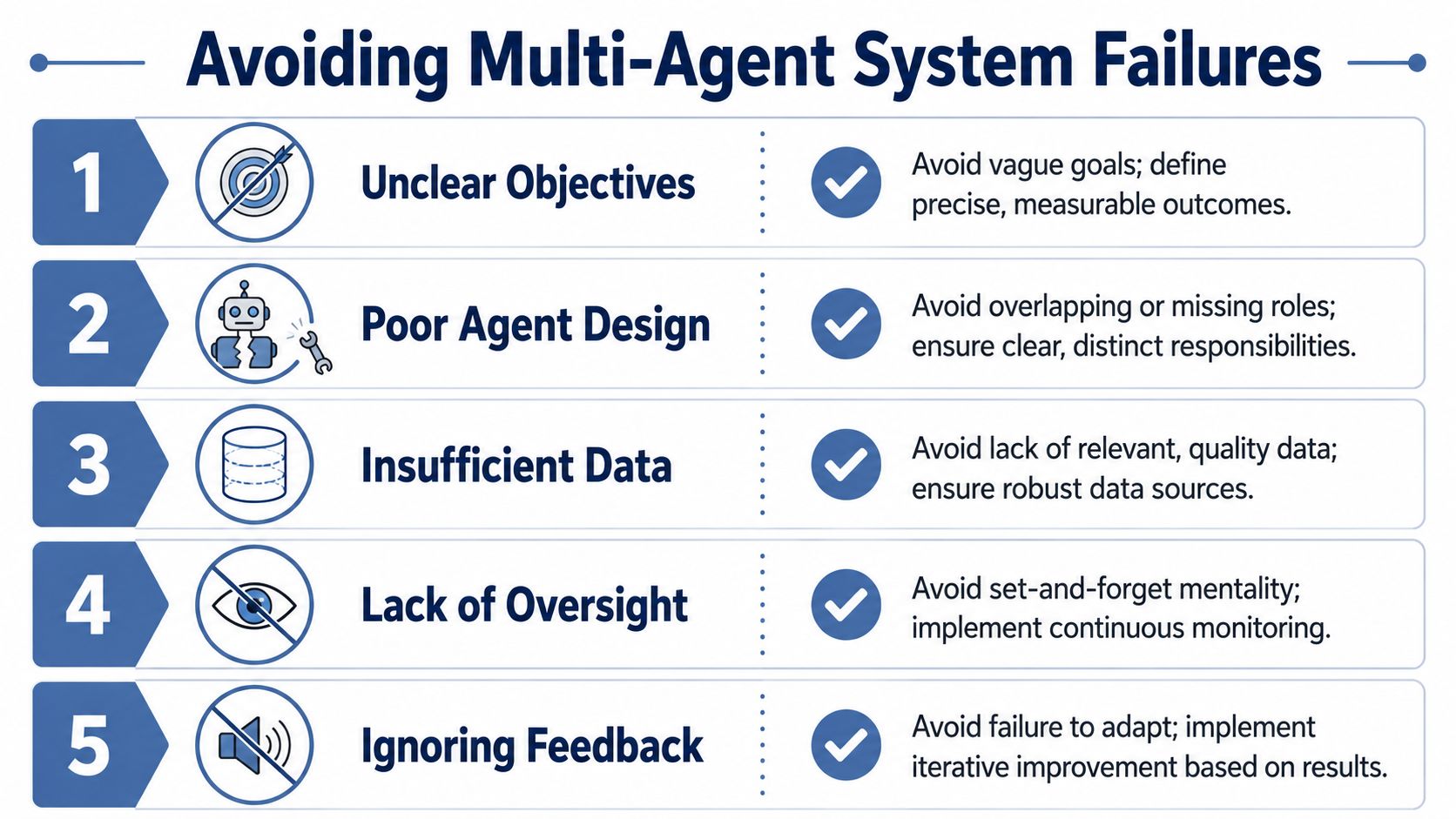
The uglier truth is coordination failure. Too many agents, weak visibility, sloppy permissions, and no clean audit trail. That's what turns an automation project into an expensive mess.
What actually breaks
Multi-agent systems face failure rates of 60 to 80 percent due to exponential coordination costs and lack of real-time visibility, and the successful ones use unique agent identities for audit trails plus mandatory human-in-the-loop checkpoints, according to Galileo's analysis of why multi-agent systems fail.
That lines up with what I see in practice. Systems usually fail because nobody can tell which agent made which decision, what data it used, or where the bad handoff happened. One weird sentence from one agent is rarely the cause.
Lean governance for SMBs
What you need is operational hygiene. A formal AI governance board is overkill.
Here's the version I'd implement for a small team:
Every agent gets a named role
Don't run mystery bots. Name them by function and keep their responsibilities narrow.Every action leaves a trail
Log the input, output, timestamp, and approval status in Airtable, Notion, or your ops system.Every sensitive output gets a human check
Customer-facing emails, pricing guidance, legal-ish language, and anything tied to brand risk should be reviewed.Every agent gets least-privilege access
If an agent drafts summaries, it doesn't need universal access to every business system.Every workflow has a recovery step
If one part fails, the process should pause and alert a human. Not keep guessing.
Small business governance should feel like a seatbelt, not a compliance theater project.
The warning signs to catch early
I tell founders to watch for these symptoms:
- Outputs get longer but less useful, which often means context is bloated.
- Agents repeat or contradict each other, which means handoffs are broken.
- Nobody trusts the results, usually because you skipped review and logging.
- The workflow touches too many tools, so complexity is outrunning value.
- One agent keeps getting “smart” instructions added, which means you're rebuilding the overloaded super-agent that should have been split apart.
A practical operating rule
Use the system for reading, sorting, summarizing, and recommending far more than writing final actions directly into production systems.
That one shift changes the risk profile. It keeps the agent crew useful while reducing the chance that one weak output cascades into customer-facing damage.
Your First Move
Don't start by buying another platform. Start by naming one repetitive task that happens every week and drains real human time.
Write it down using this simple template:
- Task: What is the recurring workflow?
- Trigger: What starts it?
- Inputs: Where does the information come from?
- Decision points: Where does judgment happen?
- Output: What should the finished result look like?
- Reviewer: Who approves it?
- Success metric: What tells you this is working?
A strong first candidate is often a weekly report, a follow-up sequence draft, or a support-summary workflow. Something bounded. Something inspectable. Something tied to revenue, retention, or response speed.
If you can map that process clearly, you're already closer than most companies pretending to “do AI.” You've turned a vague ambition into an operational asset.
That's how I think about multi agent systems for small business: a disciplined way for you to build a faster company before your competitors do.