
Forget Prompt Engineering. Context Is Your New Moat.
Everyone is obsessed with the perfect prompt. They're missing the point. I've been working with ML since 2016 and Generative AI since 2019, and I can tell you the businesses that pull ahead will be the ones with the best context. The best prompts matter less than you think.
The ability to feed an LLM the right information, at the right time, in the right format is one of the strongest competitive advantages you can build today. Research backs that up. Retrieval-Augmented Generation, a foundational context engineering pattern, improves accuracy on knowledge-based tasks compared to prompt-only approaches because it gives the model current external facts instead of forcing it to rely on stale internal training data, as noted in Intuition Labs on context engineering.
You and I are going to walk through 8 real-world context engineering examples that I use as a practical playbook inside businesses that care about revenue, speed, and defensibility. Each one is a working architecture with the operating discipline to match.
Table of Contents
- 1. Customer Support Automation with Conversation Memory
- 2. Personalized Email Copywriting at Scale
- 3. Competitive Intelligence Synthesis for Product and Pricing Strategy
- 4. Lead Scoring and Sales Prioritization Through Behavioral Context
- 5. Content Ideation and Topic Clustering for Organic Growth
- 6. Landing Page Optimization Through Variant Testing Context
- 7. Customer Feedback Analysis and Product Roadmap Alignment
- 8. AI-Powered Sales Objection Handling and Proposal Generation
- 8-Point Context Engineering Comparison
- Your Action Plan From Context to Competitive Advantage
1. Customer Support Automation with Conversation Memory
Most support bots fail for one reason. They answer the current message but ignore the customer's history.
That's amateur hour. If your AI agent can't see prior tickets, account tier, product usage, sentiment from earlier conversations, and the last unresolved issue, it's guessing instead of doing support.

A strong real-world benchmark exists here. A telecommunication chatbot that integrated customer databases, conversation memory, and dynamic instructions through context engineering achieved higher user satisfaction and reduced escalations, according to this context engineering analysis from Intuition Labs. That's the difference between a scripted bot and an actual service layer.
What I put in the context window
I order support context by relevance, not chronology. The model should see the current issue first, then the last unresolved issue, then the customer's tier, recent product activity, and any policy constraints that limit what the bot can offer.
If you're building memory into an agent, keep short-term conversation state lean and push durable history into retrieval. That's how I think about AI agent memory architecture. Your model needs enough history to stay coherent, not a full transcript dump.
A practical rule: put refund limits, legal constraints, and safety rules near the top of the prompt because models are sensitive to position.
Where most teams get this wrong
They stuff everything into the window and assume a bigger context solves quality. It doesn't. Research summarized by DataCamp says performance drops significantly around 32,000 tokens because of context distraction and confusion, even when models advertise much larger windows, as explained in DataCamp's context engineering guide.
So prune aggressively. Use summarization for old exchanges, windowing for recent turns, and hard escalation rules for cases the bot should never touch. Elastic specifically calls out summarization and windowing as core mechanics for managing limited model attention in its context engineering overview.
A few support rules I use repeatedly:
- Escalate regulated issues by routing legal, compliance, and high-risk account actions to humans.
- Inject negative context by telling the model what not to offer based on prior failures or customer restrictions.
- Carry emotional memory carefully. A frustrated customer should trigger a different tone than a routine billing query.
That's one of the clearest context engineering examples because the ROI shows up fast. Faster resolution. Fewer escalations. Better retention.
2. Personalized Email Copywriting at Scale
Generic lifecycle email is lazy. Your competitors can automate it. You win when every email reflects customer behavior instead of a segment label.
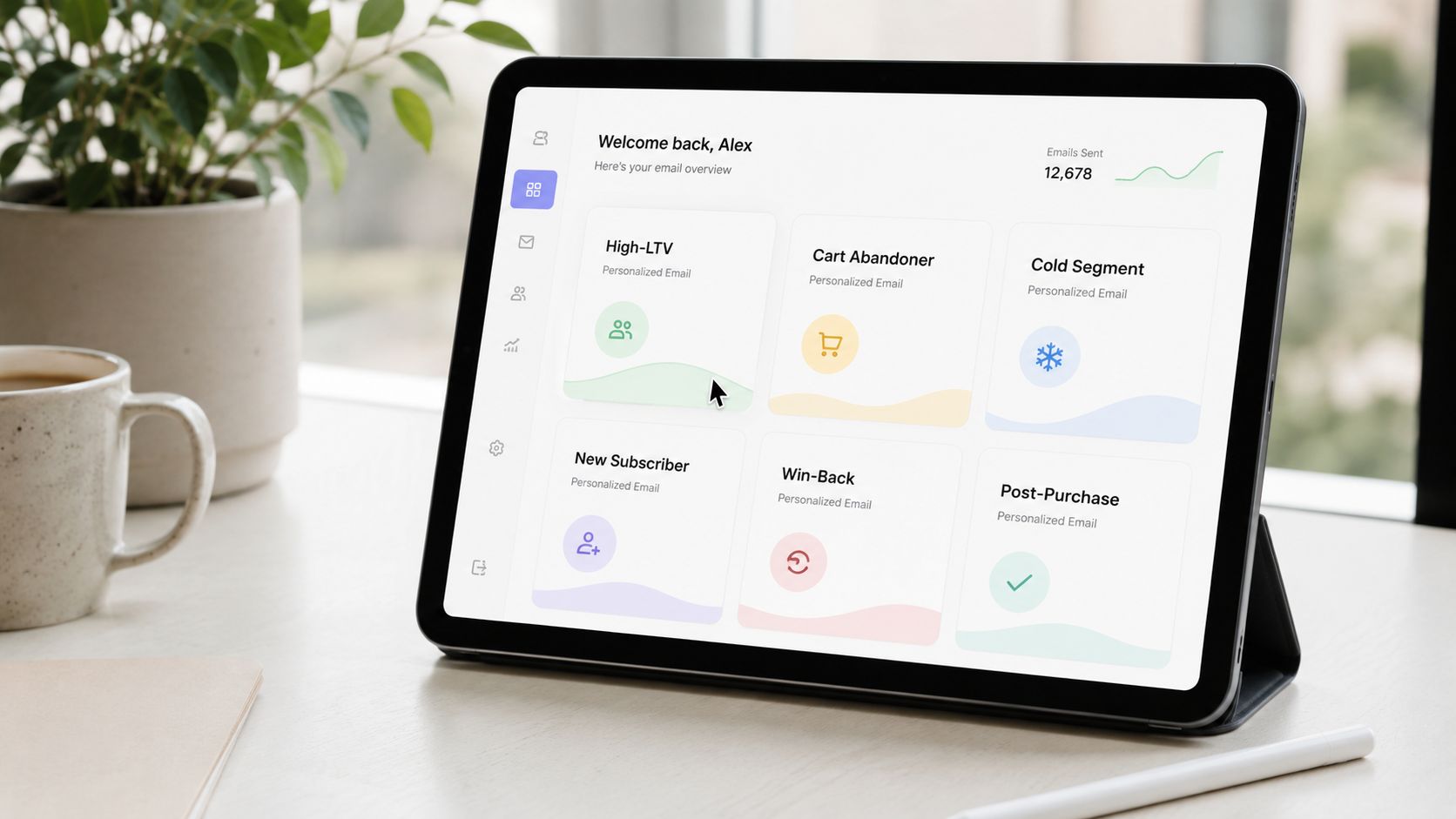
I use context engineering to generate email variants from actual buying signals. Cart state, purchase history, product category affinity, support complaints, loyalty status, and engagement recency all matter more than broad persona fluff.
The context stack that actually matters
For abandoned cart email, I care about the cart contents, margin profile of the products, first-order versus repeat-buyer status, prior discount exposure, and any known objections from support tickets. For onboarding, I care about feature adoption state and the user's intended use case.
That's where many teams need better prompt inputs, not better prose. I've written before about prompt engineering for marketing, but the prompt is only the wrapper. The performance comes from the context underneath it.
If you're trying to personalize email marketing, start with one high-volume flow. Abandoned cart. Win-back. Post-purchase cross-sell. Don't spread effort across ten automations before one proves it can move revenue.
What to test before you scale
I don't add five new data fields at once. You need to know what improves output quality.
Start with a simple hierarchy:
- Recency signals first, such as last visit, last cart event, last click, last purchase.
- Value signals second, such as average order value, product category, loyalty tier.
- Risk signals third, such as prior complaint, refund history, discount dependence.
Better email copy comes from feeding the model the buying context a good copywriter wishes they had. “Creative AI” won't get you there.
There's a hard trade-off here. More context can improve relevance, but too much can hurt reasoning quality and raise cost. Inngest notes that reasoning accuracy often declines when context grows beyond optimal thresholds, and a 2026 Sourcegraph analysis they cite frames the goal as finding the smallest possible set of high-signal tokens. They also note that overly aggressive compaction can degrade agent performance by 23% if meaning gets lost in compression, as discussed in Inngest's context engineering practice article.
So test context depth like you'd test copy. Don't assume richer equals better. The best context engineering examples in email are disciplined, not bloated.
3. Competitive Intelligence Synthesis for Product and Pricing Strategy
Most companies collect competitor data like digital hoarders. Spreadsheets. Slack messages. Random screenshots. Nobody turns it into a decision system.
I do. When you feed an LLM current pricing pages, packaging differences, release notes, review themes, sales call objections, and regional market notes, it can surface patterns you keep missing. That changes pricing, positioning, and roadmap sequencing.

What the model needs to see
I define the context explicitly. Not “competitor data.” I want named systems, fields, entities, and policies. Memgraph breaks context engineering into definition, curation, integration, and governance, and makes the important point that you should name the systems and fields the model must know instead of relying on abstract instructions in its prompt vs. context engineering article.
For competitive intelligence, that means giving the model structured inputs like:
- Pricing detail such as tier names, billing intervals, seat assumptions, contract terms.
- Positioning language such as headline claims, proof points, target segment language.
- Customer friction such as review complaints, lost-deal reasons, implementation blockers.
Then I ask the model for pattern extraction instead of a polished summary. Which unmet need keeps appearing? Which competitor wins on onboarding simplicity? Which segment gets ignored by everyone?
The competitive payoff
This is where context engineering examples stop looking like content tricks and start paying for themselves. You can spot where a rival is vulnerable before you keep losing the same deal for six months.
My advice is simple. Use this for defense first. Find out why you're losing. Only after that should you use it for offensive plays like pricing attacks, segment repositioning, or packaging redesign.
If your model sees fresh pricing, fresh reviews, and fresh objections every day, it becomes a market sensing layer. If it sees a quarterly spreadsheet, it becomes a decorative toy.
I also recommend operational freshness rules. Competitor context decays fast. A stale pricing page inside your prompt can push you toward the wrong offer and wreck margin discipline.
4. Lead Scoring and Sales Prioritization Through Behavioral Context
Traditional lead scoring usually rewards activity, not buying intent. That's why reps waste time on busy prospects who never convert.
I'd rather give sales an AI scoring layer that sees behavior in sequence. Pricing-page visits, repeat visits from the same company, trial usage depth, form responses, CRM notes, firmographics, and buying-committee activity all belong in the context.
The scoring context I trust
I start from closed-won deals and work backward. What behavior showed up before the deal moved? Not generic website traffic. Specific intent patterns.
Then I map context around four buckets:
- Behavioral depth, meaning what pages they viewed, what features they used, what docs they downloaded.
- Commercial fit, meaning industry, team size, geography, contract profile.
- Buying momentum, meaning multiple stakeholders, repeated return visits, sales email engagement.
- Disqualifying signals such as student traffic, competitor research patterns, job-seeker behavior.
That last category matters. Negative context is one of the most underused levers in lead scoring.
What to measure
I care less about whether the score “looks right” and more about whether it changes outcomes. DataCamp highlights three operational metrics for context engineering systems that I use often: token efficiency, task completion rate, and context relevance, with ablation testing to verify whether removing irrelevant context changes quality, as described in the same DataCamp article on context engineering. I won't relink it here, but the operating logic is solid.
For sales prioritization, translate that into business terms. How many routed leads become real pipeline? How quickly do reps make contact? Which context fields correlate with closed revenue?
One more warning. Don't put the score directly in charge of who gets called first until you've audited its misses. A lead scoring model that can't explain why it prioritized an account is a black box you shouldn't trust with pipeline.
5. Content Ideation and Topic Clustering for Organic Growth
Most content teams publish what internal stakeholders want to say. Buyers don't care. Searchers don't care. Revenue definitely doesn't care.
I use context engineering examples in content planning because this is one of the easiest places to turn scattered signals into compounding traffic. When the model sees your Search Console queries, support tickets, sales call questions, competitor content gaps, product pages, and ICP language, it can cluster topics around actual demand.
How I build content context
I pull from first-party sources before I touch third-party SEO tools. Search Console queries. Site search logs. Live chat transcripts. Demo-call transcripts. Those sources tell you what your market is already asking in its own words.
Then I layer in competitor pages and content inventories. The model can identify overlap, whitespace, and weak coverage areas without you manually reading hundreds of URLs.
A strong pattern for this work is retrieval plus compression. RAG improves knowledge task accuracy by grounding the model in external facts, and the broader lesson applies here too. The content planner performs better when it sees current market and customer data instead of relying on generic training priors, as discussed earlier from Intuition Labs.
When not to use this approach
Don't use AI topic clustering when your source material is thin or low quality. If support tags are inconsistent, Search Console data is barely populated, and your product positioning is fuzzy, the model will reflect that chaos.
I also don't over-compress the inputs. If you summarize customer questions too aggressively, you lose the exact phrasing that makes a page rank and convert. The customer's raw language often matters more than your polished brand language.
A few rules help:
- Preserve verbatim questions, because search intent lives in the phrasing.
- Cluster by journey stage. Awareness and bottom-of-funnel topics should not share the same context pack.
- Tie topics to commercial intent. Traffic without pipeline is a vanity project.
This is how you outproduce competitors without publishing junk. Better context. Better topic choices. Better conversion paths.
6. Landing Page Optimization Through Variant Testing Context
Most A/B testing programs move too slowly because teams create variants manually and test broad ideas instead of segment-specific messaging. You can fix that with context engineering.
I generate landing page variants using traffic source, audience type, offer type, device context, and historical winner patterns. The point is to produce disciplined hypotheses at scale. “Be creative” is the wrong instruction.
A short walkthrough helps. This video is a useful visual reference for how teams think about testing and iteration in practice.
Variant generation without nonsense
I segment first by source. Paid search visitors usually need direct intent alignment. Organic visitors often need more education. Retargeting visitors need momentum and proof.
Then I feed the model a structured pack with the winning claims from prior pages, the current offer, the segment profile, compliance constraints, and banned claims. That last part matters. A landing page system that invents proof points is a liability.
If you're running this at scale, archive every test result and feed it back as context. Winning headlines, failed CTAs, segment-specific objections, and page-scroll behavior all become training material for the next round.
The hidden risk
Bigger context does not guarantee better variants. DataCamp's discussion of attention budget is highly relevant here. The model needs a compact set of high-signal tokens, not a landfill of every historical test note.
Your testing velocity rises when the model sees the right prior results. It falls when you dump your whole CRO archive into the prompt and hope for magic.
I also want strict change control. Don't vary headline, social proof, CTA, and layout all at once unless you're doing multivariate work on purpose. Context engineering should sharpen test design, not make attribution impossible.
Among all context engineering examples, this one often wins people over fastest because the speed advantage is visible immediately. More variants. Better segmentation. Faster learning.
7. Customer Feedback Analysis and Product Roadmap Alignment
Feedback piles up. You drown in it. Then you default to the loudest customer or the strongest opinion in the room.
That's fixable. I use context engineering to turn scattered feedback into weighted roadmap input. Survey responses, app reviews, NPS comments, churn notes, support tickets, and interview transcripts all get normalized into a context layer the model can reason over.
How I structure feedback context
I separate feedback by customer segment, product area, and commercial importance. A complaint from a strategic account should not carry the same weight as a casual suggestion from a low-fit user.
Then I preserve the raw customer language alongside structured tags. Theme labels help, but the actual wording matters because it carries emotion, urgency, and specificity.
Healthcare gives a useful proof point for why depth of context matters. An experimental AI diagnostic tool for rare diseases performed better on diagnostic accuracy and timeliness when it was fed rich patient history, lifestyle data, and medical literature through context engineering protocols, according to Intuition Labs' context engineering article. Different domain, same lesson. Shallow context produces shallow decisions.
Governance matters more than most teams think
This is where most “examples” articles fall apart. They show setup. They ignore maintenance.
Nexla points to a major blind spot in production context engineering. Only 12% of recent enterprise AI case studies over the last 12 months describe real-time context validation, audit trails, or rollback strategies when source data changes, and a 2025 DeepSet study found that 68% of production LLM agent failures stem from stale or invalidated context rather than poor prompting, as reported in Nexla's enterprise context engineering analysis.
That should change how you run feedback systems. Product definitions evolve. Tag taxonomies change. Customer priorities shift.
So govern the context like an operating asset:
- Version your taxonomies, because unrecorded label changes corrupt trend analysis.
- Audit freshness by tracking when feedback sources last updated.
- Allow rollback, so that if a bad sync pollutes context, you can restore the prior state fast.
If you don't manage lifecycle drift, your roadmap starts chasing ghosts.
8. AI-Powered Sales Objection Handling and Proposal Generation
Sales reps need the right answer in the moment, grounded in actual deal context. Another chatbot won't give them that.
I build objection-handling systems that combine product positioning, competitor comparisons, approved claims, pricing rules, implementation constraints, relevant case studies, and stage-specific objections. When that context is assembled correctly, the rep gets a practical response fast and can keep control of the conversation.
The proposal engine setup
Proposal generation is one of the highest-impact uses of context engineering because speed and relevance both matter. The proposal should reflect the buyer's industry, use case, contract shape, risk concerns, and likely objections.
A strong example comes from insurance. Five Sigma Insurance achieved an 80% reduction in claim processing errors and a 25% increase in adjustor productivity by designing AI systems that ingest policy data, claims history, and regulations together using advanced RAG and dynamic context assembly, according to MarkTechPost's case study roundup. The industry is different, but the architectural lesson carries straight into proposals and objections. When the system sees the right policy, history, and rules at once, output quality jumps.
What separates useful from dangerous
I only trust sales co-pilots that stay inside an approved output contract. That means the model knows which claims it can make, which ROI math is sanctioned, which case studies are approved, and when it must defer to a human.
In underwriting, the same MarkTechPost piece notes that custom schema creation and SME-guided context templates enabled agents to handle varied formats and business rules with over 95% accuracy after deployment feedback cycles. That's the blueprint. Define the schema. Define the fields. Define the allowed outputs.
Sales context should include losses as well as wins. Your best rebuttal often comes from a deal you lost and properly analyzed.
For objection handling, organize context by deal stage and buyer role. A CFO objection about cost isn't the same as a security objection from IT or a workflow concern from operations. If you mix them together, the model gives polished but weak answers.
8-Point Context Engineering Comparison
| Title | Implementation complexity | Resource requirements | Expected outcomes | Ideal use cases | Key advantages |
|---|---|---|---|---|---|
| Customer Support Automation with Conversation Memory | High, cross-channel context, escalation logic, ongoing tuning | CRM/CDP integration, data engineering, compliance controls, human-in-loop | Faster responses (e.g., 3d → 4h), higher automated resolution (50–80%), improved CSAT and reduced churn | High-volume support, tiered accounts, SaaS/D2C with rich customer data | Scales support without linear cost, consistent voice, proactive churn prevention |
| Personalized Email Copywriting at Scale | Medium–High, segmentation, context layering, testing complexity | Deep CDP/email platform integration, copy review, A/B testing infrastructure, guardrails | Large lift in revenue per email (2–4x), higher open/CTR, lower unsubscribes | Ecommerce and large subscriber lists, lifecycle campaigns, transactionally driven emails | True 1:1 personalization at scale, rapid copy iteration, transferable messaging patterns |
| Competitive Intelligence Synthesis for Product and Pricing Strategy | Medium, continuous data ingestion and analysis, legal/ethical checks | Scrapers/APIs, review aggregation, analyst validation, automated refresh pipelines | Faster market responses, data-backed pricing/bundling decisions, ARR uplift (example +35%) | Product strategy, pricing decisions, mid-market competitive positioning | Identifies market gaps quickly, reduces opinion-driven decisions, informs sales enablement |
| Lead Scoring and Sales Prioritization Through Behavioral Context | Medium, multi-source signal fusion and model retraining | Web analytics, CRM/product telemetry, intent third-party feeds, privacy compliance | Better lead-to-SAL conversion (3–5x accuracy), shorter cycles, higher close rates | B2B with trials/product usage, high lead volume sales orgs | Focuses reps on high-intent leads, improves sales efficiency and win rates |
| Content Ideation and Topic Clustering for Organic Growth | Medium, SEO and support data integration, topic modeling | SEO tools (GSC/Ahrefs), support transcripts, content team, LLM prompts | More targeted content, faster organic traffic growth, higher topical authority | Organic growth strategies, content-heavy SaaS/ecommerce sites | Data-driven topic selection, finds content gaps, scales output without new hires |
| Landing Page Optimization Through Variant Testing Context | High, large-scale variant generation and experiment management | Experimentation platform, automation for variants, sufficient traffic, analytics | Faster learning velocity, conversion uplift (30–120% potential), discover segment winners | High-traffic acquisition pages, paid campaigns, audience-segmented landing funnels | Parallelized testing, data-grounded variants, accelerates conversion gains |
| Customer Feedback Analysis and Product Roadmap Alignment | Medium, aggregation, clustering, weighted prioritization | Feedback ingestion across channels, sentiment analysis tooling, product stakeholders | Actionable roadmap priorities, reduced churn, improved NRR (example 102% → 118%) | Product-led orgs with lots of feedback, roadmap prioritization needs | Turns unstructured feedback into prioritized signal, surfaces high-value requests |
| AI-Powered Sales Objection Handling and Proposal Generation | Medium–High, real-time context, templates, guardrails, call integration | Call recording/transcript pipeline, case studies/ROI data, proposal templates, legal safeguards | Faster proposals, higher win rates (example 18% → 31% on competitive deals), shorter cycles | Competitive enterprise sales, deal-heavy B2B environments, junior reps support | Real-time sales intelligence, faster proposal turnaround, levels up rep effectiveness |
Your Action Plan From Context to Competitive Advantage
You've seen the playbook. Context is a capability that changes how your business sells, supports, writes, tests, prioritizes, and competes.
The biggest mistake I see is trying to “adopt AI” as a broad initiative. That language is too vague to produce anything useful. Pick one workflow where better information at the moment of decision will clearly improve revenue, conversion, retention, or speed. Customer support is often a strong starting point. Lead routing is another. Proposal generation is another if you are drowning in repetitive customization.
Build the smallest version that can prove value. Define the exact context inputs. Name the systems. Name the fields. Decide what belongs in live context, what belongs in retrieval, and what must never be generated without verification. Context engineering frameworks assist with these decisions. Definition, curation, integration, and governance are the operating model, and none of them is optional.
Then measure the right thing. Token savings alone is a weak KPI. I care about business outcomes supported by context quality. Faster task completion. Higher resolution quality. Better routing. Better proposal relevance. Better conversion on segmented pages. If the workflow got cheaper but less accurate, you didn't win.
You also need governance earlier than you think. Stale context breaks systems silently. Policy changes, schema changes, offer changes, and product changes all degrade outputs unless someone owns freshness, audit trails, and rollback. That is why many flashy pilots die in production.
I'd sequence your rollout like this:
- Start with one high-impact workflow, such as support, sales, lifecycle marketing, or CRO.
- Create a structured context pack that includes only the entities, policies, constraints, and history essential for the task.
- Add retrieval and memory deliberately instead of dumping transcripts and docs into the window.
- Instrument quality by tracking task success, context relevance, and downstream business impact.
- Review drift monthly. If the business changed, your context layer must change with it.
That's how you turn context engineering examples into a durable advantage: build systems that give the model the exact business reality it needs to make good decisions, instead of chasing bigger models or polishing prompts for weeks.
If you're already doing this work, you may also recognize elements of my approach around structured context packs and agentic context loops. The framing is practical because the business problem is practical. Everyone is using AI. Your moat comes from giving it better context than your competitors can.