
Most advice on AI agent memory is wrong. It tells you to buy a bigger context window, stuff more tokens into the prompt, and call that memory.
What you get from that is expensive temporary recall.
I'm Samuel Woods. I've been working with ML since 2016 and Generative AI since 2019, and I can tell you this plainly. If your AI forgets customers, prior decisions, failed attempts, and internal context, you haven't built an asset. You've built a smart intern with a concussion. Your competitors can copy the prompt. They can copy the workflow. They can't easily copy an agent that compounds knowledge over time across teams, customers, and channels.
The bigger mistake is even less discussed. A lot of teams are wiring memory directly to one model provider's embedding stack. That creates a hidden switching cost that gets worse every month. What you need is a model-agnostic memory layer that protects your business when OpenAI, Anthropic, Google, or open-source models change on performance, cost, or policy.
Table of Contents
- Your AI Has Amnesia and It's Costing You
- The Three Brains of a Smart AI Agent
- The Modern Architecture for Agent Memory
- Practical Implementation Patterns That Work
- How to Measure Memory Performance
- Use Cases That Pay Off
- Scaling and Governance Best Practices
Your AI Has Amnesia and It's Costing You
Most AI systems in business still behave like every conversation is the first conversation. That's absurd when you think about how you evaluate people. You'd never keep a salesperson who forgot the client's goals after every call, or a support rep who asked the same setup questions every week.
Yet that's exactly how many companies deploy AI.
The market already treats this as a serious infrastructure problem. The global AI agent memory market reached $6.27 billion in 2026 and is projected to reach $28.45 billion by 2030, with a 35% CAGR, according to AI MagicX's analysis of AI agent memory architecture. That projection matters because it reflects where serious operators are placing bets. The money is going into persistent systems that learn, and away from prettier demos.
A practical rule: if your agent can't improve from prior interactions, it won't create durable business advantage.
I see business owners make two bad assumptions here.
First, they assume better models will solve forgetting. They won't. Better reasoning without persistent memory just means your AI sounds more confident while repeating the same mistakes.
Second, they assume memory is a product feature. I treat it as a competitive layer. The company that remembers customer context, prior objections, implementation history, and brand rules across channels will close faster, support better, and waste fewer cycles.
Here's the business reality:
| Common setup | Business result |
|---|---|
| Stateless chatbot | Repetitive interactions, weak personalization |
| Session-only context | Slightly better conversations, no compounding value |
| Persistent AI agent memory | Higher continuity, stronger execution, harder-to-copy moat |
The flashiest model name won't decide who wins. The businesses that pull ahead will be the ones whose agents accumulate operational memory.
That changes everything. Sales agents remember objections that blocked prior deals. Support agents recall what the customer already tried. Marketing agents preserve brand voice, campaign learnings, and channel-specific performance context. Strategy agents keep track of competitor moves over time instead of treating every market scan like a blank page.
This is where the advantage becomes real. When your AI compounds learning and your competitor's AI starts from zero, you operate faster at lower friction. Over enough interactions, that gap becomes structural.
The Three Brains of a Smart AI Agent
When most people hear “memory,” they usually imagine a big archive. That's too simplistic. A strong agent needs different memory systems for different jobs.
The cleanest model is this. AI memory breaks into semantic memory, episodic memory, and cognitive memory, where semantic stores facts, episodic stores time-stamped interactions, and cognitive manages active context, as outlined in this memory decomposition reference.
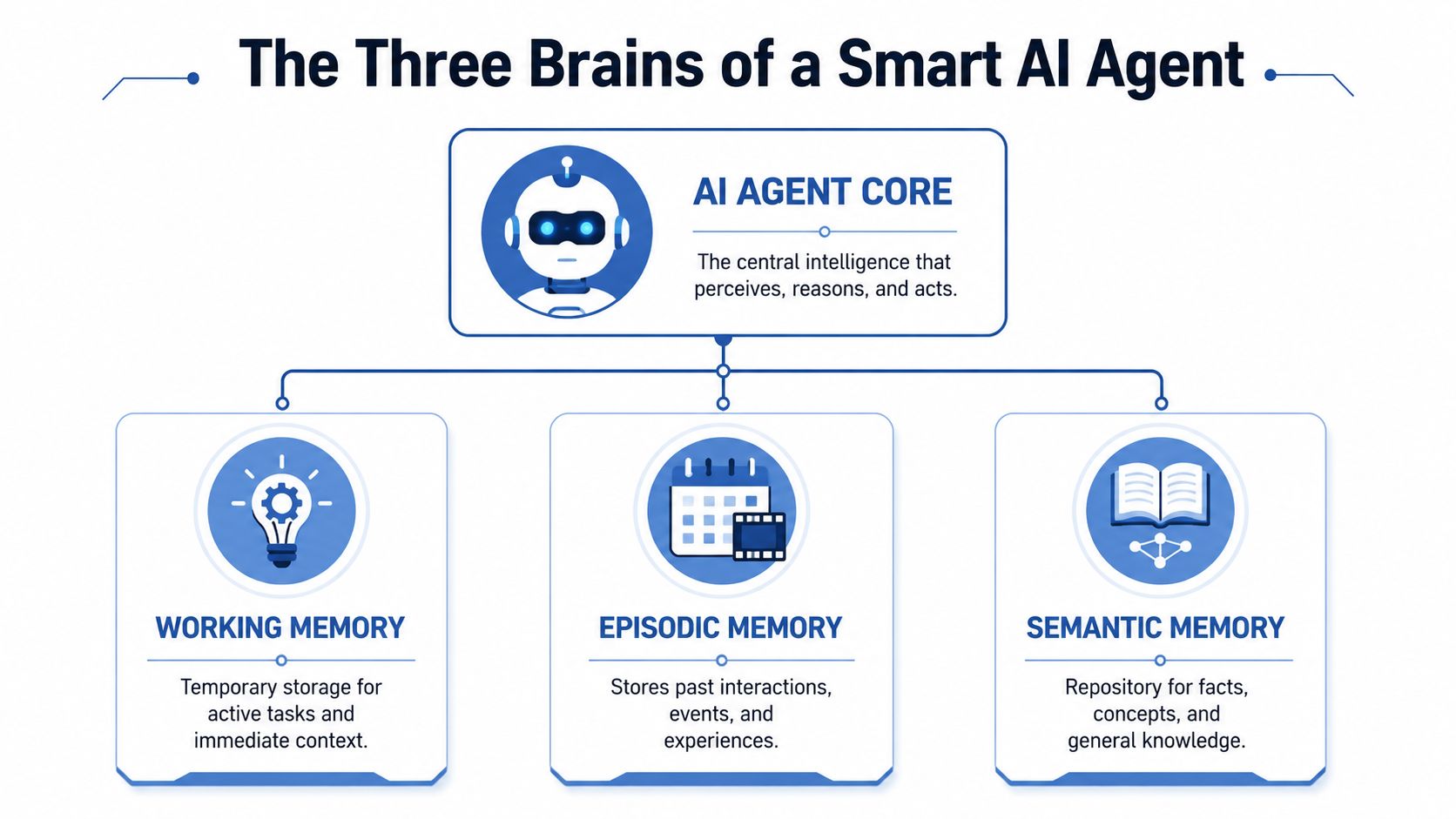
If you want a broader strategic view of how these systems fit into modern agents, my guide on intelligent agents in business gives the bigger picture.
Semantic memory keeps the business consistent
Semantic memory holds facts. Customer preferences. Product rules. Brand standards. Contract details. Internal definitions. If a user prefers concise answers, works in TypeScript, or buys only a certain product line, these details are stored in semantic memory.
Think of semantic memory as your company's operating truth layer.
Without it, your AI keeps asking for information the business already knows. That creates friction, kills trust, and makes automation feel fake. It also creates hidden revenue loss because personalization becomes shallow and repetitive.
A useful way to think about semantic memory:
- Customer facts such as names, preferences, account context, and recurring needs
- Business facts such as pricing rules, product details, workflows, and approved messaging
- Domain facts such as industry terminology, compliance boundaries, and recurring patterns
Episodic memory stops repeated mistakes
Episodic memory is different. It stores experiences. What happened in the last support interaction. Which sales angle failed. Which workflow broke. What the customer tried before escalation.
This is the memory that is often overlooked, and it's the one that often creates the biggest leap in practical performance.
A support agent with semantic memory may know the customer uses a certain plan. A support agent with episodic memory also knows that the customer already reset the integration twice and got blocked during onboarding because of a permissions issue. That second agent is useful.
A good agent knows the facts, remembers what happened, and adjusts its behavior.
Here, your AI starts acting less like search and more like a capable operator.
Cognitive memory keeps the task on track
Cognitive memory is the active working layer. It manages immediate context, current objectives, and the live state of the conversation or task.
This is the shortest-lived memory type, but it still matters. If cognitive memory is weak, the agent loses the thread mid-task, drops relevant details, or drifts into generic output.
Here's the practical breakdown:
| Memory type | What it stores | Business impact |
|---|---|---|
| Semantic | Facts, preferences, stable knowledge | Consistency and personalization |
| Episodic | Prior interactions and outcomes | Adaptation and fewer repeated errors |
| Cognitive | Current task context | Better execution in the moment |
When agent deployments fail, the cause is usually lazy memory design rather than a dumb model. Teams store everything in one blob, retrieve too much junk, and then wonder why quality declines.
You and I should treat these as separate systems with separate rules. Facts need validation. Experiences need timestamps. Working context needs expiration. Once you do that, AI agent memory starts producing business results instead of technical theater.
The Modern Architecture for Agent Memory
If your team says, “We have a huge context window, so we're covered,” that's a warning sign. They're designing a demo, not a production system.
The production standard in 2026 is the Dual-Layer Architecture, which separates a Hot Path for recent context from a Cold Path for external retrieval, with the hot layer designed for <100ms latency, according to Digital Applied's guide to AI agent memory systems.
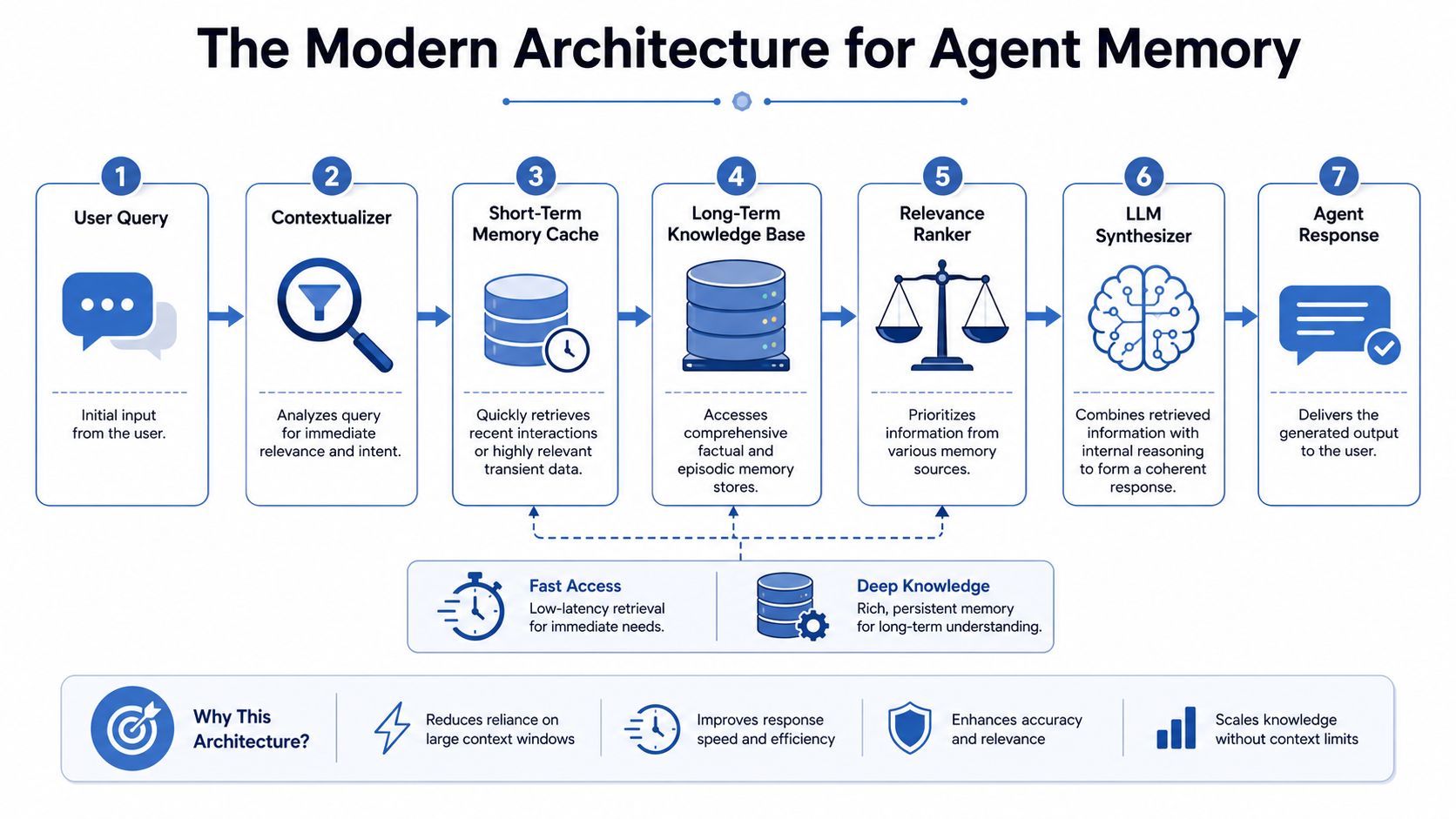
I've written separately about AI agent orchestration because architecture and orchestration are inseparable once you move past prototypes.
Why context windows fail in production
Even very large context windows are economically and operationally impractical for full history. You can't keep stuffing years of interactions into every query and expect speed, quality, and cost discipline.
That approach fails in three ways.
- Costs inflate because you pay to reprocess old context again and again.
- Latency drags, and the system feels slower when every response depends on rereading bloated history.
- The signal gets diluted as important details get buried under irrelevant interaction debris.
This is why you should stop asking, “How big is the context window?” and start asking, “How does the system decide what to remember, retrieve, and ignore?”
What the hot path and cold path actually do
The Hot Path is for what the agent needs right now. Recent messages. Current task state. Compact summaries. Immediate graph state. It's optimized for speed.
The Cold Path is for durable memory. External stores such as Zep, Mem0, or Pinecone can sit here, depending on your design. Within it reside historical preferences, prior episodes, structured facts, and deeper knowledge, awaiting justified retrieval.
A simple way to explain the split:
| Layer | Job | What belongs there |
|---|---|---|
| Hot Path | Fast response | Recent messages, current task context, summaries |
| Cold Path | Deep recall | User history, semantic facts, episodic records, knowledge stores |
This is the trade-off. A pure Hot Path design feels fast but forgets too much. A pure Cold Path design can retrieve extensively but often feels heavy or clumsy. You need both.
There's another issue you should care about. Security. The same production guidance stresses namespace isolation with user_id partitioning and PII scrubbing. Those controls are what keep one user's memory from contaminating another's.
Build memory like financial infrastructure. Fast where needed, durable where needed, and isolated by design.
When should you keep things simple? If your agent handles one-off internal tasks with no ongoing user relationship, you may not need an advanced cold layer. Don't overbuild.
When should you invest? The moment continuity matters. Sales, support, customer success, knowledge work, personalization, market monitoring. In those cases, AI agent memory is required. It's the backbone of a system people will trust.
Practical Implementation Patterns That Work
Developers often overcomplicate memory in the wrong places and underthink the part that matters most. They obsess over framework preferences, then hardwire memory to a single provider's embedding stack.
That's reckless.

The strategic move is simpler. Store memories as plain text plus metadata, keep the memory layer model-agnostic, and use re-embedding at read time so you can switch among OpenAI, Anthropic, Google, or open-source models without losing historical context, as explained in this guide to a universal memory layer.
If your team needs a practical complement to that thinking, I've also published a guide on training an AI agent on company data.
Build memory as a business asset, not a model feature
Here's the wrong pattern.
You ingest interaction history, create embeddings with one provider, store only vectors, and tie retrieval quality to that provider forever. If pricing changes, policies change, or another model becomes better for your use case, switching becomes painful.
Here's the better pattern.
You store raw memory objects in a provider-neutral form. Plain text. Metadata. Timestamps. Session IDs. Memory type. Access scope. Then you re-embed at read time for the model stack you're using now.
That one design choice changes your advantage.
- You keep the freedom to switch providers without wiping history.
- You can route tasks to the best model for the job.
- You lower your risk by depending less on a single vendor's ecosystem decisions.
A lot of cross-provider memory content misses this completely. That's why businesses end up trapped in brittle AI stacks.
A simple pattern your team can implement
I prefer architecture that a non-technical owner can understand and a single developer can ship.
Store durable records in plain text.
Keep memory entries human-readable and provider-neutral. Attach metadata likeuser_id,session_id, timestamp, memory type, and access policy.Separate write logic from retrieval logic.
On write, decide whether the event deserves storage at all. On read, create the embedding for the current provider, retrieve candidates, rank relevance, then inject only the best context.Keep fact memory and episode memory apart.
Facts should update carefully. Episodes should remain time-stamped and traceable.
Pseudo-code makes this concrete:
memory_record = {
  "user_id": "acct_245",
  "session_id": "sess_991",
  "type": "episodic",
  "text": "Customer rejected annual plan because procurement needed quarterly flexibility.",
  "timestamp": "2026-06-01T10:30:00Z",
  "tags": ["sales", "pricing-objection", "procurement"]
}

store_plain_text(memory_record)

query = "What pricing objection matters for this customer right now?"
embedding = embed_with_current_provider(query)
candidates = retrieve_relevant_memories(user_id="acct_245", query_embedding=embedding)
ranked = rerank(candidates, query)
context = build_prompt_context(ranked[:top_k])
It's plain, and it lasts.
A useful real-world parallel is how specialized workflows need portable decision memory across changing tools and models. If you want a concrete example of how agents are being applied in live financial workflows, Yield Seeker's write-up on automated DeFi strategies with AI agents is worth reviewing because the operational logic matters more than the model brand.
Here's a deeper walkthrough of the architecture in action:
Where RAG fits and where it doesn't
RAG is useful. It helps agents pull external knowledge into a response. But RAG alone isn't memory.
Use RAG for product docs, policy libraries, internal wikis, research repositories, and structured knowledge lookup. Use memory for continuity, preference retention, prior attempts, and adaptive behavior.
The strongest systems combine both. Retrieval grounds the answer. Memory shapes the judgment.
How to Measure Memory Performance
A lot of teams “measure memory” by checking latency and calling it done. That tells you almost nothing about business value.
A proper scorecard uses a four-layer evaluation stack covering task effectiveness, memory quality, efficiency, and privacy, as described in this evaluation framework for AI agent memory systems.
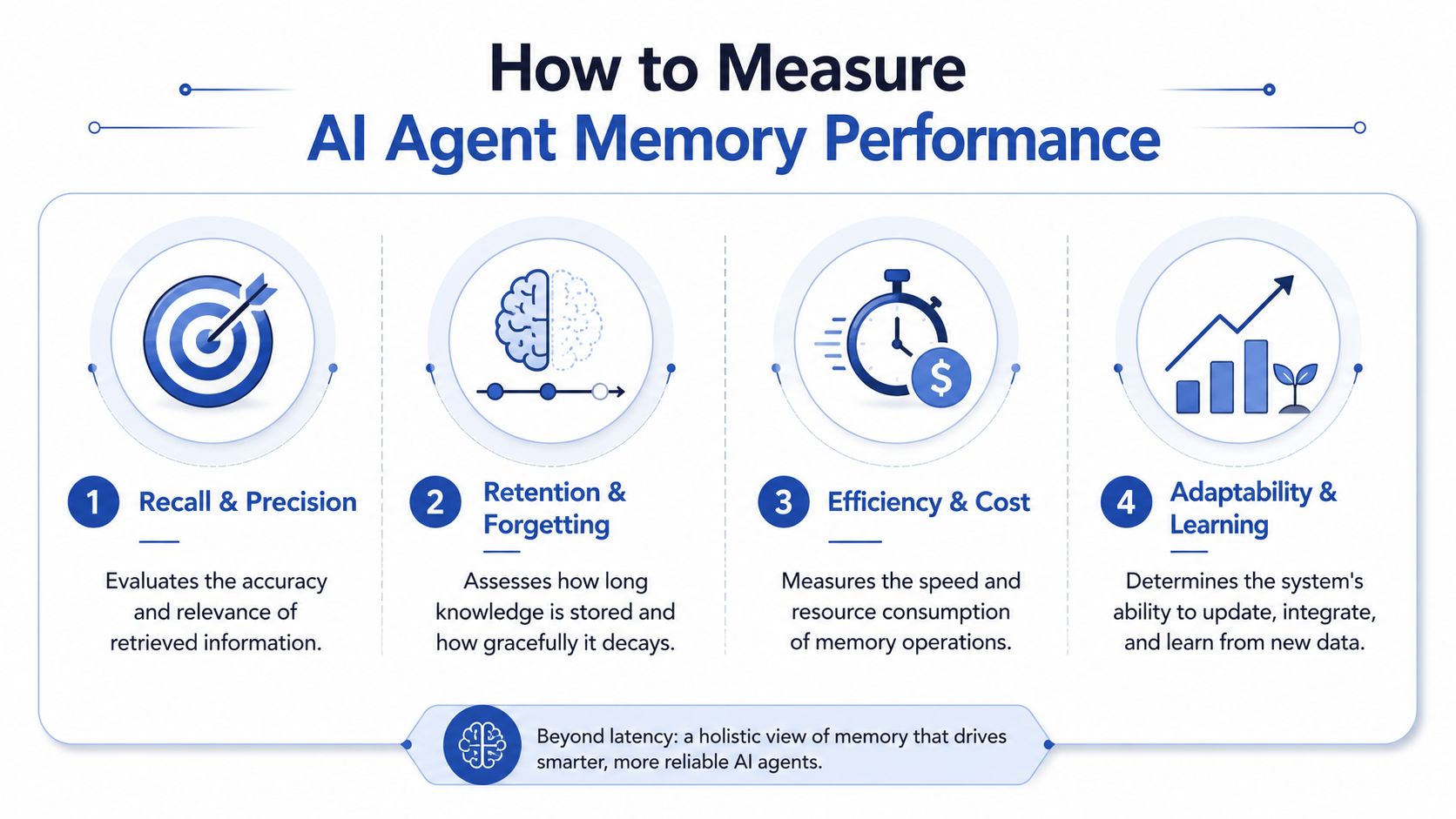
The four-layer scorecard
I like this model because it forces you to connect engineering decisions to business outcomes.
| Layer | What to evaluate | Why it matters |
|---|---|---|
| Layer 1 | Task effectiveness | Did the agent actually complete the job well |
| Layer 2 | Memory quality | Did it retrieve the right records and avoid contradictions |
| Layer 3 | Efficiency | How much latency, token use, and retrieval overhead it created |
| Layer 4 | Privacy | Whether it leaked data or violated deletion and access rules |
Most failed deployments hide in Layer 2 and Layer 4.
The agent may complete some tasks, but if it pulls stale memories, merges different users, or contradicts prior facts, confidence collapses. If privacy controls are weak, scaling the system only grows a legal problem.
If the team can't show retrieval precision, contradiction handling, and deletion compliance, the memory layer isn't ready for production.
What to ask for in reporting
Don't ask for a technical vanity dashboard. Ask for operating evidence.
- Which workflows improved when memory was enabled, and where did it create noise?
- How often did the system retrieve the right record set, and how often did it return stale or conflicting context?
- How much prompt bloat is memory adding, and which retrieval steps are proving effective?
- Can your setup show access-scope controls, deletion handling, and leakage monitoring?
I also test failure conditions. The agent should keep functioning when retrieval returns nothing. Empty memory happens. Bad retrieval happens. Production systems degrade gracefully.
This is how you move memory from “cool feature” to managed business capability. You judge it by execution quality, not by how advanced the architecture diagram looks.
Use Cases That Pay Off
The reason to invest in AI agent memory is commercial advantage.
Persistent memory creates asymmetric advantage because your system gets better at the specific work that matters to your business. Competitors can buy the same foundation model. They can't instantly replicate the accumulated memory tied to your customers, workflows, and market behavior.
Revenue growth through persistent personalization
A stateless marketing agent can personalize the current email. A memory-enabled one can personalize the relationship.
It remembers what messaging angle worked before, which product category the buyer keeps revisiting, what objections they raised, and which channels they engage with. That means better campaign sequencing, more coherent follow-up, and less tone drift across email, site copy, ads, and sales outreach.
For a small business, this matters because brand consistency and relevance stop being manual discipline problems. The agent carries the context forward.
Support that gets stronger over time
Customer support is where bad memory becomes painfully visible. People hate repeating themselves.
A persistent support agent can recall previous tickets, known preferences, device or account context, prior resolutions, and unresolved friction points. The conversation starts closer to the core issue. Escalation gets cleaner because the history is already structured.
There's also an operational edge here. Over time, the support system accumulates a durable map of what fails repeatedly, which fixes hold, and where the product or onboarding flow creates recurring strain. It improves support and also feeds product and retention strategy.
Market intelligence that compounds
This is the use case many businesses still miss. An agent with memory can track competitor sites, campaign patterns, product launches, messaging shifts, pricing changes, and recurring themes over time.
Without memory, you get snapshots. With memory, you get continuity.
That's a major difference for strategy. The agent can connect a sequence of moves instead of summarizing only the latest page. It can tell you which narratives are repeated, which competitor claims are evolving, and where market language is drifting.
A simple comparison makes the point:
| Agent type | What it gives you |
|---|---|
| No persistent memory | One-off outputs and shallow summaries |
| Persistent memory | Cumulative insight and stronger strategic timing |
This is the payoff I mean. Faster learning loops. Better customer continuity. Cleaner decisions. Less reinvention. Over time, that compounds into response speed and strategic clarity that slower competitors struggle to match.
Scaling and Governance Best Practices
The worst memory system is the one that remembers everything. That creates clutter, raises privacy risk, and lowers retrieval quality.
Selective recall is the better path. Research from the Harvard Business School AI Institute reports that selective recall mechanisms improve LLM agent performance by an average of 10%, with history-based deletion producing the strongest gains, according to their analysis of selective recall in agent memory.
Selective recall beats hoarding
Your agent should earn the right to remember.
Some interactions deserve durable storage. A stable customer preference. A pricing objection that blocked a deal. A repeated support failure. A compliance-relevant instruction. Most small talk does not.
That means you need memory rules as well as memory storage.
- Keep durable truth clean by updating stable facts carefully and only through authorized flows.
- Preserve event history by keeping important episodes append-only so you can trace what happened.
- Expire working context so temporary task state disappears when the job ends.
Governance rules that should be non-negotiable
I don't treat these as optional controls.
The memory system should isolate by namespace or user ID, scrub PII automatically where appropriate, detect conflicts when new facts challenge old ones, and continue operating safely even when retrieval fails. If your team mixes transient context with durable truth, memory pollution starts fast.
The most practical governance model I've seen separates memory into working memory, durable state, shared knowledge, and event history, each with distinct lifespan and update rules, as detailed in this production guide to AI agent memory design.
That structure matters because scale amplifies sloppiness. A prototype can survive messy memory. A business can't.
The businesses that win with AI agent memory will store the right things, retrieve them at the right moment, and keep the whole system portable enough to switch models when the market shifts. Storing the most won't get them there.