
You bought the tools. Maybe you've got a research agent scraping competitor moves, ChatGPT drafting copy, Claude cleaning up messaging, and a scheduler pushing content live. On paper, that looks like an AI-powered growth machine.
In practice, it often creates more coordination work for you.
I'm Samuel Woods. I've been working with ML since 2016 and Generative AI since 2019, and this is the pattern I keep seeing inside startups and SMBs. Businesses lose momentum when their AI stack behaves like a room full of smart specialists with no operating system. Weak models are rarely the cause.
Table of Contents
- Your AI Tools Are Creating Chaos Not Value
- What Orchestration Means for Your Bottom Line
- Choosing Your Orchestration Architecture
- A Founder's Guide to Orchestration Frameworks
- The Playbook for Deploying Your First Agent System
- Example: Deploying Agent-Based Marketing Automation
- The Future Is a Coordinated AI Workforce
Your AI Tools Are Creating Chaos Not Value
You probably already have the pieces.
A market research agent surfaces new competitor offers. A writing assistant turns those insights into ads, emails, and landing page copy. Another tool schedules social posts. A CRM automation moves leads into follow-up sequences. Every tool looks useful in isolation. Together, they often create drift, duplication, and delays.
I've watched teams generate three versions of the same campaign angle because each agent worked from a different snapshot of the business. The research agent used yesterday's competitor positioning. The copy agent pulled an outdated offer. The scheduler published content that legal or brand never would have approved if someone had checked the context earlier.
That's where the friction starts.
The hidden cost of isolated specialists
No single agent failed. Nobody defined who owns context, who passes state forward, and who has final authority.
When that's missing, you become the manual glue layer:
- You copy outputs by hand. One agent produces notes, another rewrites them, and a human still has to reconcile the differences.
- Creative reviews become cleanup work, spent fixing contradictory inputs instead of refining campaigns.
- Speed turns fake. You produce more drafts, but no more launch-ready assets.
This gets worse as you add more tools. Every new agent introduces another decision point, another handoff, and another chance to lose business context.
You don't have an AI system if you still have to babysit every handoff.
I've seen founders think they have an automation problem when they really have a coordination problem. The tools are capable. The system isn't.
Why team AI breaks faster than solo AI
Solo AI often looks impressive because one person can hold the whole objective in their head. Team AI breaks when multiple people and multiple agents interact without a shared operating model. That's why pieces like AI for product team collaboration matter. It shows the same pattern many businesses hit as soon as AI moves from individual productivity into cross-functional execution.
Orchestration is the discipline that stops this chaos.
Think of it as a business control system more than an architecture term.
It decides which agent acts first, what context it receives, what output format it must return, what business rules apply, and when a human needs to step in. That's how you turn scattered AI activity into a repeatable revenue engine instead of a pile of disconnected wins.
What Orchestration Means for Your Bottom Line
If you care about growth, AI agent orchestration is about one thing. Reliable output you can trust in production.
That means your agents produce work you can act on without rechecking every step. Research can flow into messaging. Messaging can flow into campaign assets. Campaign assets can flow into activation, reporting, and optimization without you constantly resetting the process.
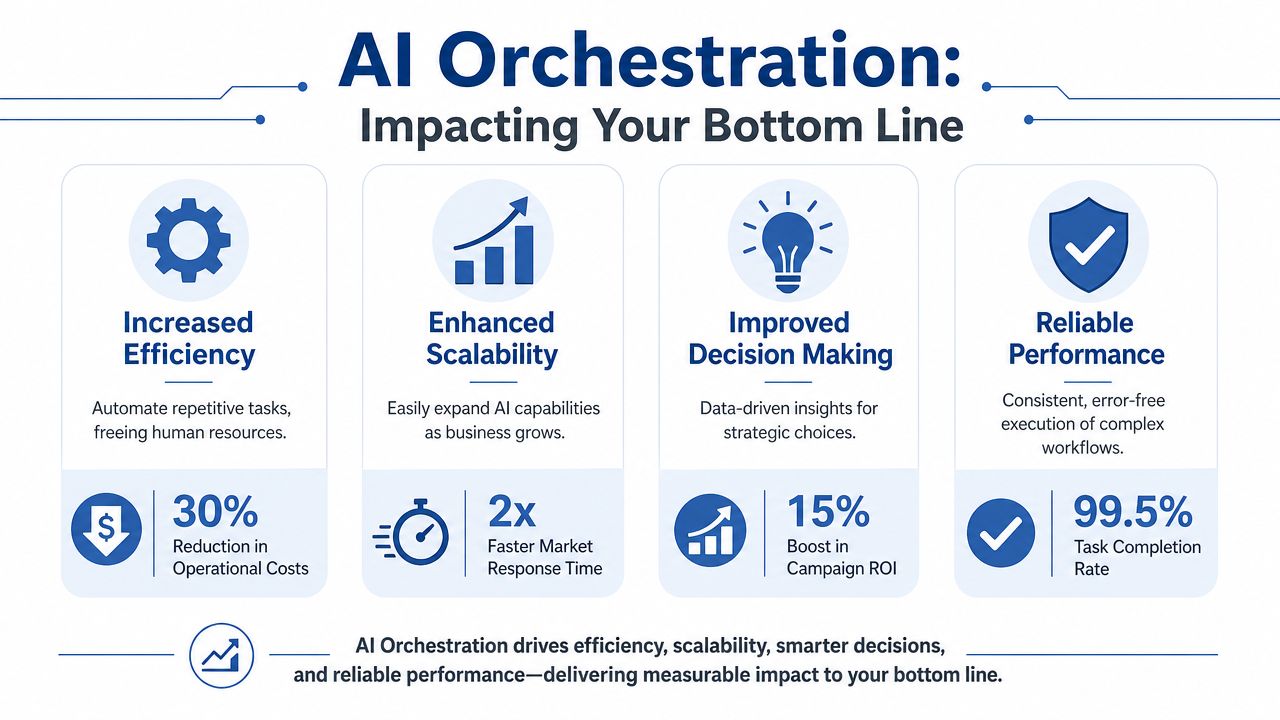
The cleanest proof of the gap comes from Redis. Research on multi-agent systems in production environments, as cited by Redis, shows that orchestrated approaches achieve 100% actionable recommendations, whereas uncoordinated multi-agent systems fail badly with only a 1.7% success rate for actionable outcomes in their breakdown of AI agent orchestration.
That gap is the difference between a usable system and a very expensive demo.
What your business actually gets
When orchestration is working, your business gets a chain of command for AI.
One layer decides which agent should act, what data it can access, which rules it must follow, and how its output gets handed off. That layer also logs decisions, manages workflow state, and makes human approval possible when the task crosses risk boundaries.
Here's what that changes in business terms:
| Business need | What orchestration does |
|---|---|
| Faster execution | Routes work automatically instead of waiting for humans to push tasks between tools |
| Better consistency | Forces agents to use the same context, rules, and expected output formats |
| Lower operational drag | Cuts rework caused by duplicated research, conflicting drafts, and missed handoffs |
| Safer automation | Creates checkpoints for approvals, compliance, and auditability |
Without that structure, each agent behaves like a subcontractor working from partial instructions.
Why this matters in revenue terms
Founders don't need more content drafts. You need campaigns, decisions, and actions that move without collapsing under review.
A well-orchestrated system protects margin in two ways. First, it reduces labor wasted on fixing AI output. Second, it increases the speed at which you can spot opportunities and ship responses before competitors do.
My practical rule: don't judge your AI stack by how many tasks it can start. Judge it by how many business-ready outputs it can finish.
That's why I steer away from “agent collections” and toward orchestrated workflows. Connecting APIs is easy. Building a governed system that behaves predictably under pressure is what creates competitive advantage.
Choosing Your Orchestration Architecture
Teams often choose architecture backwards. They pick the pattern that sounds advanced, then try to force the business into it.
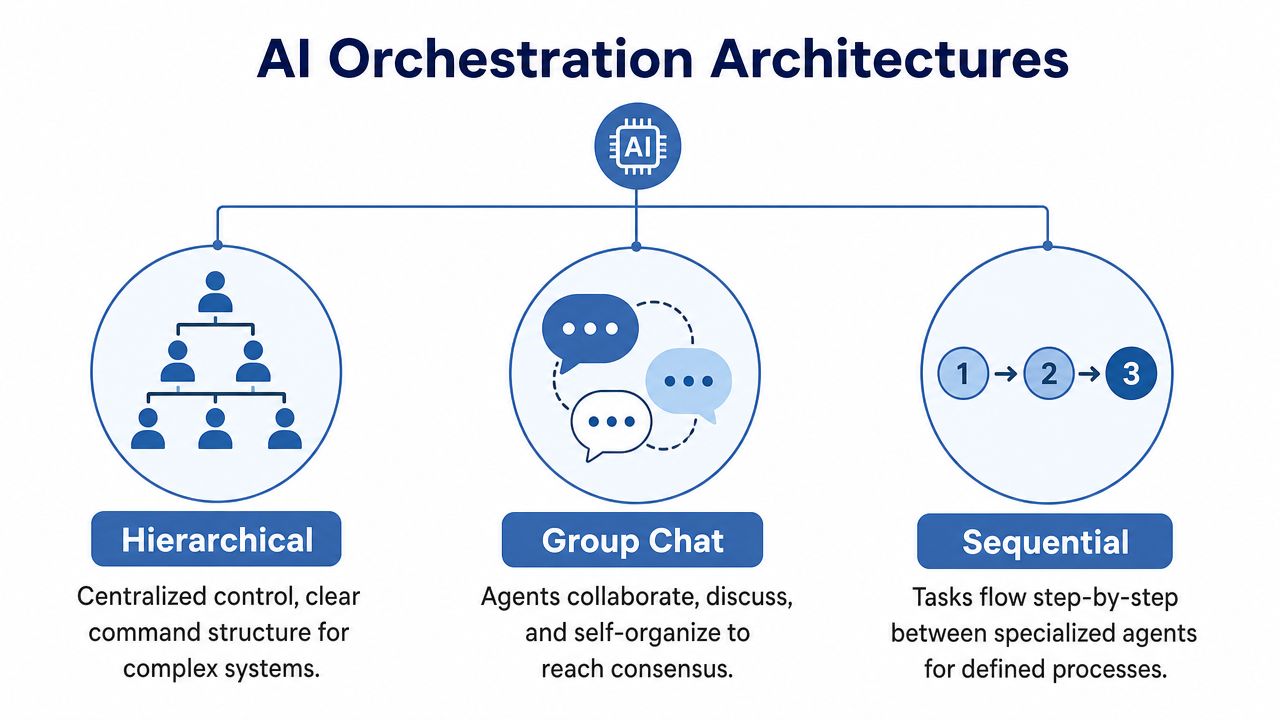
That's how you end up using a collaborative agent swarm for a process that should have been a strict approval chain, or a rigid sequential flow for work that needs parallel exploration. Architecture should follow business risk, workflow complexity, and the amount of autonomy you're willing to allow.
Sequential works when control matters
A sequential pattern is simple. Agent A finishes, then Agent B takes over, then Agent C completes the chain.
This is the right choice when your process has a clear order and low tolerance for deviation. Think lead qualification, compliance review, regulated document drafting, or a publish workflow where each output must pass a defined checkpoint.
Sequential flows fail when the work needs exploration. If you force creative ideation, market analysis, and strategy synthesis into a rigid line, you slow the whole system down and lose better options.
Group chat helps creativity and synthesis
A group chat pattern lets agents interact more freely. One agent proposes an angle, another critiques it, another adds customer objections, and another recommends a positioning shift.
That can work well for brainstorming, strategic planning, or open-ended research. It can produce sharper ideas than a strict assembly line because agents can challenge each other before a final answer is produced.
It's a bad fit for workflows where every action needs traceability and precise control. A free-form conversation between agents is harder to audit, harder to govern, and more likely to drift if the context layer is weak.
Use group chat when the cost of exploration is low and the upside of better ideas is high.
Hierarchical is best for complex execution
A hierarchical pattern introduces a supervisor. One orchestrator decomposes the task, assigns work to specialist agents, collects outputs, and decides what happens next.
I typically favor this approach for serious business operations. It mirrors how a well-run business already works. The owner sets the objective, specialists execute, and someone central resolves conflicts and keeps the process aligned to goals.
Hierarchical systems can still fail. If the supervisor has poor context or weak rules, it becomes a bottleneck that spreads mistakes across the whole workflow.
The real debate is orchestration and choreography
Most advice gets sloppy when people talk as if centralized orchestration and event-based choreography are mutually exclusive.
They're not.
For complex workflows requiring high agent autonomy, hybrid patterns are essential. O'Reilly's 2025 analysis found that pure orchestration fails when agents need autonomy, while pure choreography fails without saga patterns for compensation, as discussed in this O'Reilly analysis. In real systems, I want centralized control around goals, permissions, and state, with selective autonomy inside bounded tasks.
A simple decision lens
Use this lens before you build anything:
- Pick sequential when the process is repeatable, approval-heavy, and easy to map step by step.
- Pick group chat when the output benefits from debate, synthesis, and multiple points of view.
- Pick hierarchical when the workflow is complex enough to require delegation, oversight, and dynamic routing.
- Pick hybrid orchestration and choreography when you're building a broad agent ecosystem and certain tasks need autonomy without losing recoverability.
If you're trying to make that decision at the operating model level, my thinking aligns closely with this autonomous business operations framework because it forces architecture choices back to business intent instead of tool hype.
A Founder's Guide to Orchestration Frameworks
You don't need to write code to make a good framework decision. You do need to understand what each framework is optimizing for.
Some frameworks are great for quick experiments. Some are better when you need reliable retrieval, governance, or structured workflows. Some give developers flexibility but also invite unnecessary complexity if nobody sets standards early.
According to a 2026 poll of 800 global data leaders by Dataiku, 86% of organizations now rely on AI agents in their daily operations, making orchestration platforms the structural backbone that defines which agent acts, when, and with what authority, as covered in Dataiku's explanation of agent orchestration.
That matters because framework choice stops being a developer preference once agents touch core operations.
What to evaluate
When I look at frameworks from a business perspective, I care about three things first.
One, how quickly can you prototype and learn. Two, how much control do you get over workflow behavior, memory, and tool use. Three, what hidden cost shows up later in maintenance, observability, and governance.
A lot of teams focus on feature lists. That's the wrong lens. You want the framework that supports your operating model with the least unnecessary engineering overhead.
Orchestration Framework Comparison 2026
| Framework | Best For | Primary Trade-off |
|---|---|---|
| LangChain | Fast prototyping and broad ecosystem experimentation | Flexibility can create sprawl if your team doesn't impose strong patterns |
| LlamaIndex | Retrieval-heavy systems grounded in internal knowledge | Best value appears when data architecture is already reasonably organized |
| AutoGen | Multi-agent conversations and agent interaction experiments | Agent autonomy can become messy if governance and task boundaries are weak |
No single framework wins everywhere. The right choice depends on what you're building.
A practical way to choose
If you're still validating use cases, I'd rather see a framework that makes iteration fast and exposes workflow failures early. You're learning where the business logic breaks, where context is thin, and where humans still need to own decisions.
If you're moving toward production, framework priorities shift:
- Observability matters more, because you need to inspect runs, failures, handoffs, and decision paths.
- State management becomes essential, since multi-step workflows break when nobody owns memory and workflow status.
- Security and permissions move up the stack. Agents should only access what they need.
- Portability matters. You don't want business-critical workflows trapped in a brittle implementation.
The framework is only the vessel for the strategy.
I've seen companies waste months debating LangChain versus AutoGen when the underlying issue was that they had no shared context model, no approval rules, and no owner for orchestration design. Frameworks amplify good architecture. They also amplify bad decisions.
The Playbook for Deploying Your First Agent System
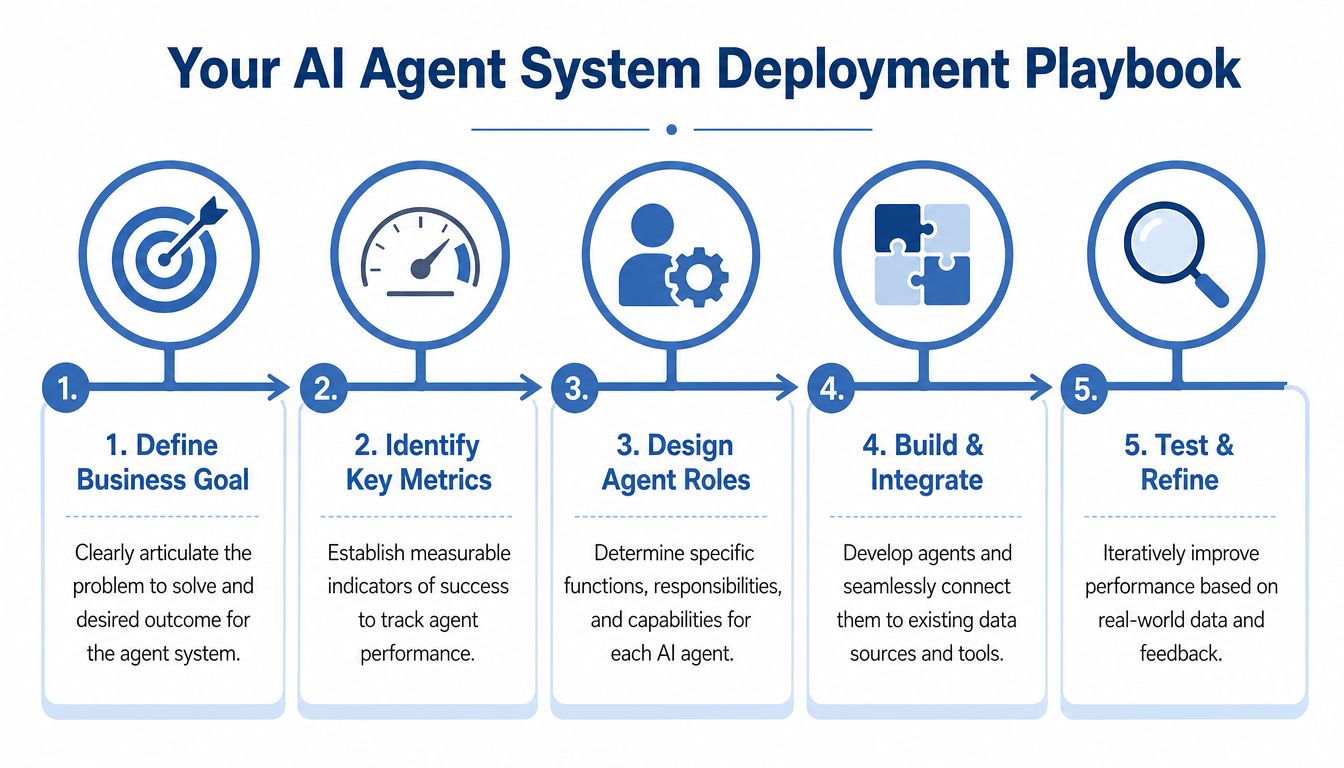
Most people start in the wrong place: with agents.
They sketch a research agent, a writer agent, maybe an ops agent, then wonder why the system falls apart when it touches real business data. The failure usually happens before the first workflow runs. The context foundation was never designed.
The most important fact in this whole conversation is this. The most underserved angle in AI agent orchestration is the need to build a shared, governed context layer first, and research says this gap causes 70% of enterprise agent projects to fail. The agents are rarely weak; the orchestration was never designed, as outlined in Atlan's guide to multi-agent system orchestration.
Start with the context layer
Before you deploy a single agent, build a governed context layer that every agent can read from and operate within.
That includes your business glossary, ownership rules, source-of-truth systems, workflow definitions, and the policies that determine what each agent is allowed to do. If one agent calls a customer “enterprise” and another classifies the same account as “mid-market,” your orchestration will produce polished nonsense at scale.
I want these pieces nailed down first:
- Write a business glossary with owners, defining terms like qualified lead, churn risk, expansion account, approved offer, and brand-safe claim.
- Map lineage between systems so you know where each important fact originates and which system is authoritative.
- Set governance rules that spell out which agents can access tools, write outputs, trigger actions, or request human approval.
- Agree on logging standards so every material action is inspectable later.
If you're evaluating builder options before the engineering layer is mature, a practical read on choosing the right no-code AI platform can help you avoid buying convenience that later blocks governance.
Then define the operating workflow
Once context is stable, define the workflow in business language before implementation language.
Who initiates the job. Which agent owns intake. What output format each specialist must return. Where approval happens. What triggers a retry. When the system should stop and hand work to a human.
A basic deployment sequence looks like this:
- Choose one business outcome, a workflow tied to pipeline, revenue operations, support quality, or campaign throughput.
- Map the handoffs by identifying every point where one role, system, or agent passes work to another.
- Assign narrow agent roles. Don't build “generalist genius” agents. Build specialists.
- Define human checkpoints, because some decisions should stay review-gated.
- Instrument before launch. If you can't inspect behavior, you can't govern it.
This video gives a useful visual frame for how these systems come together in practice.
What to watch once it goes live
A deployed agent system needs monitoring that goes beyond uptime.
You need to know whether agents are pulling the right context, whether handoffs are clean, whether outputs meet the expected format, and where humans repeatedly step in. Repeated intervention is a signal. Either the context is weak, the task boundary is unclear, or the wrong architecture was chosen.
I also want explicit safety controls in place:
- Set permission boundaries. An agent drafting content shouldn't automatically publish it.
- Add approval gates so high-risk actions require a person.
- Build fallback paths: when confidence is low or context is missing, route to human review.
- Keep audit trails, so you have a record of what happened and why.
For smaller teams building with limited internal resources, I've laid out a practical approach in how to deploy AI agents in a small team. The principle is the same. Start narrow, govern early, and scale only after the workflow behaves predictably.
Strong deployment starts with business memory, not model prompts.
Example: Deploying Agent-Based Marketing Automation
Marketing is one of the clearest places to see the value of orchestration because the handoffs are obvious. Research feeds strategy. Strategy feeds creative. Creative feeds activation. Activation feeds reporting.
When those steps are disconnected, you burn time translating work between tools. When they're orchestrated, the system behaves more like a coordinated growth unit.
The three-agent marketing system
Let's take a simple but powerful setup.
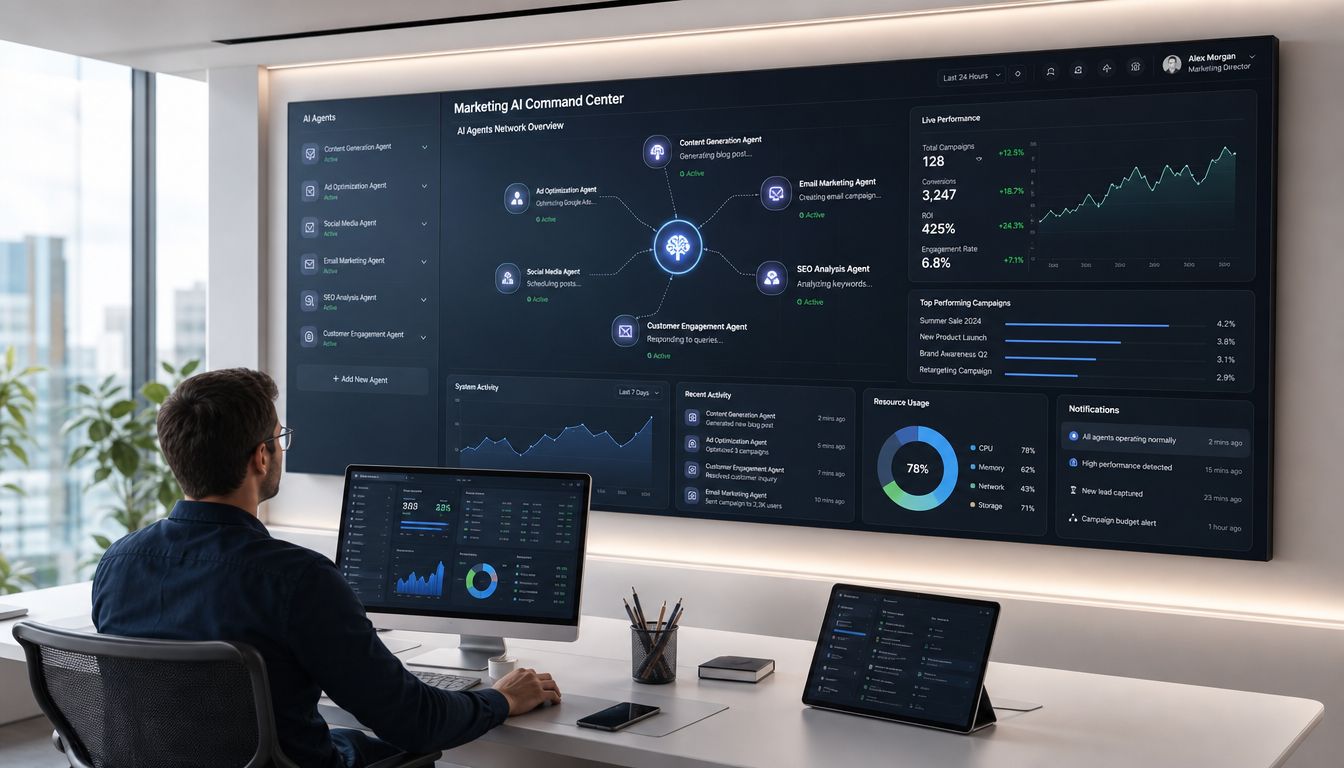
The first agent is Market Watch. It monitors competitor messaging, offer changes, landing page shifts, and content angles. The second is Creative Strategist. It turns those inputs into campaign concepts, hooks, ad variations, email angles, and landing page messaging. The third is Activation Ops. It packages approved assets and pushes them into your execution stack such as HubSpot, Klaviyo, Meta Ads, LinkedIn scheduling tools, or your internal content calendar.
This is where orchestration matters. Market Watch sends structured insight instead of dumping random notes into a Slack channel. Creative Strategist writes from governed inputs rather than from scratch. Activation Ops only moves approved assets in the correct format to the right destination.
According to my own work on AI agents for business, in marketing automation, AI agent orchestration reduces campaign development time by 50% while enabling the capture of untapped market segments through real-time competitor monitoring and dynamic angle drafting.
That's the business win. Faster campaign creation and sharper positioning.
Where competitors lose ground
Most competitors still operate with fragmented intelligence.
One person notices a competitor move late. Another person writes a reaction days later. A third person struggles to turn that into launch-ready assets. By the time the campaign is live, the market moment has passed.
An orchestrated setup closes that loop:
- Research arrives faster, so competitive shifts are captured while they still matter.
- Creative response gets sharper, because messaging is drafted against live market signals instead of stale assumptions.
- Activation happens with less drag, and assets move into distribution without the usual copy-paste chaos.
If email is part of the system, infrastructure matters there too. Teams that automate outreach without protecting inbox performance usually learn that lesson the hard way. Resources on email deliverability for AI Agents are useful because orchestration should cover channel health as well as content generation.
The best marketing agent systems let you respond to the market before slower competitors can reorganize.
A checklist you can use tomorrow
Work through this yourself, or with whoever helps you on marketing:
- Decide what competitor, customer, or market inputs the system watches.
- Standardize the output format so research arrives in a structure creative can practically use.
- Set brand and approval rules, because creative agents need clear boundaries.
- Limit activation authority. Publishing should remain gated until the workflow proves itself.
- Track response loops by measuring where campaigns stall, get revised, or require human rescue.
If you want a deeper blueprint for this exact use case, AI agents for marketing is where I'd point you once you're ready to put it into practice.
The Future Is a Coordinated AI Workforce
The next competitive divide won't come from who has access to AI.
It will come from who can coordinate it.
Right now, many businesses are still treating AI like a collection of clever assistants. That phase doesn't last. Once agents touch research, operations, campaign execution, support, and decision-making, the winning companies will be the ones that build a disciplined system around them.
That's why I treat AI agent orchestration as business infrastructure rather than a side project or a novelty layer on top of SaaS tools.
Companies that get this right will operate with tighter feedback loops, cleaner execution, and better strategic visibility. They'll spot opportunity sooner, act faster, and waste less human talent on process glue.
You and I are heading toward a world where businesses run a coordinated AI workforce on top of their AI tools.
The owners who build that operating model early will be much harder to catch.