
You’re reading articles about AI while your competitors are deploying it. Beyond using ChatGPT or Claude to write emails, they’re building AI agents: autonomous systems designed to execute complex tasks, drive revenue, and clear out operational bottlenecks.
Your Competitors Are Already Building AI Armies
I’ve been working with machine learning since 2016 and generative AI since 2019. What I’m seeing now is an arms race. The market is splitting into two camps: people who talk about AI, and people who put it to work.
Businesses building ‘bionic’ systems with AI agents are opening a gap that is hard to close. For some rivals, it will be wide enough to put them out of business.

Speed as a Weapon
Picture a competitor that gathers market intelligence, processes it, and acts faster than you can schedule a meeting. That’s the gap.
Their sales agent just analyzed 10,000 leads, scored them against their ICP, and fired off personalized outreach to the top 500. All in the time it took you to drink your coffee. You’re still fumbling with a spreadsheet.
Meanwhile, their marketing agent monitors your ad spend in real-time, finds weaknesses in your messaging, and drafts counter-campaigns. By the time you review last week’s data, they’ve already launched a campaign aimed at your customers.
The prize is operating at a speed a human-only team physically can’t match. Incremental efficiency is a side effect.
A Practical Roadmap to Real Revenue
I’m not here to feed you academic theory or buzzwords. You and I are going to build a practical roadmap for deploying AI agents that actually make you money. Forget the science fiction fantasies of some all-knowing AI.
I’m going to focus on tangible business outcomes:
- Accelerating revenue by automating lead generation and qualification at scale.
- Clearing the operational bottlenecks that drain your resources and choke growth.
- Building a durable competitive moat based on superior intelligence and execution speed.
Start with small, high-impact wins and scale from there, adding one agent at a time. That’s how you stop reacting to your market and start setting the pace.
What an AI Agent Is and Why It Matters to Your Bottom Line
Let’s clear the air. Most people hear “AI” and think of chatbots. That’s a dangerous oversimplification. It’s like comparing a pocket calculator to your entire finance department.
An AI assistant helps a human complete a task. An AI agent for business owns the task from start to finish. It’s a subtle distinction with massive consequences for your revenue. The agent drafts the email and then runs the entire outreach campaign on its own.
This is the key difference you need to grasp. An agent is a system with a goal. It perceives its environment, makes decisions, and takes action to achieve that mission. You are deploying a new type of digital workforce.
From Simple Tool to Autonomous Workforce
Think about a typical sales process. You use tools: a CRM, an email client, a prospecting database. An agent is the process.
Give it a mission: “Generate 50 qualified meetings this month.” It will then:
- Research your ideal customer profile in your CRM and on LinkedIn.
- Identify high-fit prospects and find their contact information.
- Draft personalized, multi-touch outreach sequences.
- Execute the campaign, sending emails and scheduling follow-ups.
- Analyze engagement and report back on what’s working.
That behaves like an employee who works 24/7 without getting tired, and it frees you for higher-value work. To see this in action, consider how Intelligent Document Processing Software functions, automating the extraction of data from invoices without human intervention. That’s agent-level thinking.
The shift from AI tools to AI agents is the single biggest opportunity for creating competitive advantage right now. Businesses that get this right will operate at a speed and scale their rivals will struggle to match.
The market is already moving aggressively. Projections show that by 2026, 40% of enterprise applications will embed task-specific AI agents. In customer service, 30-35% of large enterprises already deploy agents for first-line support, autonomously handling up to 65% of inquiries and slashing costs by 20-30%.
Different Agents for Different Missions
Not all agents are created equal. You wouldn’t ask your accountant to run a marketing campaign. You deploy different agents for different jobs. For example, the systems I build for customer acquisition are detailed in my guide to AI marketing agents.
You and I will focus on two main categories:
- Task-specific agents are specialists. One agent does market research. Another exclusively manages ad spend. They are the easiest to build and deliver the fastest ROI.
- Autonomous multi-agent systems are teams of specialized agents that collaborate. One researches, another writes copy, and a third analyzes performance, all orchestrated by a “manager” agent to achieve a broad business goal.
Understanding this architecture is your first step. It lets you map these systems directly to your own operational bottlenecks.
How AI Agents Create an Edge in Your Business
Theory is useless without a straight line to revenue. Here are the specific ways AI agents for business are creating an edge right now. In some cases the gains are large enough to leave slower competitors behind for good.
These agents create advantages across every function of your business. Beyond speed, they let a small business do work that was out of reach before. That changes what a business your size can take on.
To make this concrete, let’s look at how agents can be deployed across core business functions. The table below outlines specific problems, the actions an AI agent takes, and the tangible outcomes you can expect.
AI Agent Deployment by Business Function
| Business Function | Problem Solved | AI Agent Action | Measurable Outcome |
|---|---|---|---|
| Marketing | Blind spots in competitive strategy and slow campaign iteration. | Continuously monitors competitor ads, messaging, and content. Identifies market gaps and drafts new campaign angles in real-time. | 50% reduction in campaign development time; capture of untapped market segments. |
| Sales | Sales reps waste time on low-value, non-revenue tasks. | Connects to lead databases, scores prospects against an ICP, and initiates hyper-personalized outreach to the top 10%. | 40% increase in qualified meetings booked; 3x higher sales team productivity. |
| Operations | Reactive management of supply chain and inventory, leading to costly disruptions. | Connects to inventory systems and supplier APIs. Predicts future shortages and automatically places orders with alternate suppliers. | 95% reduction in stockouts; 20% decrease in operational downtime. |
| Customer Support | High-volume, repetitive customer inquiries overwhelm human agents. | Integrates with knowledge base to instantly resolve Tier 1 tickets. Escalates complex issues to human agents with full context. | 70% reduction in support ticket volume; 30% increase in customer satisfaction (CSAT). |
As you can see, the impact spreads across the whole business and compounds over time into an advantage that lasts.
Marketing Agents That Win the Market
In marketing, speed and insight are everything. Deploy an agent that continuously monitors your top five competitors' ad spend, social messaging, and content. It collects the data and turns it into a short strategic brief.
This agent can spot a gap in market positioning in real-time. It might detect a competitor has pivoted their messaging away from a key customer pain point. Instantly, it proposes three new campaign angles to exploit that gap, complete with draft copy.
Your role shifts from tedious research to approving what the agent proposes. By the time your competitor realizes their mistake, you've already reached that segment of the market, well before a monthly review would have caught it.
Sales Agents That Close at Scale
In sales, your most valuable asset is time. Yet salespeople spend 60-70% of it on non-revenue-generating activities like lead qualification and manual outreach. An AI agent eliminates this bottleneck entirely.
Consider a sales agent with one mission: "Fill the pipeline with qualified leads." It connects to your lead databases, sifts through thousands of prospects, and scores them against your ideal customer profile.
The agent then initiates a hyper-personalized outreach sequence for the top 10% of those leads. It pulls context from their recent LinkedIn activity or company news to craft a compelling opening line. You can learn more about these specialized systems in my deep dive on building powerful AI sales agents.
An AI agent can run more personalized outreach in one hour than a human can in a week. You focus on closing deals with warm prospects, which raises sales velocity.
Operations Agents That Prevent Failure
In operations, chaos is the enemy. A single supply chain disruption can halt your business. An operations agent acts as a vigilant, predictive manager for your entire backend.
Picture an agent connected to your inventory system, supplier APIs, and global shipping trackers. Beyond telling you when you're low on stock, it predicts a shortage three weeks from now because it detected a weather event near a key supplier's port.
Based on this prediction, it automatically places a re-order with an alternate supplier. This agent moves your operations from fire-fighting to planning ahead.
Each of these workflows is faster, more accurate, and more scalable with an agent at the helm. Stack a few of them and your business runs faster than competitors who still do this work by hand.
The Three Patterns for Building Your First AI Agent
Building your first AI agent sounds impossibly complex, but it isn't. After deploying dozens of these systems, I've found that nearly every successful agent boils down to one of three core patterns.
You don't need a multi-agent swarm or a custom model to start. You need a blueprint. These are the exact patterns you can use to get a valuable agent live inside your business in weeks, not years.
The timing matters. The market for enterprise AI agents is projected to hit $5.09 billion by 2025 with a 22.3% compound annual growth rate. This growth is driven by demand for automation that delivers real cost savings and productivity gains, often in the 20-30% range.
Pattern 1: The Researcher-Analyst
The first and simplest pattern is the Researcher-Analyst. Its mission is pure intelligence gathering and synthesis. This agent connects to external data sources (APIs, websites, databases) to find, filter, and analyze information, then delivers a concise report.
Think of it as a tireless market intelligence intern who never sleeps.
- The goal is to answer a specific business question with data-backed insights.
- An example mission: "Monitor our top three competitors' product launches, customer reviews, and pricing changes daily. Provide a summary of strategic shifts by 8 AM."
- It uses web scraping libraries (like Beautiful Soup), API connectors, and a simple database to store findings.
- A model like GPT-4 or Claude 3 Opus handles the final analysis and turns raw data into a strategic brief.
This pattern is the perfect starting point. It’s low-risk, doesn't require deep integration, and delivers immediate value by giving you better intelligence. You build this to out-think your competition.
Pattern 2: The Orchestrator
The second pattern is the Orchestrator. This agent acts as a central hub, connecting multiple tools to automate a complex, multi-step business process. It finds information and then takes action across your existing software stack.
This is where you automate entire workflows that drain your time.
The Orchestrator pattern is the bridge between AI insight and business action. Once you know what needs doing, it gives you a system that does it for you.
Imagine a lead nurturing process. Normally someone (often you) juggles a CRM, an email platform, and a scheduling tool. An Orchestrator agent handles all three in one run.
- The trigger is a new lead entering the CRM (e.g., Salesforce).
- Action 1 is a query to the CRM API for lead details.
- Action 2 uses a tool like Clearbit to enrich the data.
- Action 3 selects the appropriate email sequence based on the enriched data.
- Action 4 sends the outreach through an email API (like SendGrid).
- Action 5 books a meeting through a calendar API when the lead replies positively.
This pattern is more complex due to API integrations. However, its ROI is massive. It directly impacts revenue-generating activities and frees you to focus on closing deals. You build this to out-execute everyone else.
Pattern 3: The Creative Assistant
The final pattern is the Creative Assistant. This agent manages an entire creative workflow, from ideation and drafting to scheduling and performance analysis. It maintains a memory of what works to continuously improve its output.
It works alongside whoever handles your marketing (often you) instead of replacing them.
- The goal is to manage and scale a content pipeline while keeping the brand consistent.
- An example mission: "Generate and schedule five on-brand social media posts per week based on trending industry topics and past high-performing content."
- The architecture is heavier. It needs an LLM for generation, access to analytics tools, and a persistent memory (often a vector database) to store brand guidelines and performance data.
The trade-off is complexity. Building a reliable memory and feedback loop is involved. But the payoff is a content engine that scales without much extra effort, so you can keep a steady presence in your niche without hiring. You build this to out-create your rivals.
Your Roadmap from Pilot Project to Full Production
Getting your first AI agent live is the hardest part. The technology is rarely the hard part. Inertia and fear are. That’s why you and I will focus on a clear, 90-day pilot project designed to deliver a quick, undeniable win.
Pick a real business problem to solve. "Implementing AI" just to say you did it proves nothing. The goal is to build momentum and prove value fast, enough to convince any skeptic, including the one in your own head.
Day 1-30: Identify the Perfect Pilot
First, find the perfect use case. Look for the sweet spot where high business value meets low technical complexity. Avoid trying to boil the ocean. A small, contained problem is your best friend.
A good pilot candidate is:
- It's repetitive and rule-based, done over and over with a predictable pattern.
- It's high-volume, so automating it delivers significant, quantifiable time savings.
- It relies on data: the task involves gathering, processing, or acting on structured information.
Don’t settle for a vague goal like "improve marketing." Get specific: "Reduce customer response time by 40%" or "Automate initial qualification for 80% of inbound leads." This specificity is non-negotiable. It’s how you prove ROI.
The flowchart below shows the three core agent patterns. Think about which one best fits your pilot project.
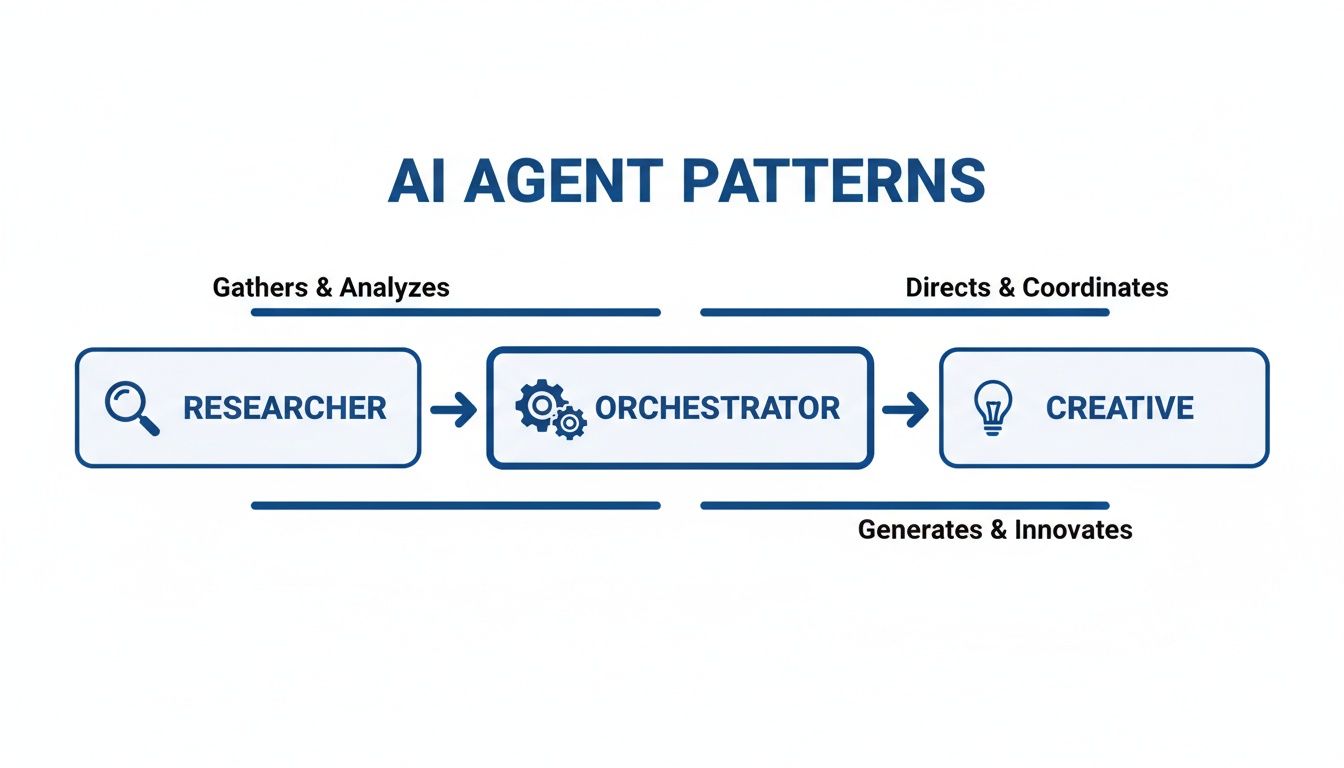
Mapping your pilot to one of these patterns simplifies the architecture and speeds up development.
Day 31-75: Build and Supervise
With your mission defined, it's time to build. This phase is all about rapid iteration with one element you can't skip: human-in-the-loop (HITL). Your agent should never operate in a black box. At first, it runs its tasks and then presents its actions for a human to review before anything is finalized.
This accomplishes two things. First, it builds trust. Anyone working with you sees the agent as an assistant rather than a replacement. Second, it creates an essential feedback loop. Every time a human corrects the agent, it learns and improves. For a deeper handle on structuring these instructions, explore the differences between context engineering vs prompt engineering.
Treat the human-in-the-loop stage as a permanent feature of a responsible AI system rather than a temporary crutch. It's your safety net for handling edge cases and maintaining quality control.
Day 76-90: Measure, Prove, and Plan for Scale
In the final month, measure your pilot against the KPIs you set on day one. Did you hit that 40% reduction in response time? Great. Now, write that result up as a simple business case, even if the only reader is you. Show the direct line from the agent's actions to the bottom line.
Once your pilot proves its worth, the conversation shifts to scaling. This is where most organizations get stuck. By 2028, Gartner predicts a 33-fold increase in agentic AI apps, yet less than 10% of organizations have successfully scaled AI agents. A clear roadmap bridges this chasm.
Scaling means more than copying your pilot. You need clear rules for what each agent may touch, locked-down data security, and a formal feedback loop. This is how you build a reliable AI workforce without accidentally breaking your business.
Measuring Success and Avoiding Common Pitfalls
"If you can't measure it, you can't manage it." This is doubly true for AI agents for business. Your standard software metrics won't cut it. You need a new dashboard focused on what moves the needle: cost reduction, revenue growth, and competitive edge.
Enthusiasm proves nothing. Hard numbers do. Having an agent counts for nothing until that agent generates tangible business value. That means you track its performance relentlessly.

Defining Your Agent KPIs
Your metrics should fall into three buckets: operational, financial, and strategic.
- Task completion rate is the operational metric. What percentage of tasks does the agent complete without human intervention? A rate below 90% is a red flag. It means something is wrong with your tools, data, or instructions.
- Cost per task is the financial metric, and it's where the rubber meets the road. Calculate the total cost (API calls, compute power, fees) and divide it by successful tasks. You must compare this to the cost of a human doing the same thing. That's how you prove ROI.
- Business value generated is the strategic metric, and the one that matters most. Did the sales agent generate $50,000 in new pipeline? Did the support agent cut ticket resolution time by 40%? Tie its work directly to a core business KPI.
These are the vital signs of your agents. They tell you exactly where each agent is paying for itself.
To make this practical, here’s a simple framework you can use to start tracking the performance and ROI of your AI agents. It forces you to connect the dots between what the agent does and the value it creates.
Agent KPI Tracking Template
A practical framework for measuring the ROI of your AI agents, focusing on operational, financial, and strategic metrics.
| Metric Category | KPI | How to Measure | Why It Matters |
|---|---|---|---|
| Operational | Task Completion Rate | (Successful tasks / Total tasks) x 100 | Measures reliability and effectiveness. Below 90% signals problems. |
| Operational | Error Rate | (Tasks with errors / Total tasks) x 100 | Highlights issues needing technical refinement or better instructions. |
| Financial | Cost Per Task | (Total operational cost / Successful tasks) | Directly compares agent cost-efficiency to human labor. |
| Financial | Human Hours Saved | (Avg. time per task x # of tasks) – Human review time | Quantifies the direct productivity gain and frees up your team. |
| Strategic | Revenue Generated | Direct attribution from agent-led activities (e.g., leads) | Ties agent activity directly to top-line growth. |
| Strategic | Customer Satisfaction | CSAT/NPS scores for agent-handled interactions | Shows if automation is improving or harming the customer experience. |
This template is a starting point. The key is to be disciplined about tracking these numbers from day one, so you can make informed decisions.
The Pitfalls That Will Kill Your Project
Now, let’s talk about what goes wrong. I’ve seen more AI agent projects die from simple, avoidable mistakes than from technical failures.
The biggest mistake you can make is trying to automate a broken process. An AI agent is an amplifier; if your process is flawed, the agent will just help you do the wrong thing much faster.
Another project-killer is ignoring governance and data privacy. What data can the agent access? Who is responsible if it makes a costly error? Answer these questions before a disaster. A single breach can get your entire AI program shut down for good.
Knowing When Not to Use an AI Agent
Finally, sometimes the most strategic decision is knowing when not to use an AI agent. They are not a silver bullet.
Some tasks require uniquely human skills. High-stakes negotiations, complex strategic planning, and moments demanding genuine empathy are terrible fits for automation. Deploying an agent for these tasks will fail, and it will damage your relationships with customers and your own team.
Knowing an agent’s limits matters as much as knowing its potential. It keeps you from spending months on the wrong build.
Frequently Asked Questions About AI Agents
You have questions. I get it. I hear the same ones from founders and small business owners every week as they map out how to bring AI agents into their operations. Let’s get you direct, practical answers.
How Is an AI Agent Different from a Chatbot?
Think of it this way: a chatbot is a glorified search bar. You ask it a question, it fetches an answer. It’s reactive.
An AI agent works more like a capable employee. You give it a mission, and it uses multiple tools (your CRM, analytics, public data) on its own to execute a complex plan to achieve that goal.
A chatbot answers a question about your return policy. An agent processes the return, updates inventory, drafts a confirmation email, and creates a follow-up task. One is passive information retrieval; the other is active problem-solving.
What Does It Actually Cost to Build and Run an AI Agent?
This is the most common question I get. The honest answer: it depends entirely on the mission. A simple “Researcher-Analyst” agent might cost just a few hundred dollars a month in API calls. A sophisticated “Orchestrator” agent connecting to multiple business systems will have higher development costs.
But the number to judge it by is ROI.
If your sales agent costs $1,000 a month but generates $20,000 in new pipeline, it’s a no-brainer. Start small, prove the value on a contained project, and scale your investment based on clear financial returns.
Can a Small Business Realistically Use AI Agents?
Absolutely. This is your biggest opportunity to punch above your weight class. While 93% of companies use AI, large enterprises are at 55% adoption, compared to just 17% for small businesses.
This gap is your advantage. You can move faster. You can deploy specialized agents to automate tasks that would otherwise require new hires, letting you compete on intelligence instead of headcount. You can explore more about these AI adoption trends on ventionteams.com.
What’s the Biggest Barrier to Getting Started?
Talent is the usual barrier, far more often than technology. Over 70% of companies point to the internal skills gap as the major hurdle holding back their AI initiatives. Finding people who understand both a business process and agentic architecture is rare.
This is why starting with a well-defined pilot project is so important. It lets you, or a small focused team, build real-world expertise and show value quickly. That success creates the momentum you need to bring everyone else up to speed.
Don’t try to hire an AI team overnight. Build a single agent, get good at running it, and expand from that first win.