
Let’s be blunt. You are working too hard for too little. While you’re stuck in endless review cycles, your competitors are using generative AI to create, test, and launch campaigns at a speed you can’t possibly match. Some of them are already taking market share from you while you sleep.
This guide is about business results. I’ve worked with AI since 2016, long before it was a headline, and I’ve seen what works. Here are the strategies I’ve tested for turning AI from a buzzword into a tool that wins you customers.
Why Your Competitors Are Winning with Generative AI

The tension in the market is palpable. You and I both know that while you manually craft campaigns, your rivals are using AI to generate hyper-personalized content at scale. They’re showing up in channels where you’re just trying to keep up.
This is a race for revenue.
The New Competitive Edge
The old way of marketing is dead. Linear funnels, broad demographic targeting, slow A/B testing cycles: it’s all fading into irrelevance. Your competitors are using AI to understand customer intent in real-time and close sales faster than ever before.
Microsoft’s internal research found that purchasing behaviors increased by 53% within 30 minutes of a user interacting with its AI, Copilot. That’s the speed you’re up against. Your rivals are capitalizing on these micro-moments to capture revenue before you even know an opportunity exists.
This is a zero-sum game. Every customer won by a competitor’s AI-driven, hyper-relevant message is a customer you have lost. Market share is actively being reallocated to the companies that adapt the fastest.
Your choice is simple. Adapt by building what I call a “bionic” marketing system (one that amplifies your own talent) or get left behind.
Building Your Bionic Marketing System
A bionic system makes you and your best people ten times more effective. It automates the low-value, repetitive work so you can focus on what truly matters: high-level strategy and creative breakthroughs that drive revenue. This is how you win.
Think about it this way:
- You go from campaign idea to launch in hours, not weeks.
- You move beyond segments to true one-to-one messaging.
- You free yourself from grunt work to focus on strategic wins.
I’ve seen this transformation firsthand. The companies that embrace generative AI for marketing are building a competitive advantage that lasts, and they are leading the shift. I’ll show you how to join them.
Where to Deploy AI for a Decisive Marketing Advantage
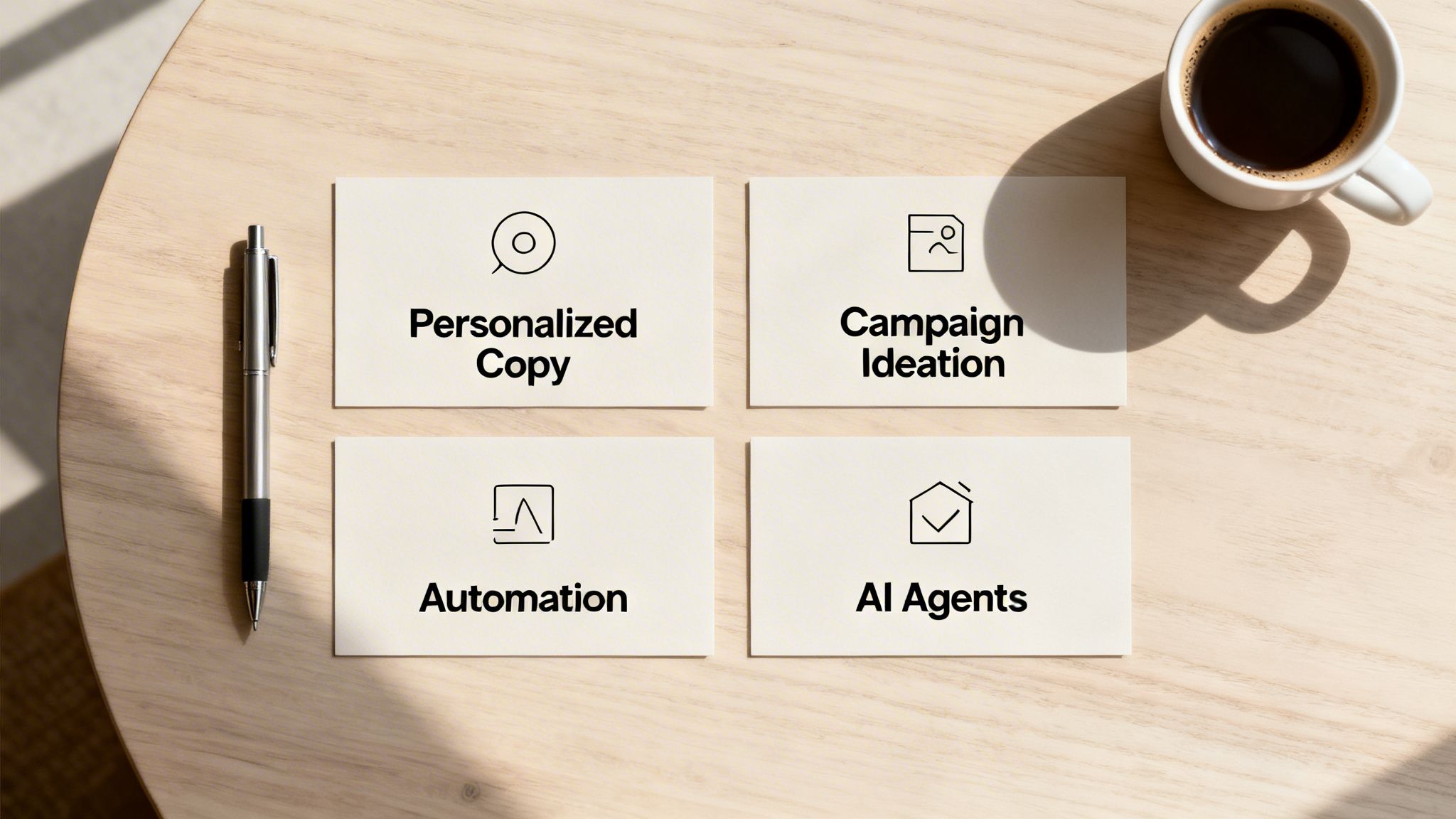
Now that you get the big picture, let’s get tactical. You win with surgical strikes on the exact spots where AI delivers the highest return on investment. Throwing it at every problem wastes money. Focus on workflows where speed, scale, and personalization create a real competitive advantage.
I’ve been in the trenches applying this stuff since 2019, and I’ve found real success comes from focusing on four core areas. These are applications I’ve tested, and they directly affect your bottom line.
1. Scaling Hyper-Personalized Copywriting
Your competitors are still writing one ad, one email, one landing page for thousands of people. With generative AI, you can write thousands of versions for specific segments, or even for individuals. This is radical relevance at a scale that was impossible just a few years ago.
Imagine feeding an AI your customer data and a core message, then getting back 50 unique email subject lines tailored to different pain points in seconds. This is how you craft messages that feel like a one-on-one conversation, directly boosting open rates and conversions in your B2B email marketing efforts.
The trade-off is quality control. You can’t just “set it and forget it.” Without a strong brand voice guide and a human in the loop, you risk producing generic, off-brand content that does more harm than good. Start small and prove the wins.
2. Accelerating Campaign Ideation and Testing
The old way of running marketing campaigns is painfully slow. Weeks are spent on brainstorming and approvals before a single ad sees the light of day. Generative AI breaks this model by acting as a brainstorming partner that never runs dry.
You and I can take a single brief and use an AI to generate five distinct campaign concepts in minutes. Each with core messaging, audience profiles, ad copy, and even visual ideas. This speed means A/B testing becomes A/B/C/D/E testing. You find winning campaigns faster than competitors who are still stuck in meeting rooms.
3. Automating Operational Marketing Tasks
Every marketer is drowning in repetitive, low-value work. Summarizing meeting notes, repurposing blog posts into social media threads, analyzing customer feedback, writing basic reports. These tasks drain your creative energy and kill momentum.
Deploying generative AI for marketing automates this grunt work. A simple AI automation can take a new customer testimonial, pull out the key benefits, and draft three social media posts celebrating that feedback. This frees up your brainpower for high-impact activities that actually drive revenue.
4. Deploying AI Agents as a Market Intelligence Network
This is where you build a true strategic advantage. An AI agent is an autonomous system that can reason, plan, and execute multi-step workflows. Think of them as your 24/7 market intelligence analysts, a concept I explore in depth in my work on the power of autonomous AI agents.
I help businesses build agents that monitor competitors’ websites, analyze their messaging, and draft a counter-positioning brief for you. Another agent can track industry news and automatically create weekly intelligence reports. The market for these capabilities is exploding, projected to grow from $91.57 billion in 2026 to $400 billion by 2030. You can find more details in this comprehensive generative AI market overview.
Start with the simpler use cases above. Build your foundation. Then deploy these powerful agents to create a moat around your business that your competitors can’t cross.
Choosing Your AI Model: A No-BS Guide for Marketers
Picking the right AI model for a marketing task is like choosing between a scalpel and a sledgehammer. Use the wrong one, and you’ll make a mess, waste time, and get terrible results. The market is a confusing mess of options (ChatGPT, Claude, Gemini, plus a dozen open-source models), and the marketing hype from AI companies just makes it worse.
Let’s ignore the noise. You don’t need a Ph.D. in model architecture. You need a practical way to pick the right tool for the job, one that’s tied to actual business goals. This decision directly shapes your campaign’s performance, your budget, and how well you can scale your efforts.
The “Big Three” Frontier Models
For most of the businesses I work with, the choice boils down to one of the “big three” frontier models. These are the powerful, all-purpose AIs that are good at almost everything, from writing copy to analyzing strategy. Each one has its own quirks and strengths, and knowing them is key to building a truly effective AI stack.
This is where you have to think like a strategist. Generative AI for marketing is taking off, with 92% of businesses planning to ramp up their investment. While ChatGPT has a huge 73-76% market share, the smartest marketers I see are diversifying. They’re adding models like Gemini, which is already grabbing 13-16% of the market, to create more resilient, multi-model automations. If you’re interested in the data behind this shift, you can learn about AI marketing statistics that break these trends down further.
Here’s my take, based on years of using these models to grow businesses:
-
OpenAI’s GPT-4 family (via ChatGPT or API) is your creative engine. When you need serious creative firepower, such as thinking up a completely new campaign angle, writing clever ad copy, or solving a complex marketing problem, GPT-4 is almost always my first choice. It follows nuanced instructions incredibly well, which makes it a beast for anyone serious about prompt engineering.
-
With Anthropic’s Claude 3 family, the killer feature is its massive context window. If you need an AI to read, remember, and perfectly apply your 50-page brand voice guide across all its outputs, Claude is the answer. It’s my go-to for analyzing long research reports or summarizing thousands of customer reviews without losing the plot. It excels at maintaining brand consistency at scale.
-
Google built its Gemini family to be a multi-modal workhorse that’s deeply plugged into its own ecosystem. That native connection to Search, Ads, and Analytics gives it a real advantage for data analysis and pulling in real-time information. It’s also often cheaper, which makes it a smart choice for high-volume tasks where “good enough” is all you need and speed is more important than pure creative brilliance.
To make this even more practical, let’s break down which model to use for specific marketing jobs. Think of this as your cheat sheet for picking the right tool.
Model Selection Framework for Marketing Tasks
The question is which model is best for a specific task, rather than which is “best” overall. Cost, creativity, and context are all part of the equation.
| Marketing Task | Best Fit Model (e.g., GPT-4, Claude 3, Gemini) | Why It Wins (e.g., Creativity, Context Length, Cost) | When to Avoid |
|---|---|---|---|
| Net-New Campaign Ideation | GPT-4 Turbo | Creativity & Reasoning: Excels at novel connections and complex brainstorming. | When you have a tight budget for high-volume, simple tasks. |
| Ad & Social Media Copywriting | GPT-4 Turbo / Claude 3 Opus | Creativity & Nuance: GPT-4 for wit; Claude for brand-aligned, emotional tone. | If you just need quick, basic headlines, Gemini is more cost-effective. |
| Long-Form Content (Blogs, Whitepapers) | Claude 3 Opus | Context Length: Can handle massive brand guides and source documents consistently. | For short-form content where its large context is overkill and costly. |
| Brand Voice Adherence @ Scale | Claude 3 Opus | Context & Instruction Following: Unmatched for absorbing and applying brand guidelines. | When the task doesn't require strict brand adherence. |
| SEO Keyword Analysis & Clustering | Gemini 1.5 Pro | Data Analysis & Cost: Efficiently processes large keyword lists and finds patterns. | For tasks requiring deep creative strategy beyond just clustering data. |
| Personalized Email Automation | Claude 3 Sonnet / Gemini 1.5 Pro | Cost & Speed: Good balance of capability and cost for high-volume personalization. | When hyper-personalization requires the advanced reasoning of GPT-4. |
| Summarizing Customer Feedback | Claude 3 Haiku / Sonnet | Context & Cost: Can analyze huge volumes of text (reviews, surveys) affordably. | If the feedback is short and simple; Gemini might be cheaper. |
| Market Research Data Synthesis | Gemini 1.5 Pro | Real-Time Info & Integration: Can pull and synthesize current data from the web. | When the research requires nuanced interpretation of qualitative, non-public data. |
Choosing the right model is a strategic trade-off. By matching the tool to the task, you get better results without burning through your budget. Don't marry a single model; build a flexible toolkit.
Beyond the Big Three: Open-Source and Fine-Tuning
While the big three will handle 90% of what you need, sometimes you need a specialist. This is where open-source models like Llama 3 or Mistral come in. Cost is one advantage. Control is the bigger one.
By fine-tuning an open-source model on your own data (like your best-performing sales emails or product descriptions), you can create a highly specialized tool that outperforms even the biggest models on that one specific task.
Now, this isn't a beginner's move. It demands technical skill and a lot of high-quality data. But for businesses with a unique, high-volume need (like generating niche technical documentation or moderating industry-specific user comments), it creates a competitive moat that's almost impossible for others to cross. You can see some of these specialized uses in action in my guide to the top AI marketing automation tools.
Ultimately, building your AI arsenal means assembling a flexible, cost-effective stack that maps to your marketing goals. This is how you build a resilient, bionic marketing system that actually drives growth.
The Playbook: Building Your Bionic Marketing System
A strategy without a clear path to execution is just wishful thinking. So, roll up your sleeves and let me walk you through exactly how to build your own "bionic" marketing system. This is the step-by-step playbook for going from zero to a functioning AI workflow that drives real results.
My goal is to give you a clear, actionable plan. First, teaching the AI to sound like your brand. Second, getting outputs you can trust. Third, proving it all works. Simple.
Step 1: Prepare Your Brand and Data
The single biggest mistake I see companies make is jumping straight into prompting without any prep. They get generic, off-brand mush and declare that "AI doesn't work." The problem is the input. You have to teach the model how to think and talk like you.
Build a Brand Constitution: a detailed document an AI can actually understand and use, with far more depth than a style guide.
- For voice and tone, skip vague labels like "friendly." Give concrete examples. "Our voice is an expert guide, not a pushy salesperson. We use short, declarative sentences. We avoid corporate jargon."
- For core messaging and value props, clearly list your key selling points, the specific problems you solve, and who you solve them for.
- Exemplars matter most. Include 5-10 of your best-performing pieces of content (emails, ads, landing pages). This gives the AI a tangible example of what "good" looks like for your brand.
This document is the foundation for every prompt you'll ever write. It’s the most important asset you have for getting quality and consistency at scale.
Step 2: Master Prompt and Context Engineering
With your Brand Constitution in hand, the next challenge is getting the AI to reliably produce what you want. This is a skill I've been working on since 2019, and it boils down to two key parts: prompt engineering and context engineering. Prompting is telling the AI what to do. Context is giving it the information it needs to do it well.
Your prompt is the blueprint for the output. A lazy, one-sentence prompt will give you a lazy, one-sentence result. A detailed, structured prompt gives you a strategic, well-crafted asset.
Here’s a quick workflow for a common task: writing landing page copy.
1. Set the stage with a role and a goal.
"Act as an expert direct-response copywriter with 15 years of experience writing for B2B SaaS companies. Your primary goal is to write compelling landing page copy that drives free trial sign-ups."
2. Provide rich context, which is the context engineering part.
"Here is our Brand Constitution: [Paste your entire brand constitution]. Here is our target audience profile: [Paste your detailed persona]. And here is the product one-pager: [Paste product description]."
3. Give a specific task, which is the prompt engineering part.
"Now, write three distinct versions of a headline, a sub-headline, and a 3-point bullet list of benefits for this landing page. The copy must focus on the audience's primary pain point of 'wasted time on manual reporting.' Make sure the tone is confident and expert, just like in the brand constitution."
This structured approach changes the AI from a text generator into a strategic partner. It’s the difference between getting generic fluff and getting copy that actually converts.
This infographic breaks down the model selection process I covered earlier. It maps the best tool to your main goal, whether you need creativity, need to analyze large documents, or are just trying to keep costs down.
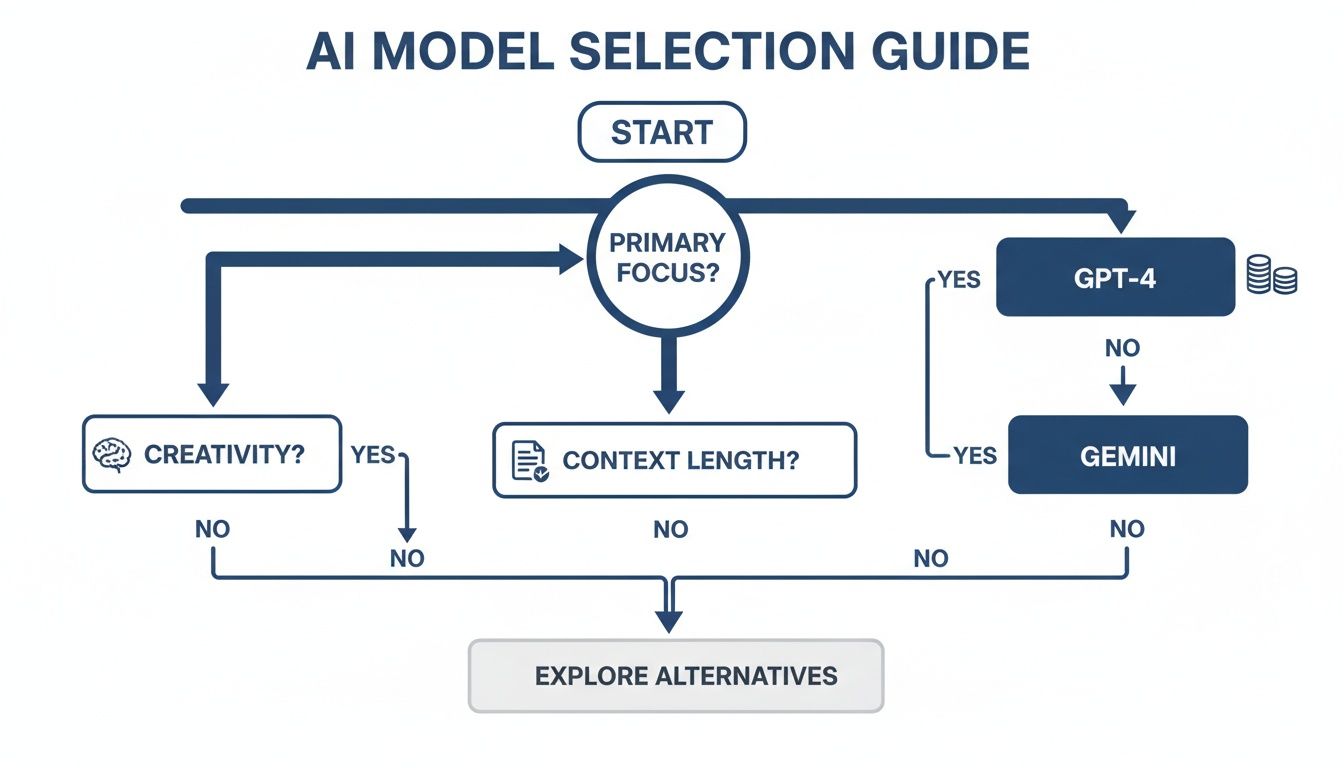
The key takeaway here is simple: there is no single "best" model. The right choice always depends on the specific marketing job you need to get done.
Step 3: Test, Measure, and Prove ROI
You can't just hope AI-generated content works. You have to prove it. Set up a simple, fast-moving testing loop to measure what’s effective and build a business case for more investment. Don't overcomplicate this.
Pick one channel to start, like email marketing.
- Start with a hypothesis: "An AI-generated subject line focused on 'cost savings' will beat our human-written control."
- Test it. Use generative AI for marketing to create five different subject line variations. Run an A/B/C/D/E test on a small segment of your email list.
- Measure the open rate and click-through rate for every single variation.
- Iterate. Take the winner, make it the new control, and then try to beat it again with a fresh batch of AI-generated ideas.
Document everything. When you can look at your own numbers and say, "My new AI workflow increased email open rates by 15% in one month," you’re talking about revenue instead of an experiment.
Step 4: Establish Lightweight Governance
Finally, you need guardrails. AI governance doesn't have to be a bureaucratic nightmare. For most small businesses, it’s a simple checklist.
Your process should always be: Generate -> Review -> Edit -> Publish. A human must always be in the loop. Always.
- Review for accuracy, because AI makes things up. It hallucinates. You have to fact-check any claims, statistics, or data points it produces.
- Review for brand voice. Does it actually sound like you? Even when using tools like HubSpot’s AI features to apply brand voice, a human needs to make the final call.
- Review for originality by running key passages through a plagiarism checker, especially for longer articles or web pages.
This human oversight is your quality control. It protects your brand and ensures every piece of content meets your standards. For a more detailed guide on putting AI to work in your strategy, a good AI UGC ads playbook can help you flesh out your own step-by-step approach. Following a playbook like this takes the guesswork out of implementation and puts you on a clear path to getting real business results.
How to Measure Generative AI Marketing ROI
If you can't measure it, you can't justify spending on it. Simple. That grace period for calling AI an "experiment" is over. Now, you have to prove every generative AI initiative directly impacts the metrics that matter: revenue, conversion rates, and customer lifetime value.
Let's move past vanity metrics like 'number of blog posts created'. Those are outputs, not outcomes. I’m going to show you how to build a bulletproof business case for more AI investment by proving its direct impact on the bottom line. This is about connecting your actions to real business results.
Moving Beyond Vanity Metrics
The first step is to isolate the impact. You can't just unleash AI across all your marketing and hope revenue ticks up. You need to tie specific AI activities to specific key performance indicators (KPIs). This is how you demonstrate a clear cause-and-effect relationship.
-
For AI-driven copywriting, track performance rather than the volume of copy. If you're using AI to generate ad variations, your primary KPI is Cost Per Acquisition (CPA). If the AI-assisted ads lower your CPA by 12%, that’s a hard number you can act on. For email, it's all about open rates, click-through rates, and ultimately, the conversion rates from those clicks.
-
For AI-accelerated campaign ideation, the core metrics are speed to market and testing velocity. Track how long it takes you to go from brief to live test, before and after using AI. If you can test five ideas instead of one in the same amount of time, you find winning campaigns much faster, leading to a direct lift in campaign-attributed revenue.
Forget how much content the AI created. The only question that matters is this: did the content produced by your AI workflow perform better than the content it replaced? If you can't answer that with data, you're just playing with a new toy.
The Critical New Channel: AI Answer Optimization
There's a massive shift happening in how people discover brands, and most marketers are completely missing it. Brand discovery is moving inside AI chats, a channel I call AI Answer Optimization (AAO). When a potential customer asks ChatGPT or Gemini for a product recommendation, is your brand showing up?
Treat it as a new discipline, separate from SEO, that you have to own. You can set up checks that query different models with relevant prompts, logging when your brand is mentioned and in what context.
The traffic from these AI referrals is valuable. Recent data shows that users coming from ChatGPT stick around for 15 minutes per visit (versus 8 from Google), view 12 pages (versus 9), and convert at an impressive 7% on transactional sites (versus 5% from search). You can explore the full analysis on this high-intent traffic to see why this is such a huge opportunity.
By measuring your visibility in AI answers and tracking this high-converting referral traffic, you can prove that optimizing for this new channel delivers substantial ROI. You can also explore my deeper guide if you want to learn how to improve marketing ROI across all your channels. That gives you a solid business case, backed by hard numbers, that shows AI working as a growth engine.
Building Your Future with AI Agents and Automation
So far, you’ve learned how to use generative AI for one-off tasks like writing a blog post. That’s a fantastic starting point. But it's like using a supercar to drive to the grocery store. The real power comes from using autonomous AI agents and intelligent automation.
This is where you graduate from simply prompting an AI to building systems that think, plan, and execute on your behalf.
Don’t get hung up on the term "agent." An AI agent is a system you can task with a complex, multi-step goal. It connects different tools and models to get the job done, reasoning its way through obstacles.
From Task-Doer to Strategic Asset
Imagine giving an agent a high-level goal like, "Own the online conversation around 'AI-powered analytics'." A simple content generator would just spit out a blog post. An agent would execute an entire campaign.
- First, the agent reasons. It scans top-ranking content, dissects competitor messaging, and identifies the gaps you can exploit. It finds the weak spots.
- Then it plans, mapping out a multi-channel content strategy: a pillar blog post, five supporting micro-articles, a viral social media thread, and a drip campaign for your email list.
- Finally, it executes. The agent drafts all that content, optimizes every piece for SEO, and stages it in your CMS for a final human review.
I build these kinds of systems for businesses right now. It's the logical next step for any marketer serious about scaling with AI. Your marketing turns into a self-improving growth engine that runs 24/7.
An AI agent keeps working when you stop. While your competitor's marketing team is asleep, your agent is analyzing market shifts, drafting counter-messaging, and finding new pockets of opportunity for growth.
Building Your First Marketing Agent
Building a fully autonomous system sounds intimidating, but you start small. A "Competitor Intelligence Agent" is a perfect first project.
This agent could connect to a web scraping tool to monitor websites, a powerful model like Claude 3 for analysis, and your Slack for reporting. You give it one job: Monitor the blogs and press releases of your top three competitors.
The moment it detects a new product launch, it analyzes the content, summarizes the key features and messaging, and instantly sends a concise alert to your Slack. What used to take days of manual research now happens in real-time. That's a massive speed advantage.
Common Questions I Get About AI in Marketing
Let's cut through the noise. These are the real questions I get from founders and small business owners every single day, the kind of stuff discussed when the office doors are closed. Here are the straight answers you need to move forward with clarity.
Will Generative AI Replace My Marketing Team?
No. But make no mistake: a marketing team using AI will absolutely replace one that isn't. The real power here is in augmenting people. It’s a force multiplier for your best talent.
Think about it. AI is perfect for automating the grunt work: the repetitive, low-value tasks that burn out your most creative people. This frees them up to focus entirely on high-level strategy, deep creative thinking, and solving the complex problems that actually win market share.
The goal is to make your A-players 10x more effective.
How Do I Keep My Brand Voice with AI-Generated Content?
This is the critical part, and it's where most companies go wrong. You can't just tell an AI to "write in a friendly tone" and expect it to capture your brand's soul. If you try to scale content without a real system, you'll lose your identity.
I guide companies to build what I call a brand "constitution." It’s a technical document loaded with your core voice principles, messaging pillars, and dozens of concrete examples of your best-performing copy.
You feed this constitution into a model with a large context window, like Claude 3, to create a system that can consistently echo what makes your brand unique.
Your brand voice is a competitive asset. Letting AI water it down into generic mush is a massive strategic error. The upfront work to build a detailed brand constitution is non-negotiable if you're serious about scaling with quality.
What's the Biggest Mistake Companies Make with Generative AI?
The single biggest pitfall is treating AI like a magic button. I see it constantly. A founder gets excited, subscribes to a tool, and tells their team to "go use AI" with zero strategy. This is a recipe for complete failure.
Jumping in without clear business goals, proper data preparation, or a human review process leads to nothing but generic content, wasted money, and total disillusionment. You have to install a human-in-the-loop workflow, like the one HubSpot outlines for its own AI features, to ensure every piece of content is accurate and on-brand.
AI is an incredibly powerful tool. But like any tool, it’s only as good as the strategy guiding it.