
Most advice on agentic AI is backward. It tells you to experiment with prompts, generate a few drafts, maybe automate a task, then call it transformation. That's how teams burn quarters and get nothing durable.
I'm Samuel Woods. I've been working with ML since 2016 and Generative AI since 2019, and I can tell you the winners aren't tinkering. They're deploying systems that observe, decide, act, and improve inside real business workflows. That's where the margin and speed gains come from, and where competitors start looking slow.
You're not here because you want a prettier chatbot. You want agentic workflow examples that move pipeline, retention, support capacity, and strategic visibility. Good. That's the only reason to care.
The strongest agentic workflows run multi-step processes, pull context from your tools, escalate when risk appears, and leave an audit trail you can inspect later. In the best customer service and financial operations deployments, agentic workflows have exceeded 95% accuracy, responded in under two minutes, and pushed cost per resolution below $2 while autonomously handling tasks like balance checks, repayment analysis, and transfer execution after approval, as outlined in ThoughtSpot's breakdown of agentic workflows.
If you're serious about growth, pair these systems with sharper AI-driven customer retention insights. Retention and agentic execution together create a moat.
Table of Contents
- 1. Lead Qualification and Scoring at Scale
- 2. Content Ideation and Brief Generation for Marketing Campaigns
- 3. Customer Support Triage and Intelligent Routing
- 4. Email Campaign Optimization and Personalization at Scale
- 5. Competitor Monitoring and Strategic Intelligence Synthesis
- 6. Customer Feedback Synthesis and Product Prioritization
- 7. Proposal and Contract Generation for Sales
- 8. Market Research and Audience Insight Generation
- Agentic Workflow Examples, 8-Use-Case Comparison
- Your Strategic Blueprint for Agentic Advantage
1. Lead Qualification and Scoring at Scale
If your reps are still digging through forms, CRM notes, and inbox threads to decide who matters, you've built a tax on revenue. Lead qualification is one of the cleanest agentic workflow examples because the business outcome is obvious. Faster response, better routing, more time in live selling.
An effective agent ingests CRM activity, web form submissions, email replies, product interest, firmographic data, and historical deal patterns. Then it scores, ranks, routes, and triggers next actions. In sales environments, Highspot shows a practical trigger model: when a lead's interactions with sales content pass a set numeric threshold, such as 5+ clicks on a specific deck, the system can immediately notify a rep and assign a persona-specific playbook through Highspot's agentic workflow example.
Why this one wins first
This workflow doesn't need abstract AI ambition. It needs clean signal and fast execution. A B2B SaaS team can use it to route inbound demo requests, flag expansion opportunities in existing accounts, and keep reps focused on high-intent conversations instead of admin work.
For hiring-heavy businesses, the same pattern works in staffing. The agent can compare candidate history, role requirements, and placement patterns, then rank likely matches before a recruiter touches the file. Same architecture. Different revenue engine.
If you want a deeper implementation model, I've laid out a practical AI agent for lead qualification approach that's closer to how operators should build this in practice.
A practical rule: give reps override authority from day one. If your sales team can't correct routing decisions, they'll stop trusting the system.
Many teams overcomplicate this. You don't need a genius agent. You need one that logs why it scored a lead highly, routes it correctly, and hands your reps context they can use immediately.
How to keep it from going off the rails
Start with a CRM audit. If lifecycle stage data is inconsistent, owner fields are stale, or closed-lost reasons are missing, the agent will learn from garbage.
Use a human review period in the first month. Compare agent scores against actual meetings booked, pipeline progression, and closed outcomes weekly. That gap tells you whether the model is surfacing intent or just rewarding noisy activity.
Your edge over competitors comes from responding first with better context while their reps are still sorting inbound manually.
Here's a live walkthrough worth reviewing before you build the routing layer:
2. Content Ideation and Brief Generation for Marketing Campaigns
The real bottleneck in content is strategic relevance. Teams lose market share when they publish decent-looking campaigns aimed at the wrong pain point, the wrong buyer moment, or the wrong competitive angle.
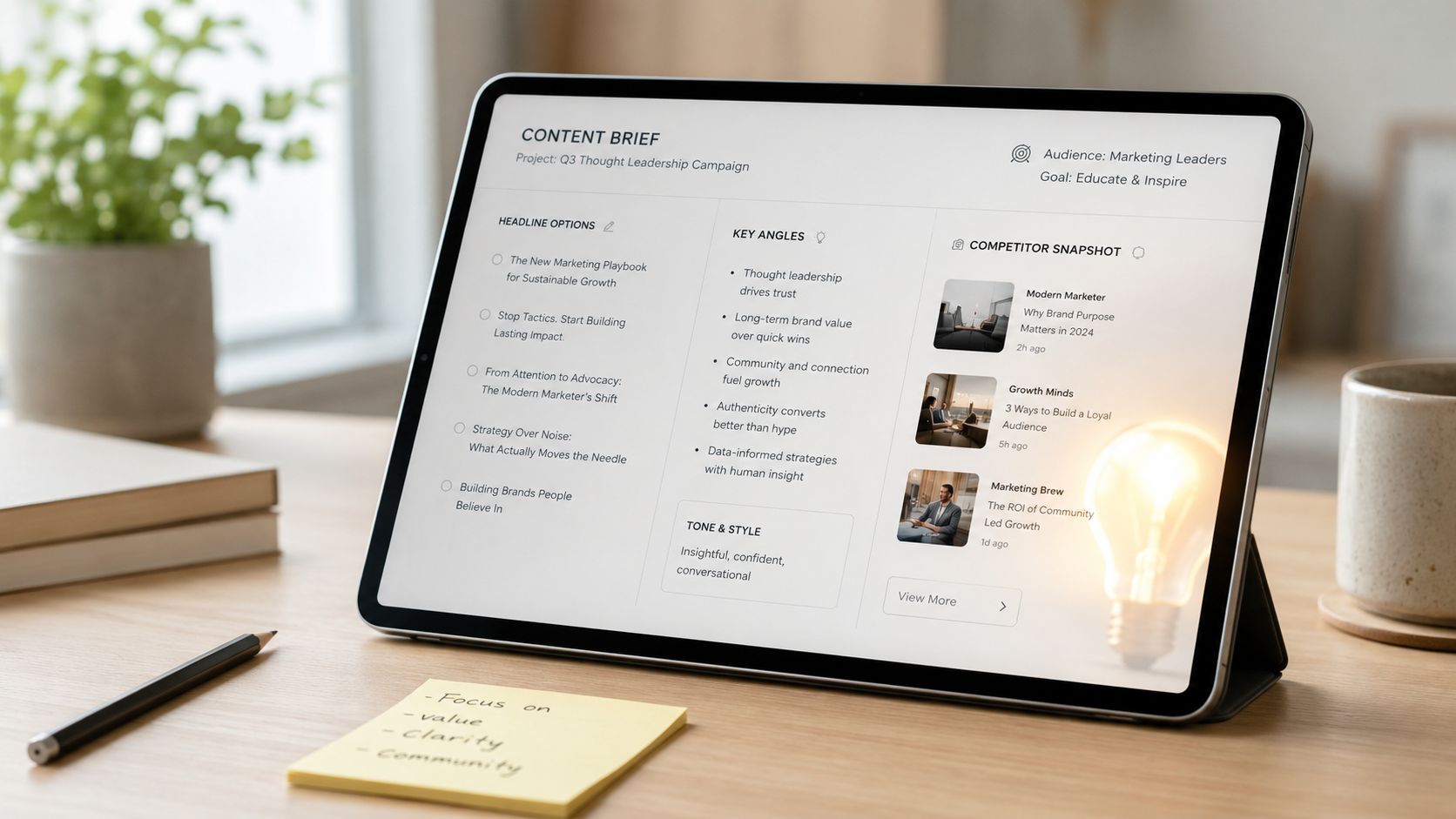
An ideation agent fixes that by turning scattered market signals into usable campaign briefs before the first draft gets written. It tracks competitor messaging shifts, mines support tickets and sales calls for recurring objections, reviews your past content performance, and delivers brief options built for specific business goals. One brief can target pipeline creation. Another can defend branded search. A third can attack a competitor's weak positioning in the market.
What the agent actually does
Feed it the inputs your writers rarely have time to synthesize well. Customer interviews. Gong call snippets. Closed-lost notes. Churn reasons. Review-site complaints. Search query trends. Product release notes.
That mix matters. McKinsey has noted that companies using customer behavior and analytics well make faster, better commercial decisions, which is exactly why this workflow beats generic prompt-based ideation that ignores actual buyer evidence.
The output should be a decision-ready brief with the target audience, angle, business objective, proof points, content format, CTA, likely objections, and a recommendation on why this campaign deserves resources now. That is how ideation starts producing revenue.
I use this model to pressure-test multiple directions against quarterly priorities. If the goal is demand capture, the agent should surface high-intent themes and conversion-focused formats. If the goal is category positioning, it should build sharper narratives around differentiation. If the goal is competitive disruption, it should identify message gaps rivals keep leaving open.
If you need the content engine behind that process, this AI content idea generator is a practical building block for turning raw signals into usable campaign directions.
Where teams waste time and budget
A single competitor scrape is a screenshot of one moment.
Strong ideation workflows run continuously. The agent needs feedback loops from campaign performance, search movement, sales objections, and audience response so it can improve the next round of briefs instead of repeating stale angles. If your system cannot explain why it recommended a theme, do not trust it with budget.
Good agents cut bad ideas early, before your team burns a sprint producing content nobody wanted.
Set brand boundaries upfront. Review the first batch of briefs yourself, or with whoever owns the brand. Define what counts as on-strategy, what claims need proof, which competitors deserve direct confrontation, and which topics are noise. After that, reduce oversight and keep the review focused on outcomes.
There is one more operational point marketers ignore. Distribution quality matters as much as brief quality. If your campaign depends on email promotion, you should also know how to stop email from going to spam in Gmail, because strong messaging does not help if the message never lands in the inbox.
If you also want a service workflow that handles inbound questions after the campaign goes live, study this guide to an AI agent for customer support in small business.
Do not deploy this workflow on top of weak positioning. The agent will produce polished briefs at scale, but it will scale confusion just as fast. Get the strategy right first. Then let the agent increase output.
3. Customer Support Triage and Intelligent Routing
Support breakdown usually starts as a routing problem. Revenue gets hit when high-value customers wait in the same queue as password resets, billing disputes bounce between teams, and technical cases arrive stripped of context.
A strong agentic support workflow fixes that by making three decisions fast. What is this issue? How risky is it? Who should handle it: the agent or a human specialist?

The workflow should read each ticket, classify intent and urgency, pull the right knowledge from your help center, CRM, order system, and prior cases, then choose the next action. Routine requests get resolved automatically. Edge cases get routed with a full context pack, including customer history, failed troubleshooting steps, product usage signals, and likely root cause. That is how you cut handle time without making the experience feel robotic.
The operational edge
Retrieval matters more than raw model quality here. If the agent cannot ground its answer in current policies, known bugs, and actual account context, it will confidently send customers in the wrong direction. Microsoft explains the pattern well in its overview of retrieval-augmented generation, or RAG. Use retrieval first, generation second.
For the routing layer, copy what the best service operations already do manually. Separate low-risk repetitive work from cases that can cause churn, refunds, compliance exposure, or public complaints. Zendesk's guidance on AI for customer service reinforces the practical point. Automation works best when it resolves common requests and hands complex issues to agents with the right context already attached.
If you run a smaller operation, the architecture still holds. Here's a grounded look at the best AI agent for customer support small business.
There is also a channel issue most owners ignore. If support relies on follow-up emails for verification, billing, or resolution steps, inbox placement affects case closure. You should know how to stop email from going to spam in Gmail, because a correct answer that never lands still creates a reopened ticket.
The checkpoint that matters
Human review should be designed around business risk, not vague comfort levels. Set clear escalation rules for cancellation intent, payment disputes, suspected fraud, account access problems, and product defects with unclear root cause. Everything else should be judged by confidence score, customer tier, and expected financial impact.
The handoff itself decides whether this workflow helps or hurts. A bad handoff forces the customer to repeat the issue and forces the specialist to start from zero. A good handoff includes summary, evidence, prior actions, relevant policy, and the reason escalation happened.
The operator's rule: escalate on churn risk, billing disputes, and product bugs with ambiguous root cause. Automate repetitive cases aggressively. Protect human time for moments that decide retention and expansion.
Do not deploy this on top of a stale knowledge base. The agent will retrieve outdated instructions at scale, and customers will feel the damage before your dashboards do.
4. Email Campaign Optimization and Personalization at Scale
Static email campaigns are slow money. They assume the same subject line, timing, and offer should work for everyone in a segment. That's lazy targeting, and your competitors will happily take the opens and clicks you leave behind.
An agentic email workflow reacts to behavior. It watches page visits, product views, prior purchases, engagement history, and lifecycle stage. Then it chooses send timing, channel, copy angle, and offer variation at the individual level.
Why static email loses
Braze reports that, in marketing, agentic workflows can improve engagement by 15% to 20% by using adaptive timing and channel choice across email, SMS, and social in its guide to agentic workflows. That's the difference between broadcasting and orchestrating.
The key is event-driven personalization. Token swapping like “Hi first name” doesn't move revenue. “This person compared two pricing tiers yesterday, ignored the webinar invite, opened the migration email, and hasn't purchased” does.
A strong agent will also test subject lines and body copy continuously, then shift traffic toward what performs for each audience slice. That compounds faster than monthly batch testing ever will.
If deliverability is weak, fix that before scaling personalization. Otherwise you'll optimize emails that never land. This guide on how to stop email from going to spam in Gmail is worth addressing alongside the workflow itself.
What to watch before you scale it
Start with a few meaningful behavioral segments. High-value customers. At-risk users. Inactive subscribers. Recent buyers. Don't begin with hyper-granular micro-segments that your data can't support.
Watch unsubscribe patterns and complaint signals every week. A smart email agent can increase relevance, but it can also over-contact people if you don't define pacing rules.
I also like pairing this workflow with churn prediction. When the system sees behavior drift, it can trigger retention messaging before cancellation happens. That's where email stops being a channel and becomes a defense system.
5. Competitor Monitoring and Strategic Intelligence Synthesis
Competitor research usually fails because it shows up too late to matter. By the time a quarterly deck gets read, the rival has already changed pricing, repositioned the product, hired the team, and started taking your deals.
An agentic intelligence workflow fixes the timing problem. It watches competitor sites, pricing pages, job boards, press releases, review platforms, social channels, and release notes continuously. Then it filters that stream against your strategy and turns it into decisions. Change packaging. Defend your best segment. Push harder into a weak flank. Adjust messaging before your win rate slips.
Catch revenue threats before they hit the pipeline
This use case matters because the payoff is commercial. If a competitor starts hiring integration engineers, launches a services-heavy motion, introduces a cheaper tier, or shifts its language toward your core buyer, you need to respond while the move is still forming.
Claygent is a good example of the model. Teams use AI web research agents like it to collect live signals across the market and feed sales and growth teams with fresh account and competitor context. That operating pattern is the point. Continuous sensing, synthesis, and response.
Done well, this protects market share. You spot pricing pressure before renewals get harder. You see category messaging shifts before analysts and prospects repeat them back to you. You find white space before another vendor claims it.
Build an intelligence system, not a clipping service
Start with the decisions you want this workflow to influence. Pricing. Positioning. Segment expansion. Partner strategy. Competitive sales plays.
Then define the signals that matter:
- pricing and packaging changes
- new product launches or feature bundles
- hiring spikes in product, sales, partnerships, or specific geographies
- customer review themes that reveal adoption problems or momentum
- message changes on homepage, category pages, and comparison pages
- executive statements that hint at market direction or ideal customer profile shifts
Without that filter, the agent will flood you with trivia.
Set clear alert thresholds. A button color change is not intelligence. A new implementation package, a security certification push, or a sudden wave of hiring in mid-market sales probably is.
If you are not reading a synthesized competitor brief every week, the workflow is producing activity and nothing more.
One more rule. Assign an owner. Competitive intelligence only matters if someone turns it into action, updates battlecards, changes campaign angles, briefs sales, or revises pricing strategy. Otherwise you built a monitoring system that reports on threats you still ignore.
6. Customer Feedback Synthesis and Product Prioritization
Product teams love to say they're customer-led. Then they ignore support logs, bury survey comments, and overweight the loudest big customer. That's how roadmaps drift away from reality.
A feedback synthesis agent pulls in support tickets, reviews, surveys, community comments, NPS responses, onboarding friction notes, and churn signals. It clusters themes, highlights sentiment, and translates raw customer language into product-ready problem statements.
Turn noise into roadmap pressure
This workflow matters because customer feedback is usually trapped in different systems and different vocabularies. Support calls it a bug. Sales calls it an objection. Customers call it confusing. The agent connects those threads.
I'm also strict about weighting. A complaint from a high-value customer segment should not be treated the same as random drive-by feedback from a poor-fit buyer. Segment relevance matters. Revenue relevance matters.
What you want out of this system is product briefs that say, “Here's the recurring friction, who it affects, how it relates to churn or expansion, and what language customers use when they describe it.”
How to measure success beyond speed
Weak implementations fall apart here: they celebrate faster synthesis and never prove business impact. One of the biggest gaps in current content is how to measure ROI for agentic workflows beyond time savings. Mastra highlights the need to pair engineering metrics like accuracy, latency, and token cost with domain-specific outcome metrics, and notes that enterprises are prioritizing multi-system workflows with high branching-path impact in its article on agentic workflows.
That's exactly right. Measure what changed in the business. Reduction in issue recurrence. Improvement in activation. Better retention for the segment tied to the solved friction. Stronger expansion among accounts requesting a missing capability.
A measurement test: if you can't connect feedback clusters to retention, conversion, or account growth, the workflow is informative but not strategic.
Don't use this workflow to replace product judgment. Use it to improve what product judgment is based on.
7. Proposal and Contract Generation for Sales
Deals usually stall when commercial momentum turns into document chaos.
Proposal and contract generation is one of the highest-ROI agentic workflows in sales because it sits close to revenue. If you can cut the time between verbal alignment and signature, you increase close rates, protect urgency, and give competitors less time to interfere.
A contract generation agent should pull from CRM data, approved pricing rules, product configurations, legal clause libraries, and buyer requirements to assemble a first draft fast. It should also flag non-standard terms, track version changes, and route approvals in the right sequence so sales, finance, and legal stop stepping on each other.

Where the real advantage comes from
The win here is disciplined document assembly.
That means using preapproved clauses, enforcing pricing policy, checking required fields, and removing hours of back-and-forth that add no value. Box recommends routing documents to a human reviewer when confidence drops below a defined threshold in its agentic workflows guide. Use that rule here. If the agent sees ambiguous deal structure, conflicting inputs, or missing commercial terms, stop the flow and escalate immediately.
The best setup is simple. The agent produces the draft. Legal reviews exceptions only. Finance checks pricing edge cases only. Sales gets a buyer-ready version while the deal still has heat.
Where to start, and where to draw the line
Start with repeatable revenue paths. Standard proposals. Renewal agreements. Common SOWs. Low-variance contract types with approved term ranges.
Do not start with heavily negotiated enterprise paper, cross-border compliance issues, or custom procurement terms that carry material legal risk. Human approval should be required for large commercial commitments, non-standard indemnity language, unusual security or privacy demands, and any clause that falls outside your approved playbook. Deloitte makes the same case in its guidance on using AI to streamline contract lifecycle management. High-value exceptions need review, not optimism.
Legal judgment stays with people. The workflow protects revenue by removing drafting friction from the deals that should move fast, while pushing risky terms to the people paid to make the call.
8. Market Research and Audience Insight Generation
Most market research is obsolete the week after it lands in a slide deck. By the time anyone acts on it, buyer language has shifted, a competitor has repositioned, and a new objection has started showing up in calls.
A market insight agent runs continuously. It scans Reddit, review sites, niche forums, communities, customer calls, survey responses, and social channels to extract pain points, buying triggers, objections, and emerging themes. Then it turns that into live commercial intelligence.
Why this beats static research decks
Audience understanding decays fast. Consequently, the longer your team relies on stale assumptions, the more money you waste on weak positioning and mistimed offers.
I've seen this workflow pay off when founders want sharper messaging, content teams want fresher angles, and sales teams need a tighter read on what buyers suddenly care about. It's one of the few workflows that directly strengthens strategy, messaging, and campaign execution at the same time.
The best versions summarize what people are saying and also map who is saying it, what alternatives they're considering, what language signals urgency, and where demand is shifting.
The right operating model
Use communities your ICP uses, even when that means looking past LinkedIn, the convenient default. If your buyers are talking in Slack groups, Reddit threads, app review comments, or industry forums, that's where the agent should listen.
A strong example from operations comes from supply chain. TBlocks describes an Autonomous Procurement Agent that continuously processed inventory telemetry, supplier data, and external signals in real time, cutting inventory holding costs by 40% and speeding order fulfillment by 25% through its agentic AI examples. Different department, same lesson. Continuous signal beats periodic reporting.
You should also cross-check these insights against pipeline feedback. If the market agent says compliance anxiety is growing, sales should confirm whether that's showing up in objections, deal stalls, or win-loss notes. That's how you turn insight into action instead of another report nobody uses.
Agentic Workflow Examples, 8-Use-Case Comparison
| Use case | Implementation complexity | Resource requirements | Expected outcomes | Ideal use cases | Key advantages |
|---|---|---|---|---|---|
| Lead Qualification and Scoring at Scale | Medium–High: data integration and model training; calibration period (3–4 months) | Clean CRM, historical win/loss data, integrations (email, web analytics), retraining pipeline | Faster qualification, higher SQL conversion, automated routing, reduced rep admin time | B2B SaaS, high-inbound lead flows, staffing, demo-heavy e‑commerce | Real-time scoring and routing; scalable lead prioritization; improved close rates |
| Content Ideation and Brief Generation | Medium: feed aggregation and performance integration; tuning for voice | Content performance history, competitor feeds, social listening, brand guidelines | Rapid briefs, increased campaign velocity, improved engagement | Marketing teams (DTC, B2B), content-heavy brands | Fast, data-backed ideation; surfaces white-space opportunities; consistent briefs |
| Customer Support Triage and Intelligent Routing | Medium: NLU, KB integration, routing rules; training ~6–8 weeks | Complete, current knowledge base, ticket history, escalation rules, sentiment models | Fewer tickets for humans, faster first responses, reduced resolution time | SaaS with high ticket volume, e‑commerce seasonal spikes, marketplaces | Reduces human load, 24/7 triage, context-rich escalations |
| Email Campaign Optimization and Personalization at Scale | High: complex segmentation, privacy and ESP integration, continuous A/B testing | First-party tracking/events, ESP integration, compliance tooling (GDPR), modeling | Higher revenue per send, lower unsubscribes, improved open/click rates | E‑commerce, DTC, large-subscriber SaaS lists | Dynamic personalization, send-time optimization, automated testing at scale |
| Competitor Monitoring and Strategic Intelligence Synthesis | Medium: multi-source monitoring and signal filtering | Access to sites, social/job feeds, press/earnings, alerting thresholds (some paywalled sources) | Early warnings, informed GTM pivots, board-ready summaries | Fast-moving markets, B2B SaaS, marketplaces | Early detection of moves; continuous competitive insight; strategic alerts |
| Customer Feedback Synthesis and Product Prioritization | Medium: aggregation, clustering, correlation to metrics | Feedback sources (support, NPS, reviews), tagging, analytics to correlate churn/LTV | Data-driven roadmap, prioritized features, reduced churn | Product-led SaaS, marketplaces, B2B software | Quantified prioritization; uncovers cross-channel patterns; faster briefs |
| Proposal and Contract Generation for Sales | High: legal guardrails, template management, integration with CRM | Approved contract templates, legal/finance sign-off, CRM/deal data, version control | Shorter deal cycles, higher close rates, consistent contract terms | B2B sales, enterprise deals, professional services | Speeds proposal-to-signature, standardizes terms, tracks negotiation history |
| Market Research and Audience Insight Generation | Medium: noisy data handling, privacy considerations | Community and social monitoring, forums, review sites, demographic profiling | Real-time trend detection, improved messaging, niche opportunity discovery | Marketing and product strategy, startups scanning emerging trends | Living, continuous insights; earlier trend identification than static reports |
Your Strategic Blueprint for Agentic Advantage
Agentic AI pays off when you wire agents into decisions that change pipeline, close rates, retention, support cost, and speed to market.
That is the core pattern across these eight workflows. Each one targets a business choke point. Lead qualification helps sales spend time where revenue is likely. Content briefing turns scattered signals into campaigns faster. Support triage cuts queue drag. Email optimization improves response and conversion. Competitive intelligence shortens the time from market movement to your response. Feedback synthesis gives product teams a clearer case for what to ship next. Proposal generation removes delay from deal progression. Market research keeps positioning tied to live buyer behavior instead of stale assumptions.
Do not roll out all eight at once.
That is how teams create noise, overload operations, and mistake activity for progress. Start with the workflow closest to money and easiest to measure. If inbound demand is high and rep capacity is tight, begin with lead qualification. If support volume is dragging satisfaction down, fix triage first. If marketing keeps missing the moment, build ideation and brief generation. Prove one workflow in production, then add the next.
Execution matters more than model shopping. Define the business outcome in plain language before you build anything. Set clear success criteria. Track latency, accuracy, cost per action, and business outcomes together. Keep event logs and audit trails so you can inspect what the agent did, what inputs it used, and where a human stepped in. As noted earlier, mature agentic systems are judged by measurable results and traceable decisions, not clever demos.
You also need firm operating boundaries. Decide which actions the agent can take on its own, which ones require review, and which ones must stay human-led. Make those rules explicit at the workflow level, not buried in prompts. That is how you keep speed without creating expensive legal, brand, or customer mistakes.
Measure the numbers that pay the bills. Qualified pipeline. Conversion rate. Retention. Resolution cost. Campaign performance. Deal velocity. Product adoption. If a workflow does not move one of those numbers, it is an experiment, not a strategic asset.
I cover the implementation side in more depth elsewhere on Samuel Woods, especially agentic context engineering and multi-agent operating models. The core principle is simple. Your advantage comes from putting AI into the work your rivals still do by hand.
That is how small operators pull ahead: they build systems that compound.