
Most advice on agentic workflows is backwards. You're told to chase a magical all-purpose AI agent, wire it into a few apps, and wait for transformation. That's how teams burn budget, spook compliance, and end up with a demo instead of a business system.
I'm Samuel Woods. I've been working with ML since 2016 and Generative AI since 2019. I've watched the market obsess over model capability while ignoring the boring part that ultimately determines whether this works in production. Your data. Your integrations. Your access controls. Your measurement layer.
If you care about revenue, margin, and beating slower competitors, stop asking, “What can this agent do?” Start asking, “What workflow can reliably move a business outcome forward without creating chaos?”
Table of Contents
- You Are Thinking About AI Agents All Wrong
- What Agentic Workflows Really Are
- The Architecture of an Agentic System
- Agentic Workflows in Action for Marketing and Growth
- Why Most Agentic Workflows Fail and How to Succeed
- How to Measure the ROI of Your Agentic Systems
- Your Questions on Agentic Workflows Answered
You Are Thinking About AI Agents All Wrong
The market keeps selling you a hero story. One brilliant AI agent that handles everything. That idea is seductive, and it's usually the wrong investment.
A single agent is rarely your competitive advantage. The advantage comes from agentic workflows, where multiple decision points, tools, approvals, and specialized agents work together toward a business goal. That's what scales. That's what survives real operations.
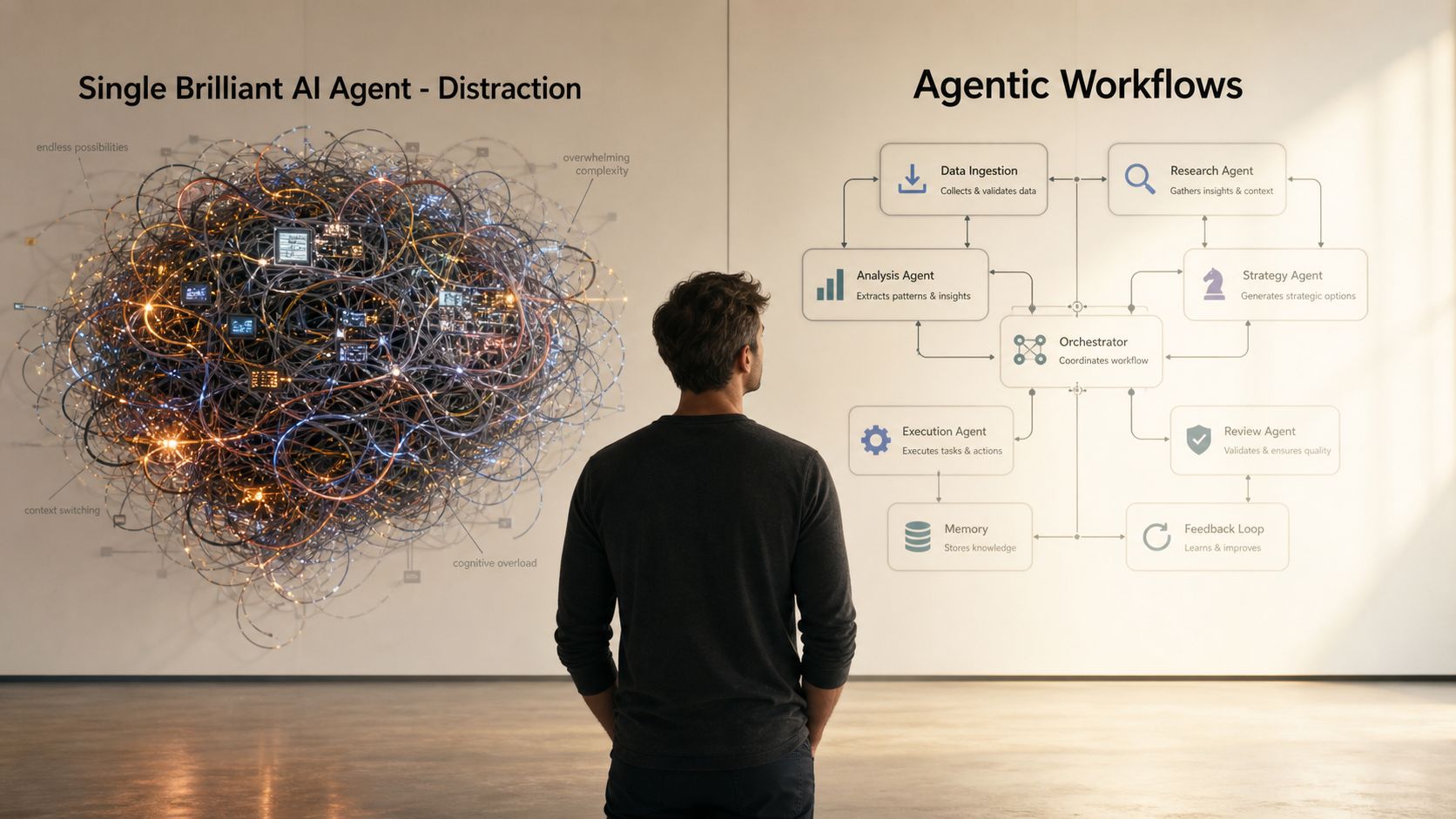
If you're still fixated on one super-agent, you're optimizing for the demo. Your competitors who think in workflows are optimizing for throughput, governance, and execution across departments.
Organizations implementing well-designed agentic workflows typically report efficiency improvements of 30-60%, with the higher end showing up in more complex use cases and environments with low prior automation (Valorem Reply on agentic workflows). That matters because efficiency in the right process doesn't just reduce effort. It speeds revenue cycles and removes operational drag.
Why single agents disappoint
A standalone agent usually breaks in one of three places:
- Context failure: It doesn't have enough business-specific context to make a useful decision.
- Execution failure: It knows what should happen but can't reliably act inside your systems.
- Governance failure: It can act, but nobody can see why it made a decision or stop it when needed.
That's why I push clients away from “build me an agent” conversations. I'd rather map the process, identify decision bottlenecks, and design an orchestrated system that can complete work end to end.
The companies that win with AI aren't building smarter chatbots. They're building faster operating systems for the business.
What this changes competitively
When you design workflows instead of isolated agents, you gain an edge in places your competitors still handle manually. Lead routing. Competitive research. Approval chains. Sales prep. Customer issue resolution. Internal ops.
That's where speed compounds. Your team responds faster, spots market shifts earlier, and wastes less time stitching together tasks across tools. Competitors chasing the super-agent idea usually get stuck babysitting outputs. You get a system that moves work.
What Agentic Workflows Really Are
Descriptions of agentic workflows are often too loose. The practice is to label anything involving an LLM as a workflow. That's sloppy thinking, and it leads to sloppy implementation.
An agentic workflow is a controlled system for pursuing a goal through multiple coordinated steps. The workflow decides what happens next. The agents, APIs, and humans each play a role inside that structure.
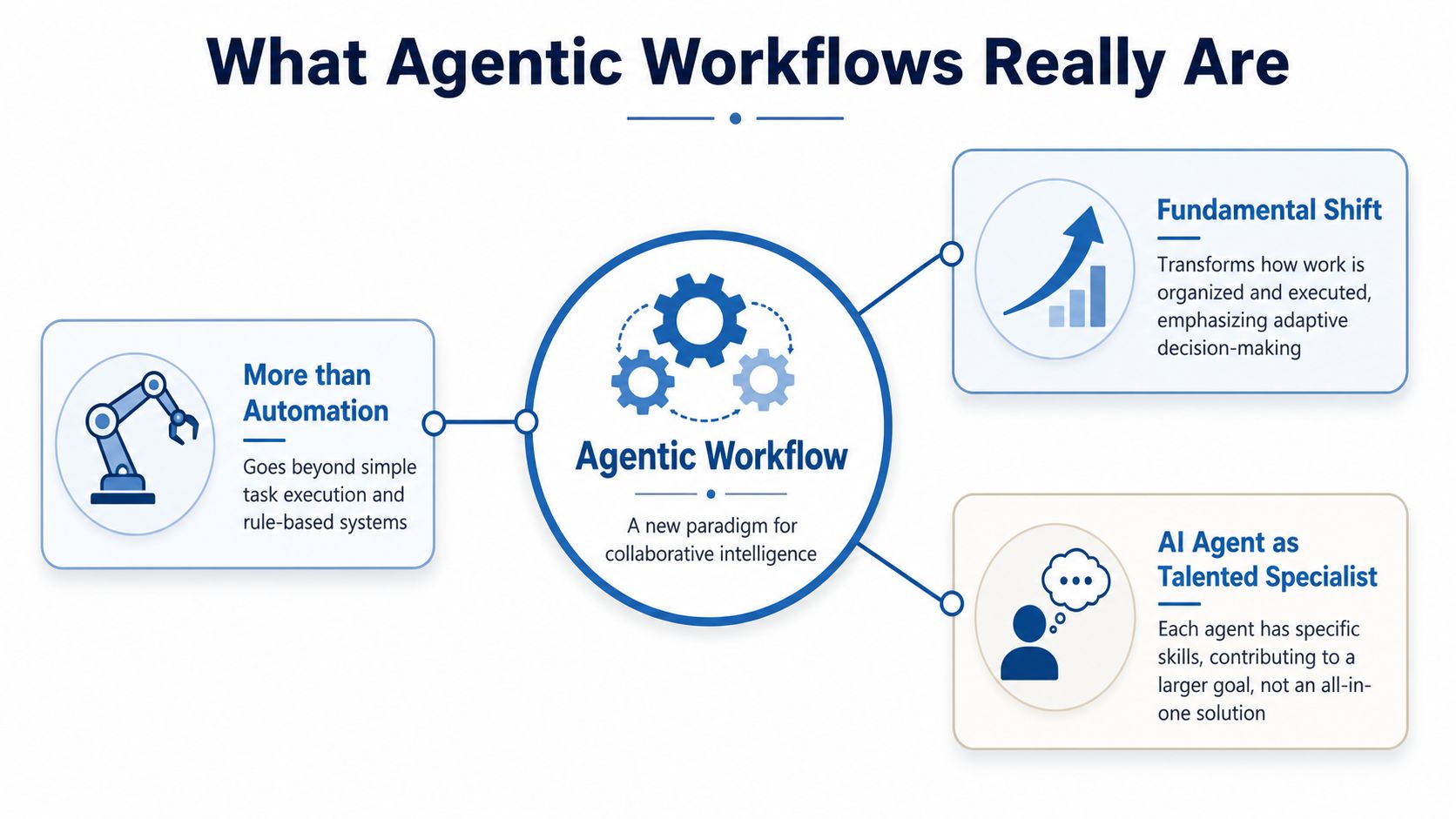
The easiest analogy is an orchestra. A single agent is a talented musician. Useful, sometimes impressive, but limited on its own. Agentic workflows are the full performance system. Conductor, score, sections, timing, and room for adaptation when conditions change.
Agentic workflows shift automation from rigid, rule-based sequences to dynamic, goal-oriented control graphs by externalizing decision points. Instead of embedding all logic within a single agent, the workflow orchestrates multiple agents, API calls, and human-in-the-loop steps (Orkes on agents vs workflows).
How this differs from old automation
Traditional automation is good at repeatable, brittle sequences. If invoice arrives, parse field. If field matches vendor, route to finance. If not, fail. It's deterministic and narrow.
Agentic workflows add judgment where judgment is needed. They can classify ambiguous inputs, choose tools, evaluate intermediate results, and branch into different paths. The workflow becomes adaptive without becoming uncontrollable.
Here's the practical difference:
| System type | Good at | Weak at |
|---|---|---|
| Traditional automation | Fixed steps, predictable inputs, narrow rules | Ambiguity, exceptions, changing conditions |
| Single AI agent | Flexible reasoning, one-off tasks, exploration | Reliability, oversight, cross-system execution |
| Agentic workflow | Coordinated multi-step work with controls | Requires design discipline and operational readiness |
The components that matter
You don't need philosophical definitions. You need operating parts.
A goal
You give the system an outcome, not a script. For example, reduce refund handling time, prepare a daily competitor brief, or complete a new-hire setup.Decision logic
The workflow evaluates results as it moves. It can branch, loop, pause for approval, or retry with a different tool.Tool access
Agents need ways to act inside the business. CRM, analytics, ticketing, CMS, ad platforms, internal knowledge bases.Human controls
High-risk decisions should surface for review. Good workflow design assumes some decisions must remain reversible.
Practical rule: If an AI system can take action but you can't inspect the decision path or override it, it isn't ready for production.
This represents the key shift. You're not adding a smarter chatbot to a process. You're redesigning how work gets coordinated.
The Architecture of an Agentic System
If you want agentic workflows that survive outside a sandbox, you need a clear architecture. Not vibes. Not a prompt chain with a nice interface. Architecture.
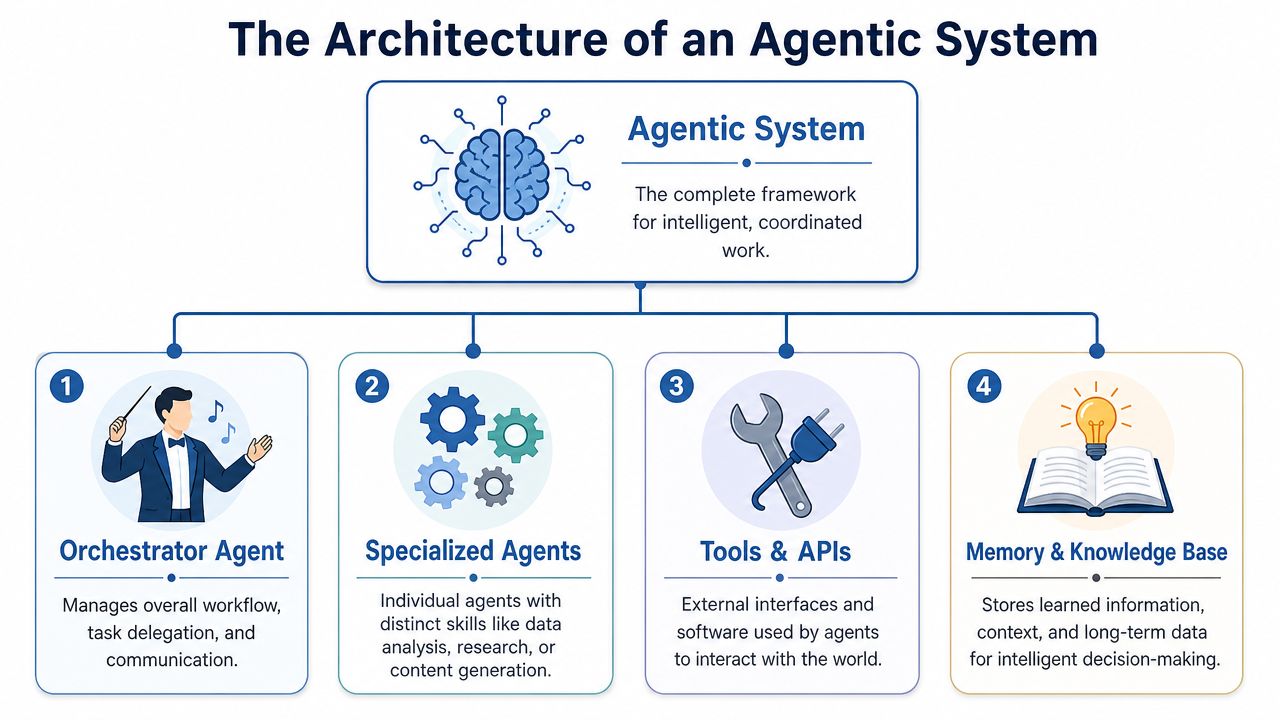
At the center is orchestration. That's the layer that decides which agent acts, when tools get called, where approvals sit, and how the system handles failure. Without orchestration, you don't have a workflow. You have a collection of disconnected tricks.
A useful overview sits here:
Agentic AI systems enhance generalist AI models by enabling them to automate complex procedures, execute multi-step plans, use external tools, and interact with digital environments to function as powerful components within larger workflows (MIT Sloan on agentic AI).
The planner decides the route
The planner takes a business goal and breaks it into workable steps. That might mean collecting data, checking constraints, assigning subtasks, and deciding whether the task is simple enough to proceed automatically.
For a growth team, a planner might receive this objective: identify declining paid search performance and suggest actions. It can then queue diagnostic checks across campaign data, landing page data, search term quality, and conversion behavior.
The planner shouldn't do all the work itself. If it does, you've built an overloaded generalist. Good systems separate planning from execution.
Executors do the work
Executors are specialized agents or services that handle specific tasks well. One researches. One drafts. One validates. One interacts with the CRM. One turns findings into a short recommendation for a human approver.
That separation matters because specialization improves reliability. You don't want the same component simultaneously inferring strategy, querying five systems, writing customer-facing copy, and deciding whether legal review is required.
A simple executor stack often looks like this:
- Research executor: Pulls internal notes, competitive signals, or market references.
- Analysis executor: Compares findings against current KPIs or thresholds you define.
- Content executor: Produces a brief, email draft, internal summary, or recommended action.
- Validation executor: Checks for missing inputs, policy violations, or low-confidence output.
Tools memory and context keep it grounded
Tool use is where most demos become real systems. An agent that can read but can't act stays trapped in presentation mode. The moment it can update Salesforce, create an Asana task, trigger a Looker report, or push a message into Slack, it starts creating operational value.
Memory and knowledge bases keep the system from working blind. Brand rules, pricing logic, customer segments, escalation policies, product inventory, account history. In these contexts, context engineering becomes decisive. I've written more on agentic context engineering because most weak agentic workflows don't fail on model quality. They fail on missing context and poor retrieval design.
Here's the architecture I trust most in enterprise settings:
| Layer | Job | What to watch |
|---|---|---|
| Orchestrator | Routes work and manages state | Failure handling, observability |
| Specialized agents | Perform focused tasks | Scope creep, prompt drift |
| Tools and APIs | Connect to business systems | Permissions, reliability |
| Memory and knowledge base | Supply durable context | Freshness, access control |
If one of these layers is weak, the whole system gets noisy. If all four are designed well, you get a workflow that can reason, act, and stay aligned with the business.
Agentic Workflows in Action for Marketing and Growth
Founders and CMOs typically lean forward at this point. Not because the architecture suddenly became interesting, but because now we're talking about pipelines, campaigns, and operational speed.
The mistake is assuming agentic workflows are only for futuristic use cases. In practice, the best early wins are in recurring work that already costs your team time every week.
Market intelligence that shows up before your morning meeting
A strong market intelligence workflow runs continuously, not quarterly. It watches competitor pricing pages, product launches, messaging shifts, customer sentiment signals, and major campaign changes. Then it turns that mess into one clean internal brief.
One agent gathers raw changes. Another compares them against your positioning. A third drafts a short summary for leadership with possible implications for acquisition, retention, or pricing.
That gives you an advantage your slower competitor won't have. They're waiting for a strategist to manually scan the market. You're starting the day with signal already processed.
For paid media teams, this same thinking applies inside the account. If you want a concrete example of workflow-driven diagnostics rather than generic reporting, this AI tool for ad account diagnosis shows the kind of targeted, outcome-focused analysis I'd rather see than another broad chatbot interface.
Personalized outbound without the manual grind
Most sales personalization is fake personalization. A rep grabs a company name, a title, maybe a recent post, and wraps a template around it. Buyers can smell that instantly.
An agentic workflow can do better because it separates research, synthesis, and drafting. One component pulls public company context and internal CRM history. Another identifies likely pain points based on segment, maturity, or recent events. A drafting layer turns that into an email or LinkedIn message that sounds informed, not stitched together.
The point isn't to automate all outreach blindly. The point is to let your team review stronger first drafts at scale. That's how you increase relevant touches without turning the brand into spam.
I use the same principle in AI agents for marketing. The practical value comes from linking reasoning to actual growth tasks, not asking a model to be “creative” in isolation.
If your outreach workflow can't pull from your CRM, product data, and message rules, it won't scale personalization. It'll just scale generic copy.
Onboarding is the easiest proof of business value
Marketing leaders should pay attention to a non-marketing example because it proves the model. HR onboarding is a classic multi-step process with handoffs, dependencies, and delays.
Agentic workflows enable organizations to reduce HR onboarding turnaround time by 50% by automating complex, multi-step tasks independently (Box on agentic workflows). That's not just an HR win. It's an operating model signal.
A well-designed onboarding workflow can coordinate account setup, hardware requests, policy acknowledgement, training assignments, and manager notifications. Instead of five teams handling fragments, the workflow manages the sequence and escalates exceptions.
That matters to growth because the same structure applies to campaign launches, partner onboarding, content approvals, and customer expansion motions. If you can orchestrate one cross-functional process well, you can replicate the pattern where revenue depends on speed.
Why Most Agentic Workflows Fail and How to Succeed
This is the part most articles avoid because it ruins the easy narrative. The model is rarely the main problem. The business is.
The critical gap between agentic workflow potential and enterprise readiness is why 78% of enterprises fail to implement them successfully, stemming from complex system integration, stringent security requirements, and inadequate infrastructure readiness (Gigster on enterprise readiness for agentic AI workflows).
That number should reset your priorities. If you're still debating model providers before fixing fragmented systems and bad data access patterns, you're solving the wrong problem.
The real blockers are operational
I see three failure modes over and over.
First, the data is scattered. Customer history lives in one system, support context in another, product usage somewhere else, and nobody has aligned definitions. The workflow can retrieve information, but it can't form a trustworthy picture of the business.
Second, integrations are brittle. The AI layer can read from one platform, write to another, and fail unnoticed on the third. Teams discover this only after they've promised automation to leadership.
Third, security rules are either too loose or too rigid. Loose is dangerous. Rigid is paralyzing. Many enterprises have permission structures built for human users, not autonomous systems that need scoped access, auditability, and override paths.
Here's my blunt view. If your internal systems don't agree on what a customer, lead, issue, approval, or campaign is, your agentic workflow will produce polished confusion.
The fastest way to kill trust in AI is to let it act on incomplete context inside a messy stack.
A readiness check I'd use before approving any rollout
Before I greenlight implementation, I want clear answers to these questions:
- Data readiness: Can the workflow access the right business context from governed sources, or is key information trapped in silos?
- Integration readiness: Do the systems involved have stable APIs, predictable events, and clear ownership when they break?
- Security readiness: Can you define granular permissions, approval gates, and logs for every meaningful action?
- Operational readiness: Does someone own monitoring, exception handling, and continuous improvement after launch?
If the answer is “not really” on any of these, don't force autonomy. Start smaller.
A better rollout path looks like this:
- Pick a bounded workflow with obvious business value.
- Keep one or two human approvals in place.
- Limit tool access to the minimum required.
- Log every decision path and every failure.
- Improve context quality before expanding scope.
Disciplined companies pull ahead. Their competitors rush into full autonomy, create internal resistance, and lose trust. They build controllable workflows, prove value, and expand from a stable base.
How to Measure the ROI of Your Agentic Systems
If your measurement plan starts with token counts, you're already losing the budget conversation. CFOs don't fund model activity. They fund outcomes.
That's why so many teams stall. 73% of leaders can't calculate ROI because they lack standardized metrics for agentic workflow value and fail to connect outputs to business outcomes like revenue or LTV (MindStudio on the agentic workflow implementation layer). The technology might work. The business case doesn't.
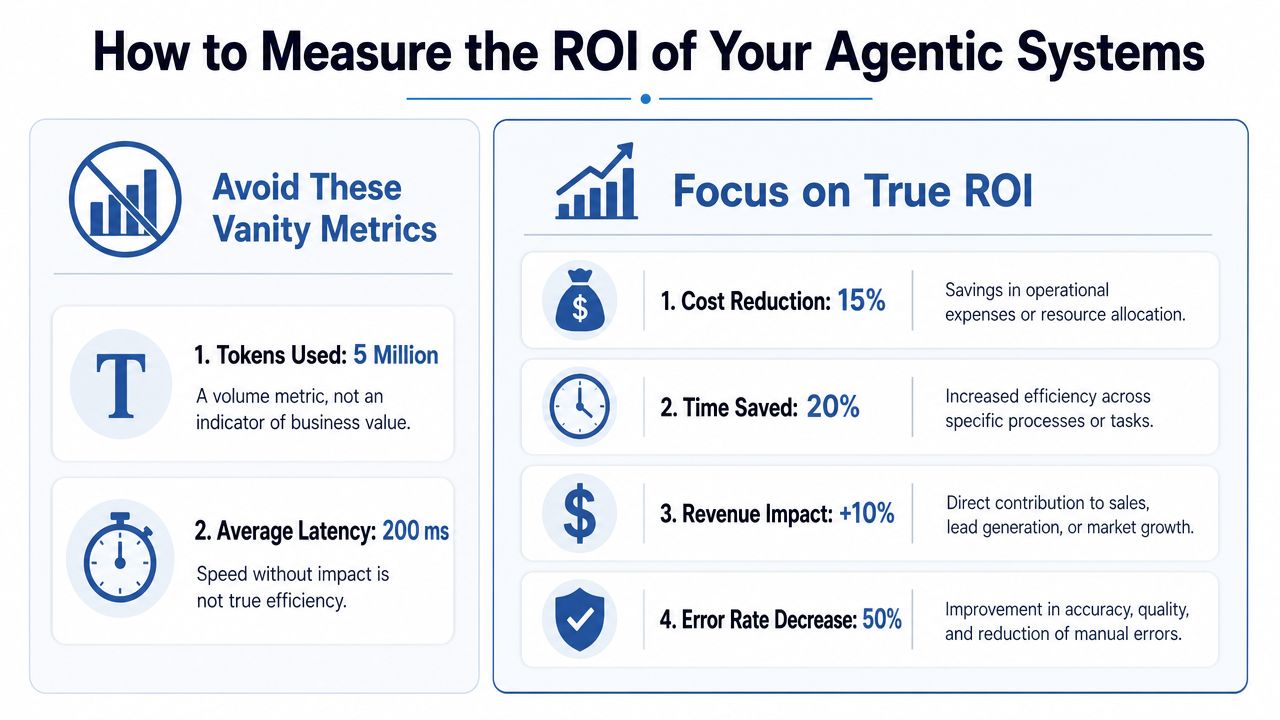
Track outcomes not machine activity
I care about three metrics first.
Completion rate tells you whether the workflow reliably reaches the intended end state. A production system should live in the 90%+ band, because systems in the 70s create customer distrust and feel like permanent beta products (Digital Applied on workflow completion metrics).
Cost per successful task is the metric I'd put in front of finance early. It's the primary metric for enterprise ROI because it ties cost to outcomes instead of treating tokens as value on their own (Google Cloud on AI agent KPIs).
Action Advancement helps you catch expensive loops before they drain budget. Scores above 0.7 indicate clear progress toward the user goal, while scores below 0.3 show the agent is spinning without advancing (Galileo on AI agent metrics).
The dashboard I want executives to see
Don't dump technical telemetry on leadership. Give them a simple business view.
| Metric | Why it matters | Executive question it answers |
|---|---|---|
| Completion rate | Reliability of the workflow | Can we trust this in production? |
| Cost per successful task | Real economic value | Are we reducing cost for actual outcomes? |
| Action Advancement | Efficiency of decision loops | Is the system progressing or wandering? |
Then add one layer that connects workflow performance to the business function it serves. For marketing, that might be influenced pipeline quality, campaign launch speed, or time-to-insight. For service, it might be resolution flow and escalations. For operations, cycle time and handoff reduction.
I've written about this broader measurement mindset in how to measure marketing effectiveness, and the same rule applies here. Tie system behavior to commercial outcomes or don't expect budget renewal.
A workflow that is fast, cheap, and wrong is not efficient. It is just automated waste.
Your Questions on Agentic Workflows Answered
Is an agentic workflow just a fancier AI agent
No. An agent is one component. An agentic workflow is the operating structure that coordinates decisions, tools, memory, and human controls around a business goal.
Should you build or buy
Buy when the workflow is common, the integrations are already solved, and the risk is low. Build when your process is a source of competitive advantage or your context is too specific for an off-the-shelf tool. Most companies should do both. Buy a foundation where it makes sense, then customize the workflow that differentiates them.
What's the safest first move
Start with one bounded internal process that already has clear friction. Onboarding, reporting, sales research, approval routing, campaign QA. Keep a human checkpoint in the loop, log every action, and measure completion quality from day one.
That's the practical path. Not the flashiest. Usually the one that wins.