Most advice on AI agents is upside down.
You're told to automate the whole business, wire up a swarm of agents, and let the machine run. That's how businesses waste budget, confuse everyone involved, and end up with a flashy pilot nobody trusts. I've been working with ML since 2016 and Generative AI since 2019, and I can tell you plainly: if you want to run a business with AI agents, you need financial discipline first, architecture second, and hype dead last.
The gap between excitement and execution is brutal. Despite 88% of organizations globally using AI in at least one business function as of 2025, fewer than 10% of enterprises have successfully scaled AI agents in any single business function to deliver tangible value. The median time-to-value is 5.1 months, yet 22% of organizations report negative ROI at the 12-month mark according to Datagrid's AI agent statistics roundup. That tells you exactly what's going on. Most firms are funding experiments instead of building strong operational advantages.
If your strategy includes customer-facing apps, internal copilots, or embedded workflows, it helps to study how product teams are approaching Developing AI-powered mobile apps. The useful lesson is that agentic systems only matter when they're tied to a real user flow, real data access, and a business outcome you can measure.
Table of Contents
- The Hard Truth About AI Agents in 2026
- Adopting the Agentic Mindset
- Designing Your First High-Impact Agentic Workflow
- The Four-Part Blueprint of a Production-Ready Agent
- The Playbook for Safe and Effective Deployment
- Operating and Scaling Your AI Workforce
- Your Path to a Real Competitive Edge
The Hard Truth About AI Agents in 2026
Most owners are hearing a fantasy. The fantasy is that AI agents are ready to run finance, sales, support, ops, and strategy with minimal supervision. They aren't.
What's real is narrower and more useful. Good operators are using agents to speed up bounded workflows, improve decision velocity, and reduce low-value manual work. Bad operators are trying to replace judgment before they've even mapped the process.
The market is full of activity, but activity is not scale. A lot of businesses have AI in the building. Very few have agents delivering durable business value at the function level. That difference matters because your competitors don't need a better demo than you. They need a better operating model.
Here's a practical rule. Skip the question of whether AI agents can run your company, and ask which single workflow can produce visible economic value without creating visible damage when it fails.
I'm opinionated on this because I've seen the same pattern too many times. Owners buy the narrative that model capability is the bottleneck. Usually it isn't. The bottleneck is sloppy workflow selection, weak evaluation, unclear ownership, and no financial threshold for success.
Here's the strategic implication:
| Common move | What happens | Smarter move |
|---|---|---|
| Launch broad pilots across multiple departments | Team attention fragments and nothing reaches production | Pick one workflow with tight scope |
| Start with high-risk customer interactions | Brand mistakes surface early | Begin with internal or low-blast-radius operations |
| Measure usage instead of business impact | The pilot looks busy but doesn't pay back | Track outcome, cost, and handoff rate |
If you want to amplify revenue, you need agents that help you act faster than competitors in moments that matter. Lead qualification. Support triage. Proposal prep. Meeting follow-up. CRM enrichment. Invoice categorization. Those are useful because they sit close to money, speed, or cost.
That's the hard truth. AI agents won't rescue a messy business. But they will multiply the advantage of a business that knows what it's trying to improve.
Adopting the Agentic Mindset
The first shift is mental, not technical.
The prevailing approach often relies on automations. Trigger comes in, rule fires, output goes out. That works until the environment changes, the input gets messy, or the task requires judgment across several steps. Then the whole thing snaps.
Stop thinking in tasks
An agent works differently. It operates through a continuous perceive, decide, act, check loop, breaking goals into steps, selecting tools for each step, and adjusting based on results, as described in AI Workforce's business guide to AI agents. The important part for you is this: autonomy is a dial, not a switch.
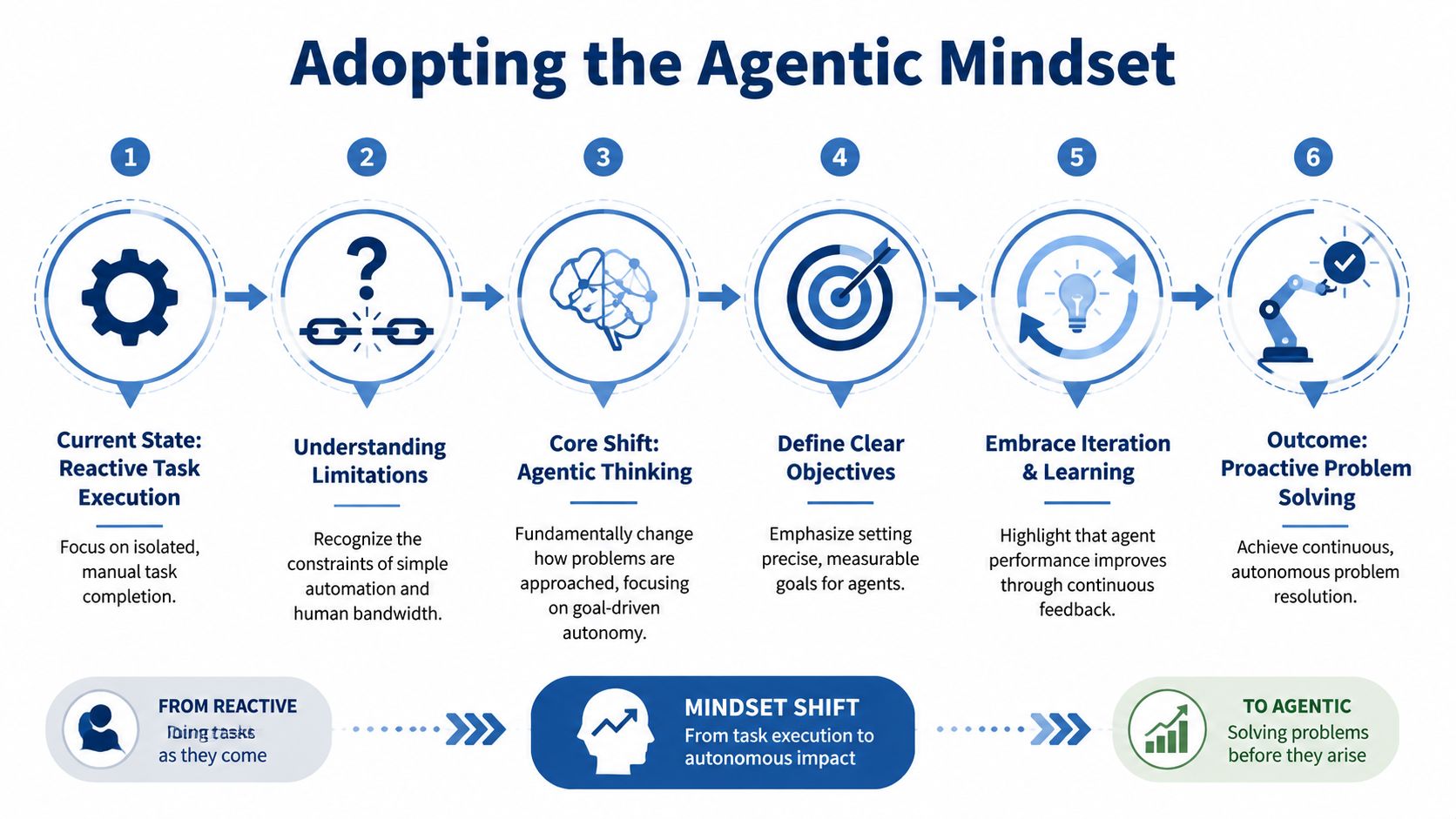
That changes how you design work. You stop asking, “What prompt should we use?” and start asking, “What goal should this system pursue, what tools can it touch, and when must it stop and ask a human?”
A normal automation might move a form fill into your CRM. An agent can evaluate the lead, enrich the account, check firmographic fit, draft the outreach sequence, flag missing context, and then decide whether the record is ready for sales. Call it structured autonomy. There's no magic in it.
If you don't define the stop conditions, the agent will keep acting inside the boundaries you forgot to draw.
A practical example with an SDR agent
Let's make this concrete.
Say you want an SDR agent for inbound leads. A brittle automation would do three things: capture the lead, assign a rep, send an email. Fine for basic routing. Useless for competitive speed.
An agentic version thinks in loops:
- Perceive incoming form data, company name, role, website, referral source, and CRM history.
- Decide whether this account matches your ICP, whether the lead has buying intent, and whether more enrichment is needed.
- Act by pulling data from your CRM, LinkedIn-style enrichment provider, calendaring tool, and email platform.
- Check whether confidence is high enough to proceed or whether the lead should be escalated to a human.
That's why I tell owners not to buy “AI employee” language too quickly. Agents are best understood as operating systems for bounded decisions. You don't win because the model sounds smart. You win because the system can repeatedly complete a useful sequence with acceptable quality.
Here's the mindset shift I want you to make:
- From isolated tasks to workflows with state
- From one-shot outputs to iterative execution
- From full autonomy fantasies to controlled levels of delegation
- From prompts to operating rules, tool access, and escalation paths
Once you think this way, you stop trying to bolt AI onto bad processes. You start redesigning work around speed, clarity, and controlled risk.
Designing Your First High-Impact Agentic Workflow
Your first workflow should be profitable. Ambition can wait.
Most failed agent projects die because the owner tries to prove too much too early. They pick a high-visibility use case, expose it to customers, add messy edge cases, and then wonder why trust collapses. That's amateur behavior.
Your first workflow should be boring
The best first workflow is usually operational, repetitive, rules-heavy, and easy to score. According to Zaruko's analysis of the AI agents hype cycle, avoiding failure requires a start narrow, then expand approach. The recommendation is explicit: pick a single well-defined workflow where the blast radius is low and value is visible within weeks rather than quarters.

That's exactly right.
I'd rather see you automate inbound lead qualification than outbound prospecting with personalized messaging. I'd rather see you handle support triage than let an agent freelance on live customer complaints. I'd rather see you automate invoice coding than build an “executive strategy agent” generating recommendations nobody can audit.
A bad first project versus a smart one
Let's compare two choices.
Here's a bad first project: an autonomous customer-facing brand agent that answers nuanced pre-sales questions, handles objections, and recommends pricing paths.
Why it fails:
- Brand risk is high.
- Edge cases are constant.
- Wrong answers spread fast.
- Evaluation is fuzzy because “good conversation” is not a clean metric.
Here's a smart first project: an inbound lead qualification and CRM enrichment agent.
Why it works:
- Inputs are structured.
- Tools are clear.
- Human review is easy.
- Business value shows up fast through cleaner routing and faster follow-up.
A workflow like that can check website quality, enrich company details, flag ICP fit, route the record, and produce a recommended next action for sales. It shortens response time and sharpens your focus. Your competitors are still digging through messy lead data while you work only the best opportunities.
If you want examples of what that looks like in practice, review these agentic workflow examples and notice the pattern. The winners are measurable, and rarely glamorous.
A simple selection scorecard
Use this before you commit to any first agent project.
| Criteria | Bad sign | Good sign |
|---|---|---|
| Outcome clarity | “Improve productivity” | Specific business result |
| Blast radius | Public error causes trust damage | Failure can be contained |
| Data access | Data lives in silos and spreadsheets | Systems are reachable through clean APIs |
| Evaluation | Success is subjective | Pass or fail can be tested |
| Time to value | Benefits arrive after process overhaul | Value appears quickly |
I also like a gut-check list:
- Can you review the output quickly? If not, don't start there.
- Does the workflow happen often enough to matter? If not, the ROI won't be obvious.
- Can you define what “wrong” looks like? If not, you can't operate it.
- Would a mistake be embarrassing or expensive? If yes, move down the risk ladder.
The point of the first deployment is to prove that your business can build one reliable agentic loop that saves time, protects margin, or accelerates revenue. Once you've done that, expansion gets easier because you've seen it work.
The Four-Part Blueprint of a Production-Ready Agent
Most owners ask the wrong architecture question. They ask, “Which model should we use?” That's too narrow.
A production-ready agent is a business system. It needs a goal, access, oversight, and constraints. If one of those is weak, the whole thing becomes expensive theater.
Here's the visual I use to explain it.

What you should actually evaluate
I break the blueprint into four parts.
1. Clear objective and mission
This is the commercial job description. What exactly is the agent supposed to accomplish? “Help sales” is not a mission. “Qualify inbound demo requests and prepare complete CRM records for rep review” is a mission.
2. Access to information and tools
Agents fail when they can't reach the systems that hold truth. CRM, help desk, calendar, docs, email, knowledge base, billing, meeting notes. If the agent can't retrieve context or take approved actions, it becomes an expensive copy generator.
3. Human oversight and feedback loop
Effective human oversight differentiates serious operators from casual users. Who reviews outputs, what gets corrected, and how does that correction improve future performance? You need defined review points, not vague “someone will keep an eye on it.”
4. Guardrails and ethical boundaries
This includes permission boundaries, stop conditions, escalation rules, and disallowed actions. The agent should know what it cannot do just as clearly as what it should do.
A useful way to inspect your design is this table:
| Component | Leadership question |
|---|---|
| Objective | What business result is this responsible for? |
| Tools | What systems can it read from and write to? |
| Oversight | Who reviews failures and edge cases? |
| Guardrails | When must it stop or hand off? |
To make these design choices tangible, I often point people to a stronger view of the AI agent tech stack than the usual “pick a model and ship it” advice.
Why architecture beats model obsession
Here's the uncomfortable truth. A cheaper model with the right tool access, memory, and operating rules can outperform a more advanced model dropped into a bad system.
That's because business performance comes from context, permissions, and repeatability, with intelligence as only one input.
This walkthrough is worth watching if you want a grounded view of how agent systems fit together in practice.
Don't buy the most impressive brain before you've built the body around it.
I also push back on overcomplicated multi-agent architecture early. A single well-equipped agent often beats a committee of half-connected agents. More moving parts means more hidden failure paths, more state confusion, and more accountability gaps.
If you want to run a business with AI agents, treat architecture as operating design. The model is one part. The system is the advantage.
The Playbook for Safe and Effective Deployment
Deployment is where businesses often expose their own sloppiness.
On a whiteboard, the agent looks sharp. In production, it hits expired credentials, malformed records, missing fields, timing issues, duplicate actions, and vague instructions for a workflow nobody ever documented properly. That's why I care less about demos and more about failure handling.
According to Agentically's deployment playbook, a structured approach can transform 40% initial AI failure rates into 92% success stories by enforcing Integration Layer First and graceful degradation and mandatory escalation. That's the right operating principle.
Build the integration layer first
Do not start by tuning prompts.
Start by proving the agent can reliably access the systems it needs. API connections. Authentication. Logging. Error handling. Retries. Permissions. Input validation. That is the job before the job.
If your CRM integration fails unnoticed, your agent didn't “almost work.” It failed. If your support agent can read the knowledge base but can't record ticket updates consistently, you've built another source of operational mess.
Define the handoff before launch
Every production agent needs a failure contract.
When a tool times out, what happens? When data is missing, what happens? When confidence is low, what happens? When the agent encounters an action outside policy, what happens?
A handoff path is part of the product, and more than a backup plan.
This is what graceful degradation looks like in business terms:
- Low-confidence lead fit gets routed to a human queue instead of auto-assigned.
- Unclear support intent gets triaged, summarized, and escalated instead of answered badly.
- Incomplete invoice data gets flagged for review instead of pushed into accounting.
That prevents silent damage. Silent damage is what kills trust.
What I insist on before go-live
Before I'd let an agent touch a live workflow, I'd want these checks answered in writing:
What systems does it read and write?
No ambiguity. Name them.What actions are fully autonomous, supervised, or forbidden?
If this isn't documented, you're guessing.What logs prove what happened?
You need traceability when something goes wrong.Where does the agent stop and escalate?
If the answer is “we'll know when we see it,” you're not ready.How will you detect correctness failures as well as outages?
Uptime is not quality.
A lot of owners want speed here. I get it. But reckless speed is fake speed. The company that deploys safely gets the compounding benefit. The company that rushes creates political resistance, and then every future AI initiative has to overcome the memory of the first failure.
Operating and Scaling Your AI Workforce
Going live is the beginning of management, not the end of build.
Too many people treat agents like software features. Ship it, monitor uptime, and move on. That's not how this works. Agents are closer to digital operators. You need to manage output quality, exception handling, review cost, and business impact continuously.
Monitoring is not enough
If you only monitor whether the workflow ran, you'll miss the bigger problem. Agents can be online and wrong.
That's why I push evaluation pipelines on top of dashboards. Monitoring tells you whether the system is alive. Evaluation tells you whether it's doing the job correctly. Those are different questions.
The visual below captures the operating discipline I want you to build.

In practice, I want a live agent function measured against a small set of operational metrics:
- Autonomous success rate, meaning how often the agent completes the workflow without human rescue.
- Cost per task, meaning what each completed workflow costs once model use, tooling, and review time are included.
- Escalation rate, meaning how often the agent needs human intervention.
- A business outcome metric, meaning the commercial metric tied to the workflow, such as speed to qualified lead, ticket resolution quality, or cleaner financial processing.
The human review cost trap
Many SMBs delude themselves on this point.
The hidden line item in agent deployment is review labor. The Krotov Studio analysis on AI agents for small businesses makes the key point clearly: human-in-the-loop cost is a financial variable, and companies can overspend on oversight if they don't calculate when review becomes a net loss against cost per task.
That matters more than most advice admits.
If an agent saves you time but now requires you or someone else to inspect every output, your efficiency gain may be fictional. You haven't eliminated work. You've redistributed it.
Run a quick finance check. If review time scales one-to-one with agent output, the agent isn't saving you anything yet.
I usually assess review cost with a simple framework:
| Question | Why it matters |
|---|---|
| How often does a human need to inspect output? | Frequent inspection raises unit cost |
| How long does review take? | Slow review destroys margin |
| What kinds of errors require intervention? | Some errors are cheap, others are dangerous |
| Can review be sampled instead of universal? | Sampling is often the path to scale |
The goal is economically sensible oversight, which is rarely zero.
When to scale beyond one agent
I'm skeptical of multi-agent systems until the first agent is reliable. Too many people build orchestration complexity before they've proven one agent can complete one job under live conditions.
Once the first agent is stable, then ask whether a second should exist. Good reasons include specialization, clear system boundaries, and different tool permissions. Bad reasons include novelty and the desire to say you built an “AI workforce.”
If you're thinking bigger, this autonomous business operations framework is a useful way to think about scale as an operating model instead of a pile of bots.
A sensible progression looks like this:
- One workflow, one owner, one scorecard.
- One agent, supervised, with clear escalation rules.
- Reduced review burden through tighter evaluation.
- Expansion into adjacent workflows with similar data structures.
- Only then, carefully orchestrated multi-agent handoffs where responsibility is obvious.
This is how you build an AI-powered function. Not with bravado. With operational math.
Your Path to a Real Competitive Edge
The opportunity is that your business becomes faster, sharper, and harder to compete against because agents handle bounded work with discipline.
That's the difference I want you to internalize. Most of your competitors will chase novelty. They'll run broad pilots, celebrate prototypes, and struggle to convert any of it into margin, speed, or advantage. Beat them at execution and let them keep the theatrics.
A serious company uses agents to compress cycle time, improve data quality, and make stronger decisions sooner. Sales gets cleaner handoffs. Support resolves routine issues faster. Finance reduces manual classification work. Marketing publishes and routes intelligence faster than slower rivals. Those gains stack.
If you're in ecommerce or digital growth, it also helps to study adjacent operating patterns like Next Point Digital's growth strategies. The same principle applies there: compounding advantage comes from systems that improve conversion, speed, and decision quality together.
Here's my thesis.
To run a business with AI agents, you need to think like an operator, not a tourist. Pick one workflow. Make the economics visible. Build the integrations before the intelligence. Force escalation paths. Measure cost per task. Reduce human review where quality allows it. Scale only after reliability is boring.
That's how you build a bionic company.
You get there by designing a business that knows exactly where autonomy creates profit, where humans still own judgment, and where speed turns into market power, instead of handing the keys to a model.