
You’re probably feeling it already.
You hire smart people, add another manager, add another layer of process, and somehow the company still moves slower. Revenue pressure goes up. Margins get tighter. Slack gets noisier. Everyone looks busy, but output doesn’t scale the way payroll does.
I’ve been building ML systems since 2016 and generative AI systems since 2019, and I’ll say this plainly. If you keep scaling your company with a human-only org chart, you will hit a ceiling faster than competitors who redesign around agents. Your team can be strong and still stall, because the structure is wrong.
What an agent-first org chart looks like is now a practical question. The answer is an operating model that gives a founder or a small team the output of a much bigger company without the overhead.
Your Competitors Are Hitting a Scaling Wall
Most founders still think scaling means adding headcount function by function. More SDRs. More coordinators. More analysts. More project managers to manage the people you just hired.
That model breaks earlier than people admit.
Every new hire adds communication load. Every extra layer slows approvals. Every handoff creates drag. If you run a startup or SMB, you don’t have the luxury of carrying that overhead for long. Bigger companies can hide it in their budgets. You can’t.
The wrong assumption founders keep making
The old assumption is simple. If demand increases, team size should rise with it.
That’s exactly what smarter operators are starting to reject. A 2026 McKinsey survey of 500 SMBs found that hybrid agent shadows, one agent per human role, boosted productivity 3.2x faster than siloed agent teams. That matters because it tells you something structural. Small businesses get more from agent capacity attached to existing operators than from a giant separate AI department.
That’s the move.
Don’t build an “AI team” before you’ve built AI capacity inside the team you already have.
If your growth lead still does research manually, your account manager still writes every follow-up from scratch, and your ops person still reconciles workflows by hand, more hiring won’t fix it. The problem is how the work is designed.
The real competitive split
Over the next few years, I expect a sharp divide.
One group will keep hiring to solve throughput problems. The other will redesign work so each strong operator has agent support embedded into the role. The first group will grow revenue while fighting rising complexity. The second group will grow with far more operational control.
That’s why I keep pushing founders to audit their stack and workflows before they post another job description. If you want a practical starting point, these AI workflow automation tools are the kind of building blocks I’d review first before changing headcount plans.
Use agents where work is repetitive, rule-based, or context-heavy. Keep humans where judgment, negotiation, taste, and accountability matter most.
That’s how you bypass the scaling wall instead of smashing into it.
From Hierarchy to Hub: What Is an Agent-First Org Chart
A traditional org chart is a control map. It shows who reports to whom.
An agent-first org chart is a work map. It shows how outcomes get produced, who owns them, and which mix of humans and agents executes the steps. That’s a different thing entirely.
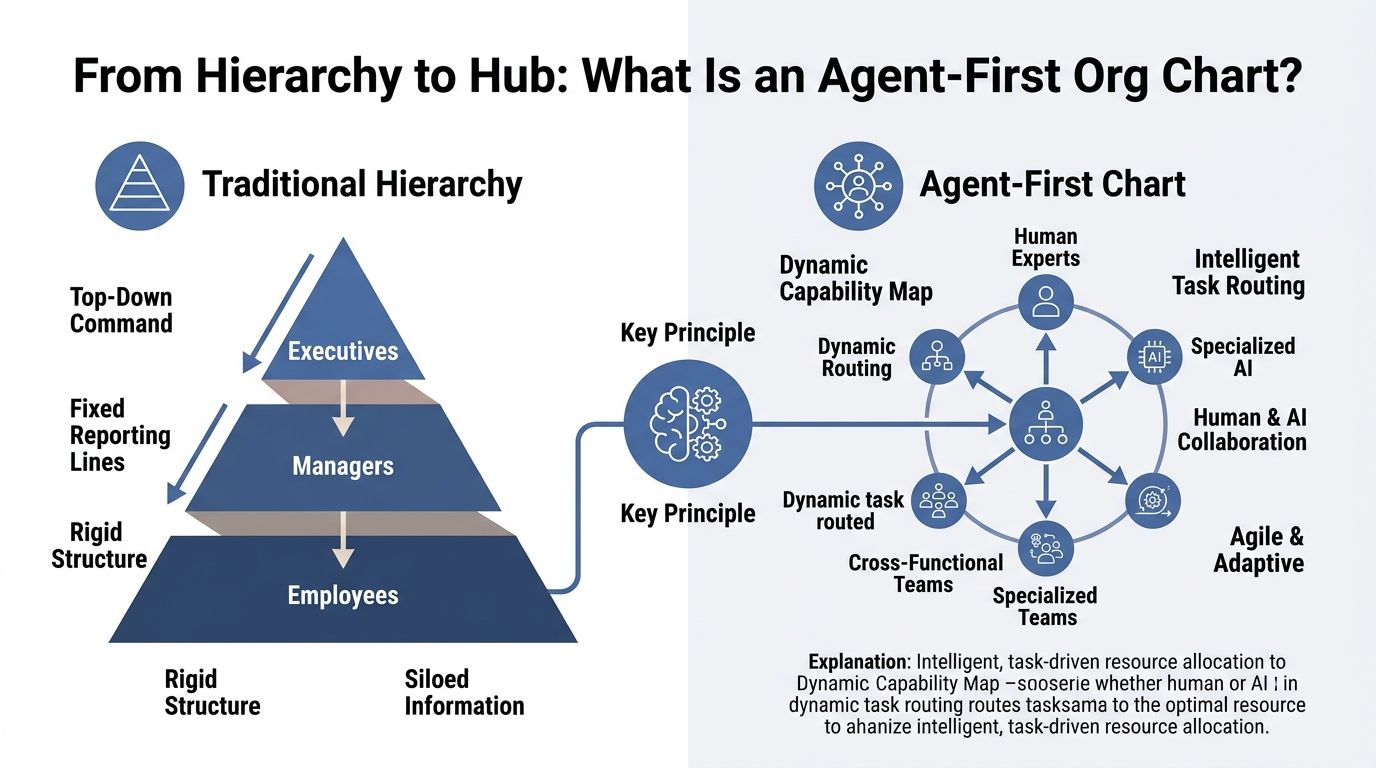
Think capability map, not reporting tree
In an agent-first company, work doesn’t move neatly down a pyramid. It routes to the best available resource.
A founder defines the goal. A human strategist sets constraints. An AI research agent gathers context. A writing agent drafts. A QA agent checks for gaps. A human reviews edge cases and makes the final call. The chart is built around flow first, and titles come second.
That’s why the best explanation of this shift is a move toward dynamic work charts and capability maps, where organizations prioritize outcomes instead of static reporting lines. In support environments, this structure lets specialists spend 70-80% more of their time on complex problem-solving because agents handle routine work, according to Inkeep’s analysis of AI org charts.
If you want a broader operational view of how this plays out across functions, Prometheus Agency’s piece on Agentic AI for Business Operations is worth reading. It’s useful because it treats agents as operating infrastructure, not gimmicks.
What changes for humans
In this model, humans stop being default task-executors.
They become:
- Outcome owners who define what good looks like
- System designers who shape prompts, context, and workflow logic
- Exception handlers who step in when nuance or risk appears
- Editors and approvers who protect quality, trust, and brand position
That shift is where most companies stumble. They buy ChatGPT Team, Claude, Gemini, or a workflow tool, then keep the same old org shape. Same approvals. Same bottlenecks. Same handoffs. That only gives you partial gains.
An agent-first org chart works because it reallocates human attention. Another software subscription does nothing on its own.
What the chart actually shows
Here’s the simplest way to picture it:
| Traditional chart | Agent-first chart |
|---|---|
| Manager over people | Outcome owner over workflow |
| Fixed roles | Blended human and agent capabilities |
| Sequential handoffs | Dynamic routing |
| Department silos | Cross-functional execution paths |
| Headcount as capacity | Agent plus human capacity |
If you’re asking what an agent-first org chart looks like in practice, it looks less like a brick pyramid and more like a network hub. Humans sit at key control points. Agents handle throughput. Work moves faster because fewer tasks wait in line for a person to become available.
That’s the structural advantage.
Three Agent-First Org Chart Models You Can Use
The right model depends on your stage.
Most founders overcomplicate this part. You don’t need a huge redesign on day one. You need a structure that matches your team size, operating maturity, and tolerance for process.

Model one for lean startups
If you’ve got a small team, start with embedded personal agents.
One marketer gets a research and content agent. One salesperson gets a prospecting and follow-up agent. One operator gets a reporting and workflow agent. Nobody “manages AI” as a full-time role yet. Each person uses agents as a role-based advantage.
This is the best fit for small, early-stage teams where speed matters more than formal governance. It keeps friction low and adoption high.
A simple layout looks like this:
- Founder or owner
- Growth lead + content agent
- Sales lead + outreach agent
- Ops lead + reporting agent
- Developer + coding agent
Best part: almost no org chart disruption.
Risk: every person builds their own habits, prompts, and standards. If you don’t document what’s working, you create scattered micro-systems that don’t scale.
Model two for scaling SMBs
Once multiple people need the same capability, move to shared team agents.
Marketing receives a shared campaign research agent. Sales receives a lead qualification agent. Customer success receives an onboarding and response-drafting agent. The human team still owns the function, but the agent layer becomes a real asset, not an individual hack.
This model usually works best when your bottleneck has shifted from individual output to team throughput.
A scaling SMB layout might look like this:
| Function | Human owner | Shared agent layer |
|---|---|---|
| Marketing | Growth manager | Research, content, reporting agents |
| Sales | Sales manager | Lead-gen, enrichment, follow-up agents |
| Customer success | CS lead | Triage, knowledge, onboarding agents |
| Operations | Ops manager | Dashboard, SOP, QA agents |
This structure also aligns with the flattening effect described in Tomasz Tunguz’s analysis. He projects that some functions can move from a classic 1:7:49 manager-to-individual ratio to a lean 1:7 structure where managers oversee seven AI agents, with an 85% reduction in human headcount for those functions and more “player-coach” managers in the mix, as outlined in Pyramids to Cylinders.
For founders trying to decide where agents belong, this is the mental model I’d use. Shared where the work is repeatable. Personal where speed and experimentation matter. If you want deeper examples of those deployment patterns, I’ve written more on AI agents.
My advice is simple: don’t centralize too early. Standardize only after you see repeated demand across roles.
Model three for bionic operators
The third model is for companies where agents are now part of the production engine.
You track human capacity and agent capacity separately. You review agent performance alongside human performance. You budget for compute, orchestration, and maintenance with the same seriousness you apply to payroll or software contracts.
This is the dual-chart or bionic model. One layer shows human accountability. The other shows agent workforce design.
Use it when:
- Agents support multiple departments.
- Agent failures can affect customers or revenue.
- You need visibility into ownership, cost, and uptime.
This is powerful. It’s also where founders can get carried away. If you’re still proving your first two or three workflows, you probably don’t need the overhead yet.
The point is to get an execution edge before competitors do. Looking advanced counts for nothing.
New Roles and Responsibilities in an Agent-First Business
Once agents become part of daily operations, your team needs clear ownership. Otherwise, everyone uses them and nobody is responsible for results.
That’s where most companies get sloppy. AI adoption is a role design issue, and they treat it as a tooling one.

The three roles I’d put in almost every SMB
You do not need a Chief AI Officer to start. You do need these responsibilities covered.
The AI Agent Builder translates a business need into a working system. This person chooses the workflow, define inputs, shape prompts, test outputs, and connect the pieces. In a small company, this might be an ops lead, growth operator, technical marketer, or product-minded generalist.
The AI Owner is the business owner for the workflow: the person accountable for whether the agent improves output, quality, speed, or margin, rather than the one tweaking prompts all day.
The AI Champion drives adoption inside a team. They train others, spot use cases, and stop the common pattern where one power user gets value and everyone else ignores the system.
These labels are already showing up in practice. Major Matters projects that by 2027, specialized roles such as Agent Operations Manager and Chief Agent Officer will emerge to govern growing agent headcount, while Fortune 500 firms may maintain two org charts and track metrics like cost per agent and retention rates. The same piece also points to roles like AI Agent Builder, Owner, and Champion as core parts of the structure in practice, outlined in The Agent Org Chart.
What changes for everyone else
The bigger shift is that every strong IC needs basic agent management skill.
That means they need to know how to:
- Delegate clearly to an agent with the right context
- Review outputs fast instead of redoing the work manually
- Escalate exceptions when the task crosses risk or quality thresholds
- Spot failure patterns and feed that back into the workflow
You’re training people to manage digital labor inside their role, which goes well past learning to “use AI.”
Weak operators often use agents to create more noise. Strong operators use agents to compress cycle time and widen execution capacity.
How I’d assign these roles in a small company
Here’s the practical version for a team that doesn’t want org-chart theater:
| Company stage | Builder | Owner | Champion |
|---|---|---|---|
| Tiny startup | Founder or operator | Founder | Same person |
| Growing SMB | Ops or growth lead | Department head | Team power user |
| More mature SMB | Dedicated systems lead | Function leader | Embedded team lead |
At first, one person may wear all three hats. That’s fine. What matters is naming the hats.
Without that clarity, agents become side projects. With it, they become a powerful advantage.
Designing Your Governance and Workflows
If you let everyone build agents however they want, you get a mess. Duplicated workflows. Inconsistent outputs. Security risk. Broken accountability.
You need governance, but not bureaucracy.
The cleanest model I’ve seen is Big G, little g. Writer describes this as a two-layer governance structure where Big G handles centralized guardrails like security and ethics, while little g gives teams the freedom to operate inside those boundaries. In the same framework, human-agent teams can see 2-3x productivity gains when delegation and ROI tracking are managed well, as explained in Writer’s guidance on the AI Agent Owner role.
Big G rules that should be non-negotiable
You set these as the owner. They apply across the business.
- Set data boundaries by deciding which systems agents can access and which they can’t.
- Set approval thresholds that define what can publish, send, approve, or escalate autonomously.
- Lock down brand and compliance standards, including tone, claims, legal review triggers, and audit expectations.
- Name the human who owns the failure when an agent underperforms or creates a problem.
Keep this short. If your governance doc is huge, your team won’t follow it.
Little g is where the work gets done
Inside each function, teams need operating rules.
A content workflow is a good example:
- A strategist writes the brief and defines the angle.
- A research agent gathers source material and supporting context.
- A drafting agent produces a first version.
- A QA layer checks alignment, missing claims, and formatting.
- A human editor approves, revises, or rejects.
- Distribution stays with a human owner unless the workflow is tightly bounded.
That’s the practical side of agentic context engineering. Good agents need role definition, memory boundaries, source constraints, and clear handoff logic on top of prompts.
If an agent can’t fail safely, it shouldn’t run autonomously.
The accountability question founders avoid
You need an answer for this before rollout.
When an agent misses the mark, who fixes it? The builder? The owner? The team lead? If that’s fuzzy, adoption drops the first time something goes wrong.
My recommendation is simple:
- Builder owns system quality
- Owner owns business outcome
- End user owns proper use
- Leader owns guardrails
That prevents finger-pointing. It also stops the lazy pattern where teams blame “the AI” as if a tool set its own standards.
The best workflow governance feels boring. That’s good. Boring systems scale.
Your Roadmap to an Agent-First Structure
Most companies fail because they try to redesign the whole business at once. Don’t do that.
Build the structure in phases. Prove value. Expand only after the workflow earns its place.
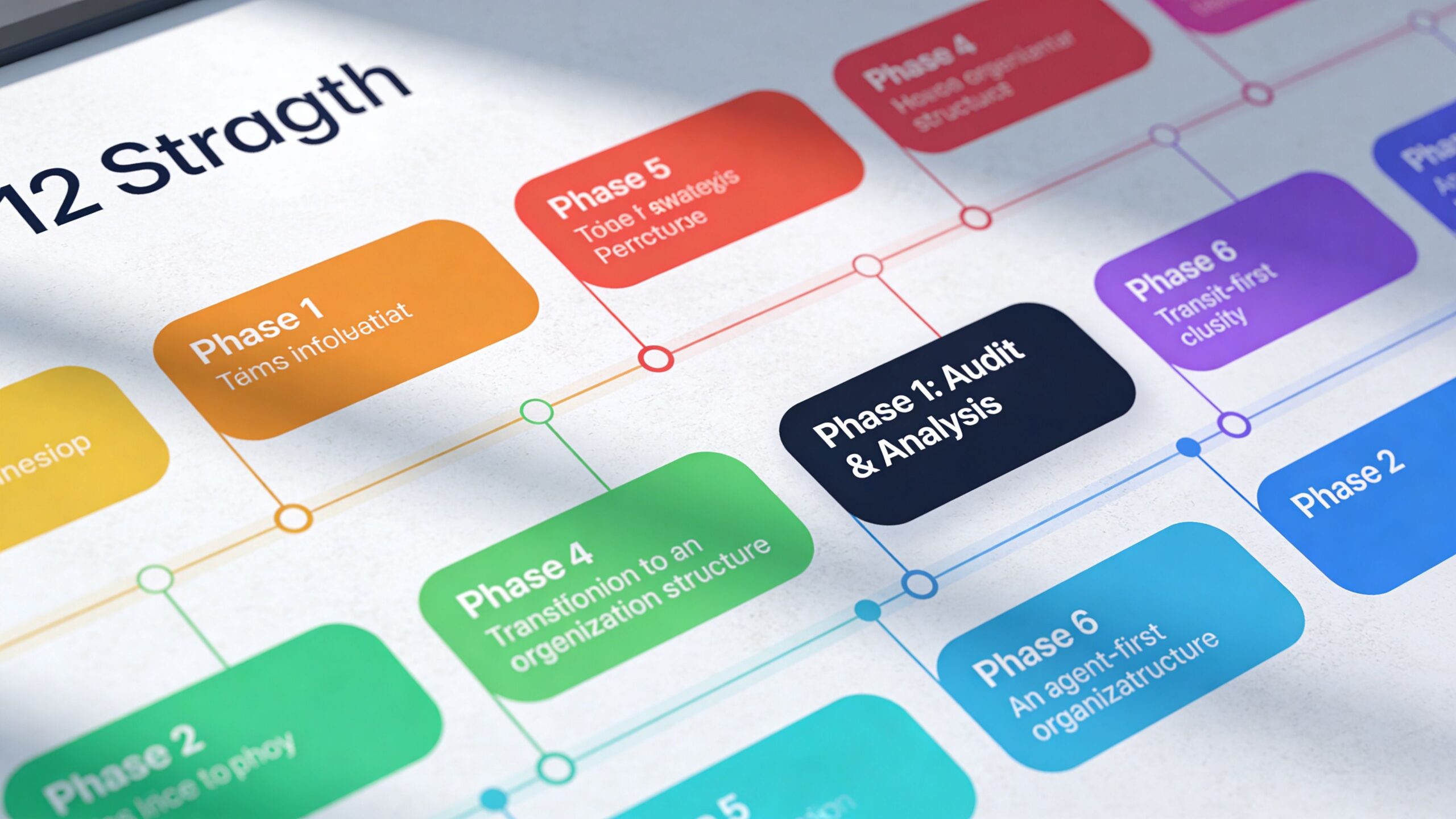
Phase one in the first 90 days
Writer’s rollout guidance for agentic roles uses a 90-day pilot rhythm, with Month 1 focused on executive alignment, Month 2 on interim owners, and Month 3 on formalization. I like that structure because it forces discipline instead of endless experimentation.
In your first phase, audit for manual work that is frequent, painful, and easy to verify. Don’t start with your most strategic or high-risk process. Start where work is repetitive and the output standard is already clear.
Good early candidates:
- Sales research
- Content repurposing
- Customer support triage
- Internal reporting
- SOP generation and updating
Choose one. Assign one owner. Build one working agent flow.
Phase two in months four through nine
Once the pilot is producing reliable results, formalize ownership and documentation.
Many teams should create a lightweight internal directory. Nothing fancy. A Notion database, Airtable base, or ClickUp view is enough. Track the agent name, workflow, owner, inputs, outputs, dependencies, and known failure modes.
If you want a broader planning lens for sequencing initiatives across a company, Mindlink Systems has a useful enterprise generative AI strategy roadmap. I’d adapt the sequencing logic, then strip out the enterprise overhead.
Here’s where you also decide whether your next layer should be:
- a second workflow inside the same team
- a shared agent for multiple people
- or a cross-functional connection between workflows
That decision matters more than adding more agents.
Phase three from month ten onward
At this point, your org chart starts to visibly change.
Your isolated agent experiments start connecting into a network. Sales hands qualified intelligence into marketing. Support feeds objections into product. Ops monitors system health across all of it.
A useful reference point sits below. It’s worth watching if you’re thinking beyond task automation and into operating model design.
At this stage, I’d review three things every quarter:
| Review area | What to check |
|---|---|
| Workflow value | Is this agent reducing friction or just moving work around? |
| Ownership clarity | Does one human clearly own the result? |
| Integration depth | Is this still standalone, or does it improve adjacent workflows too? |
The roadmap is simple on purpose. What founders need is repeatable wins that evolve into a new structure, and a dramatic reorg rarely delivers them.
Measuring Success and Avoiding Scale Traps
Don’t measure success by how many agents you’ve deployed. That’s vanity.
Measure whether the business now moves with more speed, consistency, and margin than it did before. If your team still spends too much time chasing context, correcting weak outputs, or managing disconnected tools, the system isn’t mature yet.
What to measure instead
I’d keep the scorecard tight:
- Cost per task or workflow, compared against the old manual process.
- Manual hours removed, meaning whether people are spending less time on low-value work.
- Output quality under review, because fast garbage is still garbage.
- Agent reliability, measured as operational trust rather than technical perfection.
If you’re running a dual-chart model, track agent metrics with the same seriousness you track human performance. If you’re still in the early embedded phase, focus on workflow-level outcomes first.
The best agent-first companies have the clearest ownership and the cleanest unit economics, whatever their agent count.
The scale traps I see most often
The first trap is agent sprawl. Teams build a custom agent for every tiny task. Now nobody knows what exists, what overlaps, or what breaks.
The second is weak oversight. Founders assume the model is “smart enough,” then stop reviewing strategic outputs closely.
The third is bad fit. Some work should stay human-led. Negotiation, executive messaging, high-stakes decisions, sensitive customer issues. Keep agents in support roles there unless you have very tight controls.
An agent-first org chart should make your company sharper. If it makes your operation harder to understand, you built the wrong one.
If you want help designing an agent-first org chart for your company, building the workflows behind it, or training your team to run it well, you can explore working with me.