
You're probably feeling this already. Orders keep moving, but operations don't feel under control. Support tickets pile up, inventory gets out of sync, your team is stuck making pricing calls in spreadsheets, and every small issue turns into another human bottleneck.
That's the trap.
Most ecommerce operators still think the fix is hiring more people, adding more dashboards, or bolting on another app. I don't. I think the winning move is to build an autonomous workforce inside your business: an ai agent for ecommerce operations that can monitor, decide, and execute across the systems you already run. A gimmicky bot or another FAQ widget can't do that.
I've worked with machine learning since 2016 and generative AI since 2019. The pattern is consistent. The companies that win don't use AI for novelty. They use it to compress decision time, remove manual lag, and out-execute competitors.
Your Competitors Are Building an AI Workforce
You might still be running ecommerce operations at human speed. That means someone checks low-stock alerts after the fact. Someone reviews repetitive support requests one by one. Someone notices margin erosion too late. Someone updates workflows only after performance drops.
Your stronger competitors are moving differently. They're giving software the authority to act.
That matters because this has moved past early curiosity. The AI agents in eCommerce market is projected to grow from USD 3.6 billion in 2024 to USD 282.6 billion by 2034, at a 54.7% CAGR, according to Market.us research on AI agents in ecommerce. I read that as a signal. Capital is moving where operators see advantage.
Why this changes how you operate
An AI workforce doesn't get tired, doesn't forget a rule, and doesn't wait for Monday's ops meeting to react. It can watch your catalog, support queue, inventory position, and pricing environment continuously.
That shifts ecommerce operations from reactive to strategic.
Instead of asking, “How do I handle more volume with the same team?” you start asking, “Which decisions should humans stop making manually?” That's a much better question.
My practical rule: if a workflow happens frequently, follows clear business rules, and touches live data, it's a strong candidate for an agent.
What happens if you wait
You won't lose because another brand has flashier AI branding. You'll lose because they'll operate faster than you.
They'll resolve routine issues without adding headcount. They'll react to inventory changes sooner. They'll close more purchases while your team is still triaging operational noise. That compounds into better customer experience, cleaner margins, and more freedom for you to focus on growth instead of cleanup.
If you ignore that shift, you're not staying neutral. You're choosing slower execution.
What an AI Operations Agent Actually Is
Let's strip the hype out of this.
An AI operations agent does more than a chatbot with a nicer tone or a static automation flow. I explain it to clients as your first digital employee. It has a brain, a toolbox, and memory. If one of those is missing, you don't have an agent. You have a demo.
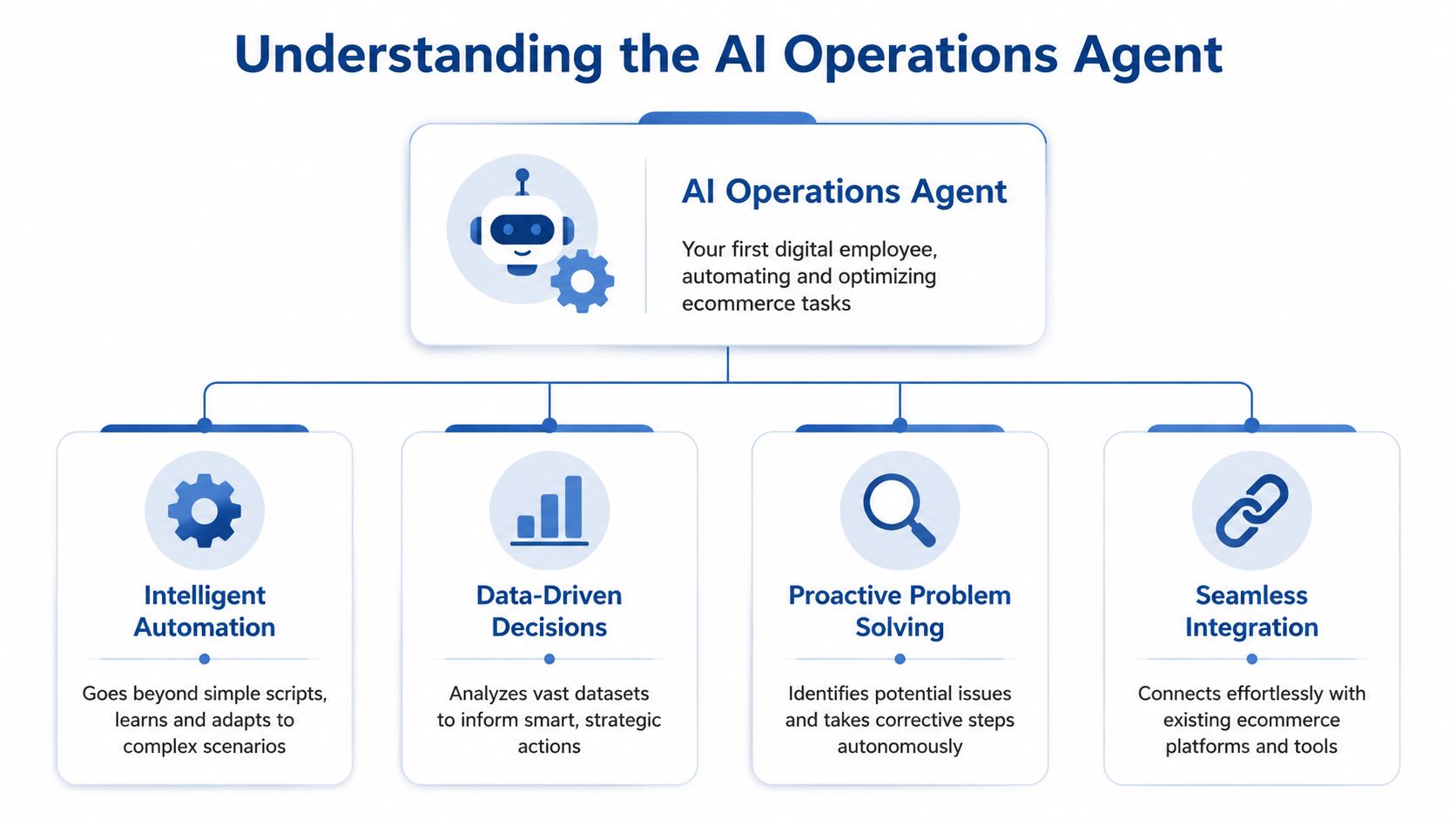
The brain
The brain is the reasoning model. That could be GPT, Claude, Gemini, or an open-source model depending on your stack and risk tolerance.
This is the part that interprets a situation and decides what to do next. Not perfectly. Not magically. But well enough to handle repeatable decision paths when you give it the right inputs and boundaries.
The toolbox
The toolbox is where substantial business value lives.
If the model can't do anything inside Shopify, your ERP, help desk, warehouse system, or analytics stack, it's just talking. Once it can read data and trigger actions through APIs, it becomes operational. That's when it can update orders, flag anomalies, trigger replenishment logic, or route tickets intelligently.
For pricing-specific workflows, I also like reviewing external references on AI-driven pricing insights because pricing agents only work when they can pair reasoning with real commercial signals.
The memory
Memory is what stops the agent from behaving like it woke up five seconds ago.
It needs business context. Product rules, return policies, supplier constraints, escalation logic, historical interactions, and approved actions. Without memory, it can respond. With memory, it can operate consistently.
Here's the simple test I use.
| Component | What it does | What happens without it |
|---|---|---|
| Brain | Interprets situations and chooses actions | The system can't reason through exceptions |
| Toolbox | Connects to business systems and executes work | The system can only answer, not act |
| Memory | Holds context, policies, and past interactions | The system becomes inconsistent and forgetful |
A chatbot answers questions. An operations agent owns outcomes.
The right mental model
Think of this as an operations manager you hired into a digital environment.
You give that manager access, policies, priorities, and performance targets. You don't expect them to “know your business” by default. You onboard them. You supervise them. Then you expand their authority as they prove reliable.
That's how I recommend you approach an ai agent for ecommerce operations. Start narrow. Give it one domain. Let it earn trust.
High-Value Use Cases That Drive Your Bottom Line
Most use-case lists are useless because they confuse possibility with value. I care about what changes revenue, margin, and operating cost.
There are three deployments I keep coming back to because they hit the business where it counts.

Customer service agents
This is the fastest win for most brands because the workflows are repetitive, the intent patterns are clear, and the operational drag is obvious.
According to Envive's AI ecommerce engagement data, shoppers who engage with AI chat convert at 12.3% versus 3.1% for unassisted visitors, a 4X improvement. The same source says AI agents can handle up to 80% of routine inquiries and cut support costs by 30%. It also notes that Alibaba's chatbots save an estimated USD 150 million annually.
That's an operating model change.
If you run on Shopify, I'd look at implementation options like these AI solutions for Shopify stores because the right support agent shouldn't just answer order-status questions. It should authenticate users, retrieve order context, explain return options, and escalate only when the issue requires a person.
Inventory agents
Inventory is where mediocre operators bleed, often without immediate notice. They don't notice until stockouts, excess holding, or fulfillment friction show up in the P&L.
The stronger pattern is an agent that monitors stock across locations, watches sales velocity, incorporates lead times and promotions, then triggers reorder decisions automatically. The source material on inventory agents describes a fashion retailer scenario where an agent manages 50,000 SKUs across 200 stores while accounting for delays and demand spikes through connected systems and predictive logic. That's what I mean by autonomous work: the agent executes the reorder instead of reminding someone to do it.
I've also seen teams get distracted by “smart forecasting” before they solve basic operational discipline. Don't do that. If your stock logic is inconsistent across channels, an inventory agent will amplify the inconsistency.
Pricing agents
Pricing is where a lot of ecommerce teams still make slow, fragile decisions.
A pricing agent can watch competitor movement, inventory pressure, demand shifts, and margin rules at the same time. Then it can recommend or apply changes inside boundaries you set. That matters because static pricing leaves money on the table in both directions. Sometimes you discount too early. Sometimes you hold too long and lose conversion.
This is also one area where I'd push you to study more practical examples before deployment. I've published a deeper breakdown of AI agent use cases for business operations if you want to compare where pricing fits against support, marketing, and internal workflows.
Fraud and exception handling
This one gets overlooked because it sits between operations, finance, and CX.
An agent can monitor transaction patterns, velocity signals, and behavioral anomalies in real time, then route for verification or pause fulfillment when something looks off. The product operations material I reviewed describes fraud-loss reduction in the 35-60% range when real-time signals are used properly. The range matters less than the pattern: agents are useful where your team can't manually monitor every edge case at speed.
Don't deploy one giant agent for everything. Build specialized agents for support, inventory, pricing, and risk. Then orchestrate them.
Where I'd start
If you want the cleanest path to ROI, start here:
- Support first if ticket volume is eating team capacity.
- Inventory next if stockouts or overstock are creating revenue leaks.
- Pricing after that if you already trust your product, inventory, and margin data.
That sequence works because it follows operational maturity. Customer service is easiest to scope. Inventory creates deeper advantage. Pricing demands the most discipline.
The Data and Integration Your Agent Needs to Function
This is the part people skip because it's less exciting than demos. It's also the part that determines whether the project works.
An AI agent without clean data and system access is useless. Smart model. Nice interface. No operational value.
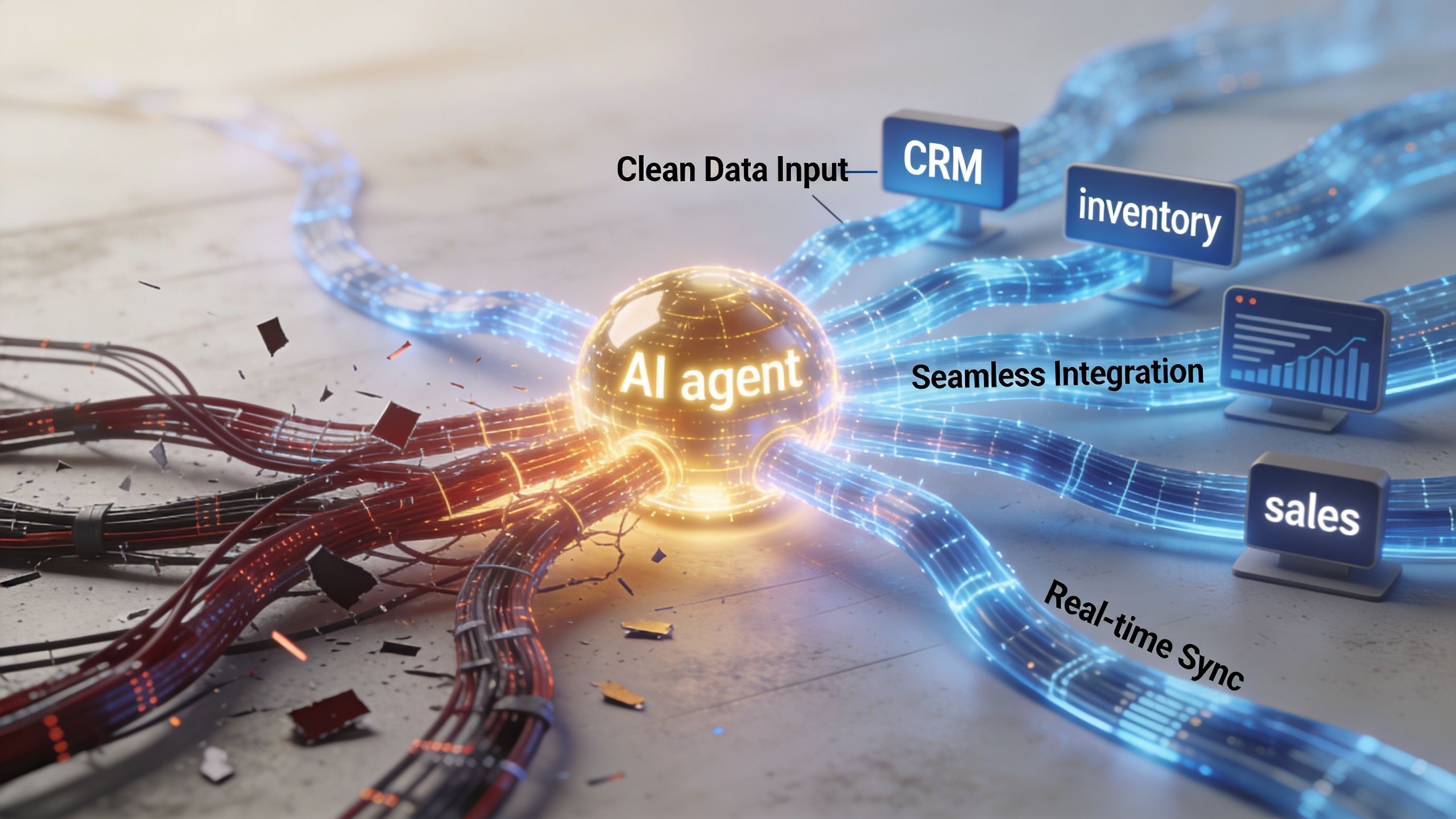
Structured product data is non-negotiable
Agents don't interpret your store the way a human merchandiser does. They need machine-readable product data.
According to Digital Applied's ecommerce AI agent readiness assessment, poor structured data can cause agents to skip listings entirely, leading to a 20-30% loss in potential transactions in agent-driven channels. That's the consequence of messy product information. Even strong APIs won't save you if the catalog itself isn't parseable.
If your product pages are inconsistent, your titles are messy, your variant data is incomplete, or your availability is stale, fix that before you build.
The minimum stack I expect
Here's the readiness checklist I use with clients:
- Your catalog data is structured, with product title, description, price, availability, brand, and SKU clean and consistently formatted.
- Inventory syncs live, because your stock status can't lag behind reality if the agent is making fulfillment or merchandising decisions.
- Shopify, ERP, OMS, help desk, and warehouse tools have stable APIs with reliable access paths.
- Your business rules are clear: refund thresholds, reorder logic, discount boundaries, and escalation criteria are written down explicitly.
- You have one source of truth. If three systems disagree, the agent will act on bad assumptions.
If you're evaluating your broader stack before deployment, my guide on best AI tools for ecommerce can help you map where platforms fit versus where you need custom orchestration.
The fastest way to kill an AI agent project is to give it conflicting data and vague rules.
Where teams get this wrong
They buy the agent layer before cleaning the substrate.
That usually means product data is incomplete, APIs are brittle, inventory updates are delayed, and no one agrees which system owns the truth. Then the vendor gets blamed for “bad AI.” In reality, the agent is exposing operational debt you already had.
I'd rather delay deployment and fix the data foundation than launch an agent that makes unreliable decisions.
Your Phased Roadmap to Deploying an AI Agent
Teams often fail because they start too wide. They want an agent to handle support, inventory, pricing, merchandising, and reporting at the same time. That's how you burn budget and lose faith in the project.
I use a phased rollout instead.
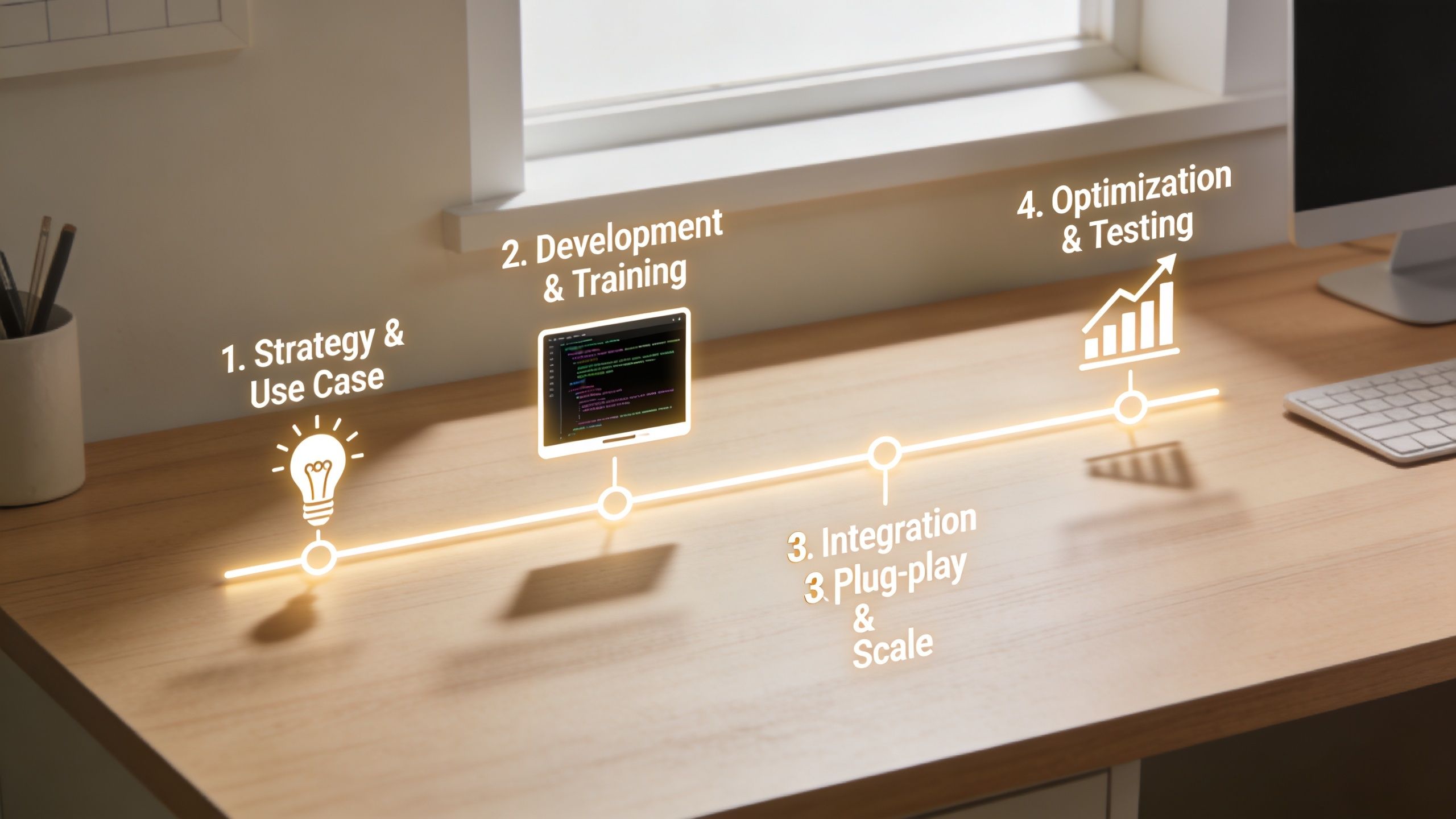
Phase one chooses the fight
Pick one operational problem with obvious value and clear boundaries.
Good choices include repetitive support requests, low-confidence inventory reordering, or exception-heavy order workflows. Bad choices are broad missions like “improve operations” or “make the store smarter.” Those sound ambitious and execute terribly.
I also want one owner on your side. Not a committee. One person who can make scope calls quickly.
Phase two gets the systems ready
The core work begins. You connect the systems, define the permissions, clean the data, and write the operating rules.
If you skip this, the pilot becomes theater.
For a broad overview of the architecture choices, orchestration patterns, and platform options involved, I'd point you to my primer on AI agents for business deployment. The specifics change by stack, but the principle doesn't. Access, context, and constraints come before autonomy.
Phase three runs the pilot
A good pilot is boring in the right way.
It has one use case, clear success metrics, limited authority, and human review where needed. The goal is to prove the agent can do one thing reliably inside your business.
Here's a useful walkthrough on the mindset behind phased rollout:
Phase four expands authority
Once the pilot performs, you widen the scope carefully.
You increase the number of actions it can take, broaden the data sources, reduce human overrides where confidence is high, and add adjacent workflows. That's how an operational agent becomes a real workforce layer instead of a contained experiment.
The timeline and budget reality
Allow me to be blunt.
Vendors love the quick-setup story. In practice, independent SMBs often face 3-6 month implementation ramps costing $20K-$100K upfront, according to MindStudio's analysis of ecommerce AI agents. The same source cites a 2025 Gartner survey reporting that 68% of ecommerce pilots fail to scale because teams underestimate integration complexity.
That matches what I see. The model is rarely the blocker. Integration is.
| Phase | What matters most | Failure risk |
|---|---|---|
| Strategy | Narrow scope and one owner | Trying to solve too much at once |
| Preparation | Clean data and reliable integrations | Hidden system conflicts |
| Pilot | Tight permissions and measurable outcomes | Demo-driven success criteria |
| Scale | Controlled expansion and review loops | Granting autonomy too fast |
If you can't explain exactly what decision the agent will own, you're not ready to build it.
Build versus buy
I'm opinionated here. Buy when the workflow is common and your stack fits the vendor. Build when the workflow is strategically important, touches proprietary logic, or needs orchestration across multiple systems.
If you're an SMB with limited technical depth, buying a narrower solution is often smarter. If your business depends on differentiated operations, custom build starts making more sense despite the heavier lift.
The mistake is pretending those paths are equal. They aren't.
Measuring ROI and Defining Your Agent's KPIs
If you judge your agent by “it seems useful,” you'll keep funding experiments instead of systems.
I want KPIs tied to money, speed, and operational control. Not vanity metrics. Not screenshot moments.
Measure outcomes by operational domain
For support, I care about resolution quality, cost per resolved issue, escalation rate, and whether the human team gets pulled into fewer low-value requests.
For inventory, I care about reorder accuracy, stockout reduction, and whether inventory decisions are happening sooner and more consistently. For pricing, I care about margin protection, conversion response, and how quickly the business reacts to market shifts.
Use a checklist like this before you approve any agent for production:
| Criterion | What to Look For | Why It Matters |
|---|---|---|
| Business owner | One accountable leader owns results | Shared ownership kills momentum |
| Use-case clarity | The agent has a defined job, not a vague mission | Clear scope improves deployment success |
| System access | Required tools and APIs are available and stable | No access means no execution |
| Data quality | Product, inventory, order, and policy data are reliable | Bad inputs create bad decisions |
| Action boundaries | Discount, refund, reorder, and escalation limits are explicit | Guardrails protect margin and trust |
| Human review path | Complex cases can escalate cleanly | You need control during early rollout |
| Baseline metrics | Current performance is documented before launch | No baseline means no ROI proof |
| Ongoing monitoring | Logs, exception review, and quality checks exist | Agents drift without supervision |
My ROI rule
I don't approve a use case unless I can answer three questions:
- What revenue does this increase or protect?
- What labor or operational cost does this remove?
- What competitive delay does this eliminate?
If the answer is fuzzy, the use case is still too vague.
Don't reward the wrong behavior
Teams sabotage themselves in these situations.
If you optimize a support agent only for ticket deflection, it may suppress valid escalations and hurt customer experience. If you optimize a pricing agent only for conversion, it may erode margin. If you optimize an inventory agent only for availability, it may create excess holding.
You need balanced KPIs. Revenue and cost. Speed and quality. Autonomy and control.
An agent is valuable when it improves business decisions, not when it simply produces more activity.
Your Next Move Is a Strategic Decision
You don't need another AI brainstorm. You need one operational decision.
Choose a workflow that drains time, slows response, or creates preventable mistakes. Then decide whether you want humans doing that work manually a year from now. If the answer is no, that's your starting point.
This is how I'd approach it if I were in your seat. Start with one agent. Give it a narrow job. Connect it to real systems. Measure hard outcomes. Then expand from there.
The ecommerce businesses that pull ahead over the next few years will operate faster, cleaner, and with less manual drag. They'll build an autonomous workforce while everyone else is still staffing around avoidable inefficiency.
That's the core opportunity in an ai agent for ecommerce operations.
If you're serious about deploying agents inside your ecommerce business, don't start with tooling. Start with the workflow that most deserves autonomy. Then build from there.