
Everyone’s selling you the AI dream. Shiny demos, big promises. But you and I know that tools are just tools. The real question is how you use them to make more money.
Since 2016, I’ve been deploying machine learning systems for one reason: to drive revenue. Experiments only count if they get there. Adopting AI is the easy part. The goal is to use it to increase average order value, raise customer lifetime value, and cut operational overhead.
This is my vetted playbook on the best AI tools for ecommerce, categorized by the exact business problem they solve, instead of another laundry list of features copied from marketing sites. No fluff. Just what works, what doesn’t, and how to get from idea to implementation faster than your competition. For those looking to understand the full impact, exploring how AI models for e-commerce can cut content costs and boost sales is essential context.
I’ll break down each platform with a focus on practical application. You’ll see screenshots, get direct links, and understand the critical trade-offs for your specific business stage. Let’s move past the hype and start building your intelligent commerce engine.
1. Shopify App Store
Before you look at standalone platforms, your first stop should be your own ecosystem. If you’re one of the millions of merchants on Shopify, the Shopify App Store is your native marketplace. The fastest path to implementing the best AI tools for ecommerce. It works as a launchpad to integrate hundreds of AI tools with a few clicks.
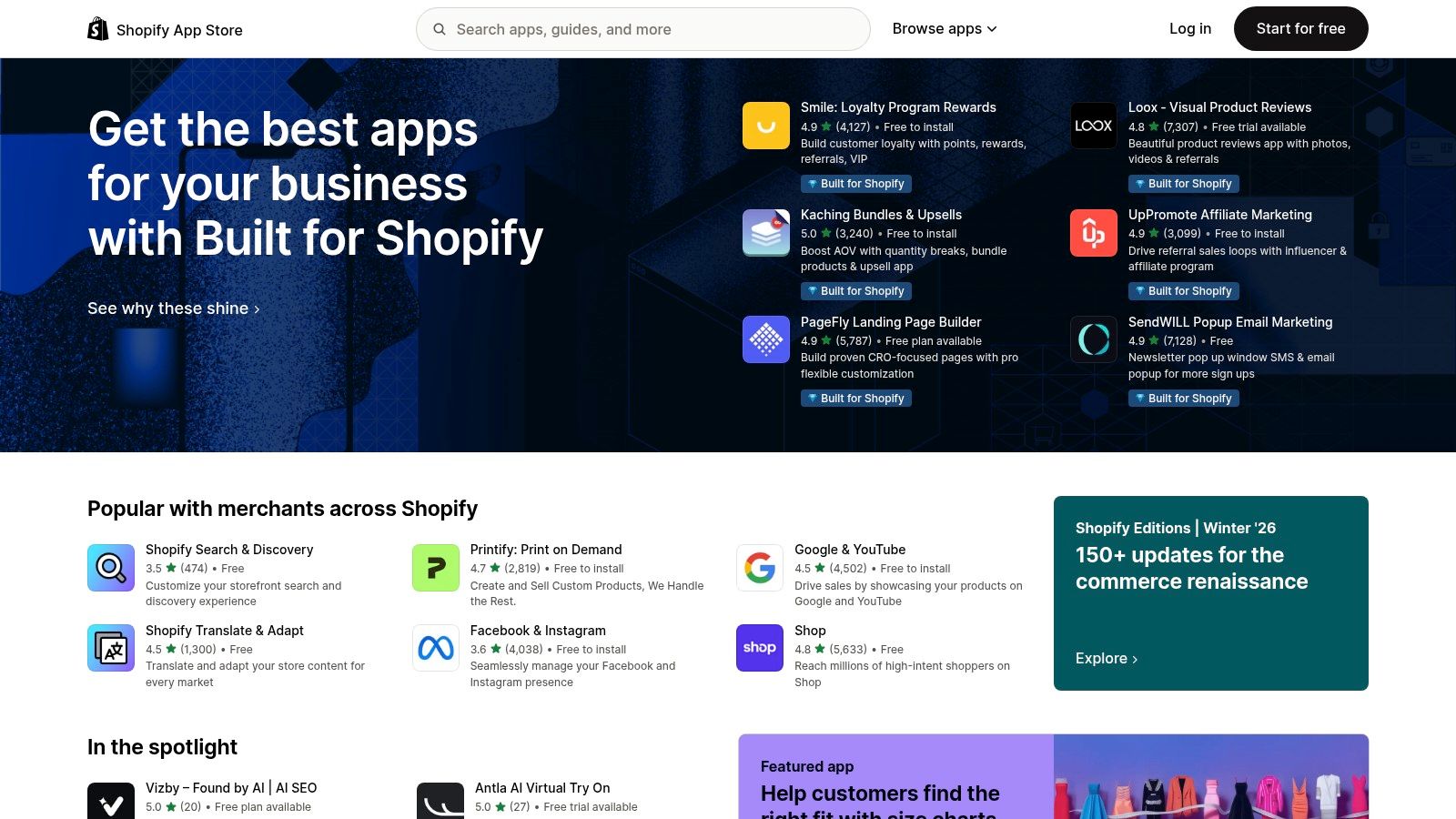
The advantage is speed and reduced risk. Native billing, one-click installation, and user reviews let you test an AI-powered search or personalization app in hours, not weeks. You see real-world feedback from merchants like you, cutting through the marketing hype.
Practical Implementation
Don’t search for “AI.” Search for the business problem you’re solving, like “product recommendations” or “customer service chatbot.” Start with apps that offer a free trial. Monitor key metrics like conversion rate during the trial to decide whether a full rollout is worth it.
Website: https://apps.shopify.com
It’s best for Shopify merchants seeking fast, low-risk AI integrations for specific use cases like personalization, search, and content creation.
| Pros | Cons |
|---|---|
| Tight integration with Shopify stores | App quality and support can vary significantly |
| Extensive user reviews provide social proof | Newer AI apps may lack a proven track record |
| Fast time-to-value with one-click installs | Can lead to “app overload” if not managed carefully |
2. WooCommerce Marketplace
Running on WordPress? Your ground zero for AI is the WooCommerce Marketplace. Similar to Shopify's ecosystem, this is your official library of extensions built for your store. It’s a trusted repository where you can find vetted AI plugins for your ecommerce operations.
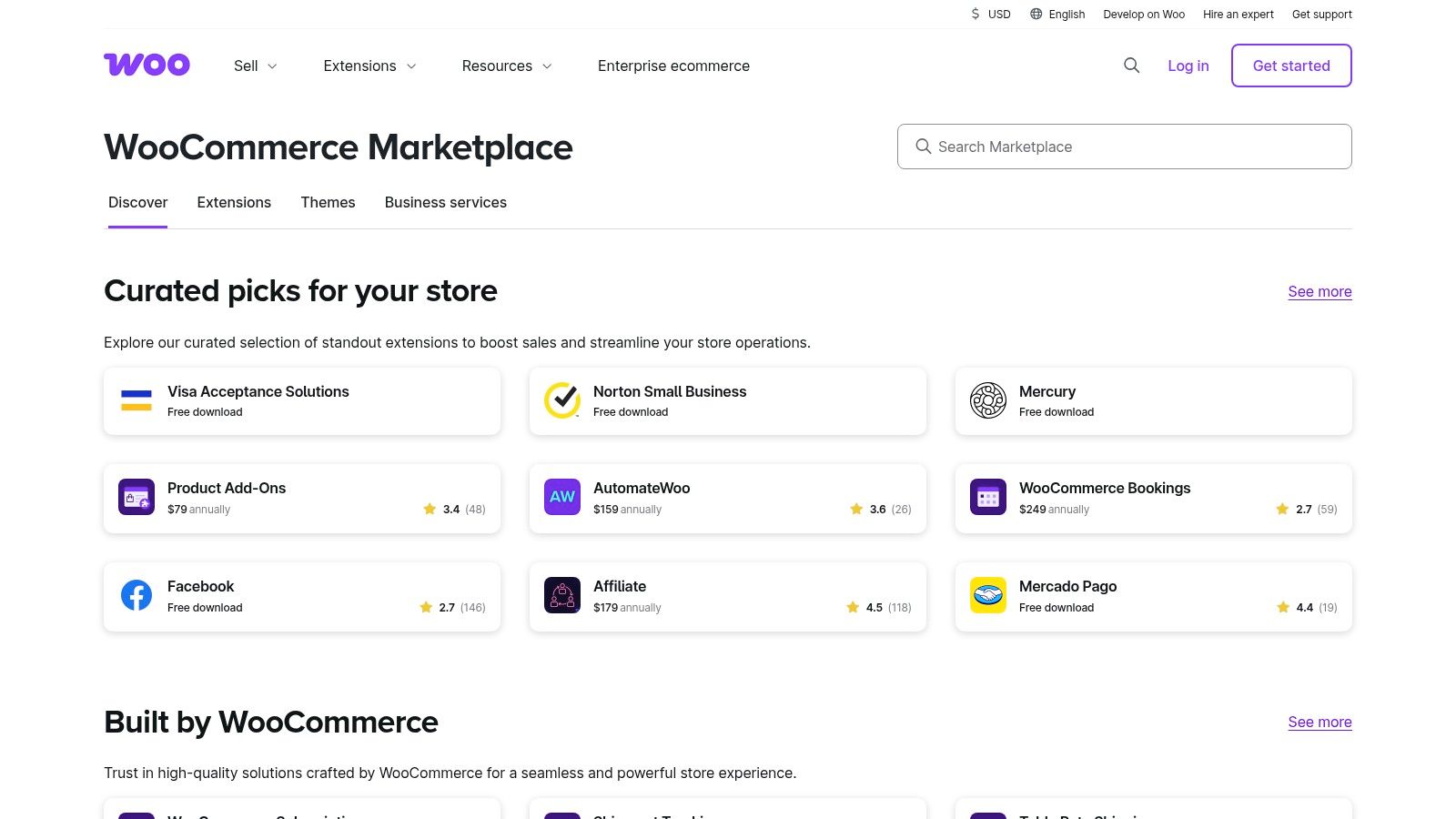
The key advantage here is trust. Every extension is screened for quality and security, critical when you’re managing your own WordPress environment. You get clear licensing and a 30-day money-back guarantee. This model de-risks the process of trying new AI capabilities without compromising your site's stability.
Practical Implementation
Focus on extensions that solve a specific pain point. Look for "AI product description writer" or "AI chatbot for support." Many of these tools require you to bring your own OpenAI API key, giving you control over usage costs but adding a setup step. Use the 30-day guarantee to fully test an extension’s impact before committing.
Website: https://woocommerce.com/products/
It’s best for WordPress/WooCommerce merchants who prioritize security, clear pricing, and officially vetted AI plugins for content, support, and recommendations.
| Pros | Cons |
|---|---|
| Plugins are screened for quality and security | Some tools require you to provide your own OpenAI API keys |
| Transparent one-time or annual pricing | Feature depth and quality can vary between plugins |
| 30-day money-back guarantee reduces risk | Smaller selection of cutting-edge AI tools vs. Shopify |
3. BigCommerce App Marketplace
Like its competitor, BigCommerce provides a native ecosystem. The BigCommerce App Marketplace is a critical hub for merchants scaling into mid-market and enterprise who need powerful AI without derailing their tech stack. It's less about quantity, more about quality.
The key difference is the emphasis on composable commerce. You'll find partner apps proven to handle massive product catalogs. Badges like "Elite" or "Preferred" partner help you identify vetted, high-performance tools for AI-driven search, recommendations, and automation. A top source for enterprise-grade AI.
Practical Implementation
Focus on "Elite" and "Preferred" partner apps first; they have stricter vetting. Use filters to find apps compatible with features like Multi-Storefront. Many of these advanced AI tools are quote-based, so be ready to engage with sales teams for a demo. This is a higher-touch process but ensures the solution fits your needs.
Website: https://www.bigcommerce.com/apps/
It’s best for enterprise and mid-market BigCommerce merchants needing vetted, high-performance AI for search, personalization, and complex catalog management.
| Pros | Cons |
|---|---|
| Supports composable architectures and headless | Many powerful AI offerings are quote-based, not fixed-price |
| Partner apps with proven enterprise rollouts | Some app categories are less populated than Shopify’s |
| Strong focus on enterprise-grade integrations | Steeper learning curve for some of the advanced tools |
4. G2 (E‑Commerce Personalization category)
Instead of relying on a vendor's marketing, you need unfiltered user feedback. That’s where a peer-review hub like G2 becomes an indispensable part of your research. You use it to compare the best AI tools for ecommerce and see how they actually perform. This is where you separate contenders from pretenders.
The power of G2 is its structured comparison data. You can filter platforms by features, user ratings, and company size, creating a shortlist in minutes. Verified reviews often detail specific ROI, implementation challenges, and support quality, giving you a 360-degree view you'll never find on a pricing page.
Practical Implementation
Use G2's comparison feature to select your top three contenders for a side-by-side report. Pay close attention to reviews from companies of a similar size. Look for patterns in the "Cons" section; if multiple users report the same issue, take it seriously. This process de-risks your decision and arms you with tough questions for your vendor demos.
Website: https://www.g2.com/categories/e-commerce-personalization
It’s best for anyone in the evaluation phase, looking to compare AI personalization vendors using verified user reviews and data-driven shortlists.
| Pros | Cons |
|---|---|
| Aggregates real user reviews and feedback | Some vendors sponsor listings for better visibility |
| Powerful filters accelerate vendor evaluation | Pricing information is often summarized or estimated |
| Side-by-side comparisons reveal key differentiators | Review quality can vary; some lack actionable detail |
5. Algolia
Ready to graduate from basic platform search? Algolia is where you turn. It's a developer-friendly AI search and recommendation engine designed for speed and relevance. The engine powering the search bars of tech giants, now accessible for your store without needing a full-time ML team.
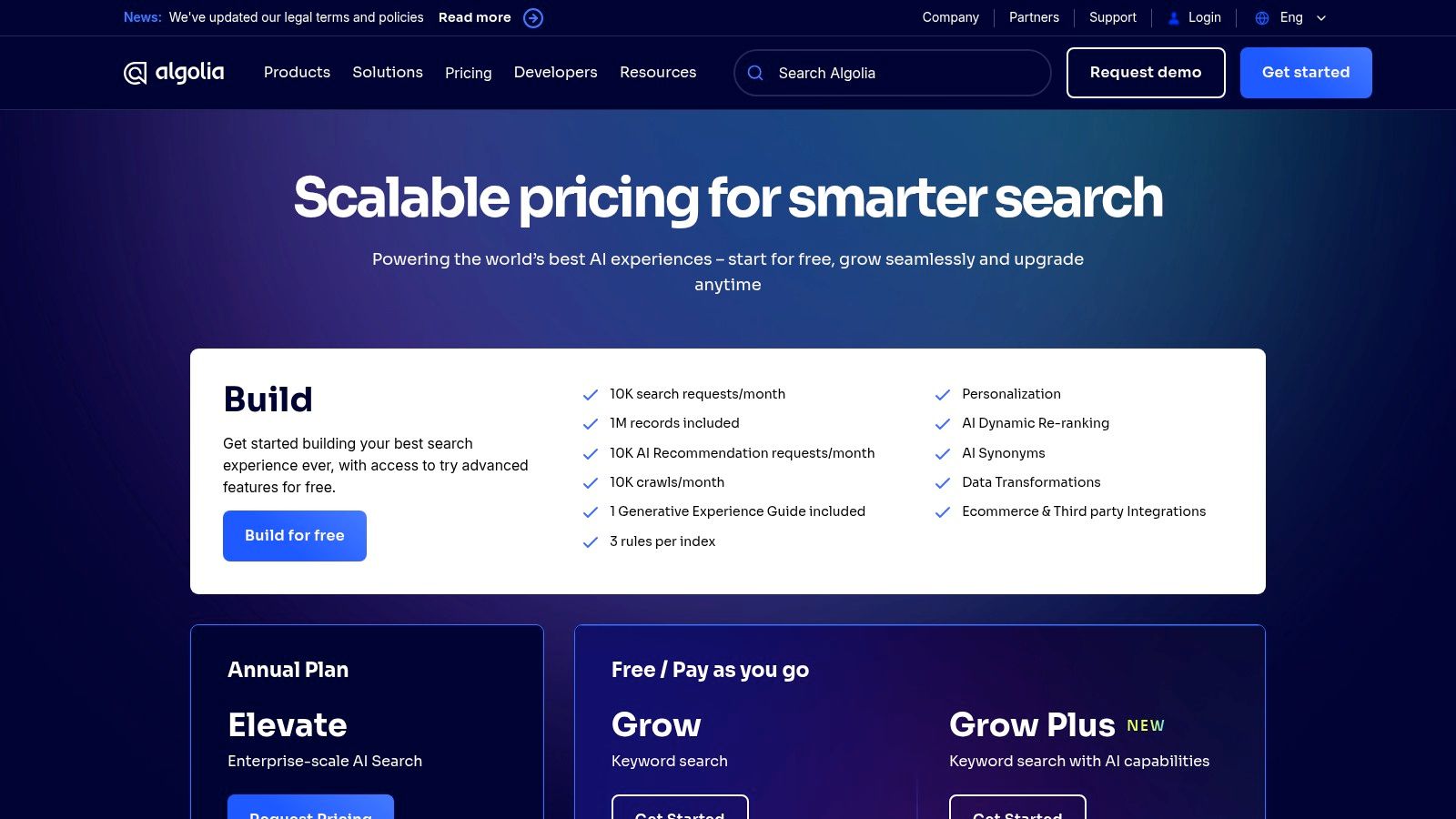
What I appreciate about Algolia is its transparency and control. You get a powerful combo of keyword and semantic search (NeuralSearch) out of the box. Its Recommend API delivers dynamic suggestions like "frequently bought together" to increase average order value. A full product discovery suite.
Practical Implementation
Start by connecting Algolia to your product catalog with their Shopify or BigCommerce integrations. Focus on configuring the search results page first. Use the merchandising studio to promote specific products for certain keywords and set up A/B tests. Using AI this way is a core strategy when you learn how to use AI for marketing to directly impact revenue.
Website: https://www.algolia.com/pricing
It’s best for store owners with some technical help who need a best-in-class, highly customizable AI search and recommendation engine.
| Pros | Cons |
|---|---|
| Transparent usage-based pricing for its Recommend API | Costs can scale quickly with high traffic volumes |
| Mature documentation and well-maintained SDKs | Requires developer resources for implementation |
| Powerful merchandising and A/B testing capabilities | Can be overkill for very small or simple catalogs |
6. Klevu
When your catalog grows, basic search leaks revenue. Shoppers can’t find what they want and leave. Klevu is an AI-powered product discovery platform that solves this by upgrading your site search, merchandising, and recommendations into one intelligent system. One of the best AI tools for ecommerce when you need to move beyond simple keyword matching.
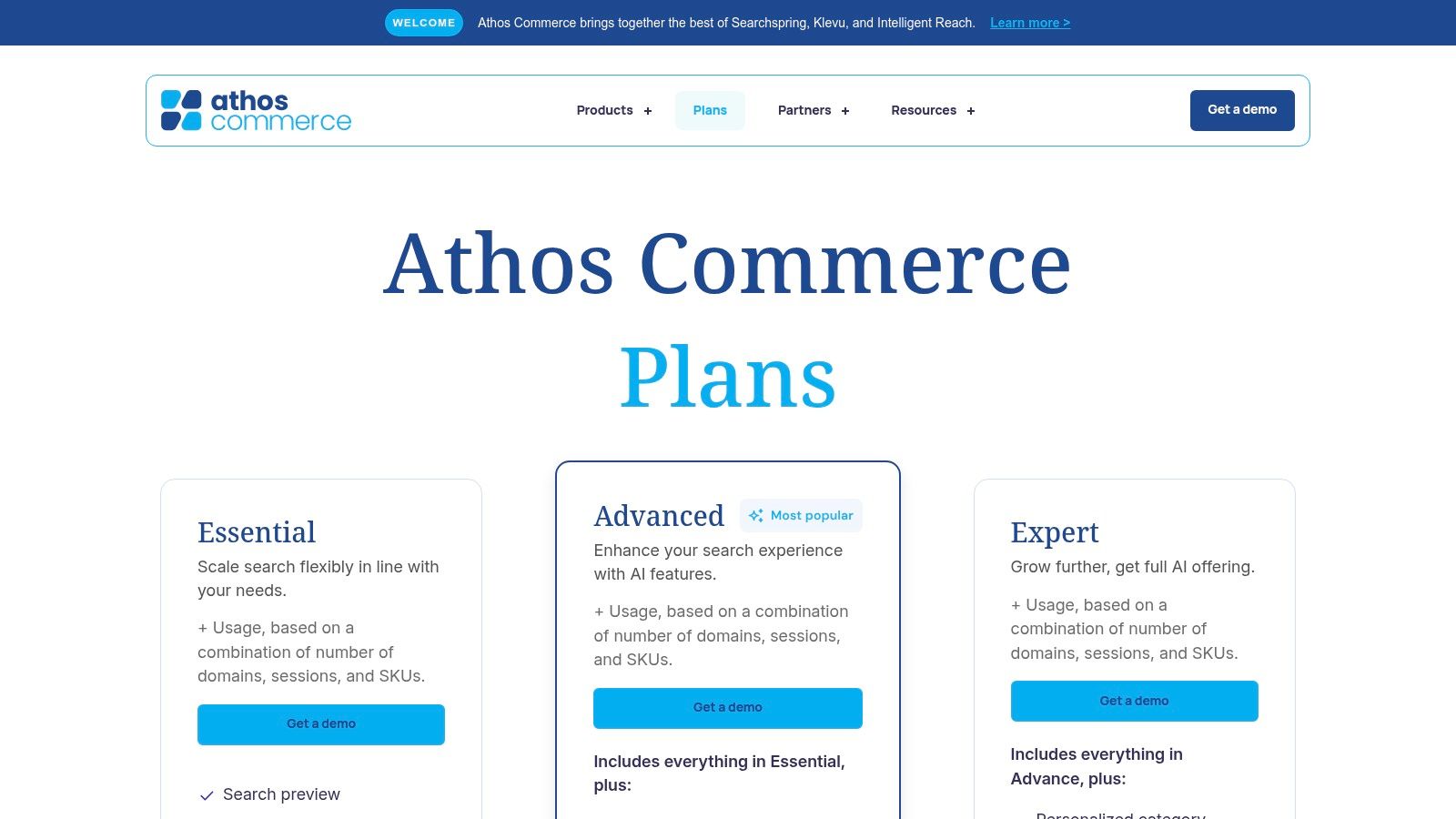
What sets Klevu apart is its deep focus on Natural Language Processing (NLP) and 1:1 personalization. It reads shopper intent instead of matching keywords. A search for "warm jacket for winter" delivers relevant results rather than only products with those exact words. This boosts conversion and average order value.
Practical Implementation
Start by integrating Klevu's core search product to fix your biggest pain point. Use its analytics to identify popular searches that yield zero results and create rules to correct them. Connect Klevu to your email service provider like Klaviyo to create hyper-targeted campaigns based on search behavior.
Website: https://www.klevu.com/pricing/
It’s best for mid-market and enterprise merchants who have outgrown basic search and need a sophisticated, AI-driven suite for product discovery and personalization.
| Pros | Cons |
|---|---|
| Published starting prices provide transparency | Pricing is posted in EUR, which can be confusing for some |
| Sophisticated NLP understands shopper intent | Final quotes are customized and vary based on specific needs |
| Broad integrations with major ecommerce platforms | Can be more complex to implement than a simple app |
7. Rebuy
To lift AOV and LTV, you need to control the entire journey from product page to post-purchase. Rebuy is a personalization engine for Shopify that uses a powerful AI model and a rules-based engine to create hyper-relevant shopping experiences. It powers everything from your smart cart to one-click upsells.
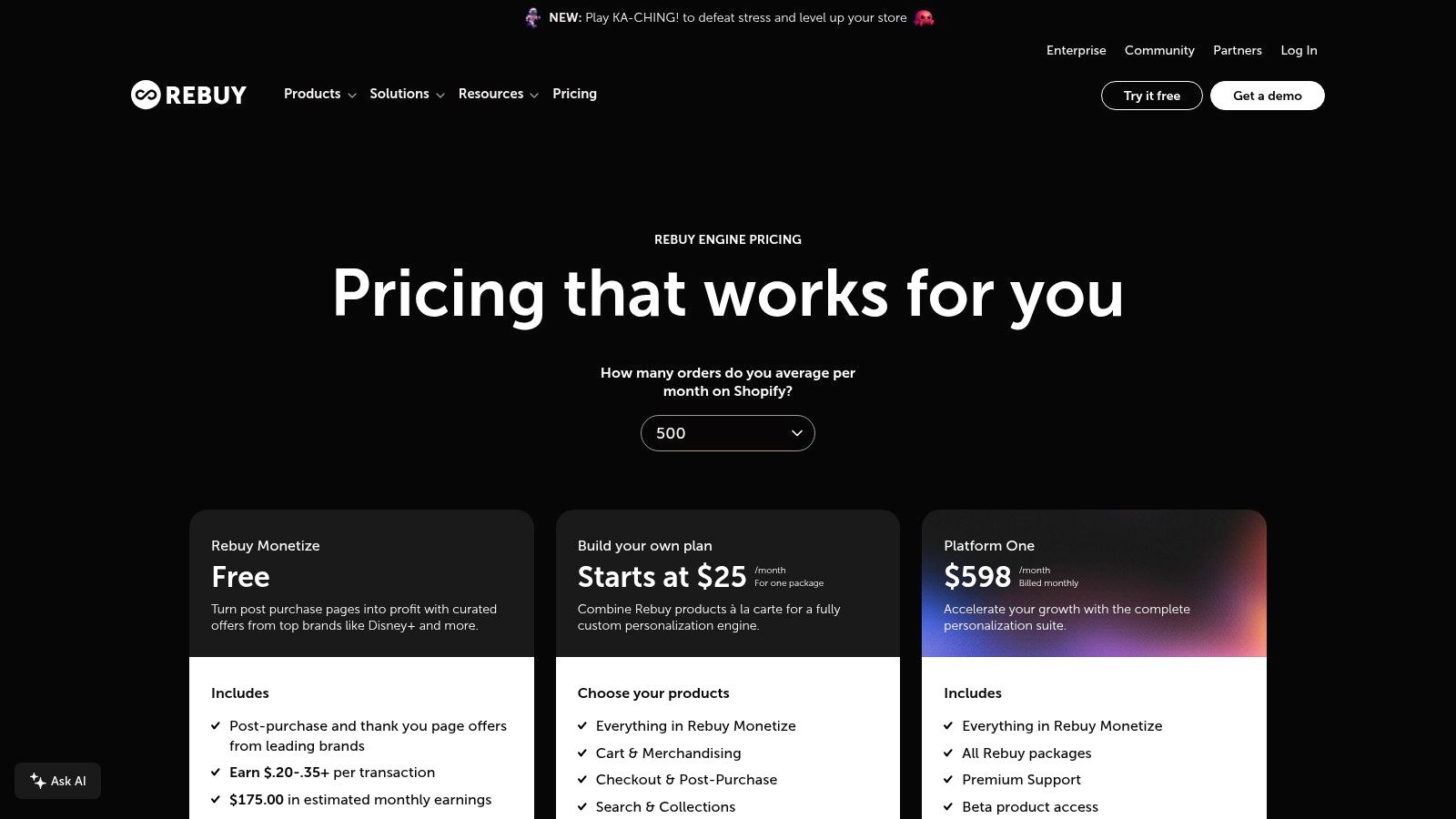
Rebuy excels because it focuses on high-impact touchpoints. It injects intelligent offers into the checkout, the thank you page, and even post-purchase notifications. This is a core tenet of modern AI conversion rate optimization. It’s a fast path to seeing a direct ROI from personalization.
Practical Implementation
Start by deploying Rebuy's Smart Cart. This is often the quickest win. Use the A/B testing feature to pit AI-driven recommendations against your manual rules. Let the data show you which approach works best for different product categories, then double down on the winners.
Website: https://www.rebuyengine.com/pricing
It’s best for fast-growing DTC brands on Shopify looking to quickly increase AOV and LTV with intelligent cross-sells, upsells, and dynamic bundles.
| Pros | Cons |
|---|---|
| A la carte packaging lets you start small | Pricing scales with order volume, which can get costly |
| Free “Monetize” add-on can help offset costs | Primarily focused on Shopify, less native for other platforms |
| Powerful AI combined with a granular rules engine | Can take time to master all the advanced features |
8. Bloomreach Discovery
When you graduate from out-of-the-box solutions, you enter the territory of platforms like Bloomreach Discovery. Far more than a simple plugin, it's a sophisticated AI engine for brands with large catalogs where personalization is mission-critical. It uses deep retail datasets to understand user intent far beyond basic keyword matching.
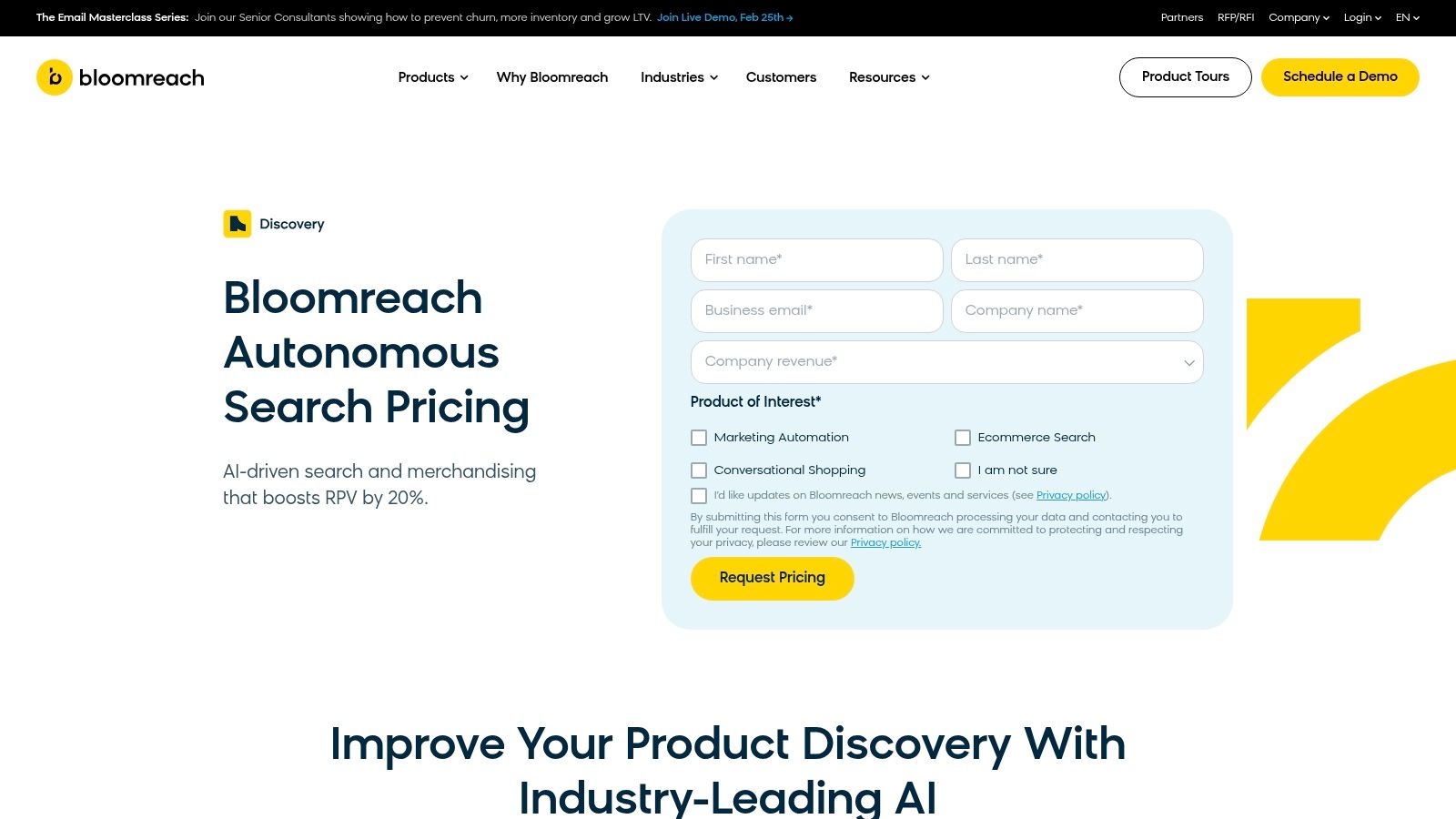
What I've seen with clients is that Bloomreach excels at interpreting nuanced queries and dynamically merchandising category pages. If every percentage point in conversion rate translates to significant revenue, this is the level of tooling required. The platform understands synonyms, attributes, and segments to deliver a personalized discovery experience.
Practical Implementation
Success with Bloomreach involves deep data integration. You’ll work with their team to connect your product catalog, customer data, and analytics. Focus the implementation on your highest-traffic categories first to prove ROI. Use their merchandising tools to blend AI-driven sorting with strategic business rules. Treat it as a partnership.
Website: https://www.bloomreach.com/en/pricing/discovery
It’s best for enterprise-level retailers and D2C brands with large catalogs seeking advanced, AI-powered search and merchandising capabilities.
| Pros | Cons |
|---|---|
| Deep retail data models and powerful relevance | Quote-based pricing requires a sales conversation |
| Proven with large catalogs and enterprise clients | Annual billing is typical, requiring a larger upfront commitment |
| Strong merchandising and optimization tools | Implementation is more involved than plug-and-play apps |
9. Nosto
If you need an all-in-one AI engine for your entire commerce experience, I point to Nosto. It’s a comprehensive suite covering predictive product recommendations, personalized search, and AI-driven merchandising. This consolidation is its key advantage, replacing what could be three or four separate apps with one unified system.
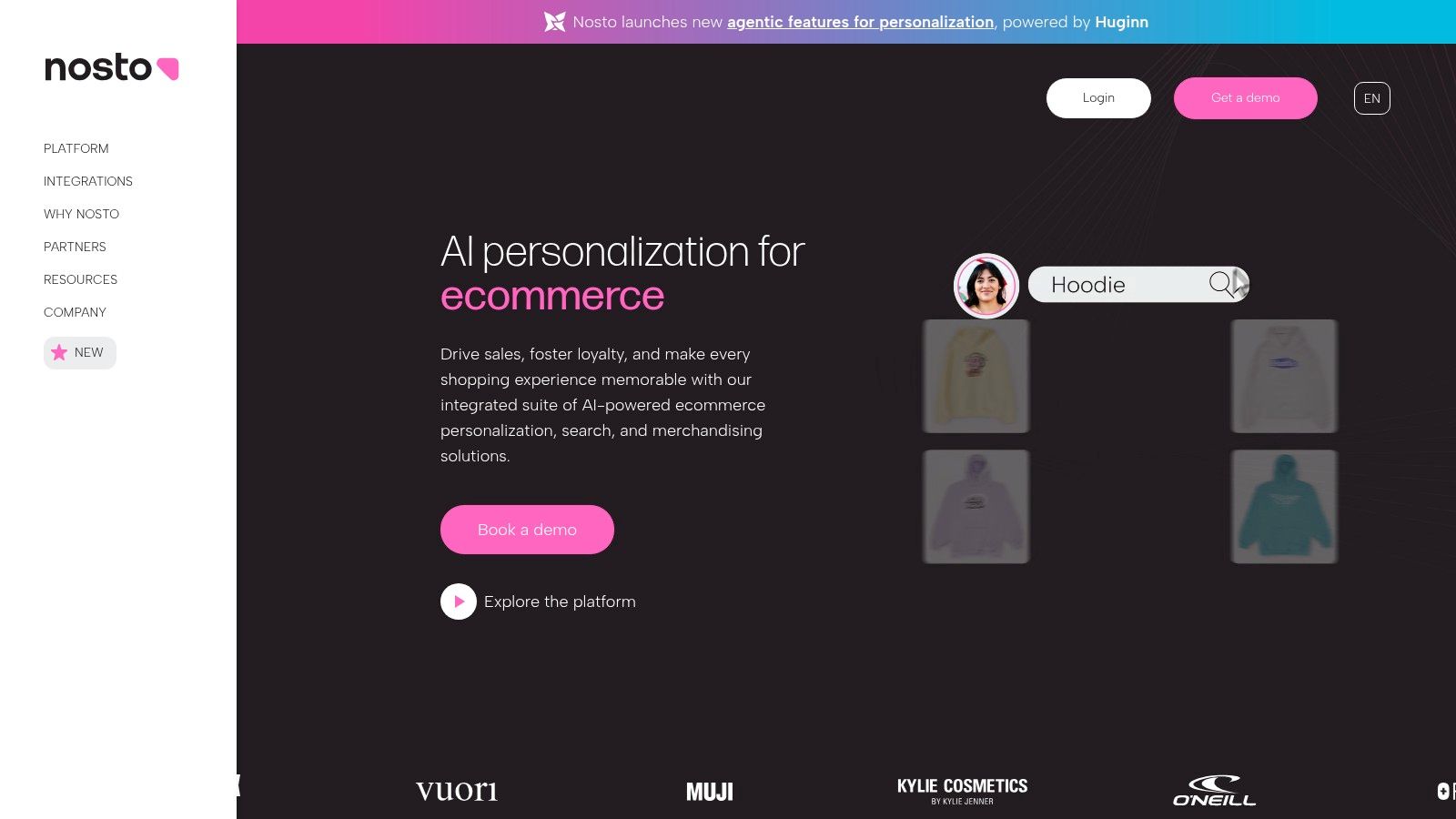
Nosto’s AI analyzes your catalog and real-time shopper behavior to dynamically adjust the experience for every visitor. It uses predictive algorithms to surface relevant products in search and on category pages. The platform integrates deeply with major platforms like Shopify Plus and BigCommerce, a powerful contender for established brands.
Practical Implementation
Identify your biggest site experience bottleneck. Is it poor search results? Use Nosto to tackle that one area first. Use the built-in A/B testing to validate every personalization rule you create, ensuring your changes actually move the needle on revenue per visitor. A targeted initial implementation will build the business case for wider adoption.
Website: https://www.nosto.com/
It’s best for mid-market and enterprise brands seeking a unified, AI-powered commerce experience platform for personalization, search, and merchandising.
| Pros | Cons |
|---|---|
| Broad feature coverage under one roof | Pricing is sales-led and quote-based |
| Documented growth results and case studies | Perceived as a premium solution, less for SMBs |
| Deep integration with major e-commerce platforms | Can have a steeper learning curve than simpler apps |
10. Constructor
When your product catalog gets massive and you’re running a serious, high-volume operation, generic search tools won't cut it. You need an engine built to optimize for business KPIs. That's where Constructor comes in. An enterprise-grade AI product discovery platform designed to maximize ecommerce revenue.
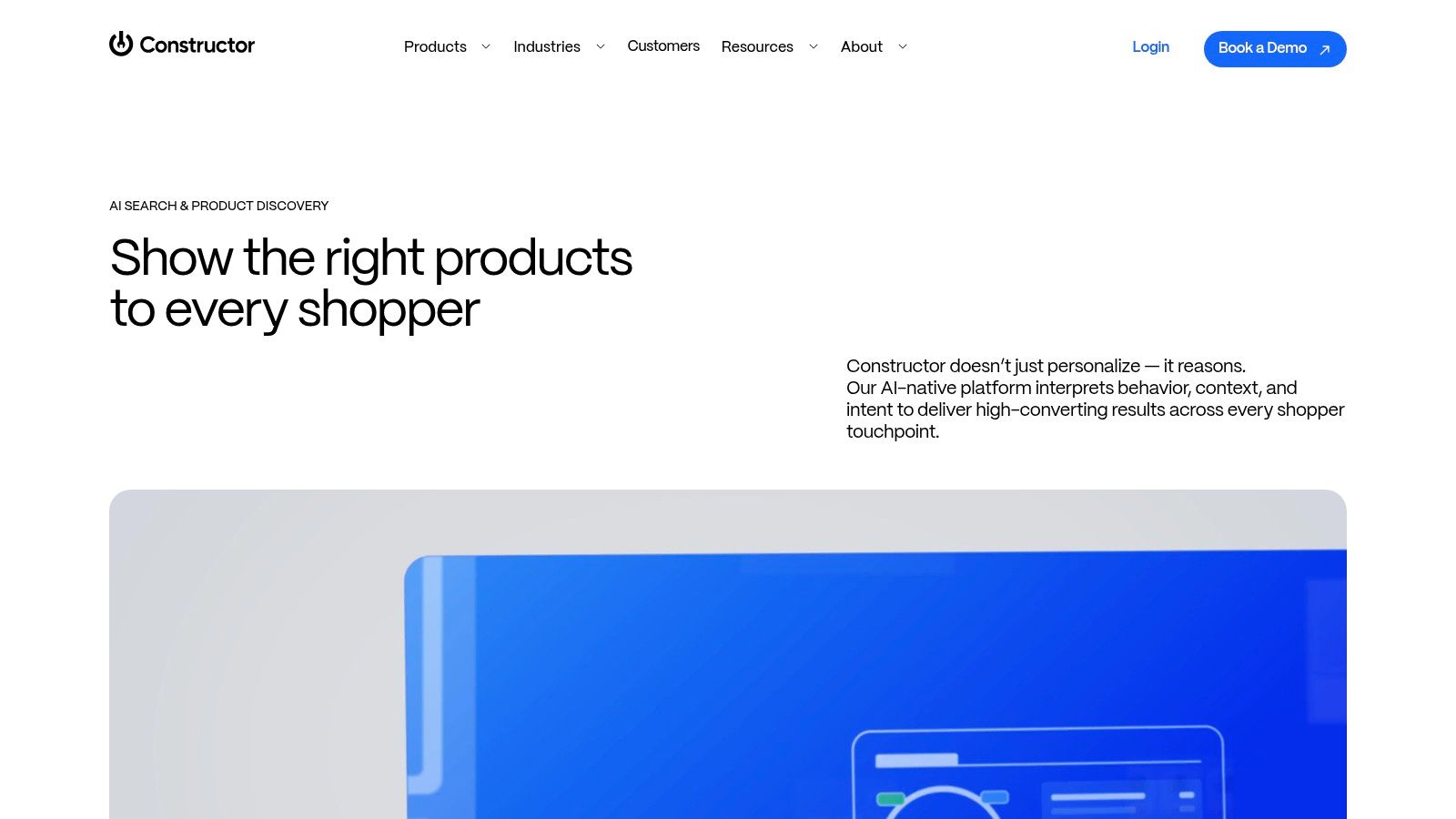
Unlike simpler apps, Constructor's AI is explicitly tuned to your business goals, like conversions or profit margins. Its NLP understands user intent, delivering highly relevant results that feel almost psychic. This is the kind of powerful tool you'll find behind major retailers and advanced composable commerce stacks.
Practical Implementation
The key to using Constructor is trusting its optimization algorithms while using merchandising controls to guide it. You can strategically boost products based on inventory or margins, and the AI learns from user behavior. If you're using a headless architecture, Constructor’s APIs integrate cleanly, making it a top-tier choice for modern tech stacks.
Website: https://constructor.com
It’s best for large-scale retailers and enterprise brands needing a revenue-optimized product discovery engine that integrates into composable commerce architectures.
| Pros | Cons |
|---|---|
| AI is directly optimized for revenue and KPIs | No public self-serve pricing; requires a sales cycle |
| Powerful personalization and merchandising tools | Contracts are at an enterprise level (six-figures) |
| Strong enterprise references and case studies | Can be overkill for small to mid-sized businesses |
11. Octane AI
Struggling to understand why your customers buy? You’re leaving money on the table. Octane AI turns this problem into a strength with interactive product recommendation quizzes. A powerful engine for collecting zero-party data (information customers willingly share) and guiding them to the perfect purchase. A modern take on guided selling.
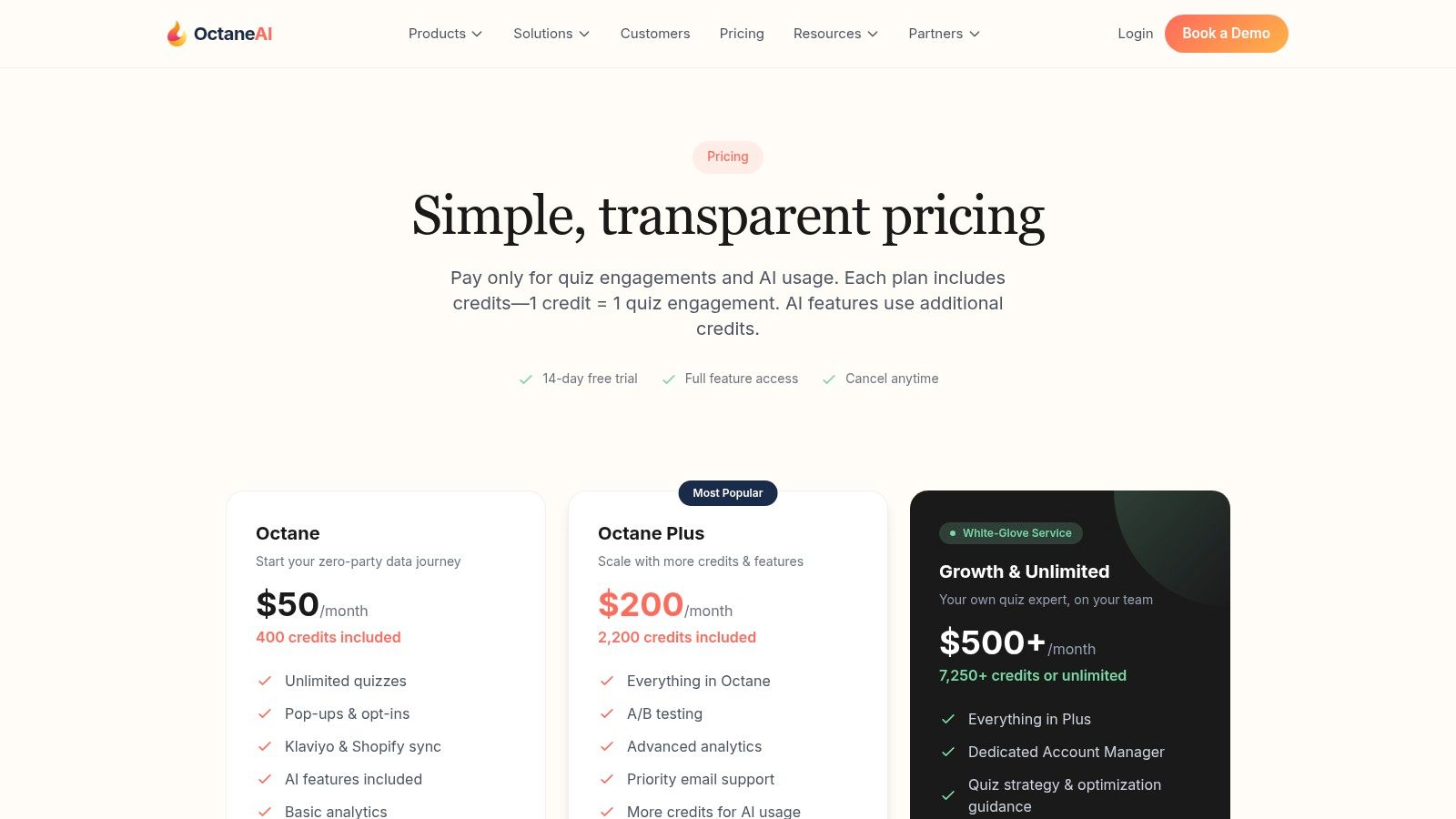
What makes Octane AI stand out is its tight integration with Shopify and Klaviyo. The data you collect from a quiz gets pushed into Klaviyo, creating powerful segments for hyper-personalized email and SMS campaigns. Its AI features, like "Smart Copy," assist in writing compelling quiz questions, reducing the creative lift.
Practical Implementation
Start by mapping out the common pre-purchase questions you get from customers. Use these as the foundation for your quiz. A skincare brand might ask about skin type and concerns. Use Octane’s AI to generate a few copy variations and A/B test them. The goal is a helpful conversation, not an interrogation.
Website: https://www.octaneai.com
It’s best for Shopify merchants in verticals like beauty, health, and apparel who want to implement guided selling and build rich, zero-party data profiles for personalization.
| Pros | Cons |
|---|---|
| Excellent for collecting actionable zero-party data | Best suited for Shopify and Klaviyo ecosystems |
| Deep integration with Klaviyo for segmentation | Credit-based pricing can be hard to predict initially |
| AI-assisted copy makes quiz creation faster | The core value is in quizzes, less of an all-in-one platform |
12. Klaviyo
Klaviyo has grown from an email platform into a data-first marketing automation powerhouse leaning heavily into AI. Klaviyo uses AI to improve the core functions you already rely on: segmentation, content creation, and understanding customer behavior. It ties AI directly to revenue-driving activities like email and SMS campaigns.
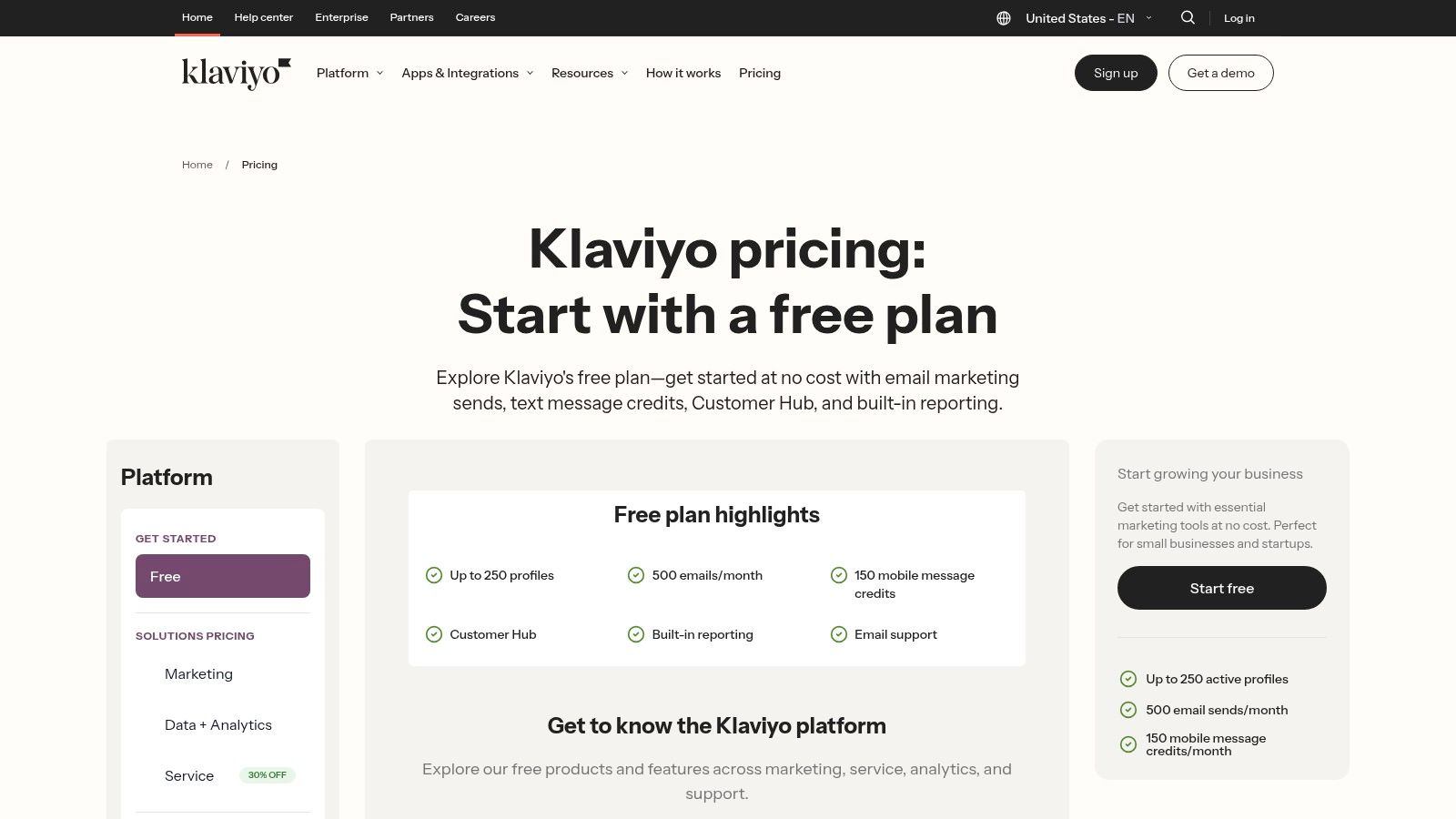
The platform’s AI-powered features, like predictive analytics, help you identify customers who are likely to churn or ready to buy. Its AI-assisted subject line generator saves you time. Because it sits on top of your customer data, the AI suggestions are more contextual and relevant than a generic tool. Practical AI embedded where you work.
Practical Implementation
Start by using Klaviyo's AI to optimize existing campaigns. A/B test AI-generated subject lines against your own. Use predictive segmentation to create a "likely to buy soon" segment and target them with an offer. For a deeper dive, explore more AI marketing automation tools to see how they stack up.
Website: https://www.klaviyo.com/pricing/
It’s best for ecommerce brands looking to infuse AI into their core email and SMS marketing to improve personalization, segmentation, and conversion rates.
| Pros | Cons |
|---|---|
| Deep integrations with Shopify and ecommerce apps | Costs rise quickly with contact list size and usage |
| AI features are embedded in core workflows | Predictive features require significant customer data |
| Strong community and extensive resource library | Can be complex for absolute beginners |
Top 12 AI Ecommerce Tools: Quick Comparison
| Platform | Core focus / Key features | Best for (target audience) | Pricing & trials | USP / Strength | Limitations / Risk |
|---|---|---|---|---|---|
| Shopify App Store | Marketplace of ecommerce apps (AI recommendations, search, content, CRO) | Shopify merchants seeking quick installs | App-level pricing + free trials; native billing | Fast time-to-value; reviews & one-click installs | Vendor quality/support varies; new apps may lack history |
| WooCommerce Marketplace | Vetted WooCommerce extensions incl. AI plugins (copy, chat, images) | WordPress/WooCommerce stores wanting vetted plugins | One-year licenses, updates, 30‑day money-back | Screened plugins; clear licensing/pricing | Some plugins need OpenAI keys; feature depth varies |
| BigCommerce App Marketplace | Apps for search, recommendations, SEO, automation with enterprise badges | BigCommerce stores and larger catalogs | Many AI apps are quote-based | Enterprise-grade integrations; composable support | Several offerings are sales/quote-based; lighter categories vs Shopify |
| G2 (E‑Commerce Personalization) | Peer-review hub for personalization vendors; filters & comparisons | Buyers shortlisting personalization platforms | Free access to reviews; pricing summaries only | Real user reviews and shortlists speed decisions | Sponsored listings possible; pricing not authoritative |
| Algolia | Developer-first AI search & Recommend API; NeuralSearch, A/B testing | Teams building fast, relevant search/recommendations | Usage-based pricing (free allocation then pay-per-request) | Mature docs, SDKs, clear usage pricing | Costs scale with traffic; requires engineering resources |
| Klevu | NLP-driven site search, 1:1 personalization, merchandising tools | Mid-market merchants wanting modular discovery | Published starter prices (EUR) | Published starting prices; broad integrations | Pricing in EUR; final quotes vary by need |
| Rebuy | End-to-end Shopify personalization: smart cart, bundles, post-purchase | DTC Shopify brands focused on AOV/LTV lifts | A la carte packaging; price scales with order volume | Fast rollouts; flows, A/B testing, analytics | Shopify-first; costs grow with volume |
| Bloomreach Discovery | Enterprise AI search, category relevance, merchandising | Large retailers with big catalogs | Quote-based, typically annual billing | Deep retail datasets and enterprise support | Sales-led pricing; annual contracts |
| Nosto | Commerce experience: personalization, search, testing, content | Mid-market → enterprise omnichannel brands | Sales-led / quote-based pricing | Broad feature coverage and case studies | Perceived premium; pricing via sales |
| Constructor | NLP search, autosuggest, recommendations tuned to revenue KPIs | Large retailers and composable stacks | No public self-serve pricing (procurement contracts) | Revenue-focused optimization; strong refs | Likely high-cost, enterprise contracts |
| Octane AI | Quiz builder, zero-party data, AI copy/images; Klaviyo sync | Shopify brands using quizzes for conversion & list growth | Usage-based credit pricing; 14‑day trial | Guided selling + tight Klaviyo integration | Credit model needs estimation; Shopify-centric |
| Klaviyo | Email, SMS, CDP with AI-assisted content and segmentation | Ecommerce teams driving lifecycle revenue | Free tier available; costs scale with profiles & SMS | Deep Shopify integrations, large community & playbooks | Pricing rises with list size and SMS volume |
Your Next Move: From Reading to Doing
You have the map. I’ve covered the best AI tools for ecommerce, from Shopify’s marketplace to powerhouses like Algolia. You and I have walked through use cases, honest pros and cons, and real-world implementation gotchas. The gap between knowing and doing is where most brands fail.
Use this as a blueprint. What matters about Klevu is how it improves your product discovery and what trade-offs you’re making. AI works as a series of deliberate decisions that compound over time into a real competitive advantage, and no single “on” switch replaces them.
Don’t Boil the Ocean: Your 90-Day Sprint
The biggest mistake I see is analysis paralysis. Owners spend six months building the “perfect” AI roadmap while competitors capture market share. Your goal is to get a win. A flawless transformation can wait.
Here’s your playbook. Pick one high-impact area and execute a 90-day sprint.
- Poor on-site search? Focus on Algolia or Klevu. Goal: reduce your “no results” rate by 50% and increase search-led conversion by 15%. This is tangible revenue.
- Low Average Order Value? You need intelligent cross-sells. A tool like Rebuy or Nosto is your weapon. Goal: increase AOV by 20% within one quarter.
- Lack of customer data? You’re flying blind. A tool like Octane AI can help you build rich, first-party data profiles. Goal: increase zero-party data collection by 30% through quizzes.
Implementation: The Hard Part That Matters
Choosing a tool is 20% of the battle. The other 80% is implementation. These tools are not magic wands. Their effectiveness depends entirely on the quality of your data and the clarity of your strategy. Before signing, ensure you have a clean product catalog and understand your tech stack’s limitations.
Think about how these systems talk to each other. Does your new personalization engine integrate with your ESP like Klaviyo? These are the questions that separate successful projects from expensive failures. For a deep-dive into AI for a specific niche, a guide on the 12 Best AI Tools For Fashion Brands provides an excellent blueprint.
The tools are ready. The market isn’t waiting. Are you ready to execute?