Stop treating market research like a quarterly project. Teams that win build an always-on market intelligence system, and AI is what makes that system fast enough to matter.
Traditional research gives you a polished snapshot after the market has already shifted. I’ve found the better approach is a market intelligence neural network: a connected stack that listens across search, social, customer interviews, product feedback, review sites, and competitor moves, then turns those signals into decisions your team can use this week.
The adoption trend is already clear. SurveyMonkey reports that AI use is common in marketing work, including research tasks, in SurveyMonkey’s AI marketing statistics. The business takeaway is simple. If your research still runs as a one-off project, your team will react late on positioning, content, pricing pressure, and competitor messaging.
You need more than a list of tools. You need a system design.
That is the angle of this guide. I’m not just ranking software. I’m showing you how to assemble the right stack for your stage, whether you need a lean startup setup or an enterprise-grade intelligence engine, and how to use AI agents to automate collection, synthesis, and reporting without flooding your team with noise.
If you want a broader view of where this fits in your stack, start with these AI powered marketing tools.
Here are the AI tools for market research I’d recommend, and how I’d use them to build an advantage.
1. Work With Me
If you want a tool list, keep reading. If you want a working market intelligence machine inside your business, work with me directly through Samuel Woods consulting and workshops.
I’m putting this first because the problem often lies not with the tools themselves, but with their orchestration. Organizations buy ChatGPT, test a social listening platform, maybe add a survey tool, and still can’t answer basic questions quickly. What changed in the market this week? Which competitor message is winning? What objections are growing in demos? Where is the next content wedge?
What I actually help you build
I help you connect the pieces into a bionic system your team can run. Human judgment on the front end. LLMs, agents, and automations in the middle. Clear actions on the back end.
That usually means a stack built around tools your team already recognizes, like ChatGPT, Claude, Gemini, and selected specialist platforms for research, synthesis, and reporting. Then we engineer the operating model around them so you stop running random prompts and start running repeatable workflows.
Practical rule: Don’t buy more AI tools for market research until you know who owns the signal, where it gets validated, and how it changes a live decision.
I’ve found founders and CMOs usually need three things fast. A clear AI strategy, agent-ready workflows, and training that doesn’t read like a generic innovation deck. That’s why my work blends workshops, architecture, playbooks, prompt systems, and implementation support.
When this is the right move
Choose this if your business needs more than software access. Choose it if you need a system for combining competitor intelligence, voice-of-customer data, campaign learnings, and internal performance data into one operating rhythm.
This is especially useful when your team is stuck between experimentation and scale. You’ve tried AI. You’ve seen some wins. But the wins are isolated, and nobody’s sure how to operationalize them across marketing, sales, product, and leadership.
Here’s the trade-off. This isn’t an off-the-shelf app, and it shouldn’t be. You need internal commitment, access to the right data, and people willing to change how they work. If your team wants passive inspiration without implementation effort, don’t hire me.
If you’re serious, I’ll help you build the neural network itself. The result isn’t more dashboards. It’s faster decisions, cleaner positioning, stronger campaigns, and a research engine your competitors won’t enjoy trying to catch.
2. Brandwatch Consumer Research
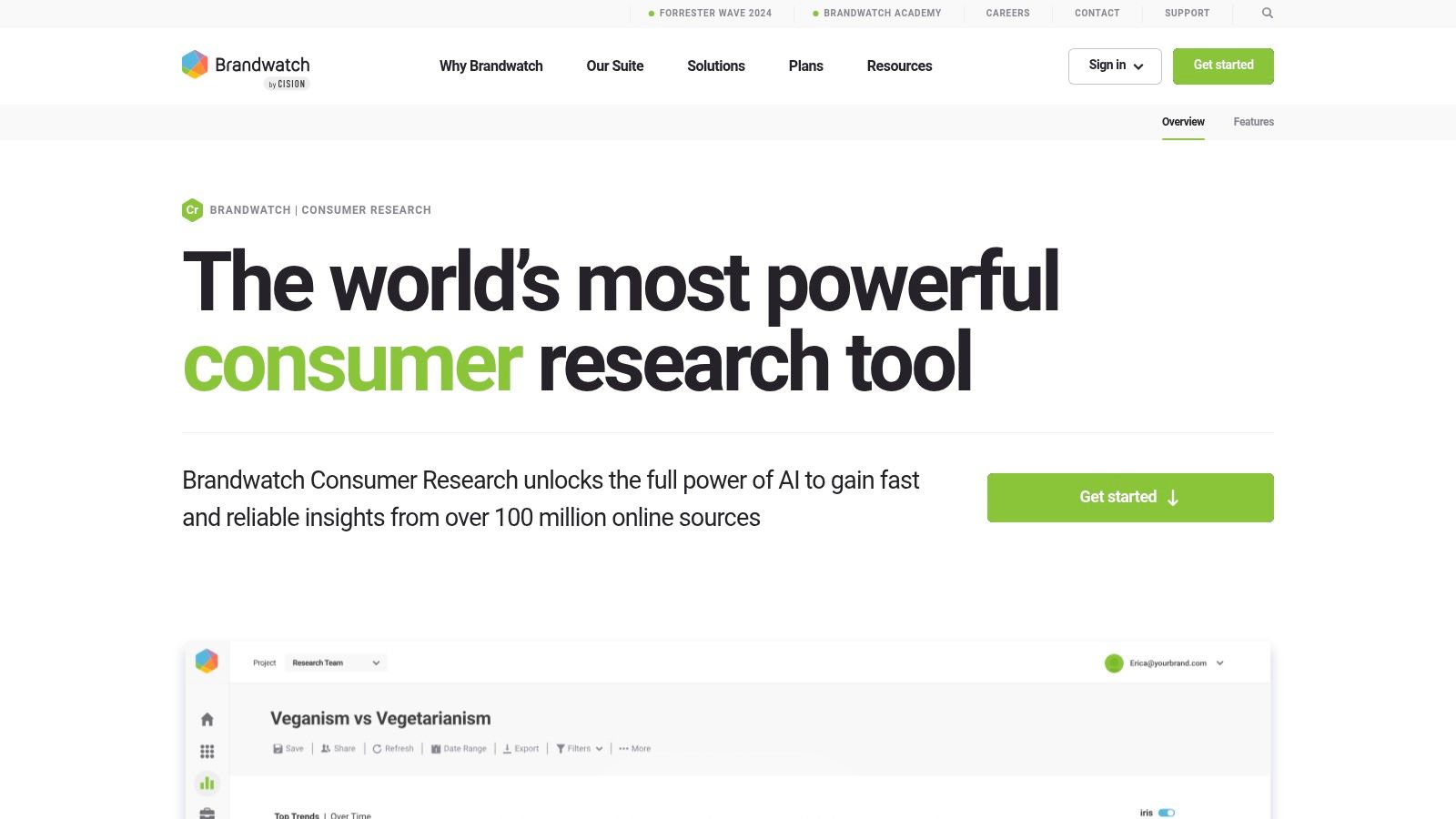
Brandwatch is for teams that need always-on consumer intelligence, not occasional social listening. If your brand is large enough that online conversation volume can hide both threats and opportunities, this platform earns its place.
Its core value is coverage and workflow maturity. Brandwatch is built for tracking brand mentions, competitor movement, emerging themes, and audience sentiment across a massive online surface area. You also get AI-assisted summaries that help leadership move from “what happened” to “what needs action.”
Where Brandwatch wins
I’d use Brandwatch when the job is continuous monitoring with executive visibility. It’s strong when your research needs to serve multiple teams at once, including brand, comms, product marketing, and leadership.
You don’t buy Brandwatch because you need a nicer dashboard. You buy it because waiting for monthly reporting means you miss narrative shifts while they’re still manageable. If that’s your situation, this is one of the stronger enterprise-grade ai tools for market research.
For teams building a larger stack, I’d pair it with a more explicit strategy for routing signals into campaign and GTM decisions. My guide on marketing intelligence tools that actually shape growth decisions goes deeper on that operating model.
When not to use it
Don’t buy Brandwatch if you’re a small team doing occasional audience research. It will be more platform than you need, and you’ll pay for complexity you won’t operationalize.
A better use case is a category where public conversation changes buyer behavior quickly. Consumer brands, media-heavy industries, and businesses managing reputation risk fit well here. If your category is quiet, highly niche, or driven mostly by private buying conversations, you may need a different mix.
Brandwatch is strongest when your market speaks in public and your team can act in public just as fast.
One more practical point. Sales-led pricing usually means a longer buying cycle, internal approvals, and setup work. If you need fast self-serve deployment, this won’t feel lightweight. If you need a serious listening layer for a serious organization, check out Brandwatch Consumer Research.
3. Talkwalker Consumer Intelligence
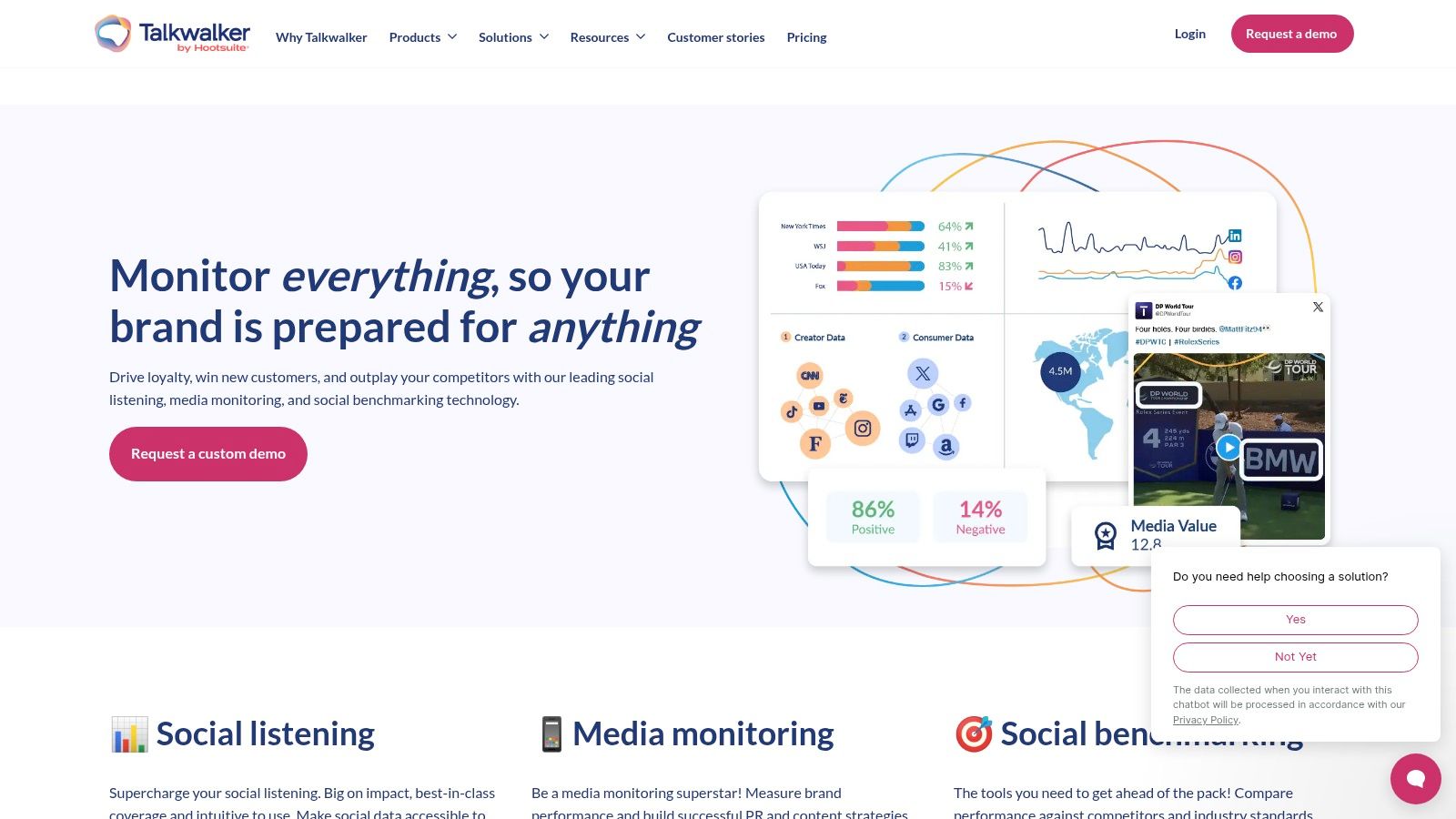
Talkwalker is what I recommend when visual intelligence matters almost as much as text. A lot of teams underestimate this. Buyers don’t just talk about brands. They post screenshots, product photos, packaging, logos, in-store experiences, and creator content that never shows up in a simple keyword scan.
That’s where Talkwalker stands out. Its Blue Silk AI layer focuses on themes, sentiment, anomaly detection, and forecasting, while the platform itself supports strong image recognition and multilingual analysis.
Best fit for global and brand-heavy teams
If you operate across regions, languages, and channels, Talkwalker gives you a better shot at seeing the full picture. That matters when market perception is being shaped by creators, customers, and competitors at the same time.
I’ve found it especially useful for teams that need to answer three questions quickly. What’s gaining traction. What’s changing sentiment. What deserves escalation right now. That makes it valuable for campaign measurement, brand tracking, and fast-moving competitive response.
Here’s the business angle. A social post spike is only interesting if your team can tell whether it’s noise, momentum, or reputational risk. Talkwalker helps separate those.
Trade-offs that matter
This is not a beginner’s tool. Non-analysts can use the outputs, but someone on your side needs to know how to configure queries, interpret shifts, and avoid sloppy conclusions from messy conversation data.
It’s also a premium platform. If your budget or team maturity is limited, you may not get full value from what you’re paying for.
Still, when the market signal lives across text, visuals, and multiple languages, Talkwalker is one of the better options. You can evaluate it directly at Talkwalker.
4. Similarweb Web and AI Search Intelligence
Similarweb is where I go when the question is market movement through digital behavior. Not abstract audience sentiment. Actual web presence, category visibility, competitor traffic patterns, and search opportunity.
This is one of the most useful ai tools for market research if you need to understand who’s winning attention online and where that attention is coming from. Great for category mapping, TAM framing, SEO strategy, paid search planning, and pressure-testing your assumptions about who your real competitors are.
Why it matters for growth
A lot of companies define competitors too narrowly. They track the vendors they know, not the sites and search patterns stealing buyer attention upstream. Similarweb helps fix that.
You can use it to look at category leaders, benchmark traffic shifts, inspect channel mix, and see where search demand clusters around a topic. For growth teams, that translates into better decisions on positioning, content investment, geographic expansion, and channel prioritization.
I also like it because it forces honesty. If leadership thinks your category is bigger than it is, or your brand is more visible than it is, digital behavior data brings the conversation back to reality.
Where it falls short
Don’t use Similarweb as a complete market truth machine. It’s excellent for directional web and search intelligence, but it doesn’t replace direct customer research, product usage data, or buyer interviews.
It’s also best when your market has enough digital footprint to analyze. If you sell into highly relationship-driven, offline-heavy, or procurement-led environments, it’s useful but incomplete.
For digital-first teams, though, it’s a serious advantage. You can explore the platform at Similarweb.
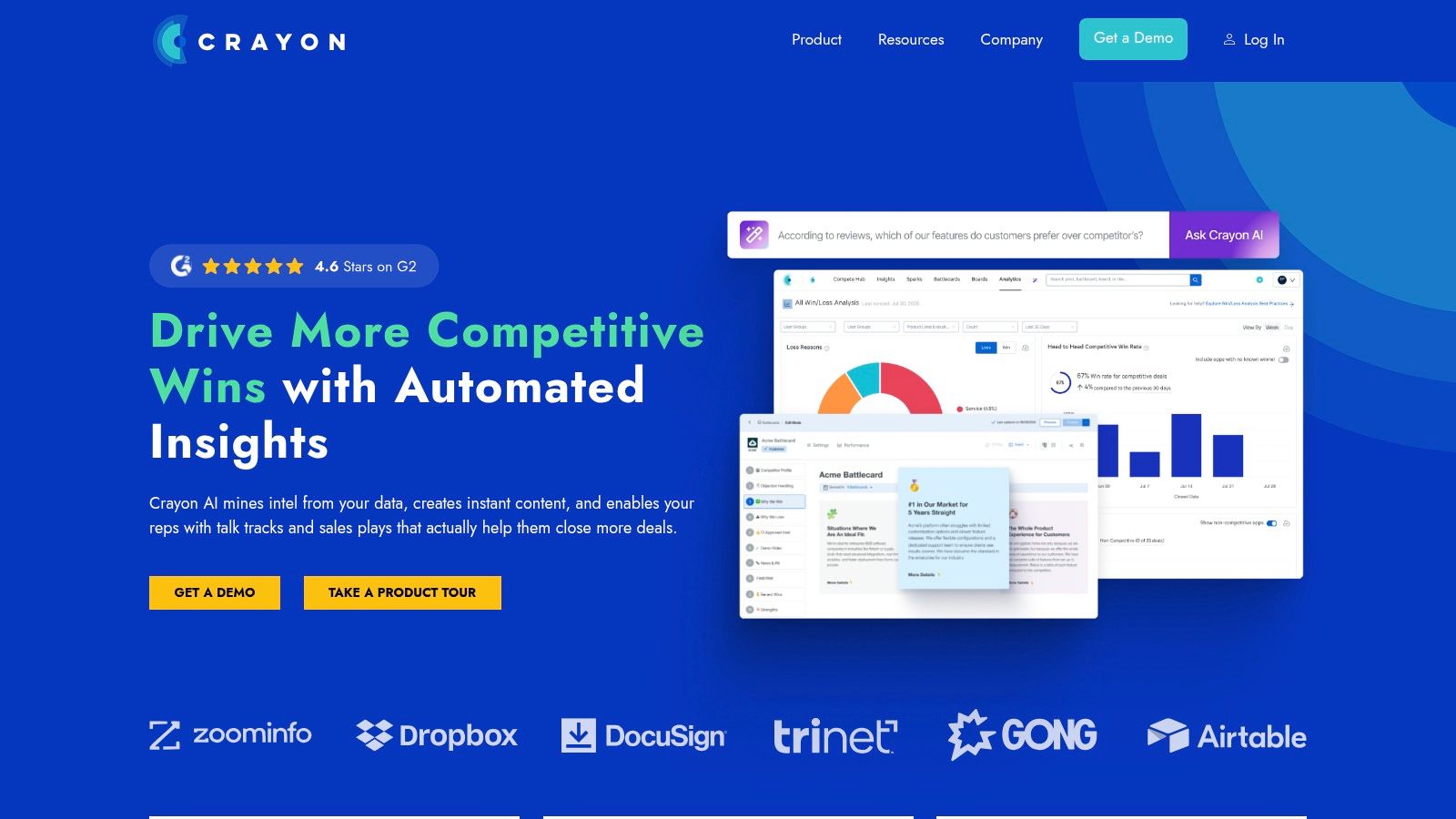
5. Crayon
Crayon is built for one thing most companies handle badly. Competitive intelligence that reaches sales and marketing in time to matter.
Too many teams gather competitor insights in scattered docs, Slack threads, and one-off win-loss calls. Crayon fixes that by monitoring competitor changes across digital channels and turning them into AI-generated outputs like battlecards and internal enablement content.
Why I like it
This isn’t generic research software. It’s operational competitive intelligence. That distinction matters.
If you need product marketing, sales, and leadership aligned on what competitors are doing, Crayon gives you a central system. Message changes. Pricing shifts. Website updates. Launch activity. Then it routes that intelligence into a format revenue teams can use.
That’s the part most companies miss. Research has no value if account executives never see it, or if campaign teams discover a competitor shift after the quarter is already planned. My thinking on this is simple. AI market intelligence is your unfair advantage, but only if it changes field behavior.
When to skip it
If your business only reviews competitors occasionally, Crayon may be overkill. It shines when competitive pressure is active and recurring, not when it’s mostly theoretical.
It also leans enterprise, both in onboarding and pricing style. You need enough organizational discipline to maintain the system and use the outputs consistently.
Use Crayon when losing deals to competitor messaging is a pattern, not an anecdote.
If that’s your situation, it’s one of the clearest picks on this list. Start with Crayon.
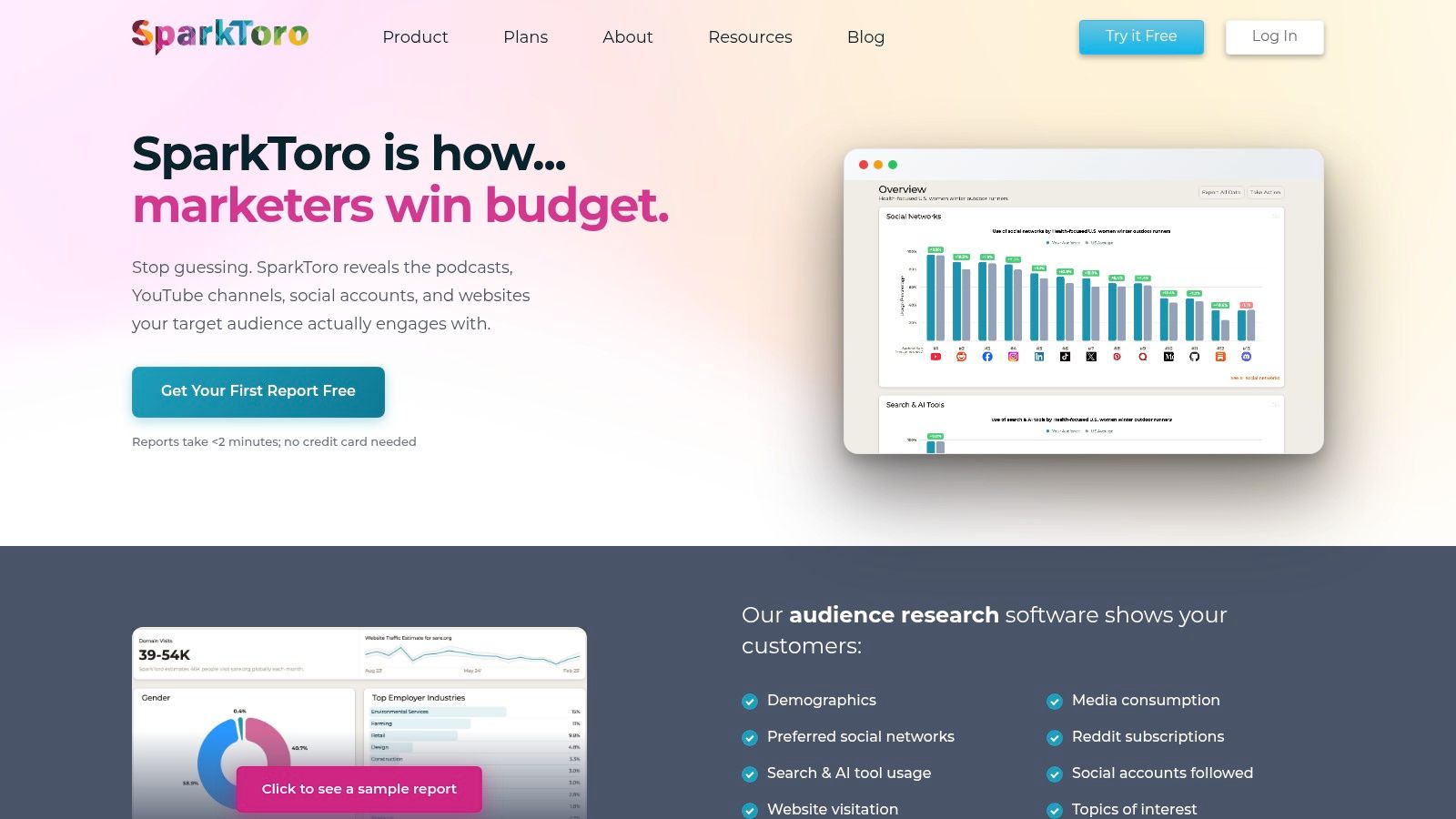
6. SparkToro
SparkToro is the fastest way I know to get directional audience intelligence without spinning up a huge research project. If you need to know where your audience pays attention, what they read, who they follow, and which channels deserve a test, start here.
It uses clickstream, search, and social data to help map audience behavior. That makes it especially useful for founders, lean growth teams, agencies, and content strategists who need to make messaging and channel choices quickly.
Where SparkToro punches above its weight
I like SparkToro for early-stage market mapping and campaign planning. You can use it to pressure-test assumptions like “our buyers all live on LinkedIn” or “this podcast category doesn’t matter.” Often, those assumptions collapse fast.
It’s also practical. The platform surfaces websites, social accounts, podcasts, YouTube channels, and Reddit communities, which makes it useful for outreach planning, influencer identification, content distribution, and message research.
Smaller teams are able to move faster than bigger competitors. You don’t need a giant insights department to get a strong directional read on audience attention.
The limitation you need to respect
SparkToro is not primary research. It won’t replace surveys, interviews, or in-product behavioral data.
It’s best used to narrow the field, spot patterns, and decide where to dig deeper. If you treat it like the final answer, you’ll over-index on directionally useful data and underinvest in validation.
That said, for speed and clarity, it’s excellent. You can try it at SparkToro.
7. Exploding Topics Pro
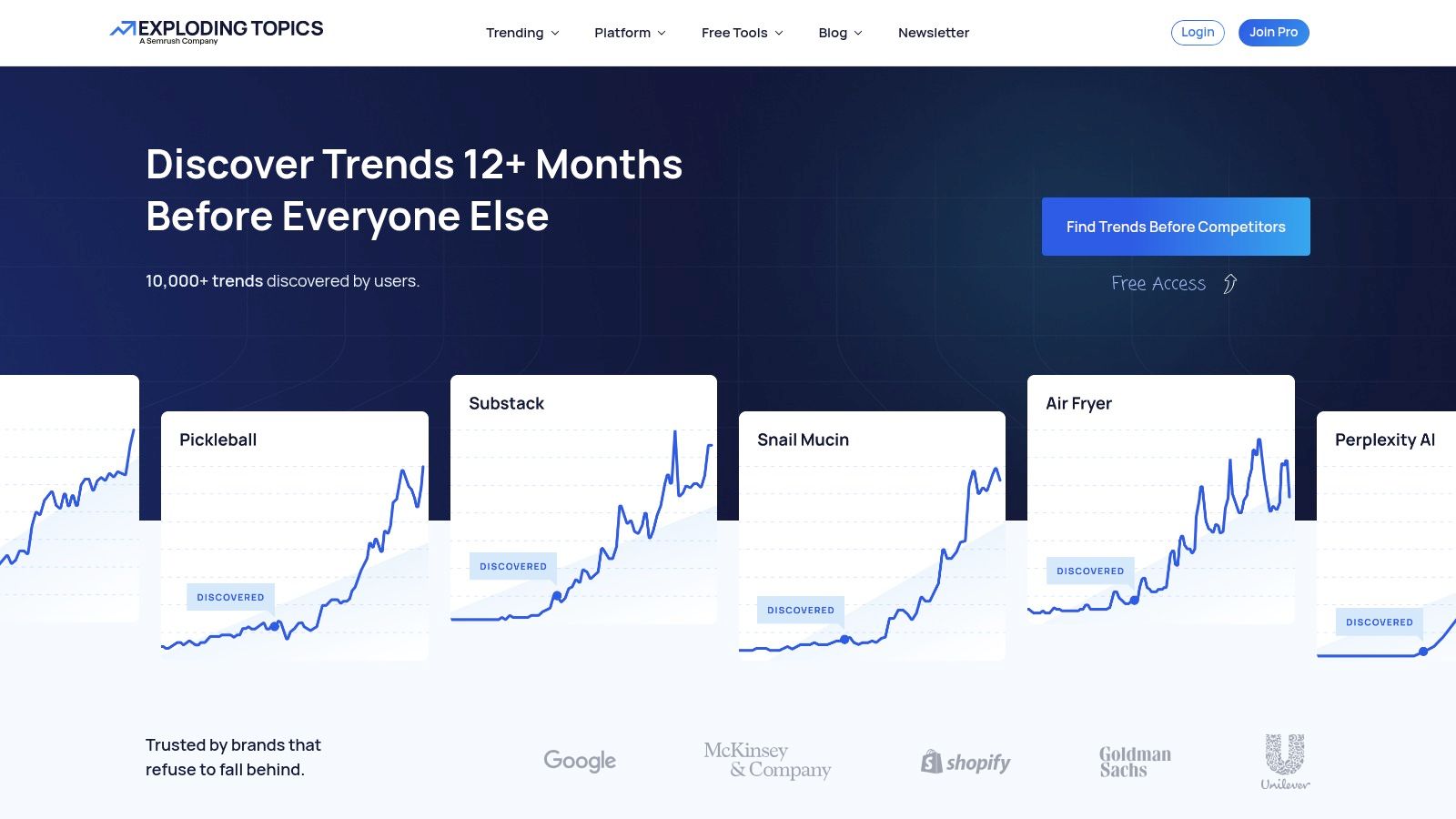
Exploding Topics Pro is for one specific job. Finding rising demand early enough to do something useful with it.
That sounds obvious, but many teams discover trends after the market has already crowded in. By then, you’re not identifying whitespace. You’re joining traffic. This platform helps you spot growing topics, products, and category shifts earlier through search, social, and commerce signal analysis.
How I’d use it
I’d use Exploding Topics Pro for content strategy, product scouting, category monitoring, and executive briefs on “what might matter next.” It’s particularly useful when you need directional trend discovery without a full analyst workflow.
You can also use it to feed a broader research process. Start with the trend signal here, validate digital demand with Similarweb or search intelligence, then confirm voice-of-customer relevance through interviews or user feedback.
That sequencing matters. Early signal tools are powerful, but they can tempt teams into trend chasing.
What to watch out for
Don’t expect deep causal explanation from this kind of platform. It’s best at discovery, not full diagnosis.
If a topic rises quickly, you still need to answer the hard questions. Is the demand durable. Is it commercially relevant for your business. Is the audience adjacent to your existing buyers or totally different. That takes follow-on research.
Still, if your competitors only react after trends become obvious, this tool helps you move earlier. Explore it at Exploding Topics.
8. Black Swan Data Trendscope
Black Swan Data’s Trendscope is one of the stronger picks for CPG, retail, and innovation teams that need to connect emerging consumer conversation to product decisions. Not just content ideas. Actual innovation, packaging, positioning, and category strategy.
That industry fit matters. General-purpose tools often surface interesting signals but leave product teams doing the hard translation work themselves. Trendscope is more oriented toward converting live conversation patterns into usable growth drivers and concept directions.
Best use case
If you’re in consumer goods, this platform can help you identify what people are starting to want before the retail data fully catches up. That’s useful for innovation pipelines, messaging changes, portfolio planning, and category expansion.
I also like the fact that it’s aimed at translating signals into product and concept exploration, not just reporting. That makes it stronger for businesses where research needs to shape what gets built and how it gets sold.
A lot of AI tools for market research stop at summarization. Trendscope pushes further into commercial application.
Where it’s less ideal
This is not a lightweight self-serve tool for SMBs. It’s more enterprise-oriented, and it works best when the team using it already understands category dynamics well.
If you don’t have that context, you can still gather interesting outputs, but you may struggle to turn them into the right product or go-to-market decisions. If your business fits the profile, though, it’s worth a serious look at Black Swan Data.
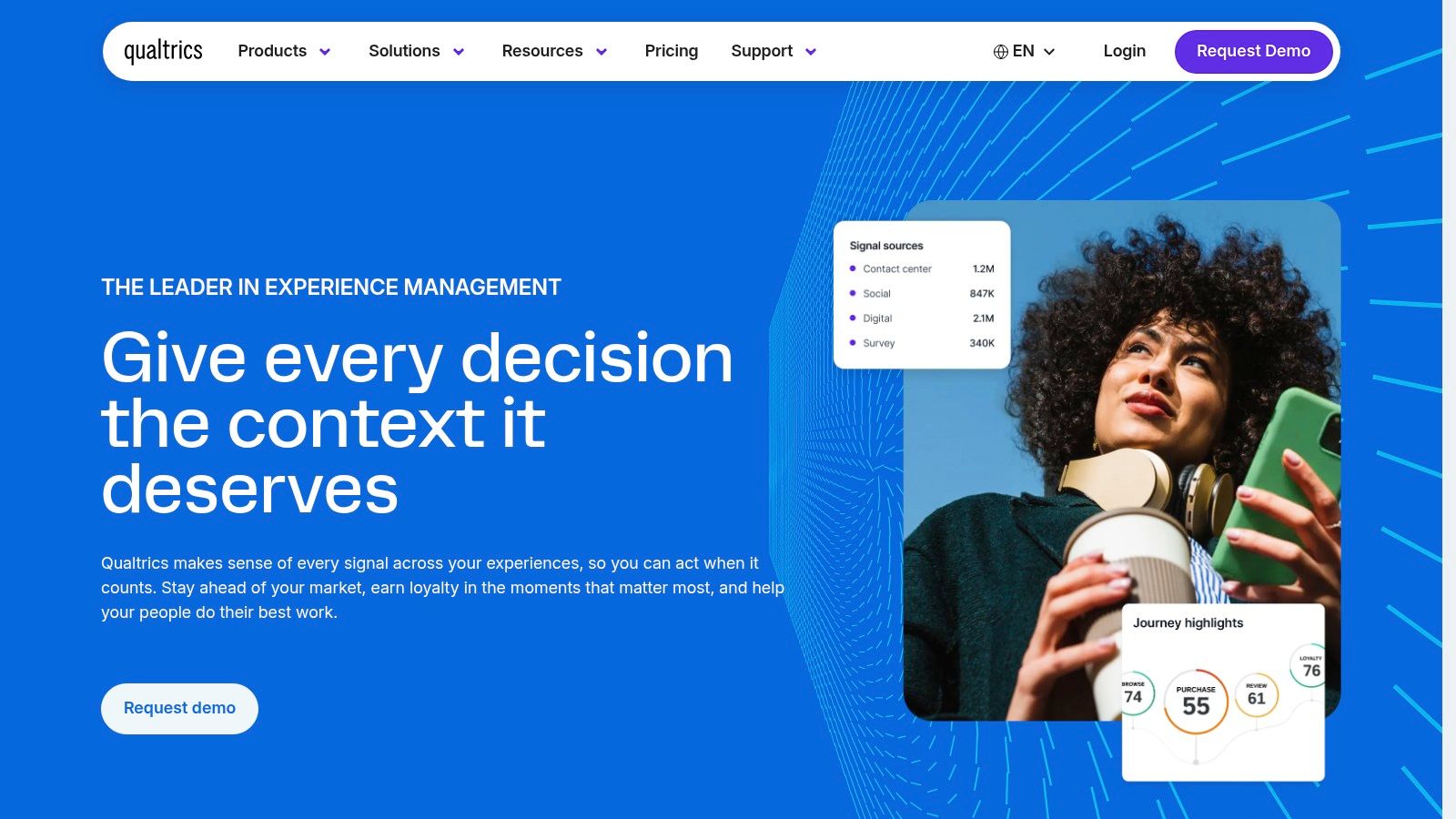
9. Qualtrics Strategy and Research
When you need structured primary research with governance, Qualtrics is hard to ignore. Surveys, video feedback, brand research, product testing, UX studies, and AI-assisted synthesis all live in a system built for serious research operations.
This is not the sexy choice. It’s the dependable one when legal, compliance, procurement, and executive scrutiny are part of the environment. If your organization needs research infrastructure, not a clever shortcut, Qualtrics belongs on the shortlist.
Why it stays relevant
A lot of businesses get excited about fast AI research and forget that respondent-based research still matters. Especially when the decision is expensive, customer-facing, or politically sensitive inside the company.
Qualtrics helps you collect that structured input while reducing manual setup and analysis burden through its AI layer. That means you can move faster without abandoning methodological discipline. If you need a grounding in where this fits conceptually, I’d read my guide on what market intelligence AI actually means in practice.
There’s another reason to take this category seriously. Predictable Innovation reports a 40% time savings in market research and a shift from two weeks to one day per new client project in its write-up on AI for market research workflows. That matters because the businesses that combine structured methods with AI acceleration will out-execute teams that choose only one side.
When not to choose it
If you’re a startup needing quick directional answers, Qualtrics may be too heavy. Setup, governance, and pricing structure can exceed what a lean team should carry.
But if your business needs high-quality primary research that leadership will trust, it’s one of the safer bets. See Qualtrics.
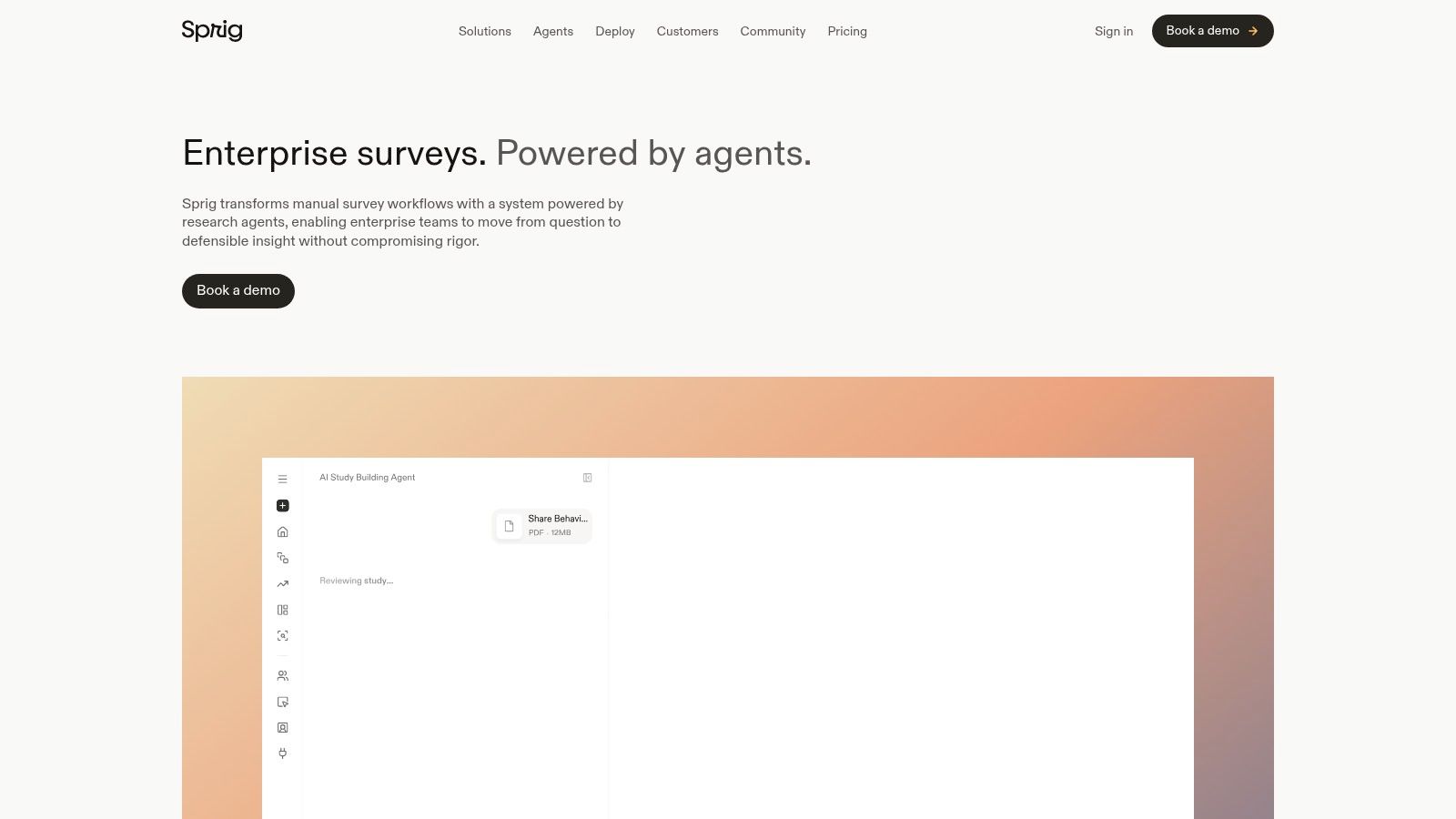
10. Sprig
Sprig is one of my favorite picks for SaaS and ecommerce teams because it closes the gap between “we should do more research” and “we have live users right now.” That’s a big deal.
Instead of waiting for a formal project, you can run in-product surveys, concept tests, and feedback studies inside the user journey. Then use AI summarization to cut through the volume and surface what deserves action.
Why this matters for speed
The best research often happens where user behavior is already happening. Sprig lets you validate messaging, features, friction points, and product concepts closer to the moment of truth.
That’s especially useful when your team ships often and needs fast loops. Product marketers can test claims. Growth teams can validate landing page language. UX and product can capture insight without building a new research process from scratch.
I also like it because it creates continuity. You stop scattering feedback across random forms, call notes, and support threads.
Limits you should respect
Sprig works best when you already have steady user traffic. If you don’t, the in-product model won’t provide much benefit.
It’s also not a replacement for broad market sizing or external category intelligence. It tells you a lot about users in your ecosystem, not the whole market. For product-led organizations, though, that’s exactly the point. You can check it out at Sprig.
Top 10 AI Market Research Tools, Feature & Performance Comparison
| Product | Core capability | Best for | Key benefits / value prop | Implementation & pricing |
|---|---|---|---|---|
| Work With Me | Hands‑on AI strategy & workshops to build “bionic” marketing systems | Mid‑market to enterprise teams needing strategy + execution | Tailored playbooks; automates workflows; preserves brand voice; CRO‑driven outcomes | High‑touch consulting; needs data/tooling commitment; custom pricing |
| Brandwatch Consumer Research | Enterprise social & consumer intelligence with proprietary + generative AI | Leadership & insight teams requiring always‑on market signals | Deep coverage (100M+ sources); fast AI synthesis; trend & brand monitoring | Mature dashboards; sales‑led packaging; quote pricing |
| Talkwalker Consumer Intelligence | Social listening with Blue Silk AI for detection, forecasting & visual analysis | Global brands tracking campaigns, sentiment, and competitors | Robust analytics; image recognition; multilingual support | Enterprise integrations; quote pricing; steeper learning curve |
| Similarweb Web/AI Search Intelligence | Digital market & competitive intelligence from real‑user panels | GTM, SEO/paid search, and market sizing teams | Granular traffic & market‑share insights; keyword/competitor discovery | Self‑serve to enterprise tiers; advanced features require paid packages |
| Crayon (Competitive Intelligence) | Automated competitor monitoring and AI battlecards/enablement | GTM, sales enablement, and product teams needing competitive ops | Standardizes competitor insights; AI battlecards; distribution to teams | Enterprise‑leaning; custom pricing and onboarding |
| SparkToro | Audience intelligence (clickstream/search/social) for where audiences spend time | Small‑to‑mid marketing teams, influencer/media planners | Fast audience maps; actionable channel advice; transparent plans | Easy to use; clear pricing & report limits; affordable tiers |
| Exploding Topics Pro | AI‑driven early trend discovery across search, social, commerce | Content strategists, product scouts, trend researchers | Early signals months ahead; quick ideation & roadmap inputs | SaaS subscription; discovery‑focused; mid‑range pricing |
| Black Swan Data, Trendscope | Predictive consumer trends & product concept optimization for CPG/retail | CPG, retail innovation and NPD teams | Translates social signals into product ideas; trend scoring & forecasting | Enterprise product; not self‑serve; quote‑based pricing |
| Qualtrics Strategy & Research | Full‑suite primary research with AI (surveys, video, synthesis) | Enterprises needing rigorous quant & qual research with governance | Broad methods in one hub; AI‑assisted design & analysis; enterprise governance | Quote pricing; setup overhead and governance required |
| Sprig | In‑product user research, concept testing and AI summarization | SaaS and e‑commerce product teams doing continuous discovery | Faster time‑to‑insight; consolidates research workflows; concept validation | Sales‑led pricing; best with steady user traffic; onboarding required |
Your Unfair Advantage Is Action, Not Just Data
Data does not create advantage. A market intelligence system that triggers fast decisions does.
That is the main takeaway from this entire list of ai tools for market research. Buying platforms is easy. Building a market intelligence neural network that connects signals, analysis, and execution is where teams win. If insight sits in a dashboard, a slide deck, or a standing meeting, you are funding observation, not growth.
I’ve found the strongest teams design this system in layers. One layer watches external shifts in the market. One tracks competitors. One captures audience behavior. One gathers direct customer feedback. One pulls in internal signals from sales, CRM, support, and win-loss analysis. Then they route those inputs into a simple decision process with named owners and deadlines.
The stack I’d recommend for different teams
For startups and SMBs, keep the stack tight. Use SparkToro for audience discovery, Similarweb for category and competitor visibility, Exploding Topics Pro for early trend signals, and Sprig if you already have product traffic. Add a general LLM workflow to summarize findings and draft briefs for marketing, product, and sales. You need speed and clarity, not a bloated stack.
For enterprise teams, build in layers and assign each layer a job. Brandwatch or Talkwalker should handle ongoing conversation monitoring. Crayon should distribute competitive intelligence across teams. Qualtrics should run structured primary research. Similarweb should cover digital behavior and market movement. Then centralize outputs into shared reporting, operating rhythms, and action triggers.
GWI’s overview of AI market research tools and consumer insights makes the bigger point clear. High-volume consumer data is becoming easier to access across markets. Advantage now comes from interpretation, prioritization, and response time.
Workflow beats tool count
Here’s the workflow I’d put in place:
- Signal collection: Pull audience attention data, competitor updates, search shifts, and product feedback into one operating view.
- AI synthesis: Use LLMs to cluster patterns, summarize changes, and draft memos for specific stakeholders.
- Human validation: Assign a marketer, product lead, or strategist to confirm what matters and what should be ignored.
- Execution loop: Update messaging, pricing pages, campaign angles, sales battlecards, or product priorities within the same cycle.
That is the difference between using AI tools and building a functioning intelligence system.
Businesses rarely lose because information was unavailable. They lose because action came after the signal was obvious.
The broader market is reinforcing this shift. As noted earlier, spending and vendor activity around generative AI are accelerating. That has a practical consequence for operators. The tools will keep improving, costs will keep changing, and your competitors will keep getting better access to AI-assisted research and synthesis.
So do not buy everything. Build deliberately.
One mistake I see all the time is a Frankenstein stack that produces disconnected reports for different departments. Nathan Ojaokomo’s analysis of the best AI market research tools and hybrid data workflows points to the same operational gap: teams struggle to combine internal proprietary data with live external signals in a way people can use. If your CRM, support tickets, sales notes, customer interviews, and market monitoring live in separate systems with no shared workflow, your research program is fragmented.
Start smaller than you want.
Pick one listening layer. Pick one validation layer. Pick one execution loop. Run it every week until the team trusts the output and changes behavior because of it. Then expand the neural network with more sources, more automation, and clearer ownership.
If you also want to turn research into pipeline, this guide on AI for sales prospecting is the next practical step. Market intelligence should change how you sell, not just how you report.
Samuel Woods is a growth marketer and AI strategist helping companies build bionic marketing systems with AI, agents, and automation. Learn more at Samuel Woods.