
You feel it, don’t you? That nagging sense your competitors are moving just a little bit faster. They seem to know which moves to make, while you’re still trying to piece together the data.
This is a practical guide on building a market intelligence engine that drives revenue and shows you what competitors are about to do. Let’s get to work.
Your Competitors Are Already Moving Faster Than You Think

The tension you’re feeling is valid. Your rivals are using smarter tools to understand the market, and it’s giving them a serious edge. While you’re manually wrestling with a spreadsheet, they’re acting on insights that are hours old, not weeks old.
Forget the buzzwords. Turn that tension into a competitive weapon. True market intelligence becomes the active nervous system for your business, sensing opportunities and threats long before they become obvious to everyone else.
The AI-Driven Intelligence Gap
The game has completely changed. Your competitors have moved past reading industry reports. They’re deploying AI agents to monitor pricing changes in real time, analyze sentiment from thousands of customer reviews, and even predict demand for new product features straight from support tickets.
They are building a picture of the market that is always on and always learning.
This creates an intelligence gap. To see how your brand stacks up, knowing how to calculate share of voice in an AI-driven world is no longer optional. It’s a basic part of modern competitive analysis. This is the difference between leading and lagging.
In this guide, I’ll walk you through the exact AI-driven framework I use to build systems that find information and turn it into revenue.
You and I are going to stop playing catch-up and start setting the pace. You’ll move from basic data collection to building an automated system that surfaces what truly matters for your bottom line.
From Data Overload to Decisive Action
Fusing market intelligence with AI is redefining what growth looks like. Companies that get this right see 45% faster decision-making because they can process customer preferences and pain points for 28% better personalization.
It gets better. Some high-performers now attribute 25% of their year-over-year growth directly to real-time tools that blend internal data with external trends. By acting early on emerging trends they spot, these brands have captured 32% more leads than their slower rivals.
This is the power you need to tap into. The point is getting the right insights to the right person at the right time, automatically. More data alone does nothing. You might also find my guide on the best AI tools for content creation helpful to see how this same thinking applies directly to your marketing workflow.
Understanding Your Edge with Market Intelligence
So, what is market intelligence? Forget the academic definitions. It’s your business’s private surveillance network, continuously scanning your market for what changes next.
Most people get this part wrong. They lump market intelligence in with other data disciplines, but confusing them is a costly mistake. Wasting time and money on the wrong one will leave your business exposed.
Market Intelligence vs. The Other Guys
You can’t afford to get this wrong. Market research is a snapshot of where your market has been. It’s a photo album. Business intelligence is a look in the mirror, focused on your own company’s performance.
Market intelligence is different. It’s your periscope, looking over the horizon to show you what’s coming next. This is how you intercept an opportunity before anyone else or dodge a torpedo from a competitor you never saw coming.
How Market Intelligence Differs from Other Data Disciplines
This table clarifies the distinct focus, goals, and data sources of market intelligence compared to market research and business intelligence, helping you allocate resources effectively.
| Discipline | Primary Focus | Key Question | Typical Data Sources |
|---|---|---|---|
| Market Intelligence | External & Future-Oriented | What will happen in our market and why? | Competitor websites, social media, review sites, news, forums |
| Market Research | External & Past-Oriented | What happened in our market? | Surveys, focus groups, historical sales data |
| Business Intelligence | Internal & Past/Present | What is happening in our business? | CRM data, sales records, internal performance metrics |
See the distinction? One tells you where you’ve been, one tells you how you’re doing right now, but only market intelligence shows you where the battlefield is moving next.
The Four Pillars of Market Intelligence
A useful market intelligence system pulls several streams of data into one view built on four pillars. Fuse these together with AI, and you see moves your competitors miss.
I use this exact framework to help businesses shift from reacting to the market to actively shaping it.
-
Competitive intelligence is about reverse-engineering your competitor's entire strategy. Track their pricing changes, deconstruct their ad campaigns, and predict their next product launch based on the job descriptions they post. Total visibility.
-
Customer intelligence starts from the fact that your customers are leaving a trail of breadcrumbs to your next revenue stream. Mine support tickets, sales calls, and online reviews to uncover their unmet needs and deepest pain points. That's where you'll find the idea for your next killer feature.
-
Product intelligence focuses on the products, yours and theirs. Spot what users hate about a rival's product by reading their reviews. Identify the exact features driving your own customer churn. One company I worked with found a single frustrating workflow in a competitor’s software, built a better solution, and poached 15% of their user base in under a year.
-
Market trend intelligence is your early-warning system. Spot a new customer demand before anyone else. Identify a regulatory change that will disrupt the industry. Catch a new technology wave just before it crests. This is how you make strategic bets with confidence.
When these four pillars are automated and analyzed by AI, they create a 360-degree view that transforms your business. You stop guessing and start knowing.
Instead of just collecting disparate data points, you're building a system that connects them into a coherent, actionable strategy. For a deeper dive, you can learn more about how AI market intelligence gives you an edge in another piece I wrote. This system turns you from a passive observer into an active player in your market.
Building Your AI-Powered Intelligence Engine
Alright, enough theory. It's time to build the system itself. I'm handing you the blueprint I use.
It’s built on a simple but potent framework: Collect → Analyze → Act. Think of this as a continuous loop that gets smarter with every cycle. You're building a machine that works for you, 24/7.
This three-stage process turns the raw, chaotic noise of the market into concrete business actions that drive revenue. Let's break it down.
Stage 1: Collect The Right Data, Automatically
Resist the urge to boil the ocean. Your goal is to gather the right data, automatically and continuously. Manual collection is for your competitors who enjoy being three months behind.
To pull this off, you need foundational tools like an AI data scraper to form the frontline of your collection efforts. This is where AI agents for business become your tireless workhorses. These are small, automated programs you set up to perform specific data-gathering tasks around the clock.
Here are a few collection agents you could spin up this week:
- A competitor price tracker is an agent that scrapes the pricing pages of your top three competitors daily. The moment they change a price, you get an alert.
- A social sentiment monitor scans social media and niche forums for mentions of your brand and competitors, flagging spikes in negative or positive chatter.
- A review aggregator pulls every new customer review from sites like G2, Capterra, or the App Store. This is a goldmine.
Automation is the name of the game. You set these up once, and they feed a constant stream of high-value data into your engine without you lifting a finger.
Stage 2: Analyze For Actionable Signals
Now you have a firehose of data. This is where most businesses drown. Stage two is about using AI (specifically Large Language Models, or LLMs) to find the signal in the noise. The output you want is a set of clear directives.
You achieve this through what I call context engineering. You give an LLM like Gemini or Claude the raw data from your collection agents and the critical business questions you need answered.
The trick is giving the AI data plus a very specific job to do. Your prompt becomes the directive that turns noise into an instruction.
For example, don't just dump 1,000 customer reviews into a model. Feed it the reviews with a prompt like this: "Analyze these customer reviews. Identify the top three most frequently mentioned feature requests that we don't currently offer. Summarize in a bulleted list." A mountain of text becomes a crystal-clear priority list.
That's the power of this stage. It turns raw information into a recommendation for action.
Stage 3: Act With Automated Workflows
Intelligence that doesn't lead to action is an expensive hobby. The final stage, "Act," is about wiring the insights from your analysis directly into your business operations, often through automated workflows. This is where the speed comes from.
Your goal is a clear, automated flow from intelligence gathering to operational execution. The four pillars should constantly feed your strategic and tactical moves.
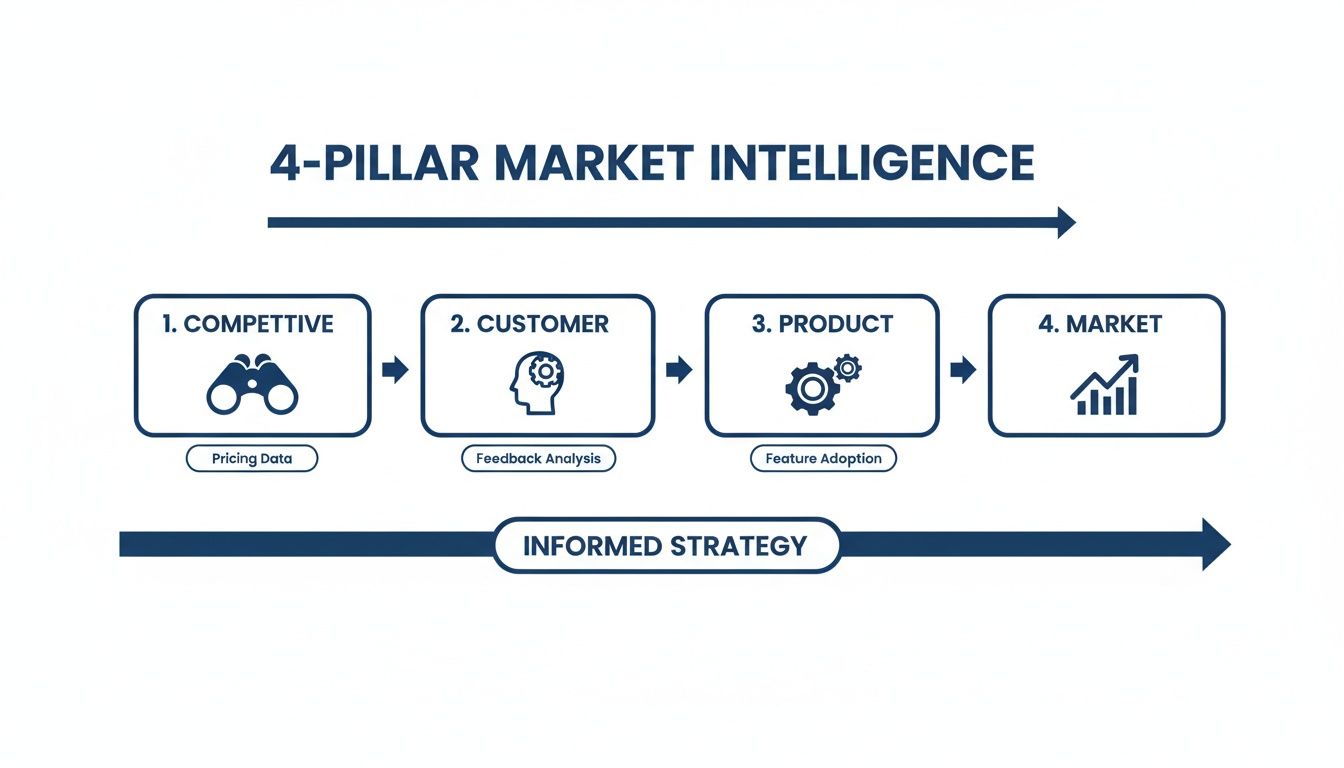
This visual shows how it all connects: a continuous, automated system where insights from the four pillars translate into tangible outcomes.
Here’s what this looks like in the real world:
- Your price-tracking agent (Collect) detects a competitor has dropped their price by more than 10%. The LLM (Analyze) confirms it's a major promotion and automatically triggers an alert in your #sales-team Slack channel with a summary of the change (Act).
- Your sentiment agent (Collect) picks up on a new, trending topic. An LLM (Analyze) verifies its relevance and drafts a content brief for a reactive blog post. This brief is automatically added to your content calendar in Asana (Act).
None of this is futuristic. The core idea has been a strategic cornerstone for a century. A landmark 2012 report showed companies systematically using it achieved 20-30% higher revenue growth. More recently, a 2026 report found that 68% of high-growth teams using these platforms saw a 15% lift in conversion rates.
This "Collect, Analyze, Act" engine is what separates market leaders from the pack. It builds a compounding advantage, making your business faster and sharper with every cycle.
Real-World Examples of AI Market Intelligence in Action
Theory is useless without results. The "Collect, Analyze, Act" engine delivers tangible ROI. This is how you and I connect market intelligence work directly to the balance sheet.
Let's move from the blueprint to the battlefield. I’m going to show you exactly how this system drives wins for different kinds of businesses. Real use cases, not academic fluff.
Use Case 1: For The SaaS Founder
A B2B SaaS company I worked with had stalled. Their product roadmap felt like a series of guesses, and they were burning cash. The job was to find a real, underserved feature gap the market would actually pay for. Fast.
I deployed two key AI agents. The first monitored support tickets and community forums of their top two rivals. The second scraped thousands of reviews from G2 and Capterra.
The prompt engineering was critical. I told the LLM to identify requests phrased with urgency, words like "we desperately need," "I can't believe it doesn't have," or "this is a dealbreaker."
The AI went past a list and synthesized the pain. It surfaced a critical workflow gap related to team collaboration that users were begging for. A need completely ignored by their competitors.
They bypassed months of guesswork and launched a new "Teams" tier focused on solving this one problem. The result? They captured 15% more market share within six months, directly poaching customers who were fed up with the incumbents.
Use Case 2: For The Ecommerce Store Owner
An ecommerce client was burning cash on customer acquisition. Their return rate on first-time purchases was eating their margins. They knew there was friction but couldn't find it.
I focused the AI engine on post-purchase data: customer reviews, Shopify return reasons, and support chat logs. I tasked the AI to find correlations between product complaints and the original marketing channel.
The AI analysis went a level deeper. It found a striking pattern: customers from Instagram ads, sold on a specific benefit, were most likely to return the item for "product didn't match the description." The landing page was overpromising.
The action was surgical. The team rewrote the landing page copy for clarity and added a short demo video. That single tweak cut the customer acquisition cost for that campaign by 20% and reduced the product's return rate by half.
Use Case 3: For The Content Strategist
A content strategist was producing good content, but so was everyone else. Organic traffic had flatlined. They needed a way to find topics where they could actually rank and generate leads without a massive ad budget.
I used AI to find 'content arbitrage' opportunities: topics with high search demand but low-quality or non-existent competitor content. Agents scanned industry forums, Quora, and Google's "People Also Ask" sections. The AI's job was to pinpoint recurring questions with no definitive answers on page one.
Once I had a shortlist, I used generative AI to scale production. I fed it the source questions from forums and a human-created outline, using it as a force multiplier to create initial drafts for human experts to refine.
This combination of AI for opportunity-finding and AI for production-scaling worked. They targeted underserved niches with precision and speed, doubling their organic traffic and lead flow in a single quarter.
Your Quick-Start Playbook for Market Intelligence

Alright, theory is comfortable, but it doesn't build anything. This is your 30-day playbook to get a functional market intelligence process running. No more excuses. Start now.
The goal is to start the cycle of collecting, analyzing, and acting on market data immediately. This is how you build momentum and lock in your first tangible wins.
Week 1: Define Your Core Mission
You can't get the right answers if you're asking the wrong questions. This week is about ruthless focus. Define your Key Intelligence Questions (KIQs), the few questions that, if answered, would give your business an immediate and significant advantage.
Start with no more than three KIQs.
- What are the top three customer complaints about our main competitor’s flagship product?
- Which marketing channels are driving their best customers?
- What new features are their users begging for in public forums like Reddit?
The power of a good KIQ is that it's specific, actionable, and tied directly to a business outcome. Answering "What do our competitor's customers hate?" leads directly to a product roadmap. Answering "What is our competitor's market share?" is a vanity metric.
Your final task for Week 1 is to choose your top three competitors. Just three. These are your initial targets.
Week 2: Assemble Your Starter Toolkit
You don't need expensive, enterprise-grade software to start. That's a classic way to fail: you burn cash before you even know what you're looking for. Start lean. Prove the value first.
Here’s your accessible starter stack:
- For collection, start with free or low-cost tools. Set up Google Alerts for your competitor names and products. Use a simple web scraping tool like Browse AI to monitor their pricing pages. This is your first automated collection agent.
- For analysis, your main tool will be a powerful LLM like Claude 3 or Gemini 1.5. You’ll feed it the raw data from your collection tools along with a specific prompt engineered to answer your KIQ.
- For action, a simple spreadsheet or a dedicated Slack channel (
#market-intel) will work perfectly. This is where you'll post the summarized insights for your team to see and act upon.
The goal is a minimum viable intelligence system. Data flows in, gets analyzed, and the output lands in a single, accessible place.
Week 3: Launch Your First Collection Agent
This is where the automation kicks in. Based on your KIQs, you’ll set up your first real intelligence-gathering workflow. Let’s say a KIQ is, "What new customer pain points are emerging in our industry?"
Your mission is to build an agent to answer this. Set it to scrape a popular industry subreddit every morning, pull the titles of all new posts, and then feed that list to your LLM.
Your prompt might look like this: "Analyze these post titles from an industry forum. Identify and summarize the top three emerging customer problems or frustrations. Ignore posts about hiring or self-promotion."
The LLM's output (a clean, three-bullet summary) gets automatically posted to your #market-intel Slack channel every day at 9 AM. You've now built a system that surfaces fresh intelligence daily, with zero manual work.
Week 4: Analyze, Act, and Avoid Paralysis
By Week 4, your system is running. Data is flowing in. Now comes the most critical part: acting on the intelligence. This is where most businesses stumble into analysis paralysis.
Your job is to force action. If your agent finds a recurring complaint about a competitor, the action is to create a product brief for a solution. If it identifies a content gap, the action is to draft a blog post outline. Every insight must have a corresponding task.
This playbook won't give you a perfect system overnight. It builds a machine that generates a steady stream of small, data-driven advantages that compound over time.
Your 30-Day Market Intelligence Launch Plan
Getting started can feel daunting, but breaking it down into weekly sprints makes it manageable. This 30-day plan is designed to build momentum fast with high-impact, low-cost actions.
| Week | Focus Area | Key Actions | Success Metric |
|---|---|---|---|
| 1 | Define Mission | 1. Brainstorm and finalize your top 3 Key Intelligence Questions (KIQs). 2. Identify and list your top 3 direct competitors. 3. Hold a 30-minute kickoff with your team to align on the goals. | KIQs and competitor list are finalized and shared with the team. |
| 2 | Build Toolkit | 1. Set up Google Alerts for competitors and KIQs. 2. Sign up for a free/trial account with a web scraper (Browse AI). 3. Create a dedicated Slack channel (e.g., #market-intel) for insights. | First alerts are received, and the Slack channel is active. |
| 3 | Launch First Agent | 1. Choose one KIQ to automate. 2. Build a simple scraper to monitor one source (e.g., a subreddit, forum). 3. Write and test an LLM prompt to analyze the scraped data. 4. Set up the workflow to post results to Slack daily. | At least one automated daily insight is successfully posted in your channel. |
| 4 | Analyze & Act | 1. Review the daily insights as a team. 2. For each valuable insight, assign a concrete next step (e.g., “Draft blog post,” “Create Jira ticket”). 3. Document your first “win” from the intel. | The team has taken at least one tangible action based on the intelligence gathered. |
This plan is your starting line. It’s designed to be simple and effective, and to prove the value of market intelligence in just one month. After that, you’ll have the foundation and early wins needed to scale.
Now, let’s go build it.
You’ve seen the framework and the real-world wins. Now, let’s get to the brass tacks: the practical questions that pop up every time I talk with founders and marketers who are ready to get serious about this.
These are the straight-shot answers I give when I cut through the hype and talk about what it really takes to get this done. This is the context you need to move forward, based on my experience building these intelligence engines for all kinds of businesses.
How Much Does It Cost To Set Up an AI Market Intelligence System?
The cost scales directly with your ambition. You can get a surprising amount done for next to nothing. A few well-placed Google Alerts piped into a powerful language model’s API can be your first prototype. It’s the perfect way to prove value before committing a real budget.
A more capable but still lean setup might run you $200-$500 a month, involving dedicated social listening and competitor tracking tools. Enterprise-grade systems can run into the thousands, but for most, starting lean is the smartest path.
The smartest way to start is by proving a small, focused system can generate more value than it costs. Get one win, then scale your investment. Don’t buy the expensive enterprise suite until you’ve proven you’ll actually use it.
What Are the Best Market Intelligence Tools for Today?
The “best” tool depends entirely on your Key Intelligence Questions. Anyone who tells you otherwise is selling something.
That said, a strong and flexible starter stack for most businesses looks something like this:
- A social listening tool like Brandwatch is great for broad sentiment analysis.
- A competitor analytics platform like Semrush is invaluable for tracking digital marketing moves.
- You’ll also need a flexible AI model as the engine for the actual analysis and synthesis, like Claude 3 or Gemini 1.5.
But honestly? The most powerful tool is often a custom AI agent you build yourself. An agent designed to monitor a specific niche forum that your competitors ignore will almost always yield the most valuable insights.
Can a Solo Founder Realistically Implement This?
Absolutely. But you have to be ruthless with your focus. Do not try to boil the ocean. If you try to monitor everything, you will achieve nothing and burn out.
Pick one critical question. For example: “What new features are my main competitor’s customers demanding on Reddit?” Then build a simple, automated system just for that one question. Use free tools and a single AI model.
One automated, focused insight stream that runs every day is infinitely more valuable than ten manual checks you perform inconsistently. Start small, get a tangible win, and only then expand your scope.
How Do You Measure the ROI of Market Intelligence?
You measure it by drawing a straight, undeniable line from an intelligence activity directly to a core business KPI. Never track intelligence metrics in a vacuum. Vanity metrics like “number of reports generated” are for people who like losing money.
For example, Mintel’s global analysis in 2024 showed that brands using ongoing intelligence entered new markets 40% faster than those relying on ad-hoc research. As you can read in this deep dive on market intelligence, without it, 73% of companies admit to missing key opportunities.
Your ROI story needs to sound like this:
- “Our competitive price monitoring (intelligence) led to a strategic pricing adjustment (action), which increased our checkout conversion rate by 5% (KPI).”
- “Our customer sentiment analysis (intelligence) identified a major onboarding pain point (insight), we shipped a fix (action), and our churn rate dropped by 2% the next month (KPI).”
Always connect the dots. The insight, the action, the result. That’s how you justify the investment and build a culture that values real intelligence over guesswork.