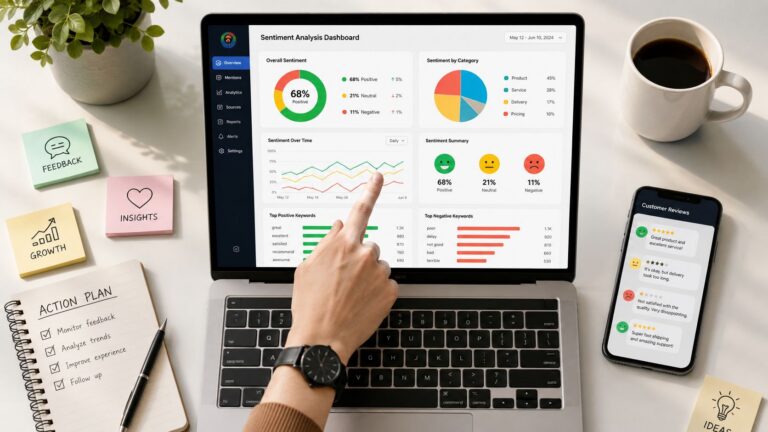
Your customers are already telling you what's broken, what's working, and what they'll leave you for. Most companies still treat that signal like background noise. Reviews pile up, support tickets sit in a help desk, survey verbatims get skimmed, and call transcripts never make it into product or revenue decisions.
That's a mistake.
I've spent years helping companies build AI systems that turn messy language into operating advantage. The pattern is always the same. The businesses that win don't just collect feedback. They build a better sensory system than their competitors, then wire it into action. Modern customer sentiment analysis tools now go far beyond simple positive and negative labels. They pull from tickets, surveys, chat, reviews, calls, and product context, then classify the signal in ways teams can use for CSAT, NPS, churn prevention, and product prioritization, as AWS explains in its overview of sentiment analysis and targeted sentiment.
The bad advice is to pick the tool with the flashiest dashboard.
The right move is to pick the tool that fits your workflow, your data sources, and the decisions you need to make next week. If you want a broader foundation first, discover DataTeams' NLP examples.
1. Qualtrics XM Discover
If you run a serious Voice of Customer program, Qualtrics XM Discover is one of the strongest choices on the market. This is the platform I'd put in front of an enterprise team that needs survey data, call data, chat data, and review data working together instead of living in separate silos.
Its edge comes from depth, not simplicity. You're buying Clarabridge heritage, mature text and speech analytics, and a platform designed to turn language into categories, intent, emotion, and workflows.
Where it wins
Qualtrics XM Discover fits companies that already think operationally. Not just “what are customers saying,” but “who owns this issue, what alert should fire, and where should this trend show up.”
You get strong value if you need:
- Omnichannel analysis: Pull surveys, support conversations, reviews, and call transcripts into one environment.
- Workflow connection: Route findings into the broader Qualtrics stack instead of exporting CSVs and hoping someone acts.
- Governance: Large teams with compliance requirements usually care as much about control as analytics.
If your marketing and CX leaders are also trying to operationalize AI more broadly, this connects well with the kind of systems work I describe in how to use AI for marketing.
Practical rule: Use Qualtrics when you already have process discipline. If your team won't maintain taxonomies, ownership, and escalation paths, you'll underuse it.
When I wouldn't recommend it
I wouldn't put this into a small startup looking for a lightweight sentiment widget. It's premium, it has admin complexity, and you need someone inside the business who can own configuration quality.
If you want a competitive advantage from customer sentiment analysis tools, Qualtrics is powerful. But only if you're ready to treat feedback as infrastructure, not a reporting side project.
Use the platform at Qualtrics XM Discover.
2. Medallia Text Analytics
Medallia is the choice I recommend when a company wants speed inside an existing CX discipline. It's especially strong for organizations that already live in survey programs, customer experience reporting, and executive dashboards tied to customer metrics.
Sentiment analysis should support measurable customer outcomes, not replace them. IBM notes that organizations use sentiment analysis to understand metrics like CSAT and NPS, then redirect operations and service processes based on what they learn in IBM's customer experience guidance.
Why operators like Medallia
Medallia tends to work well when leadership wants answers fast. Theme detection, sentiment tagging, and nuanced emotion analysis are built to plug into an established VoC operating model.
That makes it strong for teams that need:
- Fast deployment: Out-of-the-box models can shorten the path from raw feedback to usable reporting.
- KPI connection: CX teams can connect themes and sentiment to internal scorecards and executive reviews.
- Stakeholder alignment: Product, support, and service leaders can work from the same interpretation layer.
For teams building broader intelligence systems around market and customer data, this sits well next to the stack I discuss in marketing intelligence tools.
Medallia is less about experimental AI. It's about getting a large organization to trust the signal and act on it.
Where it falls short
If you don't use Medallia for your broader Voice of Customer motion, some of the platform's value gets left on the table. You can still use it, but the fit is strongest when text analytics is one layer inside a wider Medallia environment.
I also wouldn't buy it if your primary use case is public social listening or brand reputation monitoring. This is better for customer experience orchestration than broad open-web monitoring.
Explore it at Medallia Text Analytics.
3. InMoment XI
InMoment is a strong pick when you care about deployment flexibility and text analytics pedigree. The Lexalytics foundation gives it credibility with teams that want advanced natural language processing under the hood, especially when they need more control than a pure SaaS black box gives them.
I like InMoment for companies with messy environments. Multiple business units. Mixed data sources. Sometimes stricter deployment requirements than modern SaaS vendors love dealing with.
Best fit
InMoment earns its keep:
- Flexible deployment: Helpful if your security or compliance team doesn't want a one-size-fits-all setup.
- Strong categorization: Useful when you need aspect or topic-level interpretation across large feedback volumes.
- Closed-loop workflows: Good for organizations that want alerts and actioning, not just insight reports.
If your team is trying to prove whether experience work affects actual commercial performance, that discipline needs measurement design as much as tooling. I've written about that in how to measure marketing effectiveness.
My read on the trade-off
InMoment is not the cleanest option for smaller teams. It's enterprise-oriented, and the broader XI suite can feel heavy if all you need is straightforward theme and sentiment analysis.
Still, there's a reason tools like this stay relevant. Modern sentiment work has expanded into fine-grained, aspect-based, and intent-aware analysis rather than simple one-score classification. NiCE and IBM both point to that broader shift in the category, and InMoment sits squarely in that more diagnostic camp, as noted earlier.
Use it if you want flexibility and depth. Skip it if you want something lightweight and self-serve.
See the platform at InMoment.
4. Sprinklr Insights
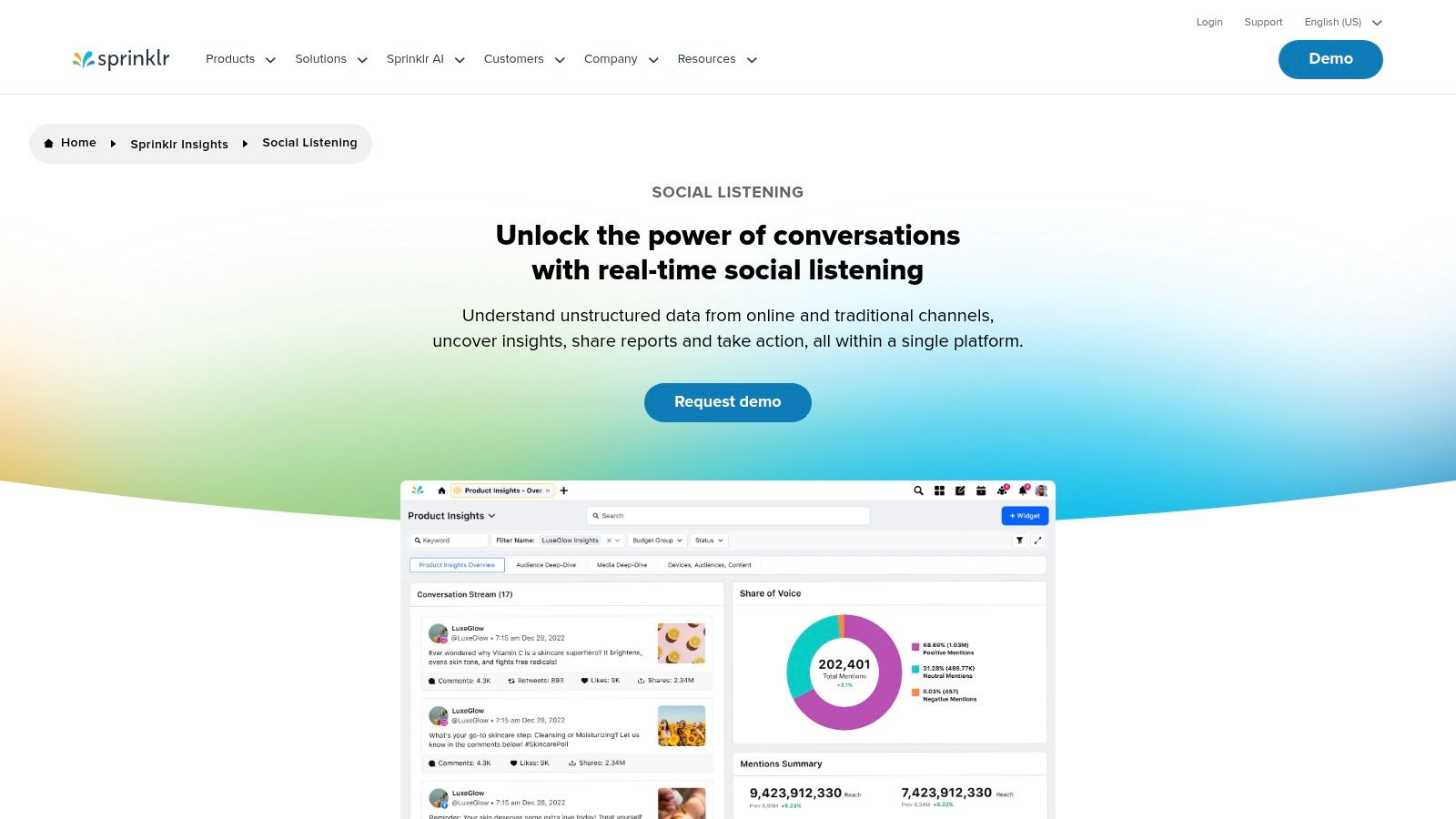
Sprinklr is for companies that care about public conversation at scale. If your brand can get hit in social, news, review sites, creator ecosystems, or emerging channels, Sprinklr gives you broad external visibility and strong enterprise controls.
This isn't a support-ticket platform pretending to do listening. It's built for monitoring the market outside your walls.
Where Sprinklr creates advantage
I recommend Sprinklr when the business problem is early detection. Competitive moves. Reputation risk. Campaign backlash. Shifts in category language.
Its strengths show up in three places:
- Public data breadth: Useful when your brand story forms across many external channels.
- Multimodal coverage: Helpful if you need signal from more than plain text.
- Enterprise governance: Large teams usually need permissions, workflow discipline, and auditability.
If your main question is “what's happening in the market before my dashboard turns red,” Sprinklr is a serious option.
Public sentiment and customer sentiment overlap, but they aren't the same thing. Don't let your team treat social buzz like direct customer truth.
Where people misuse it
I see teams overbuy Sprinklr when their real need is internal customer feedback analysis. If your richest signal lives in support conversations, surveys, and product friction, a VoC-focused platform will usually get you to action faster.
Use Sprinklr when the outside world matters most. Don't use it as your only lens if customer complaints mostly happen in private channels.
Explore it at Sprinklr Consumer Intelligence.
5. Brandwatch Consumer Research
Brandwatch is one of the cleanest choices for competitive intelligence through public conversation. If you care about brand perception, competitor comparison, and trend tracking over time, this is one of the platforms I'd shortlist immediately.
The biggest reason is data depth. Historical context matters when you're trying to separate a real market shift from a one-week spike in noise.
What it's good at
Brandwatch works well for teams doing:
- Brand monitoring: Track how perception changes around launches, issues, and campaigns.
- Competitor tracking: Compare the language and sentiment surrounding your category peers.
- Research workflows: Export data and turn it into reporting, planning, and executive narratives.
For CMOs and founders, that can become a strategic edge. You're not just measuring your own mentions. You're seeing where the market is leaning before sales calls start repeating it.
When to look elsewhere
Brandwatch is not my first pick for private operational feedback. If most of your insight lives in support tickets, survey comments, and account-level interactions, you need a tool built around internal customer data, not public conversation first.
That distinction matters more now because the category has evolved away from old-school brand monitoring toward customer-data-centric systems for SaaS and CX use cases, as discussed earlier. Brandwatch still shines. Just be honest about the job you need done.
For public sentiment and competitive intelligence, it's one of the strongest tools in the category.
Check it out at Brandwatch Consumer Intelligence.
6. Talkwalker Consumer Intelligence
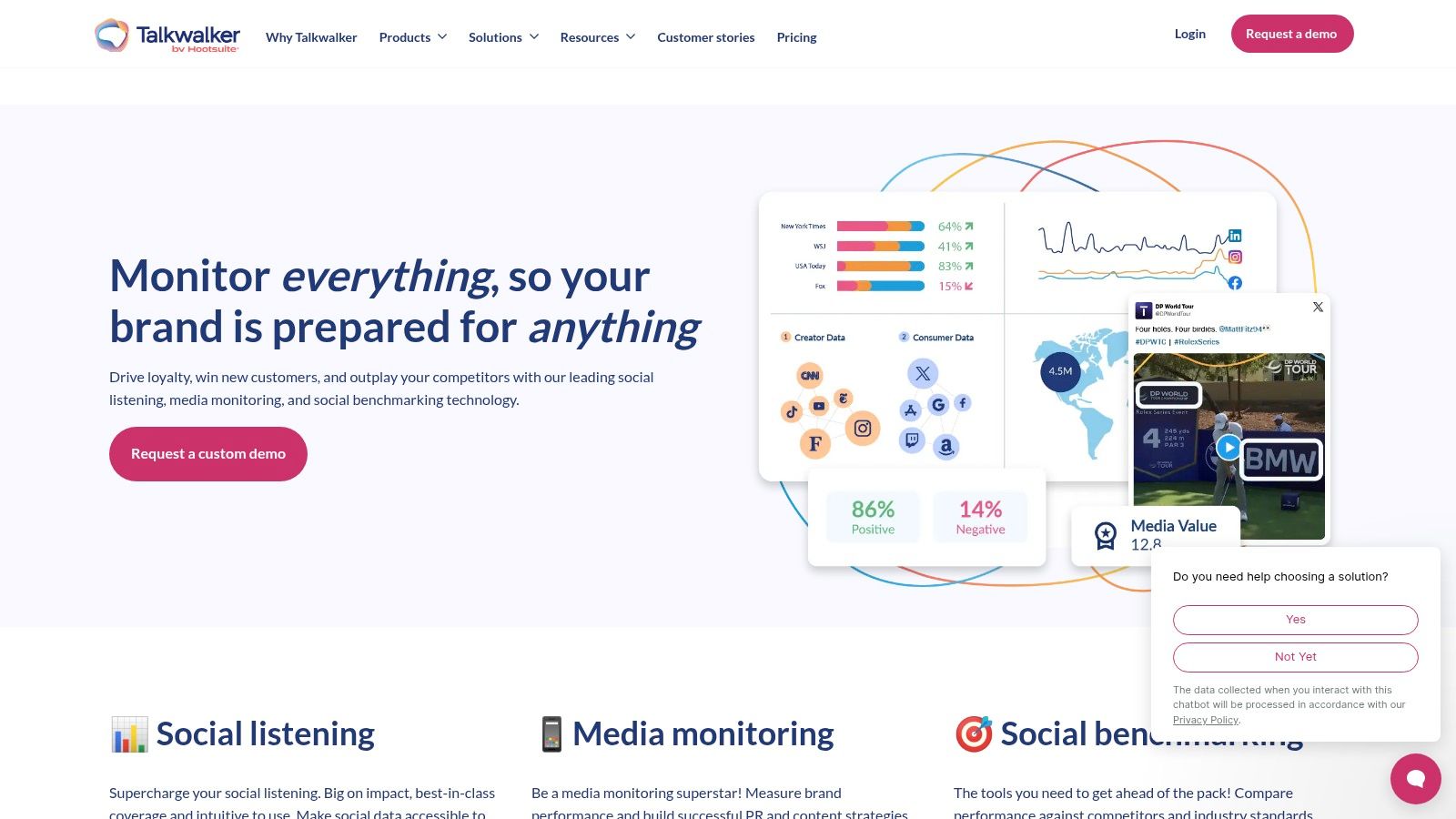
Talkwalker is the platform I'd consider when your team wants listening plus forward-looking pattern detection. That's the appeal. Not just “what are people saying,” but “is this issue building, and should we act before it gets expensive.”
For proactive brand and market teams, that's useful.
Why it stands out
Talkwalker combines social, reviews, news, and other external sources into one monitoring environment. The reporting and collaboration layer also makes it workable for bigger organizations that need multiple stakeholders involved without exporting everything into slide decks every week.
I'd prioritize it for:
- Campaign monitoring: See reaction patterns while campaigns are still live.
- Reputation management: Catch peaks in negative chatter before they become a larger narrative.
- Competitor observation: Spot changes in market attention and category themes.
My consultant take
Talkwalker makes sense when your business loses money by reacting late. Consumer brands, public-facing SaaS, hospitality, regulated sectors with reputational exposure. Good fit.
Bad fit if your use case is narrow. If you only need lightweight social listening, this can be too much platform.
The market direction also supports this broader, AI-heavy model. One forecast says the global sentiment analysis software market is projected to grow from USD 2.98 billion in 2025 to USD 6.17 billion by 2030 at a 15.1% CAGR, with North America the largest region in 2025, according to The Business Research Company's sentiment analysis software market report. That doesn't tell you which tool to buy. It does tell you this category is now a real operating layer, not an experimental add-on.
See Talkwalker.
7. Sprout Social Listening
Sprout Social Listening is the practical option for teams that already live inside Sprout for publishing, engagement, and reporting. If that's you, adding listening can be a smart move because the workflow friction is low and adoption usually comes easier.
That matters more than vendors admit. The best analytics tool is often the one your team opens every day.
Good choice for integrated social teams
Sprout Social Listening is useful when your social team needs sentiment without stepping into a heavier enterprise intelligence suite. The interface tends to be easier for day-to-day use, and the reporting is accessible enough for marketing leaders who don't want a specialist analyst translating every dashboard.
I'd use it for:
- Integrated publishing and listening: Social managers can move from scheduling to monitoring without changing systems.
- Team reporting: Clear summaries for campaign reviews and monthly brand check-ins.
- Mid-market practicality: Easier to operationalize than the biggest enterprise platforms.
The limitation
You're still mostly in the world of public and social conversation. That's fine if your brand is shaped in public. It's not enough if your churn risk hides in support, onboarding, and product friction.
Also, don't confuse convenience with thoroughness. This is a good integrated choice, not a universal one.
One broader market signal is worth noting here. A separate market forecast says modern customer sentiment analysis tools increasingly rely on NLP, machine learning, and deep learning, and that 70% of newly launched solutions use AI, ML, or NLP methods, while cloud deployment reached 55% of market revenue share in 2026, according to Business Research Insights on the sentiment analysis software market. Sprout fits that shift toward scalable, always-on monitoring.
Use the platform at Sprout Social Listening.
8. Chattermill
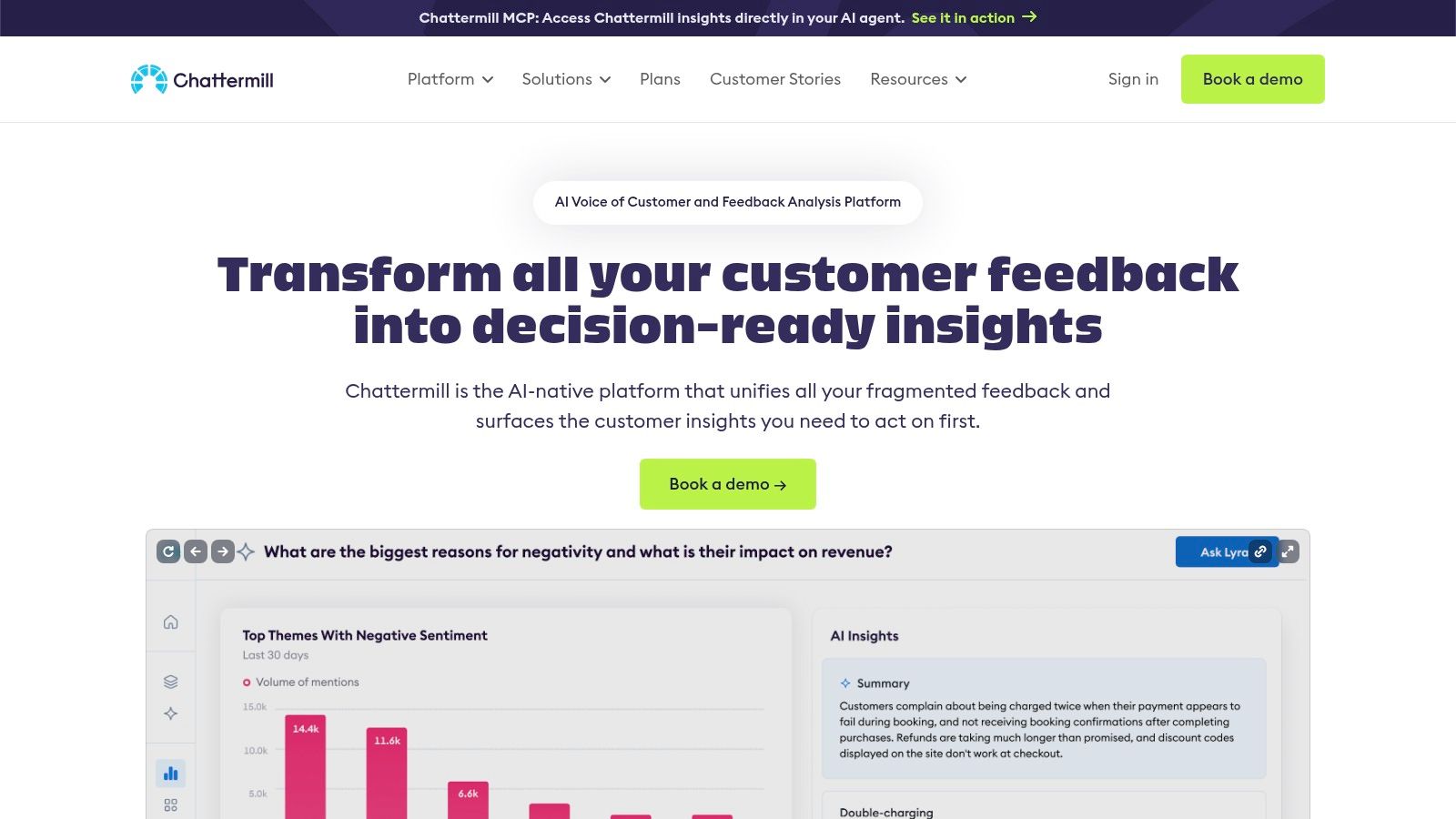
Chattermill is one of my favorite options for companies that want a centralized feedback intelligence layer across product, CX, and support. It's built around unifying customer feedback from multiple sources, then turning that into themes, sentiment, dashboards, and prioritization.
That's the right shape for most SaaS companies.
Why it works
A lot of businesses don't have a sentiment problem. They have a fragmentation problem. Support has one system, product has another, marketing watches reviews, and nobody trusts the combined picture.
That implementation gap is still poorly answered across the market. Crescendo points out that most tools remain channel-specific and that the core challenge is how to unify sentiment from product telemetry, support tickets, and public data without double-counting or conflicting scores in its guide to customer sentiment analysis.
Chattermill is strong because it's built around that exact problem.
- Unified ingestion: Bring surveys, reviews, social, and support data into one analysis layer.
- Theme-first analysis: Better for identifying root causes than staring at raw polarity scores.
- KPI linkage: More useful when product and CX teams need to tie feedback to outcomes.
If your company has three teams arguing over what customers want, Chattermill can become the shared evidence layer.
Where to be careful
You still need integration quality and taxonomy stewardship. No platform fixes messy source systems on its own. If your ticket categories are chaos and your review sources are half-connected, you'll get noisy outputs.
Still, for B2B SaaS and product-led companies, Chattermill is often closer to the operational sweet spot than big social-listening suites.
Visit Chattermill.
9. Thematic
Thematic is what I'd choose when executive clarity matters as much as analytical depth. It's built to turn large volumes of unstructured feedback into themes and topic-level sentiment that people across the business can understand.
That sounds basic. It isn't. A lot of tools can classify text. Far fewer can create outputs that product, CX, and leadership teams will trust and use.
Best use case
Thematic is a good fit for companies that want:
- Explainable theme hierarchies: Better than raw keyword clouds and generic sentiment labels.
- Fast stakeholder reporting: Helpful when you need a narrative, not just a dashboard.
- Multi-source feedback analysis: Useful across reviews, support interactions, and customer comments.
It's especially attractive when your internal bottleneck is synthesis. You don't need more data. You need cleaner interpretation and clearer stories for decision-makers.
The trade-off
This is not the platform I'd pick for broad social listening or market surveillance. It's more specialized in feedback intelligence than public conversation monitoring.
I also like that it stays closer to the business question. Which recurring themes are rising, which ones are falling, and what sentiment sits inside each one. That's usually more actionable than a single blended score.
For teams drowning in comments and struggling to create coherent action plans, Thematic is a strong specialist choice.
See Thematic.
10. Siena Insights
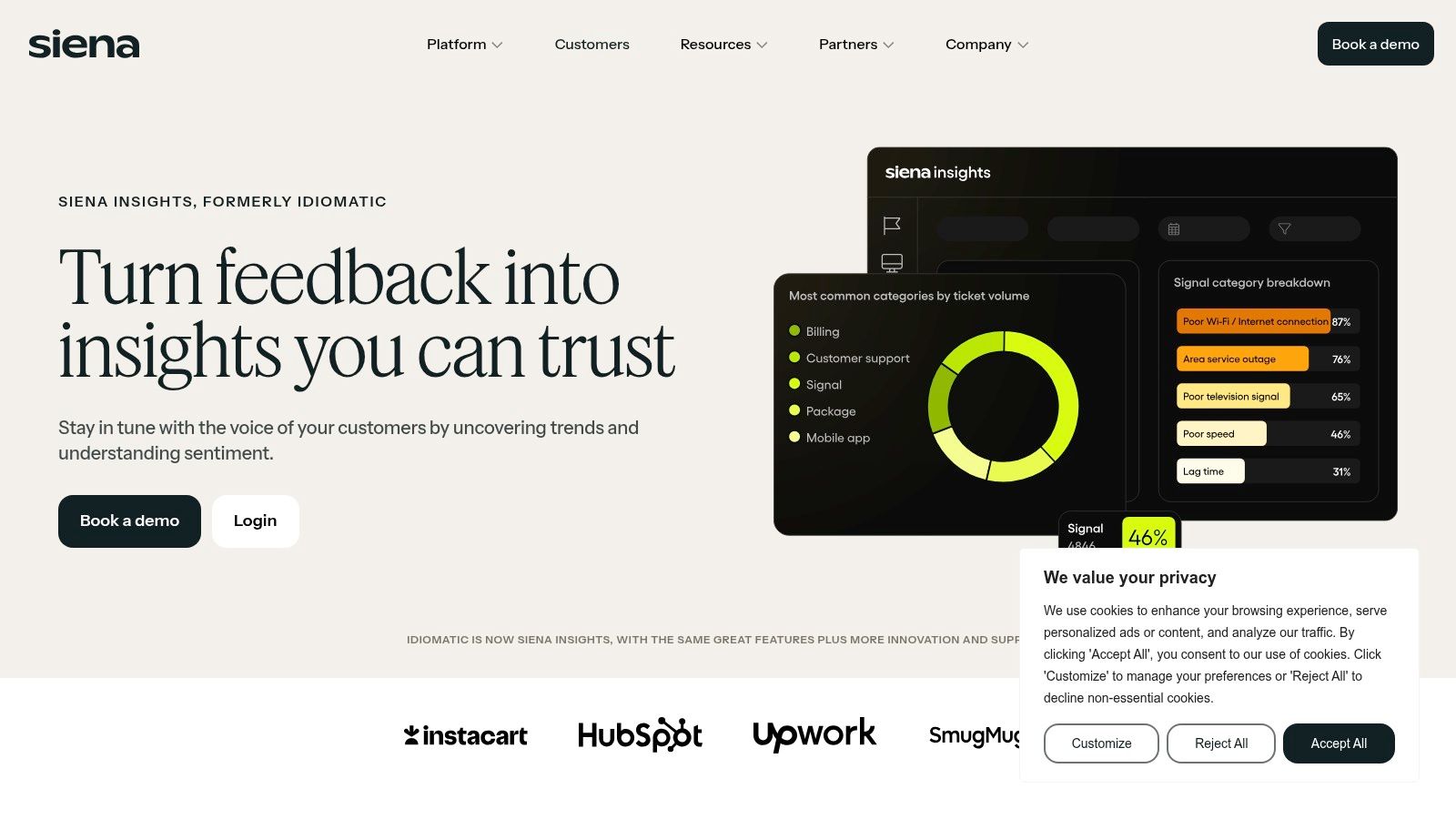
Siena Insights is the tool I'd look at when support operations are your fastest route to customer truth. If your help desk is where customers reveal frustration, confusion, feature gaps, and churn intent, this kind of setup can be much more useful than a big generic sentiment platform.
It's built for action speed. Themes, anomalies, alerts, and conversational querying.
Why support-led teams like it
Siena Insights works well when you need feedback to move directly into operations. Not six weeks later in a quarterly report. Right now, in Slack, with a team owner attached.
That makes it strong for:
- Support-led Voice of Customer: Pull patterns from tickets, reviews, and survey feedback.
- Real-time alerting: Flag anomalies and rising pain points while they're still manageable.
- Accessible analysis: Let non-technical teams query feedback without building their own taxonomy from scratch.
The bigger strategic question here is whether sentiment is predictive, not just descriptive. That's still an underserved area. Observe.ai's overview of the field highlights the market shift toward emotion detection, urgency detection, aspect-based scoring, and more granular risk signals, while leaving open the critical question of which signals predict churn, escalation, or revenue outcomes in its sentiment analysis glossary entry.
My recommendation
Use Siena Insights when support is your richest operating signal and your team cares about fast actionability. Don't choose it if your main challenge is broad social reputation management or market intelligence.
Also confirm the roadmap during the buying process. Rebrands can be harmless, but you should always ask how product direction, support structure, and migration plans are being handled.
Explore Siena Insights.
Top 10 Customer Sentiment Analysis Tools Comparison
| Product | Core features | Coverage & deployment | Best for (Target audience) | Standout (USP) | Pricing & scale |
|---|---|---|---|---|---|
| Qualtrics XM Discover (Clarabridge) | Clarabridge NLP, intent & emotion, workflow actioning | Omnichannel (calls, chats, surveys); integrated in Qualtrics XM; enterprise governance | Enterprise contact centers & VoC programs | Deep domain NLP heritage + XM platform integrations | Quote-based; enterprise / premium for small teams |
| Medallia Text Analytics | Theme, sentiment & nuanced emotion, multi-language models | Surveys, reviews, social, support tickets; built into Medallia VoC dashboards | CX teams seeking fast time-to-value | Industry-tuned, out-of-the-box models for rapid deployment | Quote-based enterprise pricing; best with Medallia stack |
| InMoment XI (Lexalytics) | Aspect/topic sentiment, categorization, alerts & orchestration | Surveys, reviews, support; cloud or on‑prem NLP options | Organizations needing flexible deployment & taxonomies | Lexalytics NLP pedigree + on‑prem/cloud flexibility | Quote-based; enterprise-focused |
| Sprinklr Insights (Consumer Intelligence) | Multimodal sentiment (text/image/audio/video), trend detection, alerts | 30+ channels, 400K+ media sources, open web coverage | Brands needing broad social listening, crisis/competitor detection | Massive public coverage and multimodal analysis | Enterprise pricing; requires sales engagement |
| Brandwatch Consumer Research | Firehose access, huge historical dataset, AI insight assistants | Official firehose (X/Twitter etc.), image analysis, API & reporting | Market/brand research teams requiring historical depth | Defensible, deep historical data and mature analytics | Custom pricing; mid‑market to enterprise budgets |
| Talkwalker Consumer Intelligence | Sentiment, trend & peak detection, forecasting, AI summaries | Social, news, reviews and external sources unified | Brand reputation, campaign analysis, competitive intel | Forecasting & peak detection with AI summaries | Quote-based enterprise pricing |
| Sprout Social Listening | Sentiment, topic trends, share-of-voice, reporting widgets | Major networks + web; listening is a separate add-on to Sprout | Teams already using Sprout for publishing & engagement | Easier UX and tight integration with publishing workflows | Add-on pricing; seat-based plans that scale with team size |
| Chattermill | Unified ingestion, AI theme & sentiment tagging, KPI linkage | Surveys, app stores, support, reviews, social; dashboards & alerts | Product and CX teams centralizing feedback intelligence | Purpose-built for product/CX insights; scales by data volume | Custom pricing; mid‑market/enterprise focus |
| Thematic | Automated topic discovery, sentiment per theme, narrative reports | Multi-source feedback ingestion (feedback, chat, reviews) | Teams needing fast, explainable insights for stakeholders | Clear, explainable outputs and fast time-to-insight | Annual floor (Foundation ≈ $25k/yr); enterprise quotes |
| Siena Insights (formerly Idiomatic) | Topic explorer, anomaly detection, Slack alerts, "Ask Siena" Q&A | Support, survey, review feedback; integrations with Zendesk/Gorgias | Support-led VoC teams needing real-time signals & alerts | Slack-first actionability and conversational querying | Quote-based; rebrand in progress, confirm roadmap |
From Data Collection to Market Domination
Most companies buy customer sentiment analysis tools for visibility. That's too small a goal. Visibility is useful, but it doesn't create advantage on its own. Speed of interpretation does. Speed of action does. Better prioritization does.
The companies that pull ahead build a closed loop. Collect feedback. Classify sentiment. Break it down by theme, feature, service issue, or customer journey stage. Route it to the team that can do something about it. Then track whether customer metrics move. That operating model matters because sentiment analysis has already evolved from simple polarity scoring into aspect-based, targeted, and multi-source customer intelligence systems, as noted earlier.
If you're choosing between these tools, make the decision based on where your most valuable signal lives.
Choose Qualtrics, Medallia, or InMoment if your center of gravity is enterprise customer experience and structured VoC operations. Choose Sprinklr, Brandwatch, Talkwalker, or Sprout Social if your edge comes from public conversation, brand monitoring, and competitor awareness. Choose Chattermill, Thematic, or Siena Insights if your real goal is turning support, survey, and product feedback into prioritization and retention action.
Then validate before you scale.
Run a narrow implementation first. Pick one business question. Churn risk in onboarding. Support friction after a release. Negative brand reaction to a campaign. Don't ask the tool to solve “customer sentiment” as a whole. Ask it to detect one recurring problem accurately enough that a team can respond fast and see whether outcomes improve.
Good sentiment operations don't start with a dashboard. They start with one decision your company needs to make better than competitors.
Also, don't let blended scores fool you. A single sentiment number across channels can hide the truth. Public complaints, private frustration, neutral-looking renewal risk, and feature praise can all coexist. You and I need channel-aware analysis, shared taxonomies, and clear ownership if we want signals that executives can trust.
That's where teams often get stuck. Not model quality. Operational design.
If you want a practical framework for connecting these tools to growth decisions, product feedback loops, and faster execution, start with this roadmap for marketing data analytics in 2026. And if you need help architecting the system itself, that's the kind of work I do at Samuel Woods. Not more AI theater. A working sensory system your business can use to move faster than the market.