
Most advice on generative AI content marketing is bad. It tells you to collect prompts, test shiny tools, and crank out more blog posts. That approach gives you more output, not more impact.
I've worked with ML since 2016 and Generative AI since 2019, and I can tell you this plainly. The winners won't be the teams with the cleverest prompt library. They'll be the teams that build a system that turns market intelligence into content, content into pipeline, and pipeline into competitive pressure their rivals can't keep up with.
The goal is a machine that helps you see opportunities earlier, respond faster, and shape buyer perception before competitors even know the conversation changed. Publishing mediocre assets more efficiently won't get you there.
Table of Contents
- Stop Chasing AI Hype Start Building an Engine
- The Bionic Marketing Framework for Generative AI
- From Raw Market Intelligence to Master Prompts
- Scaling Creative Production Without Losing Your Soul
- QA Governance and Navigating the Trust Penalty
- How to Build Your Generative AI Tech Stack
- Measuring the ROI of Your AI Marketing Engine
Stop Chasing AI Hype Start Building an Engine
The market has already moved. Adoption of generative AI for content creation in marketing has surged to nearly 73% of marketing professionals in 2025, with 91% of firms now using generative AI overall, according to Mend's 2025 generative AI statistics roundup. Everyone has the AI now, so your operating model is what sets you apart.
Many content teams still act like tool collectors. They jump between ChatGPT, Claude, Gemini, Jasper, and whatever app showed up in their feed this week. They produce disconnected assets, inconsistent messaging, and a bigger editorial mess than they had before.
That's the trap. If your AI use lives at the prompt level, you're easy to outrun.
The real competitive split
I see two camps.
- Tool jockeys generate isolated outputs. A social post here, an email there, maybe a blog draft if they're feeling ambitious.
- System builders create a repeatable engine. Research feeds prompts. Prompts feed assets. Assets feed campaigns. Campaign data feeds the next round of decisions.
The second group compounds faster because they don't start from zero every Monday.
In my view, generative AI content marketing only becomes valuable when it compresses the distance between insight, execution, and revenue.
Novelty doesn't matter. What matters is whether you can identify a shift in buyer language, create the right response assets, distribute them fast, and learn from performance before the competition adjusts.
What founders and marketers get wrong
They ask, “Which tool should we use?” before they ask, “What engine are we building?”
That's backward.
If you run a small business, you wear all of these hats yourself. You need market signal clarity. You need content throughput without quality collapse. You need message testing at speed. And you need proof that AI is driving pipeline rather than only cutting writing time. One requirement covers all of it: a system.
Here's the blunt truth. If you only use AI to write faster, you'll save some time. If you use it to think faster, route work better, and tighten the link between strategy and execution, you pull ahead of competitors who only write faster.
The Bionic Marketing Framework for Generative AI
Random acts of AI don't scale. They create noise. I use a five-stage operating model that turns generative AI content marketing into a disciplined growth system.
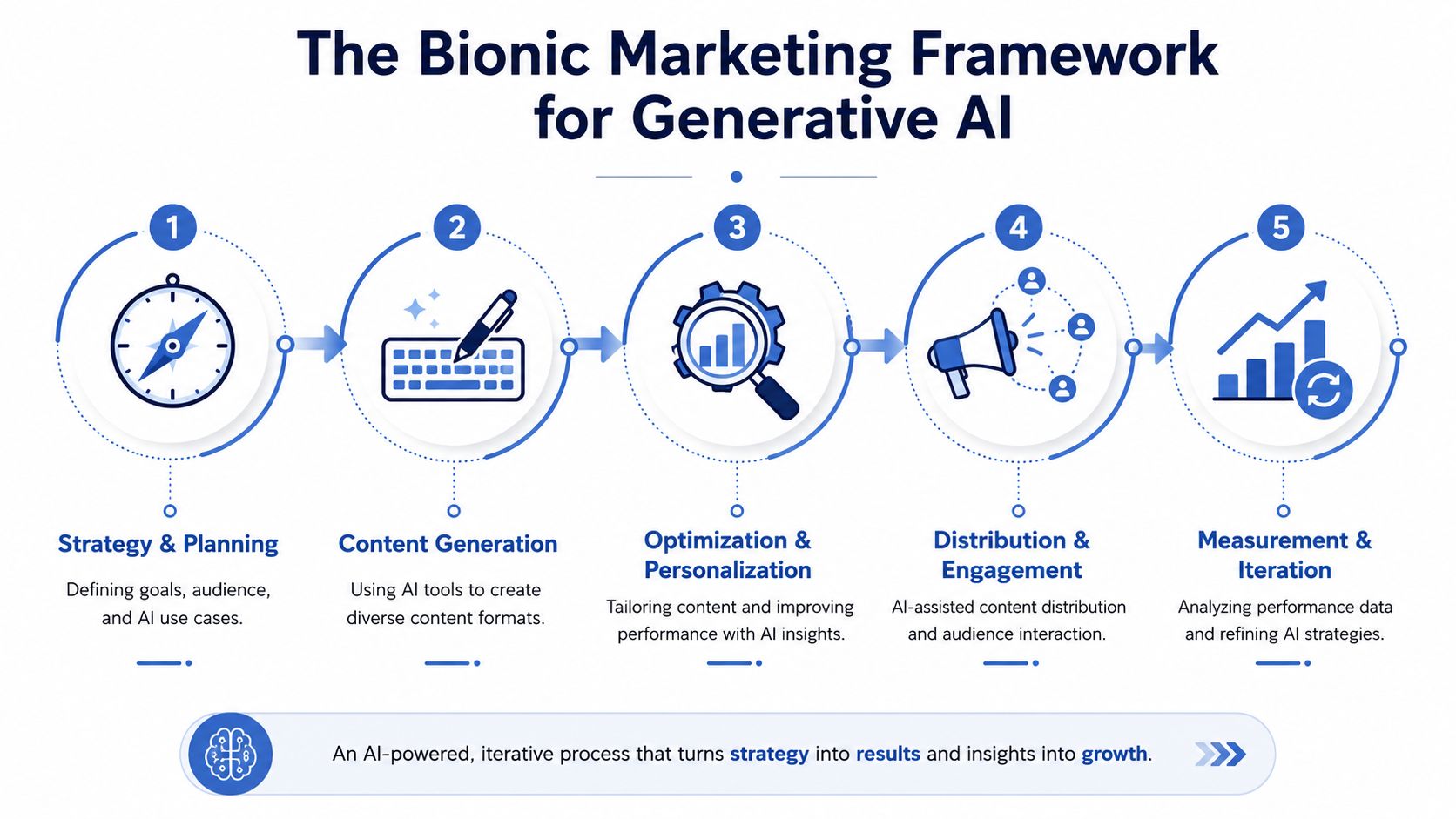
Five stages that work together
1. Strategy and planning
You start with goals, audience pressure points, offer positioning, and business constraints. If you skip this, AI will happily generate polished nonsense.
2. Content generation
Large language models and creative tools handle the heavy lifting. Drafts, variants, repurposed assets, scripts, hooks, summaries. Fast.
3. Optimization and personalization
Now you adapt. You tailor content by funnel stage, channel, persona, buying objection, and search intent. Good teams use AI here to sharpen relevance rather than to multiply formats.
4. Distribution and engagement
Content sitting in a folder is dead inventory. This stage covers publishing workflows, channel adaptation, audience interaction, and campaign coordination so assets get seen.
5. Measurement and iteration
Performance data has to flow back into the system. Winning messages should inform new prompts, campaign creative, and future editorial priorities.
Why this beats random AI usage
Many organizations use AI as a production assistant. That's too small. I want it wired across the full content lifecycle so every stage improves the next one.
Here's the flywheel in plain English:
| Stage | What goes in | What comes out |
|---|---|---|
| Strategy and planning | Goals, audience, positioning | Clear use cases and priorities |
| Content generation | Context, prompts, source material | Draft assets and creative variants |
| Optimization and personalization | Performance signals, audience differences | Sharper messaging and channel fit |
| Distribution and engagement | Campaign workflows, publishing plans | Reach, interaction, and market visibility |
| Measurement and iteration | Analytics, CRM signals, conversion data | Better decisions for the next cycle |
Efficiency is nice, but control is the real prize. When you own the whole loop, you can steer messaging faster than competitors who still rely on fragmented teams and ad hoc briefs.
Build the machine once. Then let every campaign make the machine smarter.
That's what I mean by a bionic marketing engine. Humans set direction, apply judgment, and protect the brand. AI expands speed, scale, and processing power. Together, they outperform either one alone.
From Raw Market Intelligence to Master Prompts
Bad prompts are usually a symptom of bad inputs. If your team feeds a model a vague request, it will return generic content that sounds competent and says nothing. That's a strategy problem, and switching models won't fix it.
The heavy lifting happens before generation. By front-loading the strategic work into intelligence and prompt engineering, content teams save an average of 11.4 hours per week, according to Deloitte Digital's generative AI findings. I care less about the saved hours than what you do with them. That reclaimed time should go into sharper positioning, better experiments, and tighter conversion thinking.
What I collect before I generate anything
I build context before I build copy.
My raw inputs usually include:
- Competitor messaging, meaning homepage claims, product page language, ad hooks, webinar titles, and comparison page framing.
- Customer voice from reviews, sales call notes, support tickets, demo objections, and onboarding friction.
- Search intent signals such as queries, related questions, topic clusters, and gaps where buyer demand exists but competitor content is weak.
- Internal truth, meaning your differentiators, product constraints, proof points, and the deals you want more of.
Then I compress that into one working artifact. I call it a context brief.
A strong context brief usually includes audience definition, pains, desired outcomes, brand tone, offer details, proof constraints, messaging angles to avoid, and the exact business goal for the asset. The model doesn't need more words. It needs better words.
How I turn research into a master prompt
Once the context brief is solid, I write one master prompt that behaves like an operating instruction, not a casual request.
My prompt structure is simple:
- Role the model should take
- Audience it must write for
- Objective tied to a business outcome
- Context pulled from the brief
- Constraints on tone, claims, structure, and prohibited language
- Output format for the exact asset needed
That's the difference between “write a blog post on onboarding” and “write a bottom-funnel article for SaaS operators evaluating onboarding automation, using direct language, acknowledging implementation risk, and aligning with our product's mid-market positioning.”
If you want to go deeper on the mechanics, I've written more about prompt engineering for marketing.
Better prompts don't start in the prompt box. They start in the market.
A useful rule here is to separate research mode from production mode. One workflow gathers signal. Another workflow synthesizes that signal. Only then should the generation workflow start.
That discipline is what keeps your generative AI content marketing from sounding like everyone else's. You stop asking the model to invent relevance. You hand it relevance, then force it to execute.
Scaling Creative Production Without Losing Your Soul
At this juncture, marketers either get excited or reckless.
Used properly, AI gives you a real production advantage. B2B marketing teams using this AI-augmented workflow produce 4.2 times more published assets per writer compared to their pre-AI baseline, based on The Starr Conspiracy's B2B benchmark data. That kind of lift matters because share of voice often goes to the team that can publish, test, and iterate faster without degrading message quality.
What scale actually looks like
One strategic brief can become a lot of market coverage.
From a single source package, I'll often spin out:
- A flagship article for the website
- An email sequence built around objections and use cases
- Short-form social posts with different hooks for different buyer states
- Ad variations for testing message angles
- Video or webinar scripts for higher-trust channels
- Sales enablement snippets that support outbound and follow-up
If the source strategy is coherent, that's message multiplication, and it won't read as content spam.
The catch is simple. AI should draft at scale, but humans should still decide what deserves publication.
When you should not automate heavily
There are cases where I deliberately slow the system down.
| Scenario | My recommendation |
|---|---|
| High-stakes thought leadership | Use AI for research synthesis and structure, then let a subject expert write or heavily rewrite |
| Sensitive product claims | Keep legal and product review tight before anything ships |
| Founder voice content | Use AI to organize ideas, not to impersonate lived experience |
| Crisis or reactive communications | Draft internally first, then use AI only for variant testing and adaptation |
Many brands lose themselves in this context. They let the model flatten nuance, smooth over conviction, and turn distinct positioning into polished mush.
If you're serious about distribution, especially in evolving search environments, it also helps to think beyond classic SEO and study resources on optimizing content for AI search. Retrieval-driven discovery changes how your content gets surfaced, quoted, and compared.
I also recommend teams formalize their editorial workflow around a bionic split. AI handles draft generation, repurposing, and first-pass variations. Human editors handle tone, specificity, proof, and strategic sharpness. If you want a deeper breakdown of that workflow, I've shared practical notes on AI for content creation.
Scale is valuable. Distinctiveness is priceless. Don't trade one for the other.
The team structure changes too. Writers become strategic editors. Content leads become orchestrators. Marketers spend less time staring at blank pages and more time deciding which messages deserve oxygen.
QA Governance and Navigating the Trust Penalty
This is the part enthusiastic teams try to skip. That's a mistake.
AI can create a brand advantage fast. It can also create public embarrassment fast. The two biggest problems are false confidence in the output and poor framing of how the output was made.
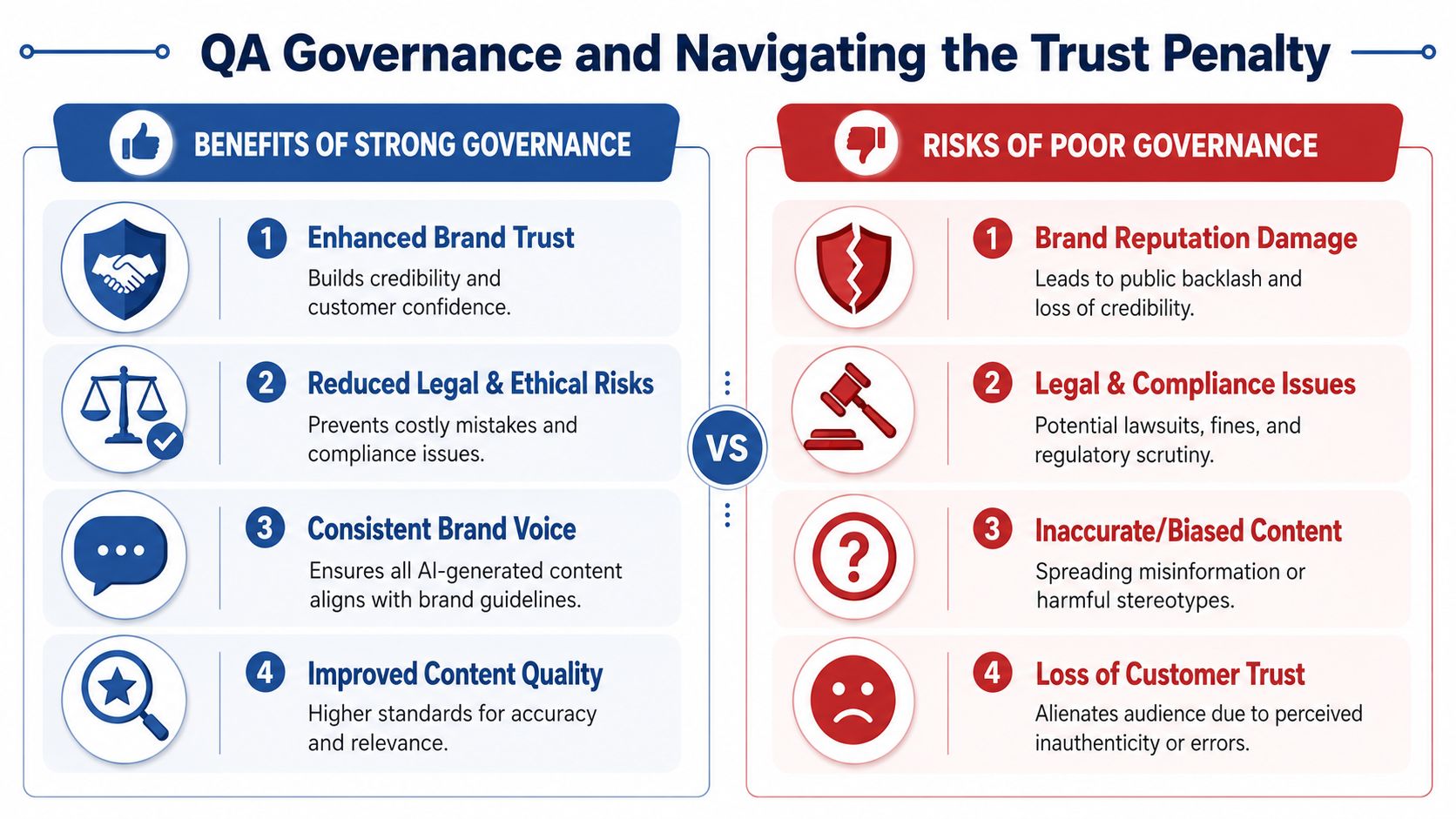
The two risks most teams ignore
First, hallucinations.
Awkward prose is the small problem. The real risk is that the model writes something wrong in a tone that sounds authoritative. The background research on this topic is clear that leading models can fabricate facts, sources, and URLs, which is why I insist on human review for every externally published asset.
Second, the trust penalty.
Recent 2025 research confirms consumers evaluate ads described as “AI-made” more negatively than identical human-made ads, specifically regarding emotional resonance, according to NIM's research on transparency without trust. That matters because marketing performance doesn't live on technical quality alone. Buyer perception shapes response.
If your audience feels they're being handled by a machine, some of the emotional weight disappears.
My minimum governance standard
I don't think governance needs to be bureaucratic. It does need to be imperative.
My baseline looks like this:
- Every factual claim must be checked against an approved source before publication.
- AI must not invent customer proof, quotes, stats, or product capabilities.
- A human editor checks voice, tone, positioning, and audience fit.
- Sensitive assets get legal, compliance, or product review where needed.
- Finished work is never framed as machine-made. I position it as human-crafted work supported by AI workflows.
For teams that want a practical operating rhythm, a structured weekly AI risk review workflow is a useful reference point. The template matters less than the habit it forces: checking every week where risk is entering the system.
My governance rule is simple: if the content can affect revenue, reputation, or legal exposure, a human signs off before it goes live.
I also tell teams to ban a few habits immediately. Don't let interns publish raw AI output. Don't let freelancers cite unverified claims from model responses. Don't let anyone confuse fluency with truth.
The strongest positioning here is “human-made with AI help,” not “AI-made.” Buyers want competence with accountability. Give them both.
How to Build Your Generative AI Tech Stack
A ChatGPT subscription is not a stack. It's one component.
If you want generative AI content marketing to operate like an engine, you need layers that support research, production, governance, analytics, and automation. Otherwise your team gets trapped in copy-paste chaos.
A visual model helps here.
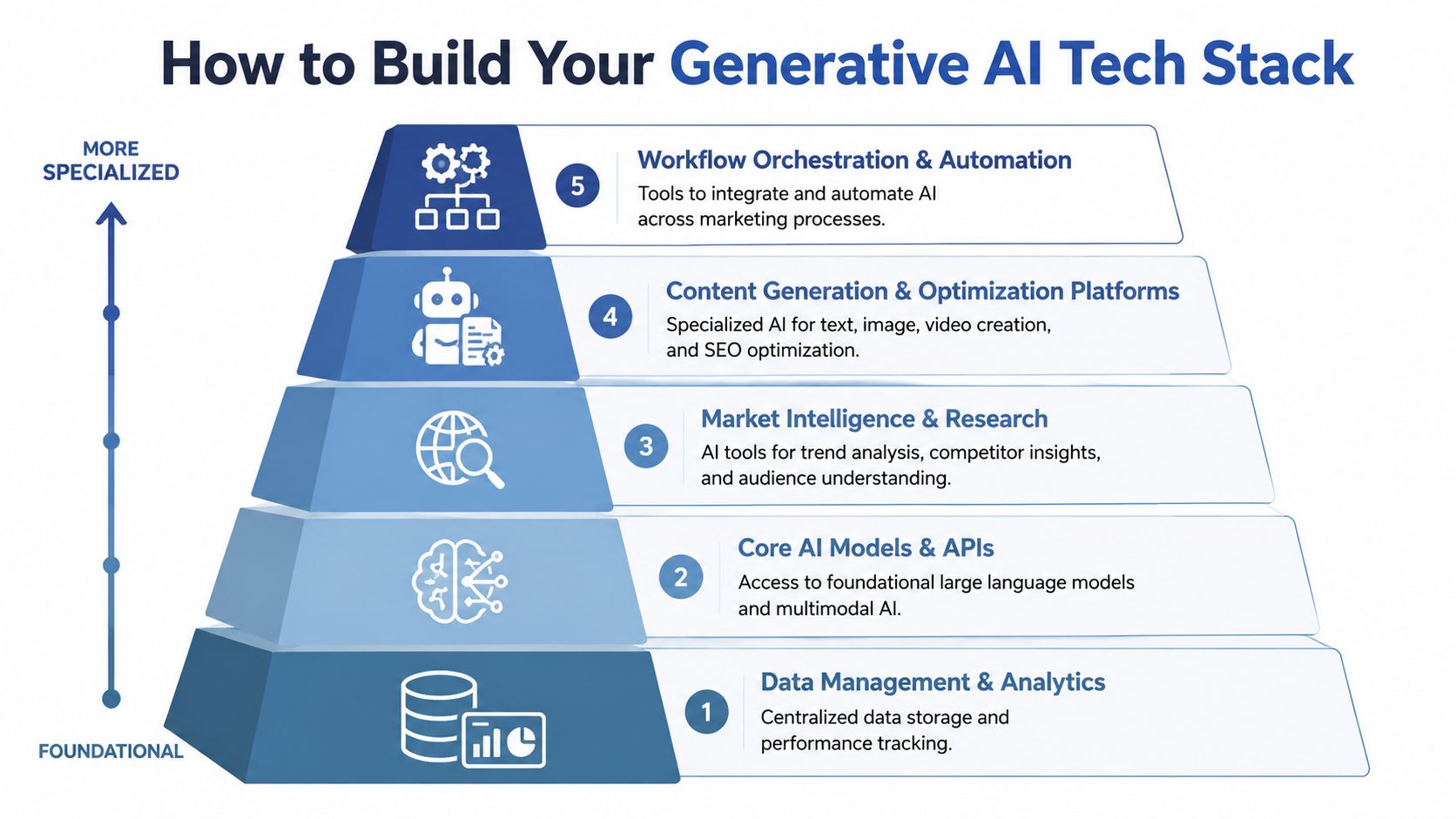
Build the stack by function
I like to assemble the stack from the ground up.
Foundation layer
Start with data and analytics. Google Analytics, your CRM, your ad platforms, and your reporting environment need to talk to each other. If performance data is fragmented, your AI layer will optimize against partial truth.
Core model layer
Pick your main models based on actual work. ChatGPT, Claude, and Gemini each have strengths. Some teams also need API access so workflows can run inside internal systems instead of inside individual chat windows.
Research layer
This is where SparkToro, SEO tools, review mining workflows, transcript analysis, and competitor monitoring live. The point is to gather signal continuously, not to do research once per quarter and pretend the market stood still.
Here's a useful decision lens:
| Layer | What to prioritize |
|---|---|
| Data and analytics | Clean performance signals and attribution visibility |
| Core AI models and APIs | Reliability, output quality, flexibility, security |
| Market intelligence and research | Audience insight and competitor awareness |
| Content platforms | Collaboration, brand controls, repurposing speed |
| Automation and orchestration | Trigger-based workflows and system integration |
A lot of teams also benefit from seeing one stack walkthrough before they start buying software. This overview video is a good place to calibrate what “integrated” should look like.
What a bad stack looks like
Bad stacks are easy to spot.
They have too many standalone tools, no shared prompt assets, no central source of truth for brand voice, and no reliable path from campaign performance back into content planning. Teams waste time exporting, pasting, rewriting, and guessing.
A better setup is boring in the best way. Inputs move cleanly. Prompts are versioned. Editors know where to review. Campaign data loops back into planning. The stack disappears into the workflow.
That's what you want. Not more software. More operational coherence.
Measuring the ROI of Your AI Marketing Engine
If you measure success by article count, you're still playing in the kiddie pool.
Publishing volume matters only if it improves business outcomes. I want to know whether the engine shortens time-to-market, increases qualified demand, supports conversion, and helps the business respond faster than competitors.
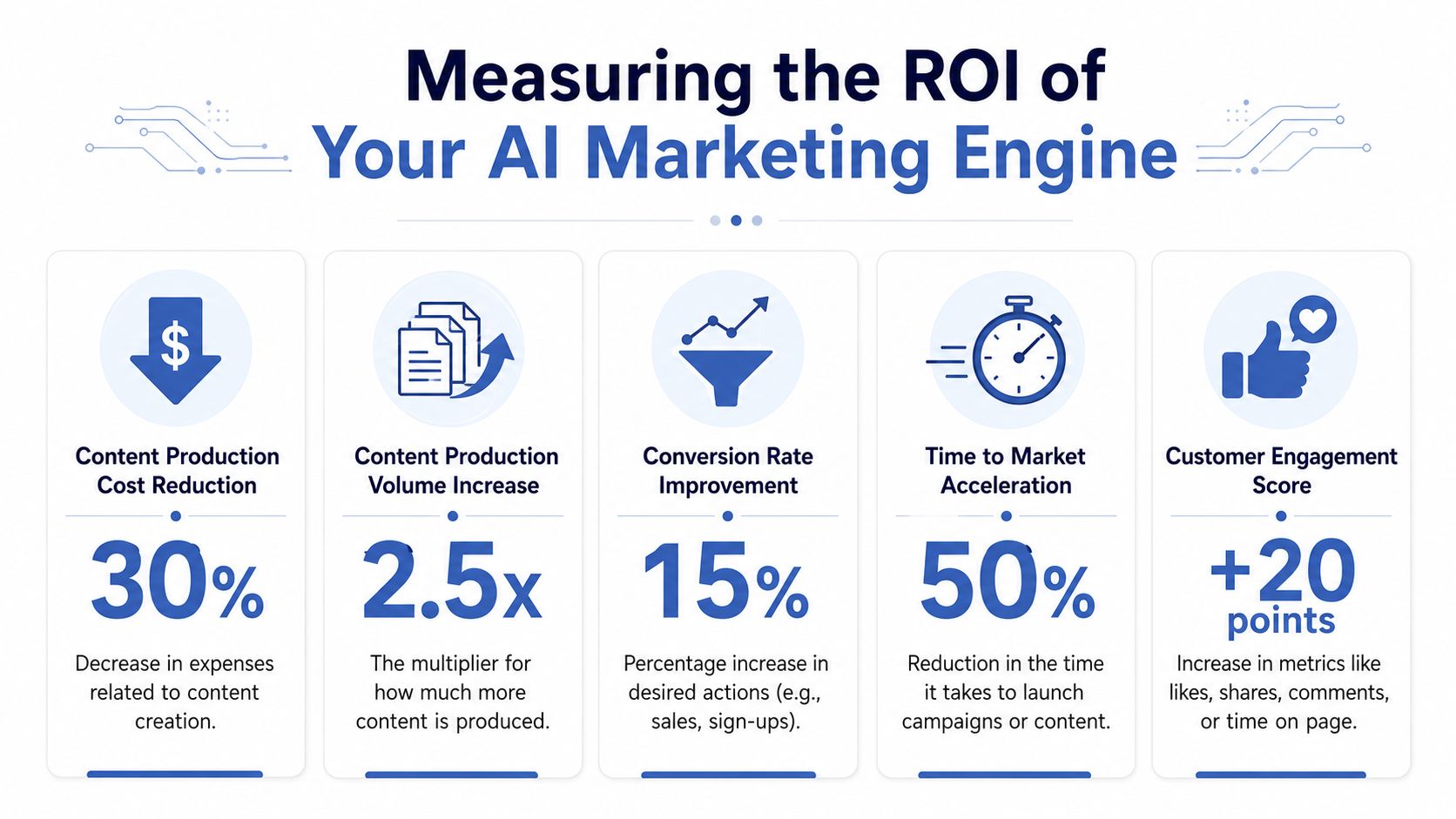
Track business outcomes not publishing activity
The infographic above includes numeric placeholders, but your real dashboard should be populated only with metrics you can verify internally. Don't benchmark your strategy against decorative numbers. Benchmark it against whether the system is improving revenue performance.
I focus on a compact set of metrics:
- Content velocity, or how quickly you move from brief to approved asset
- Time-to-market, or how fast campaigns launch after an opportunity appears
- Cost-per-asset, which shows whether your workflow lowers production cost without quality collapse
- Lead velocity from content, or how fast qualified opportunities emerge from content programs
- Conversion by funnel stage, which shows the assets that move people forward instead of only attracting clicks
That last one matters most. A content engine that generates traffic but stalls pipeline is just a louder version of the old problem.
The dashboard I actually check
You don't need a museum of marketing charts. You need a decision panel.
I want one view that answers:
- Am I creating useful assets faster?
- Are those assets reaching the right audiences?
- Are they influencing pipeline and sales motion?
- Am I learning which messages convert?
- Am I improving the system every cycle?
If you want a smart companion read on what companies should track, I'd look at this piece on key AI company metrics. It aligns with my view that generic activity metrics hide weak execution.
I've also written about how to measure marketing effectiveness in a way that connects channel performance to business impact, which is the standard you should hold your AI workflows to as well.
The ROI question to ask is “Did this engine help me win more often?” Publishing more is beside the point.
That's the real test. If your generative AI content marketing system improves speed, sharpens positioning, and strengthens revenue outcomes, keep scaling it. If it only produces more assets, fix the system before you add more fuel.
Generative AI content marketing now means building a bionic marketing engine that sees, decides, produces, and learns faster than the market around you. Using AI to write is only one small piece of it, and the engine is where the payoff comes from.