
Your competitors are using AI for content creation. They’re moving faster, cheaper, and at a scale you can’t match. That shift in market dynamics is real, and it is already here.
I’ve been working with machine learning since 2016 and generative AI since 2019. I see a clear divide: businesses that adopt AI strategically and those getting left behind. This is about gaining a real competitive advantage.
The New Speed of Business
Writing blog posts faster is the small part. The bigger part is operating at a pace your competition can’t match. Imagine testing five ad campaigns in the time it takes your rival to launch one. This is what’s possible today.
The real advantage of AI is the speed of learning, more than the volume. Faster execution means faster feedback. Faster feedback means faster optimization, and that builds a lead your competitors struggle to close.
From Cost Center to Profit Engine
For years, content was a major cost center. Hire writers, wait weeks, endless revisions, cross your fingers that it ranks. You and I both know the drill. AI flips this model on its head.
AI produces a solid first draft in minutes, freeing you up for strategy and editing. You can move from idea to live campaign in a fraction of the time, capturing opportunities before anyone else sees them.
This transition from slow manual work to a rapid, automated system is where real growth happens. It’s how you build a marketing machine that performs. You can stick with the old methods or build a system that moves faster than your market.
The 4 Levels of AI Content Mastery
Not all AI content creation is the same. One of the biggest mistakes I see businesses make is treating AI like a magic button. They get bland results and either give up or publish content that hurts their brand.
To win, you have to understand the different layers of sophistication. I think of it as four distinct levels of mastery. This is your strategic roadmap from where you are now to where you need to be.
Level 1: Basic Prompting
This is where everyone starts and where most get stuck. You open ChatGPT or Claude, type a simple command, and get a passable but forgettable article.
It’s fast. It’s easy. It’s also a fast track to brand dilution. The output sounds like everyone else’s. If you’re doing this, so are your competitors, and neither of you is gaining an edge.
Level 2: Advanced Prompt & Context Engineering
This is the first real step toward a competitive advantage. Here, you stop giving simple commands and start engineering the entire context window to guide the AI with precision. You stop acting like a user and start acting like a director.
You feed the model your specific brand voice, customer personas, and snippets from your best articles. For one e-commerce client, I built a “persona-driven product description generator” this way. The result? A 40% reduction in editing time and copy that was immediately on-brand.
This is where business wins start to materialize.
Level 3: Retrieval-Augmented Generation (RAG)
Now you’re getting into serious territory. You connect the AI directly to your own proprietary knowledge base. Think of it as giving the AI a private line to your company’s brain: your case studies, internal research, and technical documentation.
RAG is the difference between an AI that knows about the world and an AI that knows about your business. This is where you create a genuine, uncopyable information advantage.
I helped a B2B SaaS company implement a RAG system connected to their support database. Their team can now get highly accurate drafts on technical topics in minutes. This led to a 30% increase in organic traffic from long-tail keywords. Their competitors simply cannot replicate this.
Level 4: Autonomous AI Agents
This is the endgame. Instead of generating single pieces of content, you automate the entire workflow with specialized AI agents.
- An Ideation Agent monitors competitors and market trends for topics.
- A Research Agent gathers data and sources to support those topics.
- A Drafting Agent uses a RAG system to write the initial article.
- An Optimization Agent refines the draft for SEO and brand voice.
An agency I work with uses this system for client newsletters. It automatically scans news, drafts summaries in each client’s voice, and stages them for human review. This saved them over 20 hours of manual work per week. This is how you build a bionic content machine.
Choosing Your AI Content Creation Approach
So, how do you decide which approach is right for you? You don’t need to jump to Level 4. Match the right level to your goals and resources for the biggest impact now.
| Approach | Core Concept | Best For | Business Impact |
|---|---|---|---|
| Level 1: Basic Prompting | Giving simple, direct commands. | Brainstorming, summarizing text, or low-stakes internal copy. | Minimal. Generic output that doesn’t build a competitive edge. |
| Level 2: Advanced Prompting | Engineering context with brand voice, personas, examples. | On-brand marketing copy, product descriptions, first drafts. | Significant. Reduces editing time, ensures consistency, improves quality. |
| Level 3: RAG | Connecting AI to your private, proprietary data. | Expert-level technical articles, data-driven reports. | Very large. Creates an “information moat” competitors can’t cross. |
| Level 4: Autonomous Agents | Automating workflows with collaborating AIs. | Automating newsletters, market reports, or programmatic SEO. | Exponential. Frees up teams from manual work, enabling massive scale. |
Each level builds on the last. Master basic prompting, then move to context engineering for quality. Add proprietary data with RAG, and finally, automate with agents. It’s a journey.
Building Your Bionic Content Workflow
Theory is great, but execution is what separates winners from the pack. You and I know that building a system that delivers results is what matters. This is the framework I implement to help clients pull ahead in their niches.
The goal is an operational system rather than a set of tools to play with. You’re combining AI automation with human expertise. This is how you achieve scale without torching quality. Knowing the best AI content creation tools is the first step in picking your components.
Stage 1: Market Intelligence Gathering
Your content strategy shouldn’t start with a blank page. It starts with the market. You put AI agents to work as your tireless reconnaissance team.
These agents monitor your top competitors, track keywords, and sniff out emerging topics before they become saturated. Think of it as automated competitive analysis feeding you opportunities 24/7. The goal is raw intelligence on what’s working and where the gaps are.
Stage 2: Strategic Ideation
Once you have a stream of market intelligence, you need to make sense of it. I use reasoning models like GPT-4 or Claude to analyze the data from Stage 1.
You feed the model the data and give it a strategic objective. For example: “Generate 25 blog post ideas that target high-intent keywords my competitors are ignoring but my customer persona would find invaluable.”
The AI performs strategic synthesis. It connects market gaps to your business goals, producing a quarter’s worth of commercially sound content ideas.
Stage 3: Scaled Production and Human Refinement
Now you move to production. You use templated prompts and context engineering to generate high-quality first drafts at scale. Each prompt is pre-loaded with your brand voice and audience persona.
Here’s the critical part: human-in-the-loop refinement. The AI hammers out the first 80%: structure, research, core points. You (or your editor) deliver the final 20%: the unique insights, compelling stories, and strategic nuance.
The purpose of AI is to move writers up to strategist and editor, freeing them from the drudgery of the first draft so they can focus on what creates value.
This hybrid approach gives you speed and quality. For more on the right software, learn about AI tools for content creation in my detailed guide. This is how you create content that ranks and converts.
Real-World Examples of AI-Powered Growth

These frameworks are tested blueprints for driving revenue and winning market share. Let’s look at how these systems perform on the ground.
For each one, I’m laying out the exact problem, the specific AI solution, and the numbers that prove it worked.
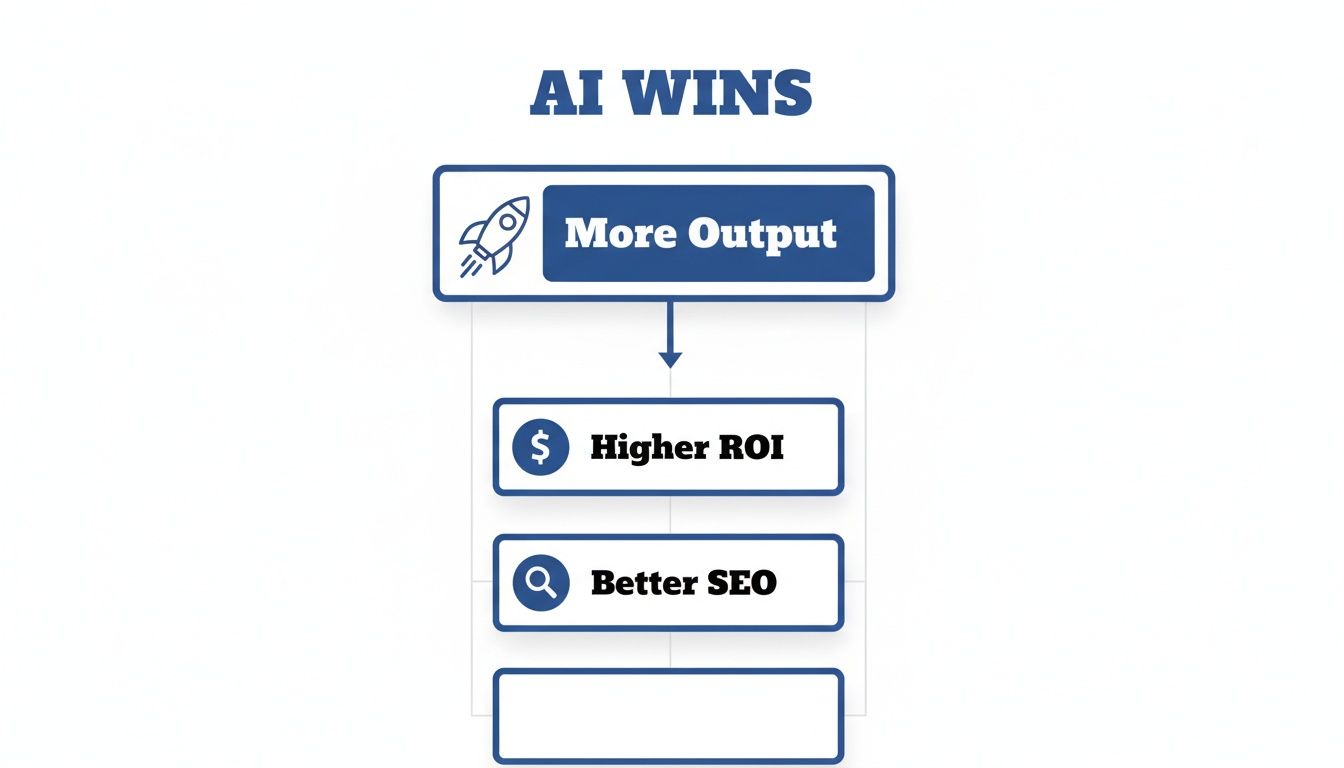
On a larger scale, the data points the same way. Today, 82% of businesses are using AI tools for content creation. This shift is fueling 59% faster production, 77% higher output, and 42% lower costs. You can discover more insights about these AI adoption trends and see how non-AI blog creation cratered in just two years.
Case Study 1: Product Descriptions at Scale
An eCommerce brand was drowning. They had 5,000 SKUs with generic descriptions. Manually localizing them for five regions was an 800-hour nightmare.
The solution was a Level 2 AI system. I built a master prompt that required inputs for each product: raw specs, cultural nuances for the target country, and regional customer personas.
They generated all 5,000 localized descriptions in an afternoon. A human team reviewed and polished them in a week. The impact: a 15% increase in add-to-cart rates across the new markets.
Case Study 2: Turning Docs into Traffic
A B2B SaaS company had a goldmine locked in its technical documentation. Valuable information, but unoptimized for search and too technical for most customers.
I built a Level 3 RAG system, indexing their entire knowledge base. This created a private “brain” for the AI to consult.
Your internal documentation is a goldmine. A RAG system is the machine that turns that raw data into a high-performance marketing asset your competitors cannot possibly replicate.
Now, their team can prompt the AI to translate technical processes into benefit-focused articles. Within six months, this led to a 40% increase in organic traffic from highly specific, long-tail keywords.
Case Study 3: Automating Client Intelligence
A marketing agency was burning 20 hours per week on a critical, non-billable task: client retention newsletters. Account managers manually pieced together industry news and competitor moves.
I deployed a Level 4 system of autonomous agents. One agent monitored news for each client. When it found a relevant article, a second agent drafted a summary in that client’s specific voice.
The drafts were sent to a dashboard for human review. This simple automation saved the agency 20 hours per week and boosted client satisfaction. It’s a perfect example of freeing up experts to focus on pure strategy.
Where AI Fails and How to Mitigate Risk

Anyone selling you AI as a magic bullet is either naive or dishonest. Its real power comes from understanding its limits. Your edge comes from knowing when not to use it.
Using AI for content creation carelessly will cause problems. I’ve seen it happen. Companies torpedo their brand, publish embarrassing lies, and burn thousands on content that does nothing.
Preventing Brand Voice Dilution
The most common failure I see is brand voice dilution. You lean on generic tools and your content starts to sound like your competitor’s. The AI defaults to a bland, middle-of-the-road tone. Death sentence.
The fix is a governance layer. Build a detailed brand bible: voice principles, examples of your best writing, and words to never use. Use context engineering to feed this to the AI every single time. And mandate human review for the final polish.
Mitigating Factual Hallucinations
AI models lie. Not maliciously, but they state falsehoods with absolute confidence. This is called factual hallucination. They are prediction engines, not truth engines. Trusting them without checking shatters your credibility.
Every statistic, claim, and factual statement an AI generates must be cross-referenced with a reliable, primary source by a human. No exceptions.
Your new mantra must be: “Trust, but verify.” Assume every fact the AI gives you is wrong until you prove it’s right. This rigor separates the professional operations from the amateurs.
Avoiding the Metric-Chasing Trap
It’s easy to get seduced by the sheer volume of content you can suddenly produce. But churning out 500 low-impact blog posts that don’t drive revenue is just creating noise.
To avoid this, every piece of content must be tied to a core business goal. Before you write a prompt, ask: “What specific business result is this supposed to achieve?” If you can’t answer that, don’t create it. This keeps your focus on revenue instead of on filling a calendar.
Your First 90 Days with AI Content
Alright, let’s move from reading to doing. This is your blueprint for getting an AI-driven content system off the ground. The goal is quick, tangible wins that build momentum and show immediate value.
Days 1-30: Pilot and Prove
Your first month is about proving the concept on a small scale. Pick one high-impact, repetitive content type to start with, like product descriptions or blog post first drafts.
Build your initial brand bible with your core messaging, audience personas, and at least five examples of your best content. Run your first production test, generating five pieces of AI-assisted content. The goal is to establish a baseline for quality and speed.
Days 31-60: Scale and Integrate
You’ve proven the concept works. Now you fold it into your actual operations. Take your successful pilot and apply it to an entire content category.
Integrate with your analytics. This is non-negotiable. Track traffic, engagement, and conversions to measure real ROI. Formalize the new workflow and, if you have a small team, train them on their new roles as strategists and editors.
Days 61-90: Expand and Explore
With one successful workflow humming, you can look at more advanced applications. You’ve earned the momentum. For ideas, explore some of my practical AI prompts for marketing.
The objective of these 90 days is to build an operational muscle. You’re creating a system that produces content and also learns and improves, giving you a sustainable competitive advantage.
Expand to a second content workflow using the same pilot-and-prove principles. Then, you can begin to explore a more advanced approach, like a simple RAG prototype. This is how you start building a true information moat.
Common Questions from Business Owners
I sit in a lot of strategy sessions with business owners. Once they see what AI for content creation can do, the same practical questions always pop up. Here are the straight answers I give them.
How Do I Keep My Brand Voice From Sounding Generic?
This is the number one fear, and it’s a good one. The answer is aggressive context engineering. You have to show the model your voice, every single time.
Build a master ‘brand bible’ with your voice principles, customer pain points, best content examples, and a strict word list. You feed this into every prompt. You literally force the AI out of its generic comfort zone.
Will AI Just Replace My Entire Content Team?
No. But it will absolutely transform their roles, shifting them from manual producers to strategists. Keep your writers and make them 10x more effective.
Let the AI handle the repetitive 80%: first drafts, research, outlining. This frees up your human experts for the high-value 20% that drives the business forward: deep insights, unique storytelling, and creative polish.
Don’t measure your team by the words they write. Measure them by the business results they generate. AI is the tool that lets them finally focus on the latter.
How Do I Actually Measure The ROI Of AI Content?
You have to stop measuring output and start measuring impact. Pumping out 500 blog posts is a meaningless vanity metric. Tie every asset back to a hard business objective.
Instead of word counts, track the numbers that matter to your bottom line: Cost Per Lead, Conversion Rate Lifts, and Reduced Time-to-Market. The true ROI shows up on your P&L statement, and a production report won’t show it. That’s the only metric that counts.