
Most advice about an AI market research report is wrong. It tells you to write a better prompt, dump some PDFs into ChatGPT, and call the output “insight.” What you get is outsourced note-taking with better formatting.
I'm Samuel Woods. I've been working with ML since 2016 and Generative AI since 2019. I've watched founders buy into the fantasy that faster report generation automatically creates competitive advantage. It doesn't. A report that lands in a shared drive and dies there is overhead.
What matters is whether your market intelligence changes product decisions, pricing, positioning, sales motions, and capital allocation before your competitors see the opening. If your current AI workflow can't do that, you don't have an intelligence asset. You have an expensive hobby with nice prose.
A strong AI market research report is one output from a repeatable system that collects signals, tests assumptions, challenges your bias, and feeds decisions every week. Build that system right, and you move faster than firms still treating AI like a writing assistant.
Table of Contents
- Why Your AI Reports Are Just Expensive Hobbies
- Define Your Mission Before Your Questions
- Build Your Intelligence Engine and Data Pipeline
- Design and Deploy Your AI Analyst Team
- Synthesize and Visualize for Action
- The Human-in-the-Loop Imperative for Validation
- Present Findings That Force a Decision
Why Your AI Reports Are Just Expensive Hobbies
If your AI market research report doesn't change a budget, a roadmap, or a go-to-market move, it's theater.
AI is already everywhere inside the average company. AI adoption reached 78% of organizations in 2024, up from 55% the prior year, according to the Stanford HAI AI Index 2025. That means using AI no longer gives you an edge. Using it to make faster, better commercial decisions does.
The performance gap is obvious. While 80% of organizations set efficiency as an AI objective, only 39% report any enterprise-level EBIT impact, and of those, most say less than 5% of their EBIT is attributable to AI, according to McKinsey's State of AI. Plenty of teams produce polished output. Few build a system that changes revenue outcomes.
That is why so many AI reports become expensive hobbies.
A founder asks for a market scan. Someone drops a few links into ChatGPT, Claude, or Gemini. The model returns trend summaries, competitor profiles, and generic recommendations that sound smart in a meeting and disappear by Friday.
The report looks finished because the formatting is good. The work is unfinished because nobody tied it to an operating decision.
Your AI market research report should trigger action. If it doesn't, you bought admin work with better formatting.
If you want a useful baseline before layering in AI, start with a founder-focused market research process that ties research to commercial decisions. Then build automation around that discipline.
Where reports fail
I see four failure patterns again and again:
- There's no economic target. The report describes a market without linking it to pricing power, margin expansion, win rate, retention, or product investment.
- There's no competitive pressure test. The analysis ignores how incumbents will respond, where they are weak, and what they can copy quickly.
- There's no operating rhythm. You create one report for one meeting, then lets it decay while the market shifts.
- There's no owner. Nobody is accountable for turning insight into a pricing change, campaign shift, partnership move, or product decision.
Those are process failures. The model is rarely the problem.
What an intelligence asset looks like
A strong AI market research report is part of a repeatable intelligence system. It keeps tracking buyer demand, competitor moves, category shifts, and whitespace opportunities. It gives you a reason to act before rivals do.
Use this standard:
| Report type | What it does | What happens next |
|---|---|---|
| Hobby report | Summarizes the market | Team says “interesting” |
| Decision report | Clarifies a specific strategic choice | You make a call |
| Intelligence system | Continuously updates signals, priorities, and recommended actions | You reallocate resources faster than competitors |
That last category matters. A single report has a short shelf life. A market intelligence system compounds. It gets better as your inputs improve, your prompts sharpen, your validation process tightens, and you learn which signals predict revenue.
You do not need more AI content. You need an intelligence engine that turns scattered market data into repeated strategic advantages.
Define Your Mission Before Your Questions
Founders often start too small. They ask AI a question like “analyze the EV market” or “summarize customer pain points in B2B SaaS.” That's lazy framing, and lazy framing produces generic output.
You need a mission. A mission has a commercial endpoint.

Start with the decision you need to make
I don't begin an AI market research report with prompts. I begin with a business decision. Enter a category or expand laterally. Raise prices or hold. Build a feature or acquire capability. Focus enterprise or move down-market.
That gives the AI something useful to work on.
A practical starting template looks like this:
- State the business objective. Example: enter a new vertical, reposition against incumbents, or identify whitespace for a new offer.
- Name the decision window. If the insight can't influence an actual planning cycle, it's trivia.
- Define success in business terms. Revenue quality, deal velocity, retention quality, or market entry viability.
- Set mandatory constraints. Geography, compliance boundaries, product capabilities, your available capacity.
That sequence lines up with a proven implementation pattern. Successful AI integration begins with defining clear research objectives and key questions, specifying research boundaries, outlining the methodology, and validating scope with stakeholders before implementing AI, as outlined in Pragmatic Institute's guide to AI for market research.
Scope beats curiosity
Founders often confuse broad curiosity with strategic thinking. It's the opposite. Broad curiosity creates sprawling outputs that nobody can act on.
A tighter brief wins. Instead of “research the market,” define:
- The buyer segment, meaning which customer group matters now
- The geography where you can sell without building an entirely new company
- The time horizon, whether a near-term move or a longer strategic bet
- The deliverable, such as a memo, one-pager, dashboard, competitor heatmap or pricing brief
If you need a useful reset on basic scoping, this founder's guide to market research is a solid reference point.
A practical rule: if your mission statement can't fit on one screen and force a decision, it's still too vague.
My preferred mission format
I like this structure because it stops the drift into academic busywork:
| Element | Weak version | Strong version |
|---|---|---|
| Objective | Understand the market | Identify a segment you can win |
| Scope | Global | North America, specific buyer type |
| Use case | General strategy | Pricing, launch, product roadmap |
| Output | Report | Ranked opportunities and risks |
The discipline here matters. AI works best when you force specificity at the front end. Otherwise the model gives you what many people secretly want, a plausible answer that saves them from making a hard choice.
That's why weak reports feel smart but never change the business. Nobody told the system what winning looked like.
Build Your Intelligence Engine and Data Pipeline
A one-off report won't give you a lasting advantage. Your competitors can generate one too. Advantage comes from a system that keeps collecting, cleaning, interpreting, and updating the signal stream while everyone else is still waiting for the next planning session.
That system is your intelligence engine.

Your edge comes from inputs
Most founders obsess over models. That's backwards. The model matters, but the input quality matters more.
I build market intelligence pipelines around four classes of data:
- Open web data, such as competitor pages, pricing pages, job listings, changelogs, review platforms, forums
- Structured external data, such as APIs, market datasets, patent databases, financial filings
- Internal operating data, such as CRM notes, win-loss calls, support tickets, sales objections, onboarding friction
- Expert interpretation layers, such as human annotations, category hypotheses, and your own assumptions worth testing
Many founders fail when they ask a model to infer too much from shallow public inputs. The output sounds authoritative and ends up thin.
If you're automating collection from multiple web sources, tools like Scrape API can help you structure acquisition without turning yourself into a part-time scraping engineer. The tool matters less than making data collection repeatable.
A practical pipeline architecture
I think in stages rather than prompts.
| Stage | What happens | Typical tools |
|---|---|---|
| Collection | Gather external and internal source material | APIs, crawlers, CRM exports |
| Normalization | Clean formats, remove junk, standardize entities | Python, ETL tools, LLM cleanup passes |
| Enrichment | Tag themes, competitors, sentiment, product categories | Claude, Gemini, GPT, embeddings |
| Analysis | Compare, cluster, rank, challenge assumptions | Multi-model workflows |
| Distribution | Push insights into dashboards, briefs, Slack, planning docs | BI tools, docs, automations |
For internal signal flow, clean integration matters more than fancy dashboards. If your CRM, campaign data, customer feedback, and product signals live in silos, the system can't reason across them. That's why marketing data integration workflows matter so much. The intelligence layer is only as strong as the connective tissue underneath it.
Don't use one model for everything
I don't treat models like interchangeable commodities. Different jobs need different behavior.
A fast model can classify competitor pages, extract recurring themes, or clean raw text cheaply. A stronger reasoning model should handle synthesis, contradiction checks, or strategic memo generation. Multimodal models can help with visual interpretation and chart planning when the source materials include slides, screenshots, or dashboards.
Cheap models are for throughput. Expensive models are for judgment. Don't confuse the two.
Your AI market research report becomes more reliable when the system routes tasks deliberately. Fast pass first. Deeper reasoning second. Human review at the end.
That's what an intelligence engine does. It stops asking one model to be a magician and starts building a production line for insight.
Design and Deploy Your AI Analyst Team
A single prompt is a query, and a query is too thin to count as research. Real AI research behaves more like a small analyst team with roles, handoffs, and conflict.
That's the shift most businesses still haven't made.

The next frontier is moving from using Gen AI to support current practices to using agentic AI to create new types of data and insights, which means pushing beyond content generation into core business infrastructure, as discussed by Columbia Business School on generative AI in market research.
Assign roles like you would with humans
When I design an AI analyst workflow, I don't ask one model to “do research.” I assign roles.
A simple setup might include:
The Signal Gatherer pulls competitor moves, customer language, pricing shifts, product updates, and category chatter.
The Pattern Synthesizer groups recurring themes, identifies changes, and drafts hypotheses about what's moving.
The Contrarian Analyst tries to break the logic and looks for weak evidence, overreach, and alternative explanations.
The Editor turns the working analysis into a decision memo with implications for product, sales, and market position.
Context engineering is the key. Along with documents, you provide business reality. Current strategy. Sales constraints. Product roadmap. Non-negotiable brand position. Without that context, your agents are articulate but detached.
Context is the operating system
Most poor AI workflows fail because the agents don't know what business they're in. They know language. They don't know your company.
I load context in layers:
- Core business context, covering ICP, offer structure, pricing, moat, constraints
- Research context, covering target market, time horizon, specific competitors, research mission
- Evidence context, covering source docs, transcripts, CRM notes, analyst memos
- Behavior context, covering tone, rigor standard, output schema, escalation rules
If you're building internal workflows for governed answers for your team, this piece on AI data analyst systems is useful because it addresses the control layer most businesses skip.
After you've defined roles and context, orchestration becomes straightforward. One agent gathers. Another synthesizes. A third attacks the conclusion. Then you decide.
A good workflow leaves a trail
You need outputs that can be audited. That means every key claim should be traceable back to underlying evidence. If your agent team can't show its reasoning path and supporting material, it isn't ready for strategic use.
For a broader view of how I think about this category, the best umbrella term is AI agents in business workflows. The value is scalable analysis with role clarity. Novelty adds nothing.
Here's a walkthrough worth watching before you overcomplicate the build:
The important point is simple. Don't hire one super-bot in your head. Build a small AI analyst team with conflict built in. That gives you better questions, better checks, and better decisions.
Synthesize and Visualize for Action
Your synthesis layer decides whether your AI market research report becomes a decision tool or another polished PDF no one uses.
You do not need more text. You need compressed judgment. You need to see what changed, where the money is, what threatens the current plan, and which decision cannot wait.
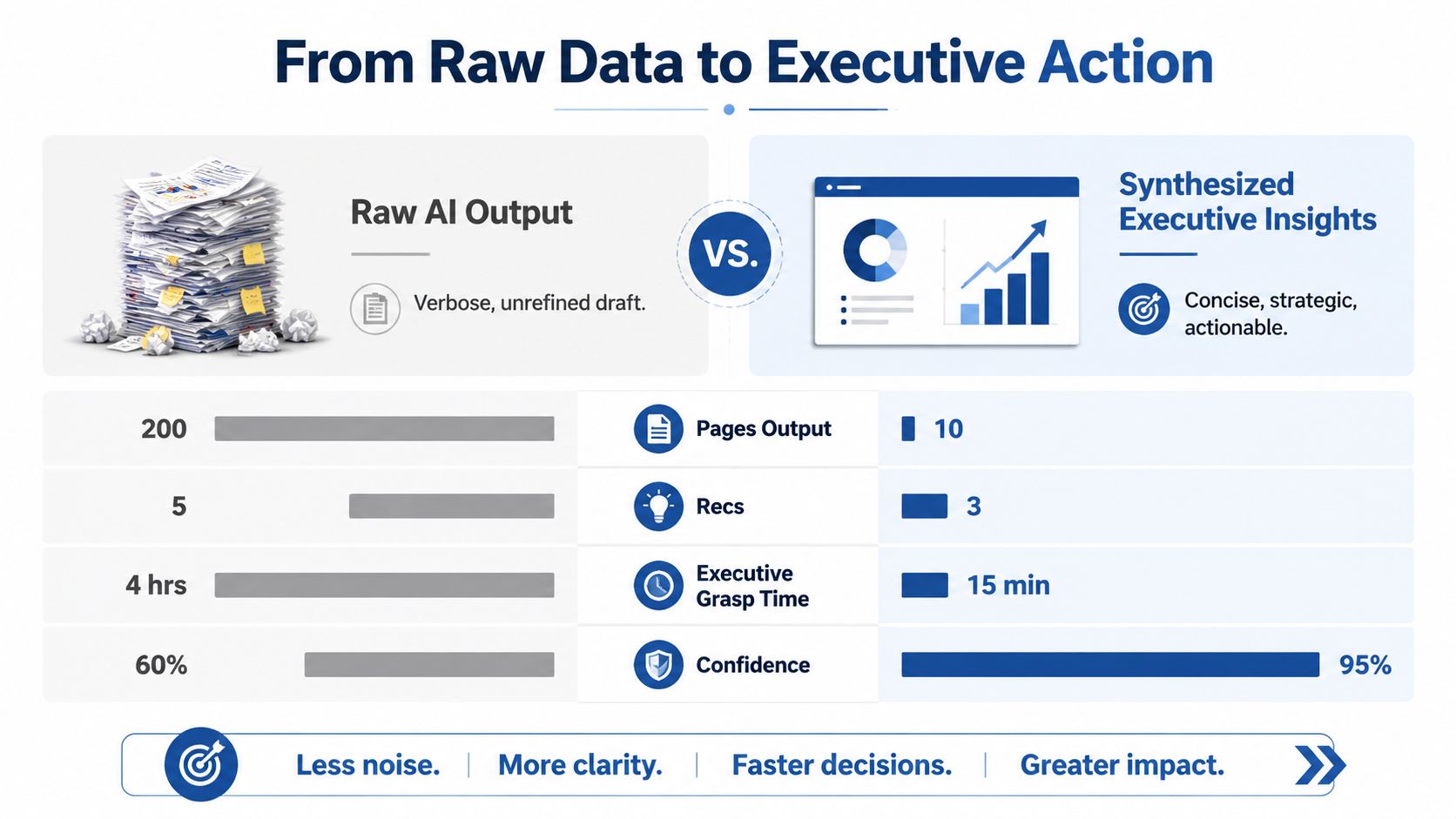
Cut anything that does not change a decision
I strip out three things first. Repeated summaries. Trend filler every competitor already mentions. Recommendations with no operating consequence.
What stays is the material that sharpens action. Pattern shifts across segments. Contradictions between survey language and sales calls. Pricing pressure. Buyer hesitation. Competitor movement that changes your window to act.
A strong synthesis layer answers three questions fast:
- What changed?
- Why does it matter now?
- What should you do next?
If you cannot get to a clear decision in a few minutes, the report is still unfinished.
Build visuals that shorten debate
A chart is useful when it cuts interpretation time. That is the standard.
Use comparative tables, segment maps, pricing snapshots, competitor timelines, and selective charts that support a decision already on the table. Do not decorate the story. Force clarity. If you are evaluating an adjacent market, show relative momentum, entry friction, and likely payback side by side. If you are reviewing competitive pressure, show claim shifts, launch timing, and pricing moves in one view.
Good visuals reduce meeting time. Great visuals expose where the current strategy is weak.
Use a format that forces discipline
I recommend a three-layer output. The first layer drives action. The second ranks options. The third proves the case.
| Slide or page | What belongs there | What does not |
|---|---|---|
| One-page summary | Core finding, business implication, decision required | Background history |
| Opportunity map | Ranked growth plays, threats, timing, likely upside | Generic trend commentary |
| Evidence appendix | Source-backed support for major claims | Raw transcript dumps |
This is how you turn a one-off report into a repeatable market intelligence system. Every cycle follows the same structure. Every quarter becomes easier to compare. Every new market signal has a place. That consistency is what gives you a strategic advantage over companies still treating research as a periodic content exercise.
Show confidence alongside conclusions
Every conclusion should carry a confidence level. Otherwise weak signals get treated like hard evidence.
Mark high-confidence findings when multiple sources converge across internal data, external research, customer language, and competitor behavior. Mark lower-confidence findings when the signal is early, sparse, or only visible in one channel. That simple labeling changes the quality of your decisions because it separates immediate action from monitored bets.
I also use AI to draft chart logic, suggest matrix structures, and clean up messy notes into presentation-ready visuals. That is a smart use of the tool. Packaging speed matters. Final judgment still belongs to you.
A serious AI market research report exists to direct capital, focus effort, and help you win markets before slower competitors see the shift.
The Human-in-the-Loop Imperative for Validation
This part matters most. Skip it and your system will eventually lie to you with confidence.
The hard truth is ugly. While 95% of general AI projects fail, AI in market research is achieving higher success rates only with a “verify + correct” workflow. One of the biggest pitfalls is asking AI to perform advanced quantitative analyses it cannot reliably handle, which can lead to hallucinated statistics that require mandatory human review, as discussed in this market research AI interview on YouTube.
What AI should not be trusted to do alone
I don't let AI operate unsupervised in four areas:
- Advanced quantitative analysis, where the model may sound certain while getting the math wrong.
- Synthetic respondent replacement, because unvalidated synthetic inputs create false confidence.
- Black-box output acceptance. If the tool can't explain or trace its answer, I don't trust it.
- The final strategic recommendation. The machine can support the decision. It should not own the decision.
That aligns with the boundary conditions many experienced market research teams have learned the hard way. AI is strong at structuring, summarizing, drafting, clustering, and surfacing patterns. It is not a license to stop thinking.
The workflow I actually use
My validation loop is simple and aggressive.
- Trace every important claim to source material. If a claim can't be traced, it gets removed.
- Use a second model as a critic. Its job is to attack assumptions and spot weak logic rather than confirm them.
- Cross-check with non-AI methods when accuracy matters most. Interviews, analyst review, internal operator judgment.
- Have a human owner sign off. One accountable person decides what enters the business.
AI is fastest when it drafts. Humans are fastest when the cost of being wrong is high.
Data quality is now a strategic issue
There's another problem that founders underestimate. AI-generated junk is getting harder to spot. Bot infiltration, fabricated inputs, and low-quality synthetic material can poison your research flow before the model even starts synthesizing.
That's why your validation layer has to inspect the data pipeline as well as the final report. If garbage gets into the system, you'll get polished garbage out.
A good intelligence system does three things at once. It checks source integrity, challenges reasoning quality, and forces human review before strategic adoption. If you don't build those controls, you're failing faster than competitors with better formatting.
Present Findings That Force a Decision
Most market research presentations die in the room because they inform without forcing a choice. They entertain smart people for half an hour and then disappear into follow-up limbo.
That's weak packaging.
Your final presentation should be a strategic narrative built around action. I keep it to three parts.
Use this three-part structure
What you now know that competitors likely don't
This is your information edge. Skip broad trends and show specific asymmetries, buyer frustrations, segment gaps, or positioning weaknesses.Where the best opportunities sit right now
Rank them. Don't dump a list on the room. Force prioritization based on strategic fit and speed to capture.What happens in the next 90 days
Name the tests, owners, and decisions. A report without immediate operating moves is unfinished.
A good companion reference on delivering valuable marketing insights is useful here because it reinforces the difference between reporting data and presenting insight.
Keep the narrative commercial
Every major finding should answer one of these:
- Does this open revenue?
- Does this protect margin?
- Does this improve win rate?
- Does this weaken a competitor's position?
If a finding doesn't connect to one of those, cut it.
Present insight as a move, not an observation.
The best AI market research report doesn't sound like a consultant trying to prove they worked hard. It sounds like an operator deciding where to attack, where to defend, and what to fund now.
Market intelligence becomes a weapon when it's sharp enough to use, which matters more than being accurate enough to admire.