
Everyone keeps selling the same fantasy: pick a shiny AI tool, press a button, and the business runs itself. That advice is lazy, and it fails the first time a client wants something specific, a lead needs follow-up, or a draft goes off-brand. A one person business with AI only works when you build an operating system that can survive a real workload, not a pile of prompts that looks clever for a week.
I've been building with ML since 2016 and Generative AI since 2019, and the pattern is consistent. The solo operators who win aren't the ones chasing every new app. They're the ones who design a business where strategy stays human, execution gets delegated to AI, and quality control never gets outsourced.
Table of Contents
- Your AI Business Is a System Not a Tool
- The New Economics of Solo Founder Leverage
- How to Choose a Defensible AI-Native Business Model
- Design Your Core AI Operating System
- The Solopreneur AI Tech Stack for 2026
- Building Your Autonomous Growth Engine
- The Human-in-the-Loop Imperative and What Breaks at Scale
Your AI Business Is a System Not a Tool
The biggest mistake in the market is treating AI like a productivity app instead of a business architecture. A tool can help you write faster, but a system decides what gets written, who reviews it, how it reaches buyers, and what happens when it fails. That difference is why some solo founders look efficient while others build something durable.
A one-person business with AI only becomes defensible when you stop thinking in isolated tasks. Lead capture, qualification, delivery, review, follow-up, and renewal have to connect as one chain. That's the true advantage, and it's also why I point operators toward an agent-native company design framework before they buy another subscription.
The real unit of advantage is workflow
If your business depends on you manually stitching together every step, AI won't save you. It just speeds up the parts that already exist. A better move is to map the business from the first contact to the final invoice, then ask where AI can carry weight without breaking trust.
A practical rule: if a workflow can't be described clearly, it can't be automated safely.
That's where most solo businesses get stuck. They add tools before they define decision rights. So AI drafts an email, but nobody owns the approval standard. AI schedules a follow-up, but nobody knows what counts as a qualified lead. The business becomes faster and sloppier at the same time.
Strategy stays human, execution moves to AI
Sogood.ai's definition of a one-person company with AI is useful because it draws the boundary cleanly: one human owns strategy, pricing, quality control, and legal accountability, while AI handles most execution that used to require employees. That's the model worth building toward, because it makes your time scarce where it should be scarce. You spend your judgment on the decisions that shape margin and positioning.
This also changes competition. A solo operator with a system can move like a small team without carrying team overhead. Competitors who still run on manual admin will feel slower, even if they're technically larger. Speed matters, but consistency matters more.
Aim for a business that stays coherent as output rises. Whether it looks automated is beside the point.
The New Economics of Solo Founder Leverage
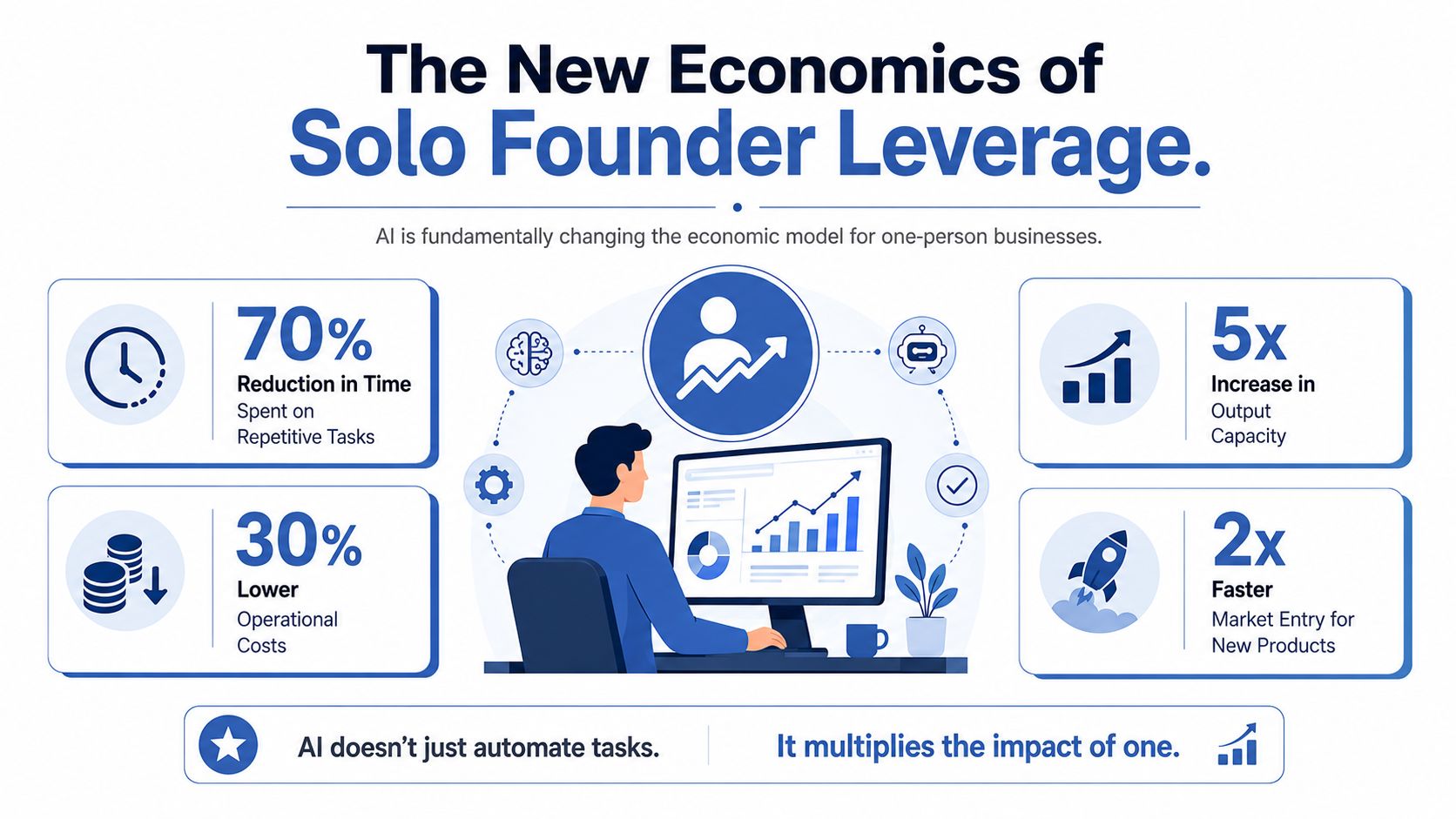
AI is changing the economics of solo business in a way that's easy to underestimate if you only look at task-level productivity. In a 2026 survey summary, 91% of solopreneurs said AI reduced administrative workload, 74% said they had scaled without hiring because of AI, and 64% said their business would not have grown without it, according to Small Business Magazine's 2026 summary. The same source says AI-assisted solo operators are growing revenue at 2.3x the rate of non-users. That is a change in the operating model, much bigger than a marginal efficiency gain.
What leverage actually looks like
Doing the same work faster is the small part. The bigger part is that AI changes which work one person can own. Admin becomes lighter. Output becomes steadier. New offers get tested sooner. You stop spending your best hours on repetitive coordination and start spending them on positioning, selling, and quality.
That's why solo AI businesses can feel structurally different from traditional service businesses. The owner still does work, but mostly designs a machine that produces, routes, and improves work. The more routine work the machine absorbs, the more of your attention is available for revenue decisions.
The same source also says 63% of solopreneurs use at least three AI tools daily, and 44% report significant revenue gains directly tied to AI use. That tells me the category has moved past novelty. AI is becoming daily infrastructure, especially in marketing, content production, and automation-heavy tasks.
Why this matters now
Nasdaq Economic Institute reported that since February 2025, nearly half of the increase in monthly U.S. business applications has come from high AI-adoption sectors. A related report says applications from one-person firms have risen by more than 20% since early 2025, while businesses more likely to hire workers stayed largely flat, and Nasdaq links that shift to the arrival of more capable agentic coding tools in early 2025, according to Nasdaq Economic Institute. That matters because formation is where markets change shape. More solo businesses are being born in the places where AI adoption is already deepest.
If you're building now, you're entering a market where the baseline cost of starting, testing, and iterating is lower than it used to be. That creates opportunity, but it also raises the bar. Buyers can now compare you against AI-generated alternatives instantly, so your edge has to live in better judgment, better packaging, and better system design.
How to Choose a Defensible AI-Native Business Model
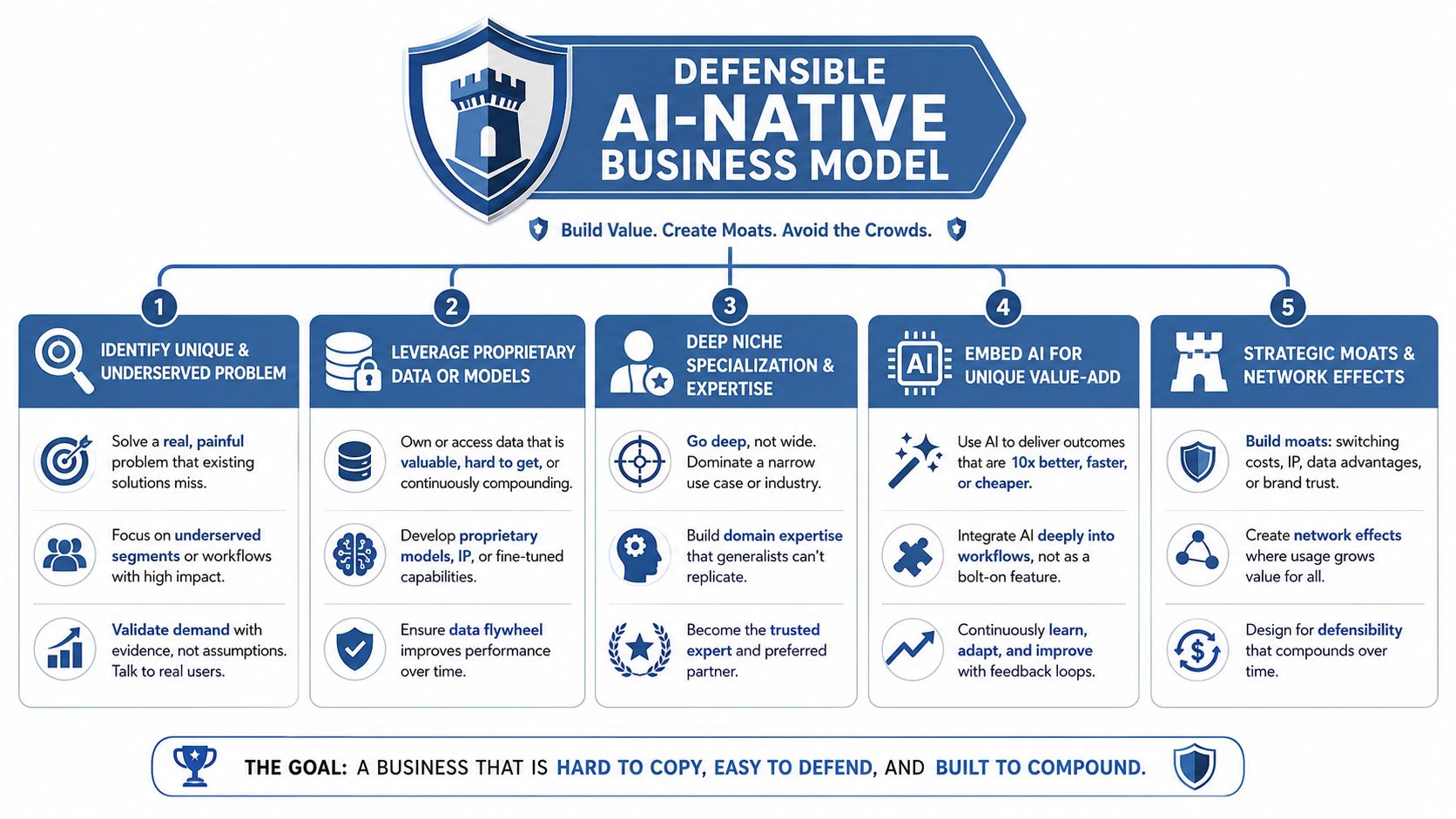
Most lists of AI business ideas collapse under one simple problem: they don't tell you which models buyers will keep paying for once the novelty wears off. That's the trap. A business can be easy to start and still be a bad business. If the offer is generic, the acquisition cost climbs, the margins shrink, and your advantage disappears the moment someone else copies the workflow.
Start with a problem people already feel
The strongest solo offers usually begin with a narrow, painful problem that buyers can recognize immediately. That's more reliable than a broad promise. If a prospect can't describe the pain in one sentence, they probably won't pay quickly, and you'll spend more time educating than selling.
The market data supports that caution. Existing content often lists business ideas but rarely answers which ones have durable demand and defensible acquisition costs, and that gap matters because while 56% of SMB leaders report positive AI impact, only 29% have fully integrated it, according to Solo Business Hub's summary. That gap tells you buyers are interested, but they're still uneven in how they purchase and operationalize AI.
Build around friction that generic tools don't solve well
A defensible model usually has at least one of three things: specific data access, workflow complexity, or a human judgment layer that AI can support but not replace. AI-powered consulting, niche content engines, and workflow-specific services tend to hold up better than generic service arbitrage because they embed your expertise into the solution. Generic tools can produce output, but they can't always interpret context, priority, or nuance.
Ask three questions before you commit:
- Can I access the inputs the work depends on? If the answer is no, the model will stall on data.
- Does the buyer need judgment as well as output? If yes, you can keep more value in the offer.
- Will the workflow improve when repeated? If the work compounds through templates, checklists, and learning loops, you have a better shot at defensibility.
Favor offers that get better with your involvement
The most attractive solo businesses aren't fully automated. They're augmented. Your expertise becomes the filter that makes AI output useful. That creates a moat that generic copy tools and template sites can't easily copy, because they lack your specificity, your taste, and your operating context.
That's also where productized services can beat pure digital products. They let you keep the premium judgment layer while AI absorbs the repeatable parts. Buyers pay for reduced uncertainty as much as for deliverables. If your model lowers uncertainty in a clear niche, you're building something sturdier than a trend chase.
Design Your Core AI Operating System
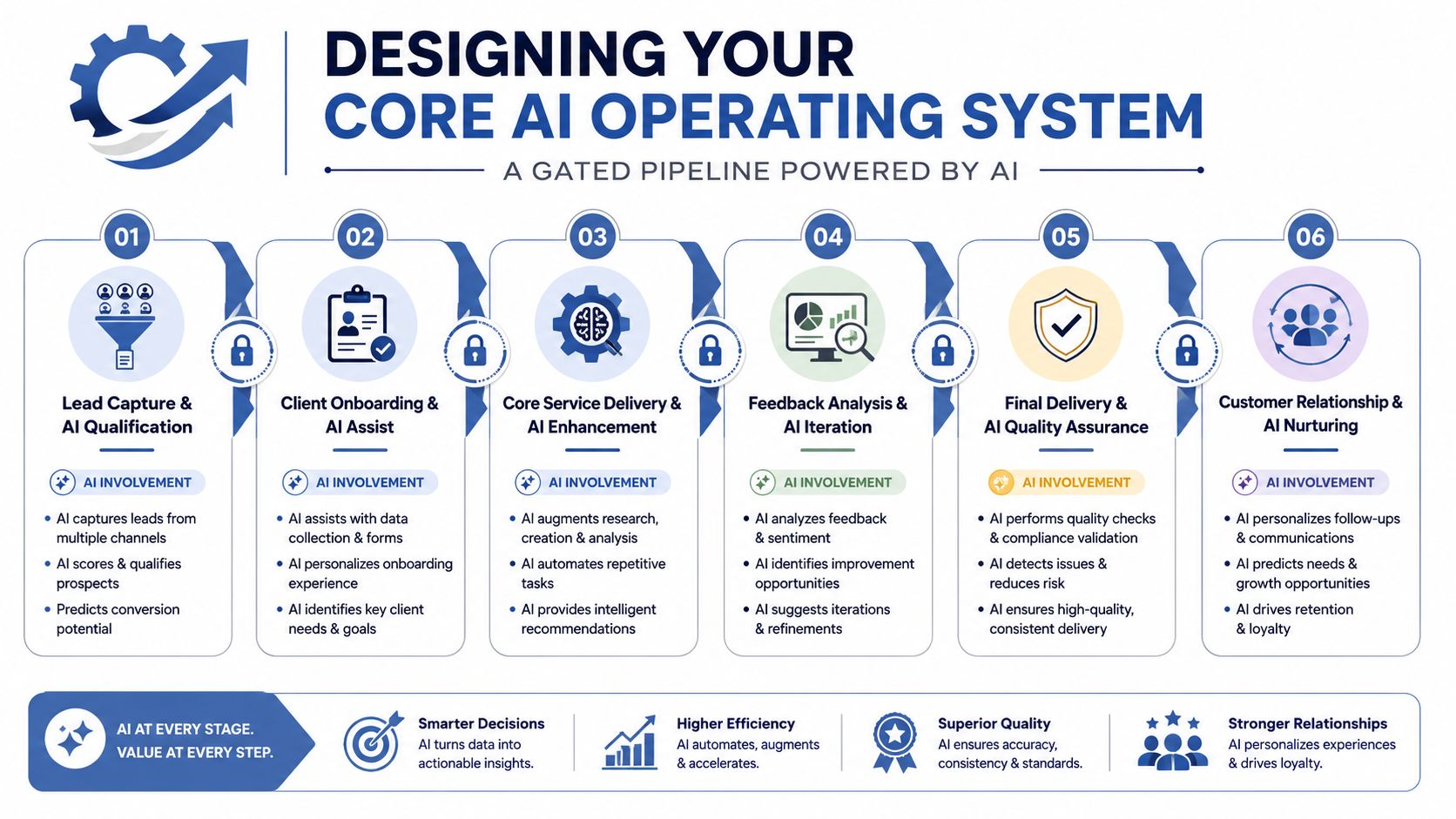
A solo business gets unstable when AI is bolted onto random tasks instead of wired into a process. The better model is a gated pipeline, where each step is clearly marked as fully automatable, human-reviewed, or fully human. That setup keeps speed from turning into churn.
Map the workflow before you automate anything
Start with lead capture and work through delivery and follow-up. Tool choice comes later. First define the sequence of work, then mark where AI can qualify, draft, summarize, sort, or nudge. The goal is to remove repeated manual effort without stripping out the human checkpoints that protect revenue and client trust.
A solo-founder playbook from Nomixy's solo-founder playbook argues that if more than half the workflow still needs full human execution, automation will not materially improve throughput. It also recommends a human review checkpoint before every client-facing output to reduce “AI failure hours.” That is the right standard. Automation should reduce strain, not create a second job of fixing weak output.
Use the gated pipeline model
A clean pipeline for a one-person business usually looks like this in practice:
- Lead capture and qualification come first. AI sorts inbound interest, tags fit, and surfaces the leads worth your time.
- During onboarding and brief collection, AI gathers context so you do not start every project from zero.
- In core delivery, AI drafts, summarizes, structures, and assists, while you steer the outcome.
- In review and iteration, you inspect output before it touches a client, buyer, or audience.
- Final delivery and quality assurance is the last pass, and it catches drift, factual issues, and brand mismatches.
- For relationship nurturing, AI helps keep contact warm without making you manually chase every follow-up.
The same logic applies if you are trying to grow your X audience with automation. The system still needs clear guardrails, because the problem is rarely output volume. The problem is sending too much low-quality work through a pipeline that has no review step.
Build decision rights into the system
The common failure is leaving it unclear who approves what. A business can move fast and still break if nobody owns the final say on client-facing work. Make the rules explicit. What can ship automatically. What needs your review. What should never be automated at all.
That operating system becomes a real asset when volume rises. Competitors can copy prompts. They cannot easily copy a disciplined review structure that protects consistency, cuts rework, and keeps the business from drifting as the workload grows.
If you want a practical reference for implementation details, compare your own process map with my AI workflow automation tools guide.
The Solopreneur AI Tech Stack for 2026
A real stack is a set of functions that work together so you can reason, execute, communicate, monitor, and remember without carrying every task in your head. That's the difference between a toy and an operating environment.
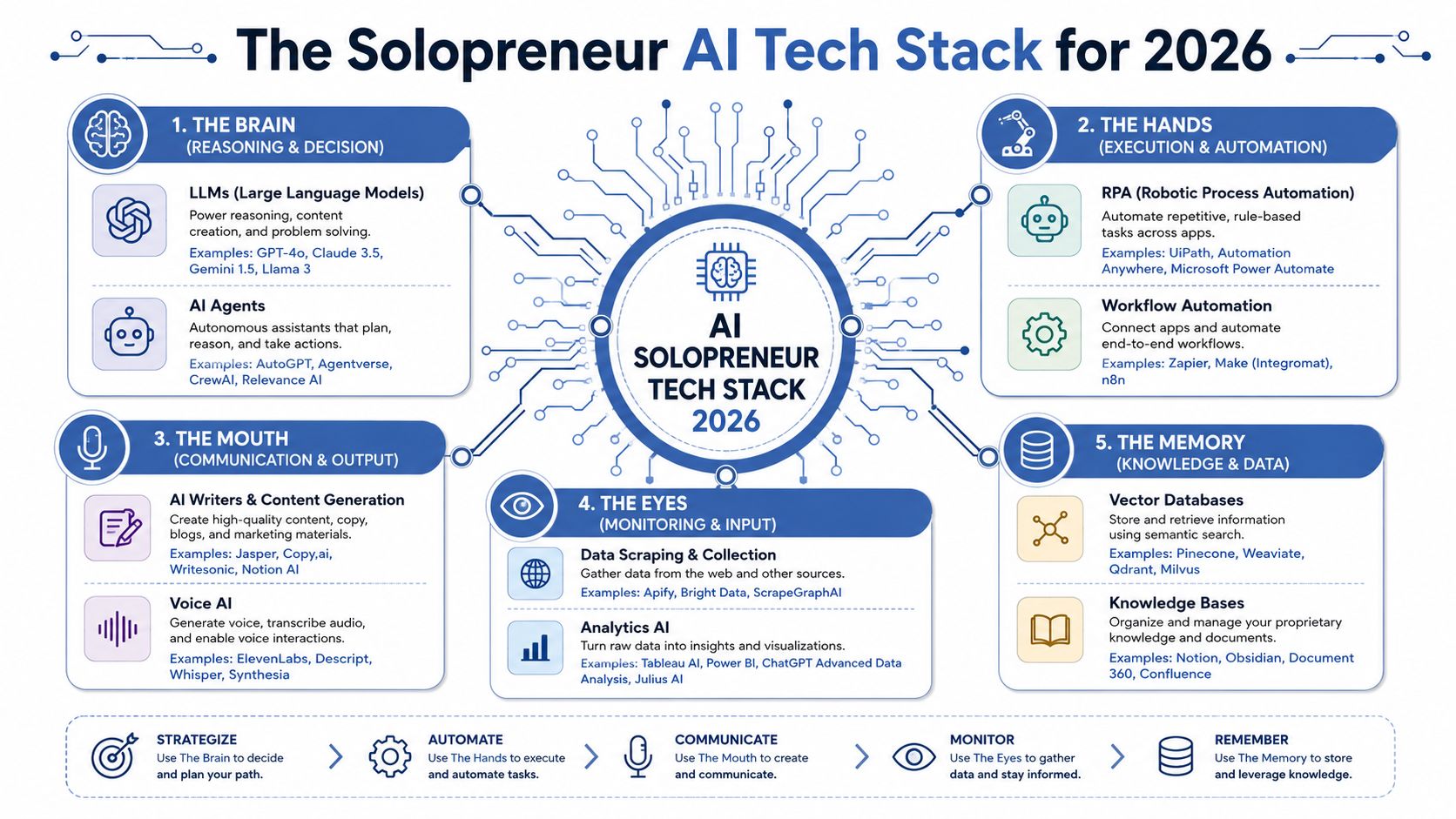
For a practical comparison of how different components fit together, here's the simplest way to think about it.
| Function | Role in the business | What to watch |
|---|---|---|
| The Brain | Reasoning, drafting, decision support | Don't let it own the final judgment |
| The Hands | Automation, routing, repetitive execution | Keep workflows narrow and testable |
| The Mouth | Content, email, client communication | Review tone and claims before sending |
| The Eyes | Monitoring, research, analytics | Validate signals before acting |
| The Memory | Knowledge base, reference materials, stored context | Keep sources organized and current |
Pick tools by job, not by hype
The Brain is where models like Claude and GPT-class systems help you think through structure, positioning, and first drafts. The Hands are your automation layers, the systems that move data and trigger actions without manual copying. The Mouth handles written output, voice, and customer-facing communication. The Eyes scan inputs, trends, and performance signals. The Memory keeps your business knowledge searchable so you're not rebuilding context every week.
That's also why the market's moving fast. Nasdaq Economic Institute's report on business formation, linked earlier, suggests the rise in solo applications is connected to stronger agentic coding tools, which means the people who win will be the ones who integrate those tools into a coherent stack instead of a pile of disconnected apps.
Keep the stack small enough to operate
I've seen founders drown in subscriptions. Fifteen tools and no process is a liability. Start with one model layer, one automation layer, one storage layer, and one review layer. Expand only when a specific bottleneck shows up.
If you want a workflow resource that treats execution seriously, grow your X audience with automation is a useful reference for social distribution mechanics, especially if your business depends on consistent visibility. For a broader operational lens, I also recommend comparing your setup with my workflow automation tools guide.
Building Your Autonomous Growth Engine
Once delivery is stable, growth becomes the next operating layer. A solo business cannot depend on bursts of energy forever. It needs a system that keeps finding prospects, warming them up, and moving them toward a decision without forcing you to repeat the same outreach every day.
The strongest growth setups avoid spam. They narrow the audience, sharpen the message, and automate the repetitive parts of discovery and follow-up. That gives a solo operator more room to focus on offer quality, pricing, and closing work that drives revenue.
Make content do more than attract attention
Content should feed the sales process, not sit apart from it. One strong article can become a newsletter, a social post, a short video script, and a lead magnet outline if the system is set up correctly. AI helps by turning one idea into several channel-specific assets, but the original point of view still has to come from you.
That workflow also has to match how you produce video and other assets in practice. ImagineVid AI's workflow guide is useful because it treats production as a repeatable sequence, not a one-off creative sprint. The same approach applies here. Build a production path, then let AI reduce the friction at each stage.
Automate lead qualification before you automate persuasion
A growth engine should answer a few questions quickly: who is a fit, what do they need, and how serious are they. AI can handle the first pass, but you need to define what counts as a real opportunity. That keeps your calendar focused on conversations that can move forward.
Lead generation automation also works better when the intake flow is simple and direct. How to automate lead generation is a useful reference if you want a clearer view of how qualification, routing, and follow-up fit together. A strong intake process reduces back-and-forth, surfaces context early, and keeps you from spending time on leads who were never serious. The business feels calmer because the system screens for fit before you invest deeper effort.
Use your output to build compounding visibility
If you publish consistently, AI can help you keep the cadence without pushing you into low-quality churn. Use it to repurpose, outline, summarize, and schedule. Do not use it to manufacture empty activity. Buyers can tell when content exists only to fill a calendar.
The best solo growth systems make your expertise more visible without making your voice generic. That is the standard. Your outreach should feel specific. Your content should answer real buying questions. Your follow-up should be timely without sounding robotic.
The Human-in-the-Loop Imperative and What Breaks at Scale
The more AI you add, the more important your judgment becomes. That sounds ironic until you've watched a workflow fail because no one noticed the draft was subtly wrong, the automation fired on the wrong trigger, or the brand voice drifted away from the offer. Scale exposes weak review logic very quickly.
A key underserved question in a one-person AI business is what breaks when volume rises. The better question is how you design review loops so a solo operator can catch hallucinations, brand drift, and bad automation before they damage revenue or trust, as noted in Entrepreneur's coverage of solo AI tools.
Review loops are the real moat
A solo business doesn't need more output if the output is unreliable. It needs a system that catches mistakes before they become visible. That means pre-send review on client-facing work, spot checks on automated workflows, and a habit of checking whether the AI is still producing what the business needs.
When I work with founders, I look for three failure points first. The model makes plausible claims that aren't true. The automation routes tasks incorrectly. The content still sounds polished, but it no longer sounds like the business. Each of those problems erodes trust in a different way, and trust is harder to rebuild than it is to lose.
You don't have to watch everything. You have to know where the machine is most likely to lie, drift, or skip context.
Decide what never gets automated
Some things should stay fully human, especially strategic pricing, legal accountability, and final approval on anything that shapes brand perception. AI can prepare the work. It should not own the decision. If you blur that line, the business may move faster for a while, but the cost shows up later in errors, rework, or reputational damage.
In this context, the solo founder advantage can also become a weakness. There's no team to notice a problem before you do. That means you need stronger personal discipline than a larger company needs.
A durable one-person business with AI is the one where the human stays strategically sharp while the machine handles the repetition. That's how you protect quality, preserve trust, and keep the operating system stable as demand grows.
If you're building a one person business with AI, stop adding tools and start mapping the workflow that makes you money. Build the gated pipeline, define the review points, and pick one bottleneck to fix this week. Then turn that into a repeatable system you can trust, because that's what separates a clever setup from a business that lasts.