
Your pipeline probably looks busy. Forms are firing, reps are sending follow-ups, traffic is coming in, and yet revenue still feels less predictable than it should.
That's the trap. Most companies don't have a lead generation system. They have a pile of disconnected activities that create motion, not control. When CEOs ask me how to automate lead generation, they usually don't need another tool. They need a machine that captures intent, filters junk, routes real opportunities, and keeps getting smarter.
I'm Samuel Woods. I've been working with machine learning since 2016 and generative AI since 2019. My view is simple. If your automation increases volume but lowers lead quality, you didn't build an asset. You built a more efficient way to waste sales time.
The Blueprint for an Automated Lead Machine
It is Monday morning. Your dashboard shows fresh leads, your reps are already working them, and your team feels productive. By Friday, half of those leads will be unqualified, sales will question the routing logic, and leadership will still lack a clear answer on what created pipeline.
That happens when automation is built around tasks instead of revenue logic.
Start with the commercial outcome you want, then design the machine backward from that point. Email sequences, chat flows, and form triggers matter, but they sit downstream of strategy. If you automate the wrong decision, you scale waste.
Your lead machine needs five connected stages. Capture, process, automate, nurture, handoff. If one stage is weak, lead quality drops, compliance risk rises, and sales capacity gets burned on noise.
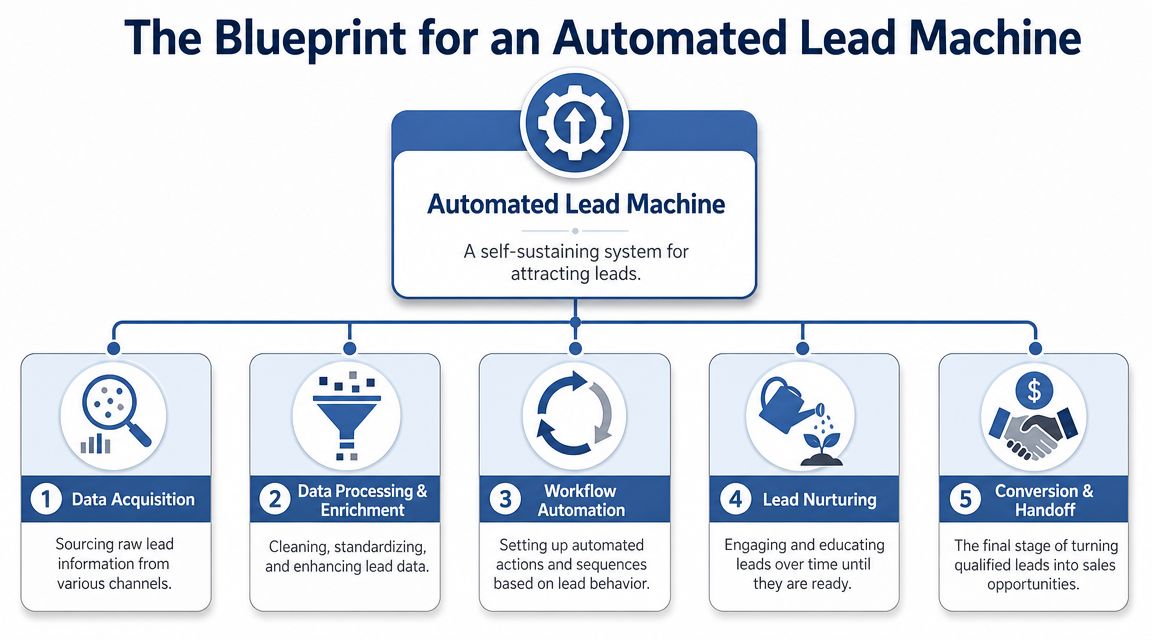
Start with business outcomes
I care about two results. More qualified pipeline. Faster conversion through the funnel.
Set KPIs that tell you whether the system is producing revenue, not activity:
| Stage | What to measure |
|---|---|
| Capture | Lead conversion rate, funnel completion |
| Qualification | Lead scoring thresholds, sales acceptance |
| Nurture | Click-through rate, engagement by segment |
| Revenue | Cost per lead, lead velocity rate, pipeline contribution |
Use those metrics to make operating decisions. If a number does not help you reallocate budget, tighten qualification, or improve conversion speed, cut it from the dashboard.
Build the machine around behavior and feedback loops
A serious lead engine responds to signals in real time. A pricing-page visit should not trigger the same path as a top-of-funnel ebook download. A repeat visit from a target account should not sit in the same queue as a student using a personal email address.
The operating model I recommend is simple:
- Define your ICP from closed-won deals. Use CRM evidence, not internal opinion.
- Centralize inbound activity in one system of record. Forms, chatbot conversations, landing pages, ad conversions, and outbound replies should feed the same decision layer.
- Score for fit, intent, and risk. Good automation does not only ask, "Could this company buy?" It also asks, "Are they showing buying behavior?" and "Should we contact them at all?"
- Trigger the next best action. High-intent leads go to sales fast. Mid-intent leads enter targeted nurture. Low-quality or risky records get suppressed, reviewed, or recycled.
- Feed outcomes back into the system. Won deals, no-shows, disqualified leads, and compliance flags should all improve future routing and scoring.
Modern AI agents change the economics. They do more than execute fixed rules. They learn from conversion patterns, spot shifts in intent earlier, and adapt routing logic without waiting for a quarterly rebuild. That creates an advantage competitors cannot copy with a few Zapier workflows and a bigger SDR team.
If you want a solid companion read on how companies grow revenue with marketing automation, that breakdown is useful because it treats automation as a revenue system instead of a campaign feature.
Put guardrails where automation can do damage
In my experience, a lot of advice on lead generation automation spends too much time on tool setup and not enough time on lead quality control or compliance exposure. That is a costly mistake.
Automation magnifies whatever logic you give it. If your targeting is sloppy, you will fill the CRM with junk faster. If your enrichment is wrong, your reps will contact the wrong accounts with more confidence. If your outreach ignores consent and data handling requirements, you create legal and reputational risk at scale.
Gumloop's article on automating lead generation makes a useful point here. Human review still belongs in high-risk decisions.
Use automation aggressively for repetitive choices. Keep human oversight for borderline qualification, sensitive personalization, suppression rules, and any workflow that could put bad leads, bad messaging, or compliance problems into your pipeline. That is how you build a machine that improves over time instead of a machine that fails faster.
Fueling Your Engine with High-Quality Data
Your team launches automation, volume goes up, and the pipeline report looks healthy for two weeks. Then sales starts marking records as junk, reply rates drop, and nobody trusts the CRM. That failure usually starts here.
Bad data does more than waste spend. It trains your automations and AI agents on the wrong patterns. Once that happens, the system gets faster at sending weak leads to sales, personalizing against stale records, and making poor routing decisions with confidence.
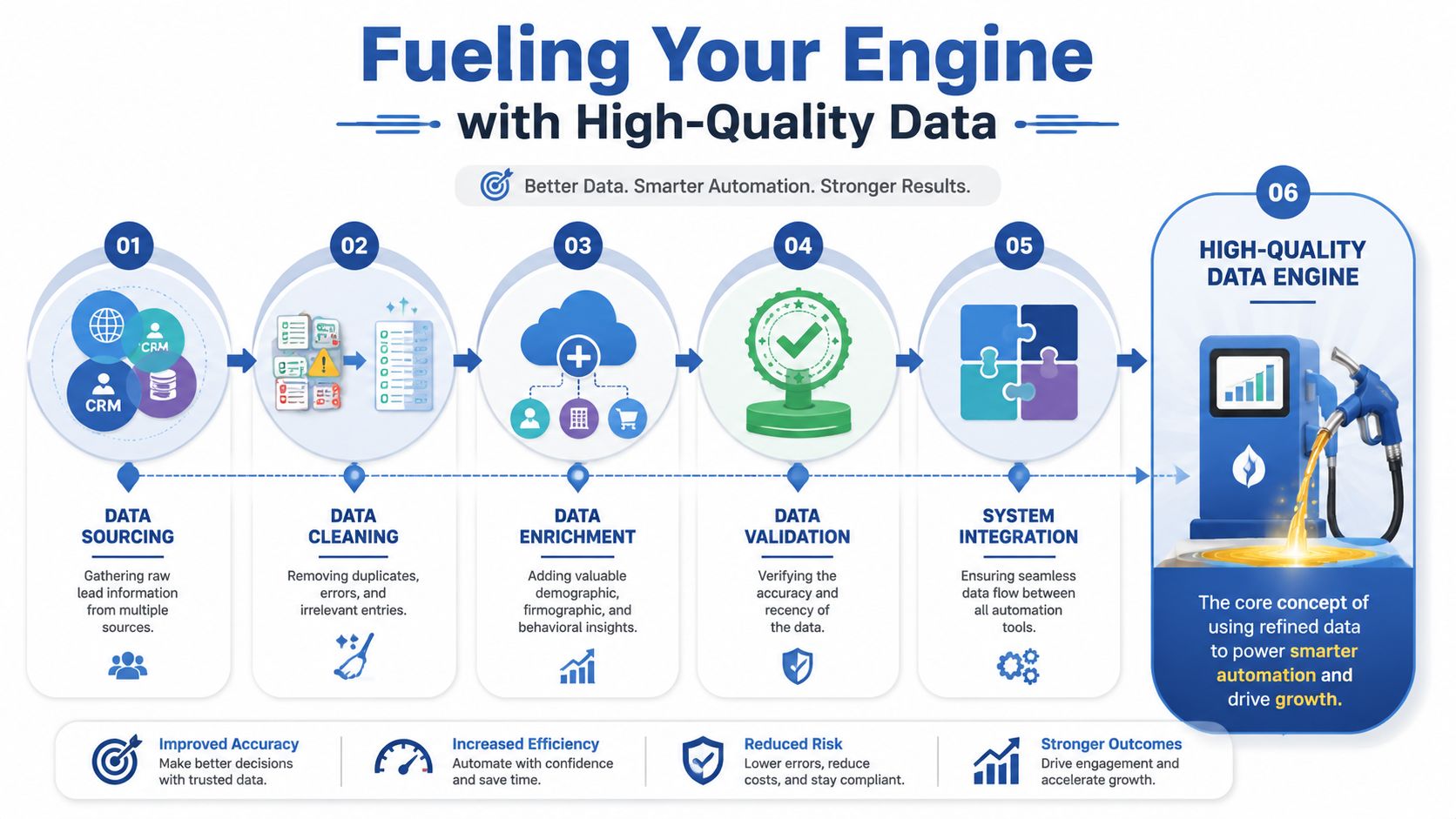
Build the pipeline from revenue back to raw inputs
Start with closed-won deals, high-retention accounts, and opportunities that moved fast. Study the common traits. Industry. Company size. Buying role. Trigger event. Entry source. Sales cycle length. Those patterns give you a real ICP based on revenue, not opinion.
Then bring in the data sources that help you detect more of those accounts earlier:
- First-party data: Form submissions, chatbot conversations, CRM activity, product signups, email engagement, meeting bookings
- Third-party data: Apollo, Clearbit, ZoomInfo, LinkedIn Sales Navigator, firmographic providers, industry databases
- Behavioral data: Pricing-page visits, repeat sessions, asset downloads, webinar attendance, ad engagement, reply behavior
That order matters. Your own customer history should define what a qualified lead looks like. Enrichment should sharpen the picture, not draw it.
Clean the records before you add more
A bigger database does not fix a weak one.
Set a strict hygiene standard before you pay for more enrichment. Merge duplicates. Remove fake or invalid contacts. Standardize field values across source, segment, geography, and lifecycle stage. Check recency on job changes, company status, and ownership. If your CRM says a prospect works at a company they left six months ago, every downstream workflow is already compromised.
This is also where compliance discipline starts. Keep consent status, suppression rules, region, and source-of-record attached to the contact. If those fields are missing or unreliable, your automation can create legal exposure at scale, especially when AI agents start making routing and outreach decisions in real time.
Score leads for buying likelihood, not form-fill activity
Lead scoring breaks when teams reward easy actions instead of commercial intent.
Use two scores. Fit measures whether the account matches the profile of customers you want. Intent measures whether the buyer is showing signs of an active project. A director at the right company who requested pricing, returned twice, and replied to outreach deserves attention. A student who downloaded three guides does not.
Keep the model visible and easy to audit. Strong positive signals usually include role relevance, company fit, pricing-page activity, demo requests, high-value page depth, and direct replies. Negative signals matter just as much. Free email domains, student or consultant titles, out-of-region records, competitors, existing customers, unsubscribes, and low-authority contacts should lower the score or block routing altogether.
If you need a practical reference point for workflow logic, these marketing automation workflow examples for lead routing and scoring show the kind of decision structure worth implementing.
Give AI agents clean feedback loops
Modern lead generation systems should improve as they run. That only happens if the feedback loop is tight.
Feed your AI agents outcome data from meetings booked, opportunities created, deal progression, disqualification reasons, spam complaints, and conversion by source. Then let the system adjust thresholds, prioritize channels, and refine enrichment rules based on actual revenue outcomes. Do not let it optimize for top-of-funnel volume alone. That creates a machine that gets better at producing activity, not pipeline.
The advantage here is hard to copy. Competitors can buy the same data vendors and the same software. They cannot easily replicate a cleaned, compliant, revenue-linked dataset that teaches your system which accounts convert, which signals predict intent, and which records create risk.
Keep the model simple enough for sales to trust
If a sales manager cannot explain why a lead was routed in thirty seconds, the model is too complicated.
Use a small set of high-trust signals. Audit them every month. Remove rules that do not correlate with pipeline or revenue. Add disqualifiers faster than you add new positive triggers. That is how you protect rep capacity, improve forecast accuracy, and build a lead machine that gets smarter instead of noisier.
Designing Your Core Automation Workflows
A CEO looks at the dashboard and sees 400 new leads. Sales looks at the same dashboard and sees 350 distractions.
Your workflows decide who is right.
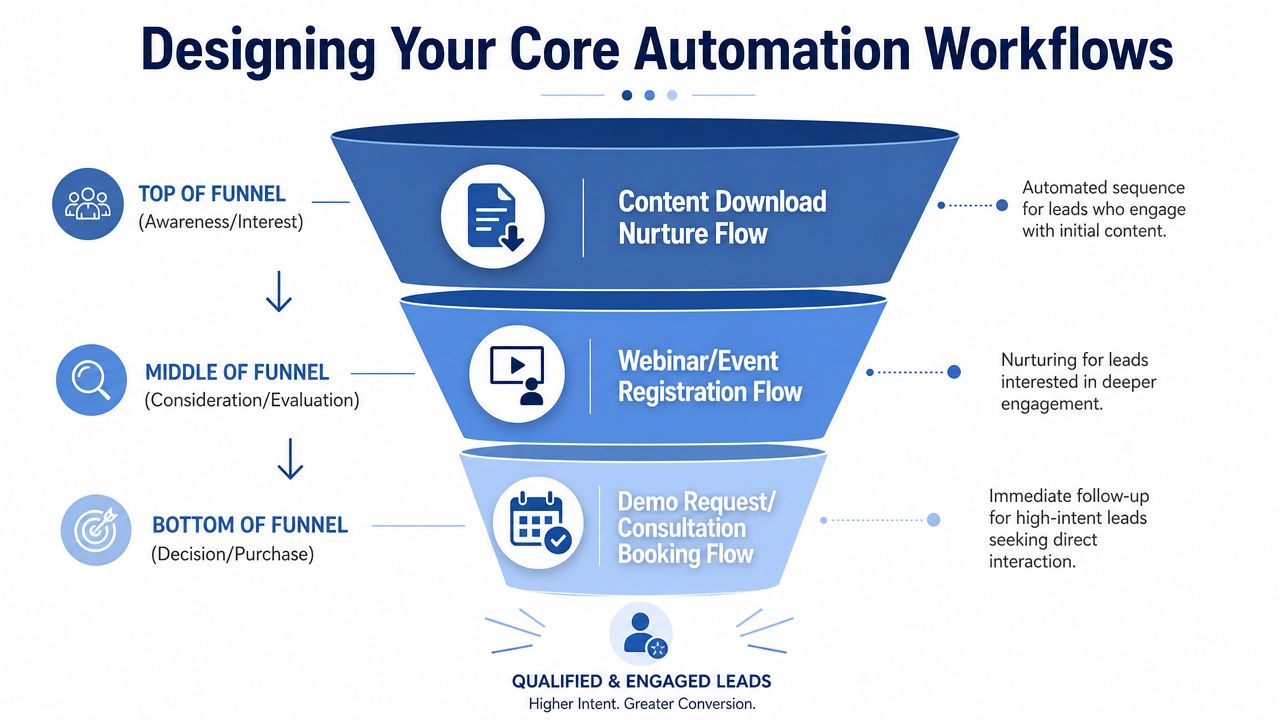
The goal is not to automate activity. The goal is to build a system that converts intent into pipeline, filters out junk before reps touch it, and learns which actions produce revenue without creating compliance risk.
Use a concrete model. Take a B2B SaaS company selling workflow software to mid-market operations teams. It has inbound demand from content, outbound campaigns to named accounts, and a sales team that needs fewer hand-raisers and more qualified buyers.
Workflow one for inbound qualification
A visitor lands on a comparison page, reads two product pages, then downloads an implementation checklist. That is enough signal to act.
The workflow should create or update the CRM record, enrich the company profile, check ICP fit, screen for missing consent or bad data, and assign a score tied to buying likelihood, not content consumption alone. If the account clears the threshold, route it to sales with context. If it does not, place it into a nurture path built around the problem it revealed.
Chat matters here, but only if you use it as a gate instead of a gimmick. Ask four things. Role. Team size. Current process. Urgency. Strong fit gets a meeting option. Weak fit gets education and more qualification.
That one decision protects rep capacity. It also gives your AI agent cleaner training data, because every branch records what happened next.
Workflow two for outbound sequencing
Outbound should not run as one static cadence. It should adapt based on account fit, response behavior, and live intent signals.
Start with a target account list built from your best customers, then split it by segment, pain point, and likely buying trigger. One sequence for operations leaders dealing with manual approvals. Another for teams replacing scattered spreadsheets. Another for firms hiring aggressively and outgrowing current processes. Relevance lifts response rates. Irrelevance creates spam complaints and compliance exposure.
A practical sequence usually mixes email, phone, and social touches over a short window, then changes based on engagement. If the buyer opens but does not reply, send proof. If they visit the pricing page, create a call task. If they ignore every touch, slow the pace or suppress them instead of hammering the inbox.
Here's a lean structure:
- Touch one: Personalized email tied to a visible operational problem.
- Touch two: LinkedIn view or connect request, based on your motion.
- Touch three: Follow-up email with proof, insight, or a sharper angle.
- Touch four: Sales call task triggered by intent or repeat engagement.
- Touch five: Social follow-up or a new message focused on business impact.
- Touch six and beyond: Short nudges shaped by engagement history, firmographic fit, and prior objections.
If you want practical flow patterns, these marketing automation workflow examples show how to structure decision logic without turning your system into an ops science project.
Your AI agent should sit on top of this motion and adjust next steps in real time. It should change timing, copy angle, and channel priority based on what is producing meetings, opportunities, and qualified pipeline. That is the difference between basic automation and a self-improving lead machine. Competitors can copy your tools. They cannot easily copy a system trained on your conversion data, your disqualification patterns, and your compliance rules.
A useful walkthrough sits below.
Workflow three for re-engagement
Every CRM contains leads that went cold for reasons that had nothing to do with fit. Budget froze. Priorities shifted. Internal timing slipped.
Some of those leads come back. Your system should catch that instantly.
Build a re-engagement workflow that watches for renewed activity such as return visits to pricing, fresh email engagement, chatbot interactions, or repeated page views from an old account. Then respond with context, not recycled copy. Reference the original pain point. Mention the new capability, case study, or implementation path that matches it. If the lead reactivates, send them back through qualification. If they do not, pause outreach and protect deliverability.
This is also where governance matters. Re-engagement workflows need suppression rules, consent checks, frequency caps, and clear exit conditions. A system that learns fast but ignores compliance becomes a liability.
If you are evaluating tooling to support these motions, this comparison of best B2B lead generation platforms is useful because it shows the major categories side by side.
The Modern Tech Stack and Integration Patterns
Most companies buy too much software and still end up with a weak system.
You don't need a giant stack. You need a stack with clean handoffs. That's different. If your CRM, enrichment layer, email platform, chatbot, and analytics don't share context, your automation is just a prettier form of fragmentation.
All-in-one versus best-of-breed
Here's the decision I usually walk CEOs through:
| Model | Strength | Weakness | Best fit |
|---|---|---|---|
| All-in-one platform | Faster deployment, fewer integration points, simpler reporting | Less flexibility, weaker specialist features | Smaller teams, simpler motions |
| Best-of-breed stack | More control, deeper functionality, stronger specialization | More setup, more maintenance, more failure points | Mature teams with process discipline |
If you're early and moving fast, HubSpot-style consolidation often wins. If you've got a defined motion and stronger ops talent, assembling your own stack can enable better performance.
For platform research, this roundup of best B2B lead generation platforms is useful because it shows the categories side by side instead of pretending one tool does everything well.
Integration patterns that actually work
There are three patterns I see repeatedly.
The first is CRM-first orchestration. Everything writes to the CRM, and workflows trigger from record changes. Good for accountability. Good for reporting. Less elegant for complex agent behavior.
The second is automation-layer orchestration with tools like Make, n8n, Zapier, or custom workflows. This gives you flexibility across systems and makes multistep logic easier.
The third is agent-led orchestration, where an AI layer evaluates context, drafts actions, and calls tools conditionally. This is more powerful, but only if the underlying data model is clean. Otherwise the agent just makes bad decisions faster.
If you're comparing implementation options, I've also written about AI workflow automation tools and where each one tends to fit.
The hidden risk most teams ignore
Compliance and deliverability are not side issues. They are operating constraints.
That's why I don't recommend “maximum volume” outreach systems anymore. The stronger pattern is safer automation. Human approval for risky sends. Smaller micro-segments. Continuous QA on engagement quality. Saleshandy's write-up on lead generation automation captures that shift well, especially around privacy exposure, inbox reputation, and platform anti-abuse pressure.
If your outreach engine burns your sender reputation or creates data-handling risk, it's not a growth system. It's a liability with automation attached.
My recommendation is blunt. Automate the repetitive mechanics. Keep approval gates around sensitive copy, high-risk audiences, and channels with enforcement risk.
AI Agent Playbooks for Competitive Domination
Traditional automation follows rules. AI agents work with context.
That difference matters. Rules are fine when every lead should get the same treatment. But that's not how real buying behavior works. Real prospects behave inconsistently, ask odd questions, arrive through different channels, and reveal intent in fragments. Agents can handle that mess better than static workflows.

Playbook one for the inbound concierge
This agent sits on your site and acts like a high-discipline SDR. Not a generic chatbot. A qualification layer with memory and judgment boundaries.
Here's what it should do:
- Read visitor context: Landing page, referral source, content history, account match.
- Ask adaptive questions: Role, use case, urgency, current stack, buying stage.
- Check fit against your ICP: In real time, not after the form.
- Route based on confidence: Book a meeting, push to nurture, or escalate for review.
- Write back to the CRM: Every answer, every signal, every outcome.
This works because automation already drives the heavy lifting in lead generation. Marketing automation has been associated with a 451% increase in qualified leads, while 80% of marketers say automation generates more conversions, according to Scoop Market's lead generation statistics roundup. The same source notes that among marketers using automation, 82% use it for triggered emails and 67% for nurture campaigns. AI agents don't replace that foundation. They supercharge it by making the interaction layer smarter.
Playbook two for the outbound prospecting agent
Competitive advantage starts to compound.
A strong outbound agent researches the account, extracts context from recent company activity, drafts outreach around likely pain points, and updates the sequence based on replies or silence. It should not have total autonomy. It should have controlled autonomy.
I'd give it these responsibilities:
| Agent task | Human checkpoint |
|---|---|
| Account research and enrichment | Review target list criteria |
| Drafting first-touch personalization | Approve for high-value accounts |
| Updating sequence paths based on engagement | Spot-check weekly |
| Logging CRM notes and summaries | Audit sample quality |
| Flagging hot accounts for rep action | Sales accepts or rejects |
This is the model I prefer because it scales judgment without pretending the model is infallible.
If you want to go deeper on implementation, I've written about AI agents for business workflows and how to design them around controlled decision rights. Samuel Woods also offers consulting around agent-led orchestration for businesses building AI-driven lead generation and qualification systems, but the same design principles apply whether you build internally or with external help.
Why agents beat static workflows
Static workflows are brittle. They break when the buyer behaves unexpectedly.
Agents are better when the problem involves messy context, variable inputs, and a need for prioritization. That includes inbound qualification, account research, message drafting, objection routing, and handoff preparation.
But don't force agents where simple automation is enough. If a task is deterministic, use rules. If a task requires interpretation, use an agent. If a task can create legal, reputational, or sales-quality damage, keep a human in the loop.
That combination is how you automate lead generation without automating stupidity.
Measure and Optimize for Perpetual Growth
A lead machine that isn't measured will drift. Imperceptibly at first, then all at once.
You'll see symptoms before you see causes. Reps complain about lead quality. Conversion slows. Sequences keep running but results flatten. The answer isn't “work harder.” The answer is feedback loops.
The dashboard I want every CEO to see
I want one view that tells you whether the engine is healthy. Not a marketing report. An operating report.
Track these metrics consistently:
- Lead conversion rate: Are visitors and contacts becoming leads at the capture layer?
- Cost per lead: Are acquisition costs staying rational as volume grows?
- Lead velocity rate: Is qualified demand moving faster or slower over time?
- Funnel completion: Where are leads stalling between capture, scoring, nurture, and handoff?
- Click-through rate: Are your nurture assets and messages generating meaningful engagement?
Those are the same kinds of metrics the earlier implementation guidance points toward when evaluating automated lead generation performance. They tell you where your bottleneck is. They also tell you where to stop spending money.
Separate leading from lagging indicators
Not all metrics deserve equal attention.
| Indicator type | What it tells you |
|---|---|
| Leading | Whether the system is functioning now |
| Lagging | Whether the business benefited later |
Leading indicators include engagement quality, qualification rates, routing speed, and funnel progression. Lagging indicators include accepted opportunities, pipeline contribution, and revenue.
If your leading indicators weaken, you can intervene before revenue drops. If you wait for closed-won data alone, you're steering by the rearview mirror.
The point of optimization is not more activity. It's faster learning.
Run optimization like an operating discipline
Teams often “optimize” by changing random things and hoping.
Use a tighter loop:
- Pick one constraint. Low qualification rate, weak landing-page conversion, poor handoff acceptance.
- Form one hypothesis. A better CTA, a different chatbot opener, a tighter scoring threshold.
- Test one change. Keep the rest stable.
- Review by segment. Good changes for one audience can hurt another.
- Promote or kill. No pet ideas.
I'm especially aggressive about reviewing conversion by segment. If one channel creates volume but poor downstream quality, cut or constrain it. If a smaller segment converts cleanly, give it more budget and more customized messaging.
Where CEOs should stay involved
You don't need to inspect every sequence. You do need to own the standards.
Stay close to three things. ICP definition. Qualification thresholds. Handoff quality. Those decisions determine whether your automation strengthens revenue or just inflates activity.
The companies that win with automated lead generation don't merely automate tasks. They build a system that learns which buyers convert, which messages trigger action, and which channels deserve more resources. That's where the compounding advantage comes from.
If you want help designing that kind of system inside your business, I work with founders and leadership teams to build AI-driven lead generation, qualification, and automation frameworks that fit your actual revenue model.