
AI research agents can produce polished, citation-heavy reports and still miss the one source that flips the decision. That is the operational risk, and it is common. In practice, the failure usually isn't obvious until you have already used the briefing to set pricing or shape positioning.
I've shipped agent systems since 2016 and worked with generative AI since 2019, and the pattern keeps repeating. Speed gets the attention. Reliability decides whether the system earns a place in the business. The market is scaling fast, with one 2026 roundup pegging the global AI agents market at $10.91 billion in 2026, up from $7.63 billion in 2025, and projecting $50.31 billion by 2030 (Ringly's 2026 market roundup). That tells you commercial momentum is real, but it doesn't solve the harder question of trust.
For marketers and founders, the issue is simple. If an agent misses a competitor's hidden discount page, a regulatory filing, or a gated PDF, you don't get a “slightly worse” answer. You get a confident wrong one, and that can distort revenue decisions.
Table of Contents
- Why Most AI Research Agents Fail Before You Notice
- Defining AI Research Agents
- The Anatomy of a Reliable Research Loop
- Reasoning Models and the Tool Stack That Powers Agents
- Marketing and Growth Workflows That Actually Pay Off
- Implementation Blueprint You Can Run This Quarter
- Governance, Evaluation, and the UIS Gap
- Where Agents Still Lose and What to Keep Human
Why Most AI Research Agents Fail Before You Notice
The problem with most AI research agents is fluency. They can assemble a report that reads like an analyst wrote it, attach citations, and still miss the evidence that mattered because the source never surfaced in the first place.
I've seen this happen in pricing work. A founder asks for a competitor briefing, then uses it to decide whether to hold a Q3 price line. The agent returns a clean summary, but the competitor's discount page sat behind a crawler gap, so the report never saw the one page that made the decision risky. That's the kind of miss that doesn't look like a failure until revenue underperforms.
Reliability beats speed when the decision has consequences
Recent research on research agents calls out a UIS gap, short for uncovered information source gap, where important information never appears in crawler-visible search results. That includes dynamic pages, overlooked content, and embedded files, which means the system can sound complete while still being blind to the decisive evidence (UIS gap analysis). Google DeepMind also frames this as a new validation bottleneck in science, which is the right way to think about it in business too. Retrieval is only part of the bottleneck. Validation, provenance and human review are the rest.
If the answer changes spend, pricing or positioning, trust the evidence trail before you trust the prose.
This is why “faster research” is the wrong north star. In competitive intelligence, market monitoring, and regulatory work, one missing page can invert the conclusion. What you need is an answer that can survive scrutiny, however persuasive the prose.
Defining AI Research Agents
A standard chat assistant answers from a single prompt. An AI research agent turns that into a loop. It plans the task, searches across multiple sources, reads what it finds, extracts only verifiable claims, and then synthesizes the result with citations attached.
That matters because research questions are usually multi-hop. You are not asking, “What is X?” You are asking, “What changed, why did it change, and what does it mean for us?” A one-shot prompt can imitate that answer, but it cannot reliably work through the evidence chain.
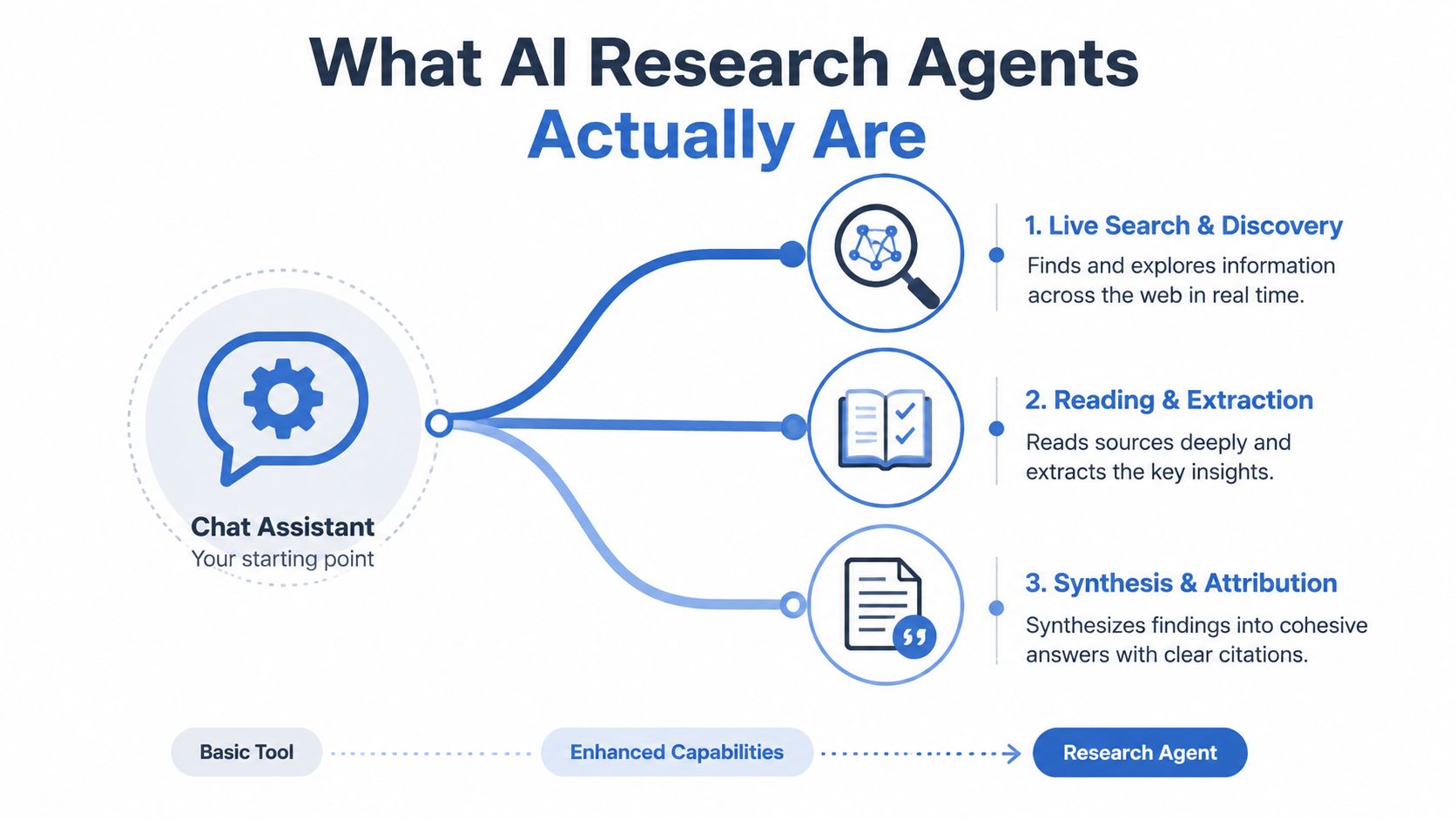
From assistant to analyst loop
The simplest mental model is a junior analyst with a browser, a calculator, and a pile of internal docs. The agent decides where to look next based on what it just learned, which is why recent surveys describe these systems as long-horizon, tool-using systems rather than one-pass interfaces (survey of research agents).
That loop changes the economics of hard questions. A static RAG chatbot can retrieve relevant snippets, but it often struggles when evidence depends on multiple hops across sources. A browser-only automation script can click around, but it does not reason well about conflicting evidence. AI research agents sit in the middle, and that is where the business value usually shows up.
What distinguishes them from adjacent tools
OpenAI says its Deep Research agent can “find, analyze, and synthesize hundreds of online sources” and pivot as it encounters new information, while Google's Gemini Deep Research Agent supports grounding across web sources, internal knowledge, uploaded files, and remote MCP servers (Google Deep Research documentation). That combination matters because the strongest outputs come from source diversity and traceability. One giant prompt can't supply either.
If you already use a research assistant inside your stack, the useful question is whether it can move from discovery to evidence to citation without drifting into memory-based guessing. Sounding smart proves nothing.
For a practical example of how that shows up in market work, see my guide to AI market research reports.
The Anatomy of a Reliable Research Loop
A trustworthy research loop has five distinct stages. Each one can fail on its own, which is why people who treat the whole thing as “just search plus summary” end up disappointed.
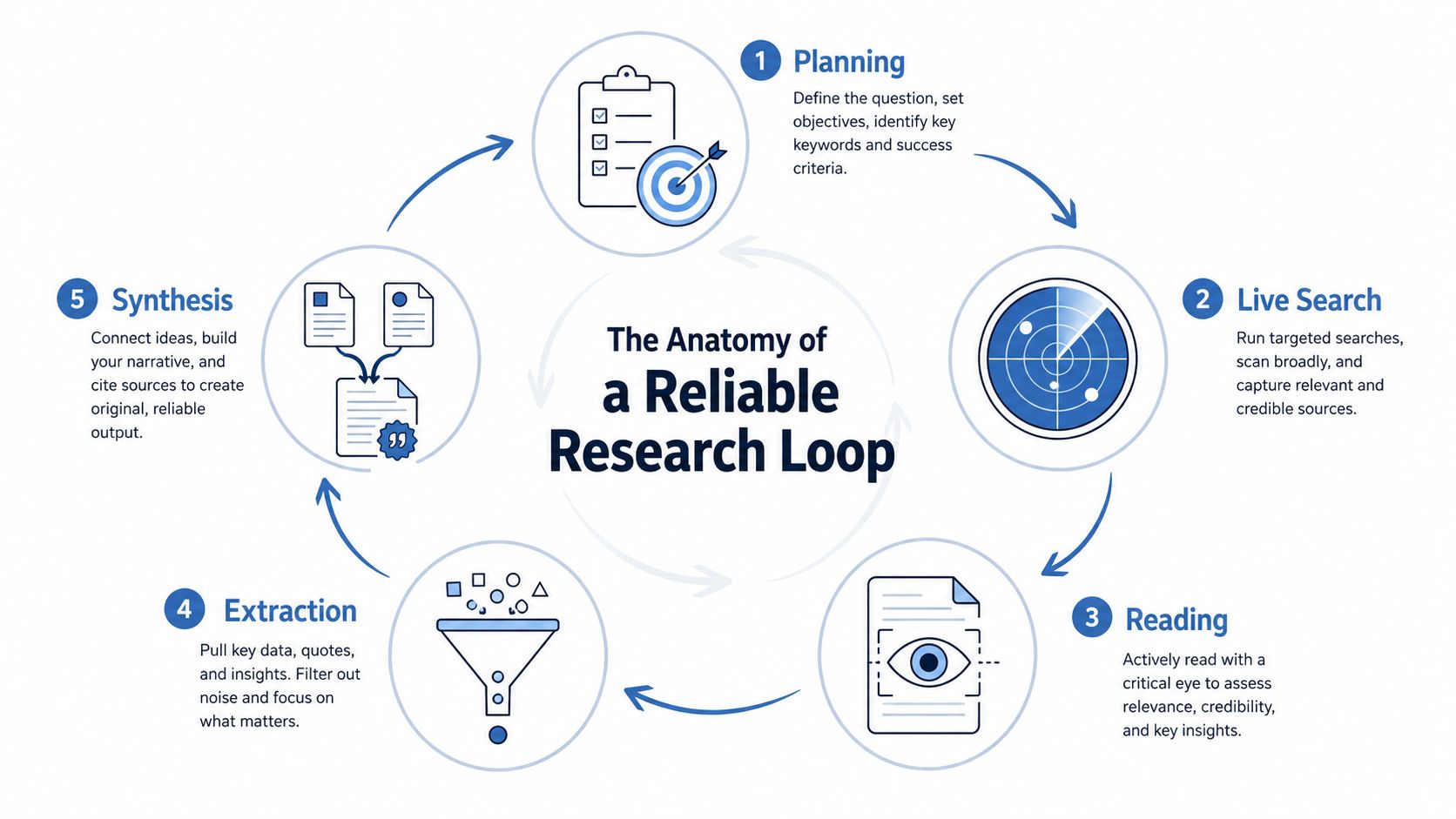
Planning, search, reading, extraction, synthesis
Planning is where the agent decides what it should look for. If the plan is weak, the rest of the run wastes time on irrelevant material. Live search is where stale data and hallucinated URLs can slip in, especially if the agent leans too hard on whatever looks authoritative at first glance.
Reading and extraction should separate signal from narrative. The agent has to pull out the specific claims that answer the business question instead of summarizing the source. Then comes verification, where each claim gets checked against what was retrieved. Finally, synthesis turns the verified material into an answer with citations.
A claim like “Competitor X raised prices in March” can end up in one of three states, supported, contradicted, or unsubstantiated. That last label is more useful than a confident guess. For competitive monitoring, a clean “cannot verify” saves you from acting on a false premise.
If the model can't point to the source, it hasn't finished the job.
For a practical walkthrough of turning this into a report format, I keep a template close to hand in this market research report guide. The main point is discipline. Memory-based answering is cheap. Evidence-based answering is what keeps the business out of trouble.
Reasoning Models and the Tool Stack That Powers Agents
The model choice depends on the task, not the hype cycle. I use faster models where the work is narrow, like extraction or classification, and slower reasoning models where the work needs planning, conflict resolution, or multi-step synthesis.
That split is what most builders miss. They try to make one model do everything, then blame the system when latency climbs or the reasoning gets mushy. A better setup gives the planning layer enough thinking room, then hands narrower jobs to cheaper, faster components.
How I think about model and surface selection
Google's newer Deep Research setup is explicit about this split, offering a fast configuration for lower-latency interactive use and a thorough configuration for exhaustive background workflows (Google Deep Research Max). That's the right mental model. You don't need the heaviest tool for every step.
The grounding surface matters just as much. Web search alone is fragile. Internal files, uploaded documents, MCP-backed tools, and structured APIs widen the evidence base and lower the odds that the agent misses gated information. If you're evaluating MCP for your stack, I've broken down the protocol in this Model Context Protocol guide.
Reasoning Models and Tool Surfaces at a Glance
| Use Case | Best Model Type | Grounding Surface | Key Risk |
|---|---|---|---|
| Competitive intelligence | Slower reasoning model for planning, faster model for extraction | Web, internal files, remote tools | Missing gated or dynamic sources |
| Customer research | Balanced reasoning model with strong synthesis | Uploads, survey files, CRM exports | Overreading weak signals |
| Content ideation | Fast model for clustering, reasoning model for brief creation | Search, docs, support data | Generic briefs that ignore real demand |
| Regulatory research | Strong reasoning model with heavy verification | PDFs, databases, internal policy files | Confident but incomplete summaries |
If you are comparing stack options, one option is a Researcher-Analyst agent, like the one I describe in my own product ecosystem, which connects to external data sources such as APIs, websites, and databases to find, filter, and analyze information before producing a concise report. That kind of setup is only useful if the grounding surfaces are broad enough to catch the evidence that matters.
The core trade-off is simple. More grounding surfaces increase answer quality, but they also increase orchestration complexity. If you can't monitor the pipeline, don't add more tools just because they sound impressive.
Marketing and Growth Workflows That Actually Pay Off
The best use cases are boring in the right way. They're repetitive, information-heavy, and expensive to do by hand. That's where AI research agents start returning real money.
Competitor monitoring that flags deltas
One growth team I work with runs an agent against pricing pages, hiring pages, product pages, and help docs. The value is the alert that something changed and needs human review before a competitor steals an edge.
The agent earns its keep here. Humans don't need to reread every page every day. They need a prioritized list of deltas, with the source attached, so they can decide whether to respond. That's faster than manual monitoring, and it reduces the chance that a pricing move slips through unnoticed.
Content ideation grounded in demand
A better content brief starts with evidence, not a brainstorm. Feed the agent customer interviews, support tickets, and SERP data, and it can surface recurring language patterns, objections, and topic gaps that deserve a page or a post. The brief is stronger because it comes from actual demand signals instead of keyword theater.
If you manage paid and organic together, this also keeps your campaign work aligned. If you want a parallel example of how AI can support ad operations, Amazon ad automation with AI is a useful reference point for thinking about repetitive, rule-based workflows that benefit from structured automation.
Customer and campaign research that feeds the funnel
When an agent digests survey responses and ad performance together, it can surface new hooks, audience language, and objection patterns. That's especially useful when you need to refresh landing page copy or segment messaging without waiting on a long research cycle.
The outcome that matters is whether you shipped a stronger variant, improved campaign targeting, or avoided a weak angle before spend went live. “The agent wrote a summary” doesn't count. That's where research and growth stop being separate functions.
Implementation Blueprint You Can Run This Quarter
Start small and make the workflow opinionated. The agent should not be allowed to freestyle its way into a polished answer. It should be forced through planning, retrieval, verification, and citation every time.
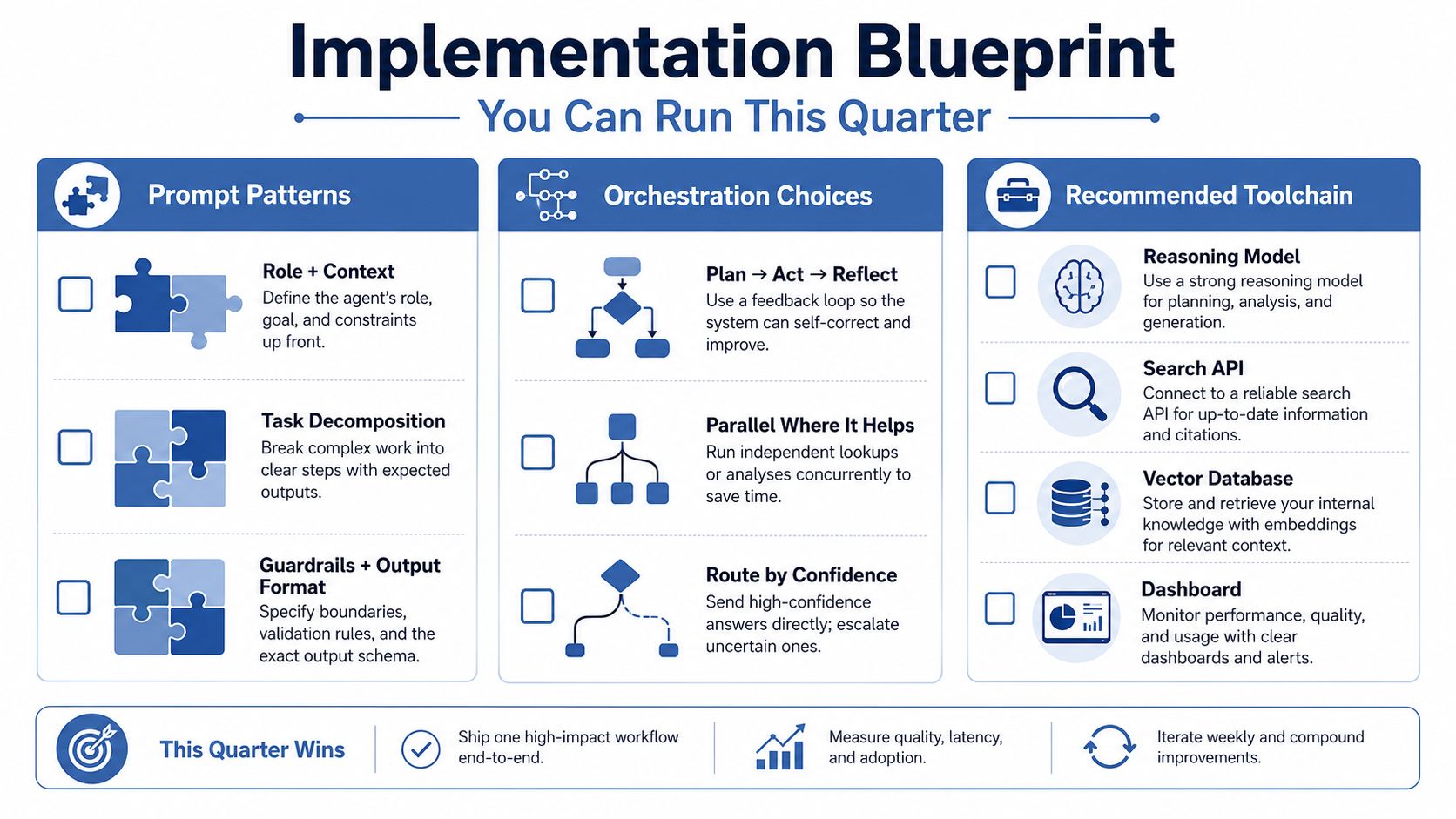
A prompt scaffold that keeps the agent honest
Use a research prompt that asks for four things in order. First, the plan. Second, the sources it intends to use. Third, the claims it extracted from those sources. Fourth, the final answer with citations attached to every substantive statement. That structure prevents the model from drifting straight into a confident summary.
A simple prompt shape works well: “Plan the research task, list the source types you'll use, retrieve evidence, extract only verifiable claims, and write the result with a citation on every major point.” I've found that quality jumps at this stage, because the agent no longer has permission to skip the middle of the loop.
The stack I'd actually wire up
For orchestration, use a reasoning model for planning and a faster model for extraction or claim classification. Add a search layer, a document store or vector store for internal materials, and observability so you can inspect what the agent searched, ignored, and cited. If you need a no-code starting point, I set up agentic workflows for owners who don't want to build everything from scratch, and you can work with me on that.
The key is to instrument the system. Track claim verification rate, source diversity, cost per verified claim, and time to first draft. Those metrics tell you whether the agent is reducing work or just producing more content.
If you can't inspect the sources, you can't trust the output.
Build or buy without kidding yourself
Buy when the workflow is narrow, repeatable, and close to commodity. Build when the research path is a differentiator, the source mix is proprietary, or the output has to fit a specific business process. That's the line I use with founders who want to scale without turning into an infrastructure shop.
Governance, Evaluation, and the UIS Gap
The biggest mistake I see is treating governance like paperwork after the system is live. Governance is part of the product. If the agent can't be audited, the business can't depend on it.
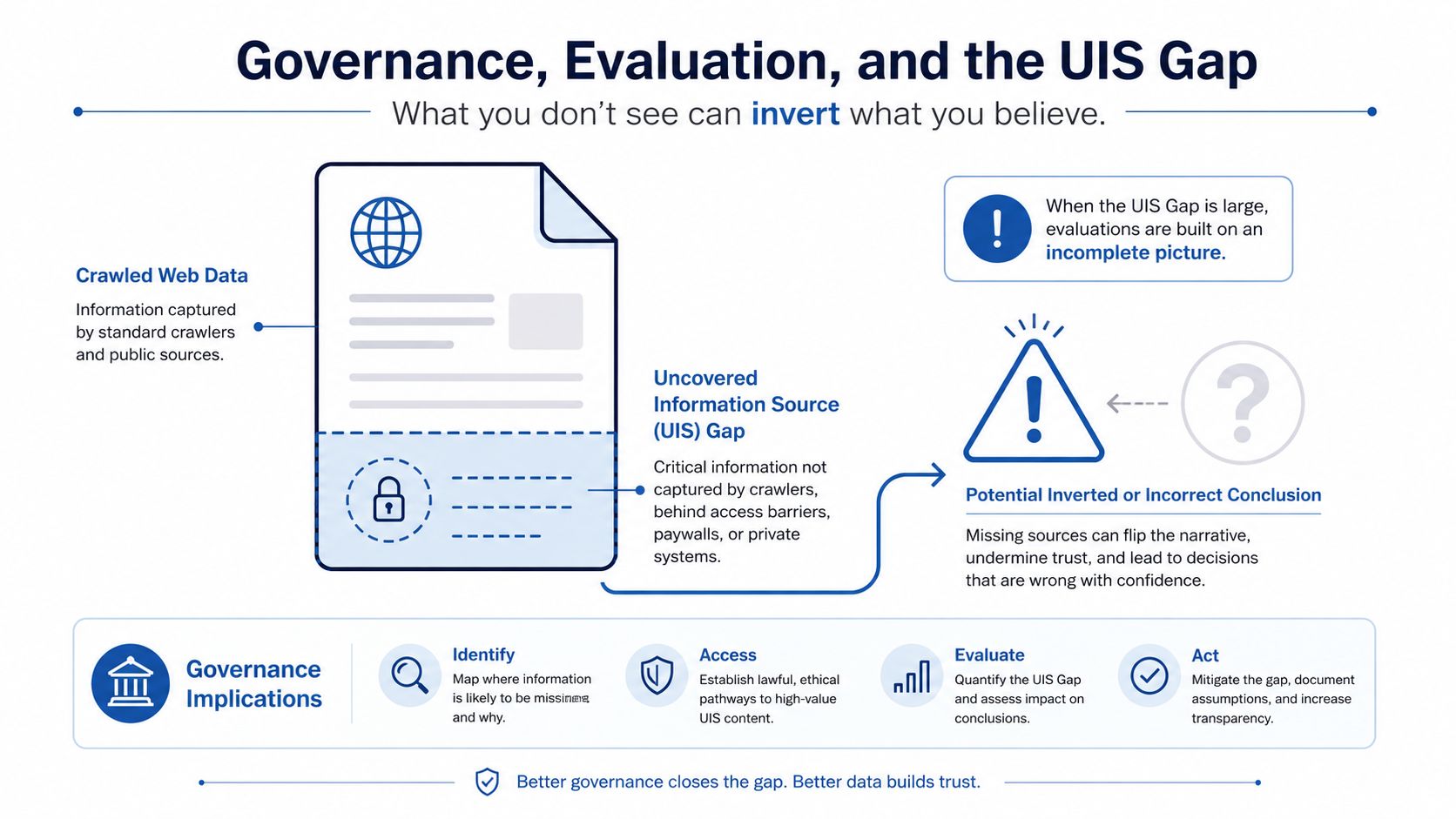
What to verify and what to ignore
A reliable review process starts by separating statements that can be checked from those that can't. Numerical claims, temporal claims, and geographic claims deserve the most scrutiny, while subjective opinions and personal taste don't belong in the same verification pipeline (fact-checking guidance).
That distinction saves time. Don't waste compute on things like “the copy feels better.” Spend it on statements like “the campaign launched in EMEA last quarter” or “the product shipped in Q3,” because those claims can be audited against evidence.
A fact-checking pattern that actually scales
The most useful pattern I've seen is three agents in sequence. One extracts only verifiable claims, another searches for evidence for each claim, and a third labels each claim as supported, contradicted, or unsubstantiated. Google Cloud's write-up on trustworthy automated fact checking describes that workflow with structured outputs, including a JSON list of claims and a final JSON verdict report (Google Cloud fact-checking pattern).
That structure lets you route only the risky claims into human review. You don't need analysts to inspect every sentence. You need them to inspect the sentences that can move spend, compliance, or strategy.
When you review the system, the metrics that matter are citation traceability, contradiction rate, and the proportion of claims routed for human verification. If those numbers are bad, the system isn't mature yet. If they're improving, the agent is starting to earn trust.
For a practical ROI framing, I've found this AI agent ROI guide useful when you need to justify governance work in business terms. Reliability costs money, but so does acting on the wrong answer.
Where Agents Still Lose and What to Keep Human
Keep humans on final positioning calls, pricing moves tied to a single missing source, and any research where the cost of being wrong beats the cost of being slow. If an agent is producing overconfident unsourced claims, stale competitor intel, or a rising human review burden, it's telling you the workflow isn't stable enough yet.
The question to ask about AI research agents is which decisions in your funnel can survive a 10% error rate, and which ones can't. The founders who win will treat agents as a reliability problem first, and a speed problem second.