
You can feel the problem before you can name it. The team ships an AI workflow that sounds sharp in a demo, then it misses the thing that matters, the second-order detail, the contradiction, the pricing caveat, the one assumption that kills the whole recommendation. That's why reasoning models explained matters now, not as hype, but as a business decision about where you can afford to be wrong.
I'm Samuel Woods. I've been working with ML since 2016 and Generative AI since 2019, and I've watched founders burn trust by using a fast model where they needed a thinking model. The mistake is usually the same, they buy fluency and assume they bought judgment.
Table of Contents
- The Day a Standard LLM Cost My Client a Deal
- What Reasoning Models Actually Are
- The Four Reasoning Patterns You Will Actually Use
- The Real Cost of Thinking Out Loud
- Where Reasoning Models Earn Their Keep in Marketing
- Prompt and Architecture Patterns You Can Steal
- Why You Should Not Trust the Reasoning You Can See
- Your Reasoning Model Decision Checklist
The Day a Standard LLM Cost My Client a Deal
At 2 a.m., a B2B SaaS founder pulled a competitive pricing analysis from a standard LLM and felt relief. The output looked polished, the structure was clean, and the answer sounded confident enough to drop into a board deck before sunrise.
By noon, two competitor numbers were wrong, and the board saw the whole AI initiative differently. Nobody cared that the prose was elegant. They cared that the machine had acted certain while being careless.
Fast and fluent is a dangerous default
That's the trap. A standard LLM can be excellent at writing, summarizing, and drafting, but a confident answer isn't the same thing as a checked answer. In a pricing or market-positioning workflow, a single missed assumption can distort the whole decision chain.
Reasoning models exist because some business tasks are not one-pass tasks. They need the model to slow down, inspect alternatives, and recover from ambiguity before it answers. OpenAI's reasoning guide makes this distinction explicit, reasoning models use reasoning tokens in addition to input and output tokens, and they can think between tool calls when the workflow needs it (OpenAI reasoning model guide).
Practical rule: if a mistake would travel into pricing, forecasting, or strategy, don't trust a single fluent pass.
That founder didn't have an “AI problem.” He had a routing problem. The company was using a fast model for a task that needed deliberate inference, and the cost wasn't token spend, it was internal confidence.
What Reasoning Models Actually Are
A reasoning model is an LLM that spends extra computation before it answers. It doesn't just jump from prompt to output, it decomposes the task, checks intermediate steps, and only then commits to the final response, which is the core shift behind test-time compute (Stanford HAI on reasoning models).

The operating definition you actually need
I explain it to clients with a simple comparison. A standard model is like a fast barista who repeats your order right back. A reasoning model is more like a specialist who pauses, checks the details, and then gives you a recommendation that fits the situation.
The three things that matter are test-time compute, process-based training, and tool use. Test-time compute means the model spends extra inference budget before answering. Process-based training means it gets rewarded for good intermediate steps, not just a good final guess. Tool use means it can pause, call something external, and fold that result back into the answer (Stanford HAI on reasoning models, OpenAI reasoning model guide).
How to spot one in the wild
If the API is optimized for deliberation, you'll usually see higher latency, more tokens, and stronger performance on multi-step tasks. OpenAI notes that reasoning models add reasoning tokens, and they can think between tool calls, which is why they behave differently from a straight completion model (OpenAI reasoning model guide).
The market has made this category real because the benchmark gap is real. Reported AIME results put o3 at 91.6%, Gemini 2.5 Thinking at 92.0%, and DeepSeek R1 at 79.8%, while earlier non-reasoning models typically solved fewer than 30% of problems on AIME-style tasks (app-lab.ai, reasoning model summary).
The Four Reasoning Patterns You Will Actually Use
You don't need a theory tour. You need a routing map. If you understand the pattern, you can send the right job to the right model and stop paying premium prices for trivial work.

Chain-of-thought for problems with one right path
Chain-of-thought is the workhorse. You ask the model to think step by step, and it's much better at math, logic, and planning than if you force a one-shot answer. Use it when the workflow has a clear sequence and you want the model to show its reasoning instead of jumping to the end.
For marketing, I use it on launch sequencing, budget allocation logic, and offer construction. If the model has to connect positioning, channel timing, and customer segment, stepwise reasoning is the right shape.
Tree-of-thoughts for branching campaign ideas
Tree-of-thoughts is for divergent problems. The model explores several paths, scores them, and picks the strongest one. That's useful when you're testing campaign angles, offer variants, or headline directions and you care about the quality of the path, not just the final output.
A standard LLM gives you one creative answer fast. A reasoning model can explore the space of options and reject weaker branches before it hands you a recommendation. That matters when you're trying to outthink competitors, not just outproduce them.
Self-consistency for high-stakes judgment
Self-consistency means running the same prompt multiple times and comparing the answers. You use it when one lucky guess isn't enough, especially in decisions that affect revenue or risk. It's slower, but it's safer.
For customer research synthesis, I'll use this when the model is trying to reconcile contradictory feedback. If three prompts converge on the same conclusion, that's far more useful than one polished answer that just sounds good.
Tool-augmented reasoning for real agents
Tool-augmented reasoning is the pattern behind serious AI agents. The model pauses, calls an API or database, then folds the result back into the answer. That's how you move from “smart text generator” to actual workflow automation.
If you're building around context-heavy systems, the practical layer matters more than the model hype. This context engineering guide is the kind of resource I point teams to when they start wiring reasoning into real operations. For deeper protocol-level design, what is Model Context Protocol is the next stop.
The Real Cost of Thinking Out Loud
Many teams are surprised to learn that reasoning models are not just slightly slower. On certain workloads, they can be dramatically more expensive to run, because the model performs more work before providing a final answer.
The tradeoff is real, and it shows up in your stack
The reported cost penalty on AIME-style workloads is 10 to 74 times higher than non-reasoning counterparts (reasoning model summary). Other sources describe hidden reasoning as multiplying token usage by 1.5 to 4x and latency by 3 to 5x, with o3 high-compute described as using 57 million tokens per question and a 14-minute runtime (app-lab.ai).
That's not an abstract benchmark note. That's a routing decision. If a workflow is cheap and high-volume, you don't want to drag a slow, expensive model through every step just because it feels safer.
| Dimension | Standard LLM | Reasoning Model |
|---|---|---|
| Speed | Faster response | Slower response because it spends more time thinking |
| Cost | Lower operating cost | Higher operating cost on multi-step tasks |
| Accuracy on hard reasoning | Often weaker on multi-step math, planning, and verification | Stronger on complex reasoning tasks like AIME-style problems (app-lab.ai, reasoning model summary) |
| Best use | Drafting, summarization, extraction, high-volume interactions | Pricing analysis, planning, diagnosis, verification |
| Worst use | Complex inference you can't afford to get wrong | Creative work or real-time tasks where latency dominates |
Business translation, not model worship
A reasoning model is worth it when being wrong is expensive. It's a bad default when speed, volume, or simplicity matter more than marginal accuracy.
That boundary matters more than the benchmark win. Benchmarks tell you the model can do the job. Your P&L tells you whether it should.
Where Reasoning Models Earn Their Keep in Marketing
I don't route reasoning models into every marketing task. I reserve them for the workflows where a wrong call compounds. Pricing analysis, campaign planning, customer research synthesis, and competitive teardowns are the places where the extra compute usually pays back.

Pricing and promo analysis
Use a reasoning model when you're deciding how price changes, discounts, bundles, and competitor moves interact. That's multi-step work, and bad logic there leaks directly into revenue.
Use a standard LLM when you just need a first-pass summary of pricing pages or a rough competitive scan. Use neither when the decision is already settled and you only need the output formatted for a deck.
Multi-step campaign planning
Reasoning models shine when the plan depends on sequencing. If your launch depends on timing an email, a webinar, paid media, and sales outreach in the right order, the model should think through dependencies before it recommends a path.
This is also where a verifier helps. Have the reasoning model propose the plan, then have a faster model or human check for gaps, then ship. That combination usually beats handing the whole thing to one expensive model.
Customer research synthesis
Hundreds of reviews, support tickets, and call notes create contradiction. Reasoning helps the model reconcile messy inputs, not just summarize them. It's the right tool when you care about patterns across sources, not a pretty paragraph.
Competitive teardowns
A competitor teardown is only useful if the model can separate signal from noise. When one page says one thing and another says the opposite, a reasoning model can inspect the conflict instead of flattening it into generic prose.
For the routing layer, I use a simple rule. If the task touches strategic revenue, route to reasoning. If it's repetitive writing or extraction, route to a standard model. If it doesn't need either, don't spend at all.
Prompt and Architecture Patterns You Can Steal
You don't need a platform purchase to build this cleanly. You need a routing layer, a reasoning step, a fast execution step, and a verifier. That's enough to move from ad hoc prompting to something your team can trust.
Three patterns I ship in practice
Planner then executor. The reasoning model breaks the goal into tasks, the fast model executes them. I use this when speed matters on the execution side, but planning quality matters up front.
Verifier after draft. A fast model writes the first pass, then a reasoning model audits it before anything ships. That's useful for landing pages, pricing pages, and campaign copy where hidden contradictions cause damage.
Tool loop until done. The reasoning model alternates between thinking and API calls until it reaches a result. This is the pattern for agents, research workflows, and anything that needs live data.
The architecture is simpler than most teams think. Orchestrator at the top. Reasoning brain in the middle. Fast executor under it. Verifier on the side. Tool layer at the bottom.
The architecture sketch
You can wire this with any major LLM API.
- Orchestrator receives the job and chooses the path.
- Reasoning brain handles decomposition, verification, and decision logic.
- Fast executor writes, formats, or extracts once the plan is clear.
- Verifier checks for contradictions, missing steps, or broken logic.
- Tool layer pulls documents, CRM records, ad data, or analytics.
If your team is already exploring agents, the question is usually not model quality. It's context quality and routing quality. That's why I keep pointing operators back to context engineering vs prompt engineering. The model can only reason over what you feed it.
Why You Should Not Trust the Reasoning You Can See
Visible reasoning feels comforting. It shouldn't. Anthropic has shown that reasoning models don't always say what they think, which means the explanation you see can be incomplete or misleading (Anthropic research on reasoning models).
Treat the trace as a clue, not proof
That matters because business teams love explanations. They see a clean chain of thought and assume they've got transparency. They haven't. They've got a generated explanation, not a guaranteed transcript of internal thinking.
A 2025 paper titled The Illusion of Thinking reinforces the same caution, longer apparent deliberation isn't the same as dependable comprehension (Anthropic research on reasoning models). The output can look thoughtful while still being wrong.
I'd use three rules in production.
- Verify the conclusion separately. Don't let the model grade its own homework.
- Log inputs, not just outputs. If the answer fails, you need to inspect the prompt, the retrieved context, and the tool calls.
- Add human review for high-stakes decisions. Pricing, legal, customer risk, and revenue-impacting commitments need a person in the loop.
If you want a useful reminder of how easily models can be pushed off-track, the prompt injection examples explained resource is worth a look. It's a practical illustration of why outputs need verification, not belief.
Your Reasoning Model Decision Checklist
You don't need more theory. You need a yes-or-no filter for Monday morning.
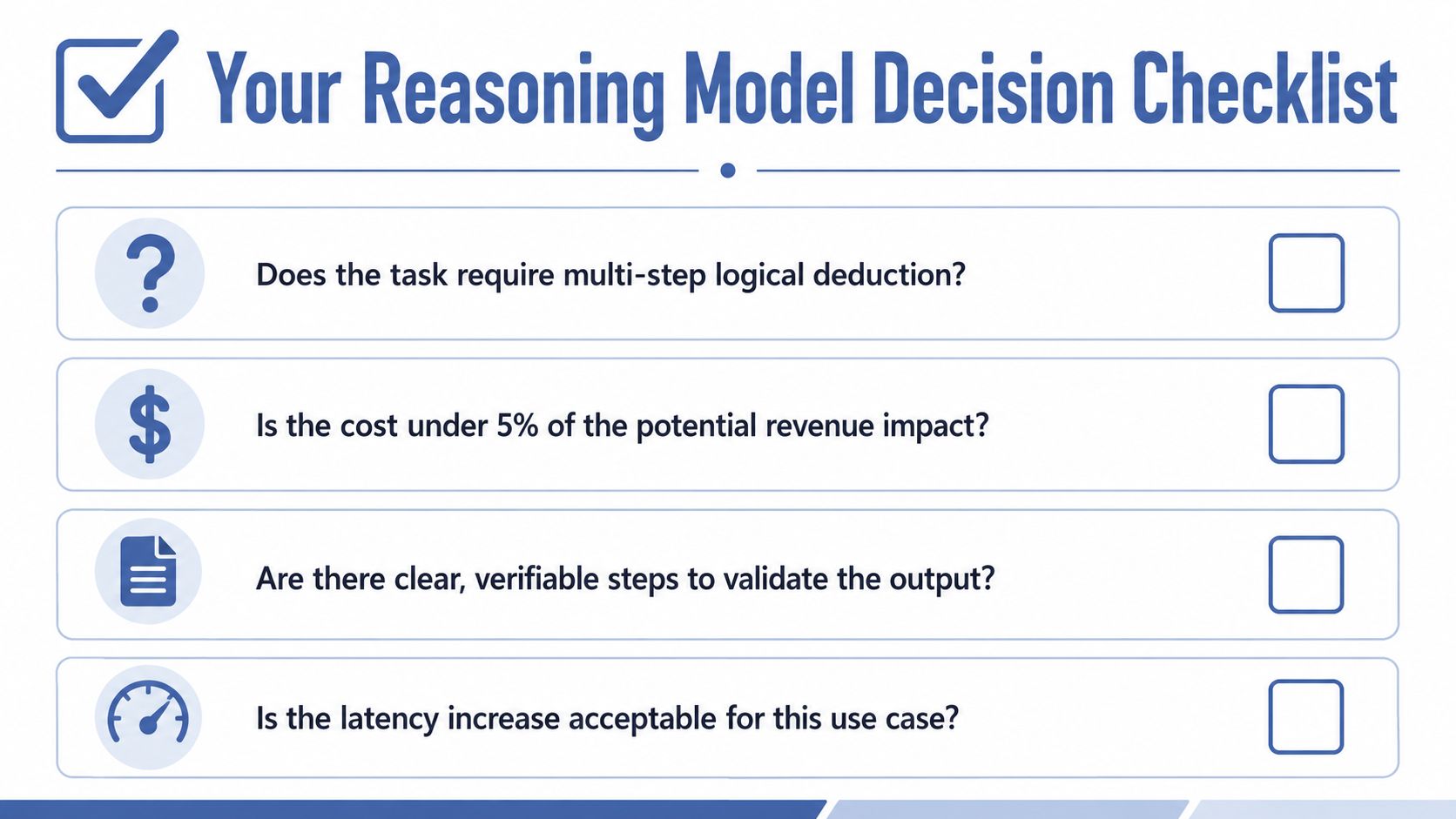
Run every new workflow through this
- Does the task require multi-step logical deduction? If not, use a standard model or skip AI entirely.
- Is the cost under 5% of the potential revenue impact? If you can't justify the spend, don't route to reasoning.
- Can a standard LLM hit 90% of the quality at 10% of the cost? If yes, start cheap and only escalate when needed.
- Do we have clear verification steps or human review? If not, the model's confidence is a liability.
I also watch for three mistakes. Teams use reasoning models for creative writing when speed matters more than precision. They route everything through them because it feels safer. They trust the visible reasoning instead of verifying the output independently.
One more thing. If you want a concrete place to start, pick one workflow this week, pricing analysis, campaign planning, or competitive teardown, and put a reasoning model behind a verifier. That's how you learn whether it earns its keep in your business.