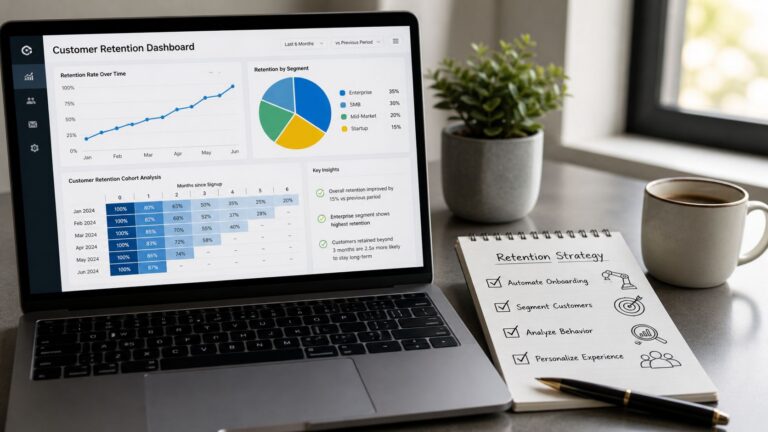
Cancellations rarely begin at the cancellation screen. By then, the useful warning has often appeared weeks earlier, in declining usage, missed milestones, weak feature adoption, or a customer who never reaches a personal outcome.
The popular advice says to launch a loyalty programme, send more discounts, or add an AI churn score. I’d start earlier and spend less. I’m Sam Woods, a Fractional Chief AI Officer working with ML since 2016 and generative AI since 2019, and I’ve found that a spreadsheet, existing product data, and one well-timed intervention usually beat complex retention software built on weak signals.
The customer retention strategies below start with observable behaviour and cancellation friction. Each one includes a small-business build path, a SaaS, ecommerce, or subscription example, and a way to distinguish genuine retention from delayed churn. Track cohort retention, customer lifetime value, churn rate, reactivation, repeat purchase, and intervention cost. Those measures tell you whether customers are staying because they’re receiving value or because you’ve postponed the same decision.
Table of Contents
- 1. Behavioral Segmentation and Win-Back Campaigns
- 2. Usage-Based Pricing and Expansion Revenue
- 3. Proactive In-Product Messaging and Onboarding Loops
- 4. Community and Peer Learning Networks
- 5. Net Promoter Score Tracking with Closed-Loop Follow-Up
- 6. Personalized Success Metrics and Customer Health Scoring
- 7. Predictive Churn Modeling with Targeted Interventions
- 8. Multi-Channel Engagement Across Email, In-App, and SMS
- 9. Expansion Revenue Through Cross-Sell and Upsell Triggers
- 10. Win-Back and Pause-Account Strategies Instead of Full Cancellation
- 10-Point Customer Retention Strategy Comparison
- Your Monday Retention Build
1. Behavioral Segmentation and Win-Back Campaigns
Customer statements can be useful, but behaviour usually gives you the earlier warning. I’d begin by dividing customers into power users, occasional users, and inactive accounts, using three to five engagement signals instead of trying to capture everything.
For a SaaS product, those signals might be logins, core-feature usage, completed workflows, support activity, and payment status. An analytics tool could flag declining API calls, then send a message about features the customer hasn’t used recently. An ecommerce platform could separate people who browse frequently from people who bought once and disappeared. A subscription app might send inactive users one short email with one reason to return, rather than a catalogue of features.
Build the first version from customers who already churned. Compare their recent behaviour with customers who stayed. Look for repeated patterns, then create one playbook for each segment. Someone who paused needs a different message from someone who hasn’t opened the product in months.
For win-back campaigns, use a relevant value proposition before offering a discount. A customer who bought replenishable goods might need a reorder reminder. Someone who purchased a one-off item may need education, a bundle, or a free-shipping threshold that makes the second purchase worthwhile. These email segmentation practices can help you organise the groups without buying a full customer data platform.
A practical rule: don’t count a reactivation as success until the customer makes another meaningful purchase or completes the next valuable action.
Track reactivation rate, repeat-churn rate, and contribution margin after the campaign. A customer who returns briefly and leaves again hasn’t solved your retention problem.
2. Usage-Based Pricing and Expansion Revenue
Flat pricing can make light users feel overcharged and give heavy users a reason to look elsewhere. Usage-based pricing can connect the bill to value, though it creates a different risk: unpredictable charges can cause bill shock and accelerate churn.
Before changing your plans, meter usage for at least the period needed to understand normal behaviour. The verified benchmark available for this article does not establish a duration, so I’d choose a period that captures ordinary seasonality in your business. Record usage by customer, identify outliers, and calculate what each customer would pay under a proposed model.
An API platform might charge per API call with a monthly minimum. An analytics product could charge per tracked event. Logistics software could price by shipment tracked, allowing a customer to grow without renegotiating a contract every time volume changes.
Give customers a visible usage dashboard. Add warnings before they reach a limit, publish a predictable base tier, and explain overage costs in plain language. If usage suddenly spikes, contact the customer. The change might indicate healthy growth, a broken integration, or accidental consumption.
A fair pricing model needs an escape hatch. Set caps, alerts, or approval steps before an unexpected invoice becomes the customer’s reason to leave.
Measure gross revenue retention separately from expansion revenue. Also track usage growth, downgrade rate, failed payments, support contacts about billing, and gross margin by account. My guide to increasing customer lifetime value covers the broader economics. Don’t switch to consumption pricing because it sounds modern. If customers value predictable bills more than flexible scaling, a base subscription with limited usage allowances may retain more of them.
3. Proactive In-Product Messaging and Onboarding Loops
Most customers don’t use everything they bought. A useful product message appears at the moment a customer can act, not as a general announcement sent to everyone.
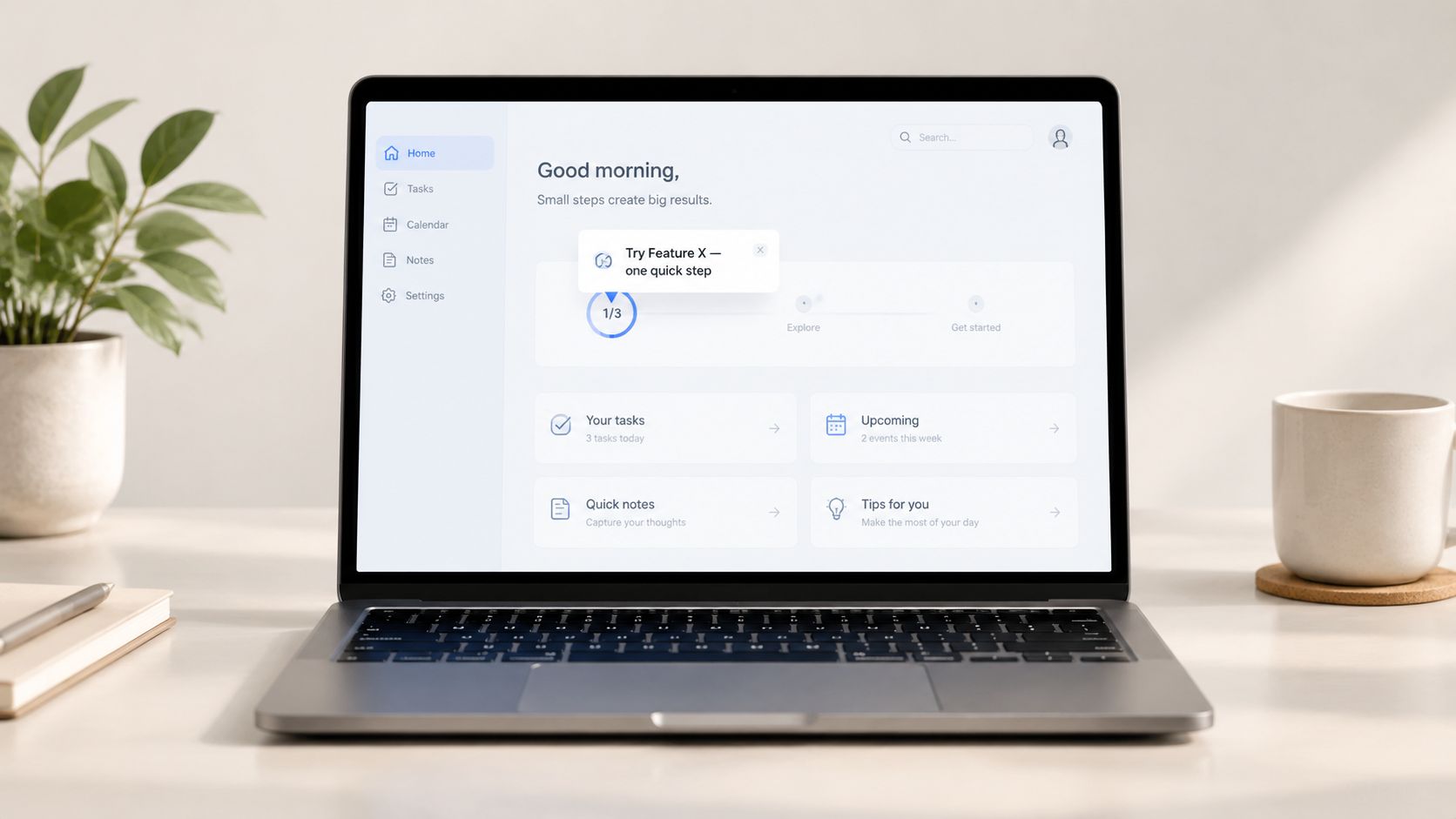
Start with three drop-off points. A project management tool might show a one-sentence template tip when a user hasn’t created a task recently. An email platform could celebrate the first successful send and suggest segmentation, automation, or analytics as the next action. Financial software might display the account balance and a single “Reconcile now” button after a long gap.
Keep the message short. One sentence and one action button is enough for the first test. Make it dismissible, and stop showing it after repeated dismissal. The customer should feel guided, not trapped.
The build path can be simple. Export event data, identify the action that predicts progress, and set a trigger in your product or email tool. Then compare customers who received the message with a holdout group that didn’t. A clear SaaS onboarding funnel helps you locate the point where customers stop moving.
For a CRM, if a deal changes stage while the customer hasn’t logged in, show a notification containing the deal summary and next action. For a project tool, test whether a template prompt works better after a shorter or longer inactivity period.
Measure time to first value, adoption of the target feature, renewal or repeat purchase by cohort, and support requests triggered by the message. AI-powered in-product guidance can help later, but automation won’t repair a confusing milestone. Fix the event and message logic first.
4. Community and Peer Learning Networks
A community can give customers practical help that your product documentation can’t provide. It can also create relationships that make cancellation feel costly for reasons beyond price.
Don’t start with a custom forum. If you have a small customer base, use a place your customers already understand, such as Slack or Discord. A design tool could create a group for template sharing, critiques, and integration advice. A fitness subscription could run challenges and member spotlights. An accounting product could host webinars where customers share workflows.
The risk is an empty room. Seed the group with questions you already answer in support conversations. Post useful examples before asking customers to create content. Set clear guidelines, then recognise contributors with early access, public thanks, or practical benefits. Avoid building a community solely to broadcast promotions. Customers will leave if every discussion turns into a sales message.
A small group also needs an owner. If you personally can’t answer questions or maintain a useful rhythm, delay the community and improve onboarding or support instead. Community participation is a signal, not proof of retention. Some customers stay quiet and still receive strong value, while active participants may enjoy the group without buying again.
Track participation, meaningful contributions, repeat purchase or renewal, referral activity, and churn by participant status. Compare active members with a similar group that didn’t participate. Measure the customer’s retained behaviour after the community interaction, rather than treating membership as a win.

5. Net Promoter Score Tracking with Closed-Loop Follow-Up
NPS is easy to collect and easy to misuse. A score without follow-up is survey theatre. I’d use the question as a reason to start a conversation, not as a dashboard ornament.
Ask customers how likely they are to recommend the product on a scale of zero to ten, then include one open field asking why. Follow up personally with detractors. Ask passives what one change would move their experience higher. Ask promoters for a referral, review, or permission to use their feedback.
A SaaS customer might identify a missing integration. A coaching platform might reveal that customers feel abandoned after onboarding. An ecommerce tool might uncover a broken report that prevents buyers from understanding results. Those answers are more useful than the aggregate score because they connect dissatisfaction to an action.
Run the survey at a consistent point in the customer lifecycle. Don’t send it repeatedly whenever a customer happens to log in. A new customer answering immediately after signup is describing first impressions, while a long-term customer can describe whether the product continues to earn its place.
Ask the detractor, “What would need to change for you to give us a 9?” Then record the answer as a retention risk, product request, or service problem.
Track response rate, detractor follow-up completion, issue categories, time to response, and churn among respondents. If you fix a repeated problem, tell the affected customers and ask again later. Don’t claim the survey improved retention until the customers who gave feedback continue purchasing or renewing beyond the normal decision point.
6. Personalized Success Metrics and Customer Health Scoring
A customer can be active and still be failing. Login frequency, feature adoption, and session counts only matter when they connect to the outcome the customer wanted.
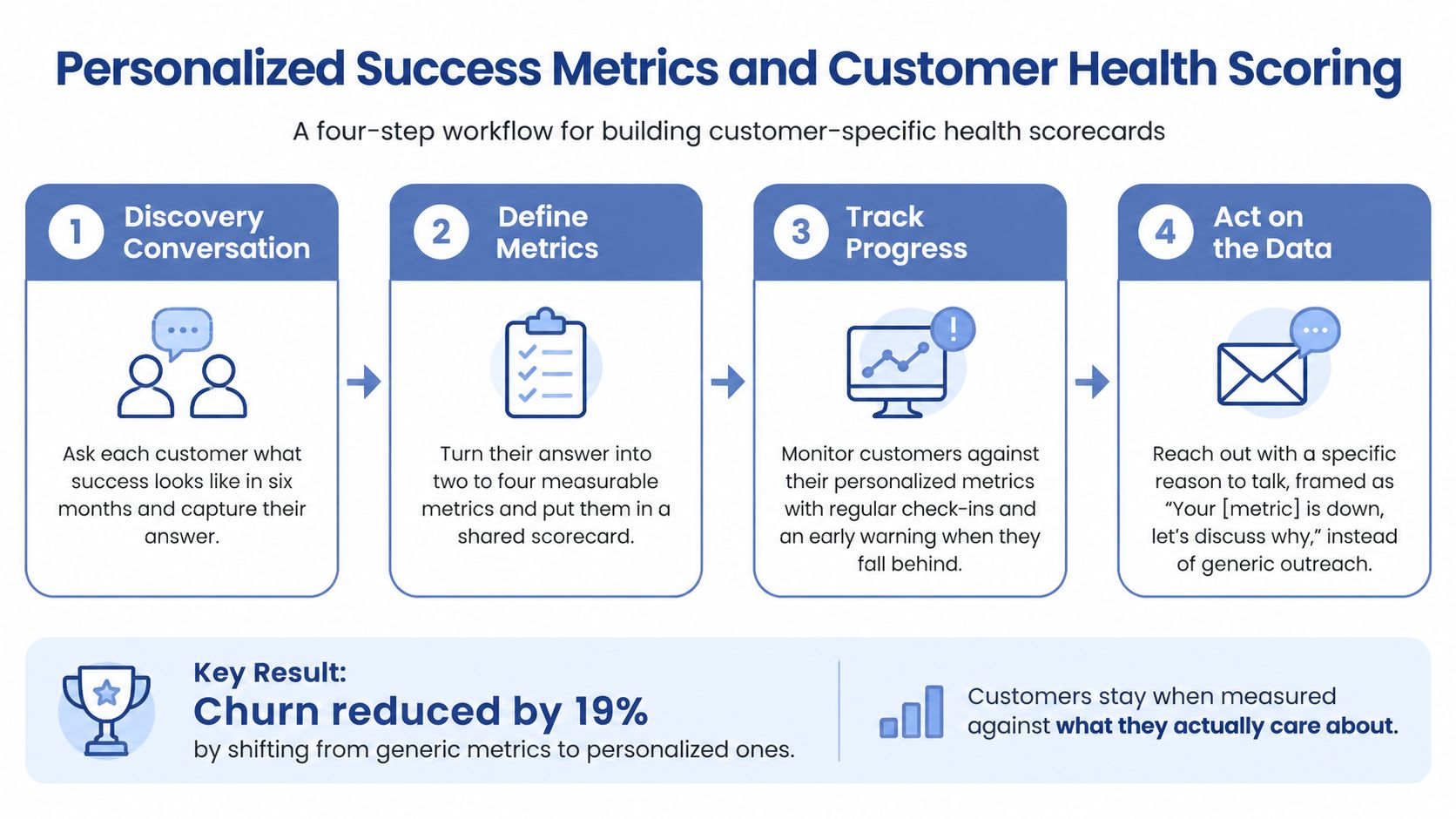
During onboarding, ask a direct question: if this purchase works well over the coming months, what will that look like in numbers? A marketing automation customer might care about click-through rate. Another might care about sending a certain volume of campaigns. A project management customer might measure completed tasks, while another cares about reducing meeting time.
Write down two to four success metrics in a shared document. Show the customer what you’re tracking and review the measures when their situation changes. A generic health score may mark someone as unhealthy because they don’t use an advanced feature, even though they’re achieving the result that justified the purchase.
For a SaaS analytics platform, one customer may need one actionable insight per week. Another may need to onboard colleagues. The product activity differs, but both can have a clear success path.
Measure the percentage of customers who define a success outcome, progress against that outcome, renewal or repeat purchase by outcome status, and time between milestones. Compare customers with visible progress against customers who stall. That separates useful health scoring from decorative scoring.
Don’t create a health score with ten inputs because your software allows it. Start with the customer’s stated outcome, one behaviour that supports it, and one risk signal. If you can’t explain why a score changed, you can’t make a good intervention from it.
7. Predictive Churn Modeling with Targeted Interventions
You don’t need machine learning to begin predicting churn. You need a list of customers who left, a similar list of customers who stayed, and a comparison of what happened before the outcome.
Look for payment delays, missed onboarding steps, reduced usage, seat reductions, abandoned carts, or heavy use of one feature without adoption of the next required feature. A SaaS product might notice that customers who reduce seats shortly after joining need a conversation. An ecommerce store might identify a pattern where a one-time buyer abandons several carts and then disappears.
Write the risk rules in a spreadsheet. Score accounts weekly, then test the rules on customers you didn’t use to create them. Wait through the normal churn window before deciding whether the prediction worked. A risk score that produces many false alarms will waste your time and train customers to ignore your messages.
When a customer misses an onboarding milestone, offer help with that milestone. When payment fails, resolve the billing issue. When usage falls, ask what changed before sending a promotion. This guide to building a churn model can help you move beyond manual rules when the underlying data is clean.
Use AI last. A complex score built on incomplete events gives you a confident explanation for a bad decision.
Track precision, saves, false alarms, holdout churn, and intervention cost. Review the rules quarterly. A risk signal can change as your product, audience, and buying cycle change.
8. Multi-Channel Engagement Across Email, In-App, and SMS
More channels won’t automatically create more retention. They can create more noise, more unsubscribes, and more work for a solo operator.
Give each channel one job. Email can handle planning and education. In-app messaging can prompt an immediate product action. SMS can carry urgent reminders or security alerts, with clear consent. A fitness app might send a progress email, show an in-app workout reminder, and reserve SMS for a scheduled class.
Start with email and in-app messages. Build one sequence around one risk signal. For example, show an in-app reminder after a customer stops completing a core action, send an email with a practical example the next day, and stop the sequence when the customer completes the action. Don’t send three versions of the same message.
A project management tool could use email for incomplete-task summaries and in-app notifications for comments. A financial product could use email for statements, in-app alerts for account activity, and SMS for security events. The channel should match the customer’s need, not your available integrations.
Ask customers how they prefer to be contacted and store the answer. Track delivery, response, completion of the target action, unsubscribe rate, and churn by channel preference. If a customer never engages with email, stop spending effort on email retention messages. Switch the intervention to a channel they use, or contact them manually when the account value justifies it.
9. Expansion Revenue Through Cross-Sell and Upsell Triggers
Expansion should follow demonstrated value. Offering a higher plan before the customer understands the current one can make the product feel extractive and increase cancellation risk.
Map every plan to an observable usage threshold or outcome. An analytics customer approaching a tracking limit may need additional capacity. A design-tool customer creating many assets and inviting collaborators may need shared brand controls. An accounting customer processing more transactions may benefit from accountant access.
Show the next option when the customer has earned a reason to consider it. Explain what changes in practical terms. “More events, dedicated support, and API access” is clearer than “upgrade for advanced features.” Offer a trial where the product and pricing allow it, then ask whether the additional value justified the change.
Cross-sell works best when the adjacent product solves a problem visible in current behaviour. A customer using reporting heavily may need data exports. A subscription buyer who repeatedly purchases complementary items may respond to a bundle. A generic product carousel shown to every customer is usually weaker than a trigger tied to a real need.
Track expansion rate separately from logo retention. Monitor upgrades, downgrades, expansion revenue, gross revenue retention, product usage, and margin after the offer. Bain’s retention research found that acquiring a new customer can cost five to twenty-five times more than retaining an existing one, as summarised by LoyaltyPass’s retention economics guide. That makes expansion attractive, but only when the offer preserves trust and margin.
10. Win-Back and Pause-Account Strategies Instead of Full Cancellation
A cancellation screen is one of the few moments when a customer tells you directly that the current arrangement no longer works. Don’t hide the cancellation button or make leaving hostile. Give the customer a useful alternative.
Offer a pause, a lower tier, or a clean cancellation. A project management subscription may suit a seasonal business that needs to preserve its history without paying during a quiet period. A fitness subscription may need a pause during a busy season. A SaaS product may retain part of the relationship through a smaller plan.
The pause must be operationally clear. Explain what happens to data, access, billing, and the reactivation date. Send one reminder before the pause ends, then allow the customer to return without a sales interrogation. If the customer chooses cancellation, ask one reason and record it.
Don’t make pause the default through confusing interface design. That may improve a short-term account count while damaging trust and increasing payment disputes. The offer should reduce genuine friction, not prevent a customer from making a decision.
Measure pause selection, downgrade selection, cancellation completion, pause-to-reactivation, later churn after reactivation, and revenue retained after costs. A pause only counts as a win if the customer returns to meaningful usage or purchasing. The same principle applies to downgrades. Retaining a customer at a loss can be worse than a clean cancellation.
10-Point Customer Retention Strategy Comparison
| Strategy | Implementation complexity | Resource requirements | Expected outcomes | Ideal use cases | Key advantages | Key limitations |
|---|---|---|---|---|---|---|
| Behavioral Segmentation and Win-Back Campaigns | Medium, requires event tracking and segmentation logic | Analytics events, marketing automation, engineering for triggers | Recover ~18–24% of inactive users in 30 days; earlier churn detection | Product with measurable usage patterns (SaaS, subscriptions) | Highly personalized outreach; lower cost to recover customers | Needs good tracking; risk of intrusive messaging and false positives |
| Usage-Based Pricing and Expansion Revenue | High, billing, metering, and pricing redesign | Accurate metering, billing system, usage dashboards, finance | Cuts involuntary churn ~22–30%; creates natural expansion path | Products where usage maps to value (API, storage, transactions) | Aligns revenue to customer value; self-serve expansion | Requires precise billing; risk of bill shock and gaming |
| Proactive In-Product Messaging and Onboarding Loops | Medium, product changes plus analytics-driven triggers | Product dev, in-app messaging platform, analytics | Higher feature adoption and reduced churn from forgotten features | Product with UI where tips and milestones can be shown | Reaches users in-context; measurable adoption lift | Can be spammy if overused; needs accurate timing and relevance |
| Community and Peer Learning Networks | Low–Medium, platform setup and ongoing moderation | Community manager, platform (Slack/forum), events coordination | Reduced churn (e.g., ~12% for engaged members); higher NPS & advocacy | B2B/B2C products with engaged user base and peer value | Creates non-price switching costs; reduces support load | Slow to scale; needs moderation; hard to measure early ROI |
| NPS Tracking with Closed-Loop Follow-Up | Low, survey tooling + disciplined follow-up | Survey tool, CS time for follow-up, tracking system | Early warning of churn; converts detractors into promoters | Companies wanting direct feedback and targeted recoveries | Direct qualitative feedback; actionable reasons to fix issues | Survey fatigue; time-intensive follow-up; lagging indicator |
| Personalized Success Metrics & Customer Health Scoring | Medium, requires discovery and custom scorecards | CSM time, shared scorecards, analytics to track metrics | Reduced churn (~19% reported); more relevant interventions | High-touch accounts where success varies by customer | Measures what customers actually care about; stronger CSM conversations | Time-intensive onboarding; metrics must be reviewed regularly |
| Predictive Churn Modeling with Targeted Interventions | Medium–High, data modeling and ongoing scoring | Historical churn data, analyst/ML resources, intervention playbooks | Catches ~30–40% of would-be churners; low cost per save | Businesses with sufficient churn history and trackable signals | Proactive, targeted outreach; measurable intervention ROI | Needs historical data; false positives and model drift risk |
| Multi-Channel Engagement (Email, In-App, SMS) | Medium, integrations and sequencing rules | Integrations (SMS gateway, in-app, email), consent handling | Higher engagement (e.g., 8% → 31% across channels) | Diverse audience preferring different channels | Meets customers where they are; better open/response rates | More integrations and compliance (SMS); risk of over-contacting |
| Expansion Revenue via Cross-Sell & Upsell Triggers | Medium, rule-based triggers and UX flows | Product analytics, UX flows, sales/CS enablement | Increased ARPU; reported expansion ~25–30% of recurring revenue | Products with clear tiers and usage thresholds | Grows revenue from existing customers with low acquisition cost | Can feel pushy if mistimed; requires clear tier differentiation |
| Win-Back and Pause-Account Strategies | Low, UI change and automated flows | Product UI, billing logic, reactivation campaigns | Recover ~10–14% of churners; paused accounts often self-reactivate | Subscription businesses with retention sensitivity | Recovers customers without aggressive discounts; buys time | Short-term revenue loss; risk of long-lived inactive paused accounts |
Your Monday Retention Build
Start with recent cancellations. Export the last group you can identify, then compare those customers with stable customers who bought or renewed during the same period. You don’t need a predictive platform for this first pass. Look for one observable difference, such as declining usage, an incomplete onboarding step, a failed payment, or a long gap between purchases.
Record your baseline before changing anything. Track churn rate, cohort retention, reactivation rate, customer lifetime value, revenue retained, gross margin, and intervention cost. For ecommerce, add repeat purchase rate and time to second purchase. For subscriptions, separate logo retention from revenue retention so a downgrade doesn’t disappear inside a stable customer count.
Pick one intervention. If inactive customers tend to leave, send a segment-specific message. If customers cancel because the plan feels too large, test a downgrade or pause. If buyers rarely return after their first order, build a second-purchase offer around a bundle, subscribe-and-save option, free-shipping threshold, or gift. Discounting isn’t automatically wrong, but it shouldn’t be your first response when you haven’t identified the reason for churn.
Create a holdout group. Don’t contact every eligible customer, because you need a comparison that shows whether the intervention changed behaviour. Define the success event before sending anything, such as a renewed subscription, a second purchase, or completion of a core product action.
Review the first cohort after the normal decision period for your business. Check whether reactivated customers stayed, whether margin survived the offer, and whether the intervention consumed more time than the retained revenue justified. If the signal holds, automate the simple parts. If it doesn’t, change the message or abandon the tactic.
Leave AI scoring, multi-channel sequences, and expansion offers until your events and customer outcomes are reliable. Halo AI’s customer retention strategies guide is one option to review when you’re ready to automate behaviour-based playbooks. On Monday, though, start with the cancellation export, one signal, one intervention, and one honest comparison.