
Many teams think they have an SEO problem. The real problem is throughput.
You've got pages to update, briefs to write, competitors to watch, and a dashboard that keeps getting louder while the revenue line barely moves. That's where AI agents for SEO matter: as a way to turn repetitive SEO work into a managed workflow that can be measured, governed, and scaled. I've spent years building ML systems and, since 2019, GenAI systems that sit inside real businesses, and the pattern is always the same: the teams that win treat agents as operational tools instead of a faster copy machine.
Table of Contents
- Why Most AI Agents for SEO Fail Before They Start
- The Operational Loop Every Serious SEO Agent Runs
- The Agent Roles That Actually Move Rankings
- Deploying on Technical SEO Before You Touch Content
- Why Striking-Distance Optimization Beats More Content
- Governance, Risk, and AI-Search Access
- The 30/60/90 Rollout Plan and What to Measure
Why Most AI Agents for SEO Fail Before They Start
A team buys an AI agent, points it at publishing, and calls that an SEO system. In practice, that usually means faster production of average work, repeated angles, and a brand voice that drifts a little more each week. I've seen teams celebrate output volume while rankings, leads, and internal trust stay flat.
The better frame is workflow first, content second. SEO agents fail when they are handed tasks without a clear operating sequence, validation step, or business target. If you want to find AI tools for SEO growth, start by asking whether the tool reduces a real bottleneck or just speeds up a low-value task.
If the agent cannot be measured against a manual baseline, it is a demo, not a system.
A serious deployment starts with business outcomes. That can mean ranking recovery, traffic from pages already close to winning, internal-link coverage, or faster turnaround on technical fixes. It does not mean “publish more content” as a default answer.
The capital allocation problem matters too. You have limited reviewer time, limited developer time, and limited tolerance for bad output. That is why I treat agents as force multipliers rather than a shortcut around strategy. If you want the ROI logic I use, I keep it in my own AI agent ROI framework.
The Operational Loop Every Serious SEO Agent Runs
An SEO agent that works in production doesn't behave like a chatbot. It runs a loop. The loop is perceive, plan, execute, validate, and if one of those stages is weak, the whole system gets brittle fast.
Perceive, then plan against live inputs
The perceive stage should ingest live signals, not stale exports. That includes crawl data, Search Console queries, rank tracking, and AI-visibility measurements. Once those inputs are in place, the agent turns a goal into a task graph, which is where the system starts to look less like prompting and more like operations.
That task graph matters because it narrows the failure surface. A research agent can pull seed topics, intents, entities, competitor URLs, SERP features, and question sets. A brief agent can then output an outline, H2 and H3 structure, FAQs, required sources, schema suggestions, and CTA guidance in structured formats like JSON or tables for easier review.
The point is control. You don't want a model inventing its own process. You want it working inside a process you can inspect.
Execute with narrow outputs and validate before approval
The execute stage should produce artifacts, not vibes. Those artifacts might be a sourced draft, a schema block, a link suggestion set, or a localization variant for a market with different SERP behavior. The human review gate sits after that, not before the agent has done useful work and not after it has already published.
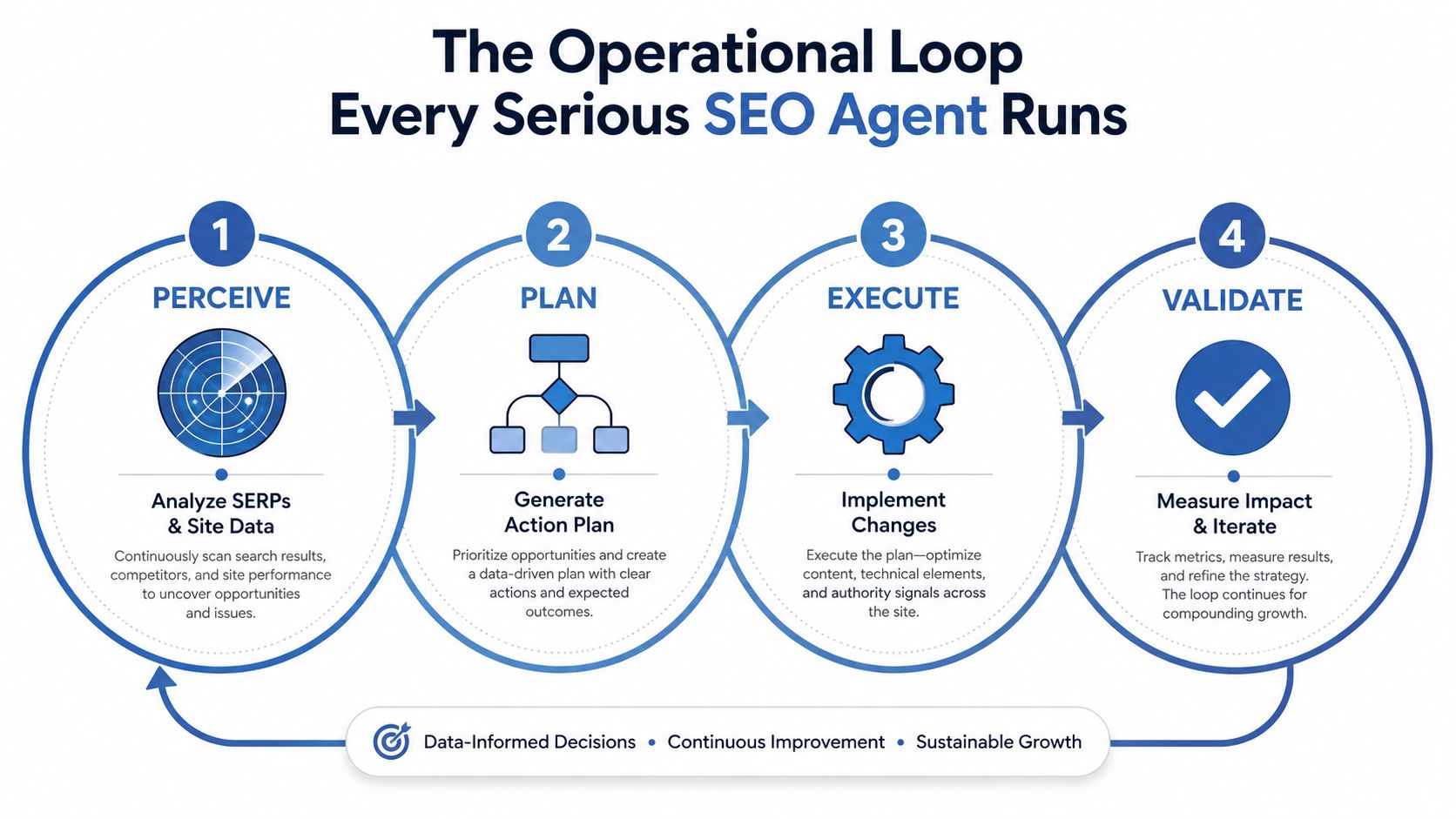
Validation is where a lot of teams get lazy. The bigger risk is a fast, wrong recommendation that lands in production and takes time to unwind. The safest pattern is to advance from research to outline to drafting only after each stage has a validated output format, which is the difference between a controlled workflow and a brittle one.
For the orchestration side, I break this down further in my agent orchestration notes.
The Agent Roles That Actually Move Rankings
Single-purpose agents win because they're easier to govern and easier to measure. In practice, the highest-value deployments usually split into research, brief, link, schema, QA, and localization. That separation keeps the input/output contract tight, which is what reduces errors when humans review the work.
Research and brief agents set the direction
A research agent should handle keyword expansion, competitor extraction, and semantic gap analysis first. Those are low-risk tasks because they feed the strategy layer without touching the live site. A brief agent then turns the research into an outline, source list, heading structure, and CTA guidance.
That division is useful because it mirrors how good teams work. One person gathers evidence, another turns it into a workable page plan. When an agent handles the first part, you get speed. When a strategist reviews the second part, you keep judgment in the loop.
Link, schema, QA, and localization close the gap to production
A link agent should suggest internal links based on topical fit and page priority rather than anchor reuse. A schema agent should generate structured data in a form that can be checked before deployment. The QA agent is where hallucinations, duplicate anchors, and unsupported claims get caught before they become expensive.
Localization deserves its own role because market adaptation goes beyond translation. It needs page structure, SERP behavior, and language nuance to line up with the target market. A page that wins in one English-language market can fail in another if the format is wrong.
Keep the strategist in the loop. Agents are strong at repetitive work and weak at brand judgment.
If you want a vendor-neutral mental model, I'd keep my research agent framework handy and map each role to a clear artifact. The more precise the contract, the less likely the system is to create sloppy output.
Deploying on Technical SEO Before You Touch Content
Technical SEO is the safest place to start because the work is reversible and the output is easier to monitor. Connect Google Search Console, rank tracking, and crawlers first, then limit the agent to tasks like broken-link repair, meta-tag optimization, internal-link suggestions, and schema markup on staging.
Start with monitored, reversible actions
That ordering matters. A technical agent can be watched against crawlability and Core Web Vitals, which gives you a cleaner read on whether it's helping or hurting. One implementation guide recommends watching performance for two weeks after deployment so regressions show up early Search Atlas on AI agents in SEO.
The lower-risk lane is optimization, not publishing. Meta descriptions, schema generation, and internal linking suggestions can still be wrong, but they're much easier to inspect and correct than a fully drafted page pushed live without review.
Don't let raw model output publish itself
The most common failure mode is letting raw LLM output hit production. That's how you get hallucinated facts, brittle recommendations, and off-brand pages with no meaningful guardrail. Drafting is a medium-risk step, so it needs substantive human editing, not a quick glance.
A useful rule is simple: if the agent can change the live site, it needs alerts, approval workflows, and a rollback path. Technical actions on staging should be the first lane, because they're easier to measure and easier to undo if something behaves badly.
I've used this same deployment logic for teams that needed a sane starting point, not a heroic transformation. If you want that kind of agentic execution inside a controlled marketing stack rather than a content factory, it is work I do with clients.
Don't start with the creative work. Start with the work that breaks cleanly when something goes wrong.
Why Striking-Distance Optimization Beats More Content
Many teams are chasing the wrong output. They think more pages will solve a visibility problem, but the faster payback usually comes from pages that already have traction. I mean the pages sitting in the striking-distance zone, with real impressions, positions roughly 7 to 15 or 11 to 20, and CTR gaps that suggest the page is close but underperforming.
Use first-party search data as the priority filter
Pull Search Console data, filter by those rank windows, and rank the opportunities by business value rather than task volume. A page with impressions and a weak click-through pattern is usually a better use of effort than a brand-new article with no existing demand signal. That's the cleanest way to make the agent useful when resources are limited.
The useful objective is simple: impressions minus expected clicks at current position. That gives the agent a way to sort opportunities by how much upside is already sitting in the data. It also prevents the system from spending your budget on content that looks productive but isn't close to revenue.
A small example makes the trade-off obvious
Think about the cost of a net-new article. You need research, brief creation, drafting, review, publication, and then time for the page to earn enough signals to matter. Now compare that with improving an existing page that already brings impressions. The second path has less editorial overhead and a shorter path to visible movement.
That's why agentic SEO should feel more like portfolio management than content production. You're deciding where to put effort for the highest probability of return instead of where to add more words.
Prioritize pages already close to winning. They're cheaper to move and easier to defend in a budget meeting.
This is the section where the agent earns its keep. Instead of generating novelty, it helps you redirect scarce attention toward the assets that already have commercial intent baked into them.
Governance, Risk, and AI-Search Access
Autonomy is a tax. The more you let the agent do, the more you owe it in guardrails, source requirements, and review discipline. That's why the governance layer has to sit above the workflow, not as an afterthought once the pages are already live.
Quality gates matter more than output volume
The trust stack should include approval workflows, explicit source requirements, and hallucination checks between drafting and publishing. The reason is simple: agents are good at repetitive deliverables, but they still need human oversight for strategic judgment, brand fit, and claim validation.
The new failure modes are bigger than duplicate content. You also get shallow content, weak original value, and systems that optimize for output volume instead of business outcomes. That's why I prefer a strategist in the loop, strict QA gates, and metrics tied to rank, clicks, and leads.
Robots.txt is now part of the discoverability strategy
AI-search access changes the conversation. BrightEdge says marketers should verify that wildcard Disallow rules aren't blocking AI agents, and explicitly list bots such as OAI-SearchBot, Claude-SearchBot, Applebot, and PerplexityBot where appropriate. It also says the training-agent policy for GPTBot and Google-Extended should be intentional BrightEdge's guide for AI agents.
That matters because your content can rank in classic search and still be invisible to AI answers if access is misconfigured. Robots.txt now helps control discoverability across search surfaces, so treat it as more than housekeeping.
The new FAQ for founders is straightforward. Can the agent improve visibility without exposing the wrong content, blocking the wrong bots, or creating spammy outputs that hurt trust later? The answer depends on governance, not enthusiasm.
If the system can't explain what it changed and why, it doesn't belong near publishing.
The 30/60/90 Rollout Plan and What to Measure
A sane rollout starts with work that is easy to control and hard to regret. In the first 30 days, keep the agent limited to technical fixes, research, and structured outputs. Broken-link repair, meta-tag suggestions, schema on staging, and research outputs that a human can approve quickly all fit that lane.
Days 1 to 30 focus on low-risk, reversible work
The first checkpoint is simple. Can the agent produce validated output formats without breaking the workflow? If the research stage cannot return clean, structured opportunities, the system is not ready for the next step. If it can, you have the basis for a brief agent and a review path that stays orderly.
By day 30, answer one practical question. Is this system reducing operator friction, or is it creating more tasks? That test matters more than volume, because output that needs cleanup does not save capacity.
Days 31 to 60 add research and brief generation
In the next phase, let the research agent feed the brief agent. The workflow starts to compound because the output from one stage becomes the input for the next. The human checkpoint stays in place, but the time spent assembling the work should drop.
Measure leading indicators first. Look at rank movement on striking-distance pages, CTR lift, and internal-link coverage before you expect revenue changes. Those signals show whether the system is driving operating efficiency.
Days 61 to 90 open drafting only after QA proves itself
Keep drafting closed until the QA gates are stable. Once they are, let the drafting lane open under human review, using the same source rules and approval workflow you used earlier. The goal is controlled scale rather than maximum autonomy.
The macro metrics matter too. The deployed-agent benchmark in the 2026 industry roundup includes a median payback period of 8.3 months and 171% average global ROI. Use those numbers as a big-picture sanity check, but manage the rollout with operational metrics first.
If you are ready to stop treating SEO as a content treadmill, start with one controlled workflow, one approval gate, and one measurable priority queue. Build from there, then expand only when the system proves it can create revenue growth without creating cleanup work.