
Most founders asking about an ai agent for seo research are solving the wrong problem.
They ask how to automate keyword research. I care about whether that automation turns into pipeline, revenue, and a stronger position than the team trying to outrank you. If your agent only saves time, you built a convenience. If it finds commercial opportunities faster than your competitors and helps you publish the right assets first, you built an advantage.
I’m Samuel Woods. I’ve been working with machine learning since 2016 and generative AI since 2019. My advice is simple. Don’t build an SEO agent because AI is trendy. Build one because Google has changed, buyer behavior has changed, and manual SEO research is too slow to defend your market.
Your Competitors Are Already Winning with AI
How much revenue are you leaving on the table while your team treats SEO research like a monthly reporting task?
Your competitors are not waiting for the next planning meeting. They are using AI systems to monitor SERP shifts, spot buying-intent patterns early, and publish pages that capture demand before slower teams even agree on priorities. In a market where search engines answer more questions directly, every missed opportunity costs more.

That changes the job.
SEO research used to reward patience and good spreadsheets. Now it rewards teams that can read intent shifts fast, connect them to offers, and act before the window closes. An ai agent for seo research matters because it helps you make better commercial decisions at search speed, not because it saves a few hours for your marketing team.
Why manual research is now costing you money
Manual research creates delay at the exact point where speed affects revenue. Someone exports keywords. Someone else groups them. Another person reviews the SERP. Then the team debates priority. By then, the highest-value terms may already be claimed by a competitor with a faster workflow.
The problem is not labor. The problem is response time.
If your process still depends on humans opening tab after tab to interpret the market, you are training your company to react late. Late research leads to late briefs. Late briefs lead to late pages. Late pages miss the highest-intent traffic when it matters.
Here’s what that looks like in practice:
- You spot opportunities too late: A competitor launches a new comparison page or feature page, and your team notices after rankings and pipeline have already shifted.
- You waste content budget on weak targets: Broad, low-intent topics look attractive in a spreadsheet but do little for revenue.
- You fail to protect brand position: Search results change faster than quarterly planning cycles. If no system is watching, you lose ground unnoticed.
That is why I keep pushing founders to stop treating SEO as a publishing function. It is a search intelligence function tied to revenue. If you want a broader view of how that shift works, this guide on mastering AI search optimization frames the business implications clearly.
What winning teams do differently
The teams pulling ahead are not just generating more content. They are using agents to evaluate which searches still deserve a click, which pages need a stronger commercial angle, and which gaps are worth attacking now.
That is a very different operating model.
A good agent helps you do three things consistently:
- Detect patterns in the SERP before they become obvious
- Prioritize opportunities by revenue potential, not search volume alone
- Trigger action fast enough to beat slower competitors to market
That last point matters most. Speed without judgment creates junk content. Judgment without speed creates missed revenue. You need both.
I’ve written about broader AI agent use cases for growth teams because the same rule applies here. You and I are not trying to build an impressive demo. We are building a system that finds profitable search opportunities early, routes them into execution, and protects your brand from becoming generic AI sludge.
If your current SEO process produces reports instead of decisions, your competitors already have the advantage.
Define the Mission Before Building the Machine
Most AI agent projects fail before the first prompt.
The mistake is always the same. Someone says, “Let’s build an SEO research agent,” which sounds smart and produces a bloated system with no commercial target. That’s not a mission. That’s a vague task list wearing expensive clothes.

The market is large because the upside is real. The global market for AI-powered SEO tools is projected to reach $1.5 billion by 2025, and companies adopting AI-driven strategies report an average 25% increase in organic traffic and a 15% rise in conversions, according to this industry analysis. Good. That tells you demand exists. It does not tell you what your agent should do for your business.
Pick a revenue mission, not a feature list
I want your agent tied to one of these missions:
- New product line expansion: Find high-intent keyword clusters tied to a product, feature, or service you need to sell now.
- Competitive capture: Identify weak competitor pages you can outrank with a better angle, tighter offer alignment, or stronger supporting assets.
- Sales assist discovery: Surface questions and problem queries that lead to demos, consultations, or purchase-ready conversations.
- Retention and expansion support: Find content opportunities that help current customers adopt more of your product and reduce churn risk.
Those are missions. “Do keyword research” is not.
The inputs that actually matter
Before you build anything, give the agent your business truth. Not marketing fluff. Real inputs.
That usually means:
- Product reality: Your product categories, service lines, offers, and margins.
- Customer language: Sales call notes, support logs, objection patterns, CRM notes.
- Existing proof: Pages that already convert, pages that already rank, and pages that attract the wrong traffic.
- Strategic constraints: Markets you care about, customer segments you don’t want, and offers you won’t prioritize.
If you skip this and feed the agent only broad prompts, it will happily produce polished nonsense.
An SEO agent without business context will optimize for motion, not money.
A lot of teams also need to think beyond Google now. If you care about answer engines and AI visibility, this piece on how to rank in ChatGPT is useful because it pushes you to think about retrieval and citation, not just blue links.
Here’s a simple litmus test. If your agent returns a list of topics and you can’t immediately tell which ones affect revenue, the mission is still wrong.
A short walkthrough helps clarify the architecture decisions behind that mission:
The scorecard I use
I don’t evaluate an ai agent for seo research on how much work it automates. I evaluate it on whether it improves commercial decision-making.
Use this scorecard:
| Question | Good answer |
|---|---|
| What business line does it support | One clear offer, category, or growth priority |
| What decisions does it improve | Topic selection, page prioritization, update timing, competitor response |
| What data does it need | Search data, analytics, CRM or sales context, SERP observations |
| What output should it produce | Prioritized keyword maps, content briefs, update recommendations, gap reports |
| How do you judge success | Better traffic quality, stronger conversion paths, faster response to opportunity |
That’s how you stop building toys and start building operating systems.
Assemble the Agent's Toolkit and Brain
An ai agent for seo research is only as smart as the systems you connect to it.
Teams often overfocus on the model and underinvest in the data layer. That’s backwards. A strong model with weak context gives you polished guesses. A good model with the right inputs gives you decisions you can use.
Start with the data stack you already own
Your agent should pull from the places where search behavior and business reality meet.
That usually includes:
- Google Search Console: Query patterns, page-level visibility, click and impression changes.
- Analytics platform: Engagement signals, conversion paths, landing page behavior.
- CRM: Lead quality, deal notes, segment value, common objections.
- SERP tools or live search pulls: Ranking patterns, page types, angle shifts, competitor moves.
- CMS or content inventory: What exists, what overlaps, what’s outdated, what supports revenue.
If the agent can’t compare query demand with on-site outcomes, it will overvalue traffic and undervalue buyers. That’s one of the most expensive mistakes in SEO.
Don’t buy a genius model for a mediocre process
Founders ask me which model to use. The honest answer is that your choice depends on the job.
Use a stronger reasoning model for analysis, synthesis, and prioritization. Use a faster, cheaper model for repetitive formatting, classification, and handoff tasks. Don’t run premium reasoning on work a lighter model can handle.
If you want the wider strategic view of how these systems fit together, I’ve broken that out in my guide to AI agents for business workflows.
Here’s the decision frame I use.
LLM Selection for SEO Agent Tasks 2026
| Model Family | Best For | Strengths | Considerations |
|---|---|---|---|
| GPT-4 series | Structured SEO analysis, workflow orchestration, mixed task environments | Strong general reasoning, broad ecosystem, useful for multi-step tasks | Can be overkill for simpler classification or formatting jobs |
| Claude 3 | Long-form reasoning, content strategy synthesis, brand-aware drafting | Handles large context well, strong writing control, useful when you need nuanced summaries | You still need tight instructions and grounded inputs |
| Gemini | Workspace-connected research, document-heavy workflows, broad business environments | Useful when your team already lives inside Google tools | Performance depends on how well you structure the workflow and context |
| Mixed-model setup | Mature systems with separate analyst, writer, and monitor roles | Lets you match cost and capability to each task | More moving parts, more governance, more testing required |
I’m opinionated here. Start simpler than you think.
If you’re an SMB or startup, you usually don’t need one perfect model. You need a reliable architecture where one model handles SERP analysis, another handles content shaping, and your automations route the right work to the right engine. That structure matters more than brand loyalty.
Build for retrieval, not vibes
Your agent needs retrieval before it needs personality.
I’d prioritize these capabilities in order:
- Live or recent SERP access
- Search Console and analytics ingestion
- Content inventory awareness
- CRM or customer language grounding
- Style and brand guidance
That order protects you from a common trap. Teams spend days fine-tuning prompts for tone, then realize the agent has no idea which pages make money.
My advice: wire the agent into your evidence first, then teach it how to sound good.
The brain matters. The toolkit matters more. If you connect the wrong sources, your agent becomes a fast way to scale bad prioritization.
The Multi-Agent Workflow That Dominates SERPs
Stop building one general-purpose SEO bot.
The highest-performing systems use specialized roles. That’s how you reduce errors, keep outputs auditable, and avoid the classic failure mode where one agent tries to analyze, research, write, and judge its own work. That setup creates confidence, not quality.
A multi-agent workflow of Analyst, Researcher, Writer, and Editor automates what used to take hours. Frase agents can produce competitive analysis in under 5 minutes instead of 2 to 3 hours manually, and Keyword Insights can save over 10 hours per article, according to this breakdown of the workflow.
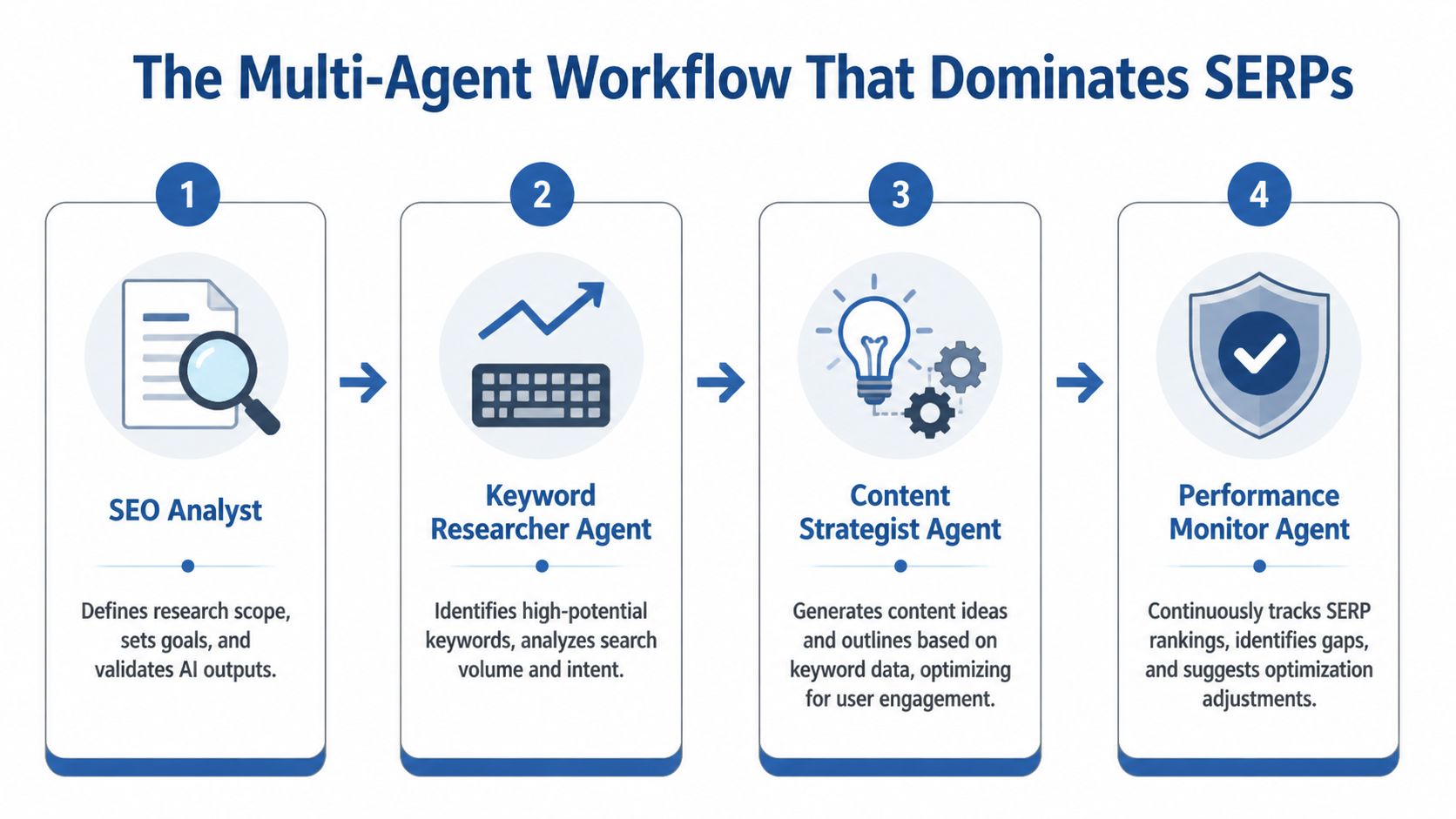
Role one, the SEO Analyst
This agent goes first because bad intent assumptions poison everything downstream.
Its job is to inspect the SERP, identify what Google is rewarding, and define the target. That includes page type, search intent, content angle, common subtopics, and whether the query is even worth your time commercially.
I want this agent answering questions like:
- Are the top results guides, landing pages, templates, or comparison pages?
- Is the SERP informational, commercial, or mixed?
- Are there patterns in titles, structures, or entity coverage?
- Does this query align with your offer, or just attract curiosity clicks?
If the answer to that last one is weak, kill the topic.
Role two, the Researcher
Your differentiation starts here.
The Researcher pulls supporting entities, fresh examples, product context, customer pain points, and missing subtopics from the top results. It should also inspect your own internal data so you don’t produce another generic article built from public consensus.
A strong Researcher doesn’t just ask, “What are competitors saying?” It asks, “What are they missing that matters to buyers?”
“The fastest path to generic content is letting the model summarize the internet without forcing it to reconcile customer reality.”
Role three, the Writer
The Writer should not have freedom. It should have a tight brief.
Give it the SERP pattern, your business goal, internal links to include, the audience stage, and the essential proof points. Then have it produce a draft that reflects E-E-A-T signals, clear structure, and natural keyword placement without sounding like a machine trying to game semantics.
A few prompt rules I use:
- Write for one buyer stage only.
- Use the target keyword where it belongs, not everywhere.
- Pull in product relevance only where it helps the reader decide.
- Flag unsupported claims instead of inventing support.
Role four, the Editor
This is your control system.
The Editor checks whether the draft matches the SERP, covers the necessary entities, stays on brand, and creates a useful path toward conversion. If it fails, it loops back with explicit revision instructions.
Use the Editor to score:
- Intent match
- Coverage completeness
- Brand voice
- Commercial alignment
- Readability and structure
The power of this setup isn’t only speed. It’s separation of duties. Each agent has one job, which makes the whole system more trustworthy and easier to improve.
From Manual Triggers to Autonomous Pipelines
If you still have to babysit the workflow, you haven’t built an agent system. You’ve built a fancier checklist.
The win comes when your ai agent for seo research reacts to business events without waiting for someone on your team to notice. A new competitor page goes live. A key article loses traction. A product launch creates a fresh content gap. Your pipeline should detect that and push the next action.
What automation should actually do
Good automation connects detection, diagnosis, and execution.
That can look like this:
- Competitor monitoring: A new article appears for a strategic topic. The pipeline triggers a SERP review, identifies the angle, compares it against your existing assets, and drafts a response brief.
- Traffic drop response: A page loses momentum. The system checks SERP changes, content freshness gaps, and internal linking opportunities, then sends an update recommendation.
- New product support: Sales launches a feature or offer. The pipeline generates initial cluster ideas, checks live search patterns, and creates a prioritized topical map.
- Publishing handoff: Once a draft clears review, the system pushes it into your CMS or project management queue with the right metadata and tasks attached.
I like using Zapier, Make, n8n, or custom scripts depending on the team. The exact tool matters less than having a clean flow between your data, your agents, and the places your team already works.
Automation without SERP checks is expensive
It is here people get reckless.
According to Frase’s analysis of AI agents for SEO, 40% of agent outputs fail without SERP validation. A practical target is 80% to 90% automation, with humans handling final strategic selection to avoid the 25% to 35% ROI drop that comes from over-automation.
That lines up with what I see in the field. Teams automate the obvious tasks, then subtly lose money because nobody validates whether the content deserves to exist.
Use this operating rule:
| Stage | Automate heavily | Keep human control |
|---|---|---|
| Detection | Yes | Only for exception handling |
| SERP data collection | Yes | Review unusual or conflicted cases |
| Clustering and prioritization drafts | Yes | Final selection and trade-offs |
| Outline and draft generation | Yes | Direction, voice, business judgment |
| Publish decision | No | Always human-approved |
Field note: let agents generate options at scale. Let humans place the bets.
That’s the model. Not total autonomy. Controlled acceleration.
If you’re building the plumbing behind this, the tool stack matters. I’ve outlined useful categories in my guide to AI workflow automation tools, especially for teams trying to connect search, analytics, and execution without creating another brittle mess.
The companies that benefit most aren’t the ones with the most automation. They’re the ones with the cleanest handoffs between automation and judgment.
The Human-Agent Loop Your Final Advantage
This is the part too many founders want to skip because they think AI should remove human effort.
That’s lazy thinking. Your final advantage is not the agent. It’s the loop between your agent and your judgment.

The risk is real. Unpublished SEMrush heuristics cited in this review of AI SEO agents suggest AI-detectable content may see 20% to 30% higher bounce rates because agents often optimize for semantic coverage instead of creative nuance. I’ve seen the same pattern qualitatively. The draft looks complete, yet it feels dead.
Where humans must stay in the loop
There are three places I won’t hand over fully.
First, topic selection. Your agent can generate a huge list of opportunities. You still need to choose which ones fit the moment, the offer, and the broader market play.
Second, brand voice and positioning. If your content sounds like everyone else, your SEO may still function for a while, but your brand gets weaker as traffic scales. That’s a terrible trade.
Third, commercial judgment. An agent might love a topic because it’s structurally attractive. You and I have to ask whether the audience behind that query is likely to buy.
The bionic operating model
The best setup is simple:
- Agent handles scale: SERP review, clustering, first-pass briefs, draft support, monitoring.
- Human handles strategic advantage: Contrarian insight, lived experience, product truth, final prioritization.
- Team handles improvement: Review what converted, what ranked, what stalled, and retrain the system accordingly.
That’s the moat. Not “AI content.” Not automation theater. A bionic system where the machine widens your field of view and your team sharpens the decisions.
Your agent should make your strategy more distinct, not your brand more generic.
If your current content process produces technically optimized pages that nobody remembers, stop feeding it more automation. Fix the thinking. Add stronger inputs. Tighten the review loop. Make the agent earn its place.
The founders who win with an ai agent for seo research won’t be the ones with the flashiest stack. They’ll be the ones who turn search data into faster, better business decisions while keeping the one thing competitors can’t clone. Their point of view.
If you want help building a profitable AI SEO system instead of another AI experiment, you can explore my work on Samuel Woods. I help teams design bionic marketing systems that connect AI agents, workflows, analytics, and real commercial strategy so you can move faster without sounding like everyone else.