
Most advice about AI content agents starts in the wrong place. Teams don't need another dressed-up chat window that can draft faster and forget faster. They need a system that can produce credible, on-brand, revenue-supporting content without turning the brand into a liability.
I've been building ML systems since 2016 and working with generative AI since 2019, and the pattern is consistent. The businesses that win aren't the ones with the flashiest prompt. They're the ones that build the right context, architecture, and governance around the agent so the output compounds instead of drifting.
The market is already telling you this isn't a toy category. One 2024 estimate valued the AI agent market at $5.1 billion, while a separate series put it at $7.6 billion in 2025 and $10.9 billion in 2026, with longer-range projections stretching to $47.1 billion by 2030 and up to $182.97 billion by 2033 (market research summary). That same source says 79% of organizations already use some form of AI agent, but only 1 in 9 runs agents in production, which is exactly the gap most content teams are still stuck in.
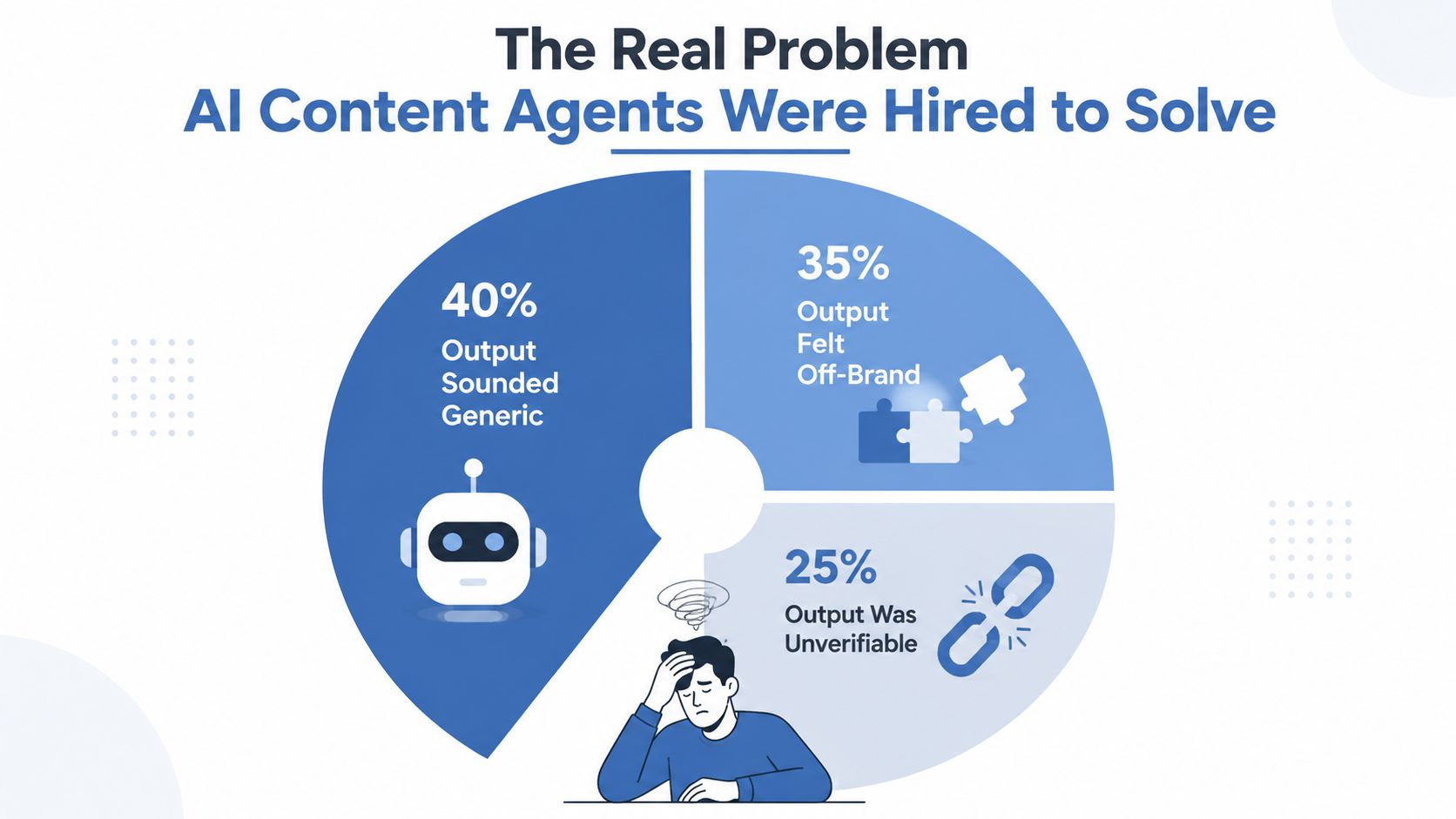
Table of Contents
- Why AI Content Agents Often Disappoint Teams
- What an AI Content Agent Actually Is
- Agent Types, Architectures, and Their Real Trade-Offs
- The Five-Stage Marketing Workflow Agents Actually Run
- Real Scenarios of Agents Saving or Sinking a Team
- Context Engineering and the Agent-Ready Content Stack
- Governance, Source Discipline, and Where to Pull the Brake
- A 30-60-90 Day Implementation Plan You Can Run Monday
Why AI Content Agents Often Disappoint Teams
Most AI content agents were hired to solve a throughput problem, then judged as if they were magic writers. That mismatch is why so many teams end up disappointed. The agent drafts quickly, but the draft sounds generic, the tone slips, and the factual surface area starts to look shaky.
The core problem is broader than speed. Content teams need more output than they can manually produce, but they also need every asset to stay credible, on-brand, and traceable. If the system cannot do all three, it is not producing business value. It is creating review debt.
Practical rule: if the agent cannot explain where a claim came from, your team does not have a content system. It has a liability generator.
One magical agent falls apart fast in real operations. Growth teams need a layered system, one layer for retrieval, one for generation, one for review, and one for distribution. Leave out any layer, and the whole setup starts to wobble. The draft can still look polished, but the business costs show up later in edit cycles, ranking instability, or brand inconsistency.
The market is still catching up to that reality. Analysts report that 79% of organizations are already using some form of AI agent and only 1 in 9 are in production, according to the market research summary. The gap is not adoption. It is operational discipline. Content teams feel that gap harder than most, because they can get a draft in seconds and still spend an hour cleaning up context, claims, and tone.
What an AI Content Agent Actually Is
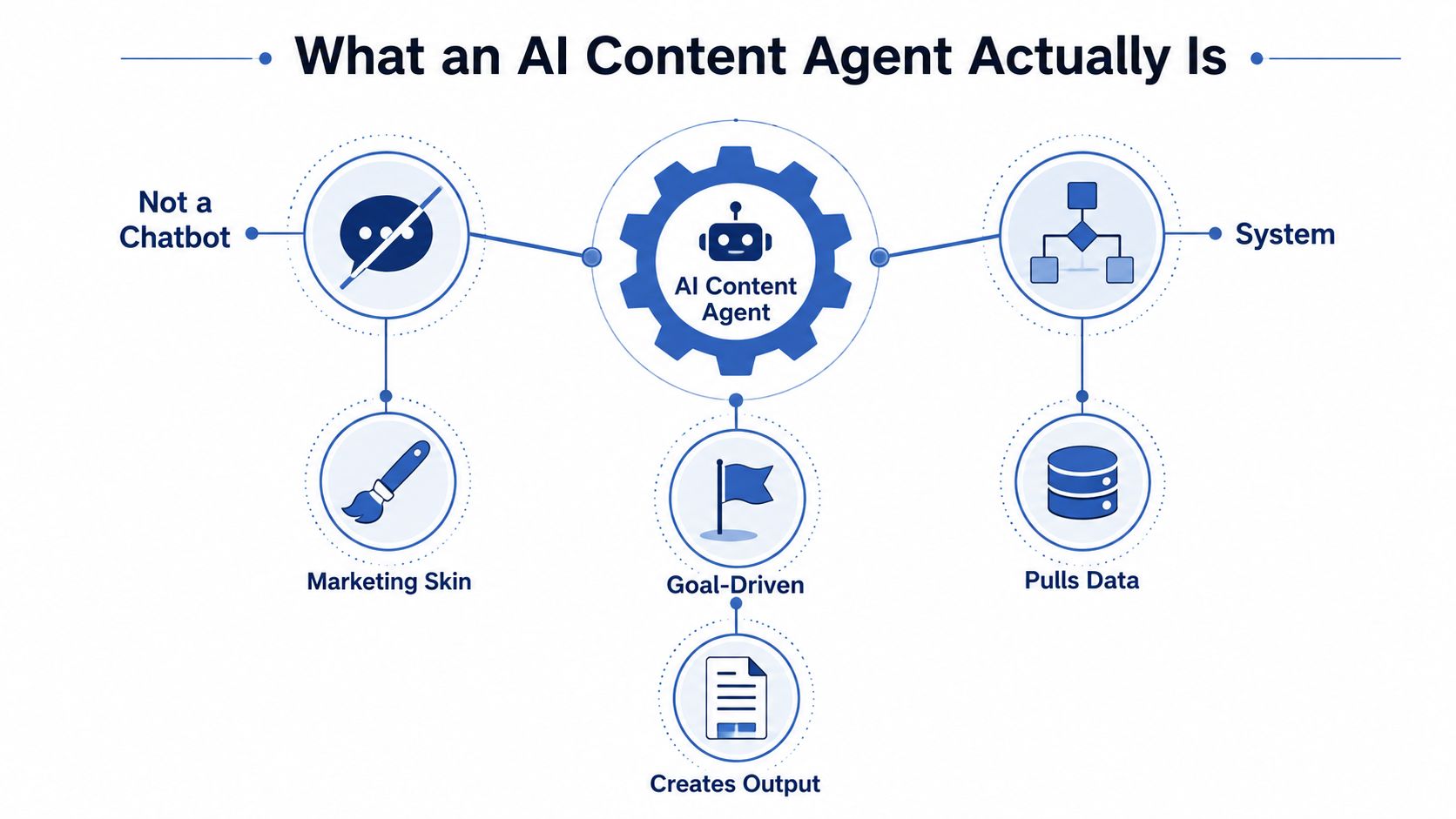
An AI content agent is a system that takes a goal, pulls from approved knowledge, plans steps, uses tools, and hands off a finished asset to a downstream system like a CMS or scheduler. A chatbot answers. An agent executes. That difference matters when you need content volume without turning the brand into a generic prompt demo.
I explain it to clients like this. The agent works like an analyst who briefs a researcher, who briefs a writer, who briefs a publisher. Each handoff needs explicit inputs, outputs, and acceptance criteria. When those contracts are clear, the system moves without improvising. When they are vague, the model fills gaps with guesses.
The three architectures you'll actually see
The simplest setup is a single LLM with retrieval. It is fast, easy to ship, and useful for straightforward drafting or summarization. The downside shows up quickly. One model ends up doing too many jobs, so it starts blending research, composition, and validation together.
A second pattern is a multi-agent orchestration layer. One agent plans, another researches, another drafts, another edits. That gives you better specialization and cleaner handoffs, but it also creates more places for context to disappear and makes debugging harder. The more hops you add, the more carefully you have to decide what each agent is allowed to know and decide.
The third pattern is the one I trust most in business. A human-in-the-loop workflow with automated checkpoints. The agent handles repetitive work, while humans still approve the claims, brand voice, and strategic frame. That is the setup that survives legal review, sales feedback, and executives who read the content before it ships.
If you want a practical view of the stack choices behind that setup, I've laid out the broader architecture in my AI agent tech stack guide.
| Architecture | Best For | Main Risk | Cost Profile |
|---|---|---|---|
| Single-task agent | Simple drafting and narrow workflows | Off-brand output and weak coordination | Lower upfront complexity |
| Multi-agent orchestrated stack | Research, drafting, review, and publishing pipelines | Latency, debugging pain, context loss | Higher build and maintenance effort |
| Hybrid human-in-the-loop system | Content that touches revenue, trust, or compliance | Slower approval paths if governance is sloppy | Moderate build cost, lower downside risk |
The business test is simple. If the content can affect trust or revenue, the agent needs a contract. Not a vibe.
Agent Types, Architectures, and Their Real Trade-Offs
Single-task agents are attractive because they feel clean. You assign one job, wire one prompt, and get output fast. That works for a narrow task like rewriting a headline set or extracting topic clusters, but it falls apart when you chain several single-purpose agents together without a real orchestration layer.
Single-task agents break on coordination
The weakness isn't intelligence. It's coordination. Each agent may perform well in isolation, but the handoff between them becomes the failure point. One agent drops context, another interprets the brief too loosely, and suddenly the output is inconsistent across sections or channels.
That's why teams often mistake speed for maturity. A stack of small agents can produce more content, but it can also produce more inconsistent content if nobody owns the final contract. More agents isn't the answer by default. Better constraints are.
Multi-agent orchestration improves quality, but not for free
A planner-agent model gives you cleaner specialization. One module can research, another can draft, another can edit against brand rules. That setup is closer to how an actual marketing team works, and it usually produces more coherent output than a single prompt trying to do everything.
But the trade-offs are real. Latency goes up. Debugging gets uglier. Context can disappear between stages, especially if the system doesn't preserve source notes and acceptance criteria in a machine-readable way. If one agent changes the intent of the brief, the next agent will confidently build on the wrong foundation.
Hybrid systems are usually the commercial sweet spot
In practice, the most useful pattern is hybrid. Let the agent do the repeatable work, then put humans only where judgment materially affects trust, ranking, or conversion. That usually means reviewing claims, brand voice, and strategic positioning, not manually rewriting every paragraph.
Full autonomy should be treated like a privilege, not an operating mode.
That's the model I'd rather sell to a board. It scales output without pretending that a machine should own every decision. If you need a modular mindset, the same logic applies across all serious content systems, from planning through publishing.
The Five-Stage Marketing Workflow Agents Actually Run
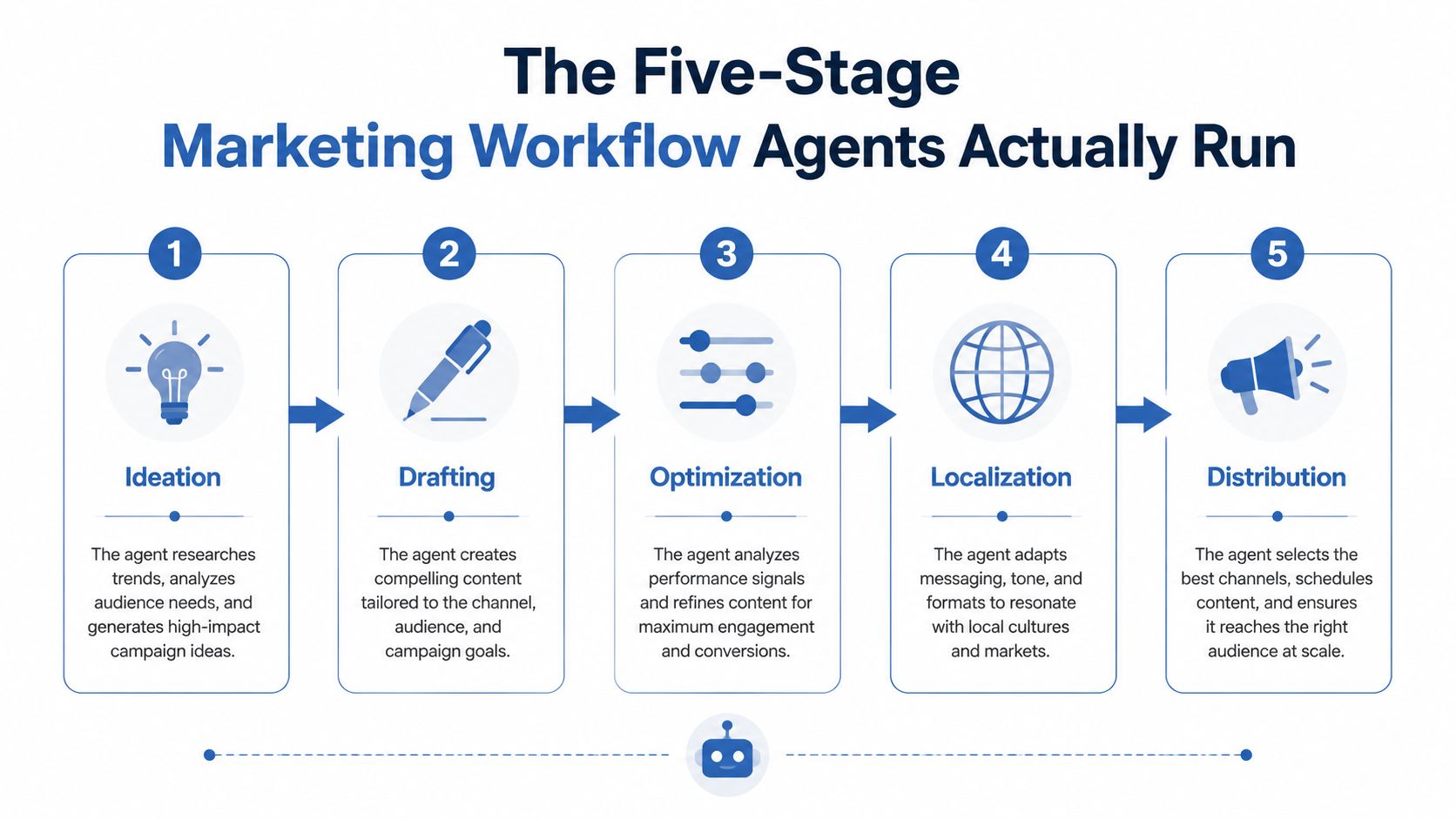
The useful way to think about AI content agents is as a workflow, not a single writing event. The work usually breaks into five stages, and each stage needs a different level of autonomy. If you collapse them into one prompt, you get slop.
Ideation and drafting are not the same job
Ideation is where the agent should scan patterns, compare angles, and surface opportunities. But it needs your positioning, your ICP, and your category boundaries first. Without that context, it will find plenty of ideas and very little strategy.
Drafting is a separate step. Here, the agent needs your voice examples, source library, and acceptance criteria. It should be building from approved material, not freelancing off a vague topic brief.
Optimization, localization, and distribution each need their own rules
Optimization is where agents can handle internal linking suggestions, schema support, and on-page refreshes. This is useful because the task is structured and repetitive. Localization is different. Translation and transcreation are not the same thing, and a good system keeps them separate so regional nuance doesn't get flattened.
Distribution is where many teams over-automate. They publish everywhere, too fast, and assume each channel will forgive weak quality because a machine produced it. It won't. Some channels reward volume. Others punish sloppy messaging, especially when audience expectations are higher than the draft quality.
A practical implementation usually looks like this:
- Ideation owns angle selection. It should generate candidate topics against your ICP and positioning, not against generic keyword volume alone.
- Drafting owns first-pass composition. It should work from approved source material and a voice pack, not from memory.
- Optimization owns structural improvements. It should suggest internal links, heading cleanup, and snippet readiness.
- Localization owns regional adaptation. It should rewrite for audience context, not merely translate word-for-word.
- Distribution owns channel fit. It should know where a piece belongs, and where it shouldn't go.
That split is boring in the best way. It makes the workflow testable. It also gives you a clean way to see where the content engine is making money and where it's just making noise.
Real Scenarios of Agents Saving or Sinking a Team
I've seen the same mistake in different clothes. A mid-sized SaaS team built an end-to-end content agent for thought leadership, then let it publish with too little review. The content moved faster, and organic traffic climbed 38% in one quarter in the period they were tracking internally. Then the cracks showed up. Google down-ranked some programmatic pages, and a competitor published a sharper rebuttal that outranked them.
The failure wasn't the model. It was the governance layer. The team optimized for output volume, not for defendable content. Once the pages started competing in a tougher SERP environment, the generic logic inside the agent couldn't protect them.
The better pattern is slower where it matters
A DTC ecommerce brand took the opposite path. They used a hybrid agent system with factual checkpoints and brand review gates before anything hit legal. The result was 4x more product launch content without a single escalation to legal during that run.
That matters because legal escalations aren't just annoying. They slow launches, consume attention, and create internal hesitation around future campaigns. If your system can produce more content while reducing that friction, it's not just an efficiency play. It's a distribution advantage.
What the teams monitored told the real story
The SaaS team should've pulled the brake when edits started increasing and the content became easier to produce than to trust. The ecommerce team knew they had a working system because review stayed bounded and the launch machine didn't trigger downstream friction.
The pattern is simple. One team treated the agent like a publishing machine. The other treated it like a controlled workflow. That difference determined whether automation became a moat or a mess.
Context Engineering and the Agent-Ready Content Stack
This is the part most guides skip, and it's the part I care about most. Context engineering means feeding the agent the right knowledge before any prompt fires. That includes your best-performing posts, voice examples, funnel definitions, and a vetted source list. If you skip that work, the model has to guess what “good” looks like for your brand.
Build the context pack before you build the prompt
The context pack should be blunt and specific. Include examples of content that converted, not just pieces that won praise in Slack. Add voice notes on sentence rhythm, taboo phrases, and where the brand sounds too fluffy or too aggressive.
When teams hand me a generic brief, I know the agent will output generic content. The fix is not a cleverer prompt. The fix is better input design. If the system doesn't know your standards, it can't enforce them.
For a practical example of how I structure context-driven workflows, I've shared templates in my context engineering examples.
Treat every page as human-readable and machine-readable
The other half of the stack is agent-ready content architecture. That means discovery, parsing, and attribution. Discovery uses machine-readable entry points like llms.txt, agents.json, sitemap.xml, and robots.txt. Parsing depends on semantic HTML, JSON-LD, structured frontmatter, and sometimes agent.md. Attribution relies on canonical URLs and an ai.txt policy so agents know how to cite the source.
That structure isn't cosmetic. It reduces ambiguity and helps autonomous systems find, parse, and preserve provenance with less confusion. Without it, the agent has to infer intent from noisy pages, which increases the odds of misclassification or partial extraction.
Bottom line: your website is no longer just a page for humans. It's also a data source for machines that will quote, summarize, and redistribute your ideas.
If you want content agents to improve over time, make every new asset strengthen the next one. That only happens when the content stack is designed for reuse, not just publication.
Governance, Source Discipline, and Where to Pull the Brake
Full autonomy is a liability when the content can affect rankings, legal exposure, or brand equity. The governance layer needs to exist before you scale anything beyond a pilot. I insist on a claim-extraction review, a source whitelist, a two-source rule for numbers on sales pages, and explicit human checkpoints for legal, medical, and financial claims.
Separate hype from verifiable claims
The most useful mechanic here is a Claim Extraction Agent. It reads the draft and isolates concrete statements, especially statistics, dates, named studies, and anything with obvious business impact. Once those claims are separated, review gets much easier because your team stops reading every sentence with the same level of suspicion.
That's the whole point. Subjective marketing language can move through the system quickly. Verifiable claims deserve proof before they leave the draft.
For a practical breakdown of the ROI side of agent systems, I've also documented the decision logic in my AI agent ROI guide.
Use source discipline like a filter, not a ceremony
I prefer primary sources first, then independent cross-checks when a number matters. If a claim can't be traced cleanly, it doesn't belong in the final piece. That's especially true for numbers, dates, legal language, and anything a buyer can easily challenge in a sales conversation.
The trigger to pull the brake is usually visible in the workflow. Rising edit rates. Falling trust from stakeholders. More support tickets that reference the article. Or branded search softening after content starts going out at scale. Those are not abstract signals. They tell you the system is leaking credibility.
If the agent starts drifting, hand the task back to a human writer and tighten the context. That's not failure. That's control.
A 30-60-90 Day Implementation Plan You Can Run Monday
Start narrow. Pick one high-volume, low-risk content lane, maybe comparison posts or product updates. Then build a context pack from your last 50 best-performing pieces. I'd rather see a team do one lane well than five lanes badly.
Days 1 to 30
Write a one-page specification for the agent. Define its tools, memory boundaries, and risk profile. Add the source whitelist, the brand voice pack, and the acceptance criteria it has to meet before a draft moves forward.
If you're choosing a stack from scratch, keep it simple. Use one reasoning model for planning, one fast model for drafting, a retrieval layer pointed at your own content and approved sources, and an orchestration framework with explicit contracts. If you can only afford one dashboard, make sure it shows where the agent is helping and where it's hurting.
Days 31 to 60
Wire in claim extraction and source verification. Ship to one distribution channel only. Track three metrics from day one, publish-to-publish time, edit rate, and downstream conversion. Those three tell you much more than vanity volume ever will.
This is also where teams discover whether their brand voice pack is strong enough. If editors keep rewriting the same kinds of sentences, your context is weak. If the system gets through review cleanly, you've got something that can scale.
Days 61 to 90
Add localization, internal-linking optimization, and a second content lane only after the first one clears your quality bar. Don't expand because the stack feels exciting. Expand because the first lane is producing content that your team trusts and your funnel can use.
If I were starting from zero today, I'd buy a reasoning model, a drafting model, retrieval over my own content, a vetted source whitelist, and an orchestration layer with hard contracts. That setup won't impress people in a demo. It will compound inside the business.
If you want to turn AI content agents into a real operating advantage, start with one lane, one context pack, and one governance model this week. Then audit your current workflow for the three places it leaks trust, the drafting step, the source step, and the publishing step, and fix those before you add another agent.