Your reporting is probably lying to you.
Google Analytics says paid search won. Meta says retargeting closed the deal. Your CRM credits direct traffic. Finance trusts none of it. Meanwhile your team burns hours exporting CSVs, fixing column names, and arguing over whose dashboard is “right” instead of deciding where to put the next dollar.
I've seen this pattern for years. Companies think they have a marketing problem when they have a marketing data integration problem. If your ad data, product data, CRM data, and revenue data live in separate systems, you don't have visibility. You have fragments. Fragments don't help you scale. They help your competitors who can see faster, decide faster, and act faster.
The mistake is treating integration like a back-office cleanup project when it is your operating system for growth. And if you stop at a “single source of truth” dashboard, you're still leaving money on the table. The real advantage comes when your integrated data is structured for causal measurement, so you can see what caused the lift instead of only what correlated with revenue.
Table of Contents
- Your Data Is a Mess and It's Costing You
- The Blueprint Before You Build
- Your Core Stack: Ingestion, Storage and Identity
- From Raw Data to Actionable Intelligence
- Activation: Turning Insights into Revenue
- The Real ROI: Governance and Next-Level Measurement
Your Data Is a Mess and It's Costing You
Monday morning. The paid team says search is winning. Sales says the leads are weak. Finance shows revenue flat. Everyone has a dashboard. Nobody has an answer you can trust.
That is what broken marketing data integration looks like in practice: budget calls made with conflicting numbers, bad attribution, and zero proof of what caused growth.
Gartner has reported that poor data quality costs organizations millions each year, and IBM breaks down how bad data drives waste, rework, and missed decisions across the business in its overview of the business costs of poor data quality. In marketing, the cost shows up fast. You overfund channels that claim conversions they did not create. You miss the campaigns that influence pipeline later. You argue about reporting while competitors buy signal and move.
If finance, sales, and marketing can each produce a different answer to the same revenue question, your stack is damaging performance.
Here's the part too many guides miss. A single source of truth is table stakes. Clean reporting matters, but it does not win markets by itself. The key advantage comes from building data flows that let you test causality and measure incrementality. You need to know which actions changed revenue, not which platform took credit for it.
What broken integration looks like in practice
The pattern is easy to spot once you know what to look for:
- Channels credit themselves. Ad platforms report success based on their own view of the customer, so every channel looks more effective than it is.
- Reporting stays manual. Hours go into stitching exports together, and you wait too long for answers that still lack confidence.
- Audiences don't match. Paid media, lifecycle marketing, and sales work from different customer definitions, so targeting and follow-up drift apart.
- Decisions lag. By the time you agree on what happened, spend has already been misallocated.
If you're trying to create a cohesive marketing dashboard, fix the integration layer first. A polished dashboard built on fractured data gives you faster access to the wrong conclusion.
What good integration actually changes
Good integration changes how money gets allocated.
You can compare platform-reported conversions against pipeline creation, deal progression, and closed revenue. You can spot where lead quality drops between click and opportunity. You can separate channels that harvest existing demand from channels that create new demand. That is the difference between reporting and measurement.
You and I both know pretty dashboards impress people for a week. A system that proves incrementality protects budget, sharpens strategy, and helps you outgrow slower competitors.
The Blueprint Before You Build
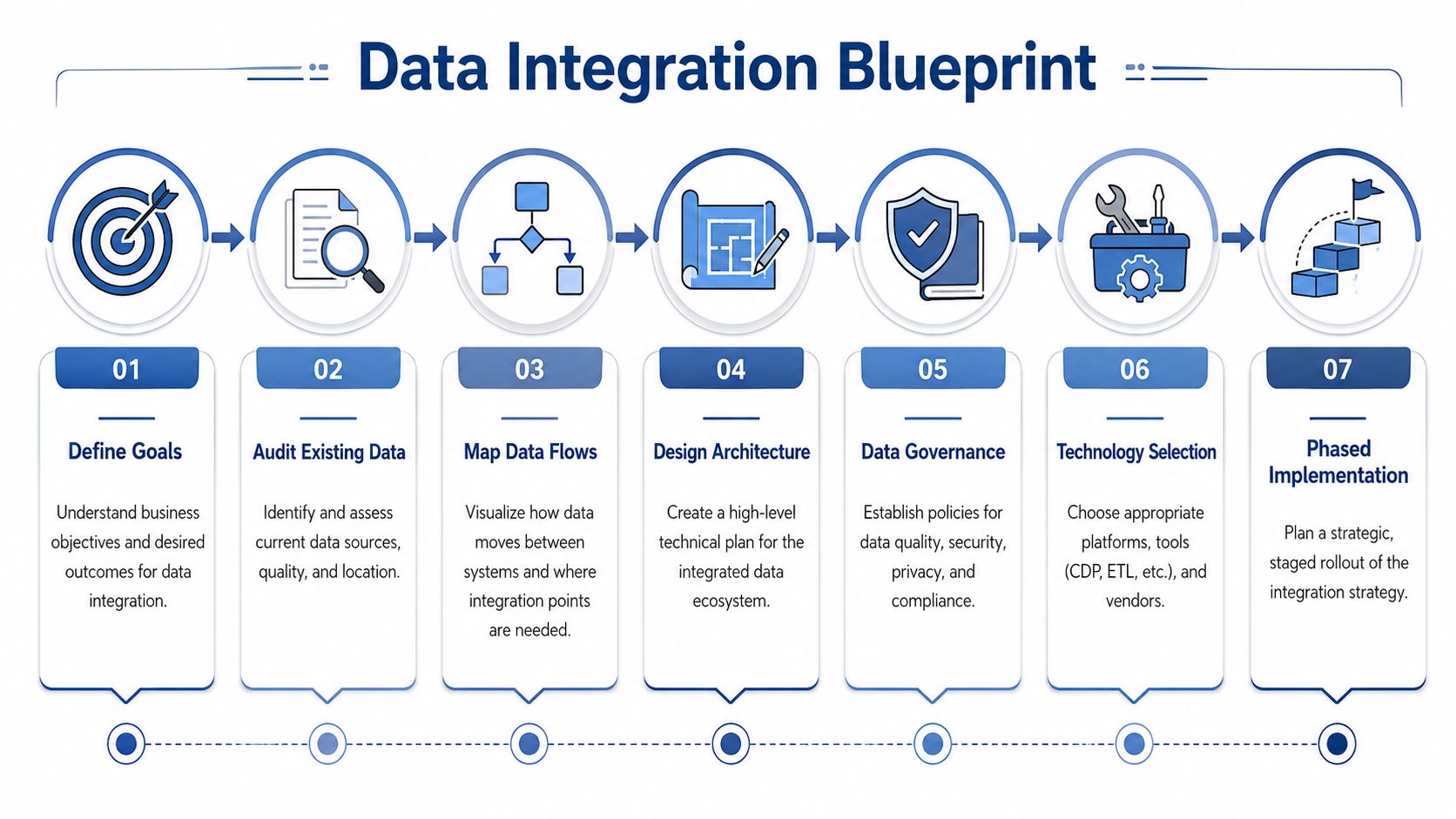
The fastest way to waste money is to buy a CDP, spin up a warehouse, or hire an engineering team before you've defined the business model behind the data.
I've watched companies spend months piping data into Snowflake, BigQuery, or HubSpot only to discover nobody agrees on what a conversion is. Or who owns customer status. Or which timestamp should drive attribution. That is a planning failure, and no tool fixes it.
Start with a source inventory
Before a single connector gets turned on, build a source inventory. Make it specific, not a vague list.
At minimum, map your ad platforms, analytics layer, CRM, email platform, payment system, subscription or billing tool, product usage data, support system, and any offline sales sources. For each one, document the key objects, primary identifiers, refresh frequency, owner, and where that data needs to end up.
Here's the blunt version. If you can't answer “where does this field originate and who owns it,” you're not ready to integrate it.
Define the business vocabulary
A unified schema matters more than vendor selection.
If “campaign,” “lead,” “MQL,” “opportunity,” “active customer,” and “conversion” mean different things in different tools, your warehouse will just become a bigger landfill. The point of marketing data integration is to standardize those definitions so reports stop changing depending on who built them.
A simple operating model works well:
- Choose canonical definitions for revenue-critical metrics.
- Assign ownership to a human, not a department.
- Write a data dictionary everyone can inspect.
- Lock naming rules for UTMs, campaign taxonomies, lifecycle stages, and revenue events.
Good governance feels slow on day one. Bad governance stays expensive for years.
Design the architecture around decisions
Your architecture should follow the decisions you want to make, not the other way around.
If your primary use case is top-line reporting, a simple warehouse-first stack may be enough. If you need near-real-time suppression, lifecycle messaging, or sales triggers, you need fresher pipelines and clearer identity rules. If your team wants experimentation and incrementality later, preserve event-level data now.
Many teams benefit from a solid comprehensive data warehouse guide before they start choosing storage patterns. Warehouses are containers. Your operating model determines whether the contents become useful.
The blueprint I'd approve
I'd greenlight a build only after these questions are answered:
| Decision area | What must be defined |
|---|---|
| Goal | Which revenue questions the system must answer |
| Scope | Which source systems are in phase one |
| Metrics | One canonical definition for each core metric |
| Ownership | Who approves schema changes and taxonomy updates |
| Freshness | Which data can be daily, which must be near real time |
| Access | Who can see, edit, and activate which records |
This work is unglamorous, and it prevents six months of rework later.
Your Core Stack: Ingestion, Storage and Identity
A lot of teams get this part wrong in a predictable way. They buy tools for visibility, then discover six months later that they still cannot prove which spend created incremental revenue. Pretty dashboards do not fix weak plumbing.
Your stack has three jobs. Ingest the data reliably. Store the raw record in a system you control. Resolve identity well enough to measure cause and effect across channels, accounts, and revenue events. If any one of those breaks, your attribution degrades and your incrementality work turns into guesswork.

ETL, ELT, and streaming without the buzzwords
Here is the practical version.
ETL transforms data before it lands. ELT loads first, then transforms inside the warehouse. Streaming moves events continuously so the business can react fast enough to matter.
I recommend ELT for most marketing teams. Keep the raw event, click, pageview, lead update, and order record. You and I both know the business logic will change. Channel definitions shift. Lifecycle stages get rewritten. Finance changes revenue rules. If you only keep the polished output, you lose the ability to rebuild history and test new causal models later.
ETL still has a place when validation has to happen before storage, especially in regulated environments. Streaming matters when delay creates revenue loss, like lead routing, suppression, trial conversion prompts, fraud checks, or usage-triggered sales outreach.
The market keeps investing in this layer because speed and measurement now matter more than static reporting. Grand View Research tracks the broader data integration market and projects continued growth through 2030 in its data integration market size report. That demand is being driven by execution pressure. Companies need data fast enough to act, and clean enough to prove what changed outcomes.
Warehouse or CDP
Stop treating this as a religious debate.
A data warehouse gives you control, history, and analytical depth. That is where you join ad spend, web activity, CRM stages, product usage, and revenue into one system that can support serious measurement. A CDP is better at profile assembly and pushing audiences into ad platforms, email tools, and sales workflows.
If budget is limited, start with the warehouse. A warehouse gives you a durable foundation for measurement. Add a CDP when activation needs become specific enough to justify the cost and operational complexity. If you buy a CDP first, you often get fast audience syncs and weak analytical depth. That is fine for campaign operations. It is weak for incrementality, holdout design, and channel-level causal analysis.
If you are comparing tools, this guide to building your marketing tech stack is worth reading because it frames the stack around workflow fit instead of vendor promises.
Identity is where measurement lives or dies
Identity resolution decides whether your records describe a buyer journey or a pile of disconnected events.
You need explicit rules for how an anonymous visitor becomes a known lead, how that lead maps to an account, how account activity ties to pipeline, and how revenue closes the loop. Email address alone is not enough. Cookies are weaker than they used to be. Device IDs are unstable. CRM data is often late or inconsistent. Skip blind faith in a customer 360 product. Build a clear identity graph with deterministic joins first, then carefully limited probabilistic logic where it adds value.
This matters for one reason. Causal measurement depends on trustworthy entity resolution. If you cannot tell which exposures belonged to which person or account, you cannot separate correlation from lift. You are left with channel reports that reward whoever shouts the loudest.
One more hard truth. AI will amplify whatever mess you feed it. If you plan to use internal copilots, enrichment workflows, or autonomous agents, read this guide on training an AI agent on company data. Clean identity and source discipline come first. Otherwise you just automate bad decisions faster.
What I'd avoid
I would avoid all-in-one platforms that promise ingestion, storage, identity, activation, and analytics in one neat box. They look efficient in a demo. They become restrictive the moment your sales motion, pricing model, or measurement standard changes.
I would also avoid designing the stack around reporting alone. Reporting tells you what happened. Competitive advantage comes from proving what caused the result, then reallocating spend with confidence. Build the core stack for that standard from day one.
From Raw Data to Actionable Intelligence
Raw data in a warehouse is inventory.
Until somebody cleans, models, and structures it, you're staring at logs, rows, and half-useful tables. Most companies stall at this point. They built the pipes, declared victory, and forgot the part where the data has to answer business questions.
A simple visual makes the point fast.

Modeling is where the value appears
The modeling layer is where you turn raw source tables into decision-ready assets.
This usually means cleaning duplicates, standardizing timestamps, mapping campaign taxonomies, tying contacts to accounts, and creating reusable business logic for the metrics you care about. Tools like dbt are popular here because they make transformations transparent, versioned, and easier to maintain.
Three models usually produce immediate value:
- Attribution-ready models that connect sessions, touches, leads, opportunities, and revenue
- Customer value models that distinguish cheap conversions from valuable customers
- Behavioral segment models that group users by what they do as well as who they are
Good models answer hard questions
The payoff is practical.
You can compare paid channels based on downstream revenue quality instead of lead volume. You can flag users who hit product behaviors associated with expansion or churn risk. You can identify product-qualified leads instead of waiting for someone in sales to “feel” that an account looks promising.
That's also why dashboarding should come after modeling. If you push raw source data straight into Looker Studio, Tableau, Power BI, or Mode, the team will still argue over logic. A dashboard only reflects the quality of the layer beneath it.
If you want examples of how those reporting layers should look once the data is modeled correctly, this walkthrough on marketing analytics dashboards is worth reviewing.
Build metrics once in the model layer. Reuse them everywhere. Rebuilding business logic inside every dashboard is how companies create reporting chaos at scale.
Multi-touch reporting has limits
A lot of teams think this stage ends with multi-touch attribution. It doesn't.
Attribution models are useful for directional visibility. They help you understand journeys, channel interaction, and sequence patterns. But they still rely on assumptions. They assign credit based on rules or modeled weights, not proof of causality.
That distinction matters. A polished dashboard can still steer budget into channels that harvest demand created elsewhere.
A short primer below gives a practical look at how teams think about transforming data into usable marketing analysis:
What this makes possible for AI
My AI background intersects with marketing operations.
If your data models are clean, AI can summarize trends, surface anomalies, suggest segments, generate campaign ideas based on historical performance, and support analysts instead of replacing them. If the models are weak, the AI just wraps bad logic in smooth language. You and I both know how dangerous that gets when you're deciding where to spend.
Activation: Turning Insights into Revenue
Monday morning. Your dashboard says paid social drove pipeline, sales says the leads were junk, retention says the new cohort is already churning, and finance wants to know which spend effectively created incremental revenue. If your data still lives in reports, you cannot answer the only question that matters. What should change today to produce more revenue next week?
Activation is the point where integrated data starts doing its job. You push modeled audiences, scores, and triggers out of the warehouse and into the systems that influence pipeline, conversion, retention, and expansion. That includes Salesforce, HubSpot, Meta Ads, Google Ads, Klaviyo, your product, and customer success workflows.
Reverse ETL is the mechanism. The concept is simple. You take the cleaned, governed data you already trust and sync it back into the tools your teams use every day.
A product-qualified account score should hit Salesforce before a rep starts the day. A churn-risk segment should enter HubSpot or Braze before the customer disappears. Low-quality leads should be suppressed from paid campaigns before you waste another dollar buying more of them.
What smart activation looks like
Good activation means sending the right signal at the right time with enough discipline that you can act on it. Sending more segments to more tools misses the point.
The best systems usually have four characteristics:
- Segments stay fresh. Audiences refresh automatically, based on behavior and status changes, not manual CSV exports.
- Definitions are shared. Sales, lifecycle, and paid media work from the same customer logic instead of inventing channel-specific versions of reality.
- Suppression rules keep converted customers, bad-fit leads, and ineligible accounts from seeing campaigns that burn budget or create a poor experience.
- Feedback closes the loop. Responses, opportunities, revenue events, and retention outcomes flow back to the warehouse so your next action improves.
That last point matters most. Plenty of companies can push audiences into ad platforms. Fewer can measure whether those audiences changed outcomes. Fewer still can prove lift.
That is the true standard.
Most articles on marketing data integration stop at the single source of truth. Fine. You need one. It is table stakes. The advantage comes from building activation around causal measurement and incrementality. The goal is to prove which actions created revenue that would not have happened otherwise, rather than to produce prettier dashboards. If you need a practical framework, this guide on how to measure marketing effectiveness is the right next reference.
Where activation actually pays off
The fastest wins usually show up in three places.
First, sales efficiency. If reps get buying signals based on product usage, fit, and intent, they call better accounts first and waste less time chasing noise.
Second, media efficiency. If your paid platforms receive suppression lists, lifecycle status, and offline conversion data on a reliable cadence, bidding gets sharper and wasted impressions drop.
Third, retention and expansion. When customer success and lifecycle marketing act on product behavior, support risk, and contract milestones, they can intervene before revenue slips.
You and I both know what happens without this. Teams keep reporting on patterns they could have acted on days earlier.
Don't automate nonsense
Activation multiplies whatever logic you feed into it. Good inputs create revenue. Bad inputs create expensive confusion at scale.
Do not rush to sync every model, score, and audience into every downstream tool. Start with a small set of revenue-linked use cases. Prioritized sales outreach. Churn prevention. Lead suppression. Offline conversion feedback. Prove those work, then expand.
Early-stage companies can keep this lighter. A few reliable syncs beat an overbuilt system nobody trusts. But once you have multiple channels, lifecycle complexity, or a sales-assisted motion, inactive data becomes dead weight. You already paid to collect it and model it. Put it to work.
The Real ROI: Governance and Next-Level Measurement
It happens all the time. You sit down for the quarterly review, pull up a polished dashboard, and start arguing over channel credit while revenue stalls. The reporting looks clean. The decisions are still weak.
A unified view of data is table stakes. Competitive advantage comes from measurement that proves cause instead of correlation. If your stack cannot tell you what created lift, you are still guessing with better visuals.
Governance keeps the system usable
Governance sounds boring right up until a broken sync poisons your audience logic, finance stops trusting marketing numbers, or customer data ends up exposed in the wrong tool.
Set clear owners for schemas. Document metric definitions. Enforce role-based access. Encrypt customer data in transit and at rest. Monitor pipelines and alert on failures fast. Keep manual CSV exports out of the operating model unless you enjoy drift, delays, and audit risk.
You do not need a grand governance committee. You need operating discipline. The companies that get paid from integrated data are the ones that treat data quality, access control, and change management like revenue infrastructure.
Attribution reports are not enough
Attribution helps you assign credit. Budget allocation requires causal evidence.
That gap matters more than most people realize. Branded search often looks brilliant because it captures demand that already existed. Retargeting often looks efficient because it follows people who were likely to convert anyway. If you optimize from attribution alone, you will keep funding channels that report well and add little net-new revenue.
Better integration can produce prettier dashboards while leaving decision quality unchanged.
Build your stack for causality
This is the part many teams miss. They build a single source of truth and stop there. That gets you cleaner reporting. It does not get you proof.
If you want a system that protects budget and finds growth, preserve the data needed for incrementality testing from day one.
| Question | Data requirement |
|---|---|
| Did this channel create net-new demand? | Exposure and outcome data tied to a test design |
| Did this campaign change behavior or just capture existing intent? | Holdout or control group preservation |
| Did lift vary by market, segment, or product line? | Consistent event data and market-level joins |
| Are you scaling efficient spend or self-reported efficiency? | Outcomes connected to spend at the right level of detail |
That means keeping raw event streams, campaign exposure logs, audience membership, timestamps, spend data, and downstream revenue outcomes. It also means running experiments your stack can support. Geo tests. Holdouts. Controlled rollouts. Those methods settle budget debates fast because they show what caused lift.
If you want a sharper framework for this, read this guide on how to measure marketing effectiveness. It connects reporting to allocation, which is the only standard that matters.
Winners measure lift instead of activity
The strongest teams do five things well. They protect data quality. They define metrics once. They connect spend to revenue at the right grain. They move insights into action quickly. And they test for incrementality instead of admiring correlation.
You and I both know what happens when that system is in place. Fewer attribution arguments. Faster budget shifts. More confidence in what to cut, what to scale, and where competitors are wasting money.
That is how marketing data integration stops being a back-office clean-up project and starts driving revenue.