
Most advice on AI content repurposing is lazy. It tells you to squeeze one webinar into a pile of posts, schedule them everywhere, and call that scale.
That approach creates more content without creating more demand. Your buyers ignore it, platforms suppress it, and your team confuses activity with traction.
I'm Samuel Woods. I've been working with ML since 2016 and Generative AI since 2019. I've watched this pattern repeat every time a new model lands. Teams chase output first, then wonder why revenue doesn't move.
If you want AI content repurposing to matter, you need a different objective than volume: owning more of your market's attention. You take proven ideas, adapt them for the channels that matter, shape them for human attention, and connect every derivative asset to pipeline and conversion data. That's how you move faster than competitors without flooding the market with recyclable sludge.
Table of Contents
- Forget Content Volume, Target Market Share
- Audit Your Assets to Find Repurposing Gold
- Building Your AI Repurposing Engine
- Orchestrate Production with Agents and Quality Control
- Measure What Matters From Your AI Content
- Where Your Real Edge in the Market Comes From
Forget Content Volume, Target Market Share
The “more is better” crowd is aiming at the wrong target. They treat AI like a content factory, then act surprised when the market responds with indifference. Buyers don't reward repetition. They reward relevance, timing, clarity, and trust.
That matters even more because the stakes are getting bigger. The global content marketing market was estimated at $600 billion in 2026 and is forecast to reach $1–1.5 trillion by the mid-2030s, while 95% of B2B marketers plan to increase investment in AI-powered applications as their top spending priority for 2026, according to Averi's analysis of AI content repurposing trends. More money is flooding into the same channels. That means mediocre AI output gets buried faster.
You and I should care about one thing. Whether repurposed content helps you win attention that turns into pipeline.
A practical rule: if a repurposed asset doesn't sharpen your market position or move a buyer toward action, don't publish it.
I don't use AI content repurposing to “stay consistent.” I use it to extend the reach of proven intellectual property. A sharp founder interview becomes sales enablement, social proof, short video, nurture email copy, and search content. A strong webinar becomes a message-testing lab across LinkedIn, email, landing pages, and sales follow-up.
That's a different game from pumping out variants.
Here's the shift I want you to make:
- Move from channel filling to message compounding. Repurpose ideas that already help buyers say yes.
- Move from generic output to strategic adaptation. Rewrite for the platform, the buying stage, and the offer.
- Move from marketing efficiency to competitive pressure. Use speed to occupy more relevant touchpoints before competitors react.
Many organizations use AI to publish more. Smart teams use AI to make their best ideas impossible to ignore.
Audit Your Assets to Find Repurposing Gold
Most businesses start with the wrong source material. They grab the newest blog post or the asset with the highest page views, then wonder why the derivatives feel flat.
That happens because popularity and business value aren't the same thing. A post can attract traffic and still do nothing for sales. The better starting point is the asset that already proved it can influence buyer behavior.
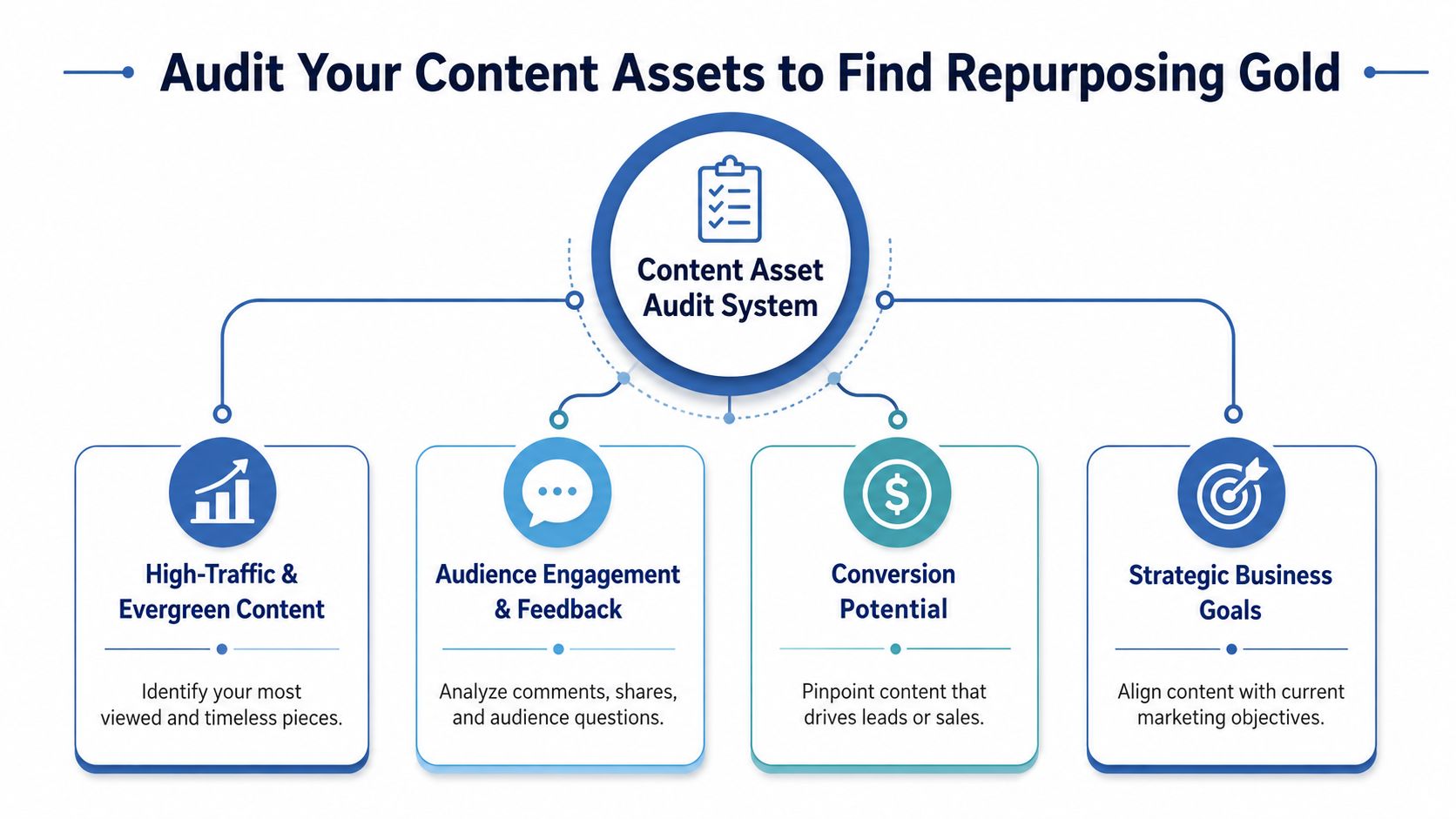
The first step in a strong workflow is a content audit and prioritization. Top performers generate up to 20 derivative touchpoints from a single, well-chosen original asset, based on this AI repurposing workflow breakdown. The phrase “well-chosen” is doing the heavy lifting.
Score assets like an operator
I use a simple scoring matrix. Nothing fancy. Just enough structure to stop you from repurposing the wrong material.
Look at each asset through four lenses:
| Lens | What I'm looking for | Why it matters |
|---|---|---|
| Sales utility | Does sales use it in live deals? | Proven relevance beats vanity traffic |
| Buyer clarity | Does it answer expensive objections? | Strong derivatives come from strong thinking |
| Evergreen value | Will it still matter in a few months? | You want reuse, not short shelf life |
| Strategic fit | Does it support the current offer or market push? | Repurposing should support revenue priorities |
A webinar that handled pricing objections well often beats a trendy blog post. A customer Q&A transcript can beat a polished ebook. A founder's blunt point of view can beat a generic guide every day of the week.
The best repurposing source is usually the asset your prospects already trust, not the one you like most.
What to pull into the audit
Don't limit yourself to blog content. That's another common mistake.
Pull from these buckets:
- Webinars and demos usually contain objections, stories, and phrasing buyers already respond to.
- Look at sales call patterns. If the same question shows up in deals, it belongs in content.
- Case studies and customer interviews carry specificity and credibility.
- Podcasts and founder interviews work because strong opinions travel well across formats.
- Whitepapers and guides are useful if the underlying thinking is still current.
Then rank each asset against current commercial goals. If you're pushing larger deals, don't repurpose content built for beginners. If you're trying to improve close rates, prioritize material that reduces friction late in the buying process.
What to skip
Some assets should stay buried.
Skip these unless you're willing to rebuild them:
- Weak originals. If the source was bland, the derivatives will be bland faster.
- Outdated content. AI can rewrite old material, but it can't rescue dead positioning.
- High-effort, low-intent pieces. If they never helped sales, don't give them a second life.
Garbage in still produces garbage. It just arrives in more formats.
Building Your AI Repurposing Engine
A lot of people think prompts are the engine. Prompts are the steering wheel.
The engine is context. If the model doesn't understand your customer, your offer, your positioning, your brand voice, and the job of the asset, it will produce smooth nonsense. That's why weak AI content repurposing feels polished but forgettable.
Brands using AI for content repurposing report that AI-generated output is 80–90% complete and accurate, needing light human editing and nuance adjustments, while cutting total repurposing time by nearly 50%, according to Typeface's global repurposing strategy analysis. That's useful, but only if you feed the model enough context to make the first draft worth editing.

Start With Context, Not Prompts
Before I ask a model to transform anything, I load a working brief. At minimum, I want five ingredients in the prompt context:
The source asset.
The full transcript, article, call notes, or raw material.The audience.
Who this is for, what they're struggling with, what they already know, and what they're skeptical about.The commercial goal.
Awareness, demo request, sales follow-up, nurture, retargeting, SEO support, or onboarding.Voice constraints.
Words to use, words to avoid, sentence style, tone, and how direct the brand should sound.Channel rules.
LinkedIn is not email. Short video is not a blog excerpt. Every format needs native behavior.
If you want a deeper walkthrough on building automation around this process, I've written about how to automate content creation in a way that doesn't flatten brand voice.
Copy Paste Prompt Patterns That Actually Work
I'm giving you prompt structures, not magic spells. You still need good inputs.
LinkedIn posts from a webinar transcript
Use this when you want multiple angles from one asset.
Convert this webinar transcript into 5 distinct LinkedIn posts for [audience].
Goal: [commercial goal].
Brand voice: [voice rules].
Each post must use a different angle: contrarian take, practical lesson, buyer mistake, short story, and strategic insight.
Keep each post native to LinkedIn. Strong opening line, short paragraphs, no jargon padding, no generic CTA.
Include one specific takeaway in each post.
Avoid copying source phrasing directly unless it is unusually strong.
Why this works: it forces angle diversity. Most models default to five versions of the same post unless you actively constrain the output.
Newsletter segments from a long-form guide
Use this when you need nurture content that doesn't read like recycled blog filler.
Turn this source article into 3 newsletter segments for [audience].
Segment 1 should educate. Segment 2 should challenge a common assumption. Segment 3 should connect the topic to a buying decision.
Keep each segment conversational, crisp, and useful as a standalone email block.
Brand voice rules: [insert rules].
Include one natural transition sentence into a fuller resource.
Short-form video scripts from a webinar or article
Plenty of people waste strong source material. If you're building clips from text or transcripts, a useful reference is this guide on URL to Video AI workflow, because weak repurposing usually falls apart during the transition from written insight to visual pacing.
Use this prompt:
Extract 5 short-form video scripts from this source asset.
Audience: [audience].
Platform: [platform].
Each script must open with a platform-native hook, deliver one clear insight, and end with a low-friction next step.
Add on-screen text suggestions and visual beat notes.
Keep the language spoken, not written.
Do not sound motivational. Sound credible and direct.
After the first pass, I usually ask for another round with tighter constraints. More tension in the hook. Simpler spoken phrasing. Fewer abstract nouns. Stronger first line.
Here's the video I'd use to reinforce the operational side of this workflow:
Pick the Right Model for the Job
I don't treat models as interchangeable.
Use a strong long-context model when you're feeding it webinars, research, transcripts, or multi-asset context. Use a faster conversational model when you need headline variants, hooks, or multiple social angles. Use specialized tools when the task moves into video clipping, scheduling, or workflow automation.
Here's the practical split:
- Long-form transformation works best when context load matters and you need structured synthesis.
- Social angle generation works best when speed and variation matter.
- Video adaptation works best when transcript-to-clip workflows matter.
- Automation handoff is best handled by Make, Zapier, or your own stack, not by a chatbot alone.
If you use one-click AI tools and expect publish-ready assets without oversight, you're setting yourself up for bland output. AI is a drafting machine. Your edge comes from context engineering and editorial pressure.
Orchestrate Production with Agents and Quality Control
Draft generation is the easy part. Production discipline is where the winners separate themselves from the tourists.
Many businesses still run AI content repurposing like a loose workshop. Someone generates posts in ChatGPT. Someone else pastes them into a doc. A designer waits for assets. Nobody owns final review. Then a batch of content gets published that technically exists but performs like wallpaper.
That's an operations problem, and a better model won't fix it.
The Workflow Most Teams Actually Need
I prefer a simple agent-assisted chain over a “fully autonomous” fantasy.
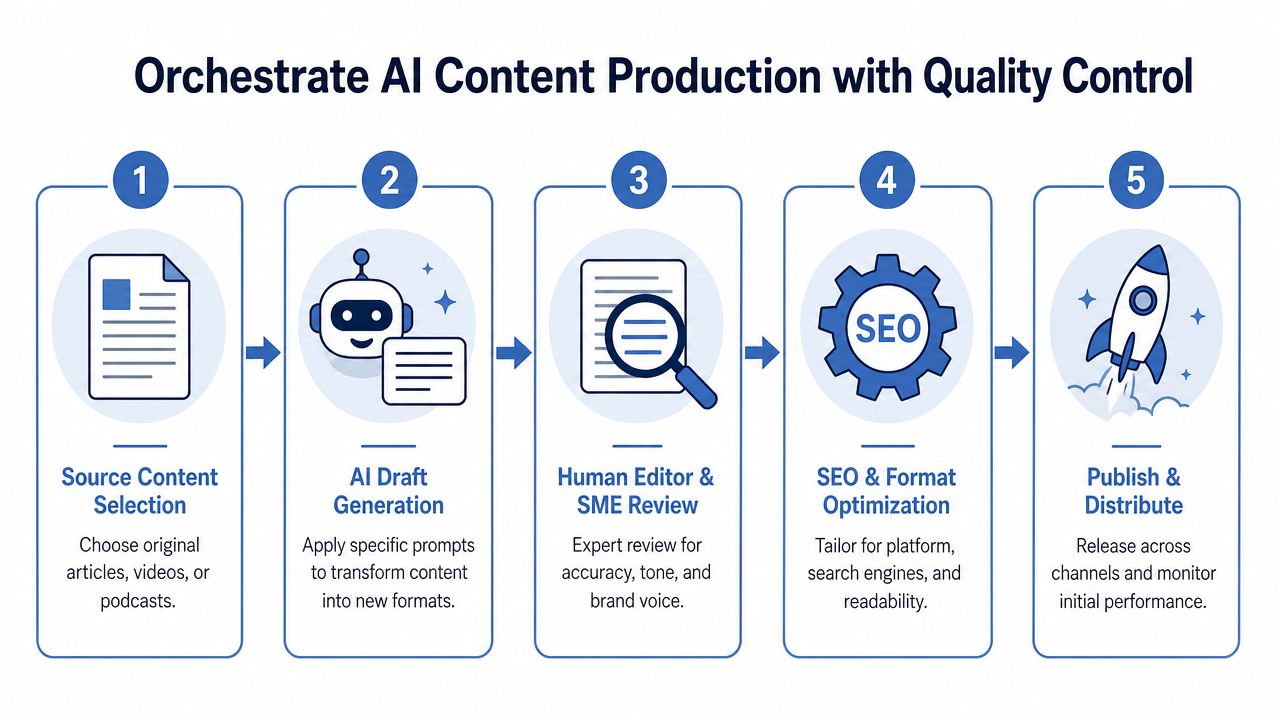
A practical setup looks like this:
- The trigger: a new source asset lands in a CMS, shared drive, or approved content folder.
- The transform: an AI step generates drafts by format, such as LinkedIn, email, clips, summaries, outlines.
- The route: Make or Zapier pushes each draft into Asana, ClickUp, or your editorial system.
- The review: a human editor or subject matter expert checks accuracy, sharpens the angle, and removes robotic phrasing.
- Distribution: approved assets move into publishing and scheduling tools.
If you want the distribution side to stay clean, this guide to content distribution strategy is the right operational companion. Repurposing without disciplined distribution turns into a messy asset graveyard.
The essential step is human review. Recent data shows 68% of AI-repurposed posts on LinkedIn receive less than 5% of the engagement of human-written equivalents because algorithms de-prioritize synthetic content, based on Typeface's review of AI repurposing and platform performance. That's the part most AI hype merchants ignore. Platforms don't reward machine-shaped writing just because it's grammatically clean.
Optimize for content that feels native enough to earn distribution. A count of “content created” tells you nothing.
A Quality Control Standard for Human Review
Whoever edits should pressure-test performance as well as grammar.
I use a QC pass built around five questions:
| QC check | What the reviewer asks |
|---|---|
| Accuracy | Is every claim grounded in the source material? |
| Voice | Does this sound like the company, or like a polite machine? |
| Platform fit | Would this feel normal on LinkedIn, email, or short video? |
| Buyer relevance | Does this solve a real problem or answer a real objection? |
| Hook strength | Would a busy prospect stop for this? |
Then I add one more filter. Does the piece create enough tension to matter? A lot of AI-generated content is technically correct but emotionally weightless.
That's where agents can help without taking over. I like using them to orchestrate tasks, summarize source material, tag assets by topic, and route drafts through the right people. I do not like letting them publish unreviewed copy at scale. That's how brands end up sounding interchangeable.
Measure What Matters From Your AI Content
If you can't trace repurposed content to business impact, you don't have a growth system. You have a production habit.
This is where many AI content repurposing programs collapse. You can usually say how many posts they generated, how many clips they published, maybe even which ones got attention. But you can't answer the only question that matters. Did this influence leads, conversions, pipeline, or revenue?
Vanity Metrics Hide Weak Strategy
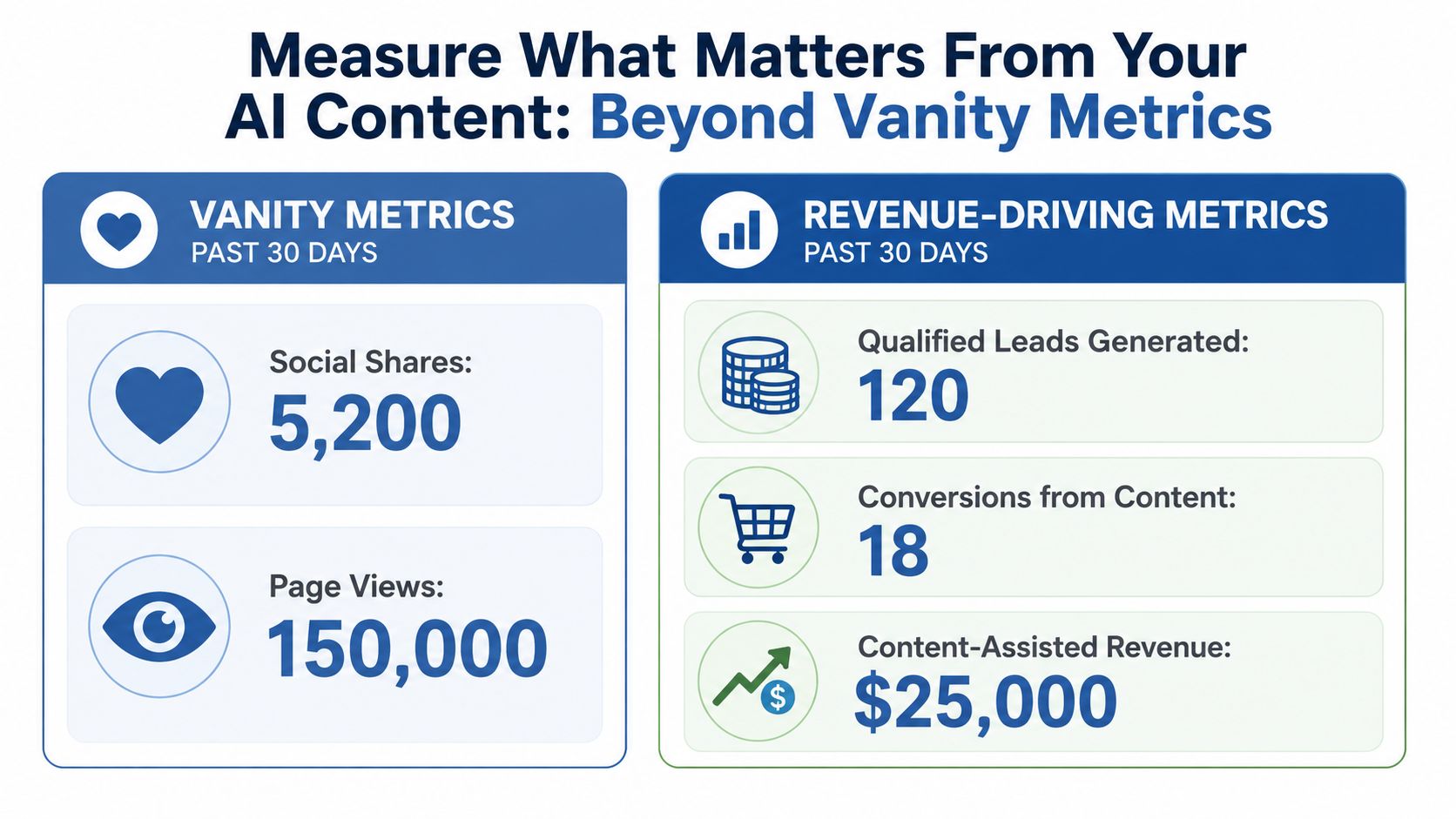
I have nothing against engagement. I object to confusing it with results.
A post that gets comments might be useful. A clip that gets views might be useful. But those signals only matter if they connect to a measurable business path.
A 2025 study found that 74% of marketing teams cannot map repurposed content to revenue impact, while top performers are using AI agents to connect repurposed content to specific CRO metrics such as influence on landing page conversion rates, according to Optimizely's analysis of AI-driven content repurposing ROI. That gap explains why so many teams keep publishing without learning.
Use a revenue lens. Count outputs if you want. Judge the system by influence on qualified demand.
How I Track Revenue Impact
I keep measurement brutally simple at the start. Every original asset gets an internal campaign ID. Every derivative piece inherits that ID with a format tag and channel tag. Then I push those tags into analytics, CRM notes, and reporting.
The minimum framework looks like this:
Track the source asset.
Know which webinar, article, or interview created the derivative content.Track the derivative.
Label format, platform, audience segment, and intent.Track the click path.
Use clean UTM structures and keep naming conventions stable.Track the conversion event.
Demo request, trial start, booked call, qualified lead, or influenced opportunity.Track post-click quality.
Look past who clicked to who moved.
If you're serious about search visibility as part of this engine, this resource on an AI agent for SEO research is useful because repurposing works best when it feeds a topic cluster instead of isolated posts.
What I actually review each month
I don't need a bloated dashboard. I need decision-grade visibility.
Here's the review set I care about:
- Source asset yield shows which original assets created the strongest downstream business signals.
- Channel quality shows which formats attracted the right audience, which is often not the largest one.
- Conversion contribution shows which repurposed assets influenced forms, demos, trials, or sales conversations.
- The content-to-CRO feedback loop shows which messaging themes improved page performance or follow-up response.
Then I cut aggressively. If a derivative format doesn't move buyers, I stop producing it. If one webinar keeps feeding demand across channels, I build a bigger system around that asset type.
That's how AI content repurposing becomes a revenue instrument instead of a publishing treadmill.
Where Your Real Edge in the Market Comes From
Your competitors are still using AI like a shortcut. They're generating content faster, but they're not building a stronger commercial system.
That creates an opening for you. If you audit the right assets, engineer context properly, enforce human quality control, and connect outputs to revenue, you move faster and become harder to ignore across the channels that shape buying decisions.
What Competitors Still Get Wrong
They think the win is quantity. It isn't.
They repurpose without checking whether the source asset deserves amplification. They publish AI-shaped copy that platforms and buyers both treat as disposable. They measure likes, impressions, and output count, then wonder why pipeline stays flat.
You can beat that kind of competitor because your system learns. Their system just produces.
The Operating Model I'd Bet On
I'd bet on the business that treats repurposing like strategic infrastructure.
That business has one strong source asset, turns it into channel-native derivatives, edits for human authenticity, distributes with intent, and measures impact against conversion behavior. Then it doubles down on what works and kills what doesn't. Fast.
One tactical detail that helps more than people expect is input cleanliness. If your source material is messy, AI will preserve the mess. Converting docs, transcripts, and notes into cleaner structured text before generation can improve output quality. A practical reference on that is convert content for better AI results.
The main advantage is that AI lets you operationalize your best thinking across more touchpoints, with more speed, and with tighter feedback loops than your competitors can manage manually.
That's how you stop “doing content” and start winning attention that turns into sales.