
Most advice on how to automate content creation is backwards. It starts with a list of AI writers, as if buying the tool were the strategy.
Your competitors can buy the same tool this afternoon. Then they'll publish the same flattened, generic content tomorrow. That gives nobody an advantage. It is a faster way to disappear into a larger pile of mediocre output.
I'm Samuel Woods, and I've been working with ML since 2016 and Generative AI since 2019. My view is simple. If you want real ROI, you don't automate content to write more. You automate content to build a governed intelligence system that spots opportunities, turns them into assets, and scales output without losing editorial control.
The market has already moved. BrowserCat reports that 47% of marketers use AI tools for content creation, and the global AI content creation market was valued at $2.2 billion in 2023 with a projection of $7.9 billion by 2033 (BrowserCat). If you're still treating this like a side experiment, you're late.
The good news is that widespread implementation remains poor. That leaves room for you to win.
Table of Contents
- Stop Chasing AI Tools and Start Building an Engine
- Define Your Goals and Content Engine
- Design the Automation Pipeline Step by Step
- Build Your Prompts and Agentic Workflows
- Implement Governance for Quality at Scale
- Integrate with Your Stack and Measure ROI
Stop Chasing AI Tools and Start Building an Engine
Owners burn time and budget when they start with the tool shortlist.
The first question is rarely “Which AI writer should we buy?” The first question is, “What content system will produce dependable commercial output, with controls strong enough to protect the brand?” Start in the wrong place and you get a pile of drafts, three overlapping subscriptions, a lot of frustrated editing, and no reliable path from idea to pipeline.
An engine fixes that problem. It has defined inputs, decision rules, production stages, approval gates, outputs, and feedback loops. It works even when you swap models, replace prompts, or lose the one contractor who became the unofficial AI operator.
The competitive mistake
A lot of small B2B businesses follow the same script. They buy ChatGPT, Claude, Jasper, or another writing tool. Volume goes up for a month. Then the cracks show. Content starts sounding generic, nobody uses it in sales conversations, the claims get shakier, distribution slows, and brand voice drifts.
That setup does not create an advantage. It creates more text.
A practical rule: if your AI setup can generate content but cannot enforce standards, route approvals, and capture learning, you do not have a content engine. You have a content slot machine.
If you want a useful overview of AI tools for marketers to scale content, review the category overview. Then make one decision quickly. Tool research is not a strategy.
What an engine actually gives you
A useful system does three jobs your competitors often leave to chance:
It turns market signals into content decisions. Sales calls, customer support tickets, competitor gaps, search behavior, and product updates become structured inputs for content production.
It standardizes execution. Briefs, prompts, voice rules, review criteria, SEO checks, and approval logic stop living in scattered docs and in people's heads.
It compounds learning. Performance data, win-loss feedback, and editorial corrections feed the next cycle, so output quality improves over time.
That last point matters more than speed.
AI-assisted content is mainstream now. Your edge comes from control. The businesses that win build systems that capture better inputs, enforce better judgment, and produce assets the rest of the business will actually use. Publishing the most words doesn't decide it.
This also changes how you approach ideation. Random prompt sessions produce random outcomes. A governed idea intake process produces a stronger backlog. If you need a starting point for that layer, study this framework for an AI content idea generator and adapt it to your own source signals, approval rules, and business priorities.
My recommendation is simple. Stop shopping for a magic app. Build a content operating system that can absorb new tools without losing quality, governance, or strategic direction. That is how you outlearn competitors, protect trust, and turn AI into a repeatable growth asset.
Define Your Goals and Content Engine
Before you touch prompts, define what the machine is supposed to do for the business. If you skip that step, you'll generate a lot of activity and very little benefit.

I've seen businesses automate blog production when the actual bottleneck was weak sales material. I've seen founders obsess over LinkedIn posts when the real prize was product-led SEO. The system only works when the content type matches the commercial objective.
Start with the business target
Pick one primary outcome. Not five.
If you're a SaaS company, that might be pipeline support through bottom-of-funnel content. If you're an ecommerce brand, it might be category page expansion and product education. If you're building a founder brand, it might be sustained top-of-funnel authority.
Here's the simple planning frame I use:
| Business goal | Content engine focus | Human owner |
|---|---|---|
| Organic acquisition | Search-led articles, landing pages, supporting snippets | SEO lead or content strategist |
| Product launch | Messaging pages, email sequences, comparison content | Product marketing |
| Sales acceleration | Objection-handling assets, use-case pages, case story drafts | Revenue marketing |
| Founder visibility | Thought-leadership posts, video scripts, repurposed snippets | Founder plus editor |
The mistake is mixing these into one blob. A search engine is different from a launch engine. A repurposing engine is different from a sales content engine. Different inputs. Different QA. Different success standards.
Map assets to operating metrics
I don't mean vanity metrics. I mean the operational signals that tell you whether the content engine is doing useful work.
For example:
- For search-led content, track which briefs turn into publishable drafts, which topics get approved fastest, and which themes keep proving useful in sales or product work.
- For sales support content, track whether you actually use the asset in sales conversations, whether objections get answered clearly, and whether the draft needs heavy rewriting before you sign off.
- For brand content, track consistency of voice, approval speed, and whether repurposed formats still sound like the founder rather than a language model.
Bad content automation usually fails before publishing. The brief is vague, the goal is fuzzy, and nobody can define what “good” looks like.
This is also where your idea intake needs structure. Don't let random prompts drive your editorial calendar. Build a repeatable intake form for topics, audience, target action, claims to avoid, approved sources, and brand constraints. If you want a practical starting point, my AI content idea generator is one way to structure raw ideas into more usable inputs.
Use a short decision filter before any topic enters the system:
Why this topic now. Tie it to demand, objections, product motion, or a strategic narrative.
Who needs it. Name the audience segment clearly. One asset. One primary reader.
What should happen next. Decide the intended action. Read another page, book a demo, join a list, share the piece, or support a sales conversation.
What must stay human. Founder point of view, regulated claims, legal review, pricing language, original examples.
If you can't fill those in, don't automate that piece yet. You're not ready.
Design the Automation Pipeline Step by Step
A good content engine is modular. One stage gathers inputs. Another shapes them. Another drafts. Another checks quality. Another distributes. Another feeds results back into planning.
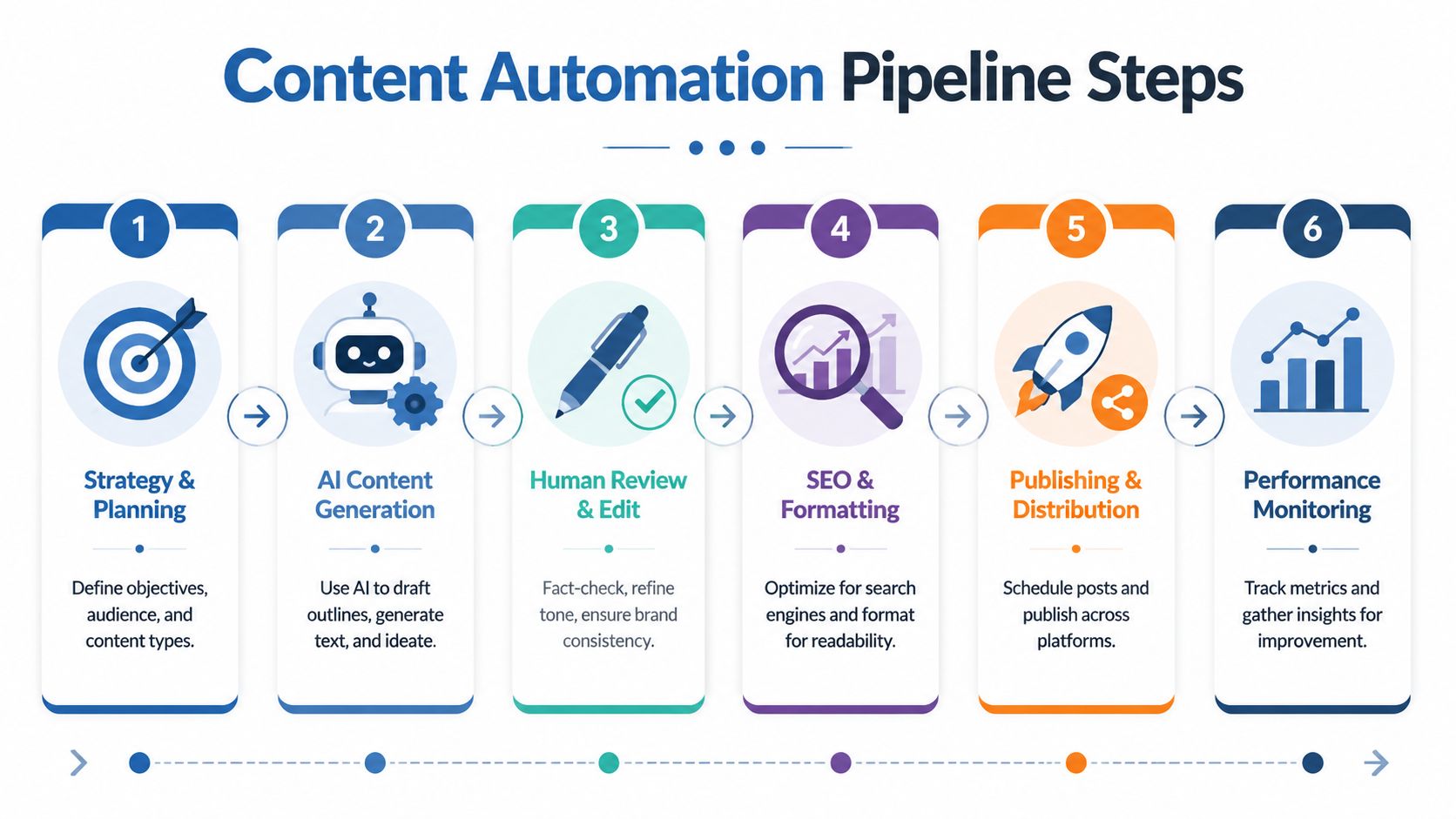
That structure matters because content automation breaks when one giant prompt tries to do everything. Research, writing, optimization, formatting, and judgment are not one task. They're separate jobs.
Progress recommends a phased workflow architecture where automation starts with repetitive tasks that require lower judgment, while human review stays in place for fact verification and brand voice alignment (Progress). That's the right model.
Build the line in phases
Start with the simplest repeatable sequence.
Audit the current workflow. Write down every step from idea to publication. Include who does it, where delays happen, and where quality usually slips.
Pilot on high-volume, rule-based work. Don't begin with your brand manifesto or investor letter. Begin with content that follows a repeatable pattern like FAQ expansions, article briefs, draft outlines, metadata suggestions, or repurposing.
Automate ideation and research intake. Pull in customer questions, competitor themes, internal notes, and search topics. Then convert that into structured topic candidates.
Generate the brief. Many people cut corners on this step. Don't. The brief should define audience, angle, desired action, source constraints, internal links, claims to avoid, and voice requirements.
A lot of operators building workflows in tools like n8n use modular handoffs for exactly this reason. If you want a concrete implementation pattern, this n8n Claude Flux automation tutorial is useful because it shows how orchestration beats one-shot prompting.
Here's the core pipeline I recommend:
| Stage | Machine does | Human does |
|---|---|---|
| Topic intake | Organizes ideas and inputs | Chooses strategic priorities |
| Research pack | Gathers relevant material and source candidates | Validates credibility and business relevance |
| Brief creation | Produces structured outline and content spec | Approves angle and message |
| First draft | Writes the initial article or asset | Adds expertise and removes generic filler |
| Optimization | Formats headings, metadata, repurposed variants | Checks readability and brand fit |
| Scheduling and tracking | Routes approved content to CMS and dashboards | Reviews outcomes and adjusts strategy |
Where the machine ends and people step in
Video is useful here because you need to think in workflow terms as well as prompt terms.
The biggest design mistake I see is removing humans from the wrong stages. People try to automate the parts that require taste, judgment, or domain expertise, then keep humans stuck doing formatting and cleanup. That's upside down.
Humans should own:
- Angle selection when positioning matters
- Fact verification when claims can create risk
- Brand nuance when tone affects trust
- Commercial judgment when a piece needs to support pipeline as well as attract clicks
Machines should handle:
- Research synthesis from approved inputs
- Outline generation with consistent structure
- First-pass drafting against a tight brief
- Repurposing into multiple formats
- Routine routing into docs, CMS queues, and review steps
Don't automate around your experts. Automate around the friction that keeps your experts from doing their best work.
This is where owners quickly gain efficiency. You don't need to rebuild your whole content operation. You need an assembly line that removes low-value drag and preserves high-value judgment.
Build Your Prompts and Agentic Workflows
Prompts decide whether your content engine produces assets or cleanup work.
A weak prompt gives you plausible text that still needs a human to rescue it. A strong prompt gives you a controlled output that fits a workflow, respects your source rules, and exposes uncertainty before it reaches publication. That difference is where ROI shows up. Faster drafting matters less than getting repeatable quality from the same system every time.
Treat prompts as production documents. They should define scope, inputs, constraints, and what happens if the model lacks evidence. If you write prompts like casual chat messages, your results will stay inconsistent.
Write prompts like operating instructions
Every production prompt should cover four things clearly:
Role. Assign one job. Research analyst, brief writer, SEO editor, founder ghostwriter, product marketer.
Context. Supply the essential material. Audience, offer, approved sources, positioning, voice rules, examples, exclusions, formatting requirements.
Task and success criteria. State the business outcome and the editorial standard. Tell the model what the asset must accomplish, what claims need support, what topics are out of bounds, and what quality checks it must pass.
Output format. Specify the handoff format. Markdown, table, JSON, CMS fields, headline options, metadata, review notes.
Here's a stripped-down template I use:
You are a content strategist for [company type].
Audience is [specific segment].
Goal is [business outcome].
Use only the supplied source material and notes.
Write in [voice traits]. Avoid [forbidden patterns].
Output in [format].
Before drafting, list the claims that require human verification.
Keep that final instruction. It changes model behavior in a useful way. Instead of hiding uncertainty inside polished prose, the system surfaces the risky claims first.
If you want a broader look at how AI helps content organizations, focus on operating design, review logic, and content controls. Draft speed is the least interesting part.
Build agentic workflows around specialized roles
One giant prompt is usually a management failure disguised as automation. It mixes research, strategy, writing, editing, and QA into one request, then leaves you to sort out the mess.
Split the work into agents with narrow responsibilities and clean handoffs:
- The research agent compiles approved source material and produces a fact sheet
- The brief agent proposes angles, identifies the target intent, and creates the content spec
- The drafting agent writes against the brief and stays inside source boundaries
- The editorial agent improves argument quality, structure, and tone
- The QA agent checks for unsupported claims, policy issues, and formatting errors
That structure gives you control. It also gives you traceability. If a draft misses the mark, you can see whether the failure came from weak inputs, a bad brief, or poor editorial instructions.
If you want examples of role-based orchestration, my guide on AI agents for content creation covers the agentic pattern in more detail.
Prompt rules that actually hold up in production
I recommend a few hard rules.
Give each agent one job. Research agents should not also optimize for SEO and rewrite for voice.
Pass structured outputs between stages. Use briefs, checklists, fielded notes, and JSON where useful. Clean inputs improve downstream quality.
State prohibitions explicitly. Ban unsupported claims, invented customer examples, unapproved competitor comparisons, and any source outside the approved set.
Store reusable context outside the prompt. Keep voice guidance, product language, proof points, and approved references in a central source so every workflow uses the same foundation.
Require visible uncertainty. The model should flag low-confidence claims, missing evidence, and sections that need human review.
The quality gap between average AI content and reliable AI content usually comes from instruction design rather than model selection. Most people buy another tool when they should fix the workflow.
Agentic complexity only pays off when the underlying process is stable. If you still can't settle on voice, approval standards, or what a good article looks like, fix that first. More agents will only produce more inconsistency, faster.
Implement Governance for Quality at Scale
This is the part often skipped because it feels slower. In practice it costs little time, and it keeps the system from turning into a liability.
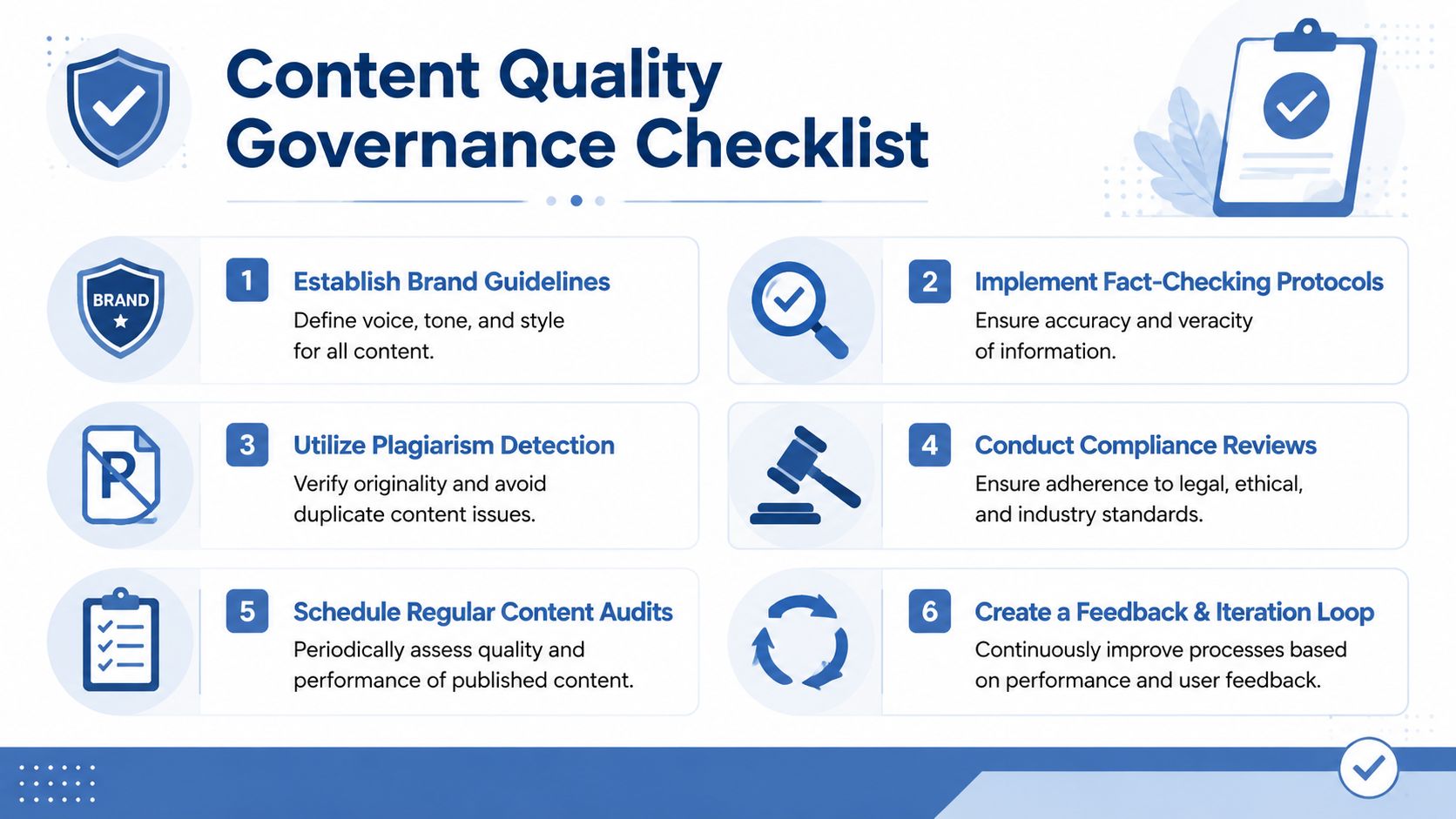
Trysight makes the key point clearly. The underserved opportunity in content automation is governance, and the conversation is moving from “generate more” to “control the system” (Trysight). I agree completely. The highest-return setup is a governed pipeline rather than full autopilot.
Governance is where the moat gets built
Anyone can generate volume. Very few businesses can generate volume without creating brand drift, factual sloppiness, or compliance headaches.
That's why governance becomes a competitive advantage. Your competitors will scale output and also scale inconsistency. Their articles will contradict each other. Their pages will slip off-message. Their social posts will sound like different companies wrote them.
You can use the same underlying models and still outperform them because your system is tighter.
Here's the control logic I want in place:
| Governance layer | What it controls |
|---|---|
| Source of truth | Product facts, positioning, approved claims, brand language |
| Prompt constraints | What each agent may use, say, and format |
| Automated QA | SEO checks, formatting checks, missing fields, risk flags |
| Human approvals | Sign-off for high-stakes claims, regulated content, brand-sensitive pieces |
Your minimum viable control layer
You don't need enterprise bureaucracy. You need a small set of hard rules.
Build a centralized knowledge base. Approved product descriptions, customer segments, competitor framing rules, founder viewpoints, legal guardrails, and source policies should live in one place.
Define approval gates by risk level. A social repurpose draft doesn't need the same review path as a product comparison page or a healthcare article.
Automate mechanical QA. Check headings, links, metadata, formatting, and basic SEO readiness before a human sees the piece.
Require claim reviews. Any factual statement, benchmark, or strategic claim that matters should be surfaced for human verification.
Create a rejection reason library. When you reject content, label why it failed. Off-brand, unsupported claim, weak angle, duplicated idea, thin insight, wrong audience.
Good governance doesn't slow output. It stops you from wasting time editing the same avoidable problems over and over.
I also recommend agent-specific roles with explicit boundaries. Research shouldn't be publishing. Drafting shouldn't be inventing facts. Optimization shouldn't rewrite core positioning. Separation reduces error spread.
When humans are essential:
Original thought. AI can synthesize. It cannot replace your business's lived experience, product intuition, or founder perspective.
Sensitive claims. Anything legal, medical, financial, reputational, or highly competitive needs human review.
Narrative judgment. The strongest pieces often break formula because you know when to lean into a sharper point of view.
That's the answer to how to automate content creation without losing control. You don't trust the model. You trust the system you built around it.
Integrate with Your Stack and Measure ROI
If your content automation lives in docs, chat threads, and manual copy-paste, you do not have an engine. You have scattered labor with AI layered on top.
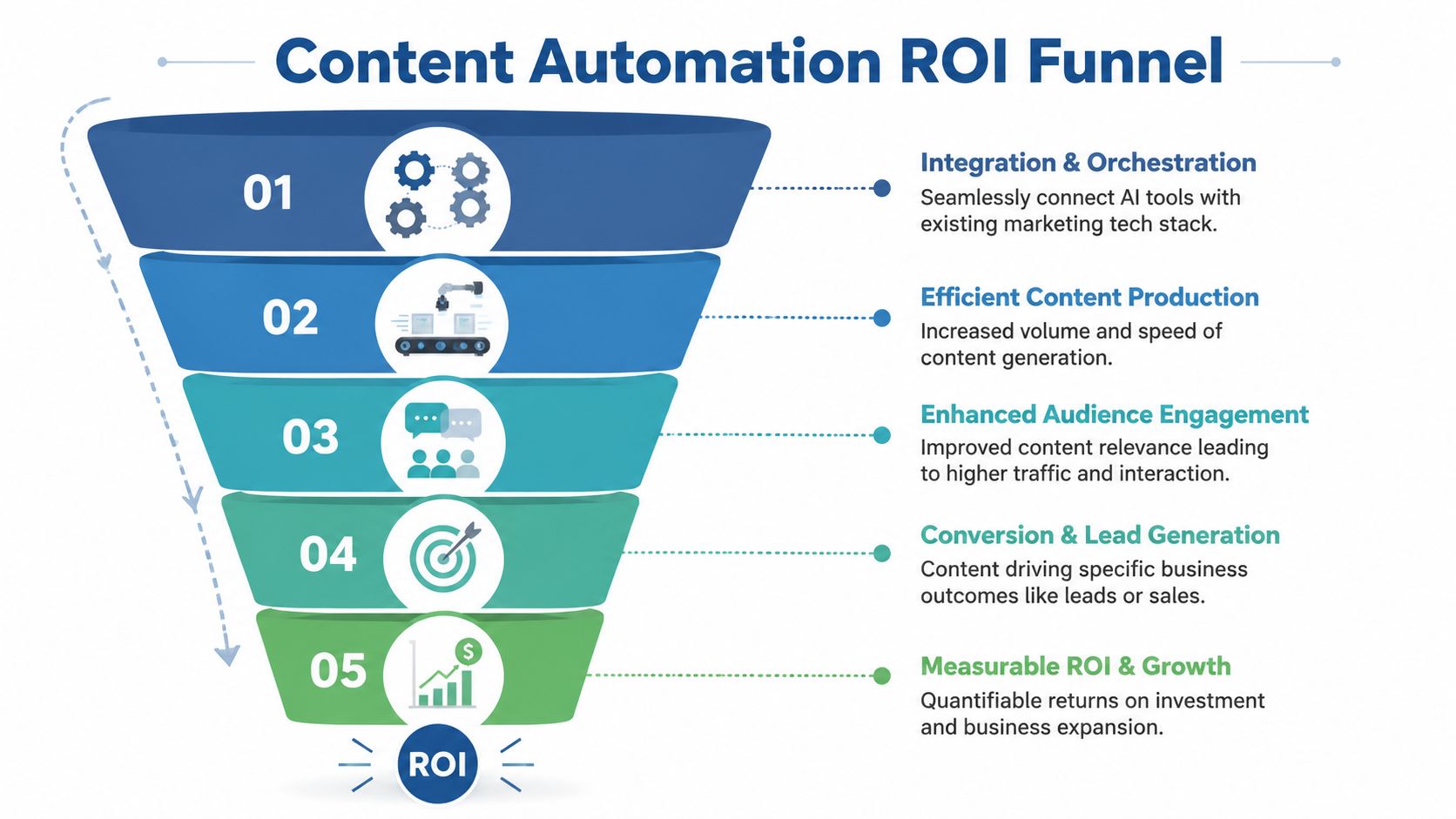
The win comes from system behavior. Approved assets should move into your CMS, distribution tools, analytics, and reporting without human routing. That usually means Zapier, Make, n8n, direct API connections, or a mix of all four. The stack matters less than the discipline of the workflow.
Connect approval to publishing
Build the process around decision points. A human approves, rejects, or requests revision. The system handles the next step.
A practical flow looks like this:
- A draft approved in your review tool routes content to WordPress, Webflow, Ghost, or your CMS.
- Completed metadata opens scheduling in the editorial calendar.
- A new published URL creates downstream tasks for email, social, sales material, and repurposing.
- Collected performance data updates topic scoring, refresh priorities, and content briefs for the next cycle.
If you are sorting through platform choices, my guide to AI tools for content creation breaks down where writing tools, orchestration layers, and review systems fit.
Keep one rule in place. No one should be copying AI output across five systems by hand. Every manual handoff adds delay, breaks auditability, and creates version control problems you will waste hours cleaning up later.
Measure business output, not content volume
Publishing more content is a weak metric. Your bank balance does not care. What matters is whether the system improves market response, supports pipeline, and compounds what you know about buyers, competitors, and positioning.
Measure the operating gains that matter:
- Speed to market on priority topics. Can you publish useful responses while the opportunity still matters?
- Sales contribution. Are you using the content in sales, sharing it, and seeing fewer objections stall deals?
- Editorial effort per piece. Is human time going toward judgment and expertise instead of cleanup?
- Content reuse. Does one approved asset produce multiple channel-ready outputs without quality drop?
- Strategic signal quality. Is performance data feeding better briefs, sharper angles, and smarter topic selection?
Run a pilot before you scale. Pick one content lane with clear commercial value, such as comparison pages, thought leadership tied to a product line, or sales support content for a target segment. Set rules, owners, and success criteria up front. Then compare the automated system against your current workflow on output quality, edit load, cycle time, and business contribution.
Here is the scorecard I use in pilot reviews:
| Measure | Why it matters |
|---|---|
| Draft acceptance quality | Shows whether briefs, prompts, and workflow logic are producing usable first versions |
| Human edit burden | Shows whether automation is reducing work or just shifting it downstream |
| Time to publish | Measures process efficiency across review, approval, and production |
| Reuse across formats | Shows whether the system creates more value from each approved asset |
| Strategic fit | Confirms content supports actual business priorities instead of filling a calendar |
Here, ROI becomes real. A governed content system should lower production friction, improve decision quality, and give you a clearer read on what the market responds to. That intelligence matters more than draft speed.
Businesses that build this well publish faster, and they also improve faster because every asset, approval, rejection, and performance signal feeds the next cycle. That is the competitive edge: control, quality, and learning at scale.