
Most advice on ai agents for content creation is backwards.
Your competitors are treating AI like a faster intern. They want more posts, more emails, more social updates, more noise. That strategy gives them exactly what they deserve. A larger pile of average content that sounds like everyone else using the same models.
I take the opposite view. If you run the business, put your money and time into a system that thinks with your business, spots opportunities early, and turns those opportunities into revenue-producing content before slower competitors react. Content volume comes second.
I've worked with ML since 2016 and Generative AI since 2019. The pattern is consistent. The businesses that win build better systems. Better prompts are a small part of it. They combine research, reasoning, memory, brand context, and execution into one operating layer.
That's what this article is about: a practical way to use ai agents for content creation without turning your business into another generic content mill.
Your Competitors Are Using AI Wrong
The market has already moved.
As of 2025, 87% of marketers are already using AI tools, and 86% report saving at least one hour daily, according to Sequencr's 2025 generative AI statistics. So the old question, "Should we use AI?" is dead. Your competitors already are.
The problem is that most of them are using it badly.
They're using ChatGPT or Claude as a one-shot writer. They paste in a topic, ask for an article, make a few edits, and publish. That gives them speed, but it doesn't give them an edge. It gives them efficiency without strategy.
Volume is easy. Advantage is harder.
If you use AI only to crank out drafts, you're renting temporary productivity instead of building a moat.
A real competitive advantage comes from using agents to do work your competitors still do manually, inconsistently, or not at all. Things like:
- Monitor competitors. Track launches, messaging shifts, customer complaints, and review patterns.
- Find content gaps. Identify questions the market keeps asking that nobody has answered well.
- Connect insight to action. Turn product signals, buyer objections, and search behavior into campaigns you can use immediately.
A practical rule: if your AI workflow starts with "write me a blog post," you're already too late in the process.
The best use of ai agents for content creation is thinking faster, researching faster and adapting faster.
What I tell business owners
Don't pay for an AI writing tool just because you want help producing drafts.
Build an agentic content system instead, because it can become part of your business's market intelligence layer. It can watch the market, distill patterns, brief you, generate on-brand assets, and support campaigns without waiting for a weekly meeting.
That changes the conversation from cost savings to competitive control.
Your rivals are focused on output. You should focus on precision. Better angles. Better timing. Better positioning. Better reuse of your internal knowledge.
That's where the payoff is.
From Content Mill to Market Intelligence Engine
The term "AI content agent" often conjures the image of a glorified blog generator.
That's the wrong mental model.
I want you to think of an agent as a specialized digital operator. You give it a lane, a set of tools, rules for how to think, and access to context. Then it handles a repeatable slice of work with much less hand-holding than a normal AI tool.
The category is growing fast because companies are starting to see the bigger opportunity. The global AI-powered content creation market is projected to rise from USD 2,563.29 million in 2025 to USD 10,593.0 million by 2033 at a 19.4% CAGR, according to Kodexo Labs' market analysis of AI-powered content creation.

That growth comes from businesses building systems that combine intelligence and execution. Generic listicles won't capture any of it.
The agent team I actually recommend
Don't start with one mega-agent that does everything.
Start with a small team of focused agents. Each one should own a job that is clear, bounded, and valuable. For example:
The research agent
scans review sites, forums, news, internal notes, and competitor pages. It pulls out themes, objections, trends, and language patterns.The strategy agent
takes that research and decides what matters. It identifies content opportunities, ranks them, and maps them to funnel stages or campaigns.The production agent
generates the actual assets: briefs, outlines, landing page copy, email drafts, LinkedIn posts, sales enablement material.The optimization agent
reviews outputs against brand rules, SEO requirements, conversion goals, and historical performance signals.
That stack behaves less like a content machine and more like a business function.
What changes when you build it this way
You stop asking, "What should we post this week?"
Instead, the system starts surfacing things like this:
| Signal | Agent response |
|---|---|
| Competitor changes pricing language | Update positioning pages and sales rebuttal content |
| Customers keep asking the same pre-sale question | Create FAQ content, sales emails, and a landing page section |
| A product feature gets unusual traction | Build a campaign around that use case before competitors notice |
This is why I call it a market intelligence engine.
The content is the output. The advantage comes from the sensing and reasoning that happen before the first word is written.
What to prioritize first
If you're deciding where to invest, fund the workflows that tie directly to business advantage.
That usually means:
- Capture customer insight. Turn support tickets, call transcripts, and reviews into usable content direction.
- Build a competitive response system. Detect changes in rival messaging and answer them quickly.
- Set up a repurposing pipeline. Convert one high-value source asset into multiple channel-specific assets.
- Keep sales content current. Give your sales conversations fresh collateral based on current buyer objections.
This is where ai agents for content creation become worth serious attention: when they help your business perceive and respond faster than the market around you.
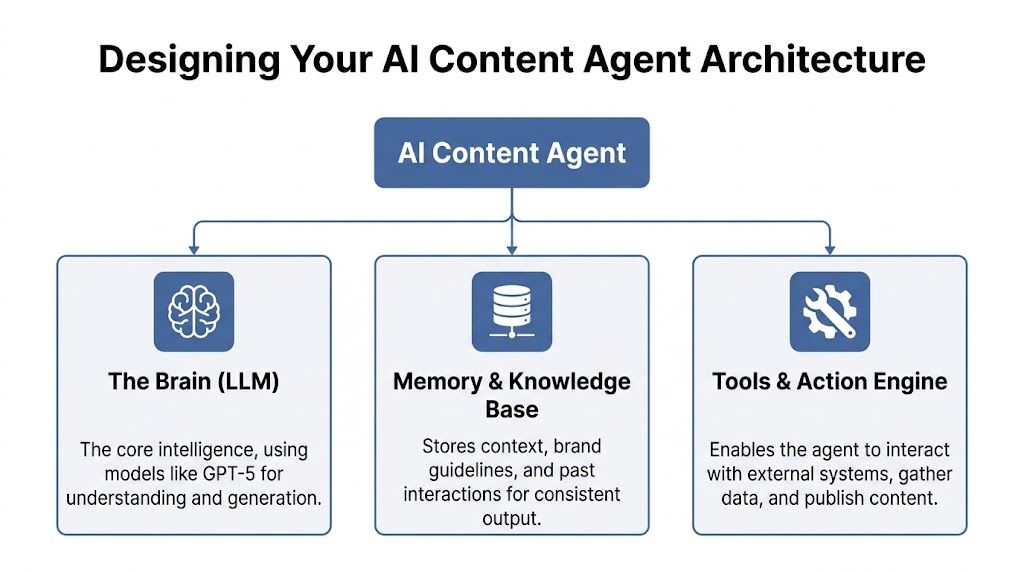
Designing Your AI Content Agent Architecture
Most businesses overcomplicate architecture and underinvest in context.
They obsess over which model to use, then feed that model weak instructions, messy source material, and no real brand memory. That produces fragile systems. The operating design is usually the main problem, more than the model.
According to DataGrid's roundup of AI agent statistics, citing McKinsey, less than 10% of organizations succeed in scaling AI agent initiatives beyond the pilot phase. The reason that matters to you is simple. A pilot can look clever in a demo and still fail in live operations.
The three layers that matter
I keep these systems simple on paper. There are three layers.
The brain
This is the model layer. GPT, Claude, Gemini, or a strong open-source model if you have the right setup.
Model choice matters, but not as much as people think. Use the model that fits the task. A high-end reasoning model for strategic analysis. A cheaper model for formatting, summarizing, or repurposing. Don't burn premium model budget on work a smaller model can do reliably.
Memory and knowledge
This is where many teams get complacent.
Your agent needs access to the right context beyond general internet knowledge. That includes brand guidelines, approved terminology, positioning docs, customer personas, product facts, top-performing content, objection handling, compliance notes, and examples of what "good" looks like in your business.
Without that memory, your agent defaults to average internet language. That's how brand voice dies.
Tools and action layer
Agents become useful when they can act. Search APIs, CMS access, analytics connectors, CRM data, internal docs, workflow automations, and publishing tools all live here.
If you're evaluating platform options, a survey of AI agent frameworks is useful because it helps you compare orchestration approaches before you lock yourself into the wrong stack.
Why prompt design isn't enough
A prompt is not a system.
A real content agent needs structured instructions, retrieval logic, memory management, fallback behavior, review steps, and output constraints. That's why I push people to think in terms of context engineering. Prompt engineering is only one piece of it.
Here's the basic comparison:
| Weak setup | Strong setup |
|---|---|
| One long prompt | Layered system instructions plus retrieval |
| Generic model behavior | Brand-specific decision rules |
| No memory | Persistent brand and product context |
| Single-step generation | Multi-step reasoning and review |
| Manual reuse | Automated workflows and logging |
If you're building from scratch, I've laid out the practical sequence in my guide on how to build AI agents.
The architecture mistake that kills projects
Teams try to build a magical all-in-one agent.
Don't.
Build narrow agents with explicit responsibilities. Then orchestrate handoffs. One agent gathers evidence. Another interprets. Another writes. Another checks compliance and voice. This is cleaner to test, easier to debug, and much safer to scale.
Build for observability first. If you can't see why an agent produced an output, you can't trust it with your brand.
My recommendation
If you run a small business or work solo, begin with one production workflow that already burns hours every week. Competitive briefs. SEO outlines. Email repurposing. Sales collateral updates.
Then design the architecture around reliability, not novelty. The people who win with ai agents for content creation have systems that keep producing good work under real business pressure. Fancy demos don't count.
How to Master Agent Prompts and Maintain Your Brand Voice
Most businesses sabotage themselves at this point.
They finally get an AI system producing at scale, then realize it sounds like a bland imitation of every other business in the category. More output, less identity. That's brand erosion.
The warning sign is already clear. MindStudio's analysis of AI agents for content creators notes that creators report publishing 42% more content with AI agents, but the hard problem is preventing brand voice decay while scaling.

Stop chasing the perfect prompt
One heroic prompt won't save you.
What you need is a system of identity. A structured package your agents can use every time they generate, revise, or adapt content. I usually build that package from five assets:
- Voice rules give clear instructions on tone, sentence style, vocabulary, and what to avoid.
- A message hierarchy sets what your business must emphasize, defend, and repeat.
- A proof library holds approved claims, references, examples, product facts, and customer language.
- Audience context covers personas, objections, desired outcomes, and buying triggers.
- Gold-standard samples are a curated set of your best content, tagged by use case.
That package matters more than clever wording in the prompt itself.
Example one for a SaaS founder-led brand
A founder-led SaaS business often wins because the founder has a clear point of view. Sharp opinions. Strong language. Distinct framing.
If you let a generic content agent handle that brand without constraints, it softens everything. The contrarian edge disappears. The content becomes polite and forgettable.
So I set the agent to do private reasoning first. It reviews the source material, extracts the founder's position, checks it against the brand rules, and only then drafts public copy. The agent is interpreting identity as it writes.
If you're trying to understand the difference between surface-level prompting and real system design, my piece on context engineering vs prompt engineering gets into the operating difference.
If your brand wins on perspective, your agent has to learn your judgment. Phrasing comes second.
Example two for ecommerce product storytelling
An ecommerce brand usually has a different problem. The voice has to stay consistent across product pages, email flows, paid social, and post-purchase content.
I wouldn't use one prompt for all of that. I'd build a small ruleset per channel. Product pages need clarity and objection handling. Email needs cadence and segmentation cues. Social needs compression and punch. Same brand. Different expression.
Here's a simple working table I use:
| Channel | What the agent should optimize for |
|---|---|
| Product page | Clarity, objections, purchase confidence |
| Relevance, timing, continuity with prior behavior | |
| Social | Distinct hook, brand tone, scroll-stopping angle |
Example three for thought leadership
For consultants, small agencies, and solo B2B service businesses, voice is usually the product.
In those cases, I don't let the agent invent from scratch. I give it transcripts, call notes, keynote recordings, Loom videos, or voice memos. Then I ask it to extract claims, arguments, and phrases that already sound like the expert. The agent becomes a distillation engine for the expert's own words.
This is also where a tool like The Bionic Copywriter can fit as one option among broader workflows. It focuses on using GPTs, projects, bots, and AI agents specifically for copywriting, which is useful when you need structure around voice-driven execution.
The operating rules I enforce
I keep brand protection blunt.
Never let the model freestyle on core positioning.
Feed it approved positioning language and force retrieval from that source.Separate ideation from publication.
The agent can brainstorm broadly. Published copy should run through tighter constraints.Create explicit banned patterns.
If your brand doesn't use hype, clichés, soft qualifiers, or certain phrases, encode that.Review outputs by failure type.
Don't just ask, "Is this good?" Ask whether it drifted off-message, weakened the point of view, or invented unsupported claims.
Good ai agents for content creation don't mimic your tone once. They reproduce your decision logic over and over.
That is the moat: distinct content at scale.
Agent Workflows That Directly Drive Revenue
A content system that doesn't affect pipeline, sales velocity, or conversion is a toy.
I care about workflows where the loop is tight. The agent finds a signal, creates an asset, ships that asset into the market, and you measure what happened next. That's where ai agents for content creation move from novelty to an operational advantage.

Workflow one for SaaS competitive response
A good SaaS workflow starts upstream.
One agent monitors competitor pages, changelogs, customer reviews, and category conversations. When it detects a shift in positioning or repeated customer frustration, it sends that signal to a strategy agent. That second agent drafts battlecards, rewrites homepage sections, proposes email messaging, and updates sales rebuttal content.
The content supports active deals instead of floating disconnected from the business.
A strong implementation usually includes:
- It captures signals such as competitor messaging changes, feature launches, or recurring complaints.
- It generates assets such as sales talking points, comparison pages, and objection-handling emails.
- It closes the loop, with sales calls, win-loss notes, and page performance feeding back into the system.
Workflow two for ecommerce conversion pressure
Ecommerce stores have no shortage of content. They usually have a relevance problem.
The right agent workflow looks at products getting attention but not converting. Then it rewrites product descriptions, drafts segmented follow-up emails, creates social variations, and suggests tests around angle and offer framing. The point is to tighten the path from interest to purchase.
Here's the practical decision filter I use:
| If the problem is | The agent should do |
|---|---|
| High traffic, weak conversion | Rewrite product copy and test new messaging angles |
| Repeated pre-purchase questions | Generate FAQs, support snippets, and reassurance blocks |
| Strong product interest, weak follow-up | Create reminder emails and retargeting copy |
Workflow three for expert content repurposing
This is one I use in my own business.
I can take one substantive source asset, like a transcript, workshop recording, or long-form conversation, and have an agent break it into platform-specific assets. Speed helps, but the useful part is preserving strategic coherence across channels so LinkedIn, email, and long-form content all reinforce the same business position.
If you want practical examples of how these systems connect across tools and channels, I recommend reviewing these marketing automation workflow examples.
A quick visual helps if you're mapping these loops into your own stack:
Why most revenue workflows still fail
The failure mode is predictable.
People automate the content generation step and ignore the signal quality, the business objective, and the measurement layer. The agent produces assets, but nobody can say whether those assets changed anything meaningful.
That is why I prefer closed-loop workflows. Every asset should connect to a business question.
Don't ask an agent to create content. Ask it to help move a metric that matters to the business.
For a business owner, that means building systems tied to obvious commercial outcomes. Better sales readiness. Faster response to competitor shifts. More relevant lifecycle messaging. More efficient repurposing from high-value source material.
Those workflows are easier to justify, easier to govern, and much harder for competitors to copy once they're wired into your own data and decision-making.
The Hard Truths of Scaling Your AI Content Operation
Getting one agent to work in a controlled environment is easy.
Running a dependable AI content operation across a real business is not. Here, enthusiasm meets operations, budgets, quality control, and failure logs.
The hard truth is ugly. MindStudio's guide to AI agent success metrics reports that 68% of production agents fail after 10 or fewer steps, and without human-in-the-loop safeguards and rigorous logging, the success rate of complex tasks in enterprise pilots can fall to 24%.
What actually breaks
In my experience, four things usually go wrong first.
- Tool chaos. The agent calls the wrong tool, calls tools in the wrong order, or misreads the result.
- Context drift. It starts with the right brand direction, then gradually slides back into generic language.
- Unbounded loops. It keeps retrying, rephrasing, or over-processing a task while cost climbs.
- False confidence. The output looks polished enough that a busy person publishes it without proper review.
None of these problems are fixed by switching models alone.
The controls you need
I treat agent operations like a production system, not a content toy.
That means:
Log everything.
Store prompts, retrieval context, tool calls, outputs, and review outcomes. If the system fails, you need a trail.Keep humans in the loop where risk is high.
Pricing pages, product claims, regulated content, and founder thought leadership should not publish unchecked.Use model tiers intentionally.
Reserve expensive reasoning models for work that needs them. Use cheaper models for lighter tasks.Define failure thresholds.
Decide when an agent should stop, escalate, or ask for help.
Automation doesn't remove management. It changes what competent management looks like.
What scaling should mean to you
A lot of business owners hear "scale" and think "remove humans."
I think that's the wrong goal.
For most small businesses, the right target is an operation where agents handle the repetitive analysis, drafting, adaptation, and routing work, while humans handle judgment, approval, and strategic exceptions. That setup is faster than doing it all by hand and safer than blind automation.
The reframing that matters
Forget the idea of a robot writer.
What you are building is an internal intelligence layer that helps your business detect, interpret, and act on market information through content. Once you see it that way, the priorities change. Logging matters. Governance matters. Cost control matters. Human review matters.
And those boring operational decisions are exactly what separate a useful system from an expensive mess.
Stop Creating Content, Start Building Intelligence
If you remember one thing, remember this.
AI agents for content creation are a way to build a sharper business. One that notices changes earlier, responds faster, and expresses a clear point of view at scale without flattening its identity.
That requires discipline. You need architecture, context, guardrails, workflows, and review. You need to treat brand voice like an asset worth protecting. And you need to tie every agent you deploy to a business outcome, not a novelty demo.
The standard I use
I don't ask whether an AI content system produces more.
I ask three tougher questions:
- Does it help you see something competitors missed?
- Does it help you act on that insight faster?
- Does it preserve the voice and judgment that make your business hard to copy?
If the answer is no, you don't have an asset. You have software generating words.
If you want to keep learning from operators building in this space, lunabloomai's blog is worth reading because it tracks practical AI implementation ideas rather than empty futurism.
The winners in this market will be the businesses building systems that turn intelligence into action, over and over, while everyone else is still chasing output and publishing the most AI-assisted content.
That's the shift. Stop trying to create more content.
Start building intelligence.