
You're probably already doing this. Someone on your team opens ChatGPT, types “give me 20 blog ideas,” gets a clean list back, and feels productive.
That's not strategy. That's assisted guessing.
I'm Samuel Woods, and I've worked with machine learning since 2016 and generative AI since 2019. I can tell you from experience that an AI content idea generator only becomes valuable when you stop treating it like a novelty tool and start treating it like an intelligence layer inside your growth system.
Most founders don't need more ideas. You need fewer bad ones, better prioritization, and a repeatable way to turn market signals into content that moves pipeline. That's where the advantage is.
The Real Problem AI Content Generators Can Solve
The common perception is that the problem is idea scarcity. It isn't. The problem is that your current ideation process produces too much generic content and not enough content with a clear business purpose.
That gets worse when you use an AI content idea generator like a vending machine. You put in a keyword, it spits out ten headlines, and now your backlog is full of topics your competitors could generate in the same minute. Nothing about that creates an advantage.
The market has already moved. In 2024, 42% of marketing leaders globally were already using generative AI, and among those users, 44% reported that AI helps them generate more creative ideas and spend less time planning, according to Statista data summarized by Rank Math. That matters for one reason. Your competitors are no longer debating whether to use AI. They're already using it to speed up planning.
More output doesn't mean more advantage
If everyone has access to fast ideation, raw volume stops being valuable. The competitive edge shifts to signal extraction.
You need your system to answer questions like these:
- What should we publish next: Not in general, but based on our ICP, sales friction, and current funnel gaps.
- Where are competitors weak: Which angles are underserved, shallow, or missing entirely in our category.
- What deserves production resources: Which ideas can support search intent, sales enablement, or campaign conversion.
Generic ideation is cheap. Targeted ideation tied to business goals is where you separate from competitors.
The right job for AI
I don't use AI ideation tools to “be creative.” I use them to compress research, surface patterns, and force structured thinking at scale.
That changes the role of the tool. Instead of asking for random topics, you build a system that ingests context and generates decision-ready opportunities.
Here's the distinction:
| Approach | What it produces | What happens next |
|---|---|---|
| One-off prompt | Topic lists | Team manually sorts noise |
| Structured ideation system | Prioritized angles with context | Team moves directly into briefs and production |
| Integrated AI workflow | Market-informed content opportunities | Content, SEO, paid, and sales all benefit |
If you want market dominance, don't optimize for idea count. Optimize for relevance, differentiation, and speed to execution.
Build a Prompt Library That Thinks Like a Strategist
A weak prompt gives you weak thinking. That's why many users get bland outputs from powerful models. They're briefing the AI like they'd brief a distracted intern.
I want you to build prompts the way an operator builds systems. Clean inputs. Consistent logic. Reusable structure.
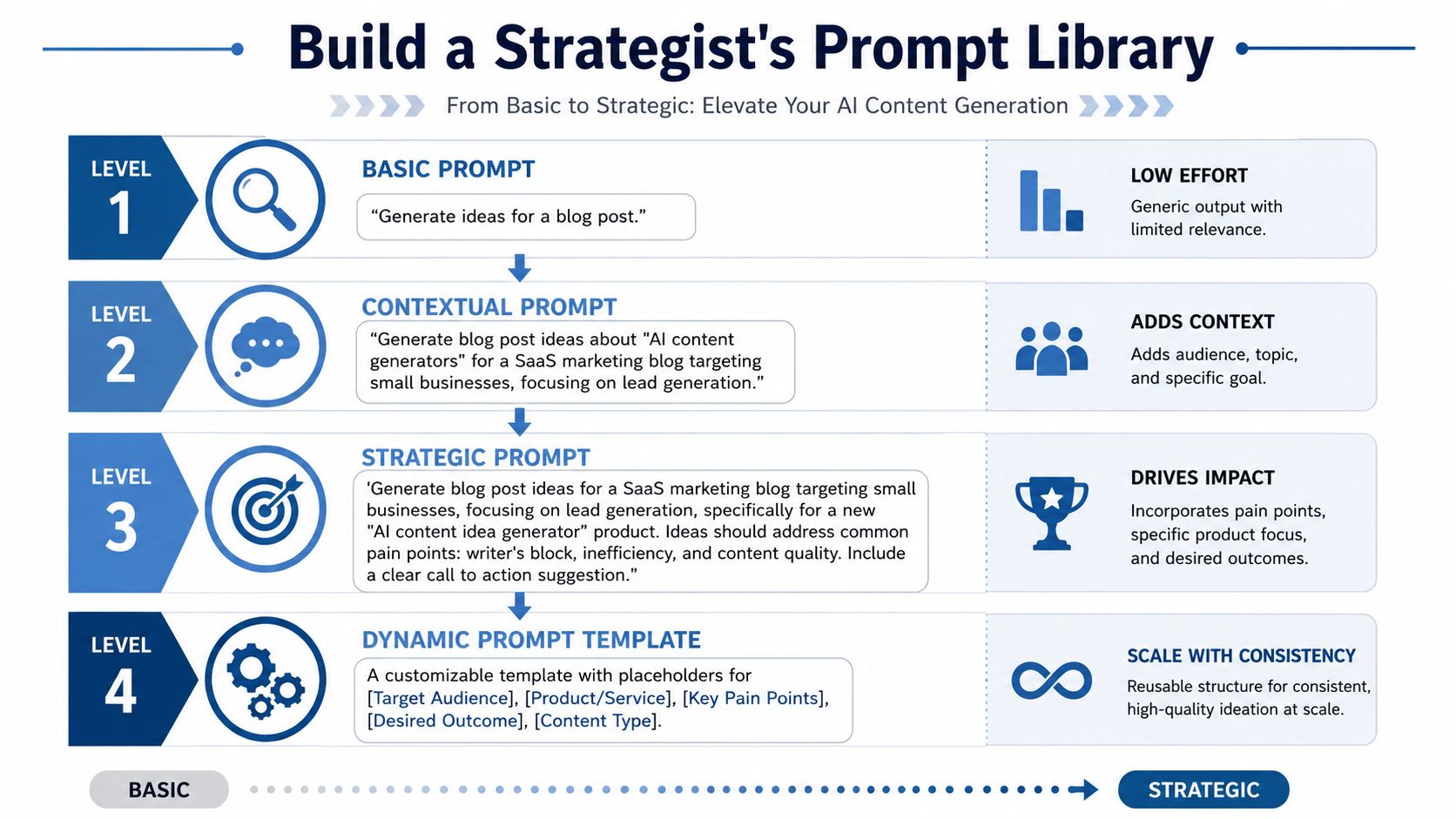
Use structure before creativity
One practical workflow documented by Hootsuite starts with defined inputs such as language, content type, up to five nouns, and a primary keyword before idea generation. That structure improves topical relevance because it narrows the model's search space, as noted in Hootsuite's content ideas generator workflow.
That's the model I recommend. Not because it's elegant. Because it works.
Your prompt library should include these fields:
Audience definition
Include the buyer type, company stage, and buying context. “SaaS founders” is too broad. “Bootstrapped B2B SaaS founders trying to generate pipeline without hiring a full content team” is useful.Content format
Blog post, landing page support article, email angle, LinkedIn post, webinar hook, comparison page. Format changes the idea shape.Primary keyword or theme
This forces search alignment when SEO matters.Business objective
Awareness, pipeline generation, objection handling, activation, retention. If the prompt has no business target, you'll get content theater.Brand and market context
Competitor names, positioning, customer pains, product constraints, tone guardrails.
Build master prompts, not disposable prompts
I keep a library of reusable prompt templates for different strategic jobs. One for SEO cluster ideation. One for founder-led thought leadership. One for sales objection content. One for product-led educational content.
That's how you stop reinventing your process every week.
A simple version looks like this:
- Role and perspective: Ask the model to think like a content strategist, not a generic assistant.
- Context block: Insert ICP, offer, problem set, competitive environment.
- Task block: Specify output type and number of ideas.
- Filter block: Require commercial relevance, non-generic framing, and angle diversity.
- Output structure: Demand a table or labeled sections so your team can scan fast.
Practical rule: If your prompt can be reused by a new hire with minimal explanation, you're building an asset. If it only works when you personally type it from memory, you're still improvising.
For founders serious about organic discovery, I also recommend studying a solid guide for AI search optimization. It helps sharpen how prompts support visibility, not just ideation. If you want a more hands-on framework for operational prompts inside marketing, my reference on AI prompts for marketing shows how to structure them around actual campaigns and workflows.
What to avoid
Here's where teams sabotage themselves:
- Vague prompts: “Give me content ideas for fintech.” You'll get commodity junk.
- No audience context: If the AI doesn't know who the content is for, it defaults to average.
- No rejection criteria: If you don't tell the model what to avoid, it will happily give you repetitive topics.
Think of prompts like precision-cut lumber. If you build with measured parts, your output holds shape. If you build with found branches, don't act surprised when the structure collapses.
Design an Agent to Automate Your Ideation Workflow
You have demand gen targets this quarter, a backlog of half-written briefs, and a team still copying ideas out of chat windows. That setup does not scale. A real advantage comes from turning ideation into a system that accepts a goal, pulls context, generates options, and routes the best ones into review.
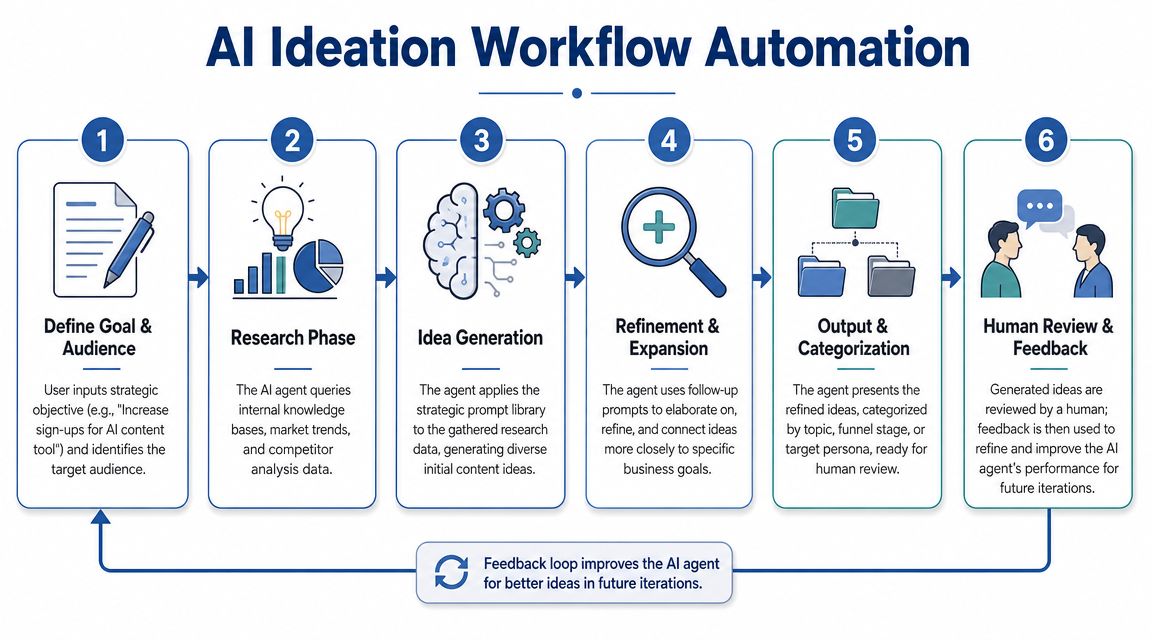
A strong prompt gives you a decent output once. An agent gives you repeatability. That is the difference between using AI and building an asset your competitors cannot copy in a weekend.
What the agent should actually do
I want this agent scoped like an operator, not a novelty demo. Give it one job. Turn raw business goals into review-ready content opportunities with enough structure that your team can act fast.
That means your agent should:
- Accept a business objective: Increase demo requests, support a feature launch, revive a stalled segment, defend a category.
- Pull live context: Sales call notes, CRM objections, search trends, product updates, customer support tickets, and competitor positioning.
- Apply the right prompt path: Use different flows for thought leadership, comparison content, BOFU assets, ad angles, or social variations.
- Score and label outputs: Add persona, funnel stage, content format, urgency, theme, and CTA direction.
- Route ideas to human review: Put the output where an editor, strategist, or founder can approve, reject, or request another pass.
The upgrade is not more ideas. It is better inputs, cleaner routing, and consistent packaging.
To make the workflow concrete, here's a visual walkthrough:
A practical build sequence
Use Zapier, Make, n8n, or your own stack. I do not care which. I care that the system runs the same way every time and gets smarter as you feed it better data.
A simple version looks like this:
| Step | Input | Output |
|---|---|---|
| Goal intake | Business objective and audience | Agent brief |
| Context assembly | Internal docs, voice-of-customer inputs, market signals | Research packet |
| Idea generation | Prompt workflows by channel and funnel stage | Draft idea set |
| Enrichment | Labels, scores, CTA suggestions, content type | Prioritized options |
| Review routing | Content database or PM system | Approved or rejected backlog |
If you want to extend this beyond ideation, study how AI agents for business workflows are structured. The same logic applies here. Clear inputs, controlled tasks, visible outputs, and a human approval layer.
You can also point the agent at downstream creative production. For example, if an idea scores high for paid social, route it into the ShortGenius AI ad generator to turn a strong angle into draft ad assets without another manual handoff.
Human review creates the moat
Founders get this wrong all the time. They chase autonomy when they should be building editorial control.
Your agent should handle the repetitive strategic prep your team keeps postponing. Your people should decide which ideas deserve budget, distribution, and brand association. That combination creates a major efficiency gain without flooding your pipeline with generic noise.
I would never let an ideation agent publish on its own. I would absolutely let it gather signals, propose angles, label opportunities, and tee up decisions for a human who understands revenue, positioning, and risk.
That is how you turn an AI content idea generator into a defensible system instead of a toy.
Integrate Your Generator with Your Growth Stack
An idea sitting in a chat window has no business value. The win happens when your AI content idea generator plugs into the systems that already run marketing, sales, and production.
Most companies remain amateur, using AI as a side tool instead of wiring it into the stack.

Connect ideation to execution
I want ideation outputs to land somewhere operational. Not in Slack. Not in a Google Doc graveyard.
Good destinations include:
- Notion: For editorial queue, briefs, and approval status
- Asana or Trello: For campaign assignment and production tracking
- CRM notes or sales enablement hubs: For objection-handling content tied to deal flow
- Analytics dashboards: For feedback loops on what themes perform
When you wire this correctly, the system can attach metadata to each idea. Persona. funnel stage. target keyword. CTA direction. owner. status.
That means your team can move faster because nobody has to translate raw AI output into something usable.
Build a closed loop
The primary upgrade happens when performance data flows back into ideation.
If your analytics show that comparison content influences conversions, your system should generate more comparison angles. If onboarding emails reveal recurring customer confusion, your system should turn those questions into education content. If your paid ads produce a strong hook, your organic engine should test adjacent topics around the same pain.
That loop creates a self-improving engine.
Here's a practical pattern I like:
- Pull top-performing content themes from your analytics or CMS.
- Feed those themes into your ideation workflow with audience and offer context.
- Generate derivative assets for blog, email, social, and landing page support.
- Push approved ideas into your production tool with a pre-filled brief.
- Review results monthly and retrain the prompt logic.
The companies that win with AI don't just generate faster. They learn faster.
If you're extending ideas into paid creative, a tool like ShortGenius AI ad generator can help turn validated messaging angles into ad variations without rebuilding everything manually. For the plumbing side of this work, I keep a practical list of AI workflow automation tools that are useful when you're stitching together prompts, triggers, and delivery systems.
How to Evaluate and Filter Ideas for Business Impact
It is common to overvalue generation and undervalue rejection. That's backwards.
The true power in an AI content idea generator is not how many ideas it can produce. It's how aggressively you can filter weak ideas before they consume writer time, design time, and distribution budget. That's especially important because, as noted by ContentIdeas.io, its primary worth is in quality control and rejecting ideas that are too generic or disconnected from conversion goals.
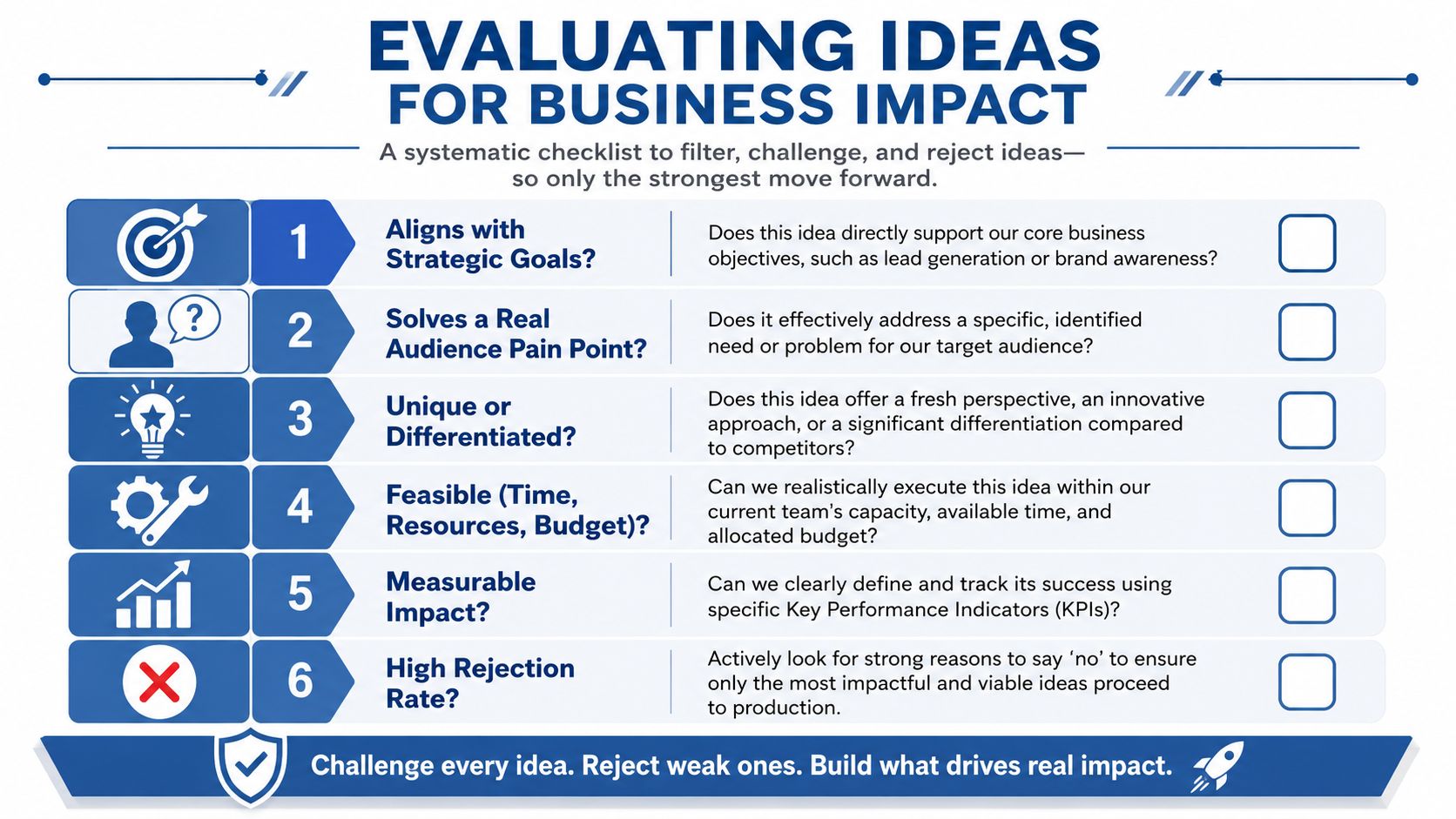
My filtering rubric
When I review AI-generated ideas with a founder or growth team, I'm not asking, “Is this a decent topic?” I'm asking, “Does this deserve resources?”
Use a scoring pass based on these criteria:
| Filter | What I look for | Kill signal |
|---|---|---|
| Strategic alignment | Supports pipeline, retention, launch, or positioning | Interesting but unrelated |
| Audience pain | Tied to a specific problem your buyer already feels | Broad educational fluff |
| Differentiation | Unique angle, sharper framing, or proprietary insight | Easily copied by any competitor |
| Execution feasibility | Team can actually ship it well | Requires assets or expertise you don't have |
| Measurement path | Clear success metric or downstream business use | No obvious way to judge value |
Reject more, publish better
A good system should eliminate a large chunk of what AI proposes. You want a high rejection rate because abundance is easy now.
I'll usually challenge each idea with questions like these:
- Would our exact buyer care about this right now
- Does this map to a commercial intent or sales conversation
- Can we say something materially better than what already exists
- Will this strengthen brand authority or just add to the noise
- Can this become more than one asset after we publish it
If the answer is weak, I cut it.
Judgment test: If your competitor could publish the same piece with minor edits, the idea is not strong enough yet.
What founders get wrong
Founders often approve content because it sounds smart, not because it supports revenue. That creates a polished library of low-impact assets.
I'd rather publish fewer pieces with tighter strategic fit than flood the market with competent irrelevance. AI makes cheap content cheaper. It does not make weak strategy stronger.
One more rule. Every idea should include a reason to exist inside the business. Maybe it drives qualified search traffic. Maybe it handles a sales objection. Maybe it supports a product launch. Maybe it arms paid media with clearer messaging. If you can't name that job, don't greenlight the piece.
Your First Step Toward an AI Content Engine
You walk into Monday's pipeline review. Marketing has a full content calendar. Sales says none of it helps close deals. Product has sharp customer insight, but it never makes it into the brief. Your team does not have a content problem. You have a system problem.
Start small, but build the first piece like infrastructure.
Pick one asset that already proved it can influence the business. Use a page that drove qualified pipeline, supported a launch, or kept coming up in sales calls. Then feed it into your AI workflow and extract the logic behind its performance.
I want your system to answer five questions:
- Who was this really for
- What tension made the topic matter
- How was the argument sequenced
- What business job did the asset perform
- Which parts can be reused across adjacent topics
That output becomes your first master prompt. Not a generic prompt copied from a tool gallery. A prompt built from your company's own evidence.
Keep the first build tight. Founders lose time when they try to automate the whole editorial process before they have a repeatable decision model.
Use this sequence:
- Choose one proven asset
- Extract the reasoning behind why it worked
- Write one reusable ideation prompt from that reasoning
- Generate three closely related ideas
- Have a human editor score them before anything gets produced
That is enough to prove whether your system can generate ideas that deserve budget, attention, and distribution.
The point is not speed by itself. Speed without judgment floods your backlog with polished junk. What matters is building a repeatable loop where AI handles pattern recognition and your team applies commercial judgment. As noted earlier, teams that structure AI this way can compress production time significantly. The gain comes from workflow design, not from letting AI publish unchecked.
This is how you start building competitive memory.
Every prompt you keep, every idea you reject, every scoring rule you refine, and every workflow you connect becomes part of a custom ideation system your competitors do not have. Off the shelf generators can produce topics. They cannot encode your market point of view, your sales language, your product nuance, and your conversion logic unless you build that layer yourself.
For a broader operational view, Wonderment Apps on AI modernization explains how to turn AI from isolated experiments into working business systems. If you want help formalizing that operating layer, Samuel Woods offers consulting on AI workflows, prompt systems, and agent design for marketing teams.
Skip another brainstorm.
Build the system that tells your team what to create, why it matters, and how to turn ideation into a moat.